
Cocoa Butter Alternatives Market Size and Share
Market Overview
| Study Period | 2022 - 2032 |
|---|---|
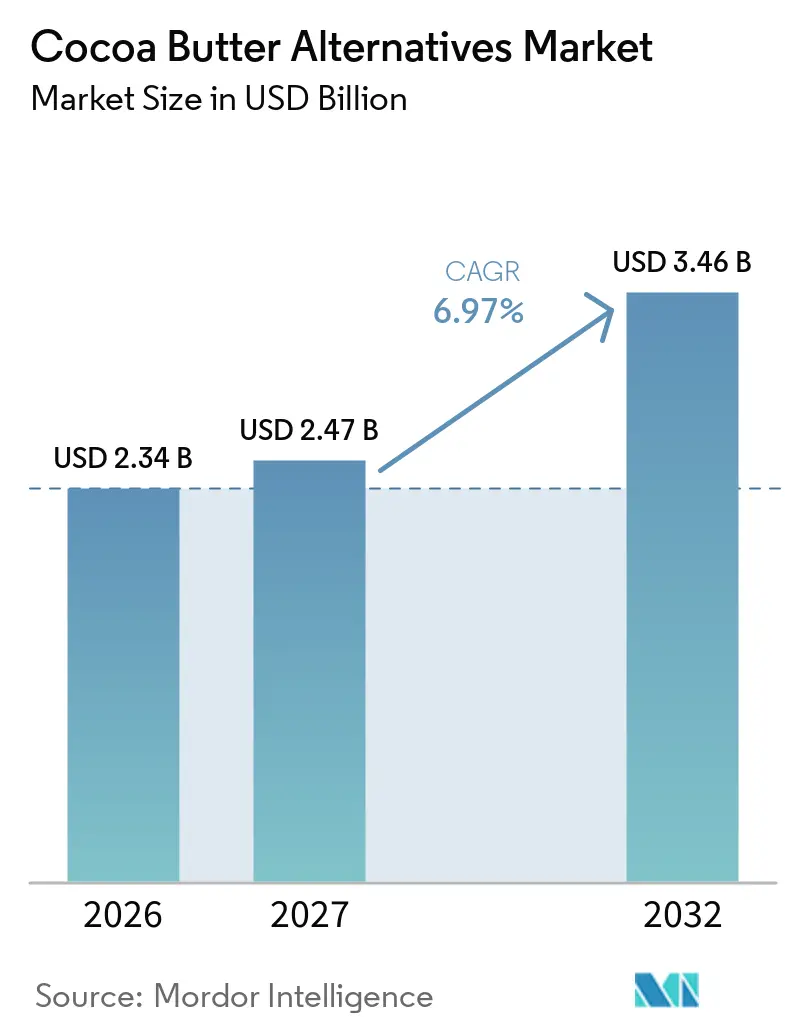
| Market Size (2027) | USD 2.47 Billion |
| Market Size (2032) | USD 3.46 Billion |
| Growth Rate (2027 - 2032) | 6.97 % |
| Fastest Growing Market | Asia-Pacific |
| Largest Market | Europe |
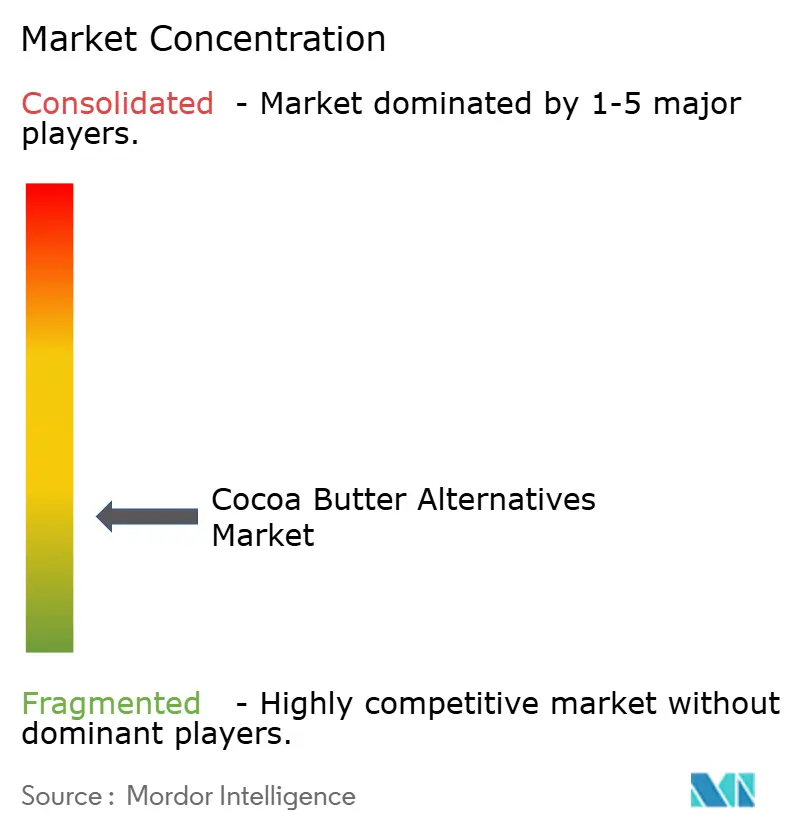
| Market Concentration | Low |
Major Players *Disclaimer: Major Players sorted in no particular order Image © Mordor Intelligence. Reuse requires attribution under CC BY 4.0. | |
Global Cocoa Butter Alternatives Market Trends and Insights
Drivers Impact Analysis*
| Driver | (~) % Impact on CAGR Forecast | Geographic Relevance | Impact Timeline |
|---|---|---|---|
| Increasing Demand for Cost-Effective Fat Alternatives in Chocolate Manufacturing | +1.7% | Global, concentrated in European-Union and North America | Short term (≤ 2 years) |
| Growing Demand for Compound Chocolate and Fat-Based Confectionery Coatings | +1.3% | Global, Asia-Pacific core, spill-over to Middle East and Africa | Medium term (2–4 years) |
| Expanding Applications of Cocoa Butter Alternatives in Confectionery and Bakery Products | +1.0% | Global | Medium term (2–4 years) |
| Expanding Use of Specialty Vegetable Fats in Cosmetics and Personal Care | +0.9% | Europe, North America | Medium term (2–4 years) |
| Advances in Fat Modification and Blending Technologies | +0.8% | Global, research and development centers in European-Union and Asia-Pacific | Long term (≥ 4 years) |
| Growing Focus on Sustainable and Diversified Alternative-Fat Sourcing | +0.7% | European-Union core, spill-over to Southeast Asia and West Africa | Long term (≥ 4 years) |
| Source: Mordor Intelligence | |||
Increasing Demand for Cost-Effective Fat Alternatives in Chocolate Manufacturing
Cocoa costs have encouraged food manufacturers to assess specialty fats that can reduce exposure to cocoa butter pricing. The cocoa butter alternatives market benefits when recipe changes are adopted across existing production lines. Cargill stated that it expanded specialty-fat capacity in Port Klang, Malaysia, to serve chocolate, bakery, dairy, and filling applications. The company identified cocoa butter equivalents and low-trans cocoa butter replacers among the products supported by the expansion[1]. Reformulation can remain in place once manufacturers have completed line validation, supplier approval, and packaging updates. The resulting demand favors fats that offer predictable processing performance while lowering formulation costs.
Growing Demand for Compound Chocolate and Fat-Based Confectionery Coatings
Compound coatings use vegetable fats instead of cocoa butter and can serve bakery, snack, and confectionery products. This route is important to the cocoa butter alternatives market because it allows broader use of cocoa butter substitutes and replacers where a chocolate designation is not required. AAK introduced its Cebes 2900 NH range for compound coatings using palm kernel and palm oils. The company described the range as non-hydrogenated and designed for bloom resistance, quick crystallization, and processing without tempering. These operating characteristics can improve throughput for producers making high-volume coated products. Compound systems also help suppliers address demand for accessible confectionery formats in price-sensitive markets.
Expanding Applications of Cocoa Butter Alternatives in Confectionery and Bakery Products
The cocoa butter alternatives market is extending beyond surface coatings into fillings, icings, biscuits, and cream-based bakery products. These applications may accept a wider range of fat profiles than molded or enrobed chocolate. Research on sal seed oil found that mahua oil-derived cocoa butter equivalents could be used in dark compound chocolate at inclusion levels up to 20% without reported bloom or texture compromise. A separate study described a 2-step enzymatic interesterification process for producing high-purity StOSt, a triacylglycerol that is important for cocoa butter equivalent performance. These findings support continued work on raw materials and structured lipids that can meet specific food processing needs. They also expand the set of formulation options available to bakery and confectionery manufacturers.
Expanding Use of Specialty Vegetable Fats in Cosmetics and Personal Care
Cosmetics and personal care is increasing demand for plant-based emollients made from vegetable oils and butters. The cocoa butter alternatives market is connected to this demand because several specialty-fat feedstocks can serve both food and personal care applications. A 2025 review discussed the skin-care and personal-care applications of cottonseed oil, including its fatty-acid composition and functional use in formulations[2]. Research on Rosaceae oils also described cosmetic applications for oils such as apricot kernel and rosehip. Dual use can tighten competition for certain plant-based feedstocks as food and personal care buyers seek similar materials. This supports supplier efforts to secure specialty-fat volumes and broaden their portfolio across applications.
Restraints Impact Analysis*
| Restraint | (~) % Impact on CAGR Forecast | Geographic Relevance | Impact Timeline |
|---|---|---|---|
| Regulatory Restrictions on Cocoa Butter Alternatives in Chocolate Products | -0.9% | European-Union, United Kingdom, North America | Medium term (2–4 years) |
| Consumer Preference for Authentic Cocoa Butter-based Chocolate | -0.6% | European-Union, North America, premium segments globally | Long term (≥ 4 years) |
| Functional Compatibility Challenges Between Cocoa Butter and Certain Alternative Fats | -0.4% | Global | Medium term (2–4 years) |
| Price Volatility and Supply Uncertainty in Alternative-Fat Raw Materials | -0.6% | Asia-Pacific, Global | Short term (≤ 2 years) |
| Source: Mordor Intelligence | |||
Functional Compatibility Challenges Between Cocoa Butter and Certain Alternative Fats
Not all alternative fats can reproduce cocoa butter's melting behavior, gloss, snap, and crystallization profile. This limits their use in applications that require close sensory and functional similarity to conventional chocolate. The cocoa butter alternatives market must therefore match product selection with the processing and performance requirements of each application. The systematic review of chocolate couverture formulations found that cocoa butter alternatives create challenges related to crystallization and sensory characteristics. Cocoa butter equivalents are more suitable where greater compatibility is needed. Cocoa butter substitutes and replacers are more often used where compound coatings, fillings, or other formats allow more formulation flexibility.
Price Volatility and Supply Uncertainty in Alternative-Fat Raw Materials
Alternative-fat raw materials can experience price and supply changes that affect the cost advantage over cocoa butter. Palm fractions, shea, and other inputs depend on agricultural production, processing capacity, and regional supply chains. The cocoa butter alternatives market can be affected when these inputs become less available or more expensive. Companies with integrated fractionation capacity can better coordinate supply with demand for specialty fats. Cargill's Port Klang expansion adds production capacity for cocoa butter equivalents, low-trans cocoa butter replacers, and fats for several food applications. Greater processing capacity can support product availability, although it does not remove raw-material uncertainty.
*Our forecasts treat driver/restraint impacts as directional, not additive. The impact forecasts reflect baseline growth, mix effects, and variable interactions.
Segment Analysis
By Product Type: Equivalents Support Chocolate Compatibility and Substitutes Lead Growth
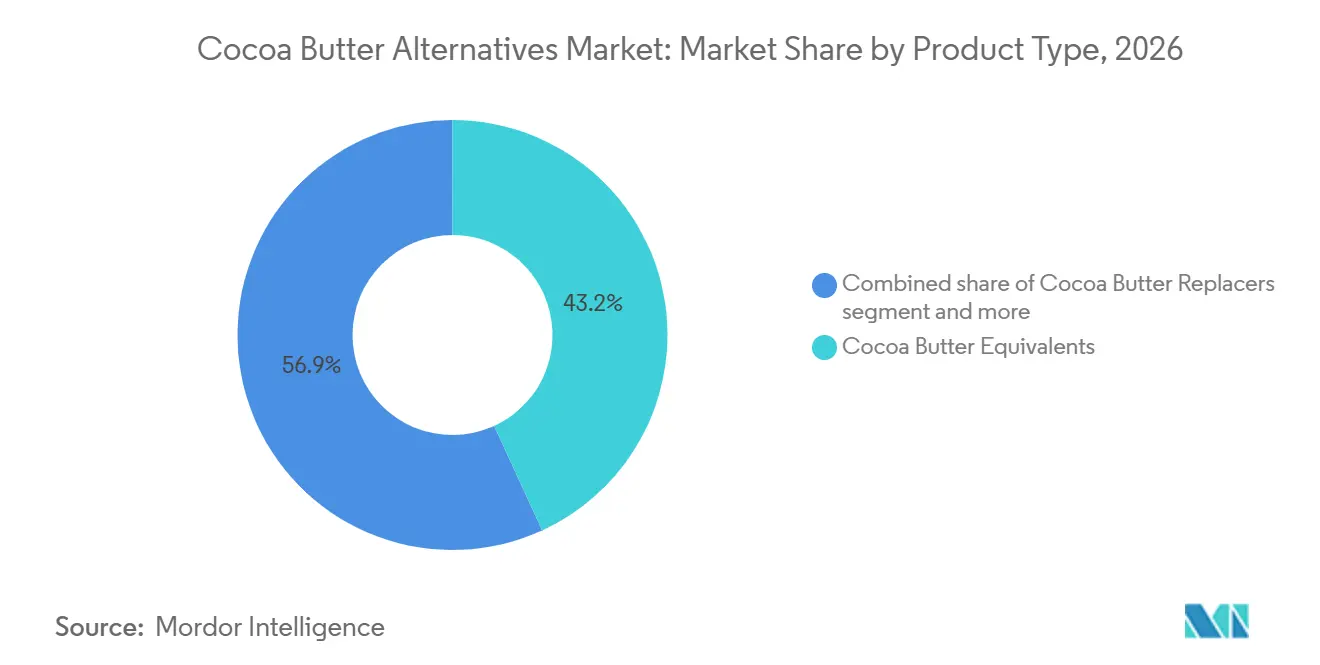
Cocoa butter equivalents held 43.15% of the cocoa butter alternatives market share in 2026. Their position reflects their compatibility with cocoa butter's triacylglycerol profile and crystallization behavior. Cocoa butter equivalents can be made from shea, illipe, mango kernel, sal fat, and palm mid-fractions. This compatibility supports products that need a fat system closer to cocoa butter. Standards addressing cocoa butter equivalents remain relevant to product development and quality control. The cocoa butter alternatives market continues to use these products where formulation performance and chocolate-related requirements are especially important.
Cocoa butter substitutes are forecast to grow at a 7.81% CAGR through 2032. Their advantage comes from use in compound systems that do not require tempering. Cocoa butter replacers occupy a middle position because they provide partial compatibility and flexibility for selected recipes. Non-hydrogenated products are becoming more important as manufacturers seek acceptable labels and functional performance. AAK's Cebes 2900 NH was introduced as a non-hydrogenated compound coating fat with quick crystallization and bloom resistance. The product category therefore combines cost management with processing efficiency in compound chocolate applications.

By Application: Food and Beverages Lead While Cosmetics and Personal Care Accelerates
Food and beverages accounted for 69.31% of the cocoa butter alternatives market size in 2026. Confectionery remains the main outlet through compound chocolate, enrobed products, bakery coatings, and filled confections. Biscuit, cookie, and cereal-bar coatings support use where a compound designation is acceptable. Bakery fillings and icings also broaden demand because their fat requirements can be less stringent. Cargill's Port Klang expansion includes fats for chocolate, bakery, dairy, and filling applications. The food and beverages segment gives suppliers several routes to serve customers with different processing and labeling needs.
Cosmetics and personal care is forecast to grow at a 7.55% CAGR through 2032. This use draws on demand for plant-derived materials in skin-care and personal-care formulations. Vegetable butters and oils can function as emollients in products that prioritize plant-based inputs. Research on Rosaceae oils identified cosmetic potential for selected plant oils, including apricot kernel and rosehip. The segment shares portions of its raw-material pool with food applications. That overlap increases the importance of feedstock availability and portfolio management for specialty-fat suppliers.
By Functionality: Chocolate-Compatible Fats Lead and Filling and Cream Fats Expand Quickly
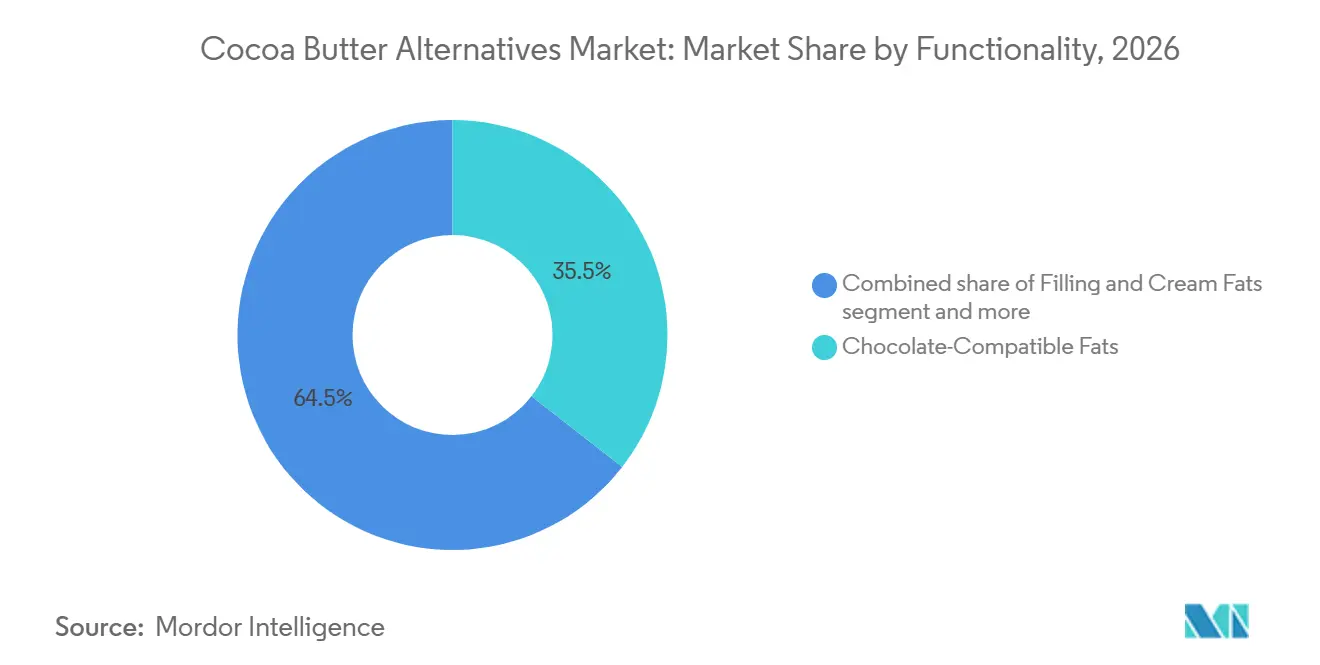
Chocolate-compatible fats held a 35.51% segment share in 2026. These products are designed to support melting behavior, gloss retention, bloom resistance, and appropriate crystallization. The category has demanding functional requirements because it is used where chocolate-like performance is important. Research found that enzymatic interesterification of palm stearin and rice bran oil blends improved crystallization properties and generated relevant solid-fat profiles. Such work supports the search for new feedstock combinations and processing methods. The cocoa butter alternatives market relies on this technical progress when developing fats for more demanding confectionery uses.
Filling and cream fats are projected to grow at a 7.83% CAGR through 2032. Filled confectionery, wafers, cream biscuits, pralines, and soft-center products support this demand. These uses can tolerate fat systems that do not fully replicate cocoa butter crystallization. That creates a wider formulation pool than surface coating or molding applications. Cargill's Port Klang expansion includes specialty fats for fillings and chocolate spreads. The functionality segment is therefore well aligned with the expansion of filled and cream-based products.
Geography Analysis
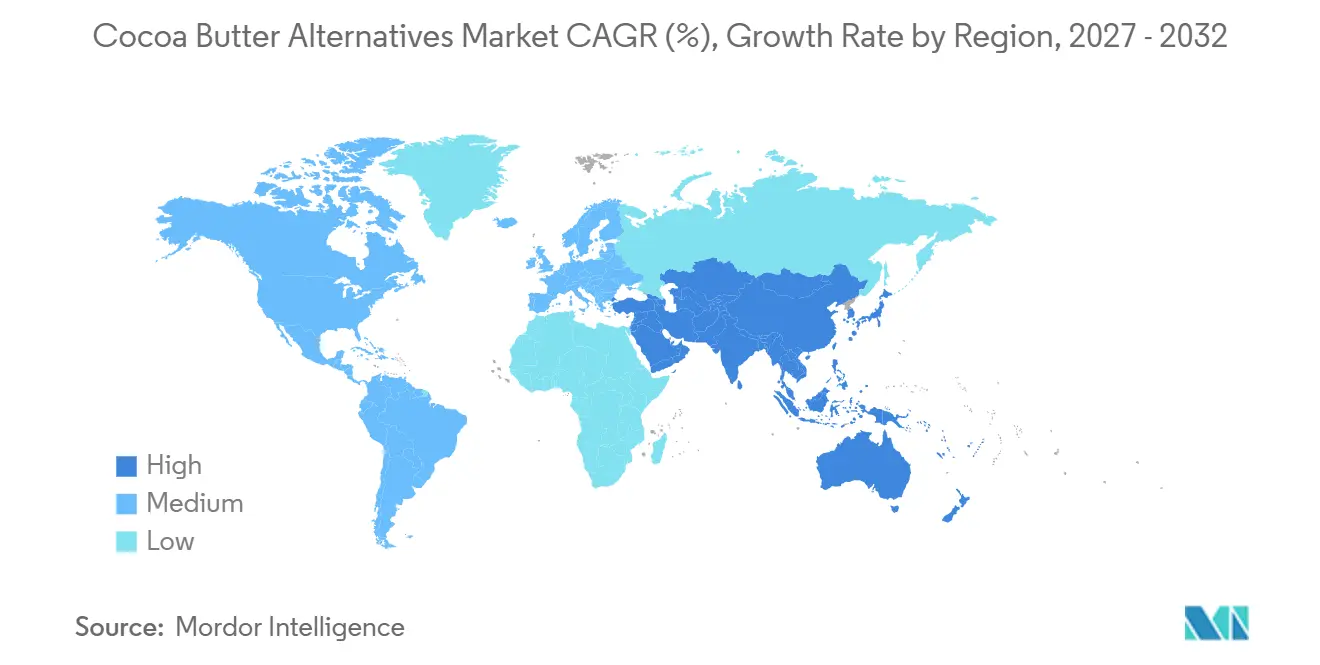
Europe held 33.76% of the cocoa butter alternatives market share in 2026. The region combines a large confectionery manufacturing base with established standards that shape cocoa butter equivalent formulation. Germany, France, the Netherlands, and the United Kingdom are important demand centers for specialty fats. Their manufacturers use vertically integrated supply chains and technical product specifications. The cocoa butter alternatives market in Europe is shaped by the need to balance product performance, traceability, and regulatory compliance. CEN-CENELEC identifies chocolate standards as part of the regional framework for cocoa butter equivalent use.
Asia-Pacific is forecast to grow at an 8.03% CAGR through 2032. Indonesia and Malaysia are central to palm oil and palm kernel oil processing. Their processing base supports fractionation and supply of specialty-fat inputs. Regional demand also benefits from the growth of affordable confectionery and compound coating formats. Cargill selected Port Klang for a specialty-fat expansion that will serve customers across chocolate, bakery, dairy, and filling uses. The cocoa butter alternatives market in the region benefits from proximity to feedstocks and investment in value-added processing[3].
North America is a stable demand area for compound and chocolate-flavored products. Product labels affect how manufacturers present products containing non-cocoa fats. South America is an emerging demand region where local confectionery production uses cost-efficient, no-temper fat systems. The Middle East and Africa have distinct roles in demand and supply. The Gulf Cooperation Council is a premium chocolate import area, while West Africa remains important to shea supply used in cocoa butter equivalents. These regional patterns give the cocoa butter alternatives market both sourcing and end-use opportunities.
Competitive Landscape
The cocoa butter alternatives market is moderately concentrated because AAK, Cargill, Bunge, and Fuji Oil have substantial specialty-fat processing capacity. No combined market-share figure for leading suppliers is provided, so a score based on verified concentration thresholds cannot be assigned without estimation. Competition is centered on feedstock access, palm-fractionation capability, product performance, and application support. Suppliers also compete on non-hydrogenated options, low-trans formulations, and responsible sourcing. AAK and Cargill have both made capacity-related investments in Malaysia. These actions reinforce the importance of integrated production close to major specialty-fat feedstocks.
AAK announced a joint venture with Kuala Lumpur Kepong Berhad in October 2025 to form NURA Specialty Oils and Fats in Pasir Gudang, Malaysia. The project is intended to strengthen supply of cocoa butter equivalent feedstock. In October 2026, AAK announced the first commercial deployment of its patented dry-fractionation technology at NURA. The company said the technology is intended to reduce capital expenditure, operating costs, and CO2e emissions. Cargill expanded its Port Klang facility in March 2026 to increase its global specialty-fat portfolio. These moves show that competitive strategies are focused on capacity, process control, and reliable specialty-fat supply.
New technologies also influence the long-term position of established suppliers. Enzymatic interesterification can improve structured lipid production for confectionery applications. Fermentation-based fats are being evaluated as another route to specialized lipid ingredients. Valio announced a research and development collaboration with Melt&Marble in January 2025 to develop microbially produced fats for plant-based foods. Such approaches remain distinct from conventional specialty-fat processing but are relevant to the future supply landscape. Leading producers are likely to maintain their position through a combination of feedstock sourcing, technical formulation capability, and investment in new fat technologies.
Cocoa Butter Alternatives Industry Leaders
-
AAK AB
-
Cargill, Incorporated
-
Bunge Global SA
-
Fuji Oil Holdings Inc.
-
Olam International Limited
- *Disclaimer: Major Players sorted in no particular order
Recent Industry Developments
- October 2026: AAK AB Advanced its patented dry-fractionation technology toward its first commercial deployment at NURA Specialty Oils and Fats, a joint venture with Kuala Lumpur Kepong Berhad (KLK) in Malaysia. The technology is designed to produce specialty palm mid-fractions used in cocoa butter equivalents, with the potential to reduce processing costs and carbon emissions while maintaining ingredient quality.
- September 2026: AAK AB and Kuala Lumpur Kepong Berhad (KLK): Broke ground on a specialty palm fractions plant in Pasir Gudang, Malaysia, through their NURA joint venture. The facility is expected to strengthen AAK's access to high-purity raw materials used in cocoa butter equivalents, improve traceability, and enhance supply-chain resilience, with production ramp-up planned from 2028.
- September 2026: C16 Biosciences launched Palmless, a cocoa butter equivalent produced through precision fermentation using an oil-producing microorganism. The ingredient is designed to provide a more consistent fat profile than conventional cocoa butter, reducing exposure to variations associated with growing regions, harvest seasons, and agricultural supply conditions.
Global Cocoa Butter Alternatives Market Report Scope
The cocoa butter alternatives market refers to the production and sale of vegetable fats and specialty fat blends used to partially or fully replace cocoa butter in chocolate, confectionery, bakery, and other food applications. The cocoa butter alternatives market is segmented by product type, application, functionality and geography. Based on product type, the market is segmented into cocoa butter equivalents (CBEs), cocoa butter replacers (CBRs), cocoa butter substitutes (CBSs). Based on application, the market is segmented into food and beverages, cosmetics and personal care, pharmaceuticals and other applications. Based on functionality, the market is segmented into chocolate-compatible fats, compound coating fats, filling and cream fats, bakery and biscuit fats. By geography, the market is segmented into North America, Europe, Asia-Pacific, South America, and Middle-East and Africa. For each segment, the market sizing and forecasting have been done in value terms (USD billion).
| Cocoa Butter Equivalents (CBEs) |
| Cocoa Butter Replacers (CBRs) |
| Cocoa Butter Substitutes (CBSs) |
| Food and Beverages | Confectionery |
| Bakery Products | |
| Dairy and Frozen Desserts | |
| Functional Foods and Beverages | |
| Cosmetics and Personal Care | |
| Pharmaceuticals | |
| Other Applications |
| Chocolate-Compatible Fats |
| Compound Coating Fats |
| Filling and Cream Fats |
| Bakery and Biscuit Fats |
| North America | United States |
| Canada | |
| Mexico | |
| Rest of North America | |
| Europe | United Kingdom |
| Germany | |
| France | |
| Italy | |
| Spain | |
| Netherlands | |
| Poland | |
| Rest of Europe | |
| Asia-Pacific | China |
| India | |
| Japan | |
| Australia | |
| South Korea | |
| Rest of Asia-Pacific | |
| South America | Brazil |
| Argentina | |
| Colombia | |
| Rest of South America | |
| Middle East and Africa | South Africa |
| Saudi Arabia | |
| United Arab Emirates | |
| Egypt | |
| Türkiye | |
| Rest of Middle East and Africa |
| By Product Type | Cocoa Butter Equivalents (CBEs) | |
| Cocoa Butter Replacers (CBRs) | ||
| Cocoa Butter Substitutes (CBSs) | ||
| By Application | Food and Beverages | Confectionery |
| Bakery Products | ||
| Dairy and Frozen Desserts | ||
| Functional Foods and Beverages | ||
| Cosmetics and Personal Care | ||
| Pharmaceuticals | ||
| Other Applications | ||
| By Functionality | Chocolate-Compatible Fats | |
| Compound Coating Fats | ||
| Filling and Cream Fats | ||
| Bakery and Biscuit Fats | ||
| By Geography | North America | United States |
| Canada | ||
| Mexico | ||
| Rest of North America | ||
| Europe | United Kingdom | |
| Germany | ||
| France | ||
| Italy | ||
| Spain | ||
| Netherlands | ||
| Poland | ||
| Rest of Europe | ||
| Asia-Pacific | China | |
| India | ||
| Japan | ||
| Australia | ||
| South Korea | ||
| Rest of Asia-Pacific | ||
| South America | Brazil | |
| Argentina | ||
| Colombia | ||
| Rest of South America | ||
| Middle East and Africa | South Africa | |
| Saudi Arabia | ||
| United Arab Emirates | ||
| Egypt | ||
| Türkiye | ||
| Rest of Middle East and Africa | ||
Key Questions Answered in the Report
What is the forecast growth rate for cocoa butter alternatives?
The cocoa butter alternatives market is forecast to grow at a 6.97% CAGR from 2027 to 2032. It rises from USD 2.34 billion in 2026 to USD 3.46 billion by 2032.
Which product category leads cocoa butter alternatives?
Cocoa butter equivalents lead by product type with a 43.15% share in 2026. Their compatibility with cocoa butter makes them useful where close product performance is required.
Why are cocoa butter substitutes growing quickly?
Cocoa butter substitutes are forecast to grow at 7.81% CAGR because compound systems can avoid tempering and support cost-efficient production. They are especially relevant for high-volume coatings and accessible confectionery formats.
Which application uses the most cocoa butter alternatives?
Food and beverages is the largest application with a 69.31% share in 2026. Confectionery, bakery coatings, filled products, and cream-based applications support its leading role.
Which region is growing fastest for cocoa butter alternatives?
Asia-Pacific is projected to grow at an 8.03% CAGR through 2032. Palm processing capacity in Indonesia and Malaysia supports regional supply and value-added fractionation.