
Clinical Software As A Medical Device (SaMD) Market Size and Share
Market Overview
| Study Period | 2020 - 2031 |
|---|---|
| Market Size (2026) | USD 18.93 Billion |
| Market Size (2031) | USD 42.67 Billion |
| Growth Rate (2026 - 2031) | 17.65 % |
| Fastest Growing Market | Asia-Pacific |
| Largest Market | North America |
| Market Concentration | Medium |
Major Players *Disclaimer: Major Players sorted in no particular order Image © Mordor Intelligence. Reuse requires attribution under CC BY 4.0. | |
Clinical Software As A Medical Device (SaMD) Market Analysis by Mordor Intelligence
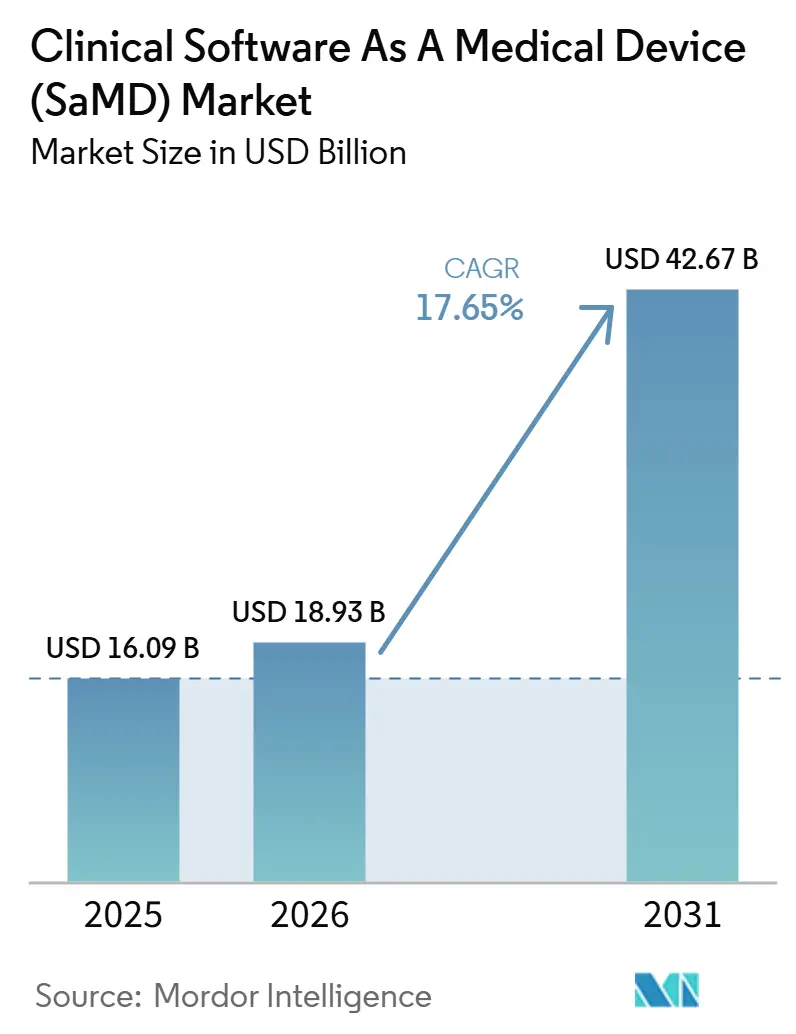
The Clinical Software As A Medical Device Market size is projected to be USD 16.09 billion in 2025, USD 18.93 billion in 2026, and reach USD 42.67 billion by 2031, growing at a CAGR of 17.65% from 2026 to 2031.
The clinical software as a medical device market is entering a phase in which software is becoming a core tool for diagnosis, monitoring, and treatment guidance rather than a support layer around hardware. Regulatory activity is gaining importance, as faster authorizations now influence hospital procurement pipelines and commercial adoption. Reimbursement changes for remote monitoring are strengthening software-led care models and expanding provider budgets. Competition is shifting toward enterprise platforms, bundled software portfolios, and recurring subscription models, while the strongest opportunity remains the integration of clinically validated software into routine workflows amid provider shortages, throughput pressure, and care delivery beyond hospital settings.
Key Report Takeaways
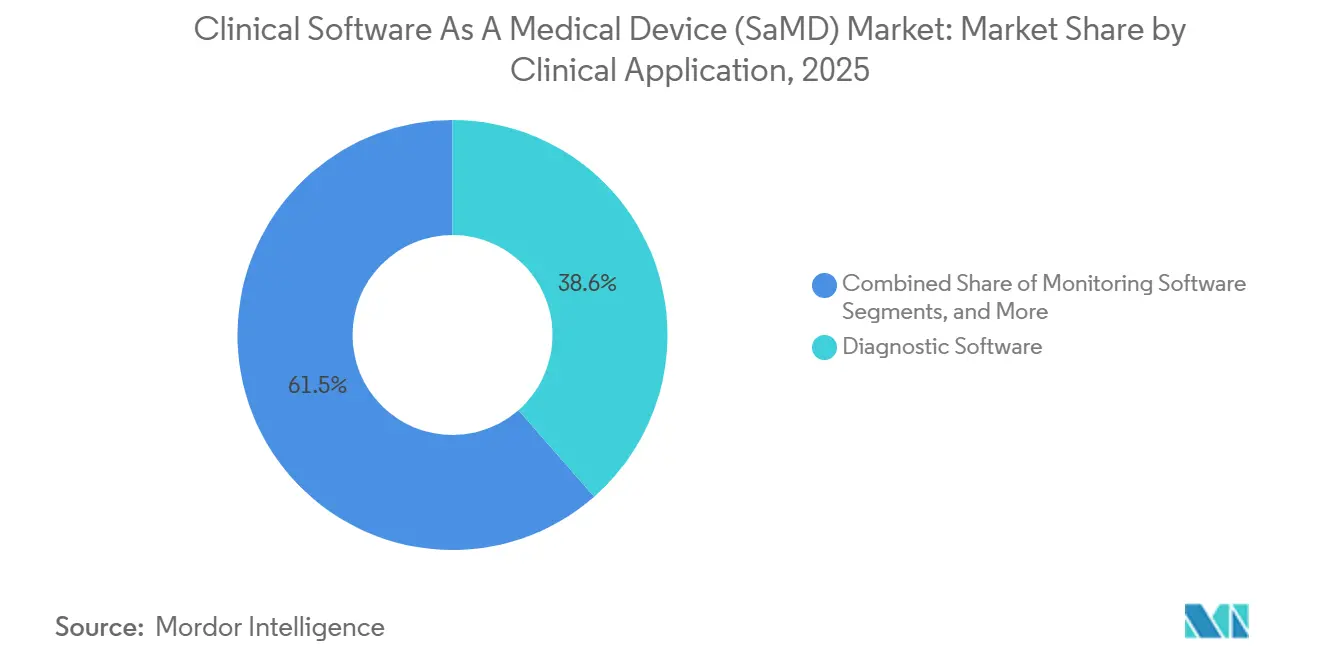
- By clinical application, diagnostic software held 38.55% of revenue in 2025, while monitoring software is projected to expand at an 18.93% CAGR through 2031.
- By deployment mode, cloud-based deployment accounted for 55.22% of revenue in 2025, while hybrid deployment is projected to grow at a 19.67% CAGR through 2031.
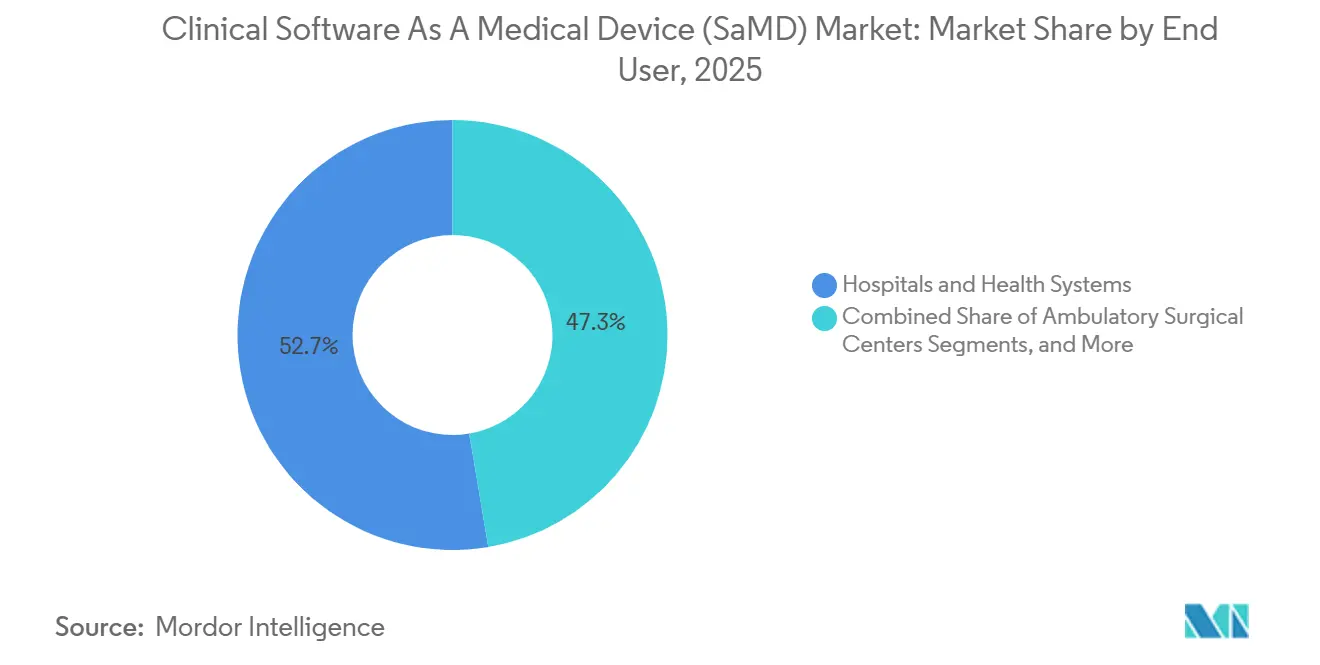
- By end user, hospitals and health systems represented 52.66% of revenue in 2025, while home healthcare providers are projected to grow at a 20.35% CAGR through 2031.
- By geography, North America held 38.86% of revenue in 2025, while Asia-Pacific is projected to advance at a 19.56% CAGR through 2031.
Note: Market size and forecast figures in this report are generated using Mordor Intelligence’s proprietary estimation framework, updated with the latest available data and insights as of January 2026.
Market Trends and Insights
Drivers Impact Analysis of Clinical Software As A Medical Device (SaMD) Market*
| DRIVER | (~) % IMPACT ON CAGR FORECAST | GEOGRAPHIC RELEVANCE | IMPACT TIMELINE |
|---|---|---|---|
| AI-enabled workflow automation reducing diagnostic turnaround time and radiologist workload | +4.3% | Global, strongest in North America and Western Europe | Short term (≤ 2 years) |
| Expanding SaMD clearances widening the pool of deployable clinical AI tools | +3.5% | North America and Europe, with spillover into Asia-Pacific and Middle East and Africa | Short term (≤ 2 years) |
| Reimbursement support for remote monitoring software through CMS code expansion and SaaS pricing discussion | +2.8% | North America, with early relevance in Europe | Medium term (2-4 years) |
| Integration with imaging, EHR, and PACS infrastructure supporting smoother deployment | +1.8% | Global, with faster uptake in private hospital networks in Asia-Pacific | Medium term (2-4 years) |
| Growing demand for software-only diagnostics that reduce reliance on specialist-heavy workflows | +2.2% | Global, with faster uptake in lower-resource settings in Asia-Pacific and Middle East and Africa | Medium term (2-4 years) |
| Rising adoption of cloud-native clinical software that supports scalable updates | +1.6% | North America and Europe, with rapid adoption in Asia-Pacific | Medium term (2-4 years) |
| Source: Mordor Intelligence | |||
AI-Enabled Clinical Workflow Automation Accelerates Diagnostic Throughput
AI-enabled workflow automation remained the leading growth driver in the clinical software as a medical device market, as it helped providers manage rising case volumes and persistent specialist shortages. Radiology continued to show the strongest adoption, with AI-focused authorizations concentrated in image-based use cases and supporting software deployment at scale. Hospitals also moved from isolated point tools to platform purchases to manage multiple algorithms across shared imaging environments. Aidoc reflected this shift, with its aiOS platform deployed across nearly 2,000 hospitals and analyzing more than 60 million patient cases annually as of April 2026. This scale strengthened its commercial position in the clinical software as a medical device market. Reimbursement also supported adoption, as coverage for HeartFlow FFRCT Analysis and Plaque Analysis by major national insurers showed that AI-driven diagnostic workflows could move beyond pilots when economic support was clear.
Expanding FDA and International SaMD Clearances Widen the Deployable Market
A broader pool of regulatory clearances supported the clinical software as a medical device market, as new approvals increased the number of tools that health systems could deploy with lower adoption risk. In the United States, the authorization base for AI-enabled medical devices expanded sharply through 2025, and the monthly pace of approvals showed that clinical software was no longer a niche regulatory category. This trend encouraged procurement teams to evaluate more cleared products across diagnostic, monitoring, and decision support functions. Outside the United States, China continued to build a large approval base for AI medical devices, mainly in imaging, while European regulators moved closer to a structured compliance regime under MDR and the EU AI Act. This development changed competition in the clinical software as a medical device market. Larger companies with established regulatory teams were better positioned than smaller single-product firms to manage lifecycle updates, documentation, and cross-market compliance.
Reimbursement Momentum for Remote Monitoring Unlocks a New Revenue Channel
Reimbursement became a more direct growth lever in the clinical software as a medical device market, especially for monitoring-focused products used outside traditional hospital settings. CMS proposed new device supply codes in July 2025 for Remote Physiologic Monitoring and Remote Therapeutic Monitoring that covered shorter data collection periods of 2 to 15 days, instead of relying only on the older 16-day threshold. This change expanded the billable patient base by including patients whose clinically useful data streams did not remain active for a full month. CMS also requested input on how software-based pricing could be handled within physician fee schedule reimbursement structures, opening the door to billing models better aligned with subscription software than one-time device transactions. As a result, monitoring, disease management, and home-based care tools gained a stronger commercial path in the clinical software as a medical device market. This shift was especially relevant for home care and distributed care models, where software could serve as the main clinical control layer rather than an add-on to physical equipment.
Growing Demand for Software-Only Diagnostics Displaces Specialist-Dependent Workflows
The need to reduce dependence on scarce specialist capacity remained a major demand driver in the clinical software as a medical device market, especially where the alternative was delayed care or no expert review. This trend was evident in advanced oncology and pathology, where new software products were being cleared to support prognosis and risk assessment in use cases that previously depended on narrower specialist interpretation. It was also visible in lower-resource care environments, where software-only or software-first solutions could reach populations without steady access to high-end equipment or specialist teams. Qure.ai’s January 2026 USD 8 million Gates Foundation grant for AI-powered point-of-care ultrasound in tuberculosis and pneumonia reflected the expansion of clinical software as a medical device beyond hospital imaging departments into public health delivery models.
Restraints Impact Analysis of Clinical Software As A Medical Device (SaMD) Market*
| RESTRAINT | (~) % IMPACT ON CAGR FORECAST | GEOGRAPHIC RELEVANCE | IMPACT TIMELINE |
|---|---|---|---|
| Clinical liability and black-box trust concerns limiting AI use in high-stakes decisions | -2.3% | Global, strongest in North America and Europe | Medium term (2-4 years) |
| Cybersecurity exposure, model drift, and post-market surveillance burden | -1.9% | Global, strongest in cloud-connected deployment markets | Medium term (2-4 years) |
| Lengthy validation and evidence requirements extending time to market | -1.5% | North America and Europe, with moderate effect in Asia-Pacific | Medium term (2-4 years) |
| Interoperability friction across PACS, EHR, and LIS systems slowing integration | -1.2% | Global, strongest in legacy hospital IT environments | Long term (≥ 4 years) |
| Source: Mordor Intelligence | |||
Clinical Liability and Black-Box Trust Constraints Slow AI Decision Embedding
Clinical liability remains a practical barrier in the clinical software as a medical device market, as physicians continue to hold primary responsibility even when software outputs influence final clinical actions. This accountability creates hesitation in high-acuity settings, where clinicians may use the software for support but remain reluctant to treat it as a primary decision signal. Trust also depends on consistent model performance across patient groups and practice settings after deployment. Peer-reviewed work cited in the user draft highlighted limited access to representative training data and uneven post-market performance across diverse populations, reinforcing concerns that real-world behavior can differ from validation outcomes.
Cybersecurity Exposure and Model Drift Create a Compounding Post-Market Burden
Cybersecurity remains a major restraint in the clinical software as a medical device market, as most new products are connected, frequently updated, and integrated into broader hospital IT environments. The FDA’s final cybersecurity guidance, issued in June 2025, stated that premarket submissions were expected to include a software bill of materials, threat modeling, and testing evidence. This raised the compliance bar for both new and updated products. In practice, every update cycle can increase the workload in the clinical software as a medical device market, as vendors must manage both performance integrity and security exposure across linked systems such as EHR, PACS, and LIS platforms. Larger firms with mature quality systems can manage this burden more effectively, while smaller vendors face greater challenges as they try to scale quickly.
*Our forecasts treat driver/restraint impacts as directional, not additive. The impact forecasts reflect baseline growth, mix effects, and variable interactions.
Clinical Software As A Medical Device (SaMD) Market Segment Analysis
By Clinical Application:
Diagnostic Software Anchors Revenue While Monitoring Scales FastestDiagnostic software accounted for 38.55% of revenue in 2025, giving it the largest position in the clinical software as a medical device market. Imaging-based workflows supported this lead because they had the deepest regulatory history and the clearest fit for machine-led analysis. Diagnostic software also benefited from easier-to-standardize data structures, making performance validation more practical than in many other clinical settings.
Monitoring software is forecast to grow at an 18.93% CAGR through 2031, making it the fastest-expanding clinical application in the clinical software as a medical device market size profile. Improving reimbursement conditions for remote oversight programs largely drive this growth. CMS support for shorter monitoring windows made this category more commercially viable for patients who could not sustain long data collection cycles and supported recurring software use outside hospital settings.



By Deployment Mode:
Cloud-Based Delivery Leads While Hybrid Adoption Rises FastestCloud-based deployment held 55.22% of revenue in 2025, representing the largest share of the clinical software as a medical device market at that point. Subscription economics, lower infrastructure burdens, and easier software updates across distributed provider networks supported this lead. Cloud delivery allowed vendors to update algorithms, roll out enhancements, and manage usage at scale without the same service burden associated with fully local installations.
Siemens Healthineers’ February 2025 launch of Syngo Flexinity reflected this approach by offering flexible subscription access to its imaging software portfolio across scanner fleets and reducing procurement friction for health systems. This model supported enterprise purchasing behavior, as providers increasingly sought broad access, predictable pricing, and centralized governance instead of separate software licenses for each workflow. Hybrid deployment is forecast to expand at a 19.67% CAGR through 2031, making it the fastest-growing mode as health systems balance local data residency needs with cloud-side computation scale.
By End User:
Hospitals Hold the Core Base While Home Healthcare Gains SpeedHospitals and health systems accounted for 52.66% of revenue in 2025, keeping them as the largest end-user group in the clinical software as a medical device market. Most regulatory clearances, workflow integrations, and enterprise buying decisions still began in these settings. Centralized governance structures strengthened their position by enabling diagnostic, monitoring, and decision support tools to be integrated into broader operating platforms instead of being approved individually.
Home healthcare providers are forecast to grow at a 20.35% CAGR through 2031, making them the fastest-growing end-user group in the clinical software as a medical device market size outlook. Software is becoming central to care supervision beyond hospital walls, driving this growth. Reimbursement support for remote monitoring and the rising availability of connected devices that feed clinically useful data into software platforms further support adoption.
Geography Analysis
North America Clinical Software As a Medical Device (SaMD) Market
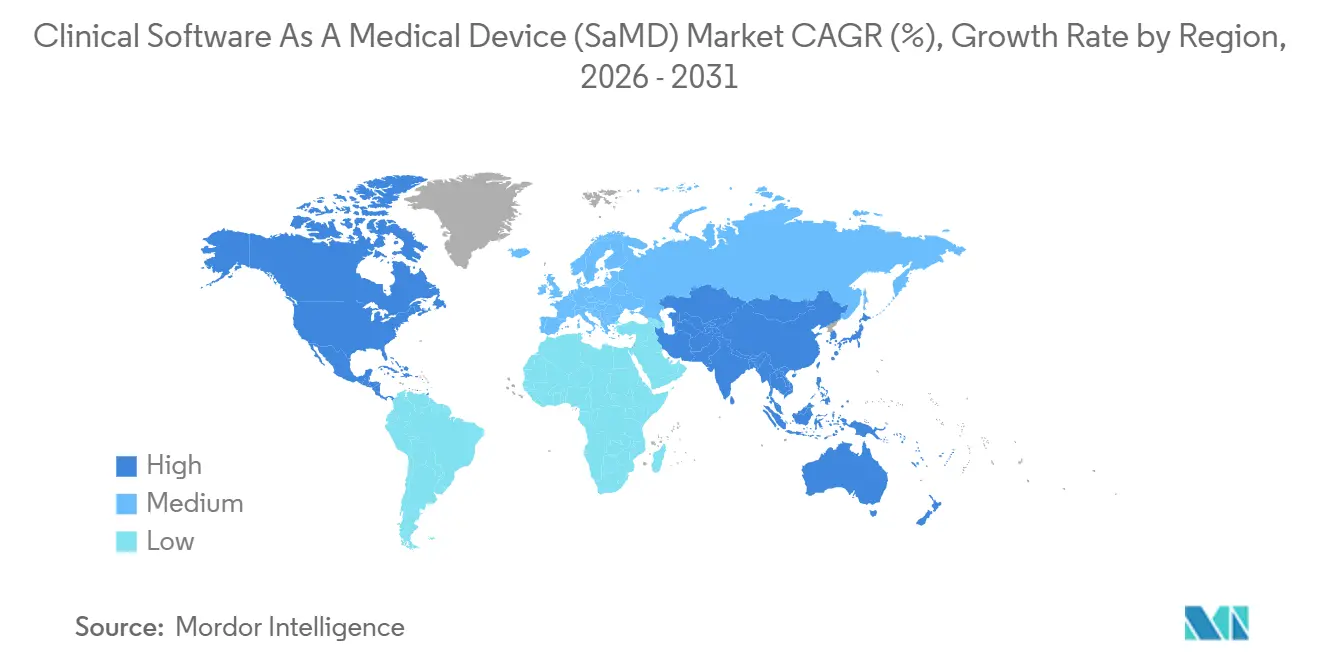
North America held 38.86% of revenue in 2025, giving the region the leading position in the clinical software as a medical device market. This reflected strong U.S. regulatory activity, payer support, and hospital technology adoption. The United States remained the main driver, supported by the most active authorization pipeline for AI-enabled clinical software and a mature path from clearance to procurement. GE HealthCare reached 100 cumulative U.S. authorizations by July 2025, highlighting how major imaging companies used software portfolios as long-term competitive assets, while Canada and Mexico supported regional growth through provincial screening activity and private hospital AI adoption.
Europe Clinical Software As a Medical Device (SaMD) Market
Europe progressed through a more compliance-intensive path in the clinical software as a medical device market, as MDR requirements and the future application of the EU AI Act increasingly shaped adoption. Germany, the UK, and France remained the strongest regional centers, supported by advanced hospital infrastructure, strong clinical validation networks, and readiness for regulated digital health deployment. The region’s regulatory structure favored larger suppliers with established quality, documentation, and post-market support teams. Lunit’s selection in September 2025 as the exclusive AI partner for breast cancer screening in Spain’s Valencian Community showed how public screening initiatives could support large-scale implementation of evidence-based software.
APAC, MEA and South America Clinical Software As a Medical Device (SaMD) Market
Asia-Pacific is forecast to grow at a 19.56% CAGR through 2031, making it the fastest-expanding region in the clinical software as a medical device market size outlook. Unmet specialist needs, large screening populations, and growing private care capacity are driving demand. China remained a central growth engine, supported by a large approval base for AI medical devices and policy support for higher-end medical technologies. Qure.ai’s January 2026 USD 8 million Gates Foundation grant for AI ultrasound focused on tuberculosis and pneumonia reflected the relevance of software-led diagnostic access in public-health-linked care delivery, while the Middle East and Africa and South America remained smaller but meaningful medium-term volume opportunities.

Competitive Landscape
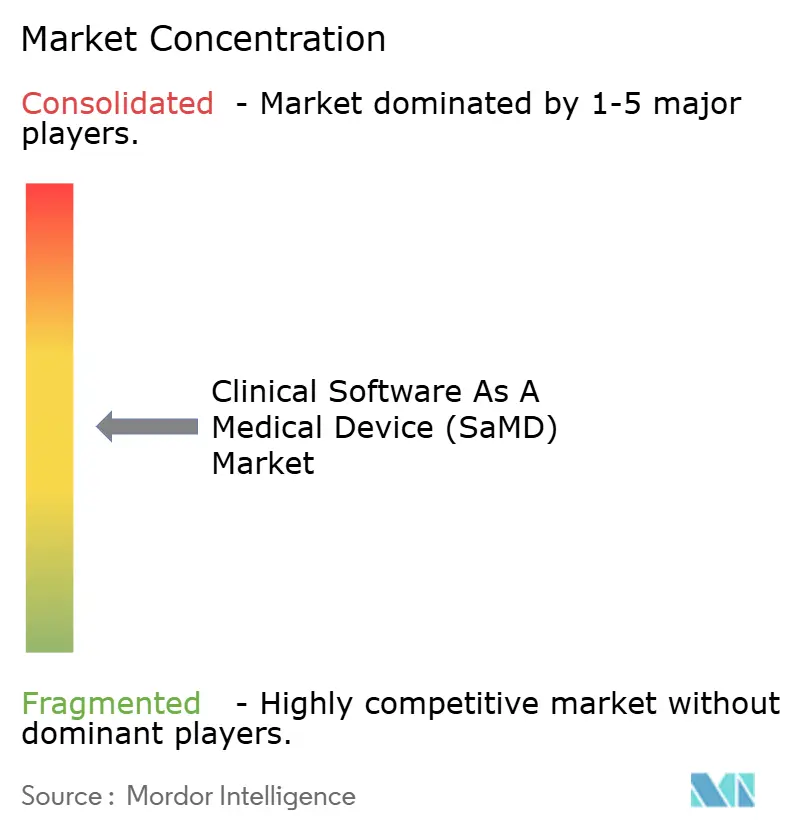
The clinical software as a medical device market showed moderate concentration at the enterprise tier, as large imaging and healthcare technology companies continued to hold advantages in distribution, installed base access, and integration capacity. GE HealthCare, Siemens Healthineers, and Koninklijke Philips ranked near the top of the competitive field by combining hardware relationships with software portfolios, which strengthened their position in enterprise negotiations. The broader clinical software as a medical device market remained fragmented, with more than 220 unique manufacturers receiving at least one FDA AI-related clearance in 2025.
GE HealthCare’s March 2026 acquisition of Intelerad for USD 2.3 billion expanded its enterprise imaging software reach into ambulatory radiology and teleradiology, where traditional hospital-centered procurement had not always been the dominant route. Siemens Healthineers followed a similar direction by expanding software subscription access and strengthening AI-enabled imaging software, reflecting a competitive shift toward recurring revenue and deeper workflow control.
Pure-play clinical AI firms formed a separate competitive layer in the clinical software as a medical device market by moving beyond narrow indication tools toward platform-based models. Aidoc, Lunit, and Viz.ai represented this shift, as they built operating environments or pathway layers that supported multiple use cases under a single enterprise relationship. Hospitals in the clinical software as a medical device market increasingly valued governance, integration, and vendor consolidation alongside algorithm performance.
Clinical Software As A Medical Device (SaMD) Industry Leaders
Siemens Healthineers AG
GE HealthCare Technologies Inc.
Koninklijke Philips N.V.
Medtronic plc
AliveCor, Inc.
- *Disclaimer: Major Players sorted in no particular order
Clinical Software As A Medical Device (SaMD) Market Companies Covered in this Report
- Aidoc Ltd.
- AliveCor
- Arterys, Inc.
- Butterfly Network, Inc.
- CureMetrix, Inc.
- DeepHealth, Inc.
- Digital Diagnostics
- GE HealthCare Technologies Inc.
- HeartFlow, Inc.
- iCAD, Inc.
- Imbio, Inc.
- Koninklijke Philips
- Lunit
- Medtronic
- Nanox AI Ltd.
- Oxipit UAB
- Qure.ai Technologies Private Limited
- Siemens Healthineers
- Viz.ai, Inc.

Recent Industry Developments in Clinical Software As A Medical Device (SaMD) Market
- July 2026: Autonomous Healthcare received FDA De Novo authorization for Syncron-E, creating a new FDA category for ventilator waveform analysis software and supporting future 510(k) submissions.
- July 2026: iHealthScreen received FDA 510(k) clearance (K253704) for iPredict-DR, an AI-based SaMD for automated diabetic retinopathy screening in primary care settings.
- July 2026: Germany’s Bundesnetzagentur and BfDI published an AI-in-medical-devices compliance roadmap to help SaMD manufacturers meet EU MDR and EU AI Act high-risk requirements.
- June 2026: GE HealthCare received FDA 510(k) clearance for MIM Contour ProtégéAI+ 2.0, an AI-enabled auto-contouring software for radiation oncology treatment planning.
- April 2026: Aidoc raised USD 150 million in Series E funding, bringing total funding to over USD 500 million to advance its CARE clinical foundation model and aiOS enterprise platform.


Global Clinical Software As A Medical Device (SaMD) Market Report Scope
As per the scope of the report, Software as a Medical Device (SaMD) is standalone software used for medical purposes (like diagnosing or treating diseases) that runs on general-purpose hardware like smartphones or cloud servers. Unlike traditional devices, SaMD's own software is the medical device.
The clinical software as a medical device (SaMD) market is segmented by clinical application, deployment mode, end user, and geography. By clinical application, the market includes diagnostic software, monitoring software, therapeutic software, disease management software, and clinical decision support software. By deployment mode, the market is segmented into cloud-based, on-premise, and hybrid. By end user, the market is segmented into hospitals and health systems, ambulatory surgical centers, specialty clinics, home healthcare providers, and diagnostic and imaging centers. By geography, the market is analyzed across North America, Europe, Asia-Pacific, the Middle East and Africa, and South America. The report also covers the estimated market sizes and trends for 17 countries across major regions globally. The report offers the market sizes and forecasts in terms of value (USD) for the above segments.
| Diagnostic Software |
| Monitoring Software |
| Therapeutic Software |
| Disease Management Software |
| Clinical Decision Support Software |
| Cloud-Based |
| On-Premise |
| Hybrid |
| Hospitals and Health Systems |
| Ambulatory Surgical Centers |
| Specialty Clinics |
| Home Healthcare Providers |
| Diagnostic and Imaging Centers |
| North America | United States |
| Canada | |
| Mexico | |
| Europe | Germany |
| United Kingdom | |
| France | |
| Italy | |
| Spain | |
| Rest of Europe | |
| Asia-Pacific | China |
| India | |
| Japan | |
| Australia | |
| South Korea | |
| Rest of Asia-Pacific | |
| Middle East and Africa | GCC |
| South Africa | |
| Rest of Middle East and Africa | |
| South America | Brazil |
| Argentina | |
| Rest of South America |
| By Clinical Application | Diagnostic Software | |
| Monitoring Software | ||
| Therapeutic Software | ||
| Disease Management Software | ||
| Clinical Decision Support Software | ||
| By Deployment Mode | Cloud-Based | |
| On-Premise | ||
| Hybrid | ||
| By End User | Hospitals and Health Systems | |
| Ambulatory Surgical Centers | ||
| Specialty Clinics | ||
| Home Healthcare Providers | ||
| Diagnostic and Imaging Centers | ||
| By Geography | North America | United States |
| Canada | ||
| Mexico | ||
| Europe | Germany | |
| United Kingdom | ||
| France | ||
| Italy | ||
| Spain | ||
| Rest of Europe | ||
| Asia-Pacific | China | |
| India | ||
| Japan | ||
| Australia | ||
| South Korea | ||
| Rest of Asia-Pacific | ||
| Middle East and Africa | GCC | |
| South Africa | ||
| Rest of Middle East and Africa | ||
| South America | Brazil | |
| Argentina | ||
| Rest of South America | ||


Key Questions Answered in the Report
What is the current value of the clinical software as a medical device market?
The clinical software as a medical device market size stands at USD 18.93 billion in 2026 and is forecast to reach USD 42.67 billion by 2031 at a CAGR of 17.65%.
Which clinical application leads revenue in this space?
Diagnostic software led in 2025 with 38.55% of revenue, helped by strong adoption in imaging-heavy workflows and growing payer acceptance.
Which application is growing the fastest through 2031?
Monitoring software is projected to grow the fastest at an 18.93% CAGR, supported by improving reimbursement for remote monitoring programs.
Why are hospitals still the main buyers of SaMD platforms?
Hospitals and health systems held 52.66% of revenue in 2025 because they control enterprise procurement, workflow integration, and governance across multiple software tools.
Which deployment model is expanding most quickly?
Hybrid deployment is forecast to grow at a 19.67% CAGR as providers balance local data control with the computing scale of cloud-based systems.
Which region offers the strongest growth outlook?
Asia-Pacific has the fastest outlook with a 19.56% CAGR through 2031, driven by specialist shortages, large screening demand, and expanding hospital capacity.
Page last updated on:





