
CIP Chemicals Market Size and Share
Market Overview
| Study Period | 2021 - 2031 |
|---|---|
| Market Size (2026) | USD 17.81 Billion |
| Market Size (2031) | USD 25.64 Billion |
| Growth Rate (2026 - 2031) | 7.56 % |
| Fastest Growing Market | Asia-Pacific |
| Largest Market | Asia-Pacific |
| Market Concentration | Medium |
Major Players *Disclaimer: Major Players sorted in no particular order Image © Mordor Intelligence. Reuse requires attribution under CC BY 4.0. | |
CIP Chemicals Market Analysis by Mordor Intelligence
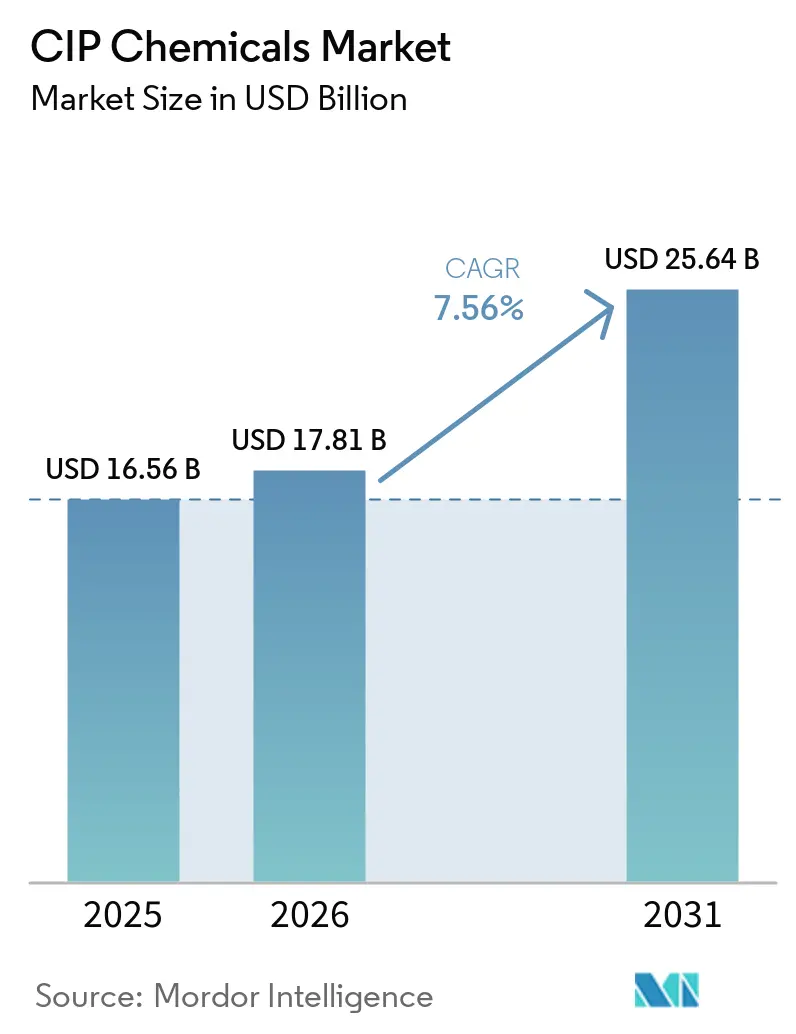
The CIP chemicals market size was USD 16.56 billion in 2025 and is estimated to grow from USD 17.81 billion in 2026 to reach USD 25.64 billion by 2031, at a CAGR of 7.56% during the forecast period (2026-2031). The Clean-in-Place (CIP) chemicals market is supported by recurring sanitation needs in food processing, pharmaceutical manufacturing, and dairy operations, where cleaning must address product residues, mineral scale, and microbial-control requirements. Chemical purchasing is tied to cleaning and validation programs, which can sustain demand even when a facility operates below capacity or changes its production mix. Plants often need a defined sequence of alkaline, acid, enzymatic, and sanitizing stages to address different residues and microbial-control needs. Suppliers are moving beyond chemical formulations by combining dosing equipment, monitoring, and application support with their programs. This approach can deepen relationships with large facilities, improve process records, and make supplier changes more difficult. Environmental requirements and the wider use of single-use bioreactor systems may limit demand in specific applications, but hygiene requirements continue to support the CIP chemicals market.
Key Report Takeaways
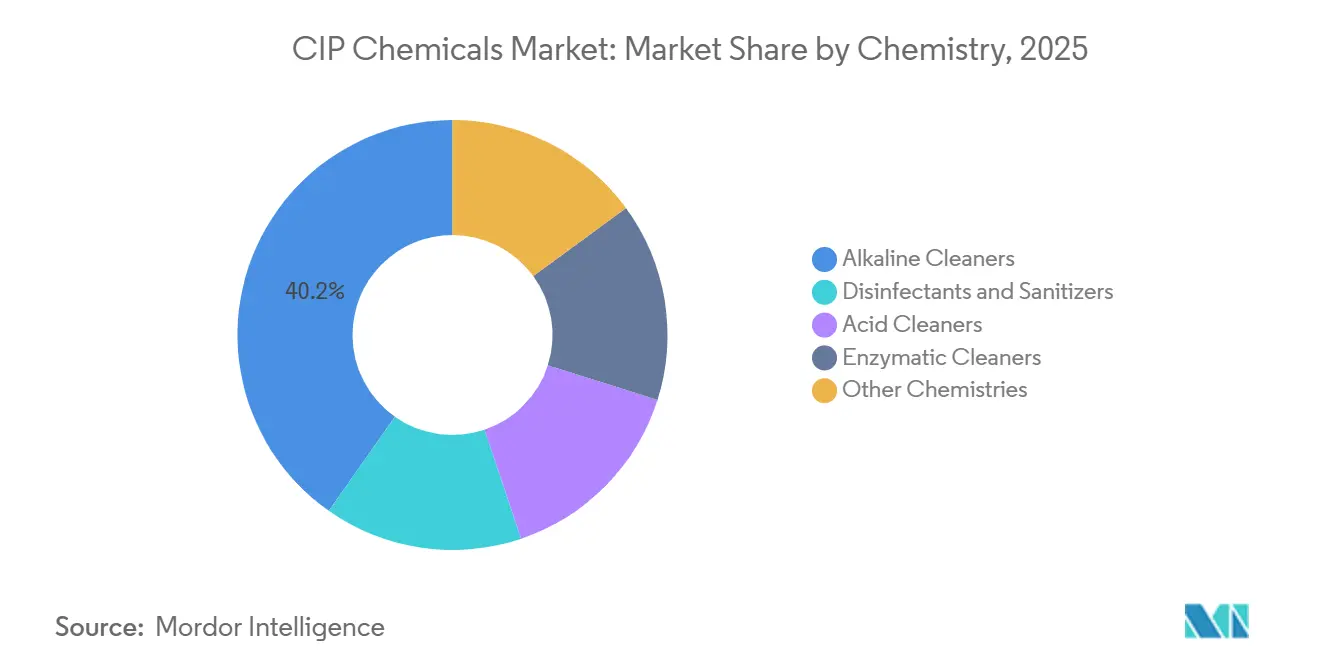
- By chemistry, alkaline cleaners held 40.23% of the global CIP chemicals market share in 2025, while enzymatic cleaners are projected to advance at an 8.13% CAGR through 2031.
- By form, liquid held 72.16% of the CIP chemicals market share in 2025, while powder is projected to advance at an 8.34% CAGR through 2031.
- By process type, recirculated cleaning held 64.67% of the CIP chemicals market share in 2025, while single-use cleaning is projected to advance at an 8.54% CAGR through 2031.
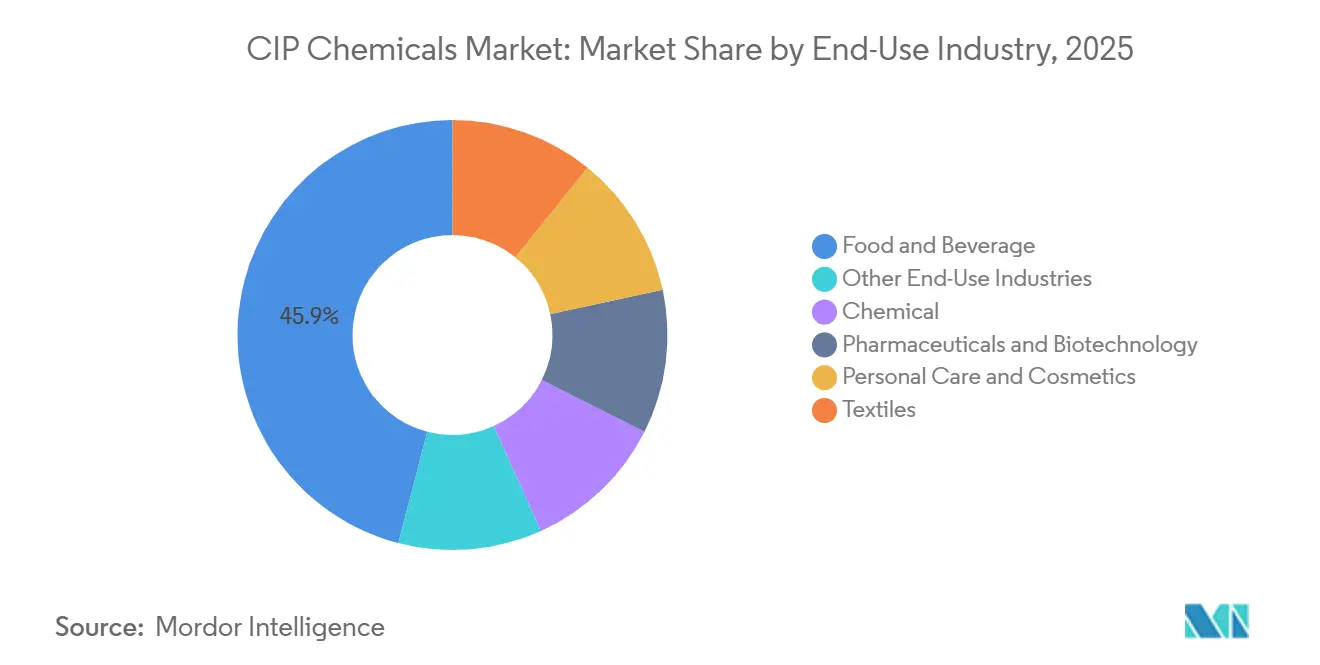
- By end-use industry, food and beverage held 45.94% of the CIP chemicals market share in 2025, while pharmaceuticals and biotechnology are projected to advance at an 8.88% CAGR through 2031.
- By geography, Asia-Pacific held 40.77% of the CIP chemicals market share in 2025 and is projected to advance at an 8.17% CAGR through 2031.
Note: Market size and forecast figures in this report are generated using Mordor Intelligence’s proprietary estimation framework, updated with the latest available data and insights as of January 2026.
Global CIP Chemicals Market Trends and Insights
Drivers Impact Analysis*
| Driver | (~) % Impact on CAGR Forecast | Geographic Relevance | Impact Timeline |
|---|---|---|---|
| Rising Hygiene, Food Safety, and Contamination-Control Requirements | +2.2% | Global | Short term (≤ 2 years) |
| Expansion of Automated and Validated Cleaning in Food and Beverage Plants | +1.8% | Global, with APAC and North America leading | Medium term (2–4 years) |
| Pharmaceutical and Biotechnology Capacity Expansion | +1.5% | North America, Europe, APAC | Long term (≥ 4 years) |
| Water, Energy, and Chemical Optimization Through Recirculated CIP | +0.9% | Global, North America, Europe | Medium term (2–4 years) |
| Digital CIP Monitoring and AI-Assisted Process Control | +0.6% | North America & EU, spillover to APAC | Long term (≥ 4 years) |
| Source: Mordor Intelligence | |||
Rising Hygiene, Food Safety, and Contamination-Control Requirements
Hygiene and food safety requirements create recurring demand in the CIP chemicals market because cleaning programs need chemicals on a defined schedule. This demand is connected to sanitation procedures for production equipment, rather than purchases made only when output expands, because validated programs must be completed between defined operating cycles. The European Hygienic Engineering & Design Group released Document 58, Hygienic Design Risk Management, in 2025. The document set out a risk-based approach that considers sanitation methods during equipment design for food operations. In the United States, 21 Code of Federal Regulations (CFR) Part 117 established Current Good Manufacturing Practice and preventive control requirements for human food facilities[1]U.S. Food and Drug Administration, “21 CFR Part 117 Current Good Manufacturing Practice, Hazard Analysis, and Risk-Based Preventive Controls for Human Food,” U.S. Food and Drug Administration, accessdata.fda.gov. These frameworks favor documented and repeatable sanitation practices, increasing the importance of fit-for-purpose chemical programs.
Expansion of Automated and Validated Cleaning in Food and Beverage Plants
Food and beverage facilities are adopting automated cleaning processes that rely on defined operating conditions and recorded cycle results. Automated systems can use conductivity, temperature, flow, and time settings to control chemical concentration, rinse steps, and cleaning duration. This arrangement supports more consistent outcomes than partial-manual processes, where practice can vary between shifts. It also gives operators clearer records for internal quality reviews, corrective action, and regulatory inspections. Automated dosing can reduce unnecessary chemical use while keeping cleaning cycles within validated parameters in the CIP chemicals market, especially where facilities run several circuits with different soil loads. Suppliers that combine formulations with dosing controls and technical support can be better placed at large food and beverage sites.
Pharmaceutical and Biotechnology Capacity Expansion
Pharmaceutical and biotechnology facilities require highly controlled cleaning programs because residues and microbial contamination can affect manufacturing quality. Cleaning-in-place validation in pharmaceutical production covers equipment design, operating conditions, performance qualification, and continued review. This requirement supports chemical programs with consistent composition, documented handling procedures, and reproducible results across production campaigns. Biologics production increases the relevance of chemistry designed to remove protein-based residues from shared equipment and transfer lines. Enzymatic cleaners can have a stronger role where lower-temperature cleaning and substrate-specific action are useful. These requirements make pharmaceutical demand more technically demanding than routine food processing applications and increase the value placed on documented chemical consistency.
Water, Energy, and Chemical Optimization Through Recirculated CIP
Recirculated CIP systems can help facilities manage water, energy, and chemical use while maintaining required cleaning performance. Food and dairy processors can integrate heat recovery and rinse-water reuse into existing cleaning infrastructure where cleaning loads are high. A 2026 study assessed an ammonia heat pump that recovered chiller waste heat for a dairy CIP system. This approach can preheat cleaning tanks and reduce the energy needed to prepare caustic and acid solutions. These operating benefits support continued investment in recirculated systems at facilities with substantial cleaning loads. The CIP chemicals market benefits when such systems remain part of long-lived plant infrastructure, because replacement or modernization projects continue to require compatible formulations and application support.
Restraints Impact Analysis*
| Restraint | (~) % Impact on CAGR Forecast | Geographic Relevance | Impact Timeline |
|---|---|---|---|
| High Initial Cost of Automated CIP Infrastructure | -1.3% | Global, spillover to APAC core and MEA | Short term (≤ 2 years) |
| Chemical Handling, Disposal, and Environmental Compliance Burden | -0.9% | North America & EU, APAC | Medium term (2–4 years) |
| Incomplete Cleaning Validation and Poor Sensor Calibration | -0.5% | APAC, South America, MEA | Long term (≥ 4 years) |
| Source: Mordor Intelligence | |||
High Initial Cost of Automated CIP Infrastructure
Automated CIP systems require investment in programmable skids, chemical tanks, inline sensors, heat recovery equipment, and process controls. These requirements can delay adoption among small and midsized food processors with limited capital budgets. The barrier is more visible where equipment financing is limited or imported automation equipment is costly. Smaller dairy cooperatives and independent beverage producers may continue to use partial manual cleaning methods while prioritizing other investments. Those methods generally use fewer chemicals than fully automated and repeatable cleaning cycles because they are less standardized. The CIP chemicals market can therefore expand more slowly in price-sensitive locations until operators can justify the initial infrastructure cost through lower utility use, better process control, or export-driven quality requirements.
Chemical Handling, Disposal, and Environmental Compliance Burden
Concentrated alkaline and acid chemicals require appropriate storage, handling procedures, employee safeguards, and wastewater management. These requirements add costs beyond the purchase price of the chemical program and can be difficult for smaller facilities to manage. European food businesses must comply with hygiene requirements under Regulation (EC) No 852/2004. Facilities may also need to manage wastewater before discharge, where local limits apply to chemical concentration. These costs can encourage interest in lower-caustic, enzyme-compatible, or biodegradable formulations that reduce handling concerns. The CIP chemicals market must balance cleaning effectiveness with the handling and compliance requirements faced by end users, particularly where wastewater treatment equipment is not already available.
*Our forecasts treat driver/restraint impacts as directional, not additive. The impact forecasts reflect baseline growth, mix effects, and variable interactions.
Segment Analysis
By Chemistry: Alkaline Cleaners Anchor Revenue as Enzymatic Cleaners Gain Momentum
Alkaline cleaners accounted for 40.23% of the CIP chemicals market in 2025. Their leading position reflected established use against protein and fat residues in dairy, brewery, and ready-to-eat food facilities across the CIP chemicals market. They are routinely used where organic soils need reliable removal from enclosed process lines. Acid cleaners provide a complementary function by removing mineral deposits, beer stone, and scale that alkaline cleaning does not address. Disinfectants and sanitizers complete programs where operators require a documented microbial-control step after soil removal.
Enzymatic cleaners are projected to advance at an 8.13% CAGR through 2031. Their demand is linked to biologics manufacturing, where protein residues can require specialized cleaning approaches. Pharmaceutical validation requires documented and repeatable performance throughout the equipment lifecycle. BASF launched Trilon G in April 2025 as a glutamic acid diacetate chelating agent for cleaning formulations. BASF stated that the product is 56% biobased and readily biodegradable under Organisation for Economic Co-operation and Development (OECD) 301D testing.



By Form: Liquid Segment Dominates, Powder Segment Builds on Sustainability Logic
The liquid segment held 72.16% of the CIP chemicals market share in 2025. Its role is supported by direct compatibility with automated dosing systems and continuous-flow cleaning processes used across the CIP chemicals market. Ready-to-use and concentrated liquids let operators control chemical additions with limited preparation before a cleaning cycle begins. Powder systems need dissolution before use, which creates an added handling step.
Powder is projected to advance at an 8.34% CAGR through 2031. Concentrated powder formulations can lower transportation weight and volume compared with equivalent liquid products. This feature matters for facilities in South and Southeast Asia that import higher-value cleaning chemicals from distant suppliers. Lower shipping volumes can also support procurement goals related to supply-chain emissions and packaging use. Adoption will depend on whether facilities can manage dissolution, safe handling, and accurate dosing without disrupting cleaning consistency.
By Process Type: Recirculated Cleaning Leads Revenue, Single-Use Cleaning Quickens
Recirculated cleaning accounted for 64.67% of the CIP chemicals market in 2025. It is deeply integrated into large food, dairy, and pharmaceutical sites with fixed cleaning skids and multi-tank chemical systems. These systems represent long-term infrastructure investments that can remain in service through many equipment replacement cycles. Recirculated programs circulate cleaning solutions through multiple stages before discharge, supporting repeatable cleaning across complex process circuits. The installed base provides a stable source of recurring chemical demand for suppliers serving high-volume production facilities in the CIP chemicals market.
Single-use cleaning is projected to advance at an 8.54% CAGR through 2031. Growth is associated with hybrid biopharmaceutical facilities that use disposable bags but retain stainless-steel tanks, transfer lines, and filtration equipment. These shared assets still require validated chemical cleaning even when disposable components are used upstream. A 2024 Fraunhofer Institute study examined adapting automated CIP concepts from food production to biopharmaceutical processes. This need supports specialized high-purity chemical products in facilities that combine single-use and fixed process assets.
By End-Use Industry: Food and Beverage Anchors Demand, Pharmaceuticals and Biotechnology Accelerate
Food and beverage accounted for 45.94% of the CIP chemicals market in 2025. Dairy processing, brewery operations, beverage bottling, and ready-to-eat production require frequent cleaning of enclosed equipment. A mid-scale dairy or brewery can conduct 3 to 8 complete CIP cycles daily across multiple circuits. The chemical segment uses CIP chemicals in active pharmaceutical ingredient synthesis and industrial disinfection processes. Personal care and cosmetics producers use alkaline and enzymatic formulations for emollient and silicone residues, while textiles use specialized programs for dye-residue removal.
Pharmaceuticals and biotechnology are projected to advance at an 8.88% CAGR through 2031. This segment requires lifecycle-validated cleaning programs, controlled chemistry, and electronic documentation that supports quality review. Research describes validation activities from process design to performance qualification and continued revalidation. These requirements make chemical purchasing part of an ongoing quality system rather than a discretionary maintenance decision in the CIP chemicals market.
Geography Analysis
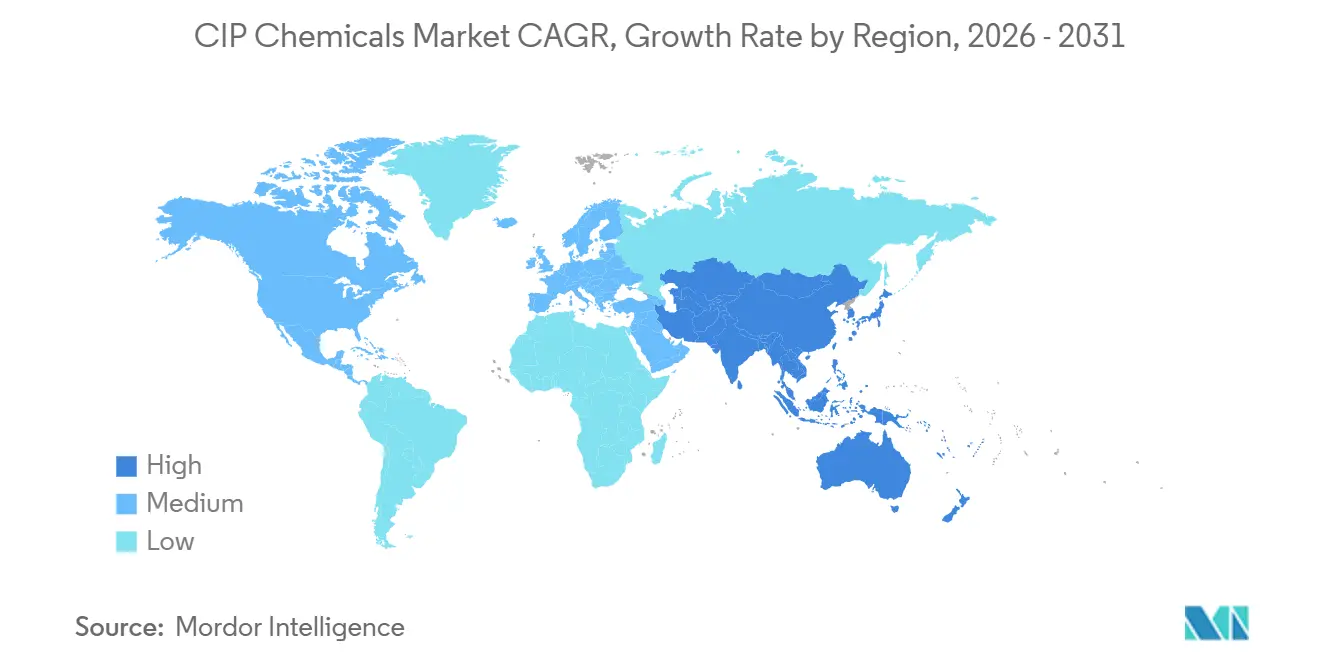
Asia-Pacific held 40.77% of the CIP chemicals market share in 2025 and is projected to advance at an 8.17% CAGR through 2031. China supports demand through food processing, dairy, brewing, ready-to-eat foods, beverage production, and active pharmaceutical ingredient manufacturing. India contributes through dairy cooperative upgrades, food safety enforcement, and biosimilars manufacturing expansion. Japan and South Korea support demand from advanced food processing and biologics facilities with strict quality requirements. The Association of Southeast Asian Nations (ASEAN) countries are strengthening hygiene practices to support food export requirements and maintain international market access.
Krones AG inaugurated a manufacturing facility in Vemagal, Karnataka, in August 2026, following an INR 315 crore investment (approximately USD 37 million). The plant supports beverage-line equipment capacity in India and the surrounding region. North America’s demand is supported by automated food plants, pharmaceutical manufacturing, and an established demand for documented sanitation procedures. United States food facilities operate under the Food Safety Modernization Act framework and related federal food regulations. Canada adds demand through dairy and food processing, while Mexico is expanding as an export-oriented food producer with increasing hygiene requirements.
STERIS plc announced in August 2026 a USD 600 million investment in a formulated chemistries manufacturing Center of Excellence in North Carolina. The project indicates continued supplier investment in regional formulated-chemistry capacity for the CIP chemicals market. Europe’s demand is led by mature dairy, beverage, and pharmaceutical activities in Germany, France, and the United Kingdom. South America and Middle East and Africa are emerging growth areas, where Brazil, Argentina, Saudi Arabia, and the United Arab Emirates are expanding food production and hygienic processing capacity.

Competitive Landscape
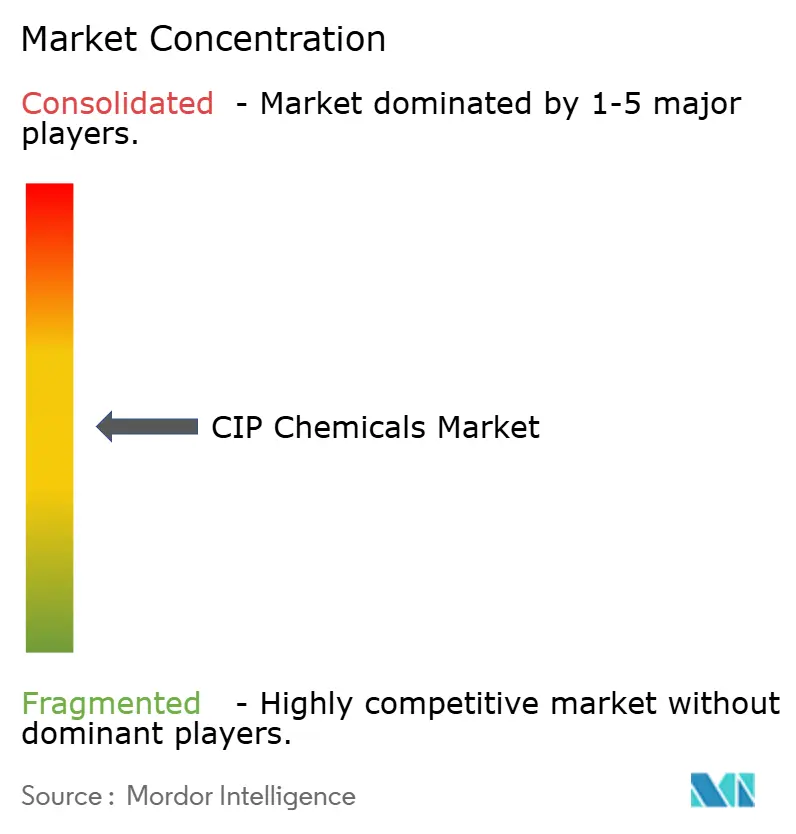
The CIP chemicals market is moderately concentrated, with the top five players including Ecolab Inc., Solenis, BASF, Evonik Industries AG, and KERSIA GROUP. Diversified chemical and water-treatment suppliers hold long-term agreements with large food, dairy, and pharmaceutical facilities. Regional formulators and system integrators compete through price, local service, and application-specific support in smaller accounts. Large suppliers use formulation research, automated dosing equipment, and performance monitoring to retain customers. These capabilities shift competition beyond commodity alkaline and acid formulations and make documented cleaning performance important in purchasing decisions.
BASF launched Trilon G in April 2025 to expand its sustainable chelating-agent offering[2]BASF, “BASF Expands Sustainable Chelating Agent Solutions with Trilon G,” BASF Media Release, basf.com . The product provides formulators with an option for lowering ethylenediaminetetraacetic acid content in cleaning formulations. Krones AG also opened its new India plant in 2026, increasing its proximity to food and beverage equipment customers in the region.
Opportunities are centered on enzymatic formulations for biologics, powder products for logistics-sensitive locations, and integrated monitoring services. Specialty suppliers can compete in the CIP chemicals market where customized formulations and validated outcomes matter more than scale. Dosing controls, conductivity sensors, and consumption analytics can turn chemical supply into a managed service relationship. This model can increase switching costs for customers who depend on consistent cleaning results and recorded process data.
CIP Chemicals Industry Leaders
Ecolab Inc.
Solenis
BASF
Evonik Industries AG
KERSIA GROUP
- *Disclaimer: Major Players sorted in no particular order

Recent Industry Developments
- July 2026: GEA Group Aktiengesellschaft commissioned a new plant-based food production facility for Bauer in Germany, integrating CIP cleaning systems across the processing line. The installation supports demand for CIP chemicals as plant-based food processing expands and requires hygienic cleaning of tanks, pipes, heat exchangers, and other equipment.
- April 2025: BASF launched Trilon G, a glutamic acid diacetic acid (GLDA)-based chelating agent designed for home care and industrial and institutional cleaning applications. Its water-softening and metal-ion binding properties improve cleaning performance, supporting demand for sustainable chemical formulations used in CIP and industrial cleaning processes.


Global CIP Chemicals Market Report Scope
CIP chemicals are cleaning formulations used in clean-in-place systems to remove residues, deposits, microorganisms, and other contaminants from process equipment without requiring disassembly. They support hygienic processing and help maintain equipment cleanliness, operational efficiency, and product quality.
The CIP Chemicals Market is segmented by chemistry, form, process type, end-use industry, and geography. By chemistry, the market is segmented into alkaline cleaners, acid cleaners, enzymatic cleaners, disinfectants and sanitizers, and other chemistries. By form, the market is segmented into liquid, powder, and other forms. By process type, the market is segmented into recirculated cleaning and single-use cleaning. By end-use industry, the market is segmented into food and beverage, chemical, pharmaceuticals and biotechnology, personal care and cosmetics, textiles, and other end-use industries. The report also covers the market size and forecasts for CIP chemicals in 15 countries across major regions. For each segment, the market sizing and forecasts have been done on the basis of value (USD).
| Alkaline Cleaners |
| Acid Cleaners |
| Enzymatic Cleaners |
| Disinfectants and Sanitizers |
| Other Chemistries |
| Liquid |
| Powder |
| Other Forms |
| Recirculated Cleaning |
| Single-Use Cleaning |
| Food and Beverage |
| Chemical |
| Pharmaceuticals and Biotechnology |
| Personal Care and Cosmetics |
| Textiles |
| Other End-Use Industries |
| Asia-Pacific | China |
| India | |
| Japan | |
| South Korea | |
| ASEAN Countries | |
| Rest of Asia-Pacific | |
| North America | United States |
| Canada | |
| Mexico | |
| Europe | Germany |
| United Kingdom | |
| France | |
| Italy | |
| NORDIC Countries | |
| Rest of Europe | |
| South America | Brazil |
| Argentina | |
| Rest of South America | |
| Middle East and Africa | Saudi Arabia |
| South Africa | |
| Rest of Middle East and Africa |
| By Chemistry | Alkaline Cleaners | |
| Acid Cleaners | ||
| Enzymatic Cleaners | ||
| Disinfectants and Sanitizers | ||
| Other Chemistries | ||
| By Form | Liquid | |
| Powder | ||
| Other Forms | ||
| By Process Type | Recirculated Cleaning | |
| Single-Use Cleaning | ||
| By End-Use Industry | Food and Beverage | |
| Chemical | ||
| Pharmaceuticals and Biotechnology | ||
| Personal Care and Cosmetics | ||
| Textiles | ||
| Other End-Use Industries | ||
| By Geography | Asia-Pacific | China |
| India | ||
| Japan | ||
| South Korea | ||
| ASEAN Countries | ||
| Rest of Asia-Pacific | ||
| North America | United States | |
| Canada | ||
| Mexico | ||
| Europe | Germany | |
| United Kingdom | ||
| France | ||
| Italy | ||
| NORDIC Countries | ||
| Rest of Europe | ||
| South America | Brazil | |
| Argentina | ||
| Rest of South America | ||
| Middle East and Africa | Saudi Arabia | |
| South Africa | ||
| Rest of Middle East and Africa | ||


Key Questions Answered in the Report
What is the size of the CIP chemicals market?
The CIP chemicals market stands at USD 17.81 billion in 2026 and is projected to reach USD 25.64 billion by 2031.
What is driving demand for CIP chemicals?
Food safety requirements, automated plant cleaning, pharmaceutical validation, and resource-efficient recirculated systems support demand across food, dairy, and biopharmaceutical facilities.
Which chemistry led the market share in 2025?
Alkaline cleaners led with 40.23% of the market share in 2025 because they are widely used against protein and fat residues in dairy, brewery, and ready-to-eat processing.
Which end-use industry is expected to grow fastest through 2031?
Pharmaceuticals and biotechnology are projected to advance at an 8.88% CAGR through 2031, supported by validated cleaning needs, quality documentation, and the requirements of biologics facilities.
Page last updated on:


 Your data is secure and never sold or shared.


