
Chromatic Confocal Displacement Sensor Market Size and Share
Market Overview
| Study Period | 2020 - 2031 |
|---|---|
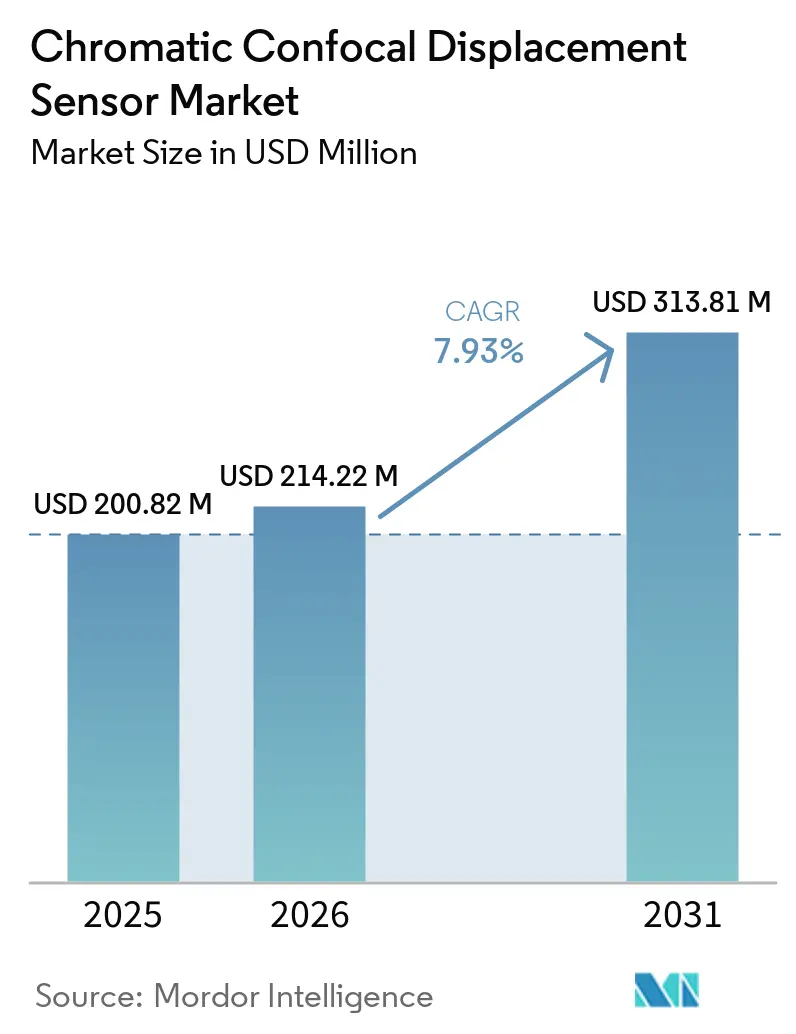
| Market Size (2026) | USD 214.22 Million |
| Market Size (2031) | USD 313.81 Million |
| Growth Rate (2026 - 2031) | 7.93 % |
| Fastest Growing Market | Asia-Pacific |
| Largest Market | Asia-Pacific |
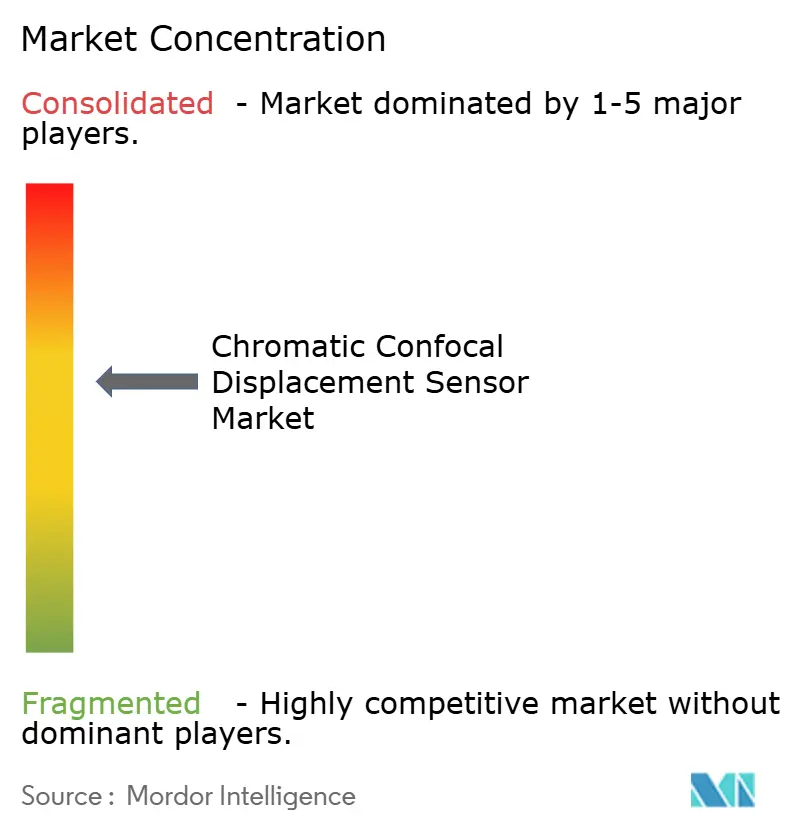
| Market Concentration | Medium |
Major Players *Disclaimer: Major Players sorted in no particular order Image © Mordor Intelligence. Reuse requires attribution under CC BY 4.0. | |
Chromatic Confocal Displacement Sensor Market Analysis by Mordor Intelligence
The Chromatic confocal displacement sensor market size was valued at USD 200.82 million in 2025 and estimated to expand from USD 214.22 million in 2026 to reach USD 313.81 million by 2031, at a CAGR of 7.93% during the forecast period 2026-2031. Demand is centered on non-contact measurement in semiconductor fabrication, battery production, precision optics, and other processes where surface tolerances are tight and reliable surface data is essential. Smaller device features, transparent materials, and more layered components increase the need for repeatable surface profiling that contact methods and standard triangulation tools cannot consistently provide. Public and private semiconductor investment also supports a longer pipeline for metrology purchases, including European initiatives and Intel’s planned expansion in Ireland, where advanced manufacturing capacity is being added. Suppliers are competing on controller capability, software integration, calibration support, and application engineering rather than hardware specifications alone, because customers need production-ready systems instead of isolated components. The Chromatic confocal displacement sensor market also faces exposure to semiconductor capital spending cycles, high system costs, integration complexity, and the limited availability of optical metrology specialists in emerging manufacturing locations.
Key Report Takeaways
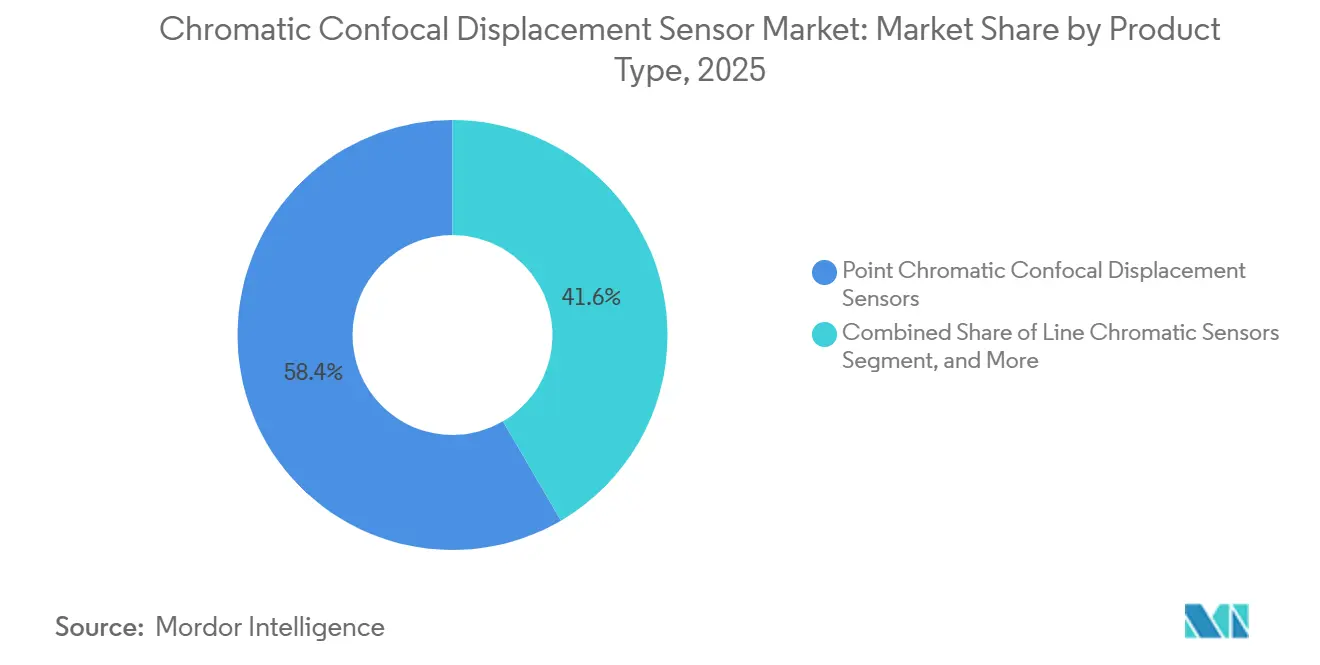
- By product type, point sensors held 58.41% of the chromatic confocal displacement sensor market share in 2025, while multi-point sensors are projected to expand at an 8.34% CAGR through 2031.
- By technology, multi-wavelength detection held 46.71% share in 2025, while wavelength-swept detection is projected to expand at an 8.14% CAGR through 2031.
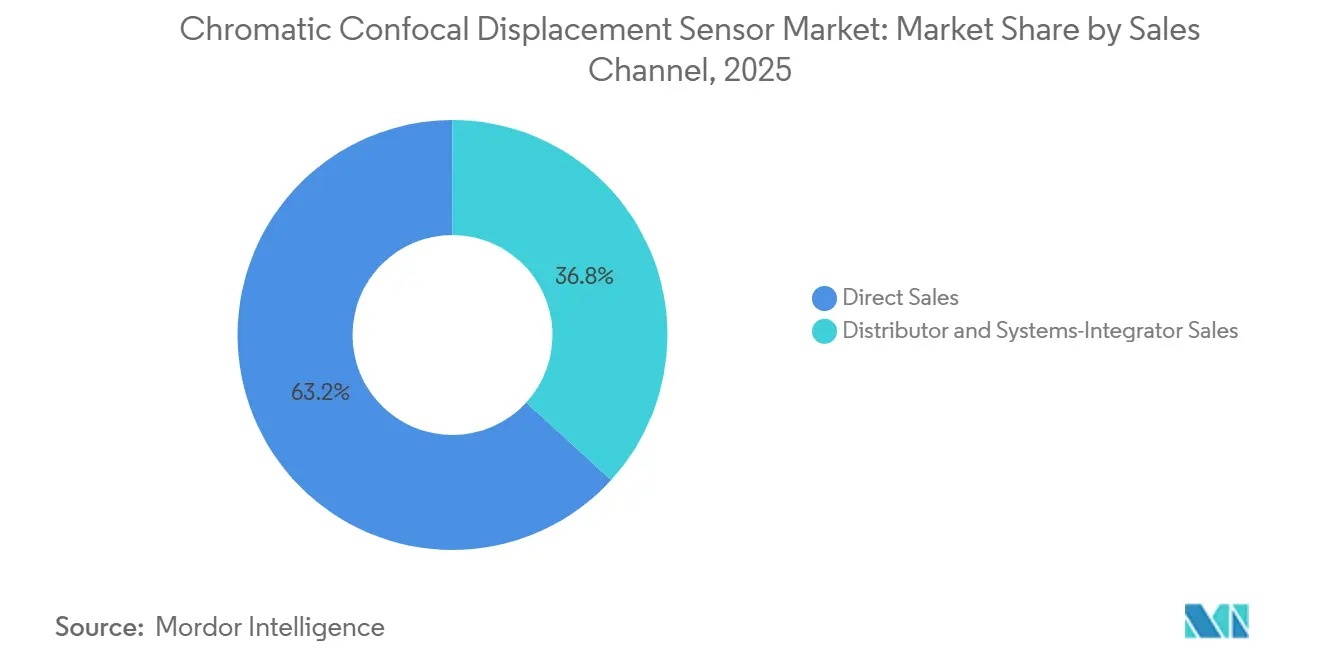
- By sales channel, direct sales held 63.21% share in 2025, while distributor and systems-integrator sales are projected to expand at an 8.26% CAGR through 2031.
- By end-user industry, semiconductor manufacturers held 31.81% share of the chromatic confocal displacement sensor market in 2025, while general manufacturing and industrial automation are projected to expand at an 8.33% CAGR through 2031.
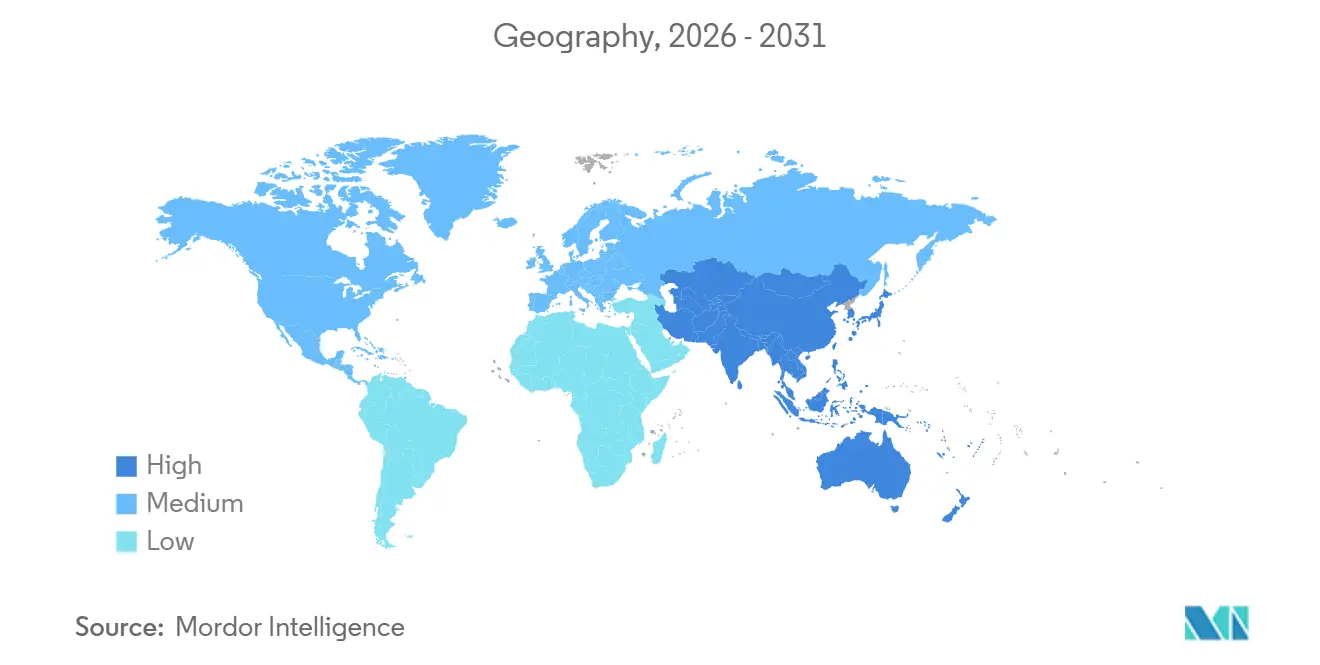
- By geography, Asia-Pacific held 44.61% global share in 2025 and is projected to expand at an 8.42% CAGR through 2031.
Note: Market size and forecast figures in this report are generated using Mordor Intelligence’s proprietary estimation framework, updated with the latest available data and insights as of January 2026.
Global Chromatic Confocal Displacement Sensor Market Trends and Insights
Drivers Impact Analysis*
| Driver | (~) % Impact on CAGR Forecast | Geographic Relevance | Impact Timeline |
|---|---|---|---|
| Semiconductor Wafer Metrology and Process-Control Expansion | +2.1% | Global, concentrated in Asia-Pacific and Europe | Long term (≥ 4 years) |
| Inline Quality Control for Transparent and Reflective Materials | +1.5% | Global, strongest in Asia-Pacific electronics and display manufacturing and European precision optics | Medium term (2-4 years) |
| Industry 4.0 Integration and Closed-Loop Automation | +1.4% | Global, with North America and Europe leading adoption and Asia-Pacific scaling rapidly | Medium term (2-4 years) |
| EV Battery Electrode and Cell-Assembly Inspection | +1.0% | Asia-Pacific core, with demand extending to Europe | Short term (≤ 2 years) |
| Non-Contact Metrology for Biomedical and Medical Devices | +0.6% | North America and Europe, with emerging Asia-Pacific medical manufacturing hubs | Long term (≥ 4 years) |
| Localized Multi-Point Inspection for Complex Geometries | +0.5% | North America, Europe, and Japan | Medium term (2-4 years) |
| Source: Mordor Intelligence | |||
Semiconductor Wafer Metrology and Process-Control Expansion
Advanced packaging requires measurement systems that can assess increasingly small structures across large wafers in the Chromatic confocal displacement sensor market. Hybrid bonding, fan-out wafer-level packaging, and through-silicon-via stacks have reduced interconnect pitches to single-digit microns. These processes require repeatable surface and depth measurements across 300 mm substrates during production, often at throughput speeds that inspection teams must sustain. Research in 2025 reported backside-illumination chromatic confocal sensing at a 1,560 nm wavelength inside 3D integrated circuits. The work achieved 72.3 nm repeatability on 534.2 µm silicon wafers and mapped copper-filled through-silicon-via depths.[1]Haoran Zhu et al., “Backside Illumination-Enabled Metrology and Inspection Inside 3D-ICs Using Frequency Comb-Based Chromatic Confocal and Spectral Interferometry,” Light: Advanced Manufacturing, light-am.com. The result supports the use of the Chromatic confocal displacement sensor market in buried-structure inspection for high-bandwidth memory and advanced chip packaging, where conventional surface tools have limited reach.
Inline Quality Control for Transparent and Reflective Materials
Display glass, optical coatings, semiconductor dielectrics, and polymer films can be difficult to inspect with contact gauges or standard laser triangulation tools. Polished surfaces can saturate triangulation signals, while contact gauges can introduce contamination in cleanroom work. Chromatic confocal systems measure the reflected focal wavelength rather than relying on reflected intensity or angle, bypassing both of these limitations on difficult materials. Precitec’s CHRocodile CVC supports throughput of up to 280 Mpixels per second for inline inspection of wafer dicing, consumer electronics, and glass defects. A 2026 study described a divided-pupil configuration that improved line-scanning accuracy on steep surface features.[2]Weiguang Yang et al., “Divided-Pupil Hybrid Configuration for Accuracy Enhancement in Line-Scanning Chromatic Confocal Measurement,” Optics and Laser Technology, sciencedirect.com. These capabilities support wider use across glass-edge, display-panel, and reflective-surface inspection as the Chromatic confocal displacement sensor market reaches manufacturers in Southeast Asia and India.
Industry 4.0 Integration and Closed-Loop Automation
Connected measurement points within automated quality control increasingly support the Chromatic confocal displacement sensor market. Integration with manufacturing execution systems and statistical process control software can convert a measurement result into a process-correction signal. This approach can reduce manual intervention and provide faster feedback when process conditions shift, turning periodic quality audits into real-time correction triggers. Micro-Epsilon introduced the IFC2412 and IFC2417 two-channel controllers in February 2026 with 2 nm resolution and Ethernet-native outputs for EtherCAT, PROFINET, and EtherNet/IP.[3]Micro-Epsilon Messtechnik GmbH and Co. KG, “New Possibilities in Confocal Measurement Technology,” Micro-Epsilon, micro-epsilon.com. The controllers support sampling rates of up to 25 kHz and can simplify connection to industrial automation platforms. Merck KGaA opened a EUR 20 million (USD 22 million) facility in Saint-Ismier, France, in May 2026, expanding its metrology tool production capacity fivefold.
EV Battery Electrode and Cell-Assembly Inspection
Lithium-ion battery production has added a large use case for the Chromatic confocal displacement sensor market and non-contact thickness inspection. Electrode coating tolerances of ±1 µm to ±3 µm during calendering can exceed the practical range of eddy-current or capacitive gauges on non-conductive and multilayer materials. A 2025 study from the Karlsruhe Institute of Technology tested dual-sided Precitec CHRocodile 2 DPS sensors during battery-electrode drying. The sensor heads tracked electrode thickness with sub-1 µm accuracy despite substrate-belt vibration of up to 30 µm. Micro-Epsilon reported in August 2026 that its thicknessCONTROL systems had completed 12 months of continuous inline operation at the UK Battery Industrialization Center.[4]Micro-Epsilon Messtechnik GmbH and Co. KG, “UKBIC Validates Micro-Epsilon Inline Battery Foil Thickness Technology After 12 Months of Successful Operation,” Micro-Epsilon, micro-epsilon.co.uk. The systems achieved ≤0.3 µm accuracy on industrial-scale calendering lines and supported anode-cathode material matching for improved cell NP ratio control.
Restraints Impact Analysis*
| Restraint | (~) % Impact on CAGR Forecast | Geographic Relevance | Impact Timeline |
|---|---|---|---|
| High System Cost and Total Cost of Ownership | -1.2% | Global, most acute in South America, Africa, and Southeast Asia outside leading electronics clusters | Short term (≤ 2 years) |
| Integration and Calibration Complexity | -0.8% | Global, strongest among general manufacturing small and mid-size enterprises without metrology staff | Medium term (2-4 years) |
| Skilled Optical-Metrology Talent Shortage | -0.6% | Global, most severe in the Middle East and Africa and emerging Asia-Pacific markets | Long term (≥ 4 years) |
| Broadband-Source Stability and Speed-Accuracy Trade-Offs | -0.4% | Global, especially in high-volume and high-speed production | Long term (≥ 4 years) |
| Source: Mordor Intelligence | |||
High System Cost and Total Cost of Ownership
A full chromatic confocal system in the Chromatic confocal displacement sensor market includes an optical head, controller, application software, and engineering support. Its acquisition cost is higher than laser triangulation and capacitive sensing systems. Calibration artifacts, maintenance contracts, and specialist staffing increase the total cost over the operating life of the equipment. A 2024 peer-reviewed review identified broadband-source stability and spectral recalibration as recurring operating considerations in chromatic confocal systems. Manufacturers with moderate tolerance requirements may choose lower-cost alternatives when they can meet the required measurement range, especially outside semiconductor and automotive supply tiers. This constraint is strongest where capital-equipment return thresholds are strict and established metrology infrastructure is limited.
Integration and Calibration Complexity
These sensors in the Chromatic confocal displacement sensor market require careful optical alignment, environmental control, and signal-processing settings. Certified calibration artifacts that are traceable to national standards are routine in semiconductor plants but harder to arrange in smaller manufacturing operations. OMRON’s 2025 technical publication described a fiber coaxial displacement sensor architecture for thickness measurement. However, multi-channel implementations still need coordination with production controllers, robot signals, and upstream vision systems. Engineers who are familiar with contact gauges also need training to interpret spectral waveform data. Documentation and uncertainty requirements for aerospace and medical-device work can lengthen deployment cycles in the Chromatic confocal displacement sensor market, particularly where ISO 17025-accredited laboratory support is required.
*Our forecasts treat driver/restraint impacts as directional, not additive. The impact forecasts reflect baseline growth, mix effects, and variable interactions.
Segment Analysis
By Product Type: Point Sensors Lead, Multi-Point Configurations Gain Ground
Point sensors held 58.41% share of the product-type segment in 2025. They are established in wafer inspection, precision surface profiling, and optical coating thickness measurement, where sub-nanometer readings meet established quality procedures. A single-point measurement meets many quality requirements without the mechanical complexity of multi-channel systems. Their simpler optics support cleanroom qualification, mature use of fiber-optic cables, and familiar procurement specifications for experienced metrology teams. Fiber-optic compatibility also avoids heat generation at the sensor head.
Multi-point systems in the Chromatic confocal displacement sensor market are projected to expand at an 8.34% CAGR through 2031. They collect data at several locations simultaneously for battery bipolar plates, advanced-package warpage, and turbine blade tip-clearance inspection, where sequential collection would delay production decisions. Sequential point scanning can be too slow for these applications. A June 2026 study presented an 8 mm by 3 mm probe with an axial range above 150 µm. A 2025 study also reported a 1 mm-diameter metalens sensor with switchable measurement modes.



By Technology: Multi-Wavelength Platforms Anchor Precision, Swept Sources Accelerate
Multi-wavelength detection held 46.71% share of the Chromatic confocal displacement sensor market technology segment in 2025. It supports high-precision measurement of single surfaces through simultaneous acquisition at several discrete wavelengths. This approach supports onboard chromatic correction and repeatability linked to calibrated wavelength standards, which remain important in semiconductor and precision-optics work. It also has a mature calibration ecosystem, broad third-party controller compatibility, and a substantial body of published application evidence. Single-wavelength detection remains relevant for cost-sensitive glass-container and consumer-plastics inspection.
The wavelength-swept Chromatic confocal displacement sensor market size is projected to expand at an 8.14% CAGR through 2031. Swept-source systems map a continuous spectrum to depth and can extend measurement range without reducing high resolution across surfaces with large height variation. A 2026 Applied Optics paper reported a 1,030 µm axial range with 10 nm resolution. The study reported a maximum displacement error of 0.06 µm. This capability is relevant to advanced semiconductor packaging and mold-cavity measurement, where previous discrete multi-wavelength designs had more limited range.
By Sales Channel: Direct Model Anchors High-Value Sensor Deployments
Direct sales held 63.21% share of the sales-channel segment in 2025. Large installations require specialists who understand production-line mechanics, cleanroom qualification, software integration, and application-specific calibration requirements. This support is important for semiconductor and medical-device customers. Direct vendors can supply proprietary software, manufacturing execution system and statistical process control links, service, recalibration, and upgrade support. Qualification, traceability documentation, and local service coverage also reinforce direct engagement.
Distributor and systems-integrator sales in the Chromatic confocal displacement sensor market are projected to expand at an 8.26% CAGR through 2031. These channels serve general manufacturers that need packaged deployment, local engineering support, and faster implementation rather than stand-alone measurement products. Integrators can combine sensors with robotic handling, machine vision, and statistical process control software. The approach can shorten deployment for organizations without optical metrology specialists by reducing the coordination burden across several equipment providers. It is expanding in Southeast Asia, South America, and India through local automotive and electronics relationships.
By End-User Industry: Semiconductor Anchors the Base, Automation Accelerates Fastest
Semiconductor manufacturers held 31.81% share of the end-user segment in 2025. They inspect wafer bow, layer thickness, die tilt, passivation steps, and bonding surfaces within complex wafer and package production flows. Complex 2.5D and 3D structures introduce additional measurement steps in production without requiring suppliers to find entirely new end customers. Electronics and display manufacturers use these systems for OLED-panel inspection and display-glass thickness checks. Automotive and aerospace users apply them to blade tips, painted surfaces, and fuel-injector bores.
General manufacturing and industrial automation in the Chromatic confocal displacement sensor market is projected to expand at an 8.33% CAGR through 2031. Lower controller costs, Ethernet-native interfaces, and regional systems integrators reduce deployment barriers beyond the semiconductor applications that drove early adoption. The FDA’s Quality Management System Regulation took effect on February 2, 2026, and incorporates ISO 13485:2016 by reference. Documented non-contact measurement supports compliance for implant surfaces and precision-machined components. Quality-control laboratories and R&D institutions remain early adopters, while photovoltaics, consumer electronics, and food packaging add a wider long-tail demand base.
Geography Analysis
Asia-Pacific held 44.61% global share in 2025 and is projected to expand at an 8.42% CAGR through 2031. A concentration of semiconductor foundries, advanced display plants, and EV battery gigafactories supports the Chromatic confocal displacement sensor market across multiple precision manufacturing supply chains. China has demand across electrode coating, calendering, and slitting inspection, creating a base that is less dependent on semiconductor procurement alone. South Korea adds memory and display production. Japan contributes precision optics and automotive supply capabilities.
ASEAN electronics assembly hubs add another base for deployment. North America supports the Chromatic confocal displacement sensor market through advanced research institutions, aerospace and defense component inspection, and pharmaceutical manufacturing metrology. Europe is supported by public semiconductor investment, Germany’s automotive supply chain, Italy’s precision machinery sector, and France’s semiconductor-equipment cluster. The European Commission describes the European Chips Act as a framework for regional capacity and investment. Merck KGaA opened a metrology and inspection facility near Grenoble in May 2026.
Intel announced a EUR 5 billion (USD 5.7 billion) investment for its Leixlip campus in July 2026. South America, the Middle East, and Africa, and smaller geographies held a limited combined share in 2025. Brazil, Saudi Arabia, and the United Arab Emirates support selective industrial automation and manufacturing-diversification demand across smaller application bases. Limited calibration infrastructure and shortages of metrology specialists constrain adoption outside established manufacturing centers.

Competitive Landscape
The Chromatic confocal displacement sensor market is moderately consolidated among technology-leading suppliers. Keyence Corporation, Micro-Epsilon Messtechnik GmbH and Co. KG, and Precitec Optronik GmbH have established positions. Their strengths include layered patent portfolios, proprietary controller designs, and application-engineering expertise in demanding production environments. Suppliers also compete through software ecosystems, calibration tools, statistical process control integration, and post-sale recalibration services delivered through one engagement. These services can make replacement difficult after a production line is qualified in the Chromatic confocal displacement sensor market.
Chinese manufacturers are developing lower-cost point-sensor systems for general manufacturing and battery coating in the Chromatic confocal displacement sensor market. This strategy addresses price-sensitive volume applications while avoiding direct competition in high-margin semiconductor and medical-device verticals with deeper qualification requirements. Micro-Epsilon launched two 2 nm-resolution controllers with Ethernet-native connectivity in February 2026. LMI Technologies presented the Gocator 4000 series for the Chromatic confocal displacement sensor market at Automate 2026 in May 2026. The series used coaxial line confocal technology for semiconductor, EV battery, and medical-device applications that require high-speed surface data, with 1.9 µm X-resolution and scan rates up to 36 kHz.
Researchers supported by Renishaw also demonstrated an 8 mm by 3 mm metasurface probe in June 2026. LMI Technologies reported a favorable patent infringement ruling against Hypersen Technologies in June 2025. The ruling shows that patents registered in China can be enforced against domestic competitors and can raise the cost of replication-based entry. A pre-engineered package of controllers, robot interfaces, statistical process control dashboards, and field calibration remains an opportunity for suppliers and integrators that lack direct factory-engineering scale.
Chromatic Confocal Displacement Sensor Industry Leaders
Keyence Corporation
Precitec Optronik GmbH
Micro-Epsilon Messtechnik GmbH & Co. KG
LMI Technologies Inc.
Marposs S.p.A.
- *Disclaimer: Major Players sorted in no particular order

Recent Industry Developments
- August 2026: Micro-Epsilon's thicknessCONTROL inline confocal chromatic sensor systems at the UK Battery Industrialization Center, UKBIC, in Coventry, passed their first annual recalibration after 12 months of continuous operation across three triple-track and one twin-track calendering line installations, achieving ≤0.3 µm system accuracy for anode and cathode electrode thickness measurement, establishing the first industrial-scale reference for precision inline battery electrode metrology at this accuracy level in the United Kingdom.
- July 2026: Intel announced a EUR 5 billion (USD 5.7 billion) capital investment to expand advanced logic chip production using Intel 3 and next-generation Intel Xeon nodes at its Leixlip campus in Ireland, a manufacturing commitment that will generate sustained procurement of metrology and process-control equipment, including non-contact surface measurement systems, across multiple production ramp cycles.
- May 2026: LMI Technologies unveiled the Gocator 4000 series smart 3D coaxial line confocal sensors at Automate 2026, with new Gocator 4011 and 4021 models delivering 1.9 µm X-resolution, ±85° slope angle, up to 5 mm field of view, and 36 kHz scan rates for demanding semiconductor, medical device, and EV battery manufacturing applications.
- May 2026: Merck KGaA, Darmstadt, Germany, opened a EUR 20 million (USD 22 million) Metrology and Inspection facility in Saint-Ismier, France, a 4,500 m² site in the Grenoble semiconductor cluster employing more than 100 specialists, expanding the company's metrology tool production capacity fivefold to serve growing demand from chip manufacturers requiring advanced packaging and heterogeneous integration inspection solutions.


Global Chromatic Confocal Displacement Sensor Market Report Scope
Chromatic Confocal Displacement Sensor Market refers to high-precision, non-contact optical sensors that use the chromatic confocal principle (white-light dispersion through specialized optics) to measure distance, displacement, thickness, and surface profile with sub-micron to nanometer-level resolution.
The Chromatic Confocal Displacement Sensor Market Report is Segmented by Product Type (Point Chromatic Confocal Displacement Sensors, Line Chromatic Confocal Displacement Sensors, and Multi-Point Chromatic Confocal Displacement Sensors), Technology (Single-Wavelength, Multi-Wavelength, and Wavelength-Swept), Sales Channel (Direct Sales, and Distributor/Systems-Integrator Sales), End-User (Semiconductor Manufacturers, Electronics and Display Manufacturers, Automotive and Aerospace Manufacturers, Medical-Device Manufacturers, General Manufacturing and Industrial Automation, Quality-Control Laboratories, Research and Development Institutions, and Other End-User Industries), and Geography (North America, South America, Europe, Asia-Pacific, and Middle East and Africa). The Market Forecasts are Provided in Terms of Value (USD).
| Point Chromatic Confocal Displacement Sensors |
| Line Chromatic Confocal Displacement Sensors |
| Multi-Point Chromatic Confocal Displacement Sensors |
| Single-Wavelength Detection |
| Multi-Wavelength Detection |
| Wavelength-Swept Detection |
| Direct Sales |
| Distributor and Systems-Integrator Sales |
| Semiconductor Manufacturers |
| Electronics and Display Manufacturers |
| Automotive and Aerospace Manufacturers |
| Medical-Device Manufacturers |
| General Manufacturing and Industrial Automation |
| Quality-Control Laboratories |
| Research and Development Institutions |
| Other End-User Industries |
| North America | United States | |
| Canada | ||
| Mexico | ||
| South America | Brazil | |
| Argentina | ||
| Rest of South America | ||
| Europe | Germany | |
| United Kingdom | ||
| France | ||
| Italy | ||
| Spain | ||
| Rest of Europe | ||
| Asia-Pacific | China | |
| Japan | ||
| India | ||
| South Korea | ||
| ASEAN | ||
| Rest of Asia-Pacific | ||
| Middle East and Africa | Middle East | Saudi Arabia |
| United Arab Emirates | ||
| Turkey | ||
| Rest of the Middle East | ||
| Africa | South Africa | |
| Nigeria | ||
| Rest of Africa | ||
| By Product Type | Point Chromatic Confocal Displacement Sensors | ||
| Line Chromatic Confocal Displacement Sensors | |||
| Multi-Point Chromatic Confocal Displacement Sensors | |||
| By Technology | Single-Wavelength Detection | ||
| Multi-Wavelength Detection | |||
| Wavelength-Swept Detection | |||
| By Sales Channel | Direct Sales | ||
| Distributor and Systems-Integrator Sales | |||
| By End-User Industry | Semiconductor Manufacturers | ||
| Electronics and Display Manufacturers | |||
| Automotive and Aerospace Manufacturers | |||
| Medical-Device Manufacturers | |||
| General Manufacturing and Industrial Automation | |||
| Quality-Control Laboratories | |||
| Research and Development Institutions | |||
| Other End-User Industries | |||
| By Geography | North America | United States | |
| Canada | |||
| Mexico | |||
| South America | Brazil | ||
| Argentina | |||
| Rest of South America | |||
| Europe | Germany | ||
| United Kingdom | |||
| France | |||
| Italy | |||
| Spain | |||
| Rest of Europe | |||
| Asia-Pacific | China | ||
| Japan | |||
| India | |||
| South Korea | |||
| ASEAN | |||
| Rest of Asia-Pacific | |||
| Middle East and Africa | Middle East | Saudi Arabia | |
| United Arab Emirates | |||
| Turkey | |||
| Rest of the Middle East | |||
| Africa | South Africa | ||
| Nigeria | |||
| Rest of Africa | |||


Key Questions Answered in the Report
What is the Chromatic confocal displacement sensor market size?
The market size was USD 214.22 million in 2026. It is forecast to reach USD 313.81 million by 2031, supported by a 7.93% CAGR across the forecast period.
Which product category leads chromatic confocal displacement sensing?
Point sensors led with 58.41% share in 2025. Their installed base reflects routine wafer inspection, precision surface profiling, and optical-coating thickness measurement requirements.
Which technology is expanding fastest in chromatic confocal sensing?
Wavelength-swept detection is projected to expand at an 8.14% CAGR through 2031. It can extend measurement range while retaining the resolution needed for complex component inspection.
Which end users are adopting chromatic confocal sensors?
Semiconductor manufacturers were the largest end-user group in 2025. General manufacturing and industrial automation is projected to expand fastest as integration barriers decline.
Why are these sensors used in battery manufacturing?
They support non-contact electrode thickness monitoring during drying and calendering. This includes applications that require sub-1 µm measurement accuracy despite production-line vibration and thermal conditions.
Which region leads demand for chromatic confocal displacement sensors?
Asia-Pacific led with 44.61% share in 2025. The region is projected to expand at an 8.42% CAGR through 2031, supported by semiconductor, display, and battery manufacturing capacity.
Page last updated on:





