
China Wire and Cable Market Size and Share
Market Overview
| Study Period | 2020 - 2031 |
|---|---|
| Forecast Data Period | 2026 - 2031 |
| Base Year Market Size (2025) | USD 13.01 Billion |
| Market Size (2026) | USD 13.78 Billion |
| Market Size (2031) | USD 17.78 Billion |
| Growth Rate (2026 - 2031) | 5.23 % |
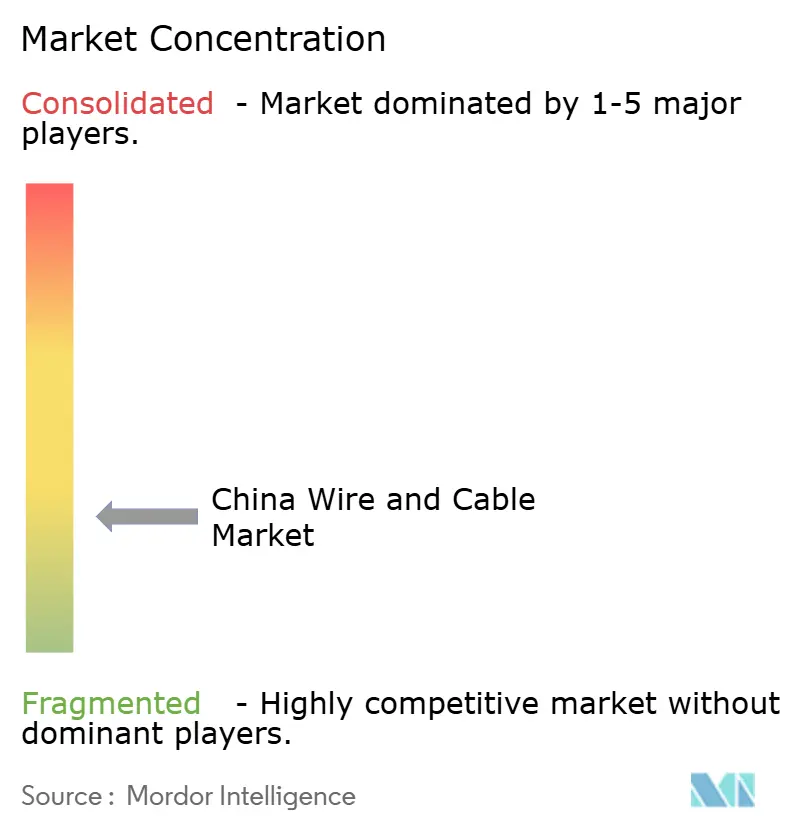
| Market Concentration | Low |
Major Players *Disclaimer: Major Players sorted in no particular order Image © Mordor Intelligence. Reuse requires attribution under CC BY 4.0. | |
China Wire and Cable Market Analysis by Mordor Intelligence
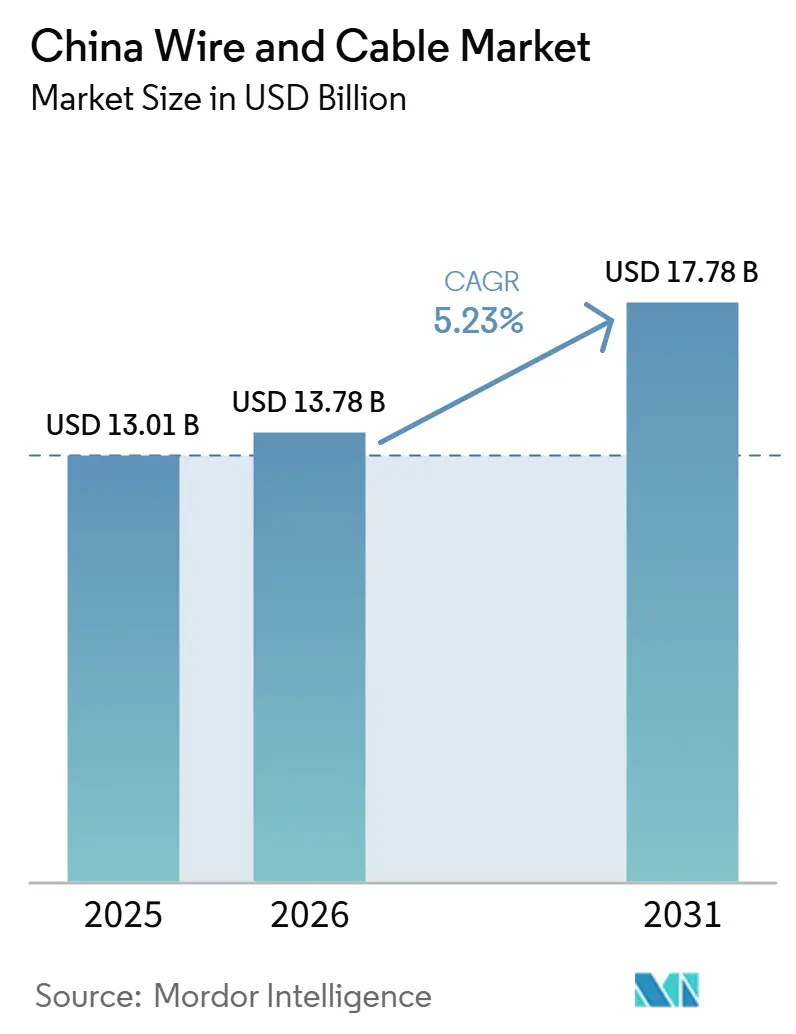
The China wire and cable market size was projected to expand from USD 13.01 billion in 2025 and USD 13.78 billion in 2026 to USD 17.78 billion by 2031, registering a CAGR of 5.23% between 2026 to 2031. Demand is supported by the 15th Five-Year Plan, which places grid modernization, renewable integration, and digital infrastructure among national priorities. State Grid Corporation of China announced a CNY 4 trillion grid investment program for 2026-2030, equivalent to USD 574 billion, that will create a longer procurement pipeline for high-voltage products. The China wire and cable market is also moving toward underground and submarine networks, where more demanding specifications increase cable value per kilometer. This shift favors suppliers that can meet testing, certification, and installation requirements. At the same time, material-price volatility and excess capacity in standard products continue to limit returns for less differentiated manufacturers.
Key Report Takeaways
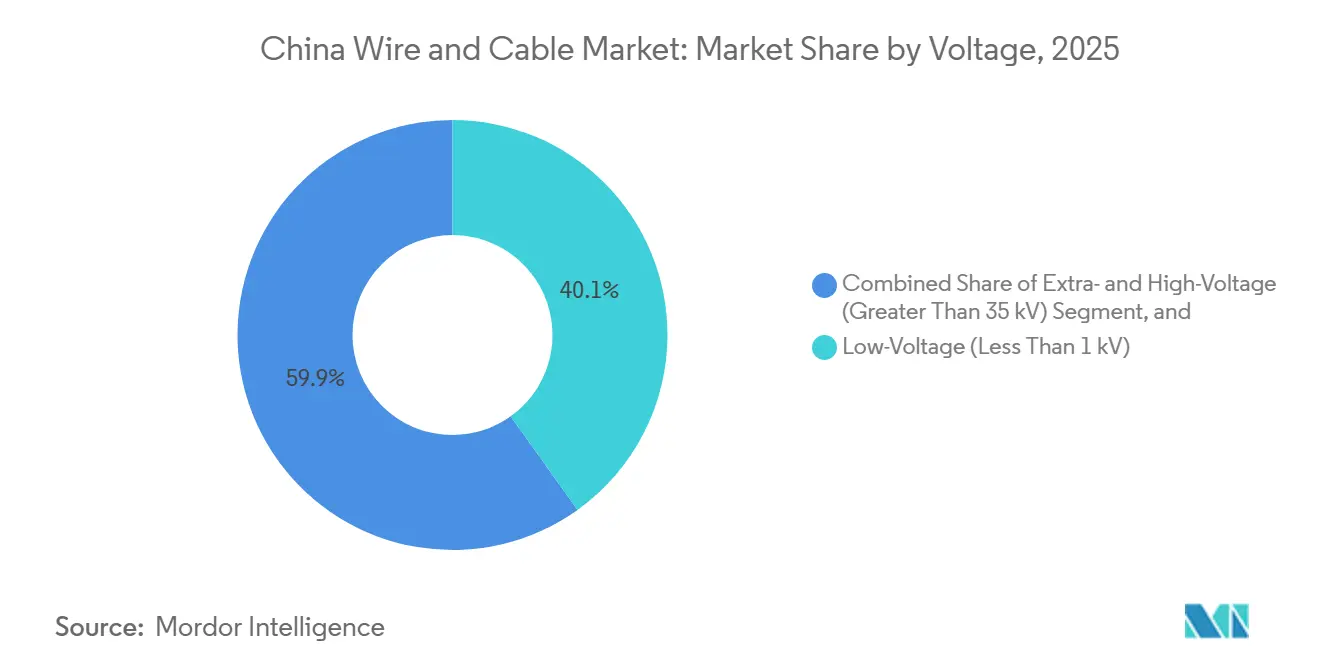
- By voltage, low-voltage cable held 40.12% revenue share in 2025, while extra- and high-voltage cable is projected to expand at a 7.12% CAGR through 2031.
- By cable type, power cable accounted for 32.12% of revenue in 2025, while fiber-optic cable is projected to expand at a 6.11% CAGR through 2031.
- By conductor material, copper conductor accounted for 50.11% of revenue share in 2025, while aluminum conductor is projected to expand at a 7.41% CAGR through 2031.
- By installation type, underground installations held 43.11% of the revenue share in 2025, while submarine installations are projected to expand at a 6.43% CAGR through 2031.
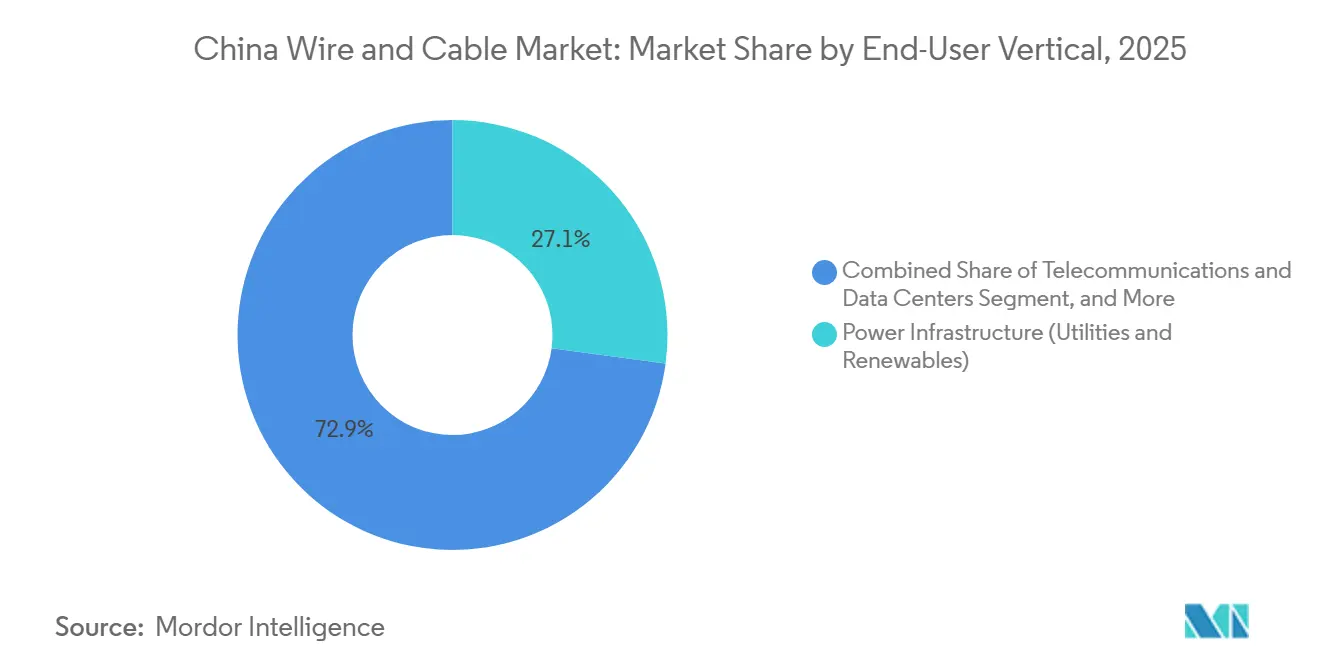
- By end-user vertical, power infrastructure, utilities, and renewables accounted for 27.11% of revenue in 2025, while telecommunications and data centers are projected to expand at a 7.65% CAGR through 2031.
- By insulation type, insulated cables accounted for 79.88% of revenue in 2025. No forecast CAGR was provided for the fastest-growing insulation segment.
Note: Market size and forecast figures in this report are generated using Mordor Intelligence’s proprietary estimation framework, updated with the latest available data and insights as of January 2026.
China Wire and Cable Market Trends and Insights
Drivers Impact Analysis*
| DRIVER | (~) % IMPACT ON CAGR FORECAST | GEOGRAPHIC RELEVANCE | IMPACT TIMELINE |
|---|---|---|---|
| Grid Modernization and UHV Transmission Buildout | +1.8% | National, with concentrated spending in west-to-east corridors from Xinjiang, Sichuan, and Shaanxi to Anhui and Guangdong | Short term (≤ 2 years) |
| Renewable Power and Offshore Wind Interconnection | +1.4% | Asia-Pacific coastal core, including Guangdong, Jiangsu, and Fujian, with deep-sea activity near Hainan and the Yellow Sea | Medium term (2-4 years) |
| Data Center, 5G-Advanced, and Industrial Internet Expansion | +0.9% | National, with early gains in Beijing-Tianjin-Hebei, the Yangtze River Delta, and inland computing hubs | Medium term (2-4 years) |
| Electric Vehicle and Rail Electrification | +0.6% | National, with concentrated rail demand in Sichuan-Chongqing, the Pearl River Delta, and the Yangtze River Delta | Short term (≤ 2 years) |
| Factory Automation, Robotics, and High-Flex Cable Adoption | +0.4% | Pearl River Delta and Yangtze River Delta manufacturing clusters | Medium term (2-4 years) |
| Replacement of Aging Urban Underground Networks | +0.3% | Tier-1 and Tier-2 cities, including Shanghai, Beijing, Shenzhen, and Chengdu | Long term (≥ 4 years) |
| Source: Mordor Intelligence | |||
Grid Modernization and UHV Transmission Buildout
Grid modernization is the main source of high-specification cable demand in the China wire and cable market. Each UHV direct-current line needs specialized cable systems that carry materially higher value per kilometer than conventional high-voltage wire. The Shaanbei-Anhui ±800 kV UHVDC project entered operation in June 2026 with CNY 20.50 billion in investment, a 1,055 km line length, and 8 million kW capacity. The project became the first UHVDC line placed in service during the 15th Five-Year Plan period. State Grid had 43 UHV projects in operation by mid-2026 and plans to commission 15 additional UHVDC lines by 2030. These projects require lengthy type testing and qualification, which can restrict participation to suppliers that already hold the required approvals.[1]“Shaanbei-Anhui ±800-Kilovolt UHVDC Transmission Project Begins Operation,” China Daily, chinadaily.com.cn
Renewable Power and Offshore Wind Interconnection
Offshore wind development is moving from nearshore sites to deeper waters, increasing the technical demands on submarine cables. China had 650 million kW of installed wind capacity in February 2026, and the national target calls for 100 GW of cumulative offshore wind capacity by 2030. The Yangjiang Qingzhou V and VII project deployed a 25,000-tonne offshore converter station in May 2026. The platform used ±525 kV DC submarine cables with 2,500 mm² conductor cross-sections. Deep-water projects require cable designs that can withstand sustained cyclic loads and high-current marine conditions. The China wire and cable market therefore offers greater contract value to suppliers that have qualified dynamic and high-voltage submarine products.[2]“World's Largest Offshore Converter Station to Break China's Deep-Sea Power Transmission Bottleneck,” Xinhua, news.cn
Data Center, 5G-Advanced, and Industrial Internet Expansion
Digital infrastructure is widening the range of cable products used in computing and telecommunications facilities. Telecommunications and data centers are forecast to be the fastest-growing end-user vertical, with a 7.65% CAGR through 2031. The underlying demand includes high-density power distribution, optical interconnection, and ruggedized outdoor fiber systems. The China wire and cable market also benefits when grid operators add optical ground wires and fiber sensing to transmission corridors. These applications connect power and communications procurement that historically sat in separate supply chains. Suppliers with qualified high-fiber-count and ultra-low-loss production lines can benefit when projects require more specialized cable configurations.
Electric Vehicle and Rail Electrification
Rail networks require contact wire, signaling cable, traction cable, and fiber assemblies that must meet defined performance standards. China XD Electric Group's XD Optical Cable won the CR450 contact-wire project for the Chengdu-Chongqing Middle Line with an ultra-high-strength copper-magnesium alloy product. The material was developed to reduce wear and extend operating life under high-speed contact conditions. Metro programs in more than 40 Chinese cities also support demand for medium-voltage traction and fiber backbone systems. Electric vehicles require charging and harness cables that withstand repeated bending cycles. These requirements make specialty cable grades less interchangeable with standard power cable products.[3]“China XD Electric's Optical Cable Wins Bid for Contact Wire Project on Chengdu-Chongqing Middle Line High-Speed Railway at 450 km/h,” Wedoany, wedoany.com
Restraints Impact Analysis*
| RESTRAINT | (~) % IMPACT ON CAGR FORECAST | GEOGRAPHIC RELEVANCE | IMPACT TIMELINE |
|---|---|---|---|
| Copper and Aluminum Price Volatility | -0.7% | National, most acute for mid-tier and small producers in Jiangsu, Zhejiang, and Guangdong clusters | Short term (≤ 2 years) |
| Low-End Overcapacity and Margin Compression | -0.5% | National, with high excess capacity in Jiangsu, Shandong, and Guangdong | Medium term (2-4 years) |
| Qualification Lead Times for Critical-Application Cables | -0.2% | National, limiting eligible bidders for UHV, nuclear, and offshore wind tenders | Long term (≥ 4 years) |
| Export Controls and Dependence on Selected Advanced Materials | -0.2% | Coastal and inland EHV producers that rely on specialty polymer and insulation materials | Medium term (2-4 years) |
| Source: Mordor Intelligence | |||
Copper and Aluminum Price Volatility
Copper accounted for more than 60% of cable production costs, leaving manufacturers exposed to sharp fluctuations in raw-material prices. Shanghai copper futures exceeded CNY 90,000 per metric ton at their 2024-2025 peak before retreating. Fixed-price contracts can compress margins when manufacturers buy material at elevated prices before deliveries are completed. A producer consuming 100 metric tons of copper per month faces CNY 100,000 in additional monthly cost for every CNY 1,000-per-ton increase in copper prices. This equals CNY 1.2 million on an annualized basis, while standard products often carry net margins of 3-6%. Aluminum substitution offers a partial solution, but qualifying high-voltage aluminum conductors takes time and capital that smaller suppliers may not have.
Low-End Overcapacity and Margin Compression
Standard low- and medium-voltage cable categories have excess manufacturing capacity, especially for PVC and standard XLPE grades. The input estimates that capacity in these categories exceeded domestic demand by 20-30%. Small and medium-sized producers operated at 50-65% utilization, compared with 70-85% for Tier-1 producers. This gap can encourage bids below sustainable cost levels, particularly in routine product categories. Lower prices can also create quality risks when suppliers reduce conductor size or insulation thickness. The Ministry of Industry and Information Technology has promoted a shift toward higher-quality competition, stricter traceability, and reduced support for inefficient capacity, which may speed consolidation over time.
*Our forecasts treat driver/restraint impacts as directional, not additive. The impact forecasts reflect baseline growth, mix effects, and variable interactions.
Segment Analysis
By Voltage: Ultra-High-Voltage Lines Redefine the Revenue Mix
Extra- and high-voltage cable is projected to grow at a 7.12% CAGR from 2026 to 2031, the highest rate across the voltage categories. The segment is tied to planned UHVDC additions and cross-regional transmission expansion. These systems require cables that meet high-voltage, thermal, and reliability requirements. Qualification periods of 18-36 months can limit the supplier pool for critical projects. This supports a better pricing position than in conventional cable categories. The economic benefit comes from the combination of higher material and engineering content, limited approval status, and the consequences of failure in a transmission network. Suppliers cannot secure this work solely by increasing factory output, because customers also assess testing records, reference projects, system compatibility, and the ability to maintain consistent quality over long delivery cycles. The China wire and cable market has therefore placed greater strategic weight on certified EHV capability. State Grid plans to add 15 UHVDC lines by 2030, providing a clear pipeline for this part of the business. The effect extends beyond the transmission line itself because converter stations, substations, network connections, monitoring equipment, and supporting distribution assets also require cable and wiring. Project timing can vary, but the program provides suppliers with a clearer basis for planning capacity, testing, product development, and customer qualification than does ordinary construction demand.[4]“Shaanbei-Anhui ±800-Kilovolt UHVDC Transmission Project Begins Operation,” China Daily, chinadaily.com.cn
Low-voltage cable held 40.12% of the China wire and cable market share in 2025, making it the largest voltage segment by revenue. Residential and commercial construction continued to provide the main volume base for the category. Urban housing activity moderated, but installed-building demand remained supportive of replacement and fit-out work. Standard building wire faced the strongest pressure from excess capacity. Net margins for routine products often remained within the 3-6% range. Updated fire-safety requirements increasingly favor halogen-free and low-smoke grades in public and commercial buildings. This change creates an opportunity for suppliers to meet GB/T requirements for flame resistance and smoke suppression. Buyers in this category increasingly balance unit price against certification, fire performance, installation conditions, and the need to avoid disruption when a building is occupied. That purchasing pattern does not remove competition in standard building wire, but it gives qualified suppliers a clearer route to defend value in public and commercial projects.



By Cable Type: Fiber-Optic Cables Gain Structural Momentum Beyond Telecom
The power cable segment held 32.12% revenue share in 2025 and remained the largest cable-type category. Demand came from grid operators, industrial facilities, and real-estate projects. The product group ranges from low-voltage building wire to specialized ±800 kV UHVDC systems. This broad scope means pricing and margin conditions differ sharply across applications. The premium end is growing faster than commodity products, which changes the average value reported for the group. Signal and control cable supports factory automation and process applications. Coaxial and data cable continues to serve broadcast and short-range structured cabling needs. Their demand is less dependent on the large transmission projects that shape the premium end of power cable, but these products remain part of routine communications and industrial installations. The contrast within cable types is important because a single revenue category combines products with very different procurement conditions, technical standards, and exposure to price competition.
Fiber-optic cable is projected to expand at a 6.11% CAGR through 2031, the fastest rate among cable types. The China wire and cable market size for fiber applications is supported by data center interconnection, smart-grid sensing, and optical ground wire integration. Optical ground wires allow transmission systems to combine electrical protection and communications functions. This increases coordination between power cable and fiber supply chains. The East Data, West Computing initiative also supports demand for trunk fiber routes between inland computing hubs and coastal data centers. Suppliers with integrated power and optical capabilities are better positioned to serve these combined requirements. The category becomes more relevant as digital infrastructure becomes a larger part of cable procurement. Fiber products must support high-capacity connections within facilities, longer-distance links between facilities, and sensing functions along grid assets, broadening the range of technical requirements. Operators also require dependable performance as traffic volumes rise and networks carry more critical computing and control functions. This places greater emphasis on production quality, cable design, and compatibility with the installation environment than in applications where basic connectivity is the only requirement. This broader application base reduces dependence on a single telecom use case and aligns optical demand more closely with power-system investment.
By Conductor Material: Aluminum Gains Ground as Copper Alternatives Scale Up
Copper conductor accounted for 50.11% of revenue in 2025, reflecting its role in applications that require high conductivity. It remained important for EHV systems, fine-wire electronics, and precision control products. Copper cable also carries a higher unit value than many aluminum alternatives. This price effect increases its share on a revenue basis. Optical glass and polymer conductors served a narrower role in fiber-optic cable and grid-monitoring applications. Their use supported telecommunications and sensing demand without representing a large share of the overall value pool. The established role of copper continued to define the material mix in high-performance applications. In these uses, reliability and electrical performance can outweigh the material-cost advantage of alternatives. Copper, therefore, remains central where product failure has high operational consequences, while aluminum adoption progresses where technical requirements allow substitution, and lower conductor cost has a more direct influence on purchasing decisions.
The aluminum conductor market is projected to grow at a 7.41% CAGR from 2026 to 2031. Higher copper prices made aluminum more attractive in medium-voltage distribution and selected high-voltage applications. Aluminum alloy conductors can reduce material costs by more than 30% compared with copper for relevant applications. They also offer weight advantages for overhead lines and submarine installations. Far East Smarter Energy delivered China’s first 66 kV aluminum-core submarine cable in 2025. The project showed that aluminum could be used in a higher-voltage submarine setting that had previously relied on copper. This development expands the addressable application base, though engineering qualification remains essential. Material substitution is not automatic because operating voltage, thermal behavior, cable weight, jointing practices, and project acceptance standards still determine whether aluminum is appropriate. Producers that can demonstrate performance in these conditions can address cost-sensitive projects without abandoning the higher-performance requirements of the application. The transition is likely to be selective rather than uniform, because the best material choice remains tied to the voltage class, route conditions, conductor size, system design, and customer specifications. That selective adoption can still create a meaningful growth path for qualified aluminum products.
By Installation: Submarine Cables Emerge as the High-Value Growth Frontier
Underground installation accounted for 43.11% of revenue share in 2025, making it the largest installation mode. Replacement of overhead distribution networks in major cities continued to support procurement. Underground EHV systems in dense urban areas cost more per kilometer than overhead alternatives in rural areas. This helps explain why the segment's value contribution exceeds its likely volume contribution. Overhead installation remained necessary in rural areas and long-distance transmission corridors. Conversion is less economical where land availability is greater, and network density is lower. The China wire and cable market continues to benefit from targeted underground upgrades in Tier-1 and Tier-2 cities. City projects often involve constrained construction environments, existing utilities, traffic management, and service-continuity requirements that are not present on open rural routes. These conditions add engineering complexity and can increase the value of products designed for compact installation, reliable joints, and longer service life.
Submarine installation is projected to expand at a 6.43% CAGR through 2031, the fastest installation category. Offshore wind farms and cross-sea interconnection projects are driving this growth. These projects require products that can withstand high pressure, corrosion, and mechanical movement. The relevant cable systems also have limited qualified suppliers and demanding installation requirements. The ±525 kV XLPE DC submarine cable is a key technology frontier for the category. European suppliers had made commercial deliveries from 2023-2024, while Chinese manufacturers were approaching initial engineering delivery in 2026-2027. Domestic technical progress may strengthen local participation in higher-value projects. Cable supply alone is not sufficient in many offshore contracts, as route design, marine handling, installation equipment, testing, and repair capability all affect project execution. Suppliers that pair qualified products with installation capacity can compete for a wider portion of the contract while reducing coordination risk for project owners. The installation stage is particularly important because cable damage, seabed conditions, weather windows, and vessel availability can affect both schedule and long-term reliability. Experience across manufacturing and installation can therefore become a material factor in supplier selection for larger offshore developments.
By End-User Vertical: Digital Infrastructure Emerges as the Fastest-Growing Demand Source
Power infrastructure, utilities, and renewables accounted for 27.11% of the China wire and cable market share in 2025. The segment remained the largest end-user vertical because it combines grid investment with new renewable capacity. Onshore and offshore renewable assets require collection systems, export cables, substations, and supporting control wiring. Industrial manufacturing was another major source of high-volume demand, supported by automation investment. Residential construction continued to consume standard cable products but remained more sensitive to property-market conditions. Oil, gas, and petrochemical facilities formed a stable niche where durability and fire resistance are important. These specifications can support more disciplined pricing than in standard construction cable. Facilities in these sectors must consider heat, fire, chemical exposure, mechanical stress, and operating continuity when selecting cable systems. This narrows the number of acceptable products and makes quality assurance more relevant to the buying decision than it is for routine, high-volume construction cable.
Telecommunications and data centers are projected to grow at a 7.65% CAGR through 2031. AI training and inference workloads require higher-density power and data connectivity within computing facilities. New data center campuses require high-voltage facility supply and high-fiber-count internal cabling. The 5G+ Industrial Internet program also supports demand for outdoor fiber cable in industrial zones and smart-city projects. Energy-efficiency requirements encourage the selection of low-loss cable grades in new facilities. This creates a more specialized demand profile than traditional structured cabling. The fastest growth is therefore associated with digital infrastructure rather than conventional telecom backhaul alone. Customers in this segment need cable systems that support electricity delivery, data transmission, operating reliability, and energy management within the same facility. This makes product selection more specification-led and gives suppliers an incentive to develop offerings for computing environments rather than relying only on conventional communications demand. Computing customers may assess product reliability alongside installation density, power use, operating temperatures, maintenance access, and the need to scale capacity over time. This favors manufacturers that understand how cable systems operate within the broader design of a digital facility.
By Insulation: Insulated Cable Dominates, Specialty Fire-Rated Grades Drive Value
Insulated cable held 79.88% revenue share in 2025, reflecting its necessary use in construction, energy, and industrial applications. Electrical safety requirements generally require conductors to be suitably protected. The segment, therefore, tracks broad demand across most cable end uses. Fire-retardant, low-smoke, and halogen-free requirements add value within the category. These specifications are increasingly relevant in public buildings, commercial projects, tunnels, and transit infrastructure. Non-insulated cable retained a narrower role in overhead high-voltage lines and grounding applications. Its relative position may weaken as urban networks move toward underground systems. Even so, non-insulated products remain necessary where overhead transmission and grounding are the most practical solutions. The change is therefore one of relative mix rather than the disappearance of a product category, with urban safety and land-use considerations shifting more spending toward protected cable systems.
The internal mix of insulated cable is shifting toward higher-performance formulations. XLPE remained important in EHV and high-voltage power cables. Low-smoke halogen-free compounds gained use where public safety and smoke control are central requirements. Revised fire-safety codes supported movement away from conventional PVC formulations in selected public and commercial projects. This change can displace some conventional cable volume while adding demand for qualified specialty capacity. Manufacturers with established LSZH production capability can respond more readily to the updated specifications. The broad insulated category remains dominant, but performance requirements increasingly determine where value is created. Product selection now depends more clearly on installation location, fire risk, smoke-control requirements, and the consequences of cable failure in public or high-occupancy spaces. As these conditions become more important, manufacturers with tested formulations and consistent quality control can be better placed than suppliers focused only on standard PVC volume. Compliance is not solely a formulation issue, as the finished product must maintain expected performance throughout manufacturing, handling, installation, and operation. Customers in regulated settings can therefore place greater value on proven product documentation and dependable supply than on the lowest initial bid.
Geography Analysis
East China remained a major manufacturing and demand base for the China wire and cable market. Jiangsu, Zhejiang, and Shanghai formed the center of this regional position. Jiangsu hosted concentrated production clusters in Yixing, Yangzhou, and Wuxi. These locations supplied power, fiber-optic, and specialty submarine cable for domestic projects. The clusters supported the Jiangsu Dafeng offshore wind project, which had 800 MW capacity and was China’s most distant offshore installation at the time. They also supplied several UHV corridor projects linked to the Yangtze River Delta. The East Data, West Computing initiative added demand for high-fiber-count trunk routes serving the region. East China, therefore, combines a dense manufacturing supply base with demand from offshore energy, transmission systems, commercial construction, and digital connectivity. Its established industrial clusters also help manufacturers coordinate with component suppliers, project contractors, and equipment producers, which remains important when projects require specialized cable design and timely delivery. This regional concentration can shorten communication between parties responsible for materials, manufacturing, testing, and installation planning. It also provides suppliers with experience across several end uses, including grid work, offshore energy, telecommunications, and construction, rather than limiting regional demand to a single customer group.
South China supported the most active offshore cable demand, led by Guangdong. The Yangjiang cluster required 66 kV and ±500 kV DC submarine cables, HVDC export cables, and dynamic cables for floating platforms. The region also received power from cross-sea and west-to-east transmission systems serving the Greater Bay Area grid. The China wire and cable market size in South China also benefits from data center growth across the Pearl River Delta. These facilities require structured cabling and medium-voltage distribution systems. Guangdong’s manufacturing base also allows producers to work closely with equipment suppliers and offshore project developers. The concentration of renewable and digital projects supports demand for specialized cable systems. Offshore projects involve electrical export, collection, and control requirements, while data center projects combine incoming power supply with internal communications infrastructure. This overlap does not make product requirements identical, but it gives regional suppliers exposure to several forms of higher-specification demand beyond routine building-wire procurement. It also makes project scheduling and supply reliability more important, because equipment, cable, and installation activities must be coordinated across several parts of the same infrastructure program.
North China and western provinces were connected by UHV transmission corridors that require EHV cable and control wiring. Shaanxi, Xinjiang, Sichuan, and Yunnan supplied renewable power into west-to-east transmission systems. The Xizang-Guangdong UHV project involved CNY 53.2 billion in investment, equal to USD 7.76 billion. The project illustrates the scale of transmission infrastructure crossing Western provinces. Beijing, Tianjin, and major Shandong cities also supported medium- and high-voltage underground conversion programs. These city projects sought stronger grid resilience and less visible overhead infrastructure. The regional demand base, therefore, combines long-distance transmission with upgrades to urban distribution. Source provinces need cable around converter stations, substations, and local distribution systems, while receiving regions need infrastructure to connect imported power to dense load centers. This combination spreads demand across several project stages and supports products ranging from EHV cable to monitoring, control, and underground distribution systems.
Competitive Landscape
The China wire and cable market has a divided competitive structure. Thousands of small and mid-sized manufacturers compete in routine cable categories. These businesses typically have limited product differentiation and face pressure to compete on price. Domestic suppliers lead a smaller specialty tier with EHV, submarine, and industrial cable capability. Hengtong Optic-Electric, Jiangsu Zhongtian Technology, Far East Smarter Energy, and Ningbo Orient Wires and Cables are among the domestic companies active in these applications. Prysmian S.p.A. and Nexans S.A. selectively pursue projects that require international third-party certification. The two tiers face different margins, qualification requirements, and contract values. Commodity suppliers rely more on manufacturing efficiency, local customer relationships, and pricing, while specialty suppliers must demonstrate technical performance and project-delivery capability. This distinction explains why the sector can appear fragmented overall, even though a much smaller group of companies competes for high-specification contracts. Buyers of routine products can select from many local manufacturers, while buyers of UHV, submarine, nuclear, or advanced data-center cable must consider a narrower list of suppliers that have completed the appropriate technical qualifications. The number of manufacturers alone does not therefore describe competitive conditions in every product category.
Leading domestic suppliers have shifted their portfolios toward EHV, submarine, and specialty industrial cable. They have pursued type-test approvals at higher voltage levels and invested in marine installation capacity. This approach combines cable design, manufacturing, and project delivery. It resembles the project-scope strategy used by established European suppliers. Jiangsu Zhongtian Technology completed ±525 kV submarine cable type testing in 2025. The milestone indicated that the gap between domestic and international suppliers of ultra-high-voltage submarine cables was narrowing. Initial domestic engineering delivery was expected in the 2026-2027 period. The move toward integrated delivery also reflects the practical demands of submarine work, where cable design must be aligned with transport, laying, testing, and long-term service requirements. Companies that invest across this chain can offer a more complete project solution, although the needed capital and qualifications can raise the threshold for new entrants. The strategy also places greater responsibility on the supplier, as project owners expect coordinated performance across product design, manufacturing, transport, installation, and post-installation testing. This makes marine capability a strategic asset rather than a separate service added after cable production. It can also improve accountability when technical issues arise during project execution and final commissioning.
Floating-wind cable is a developing opportunity because it requires designs capable of 25 years of service under severe wave loading. Nuclear-grade cable also remains limited to suppliers that meet Hualong-1 qualification requirements. AI computing clusters are adding demand for high-density direct-attach copper cable rated at 400G and above. This is distinct from traditional telecommunications structured cabling. Smaller specialists can secure early design-in positions by quickly meeting new specifications. Larger generalist suppliers retain strengths in scale and established customer relationships. The China wire and cable market has room for both models, as project requirements vary widely by application, voltage level, location, and certification needs. Competitive advantage is therefore concentrated around the ability to meet a defined specification reliably, rather than around manufacturing volume alone. This is especially clear where system reliability, long operating life, third-party approvals, and project execution are central to the purchase decision. A fragmented supplier base can coexist with focused competition in these demanding applications, since only a limited number of companies can meet all requirements simultaneously.
China Wire and Cable Industry Leaders
Prysmian S.p.A.
Nexans S.A.
Belden Inc.
LS Cable & System Ltd.
Fujikura Ltd.
- *Disclaimer: Major Players sorted in no particular order

Recent Industry Developments
- July 2026: China commissioned its first domestically designed and built deep-sea intelligent cable-laying vessel, the Tianyi Linghangzhe, in Shanghai. The vessel is 116 meters long, has a full-load displacement of 18,000 tons and a cable-tank capacity of 8,000 tons, and can conduct burial operations to depths of up to 1,000 meters. It supports submarine telecommunications cable and underwater data center connectivity.
- June 2026: The Shaanbei-Anhui ±800 kV UHVDC transmission project was commissioned on June 30, 2026, with a total investment of CNY 20.50 billion, 1,055 km line length, and 8 million kW capacity. It became the first UHVDC project to enter service during China’s 15th Five-Year Plan period and delivered more than 36 billion kWh annually to Anhui province with more than 50% renewable power share.
- May 2026: The world’s largest offshore converter station, a 25,000-tonne, ±500 kV, 2,000 MW facility designated Hai Feng Zhi Xin, was deployed from Nantong, Jiangsu Province, for the Yangjiang Qingzhou V and VII offshore wind farms. The project incorporated ±525 kV DC submarine cables with 2,500 mm² copper-core cross-sections and was capable of delivering 7.7 billion kWh of renewable electricity annually to the Greater Bay Area.
- April 2026: State Grid Corporation of China is advancing 6 UHVAC and UHVDC projects with combined investments exceeding CNY 200 billion (USD 28 billion). The projects reinforced interregional power transmission and grid modernization and supported multiyear procurement for EHV cable suppliers.


China Wire and Cable Market Report Scope
The China Wire and Cable Market Report is Segmented by Voltage (Extra- and High-Voltage [Greater Than 35 kV], Medium-Voltage [1–35 kV], and Low-Voltage [Less Than 1 kV]), Cable Type (Power Cable, Fiber-Optic Cable, Signal and Control Cable, and Coaxial and Data Cable), Conductor Material (Copper, Aluminum, and Optical Glass / Polymer), Installation (Overhead, Underground, and Submarine), End-User Vertical (Residential Construction, Commercial Construction, Power Infrastructure, Telecommunications and Data Centers, Oil and Gas and Petrochemicals, Automotive and Mobility, and Industrial Manufacturing), and Insulation (Insulated, and Non-Insulated). The Market Forecasts are Provided in Terms of Value (USD).
| Extra- and High-Voltage (Greater Than 35 kV) |
| Medium-Voltage (1–35 kV) |
| Low-Voltage (Less Than 1 kV) |
| Power Cable |
| Fiber-Optic Cable |
| Signal and Control Cable |
| Coaxial and Data Cable |
| Copper |
| Aluminum |
| Optical Glass / Polymer |
| Overhead |
| Underground |
| Submarine |
| Residential Construction |
| Commercial Construction |
| Power Infrastructure (Utilities and Renewables) |
| Telecommunications and Data Centers |
| Oil and Gas and Petrochemicals |
| Automotive and Mobility |
| Industrial Manufacturing |
| Insulated |
| Non-Insulated |
| By Voltage | Extra- and High-Voltage (Greater Than 35 kV) |
| Medium-Voltage (1–35 kV) | |
| Low-Voltage (Less Than 1 kV) | |
| By Cable Type | Power Cable |
| Fiber-Optic Cable | |
| Signal and Control Cable | |
| Coaxial and Data Cable | |
| By Conductor Material | Copper |
| Aluminum | |
| Optical Glass / Polymer | |
| By Installation | Overhead |
| Underground | |
| Submarine | |
| By End-User Vertical | Residential Construction |
| Commercial Construction | |
| Power Infrastructure (Utilities and Renewables) | |
| Telecommunications and Data Centers | |
| Oil and Gas and Petrochemicals | |
| Automotive and Mobility | |
| Industrial Manufacturing | |
| By Insulation | Insulated |
| Non-Insulated |


Key Questions Answered in the Report
What is the size of the China wire and cable market?
The China wire and cable market size was projected to rise from USD 13.78 billion in 2026 to USD 17.78 billion by 2031, at a 5.23% CAGR.
Which voltage category is growing fastest in China?
Extra- and high-voltage cable is projected to grow at a 7.12% CAGR through 2031, supported by UHV transmission investment.
Why are submarine cables becoming more important in China?
Offshore wind and cross-sea interconnection projects are increasing demand for high-voltage submarine and dynamic cable systems.
Which end-user segment has the strongest growth outlook?
Telecommunications and data centers are projected to grow at a 7.65% CAGR through 2031, driven by computing, AI, and 5G-related connectivity.
How does copper price volatility affect cable manufacturers?
Copper accounted for more than 60% of production costs, so price movements can reduce margins under fixed-price supply contracts.
Why is aluminum conductor demand rising?
Aluminum conductor is projected to grow at a 7.41% CAGR because it can reduce material costs and weight in suitable applications.
Page last updated on:





