
China Robotic Lawn Mower Market Size and Share
Market Overview
| Study Period | 2021 - 2031 |
|---|---|
| Forecast Data Period | 2026 - 2031 |
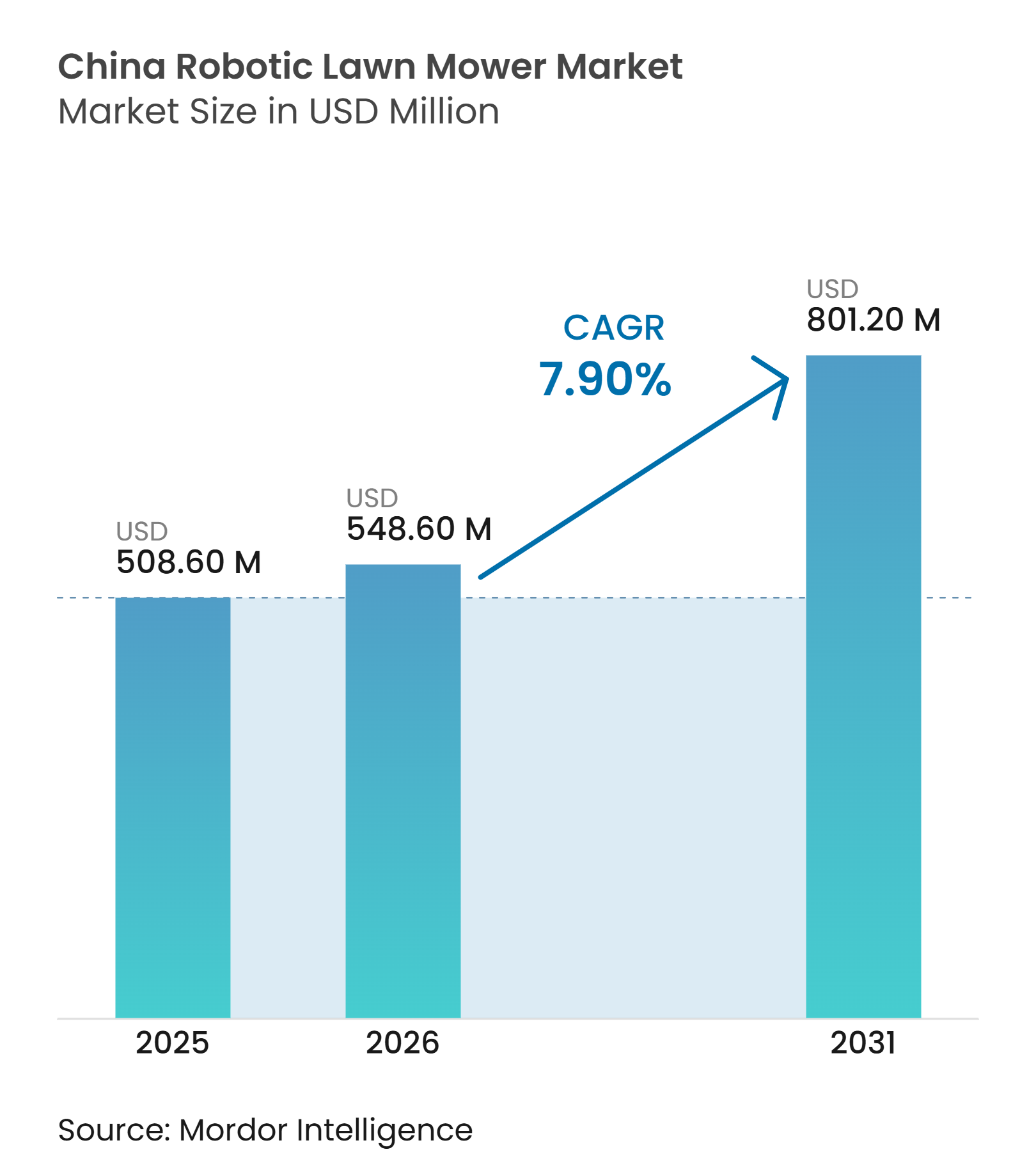
| Base Year Market Size (2025) | USD 508.60 Million |
| Market Size (2026) | USD 548.60 Million |
| Market Size (2031) | USD 801.20 Million |
| Growth Rate (2026 - 2031) | 7.90 % |
| Market Concentration | Medium |
Major Players *Disclaimer: Major Players sorted in no particular order Image © Mordor Intelligence. Reuse requires attribution under CC BY 4.0. | |
China Robotic Lawn Mower Market Analysis by Mordor Intelligence
The China robotic lawn mower market size was valued at USD 508.6 million in 2025 and is estimated to grow from USD 548.6 million in 2026 to reach USD 801.2 million by 2031, at a CAGR of 7.9% during the forecast period (2026-2031). Demand is shifting toward wire-free models as buyers prioritize simpler installation and reliable obstacle detection. Domestic suppliers benefit from established supply chains for sensors, batteries, motors, and positioning modules. Premium residential properties remain an important source of demand, while commercial sites offer higher-value opportunities. Online sales broaden product access, although complex installations still require dealer support. Competition is intensifying as Chinese and international brands shorten product development cycles and expand AI-based navigation features.
Key Report Takeaways
- By range, the low segment held 54.3% of the China robotic lawn mower market size in 2025, while the high segment is forecast to grow fastest at an 11% CAGR through 2031.
- By navigation technology, boundary-wire systems accounted for 45% of revenue in 2025, while vision and camera systems are projected to expand fastest at a 15.8% CAGR through 2031.
- By end user, residential users accounted for 68% of the China robotic lawn mower market share in 2025, while commercial users are projected to grow at a 12% CAGR through 2031.
- By distribution channel, online sales accounted for 52% of market value in 2025 and are forecast to be the fastest growing at a 10.5% CAGR through 2031.
Note: Market size and forecast figures in this report are generated using Mordor Intelligence’s proprietary estimation framework, updated with the latest available data and insights as of January 2026.
Market Trends and Insights
Drivers Impact Analysis of China Robotic Lawn Mower Market*
| Driver | (~) % Impact on CAGR Forecast | Geographic Relevance | Impact Timeline |
|---|---|---|---|
| Wire-free RTK, vision, and LiDAR navigation | 1.80% | East China, followed by South and Southwest China | Short term (≤ 2 years) |
| Domestic robotics manufacturing and components | 1.50% | Pearl River Delta and Yangtze River Delta | Medium term (2–4 years) |
| Premium landscaping and gated communities | 0.80% | East China and South China villa corridors | Medium term (2–4 years) |
| E-commerce and smart-home distribution | 0.70% | National, with early gains in Tier 1 and Tier 2 cities | Short term (≤ 2 years) |
| Export-scale product iteration and lower unit costs | 1.20% | National, supported by export-oriented production | Medium term (2–4 years) |
| Service-robot skills and algorithm transfer | 0.60% | North China and East China research centers | Long term (≥ 4 years) |
| Source: Mordor Intelligence | |||
Expansion of Wire-Free RTK, Vision, and LiDAR Navigation
Wire-free navigation is reshaping product expectations in the China robotic lawn mower market. Global shipments of boundary-free robotic mowers reached 1.318 million units in 2025, up 182.4% from the previous year. This growth in shipments indicates that wire-free mowing is moving beyond a small premium niche. Mammotion introduced its Tri-Fusion positioning system in September 2025. The system combines LiDAR, RTK, and AI vision to support positioning in complex environments. Mammotion stated that the system achieves ±1 cm positioning accuracy across its operating conditions. Multi-sensor designs reduce dependence on a single signal source and can improve performance near trees, buildings, and other obstructions. This capability is encouraging brands to bring wireless features into more product tiers. Forthcoming outdoor robot safety guidelines may further increase the importance of robust obstacle detection.
Domestic Robotics Manufacturing and Component Availability
China's manufacturing base supports the robotic lawn mower market by providing domestic access to LiDAR, cameras, batteries, motors, and positioning components. In April 2025, Hesai Technology agreed to supply 300,000 JT-series LiDAR units to MOVA within 12 months, indicating that mower manufacturers have become significant customers for sensor suppliers. Livox delivered 100,000 Mid-360 LiDAR units to Dreame Technology for its A2 robotic mower[1]. Established supply relationships reduce component lead times for domestic brands and allow hardware and software teams to coordinate product updates more closely. Greenlibo's third-generation mower incorporated RTK, inertial navigation, millimeter-wave radar, and ToF depth cameras sourced from domestic suppliers. The local supply base supports faster design changes without dependence on distant component sources.
Growth of Premium Residential Landscaping and Gated Communities
Premium homes and gated communities represent a practical use case for robotic mowers in China. Most apartment households do not have private lawns that can support this equipment. Low-density residential projects around major cities in East China and South China have increased the number of suitable private gardens. Many buyers in these communities view robotic mowers as part of a connected home setup rather than as stand-alone appliances, supporting demand for models that integrate with home-control platforms. Government-managed green spaces in the Greater Bay Area also create a commercial use case, with contracts that may support larger order values than household purchases. Demand is strongest where premium housing, landscaped common areas, and reliable service coverage coexist.
E-Commerce and Smart-Home Distribution Penetration
Digital storefronts let brands present product features directly to prospective buyers. Live demonstrations can show mowing routes, obstacle avoidance, and app controls before a customer visits a dealer. This is especially useful for products that remain unfamiliar to many first-time buyers. Smart-home connections also make a mower more relevant to consumers already using connected devices. Chervon’s Power Share platform connects more than 100 tools, showing how a broader tool ecosystem can support repeat engagement. Online demand generation works alongside local installation and after-sales services.
Restraints Impact Analysis of China Robotic Lawn Mower Market*
| Restraint | (~) % Impact on CAGR Forecast | Geographic Relevance | Impact Timeline |
|---|---|---|---|
| Limited private-lawn density in dense urban areas | -1.20% | National, especially North and Central China urban cores | Long term (≥ 4 years) |
| High upfront cost and unclear payback | -0.90% | National, strongest in Central, Southwest, and Northwest China | Medium term (2–4 years) |
| Rtk and vision reliability at complex sites | -0.80% | East China villa estates and Northeast China | Short term (≤ 2 years) |
| Warranty, parts, and after-sales service gaps | -0.70% | Tier 3 cities and beyond, especially Southwest and Northwest China | Medium term (2–4 years) |
| Source: Mordor Intelligence | |||
Limited Private-Lawn Density in Dense Urban Areas
Private lawn density limits the household base for the China robotic lawn mower market. According to the Ministry of Housing and Urban Development in China, an estimated 65% to 70% of urban households in 2025 live in high-rise apartments without private outdoor green space[2]. This leaves villa owners, residents of low-density communities, property managers, and public-site operators as the main customer groups. The constraint is more pronounced in dense North China and Central China cities, where the share of private-lawn properties is smaller than in coastal villa districts. Broad household adoption is not anticipated to follow the same path as in countries with detached housing. Commercial landscaping and municipal procurement can partly expand the addressable base, though these routes require longer sales cycles, site planning, and dependable service support. This structural constraint will remain a factor even as product prices become more accessible.
High Upfront Cost and Unclear Payback
Entry-level wire-free robotic mowers in China were priced between CNY 5,000 and CNY 15,000 (USD 685 to USD 2,055) in 2025. This cost remains significant for households in Tier 2 and Tier 3 cities, where informal gardening labor is often less expensive than professional landscaping services. As a result, buyers find it difficult to calculate a clear payback period. Eufy reported first-month overseas sales of more than 4,000 units across its E15 and E18 mower models, indicating that demand responds when product value and price are aligned. However, domestic buyers may delay purchases when installation, maintenance, and replacement costs are not clearly communicated. Export compliance costs can also limit manufacturers' ability to apply domestic discounts on surplus export production. Greater price transparency and bundled service packages could reduce this barrier over time.
*Our forecasts treat driver/restraint impacts as directional, not additive. The impact forecasts reflect baseline growth, mix effects, and variable interactions.
China Robotic Lawn Mower Market Segment Analysis
By Range:
Low Range Leads Demand While High Range Gains Commercial ImportanceThe low-range segment, covering lawns below 500 m², accounted for 54.3% of the China robotic lawn mower market share in 2025. This reflects the typical size of private gardens in suburban villa communities and gated residential estates, where many lawns range from 200 m² to 450 m². This makes compact models a practical starting point for first-time buyers. Segway Navimow's i2 AWD models, priced between USD 999 and USD 1,299, were designed for smaller residential plots without boundary wires. Mammotion launched the LUBA Mini AWD at CES 2025, featuring UltraSense AI vision and RTK navigation. These products indicate that brands are targeting accessible residential use cases with wire-free navigation.
The high segment, for lawns above 2,000 m², is forecast to grow at an 11% CAGR through 2031, driven primarily by commercial landscaping, sports facilities, and large estates. Medium-range products, covering 501 m² to 2,000 m², remain a contested area between domestic and international brands. Husqvarna, STIHL, Honda, and STIGA compete in this range against Chinese suppliers on features and service coverage. In June 2025, Greenlibo stated that its third-generation RTK mower could cover up to 10,000 m² in two days. The mower also uses on-device recognition and obstacle-avoidance processing, which is useful at larger sites where Wi-Fi coverage may be inconsistent. The high-range segment of the China robotic lawn mower market stands to benefit as commercial users seek reliable equipment for recurring maintenance tasks.
By Navigation Technology:
Boundary-Wire Systems Give Way to Sensor FusionBoundary-wire navigation accounted for 45% of domestic revenue in 2025. The installed base reflects years of cost-effective and proven installations. Boundary-wire systems retain a role when customers prefer familiar technology, though their position is shifting toward servicing existing installations rather than supporting the adoption of new technology. Vision and camera systems are forecast to grow at a 15.8% CAGR through 2031. Domestic chip and sensor suppliers are helping reduce the cost of camera and LiDAR designs. This makes wire-free products more accessible outside the premium price tier. Navigation choice increasingly depends on lawn complexity and local signal conditions.
LiDAR-only, RTK-only, and multi-sensor systems each offer different operating characteristics. LiDAR supports accurate mapping but adds cost. RTK provides precision where satellite coverage is consistent. Multi-sensor configurations use cameras and other sensors to address the limitations of single-mode operation. Mammotion presented Tri-Fusion at IFA 2025 as a combination of LiDAR, RTK, and AI vision. Dreame combined 3D LiDAR and an HDR camera in its OmniSense 2.0 approach. GNSS and RTK-GPS systems remain relevant for large commercial sites with clear sky visibility. Safety specifications are expected to favor products with stronger obstacle-detection capabilities.
By End User:
Residential Users Lead While Commercial Sites Expand FasterResidential users accounted for 68% of the China robotic lawn mower market in 2025. Consumer awareness has been supported by direct online sales and product launches at major technology events. The addressable residential base is concentrated in villa and low-density communities, as high-rise apartment residents generally lack suitable lawns, thereby limiting residential growth outside specific housing types. The commercial segment is projected to grow at a 12% CAGR through 2031. Higher average transaction values support its faster projected growth. The commercial opportunity spans sports fields, golf courses, parks, hotels, and large landscaped properties.
Commercial users require machines capable of managing large areas with limited manual oversight, along with reliable scheduling, site mapping, fleet monitoring, and local maintenance support. Belrobotics reported that 23 Bigmow units deployed at municipal sports grounds in Venlo saved 77,000 kg of CO₂ annually, illustrating the operational and sustainability case relevant to public-sector buyers. FJDynamics introduced its FR4000 commercial platform with fleet management software for sites up to 10,000 m². Toro and Yamabiko Europe have also developed robotic mowers and range pickers for golf and sports field applications[3]. Commercial demand is expected to grow in areas where private lawns remain limited. Service quality and contract support will influence supplier selection for these projects.
By Distribution Channel:
Online Sales Lead While Dealers Support Complex ProjectsOnline sales accounted for 52% of the China robotic lawn mower market in 2025. Brand storefronts on platforms such as Tmall, JD.com, and Douyin Commerce provide a broad customer reach. This channel is forecast to grow at a 10.5% CAGR through 2031. Brands can use live demonstrations and digital tools to explain product features before purchase. Greenworks launched its AiMowBot series at Walmart in March 2026, and this retail rollout demonstrated how national consumer channels can expand availability for robotic mowers. Chinese digital channels offer an established route for a similar model domestically. Online sales also allow brands to link product ordering with service booking.
Offline channels, especially dealers, remain important for high-end and semi-commercial equipment, where buyers often require a property survey, installation, diagnostics, and ongoing maintenance. The dealer role is shifting toward outdoor automation specialists with expertise in RTK and sensors. A hybrid approach can pair online demand generation with local installation support, a combination that Positec's Worx brand applies across its product markets. Dealers can also help customers assess whether tree cover, terrain, or site access will affect performance, reducing the risk of a poor installation experience. The balance between channels will depend on whether brands expand technical service capacity alongside online sales growth.
Geography Analysis
East China, including Shanghai, Jiangsu, Zhejiang, and Shandong, combines premium housing demand with a well-developed robotics supply chain. The region includes many villa communities and consumers familiar with smart-home products. ECOVACS operates from Suzhou, while component suppliers in Shanghai and Zhejiang support the regional manufacturing base. China exported CNY 13.2 billion (USD 1.8 billion) worth of robotic lawn mowers in the first seven months of 2025. Export-scale manufacturing may help reduce unit costs for local customers. East China remains an important center of consumption and production for this market.
South China benefits from Greater Bay Area housing development and the Pearl River Delta electronics base. Coastal villa communities have a higher incidence of suitable private lawns than dense inland cities. Segway-Ninebot's development center in Shenzhen and Mammotion's supply-chain relationships support local product development. North China and Central China face more challenging conditions due to denser apartment living and a lower prevalence of private villas. Beijing still offers opportunities through parks, sports facilities, and government-managed green spaces. Kress introduced the Voyager commercial mower for route-based maintenance crews. Larger commercial platforms may be more suitable than consumer models in these regions.
Southwest and Northwest China have smaller installed bases and thinner dealer networks. Resort, hotel, and tourism properties in Yunnan and Sichuan can generate localized commercial demand. Northeast China has a shorter grass-growing season and lower purchasing power than coastal areas, which limits demand for household equipment. National safety regulations for autonomous outdoor equipment could encourage more structured service investment once certification is finalized. Demand is currently concentrated in coastal areas but may expand inland as commercial use grows. Lower unit prices, dealer network expansion, and clearer service models will shape that progression.
Competitive Landscape
Market Concentration
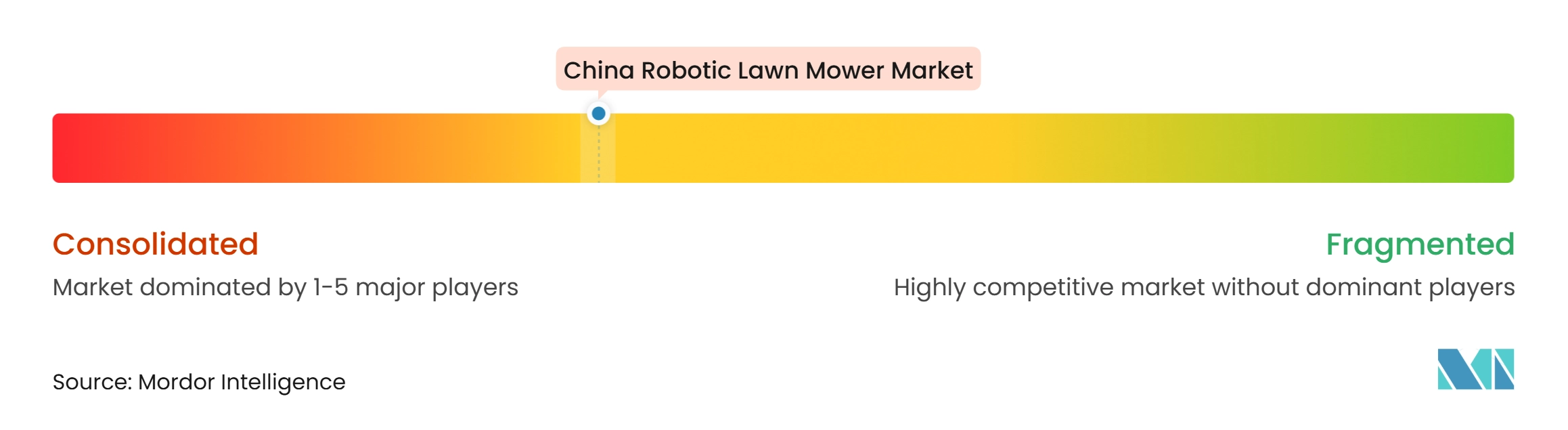
The China robotic lawn mower market is moderately concentrated in 2025. The top five companies, such as Navimow (Segway-Ninebot), Mammotion, ECOVACS, Dreame, and Positec, compete on navigation capabilities, product releases, and online reach. Husqvarna, STIGA, Honda, and STIHL compete through established brands, dealer networks, and product engineering. Husqvarna announced 7 robotic lawn mower models with AI Vision for 2026. STIGA introduced 9 Vista Technology models in March 2026. Honda launched the wire-free Miimo 1500i and Miimo 2200i in 2026. These launches indicate that international suppliers continue to invest in wireless technology.
Chinese brands are also expanding their product ranges and sensor systems. Segway Navimow launched 5 product lines at CES 2026, covering residential and professional applications. Mammotion launched the LUBA 4 AWD at IFA 2026, featuring Quad-Vision, 360° LiDAR, NetRTK, and independent front-wheel steering. Positec launched the Worx Landroid Vision Cloud at CES 2026 with AI vision and RTK Cloud positioning. Product development is moving toward systems that operate across diverse site conditions. Commercial fleet management remains a gap, as few suppliers offer an integrated large-scale hardware and software solution in China. This has become an area of competition as multi-site mowing projects expand.
Trade policy is influencing manufacturing strategies for export-oriented Chinese suppliers. The European Commission opened anti-dumping investigation C/2025/6235 in November 2025, and registration requirements for Chinese imports took effect from January 22, 2026. Segway-Ninebot completed and began operating its Malaysia production line in 2026. Zhejiang Daye acquired AL-KO Geräte GmbH, adding an Austrian manufacturing base. These moves reduce dependence on a single manufacturing location and may widen the gap between well-funded established brands and smaller suppliers.
China Robotic Lawn Mower Industry Leaders
-
Navimow (Segway-Ninebot)
-
Mammotion
-
ECOVACS
-
Dreame Global
-
Positec
- *Disclaimer: Major Players sorted in no particular order
China Robotic Lawn Mower Market Companies Covered in this Report
- Navimow (Segway-Ninebot)
- Shenzhen Mammotion Technologies Co., Ltd.
- ECOVACS Robotics Co., Ltd.
- Dreame Technology
- Positec Technology Co., Ltd.
- Chervon Holdings Limited
- Zhejiang Daye Co., Ltd.
- EcoFlow Technology Inc.
- Hangzhou Favor Robot Technology Co., Ltd.
- Kress Robotik GmbH
- Husqvarna AB
- Honda Motor Co., Ltd.
- Deere and Company
- STIGA S.p.A.
- The Toro Company
- Yamabiko Corporation
Recent Industry Developments in China Robotic Lawn Mower Market
- September 2026: Navimow unveiled the H5 Pro with EdgeMaestro at IFA 2026. The model uses LiDAR, NRTK, and 3 vision cameras, and it has a mechanical arm that extends the cutting disc for edge mowing.
- September 2026: Mammotion launched the LUBA 4 AWD at IFA 2026. The mower includes Quad-Vision, 360° LiDAR, NetRTK positioning, independent front-wheel steering, and bidirectional driving.
- July 2026: Kress introduced EyePilot autonomous mowers with V-SLAM and RTK vision AI. The models do not require a boundary wire, on-property antenna, or unrestricted sky view
China Robotic Lawn Mower Market Report Scope
A robotic lawn mower is an autonomous, battery-powered machine designed to mow and maintain grass with minimal human intervention. It uses sensors, navigation systems, and intelligent controls to operate within a defined lawn area, avoid obstacles, maintain the desired grass height, and recharge automatically when required.
The China robotic lawn mower market is segmented by range (low, medium, and high), navigation technology (boundary-wire, vision and camera, and GNSS and RTK-GPS systems), end user(residential customers and commercial customers), and distribution channel (online channels and offline channels). The market forecasts in terms of value in USD.
Segmentation Overview
| Low (Less Than 500 m2) |
| Medium (501-2,000 m2) |
| High (More Than 2,000 m2) |
| Boundary-Wire |
| Vision / Camera |
| GNSS / RTK-GPS |
| Residential |
| Commercial |
| Online (Direct, Marketplaces) |
| Offline (DIY Stores, Specialty Dealers) |
| By Range | Low (Less Than 500 m2) |
| Medium (501-2,000 m2) | |
| High (More Than 2,000 m2) | |
| By Navigation Technology | Boundary-Wire |
| Vision / Camera | |
| GNSS / RTK-GPS | |
| By End-User | Residential |
| Commercial | |
| By Distribution Channel | Online (Direct, Marketplaces) |
| Offline (DIY Stores, Specialty Dealers) |
Key Questions Answered in the Report
What is the forecast growth rate for robotic lawn mowers in China?
The China robotic lawn mower market is projected to grow at a 7.9% CAGR from 2026 to 2031, reaching USD 801.2 million by 2031.
Which range category leads robotic lawn mower demand in China?
Low range products for lawns below 500 m² led demand with a 54.3% share in 2025.
Which navigation technology is growing fastest in China?
Vision and camera systems are projected to expand at a 15.8% CAGR through 2031 as wire-free products gain acceptance.
Why are commercial robotic mower applications growing in China?
Commercial sites such as sports fields, parks, golf courses, hotels, and large estates need equipment for recurring maintenance and have larger average transaction values.
What role do online channels play in robotic mower sales?
Online channels held 52% of distribution value in 2025 and are projected to grow at a 10.5% CAGR through 2031.