
China Pet Grooming Services Market Size and Share
Market Overview
| Study Period | 2032 - 2032 |
|---|---|
| Forecast Data Period | 2027 - 2032 |
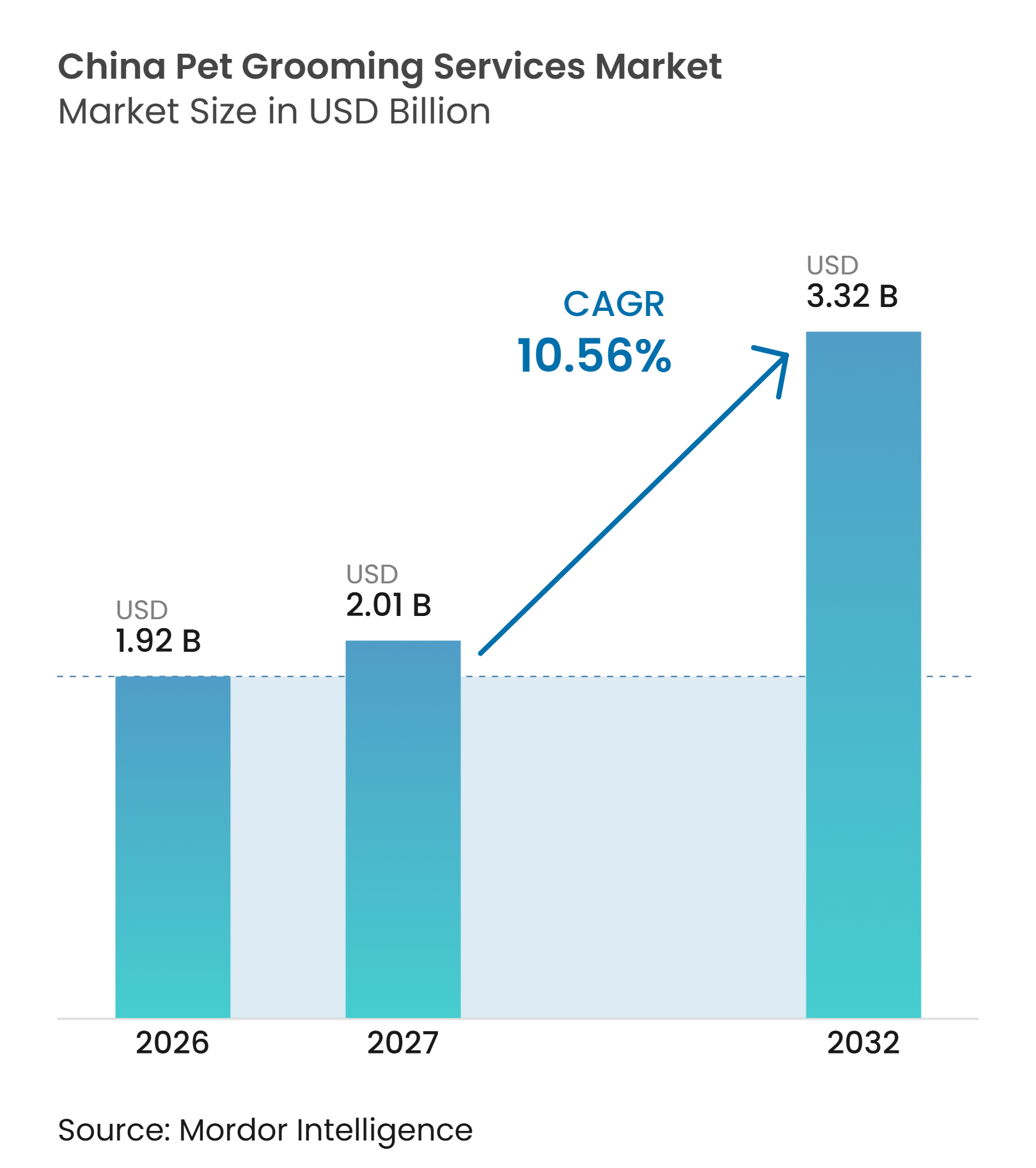
| Base Year Market Size (2026) | USD 1.92 Billion |
| Market Size (2027) | USD 2.01 Billion |
| Market Size (2032) | USD 3.32 Billion |
| Growth Rate (2027 - 2032) | 10.56 % |
| Market Concentration | Low |
Major Players *Disclaimer: Major Players sorted in no particular order Image © Mordor Intelligence. Reuse requires attribution under CC BY 4.0. | |
China Pet Grooming Services Market Analysis by Mordor Intelligence
The China pet grooming services market size was valued at USD 1.92 billion in 2026 and is estimated to grow from USD 2.01 billion in 2027 to reach USD 3.32 billion by 2032, at a CAGR of 10.56% during the forecast period (2027-2032). The China pet grooming services market is moving beyond occasional hygiene visits as urban owners spend more on care, convenience, and service quality. China had 126 million urban dogs and cats in 2025, while urban pet consumption reached CNY 312.6 billion (USD 44.65 billion), expanding the addressable base for recurring services. Although pet population growth slowed to 1.8% in 2025, spending per dog reached CNY 3,006 (USD 429.33) and spending per cat reached CNY 2,085 (USD 297.79), supporting value growth as ownership matures[1]. Higher-value care services in dense coastal cities and lower-cost mobile formats in less-developed cities tier the market. Competition remains fragmented due to localized service delivery, scarce skilled labor, and limited standardized procedures among operators.
Key Report Takeaways
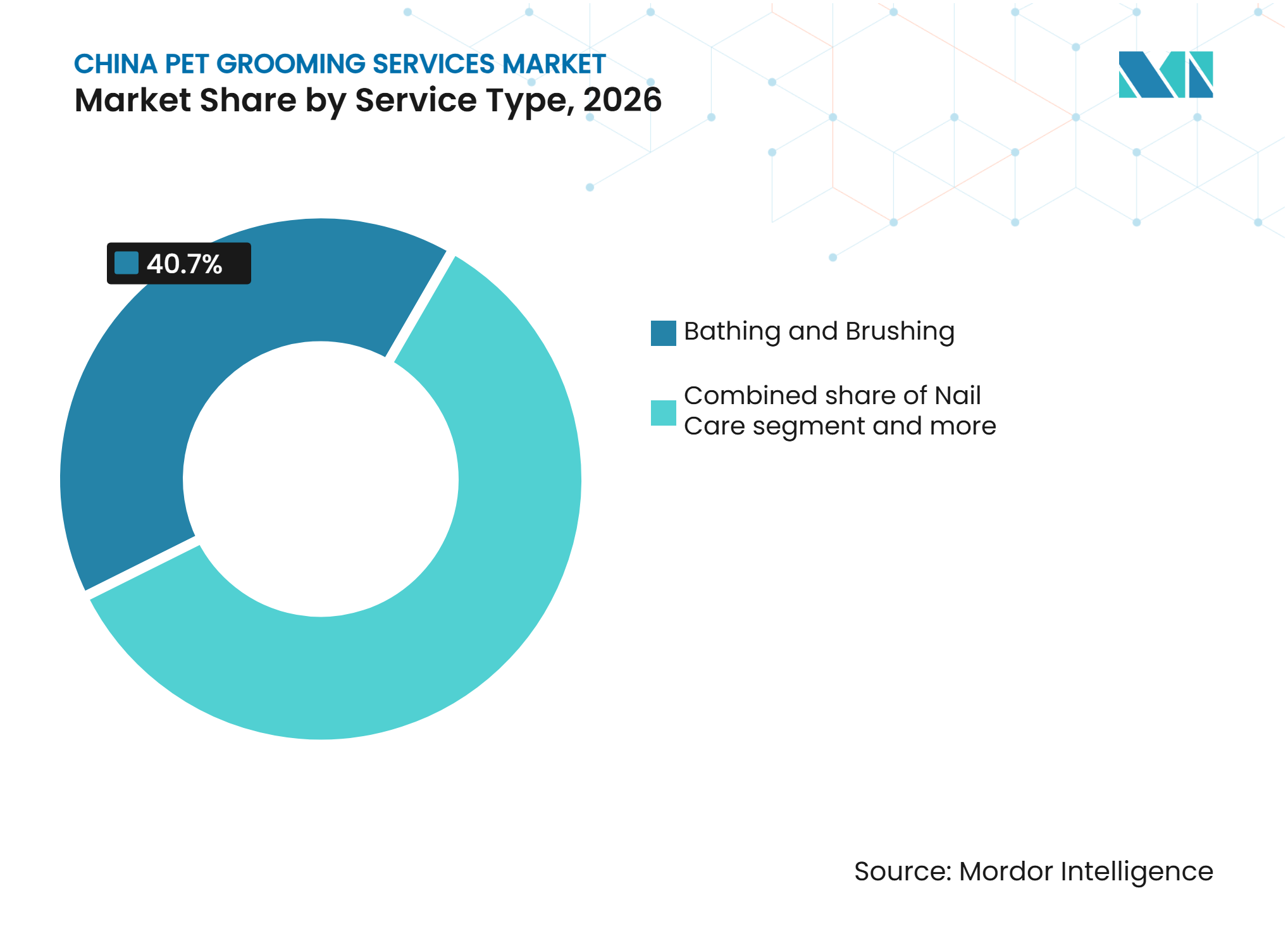
- By service type, Bathing and Brushing accounted for 40.70% of theChina pet grooming services market revenue in 2026, and Specialized Skin, Coat, and Spa Treatments are projected to grow at a 10.92% CAGR through 2032.
- By pet type, Dogs accounted for 81.40% of the China pet grooming services market revenue in 2026, and Cats are projected to grow at a 10.84% CAGR through 2032.
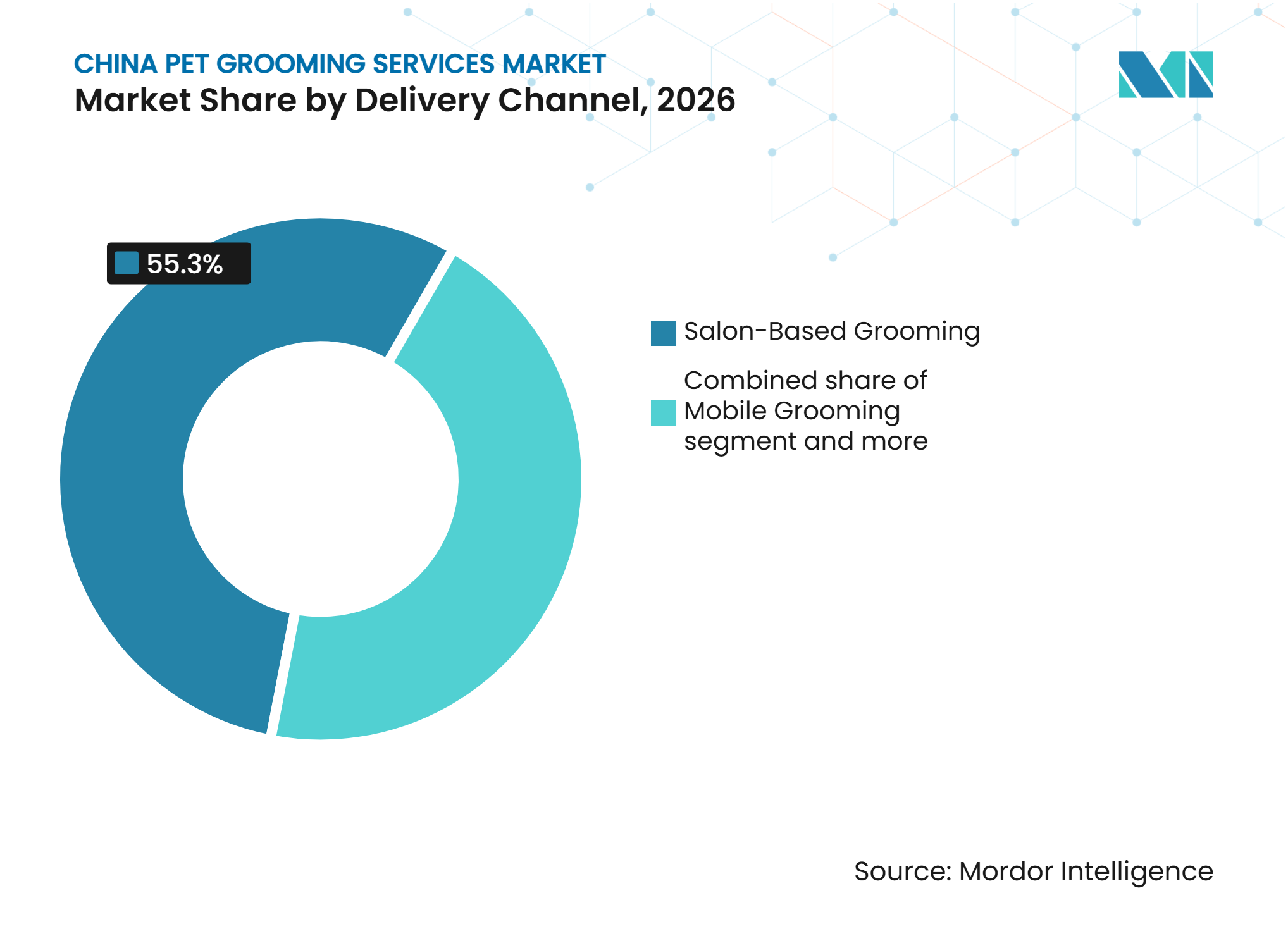
- By delivery channel, Salon-Based Services accounted for 55.30% of theChina pet grooming services market revenue in 2026, and At-Home Grooming is projected to grow at an 11.20% CAGR through 2032.
- By region, East China accounted for 39.10% of the China pet grooming services market revenue in 2026, and Northwest China is projected to grow at an 11.14% CAGR through 2032.
Note: Market numbers in this report are based on Mordor Intelligence's proprietary estimation framework, which combines nine months of actuals with Q4 projections for base year 2026.
Market Trends and Insights
Drivers Impact Analysis of China Pet Grooming Services Market*
| Driver | (~) % Impact on CAGR Forecast | Geographic Relevance | Impact Timeline |
|---|---|---|---|
| Rising Urban Pet Ownership and Pet-Parent Base | +2.0% | National, with the strongest demand in Tier-1 cities and emerging Tier-2 hubs | Short term (≤ 2 years) |
| Pet Humanization and Higher Spending per Pet | +2.3% | National, the strongest in the Yangtze River Delta and Pearl River Delta | Medium term (2-4 years) |
| Growing Awareness of Hygiene, Skin Health, and Preventive Care | +1.8% | National, led by East and South China | Short term (≤ 2 years) |
| Cat Grooming Demand and Cat-Specific Services | +1.5% | National, concentrated in East and South China | Medium term (2-4 years) |
| Expansion of Mobile, At-Home, and Appointment-Based Grooming | +1.6% | National, with higher adoption in Tier-1 cities | Medium term (2-4 years) |
| Digital Discovery, Booking, Reviews, and Standardization | +1.2% | National, the strongest in coastal and technology-oriented cities | Medium term (2-4 years) |
| Source: Mordor Intelligence | |||
Rising Urban Pet Ownership and Expanding Pet-Parent Base
China’s urban dog and cat population totaled 126 million in 2025, including 53.43 million dogs and 72.89 million cats. The urban pet consumption market reached CNY 312.6 billion (USD 44.65 billion), up 4.1% year over year, reflecting sustained spending on companion animals. Pet shops were the primary channel for grooming and washing services, used by 78.4% of pet owners. Demand for bathing, trimming, coat maintenance, and hygiene services created opportunities for providers to expand service offerings and customer reach. Grooming businesses could address this demand through franchised salons, independent outlets, and mobile grooming teams, particularly in underserved urban districts and emerging city markets with less-developed professional service networks.
Pet Humanization and Higher Spending per Pet
Pet owners’ emphasis on professional service quality supports demand for skilled grooming services in China. Service quality influences grooming-store selection, with 63.3% of respondents identifying it as a key consideration. The national occupational standard establishes five skill levels for pet groomers, providing a framework to assess professional competencies[2]. These standards can strengthen consumer confidence in groomers’ expertise and support differentiation among service providers. Demand for specialized styling, coat care, hygiene treatments, and personalized service packages creates opportunities for salons to improve customer retention through recurring appointments. Grooming operators can expand into underserved urban markets by offering differentiated services and developing accessible salon networks.
Growing Awareness of Hygiene, Skin Health, and Preventive Care
China’s pet grooming services market increasingly emphasizes hygiene, skin health, and professional care. In 2025, pet shops were the preferred channel for grooming and washing services among 78.4% of pet owners. A clean and comfortable environment influenced salon selection for 54.6% of surveyed owners, while 32.1% prioritized value for money. China Agricultural University’s 2025 pet groomer training program covered hygiene standards, skin and coat care, safe tool use, and identifying of common skin conditions[3]. These factors underscore the need for sanitation procedures, trained staff, and consistent service protocols. Grooming providers can differentiate through documented care practices, specialized coat treatments, and appropriate veterinary referrals for suspected skin conditions.
Cat Grooming Demand and Cat-Specific Service Development
Consumer spending on cats increased by 5.2% in 2025, compared with 3.2% for dogs, indicating stronger spending momentum among cat-owning households. Cats may experience increased stress during transportation and in shared salon environments. This creates demand for quieter settings, separate grooming rooms, dedicated technicians, and shorter waiting times. Service providers may need to adapt standard grooming operations to accommodate cat-specific handling and care requirements. The China pet grooming services market offers opportunities for providers expanding cat-specific protocols and at-home grooming services.
Restraints Impact Analysis of China Pet Grooming Services Market*
| Restraint | (~) % Impact on CAGR Forecast | Geographic Relevance | Impact Timeline |
|---|---|---|---|
| Limited Skilled-Groomer Supply and Uneven Certification Coverage | -1.2% | National, particularly Tier-3 cities and Northwest China | Medium term (2-4 years) |
| Low Industry Standardization and Variable Service Quality | -0.9% | National, more pronounced in lower-tier and rural-adjacent markets | Long term (≥ 4 years) |
| Pet Stress, Safety Incidents, and Liability Exposure | -0.7% | National, especially dense urban salon markets | Medium term (2-4 years) |
| Uneven Regional Demand, Rent Pressure, and Small-Store Economics | -0.8% | Northwest China, Northeast China, Tier-3 cities, and Tier-1 commercial districts | Long term (≥ 4 years) |
| Source: Mordor Intelligence | |||
Limited Skilled-Groomer Supply and Uneven Certification Coverage
China’s pet grooming services market may face challenges in scaling professional services due to skilled labor shortages across the broader pet industry. The 2023 National Occupational Standard established five skill levels for pet groomers, requiring at least 180 standard hours for Level 5 (entry-level), 150 hours for Level 4, 120 hours for Level 3, and 90 hours each for Levels 2 and 1 (technician and senior technician, respectively). China Agricultural University’s June 2025 training program accommodated approximately 40 participants and covered hygiene, breed-specific grooming, skin and coat care, and safe equipment use. Expanding practical training and professional development can help salons maintain consistent service standards as they grow. Skilled personnel remain important for services requiring careful animal handling, specialized styling, and safe grooming procedures.
Low Industry Standardization and Variable Service Quality
Uneven service standards remain a restraint, as pet owners cannot always assess grooming quality and hygiene before booking an appointment. Although China has national standards for environmental cleaning and disinfection at pet business premises, these guidelines do not establish comprehensive or uniformly enforced operating requirements for all grooming providers. A Beijing-led industry meeting held in September 2025 identified gaps in pet industry standardization and reached preliminary agreements on more than 20 proposed national standard revisions and developments covering pet food, products, and services[4]. Zhejiang’s pet-economy policy, issued in October 2025, also called for stronger standardization of grooming, boarding, and other pet services, along with improved hygiene and safety controls. Until providers apply service procedures and quality controls more consistently, those investing in trained staff, sanitation, and customer records may struggle to differentiate themselves from lower-priced competitors.
*Our forecasts treat driver/restraint impacts as directional, not additive. The impact forecasts reflect baseline growth, mix effects, and variable interactions.
Consumer Preferences & Spending Patterns
China’s 2026 Pet Industry White Paper reported that 78.4% of owners preferred pet shops for grooming, while 3.2% chose at-home grooming, up from 2024. Professional service quality influenced 63.3% of store choices, compared with 54.6% prioritizing a clean, comfortable environment. Established salons remained central, while home visits served customers seeking convenience or reduced travel stress. Providers could differentiate through feline-specific handling, appointment-based services, and hygiene practices rather than proximity.
China had 72.89 million urban pet cats in 2025, compared with 53.43 million dogs. Cat numbers grew 1.9% year on year, versus 1.6% for dogs. Shampoo and conditioner purchases reached 49.8% among cat owners, up 4.7 percentage points, compared with 62.3% among dog owners, up 1.7 percentage points. Faster growth in cat-care product adoption indicated an opportunity for feline grooming services, although product purchases did not directly establish salon demand. Cat-friendly facilities and trained handlers could support repeat bookings.
Service Market Performance Intelligence
During Shenzhen’s 2025 Spring Festival peak, Ruipeng added CNY 20 (USD 2.86) for bathing and CNY 50 (USD 7.14) for styling, while another salon raised grooming fees by 30-80%, depending on the holiday period. A two-cat bathing visit costs approximately CNY 340 (USD 48.56), with grooming taking nearly three hours per pet. Seasonal surcharges reflect labor constraints and concentrated demand, creating opportunities for salons to introduce advance booking and transparent peak-period pricing without relying on year-round price increases.
In 2024, 73.5% of surveyed Chinese pet owners used short-video platforms, while 66.1% used Xiaohongshu, and more than 80% preferred Douyin for pet-product livestreaming. Grooming salons can use these channels for before-and-after demonstrations, service explanations, and local booking links. Visual content can make grooming quality easier to assess before purchase, helping salons build trust and generate local inquiries; however, broader pet-content engagement does not establish grooming-specific conversion rates or acquisition costs.
China Pet Grooming Services Market Segment Analysis
By Service Type:
Bathing and Brushing Retains Volume While Specialty Care Builds ValueBathing and brushing accounted for a 40.70% of the China pet grooming services market in 2026. Owners recognize the need for regular cleaning, coat maintenance, and hygiene, supporting repeat dog-bathing visits and professional care for stressed cats. Hair cutting and styling serves breeds requiring regular coat management. Salons often bundle nails, ears, eyes, and oral care with basic visits. China Kennel Union breed standards guide breed-specific styling at licensed centers. Basic hygiene packages support accessibility in Tier-2 and Tier-3 cities, where value and price transparency matter. This category generates recurring demand and introduces specialized care when needed.
Specialized skin, coat, and spa treatments are projected to be the fastest-growing service type, expanding at a 10.92% CAGR through 2032. Demand reflects a shift toward condition-based care, including conditioning, de-shedding, coat maintenance, and wellness services. Trained staff must distinguish grooming from conditions requiring veterinary diagnosis and referral. Integrated providers can link grooming concerns to clinical care, while independent salons can compete through hygiene procedures, product records, and veterinary referral relationships. Services must be appropriate, transparent, and supported by staff knowledge.



By Pet Type:
Dogs Maintain Revenue Leadership While Cats Alter Delivery RequirementsDogs accounted for a 81.40% of the China pet grooming services market in 2026. Their share reflects higher grooming frequency, visible coat maintenance needs, and more styling options. China had 53.43 million urban pet dogs in 2025, supporting recurring bathing and trimming appointments. Small companion breeds suit apartment-dense cities, while large-breed grooming generates higher ticket values but requires more space, equipment, and technician expertise.
Cats are the fastest-growing segment, with services forecast to grow at a 10.84% CAGR through 2032. China had 72.89 million urban cats in 2025. Demand includes in-home grooming, fixed appointments, and low-stress environments, focused on bathing, de-shedding, nail care, and coat management. Feline-specific training differentiates providers. Other pet categories offer selective opportunities, but dogs and cats remain the commercial focus due to their larger populations and established service routines.
By Delivery Channel:
Salons Led Today While At-Home Care Gains RelevanceSalon-based services accounted for a 55.30% of China’s pet grooming services market revenue in 2026. Pet shops remained the primary grooming venue due to convenience and familiarity. Salons support repeat visits and retail cross-selling by combining grooming, supplies, and basic care. They must maintain hygiene, trained staff, and calm environments amid variable demand. Standalone boutiques compete through specialized skills and service, while integrated facilities add veterinary consultations, boarding, and retail. New Ruipeng’s hospital network demonstrates the scale of integrated care. Providers should adapt operating models to neighborhood needs.
At-home grooming is forecast to grow at an 11.20% CAGR through 2032, supported by convenience and demand from stress-sensitive pets. High commercial rents also support the model. However, technician availability, travel time, safety, and service consistency constrain expansion. Formal skill standards support quality, but supervision and customer trust remain essential. Mobile grooming offers a related option. Both models require effective scheduling and clear pricing. Salons are expected to remain the largest channel, while at-home and mobile services gain share.

Geography Analysis
East China accounted for a 39.10% of China’s pet grooming services revenue in 2026. Shanghai, with 1.82 million pet-owning households, is a major demand center. The Yangtze River Delta, including Shanghai, Suzhou, Hangzhou, Nanjing, and Ningbo, supports salons, boutiques, and integrated care facilities. Higher incomes and digital engagement encourage frequent grooming visits and adoption of advanced treatments. Zhejiang’s policy emphasizes standardized pet washing, grooming, and care services, supporting quality-focused expansion. East China’s developed service base increases the need for differentiation. Operators compete through hygiene standards, staff capabilities, transparent pricing, and service plans that encourage repeat visits. Clinics and boutique groomers can expand through specialized expertise, while neighborhood salons can compete through dependable everyday services.
Northwest China is the fastest-growing regional segment, with an 11.14% CAGR through 2032. Xi’an, Urumqi, Lanzhou, and Yinchuan benefit from urban pet adoption among younger consumers. Limited grooming infrastructure creates opportunities for mobile teams, franchised salons, and training-led expansion. However, skilled groomer recruitment remains a challenge. Operators may begin with basic services before adding advanced treatments. Appointment-based models can manage uneven demand and limit fixed costs. Expansion should reflect local customer density, supported by formal training programs. South and North China combine large urban centers with policy attention. Guangdong focuses on pet-service quality, while Beijing is developing pet-service standards. Growth depends on local income, talent availability, consumer preferences, and regulatory expectations.
Service Provider Network & Expansion Intelligence
China’s offline grooming network benefits from a broad pet-store base. In H1 2024, China had 81,534 pet stores, up 1.6% year on year. First-tier cities accounted for 13% of outlets, versus 24% across 15 new first-tier cities and 21% in second tier. The 2026 China Pet Industry White Paper found that 78.4% of owners preferred pet shops for grooming, while service quality (63.3%) and clean, comfortable environments (54.6%) influenced provider selection. Existing outlets can differentiate through skilled staff and consistent service protocols.
Formal training and provincial policy support service-network development. In June 2025, China Agricultural University announced a seven-day grooming skills course for about 40 participants per cohort, including four days of theoretical instruction and one day of field visits. Zhejiang’s October 2025 policy targets pet-related consumption exceeding CNY 30 billion (USD 4.28 billion) by 2027 and CNY 50 billion (USD 7.14 billion) by 2030 and encourages standardized grooming, boarding, and training services.
Competitive Landscape
Market Concentration
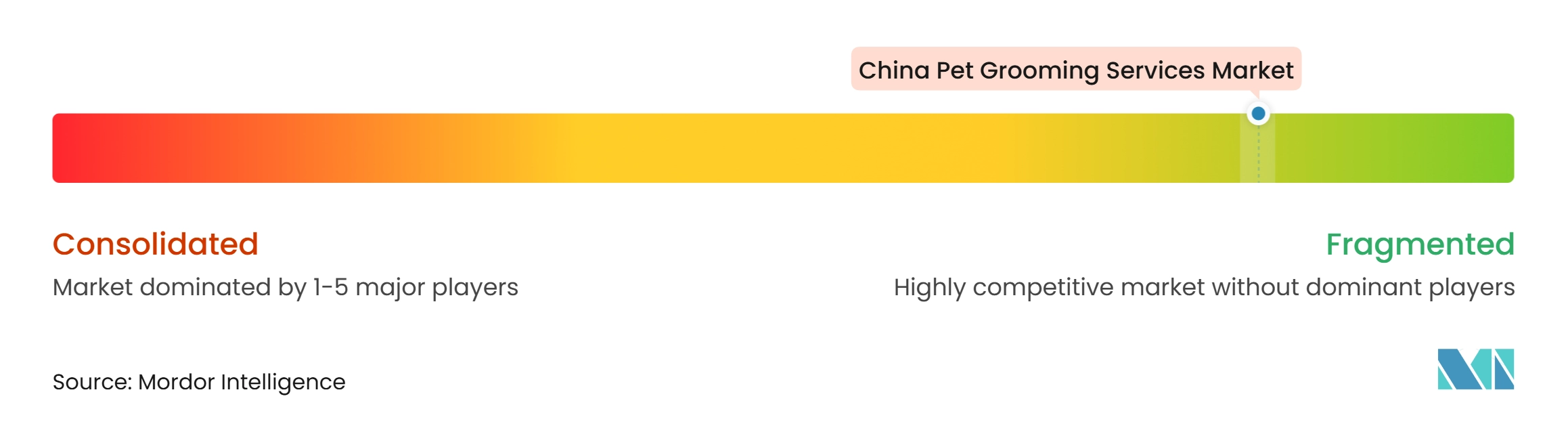
The China pet grooming services market remains highly fragmented, with competitors including national chains, veterinary networks, regional multi-city providers, and independent salons. Pet’em, New Ruipeng Pet Healthcare Group, Pai Duo Ge Pet, and ICVS operate through salon-based, integrated-care, and localized service models. This structure creates opportunities for local consolidators but challenges efforts to establish consistent national service standards.
New Ruipeng differentiates through its veterinary hospital network and integration of veterinary care with grooming-adjacent services. It operates more than 1,400 veterinary hospitals nationwide under the Ruipeng, Babatang, and Meilian Zhonghe networks. In November 2025, three Beijing hospitals received American Animal Hospital Association (AAHA) certification, raising their total certified locations to more than 10. Its strategy emphasizes quality credentials, integrated services, and infrastructure. Hospital-based care requires higher capital investment and more qualified staff than conventional salons.
Boqii Holding Limited primarily operates as an e-commerce and software platform, despite connections with offline pet stores. Local salons, regional providers, veterinary-care networks, and directly managed grooming chains form the core competitive landscape. Providers that combine skilled staff, transparent pricing, hygiene controls, and convenient access are likely to benefit.
China Pet Grooming Services Industry Leaders
-
Pet’em (Beijing Haotang Technology Co., Ltd.)
-
New Ruipeng Pet Healthcare Group
-
Pai Duo Ge Pet
-
Boqii Holding Limited
-
International Center for Veterinary Services (ICVS)
- *Disclaimer: Major Players sorted in no particular order
China Pet Grooming Services Market Companies Covered in this Report
- New Ruipeng Pet Healthcare Group
- Pet'em (Beijing Haotang Technology Co., Ltd.)
- Pai Duo Ge Pet
- Boqii Holding Limited
- PetLove365
- Yangchongbang
- CHIPET (Xinchong)
- PUPPYWALKER
- Bailiorda
- PetDog
- ZhuaZhua
- Ringpai Pet
- International Center for Veterinary Services (ICVS)
- BuddyDog
- Kung Fu Pet
- Xiaopei Pet
- Babang Shushu Pet
- Ji Duo Pet Lifestyle Hall
- Beijing Aisi Pet Grooming Center
- Huaying Pet Lifestyle Center
Recent Industry Developments in China Pet Grooming Services Market
- October 2026: PetLove365 hosted Shanghai’s community pet-friendly carnival, attracting more than 8,000 pet-owning households and 32 prospective brand partners. The event increased community engagement and awareness of pet services.
- May 2026: New Ruipeng partnered with JD.com to integrate online consultations, pet insurance, at-home testing, and retail services through its network of more than 1,000 veterinary hospitals across over 100 cities in China.
- October 2025: Six Zhejiang provincial departments issued a policy on October 20, 2025, targeting a pet consumption market value above CNY 30 billion (USD 4.28 billion) by 2027 and CNY 50 billion (USD 7.14 billion) by 2030. The policy promotes standardized pet grooming, boarding, and care services.
- June 2025: China Agricultural University announced a professional pet groomer training program in June 2025. The seven-day course accommodated approximately 40 participants per cohort.
China Pet Grooming Services Market Report Scope
The China pet grooming services market report analyzes professional grooming services for pets across China. The market is segmented by service type, pet type, delivery channel, and region. The study examines key drivers, including rising urban pet ownership, pet humanization, higher spending per pet, growing awareness of hygiene and coat health, increasing cat grooming demand, expansion of mobile and at-home services, and digital booking adoption. It also assesses restraints such as limited skilled-groomer supply, uneven service standardization, pet safety concerns, regional demand disparities, and operating costs. The report evaluates service-provider networks, geographic expansion, pricing, customer acquisition, consumer preferences, spending patterns, and regional service availability. It provides market size and growth forecasts, competitive landscape analysis, market share assessment, strategic developments, and profiles of leading grooming service providers. It also explores opportunities in premium and breed-specific grooming, cat-focused services, mobile grooming, and integrated pet-care facilities. Market estimates and forecasts are presented in value (USD) across all covered segments.
Segmentation Overview
Key Questions Answered in the Report
What is the projected size of the China pet grooming services market?
The China pet grooming services market is projected to reach USD 3.32 billion by 2032, from USD 2.01 billion in 2027, at a 10.56% CAGR.
Which service category generates the largest share of grooming revenue in China?
Bathing and brushing leads with 40.70% revenue share in 2026 because they are the most common recurring professional services.
Why are cat-focused grooming services growing in China?
Cats numbered 72.89 million in urban China in 2025, and their owners increasingly seek low-stress, appointment-based, and at-home care options.
Which delivery channel is expanding fastest for pet grooming services?
At-home grooming is forecast to grow at an 11.20% CAGR through 2032, driven by convenience and demand for lower-stress service environments.
Which region leads demand for pet grooming services in China?
East China leads with 39.10% revenue share in 2026, supported by Shanghai and the wider Yangtze River Delta service ecosystem.
What limits expansion for pet grooming providers in China?
The main constraints are a limited supply of trained groomers, uneven service standards, safety concerns, and differing city-level operating economics.