
China Milling Machines Market Size and Share
Market Overview
| Study Period | 2020 - 2031 |
|---|---|
| Forecast Data Period | 2026 - 2031 |
| Base Year Market Size (2025) | USD 4.59 Billion |
| Market Size (2026) | USD 4.88 Billion |
| Market Size (2031) | USD 6.62 Billion |
| Growth Rate (2026 - 2031) | 6.30 % |
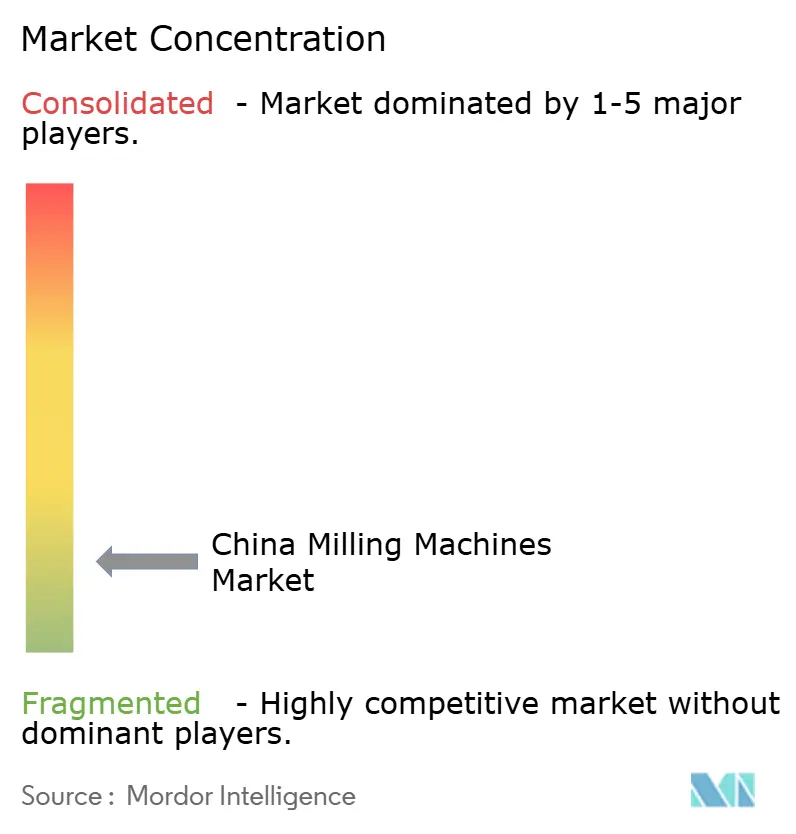
| Market Concentration | Low |
Major Players *Disclaimer: Major Players sorted in no particular order Image © Mordor Intelligence. Reuse requires attribution under CC BY 4.0. | |
China Milling Machines Market Analysis by Mordor Intelligence
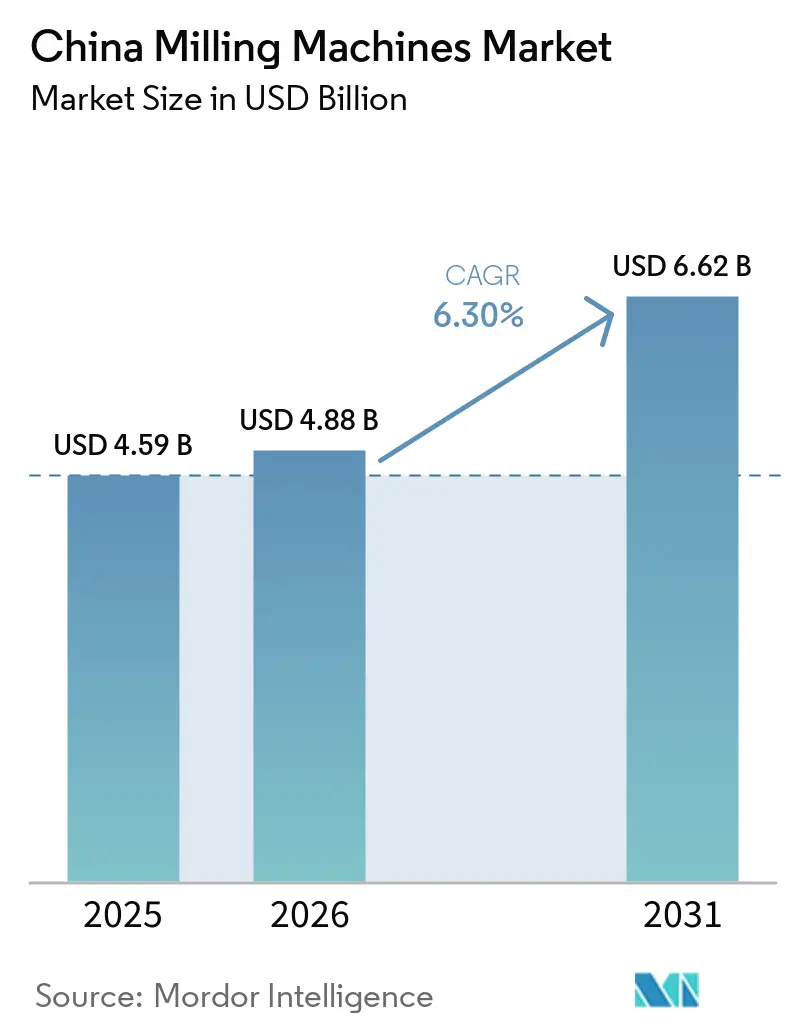
The China Milling Machines Market size is expected to grow from USD 4.59 billion in 2025 to USD 4.88 billion in 2026 and is forecast to reach USD 6.62 billion by 2031 at 6.30% CAGR over 2026-2031.
China’s milling machines market is supported by the country’s extensive manufacturing ecosystem, with demand spanning automotive and new-energy vehicles, electronics, industrial machinery, aerospace, and precision engineering. Ongoing industrial equipment renewal and manufacturing upgrades are encouraging manufacturers to replace aging equipment with CNC, automated, and multi-axis machining systems, with China’s equipment-renewal policy specifically targeting older machine tools and promoting digital and intelligent manufacturing. Growth in EV production, semiconductor-related manufacturing, and other advanced industries is also increasing the need for higher machining accuracy, productivity, and complex-part capabilities. At the same time, Chinese machine-tool manufacturers are moving toward higher-value CNC and five-axis equipment, supported by the broader push for domestic industrial technologies, while international suppliers remain important in high-precision and advanced machining applications. However, intense competition among domestic manufacturers, pressure on equipment pricing, and gaps in selected high-end CNC technologies and components continue to constrain margins and limit full localization of advanced milling equipment.
Key Report Takeaways
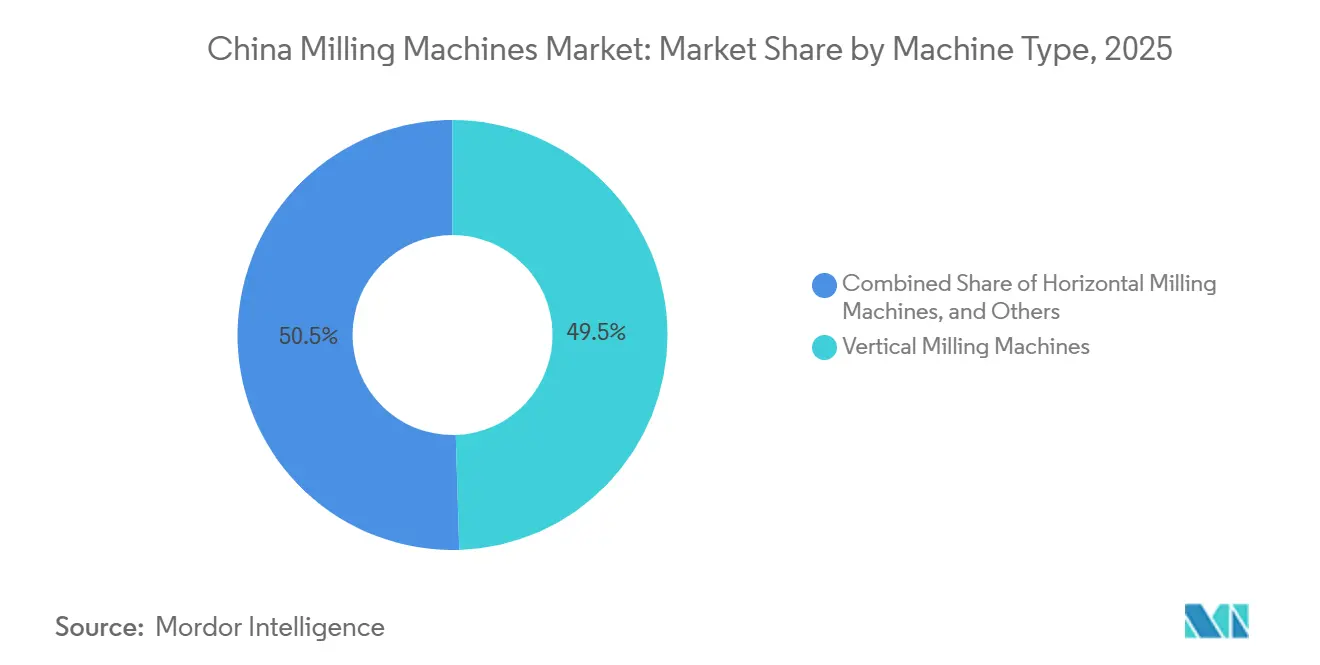
- By machine type, vertical machines held 49.50% of the China milling machines market share in 2025, while horizontal machines recorded the fastest growth outlook of 7.30% CAGR through 2031.
- By axis type, 3-axis machines held 53.50% of the China milling machines market share in 2025, while 5-axis and more machines recorded the fastest growth outlook of 10.50% CAGR through 2031.
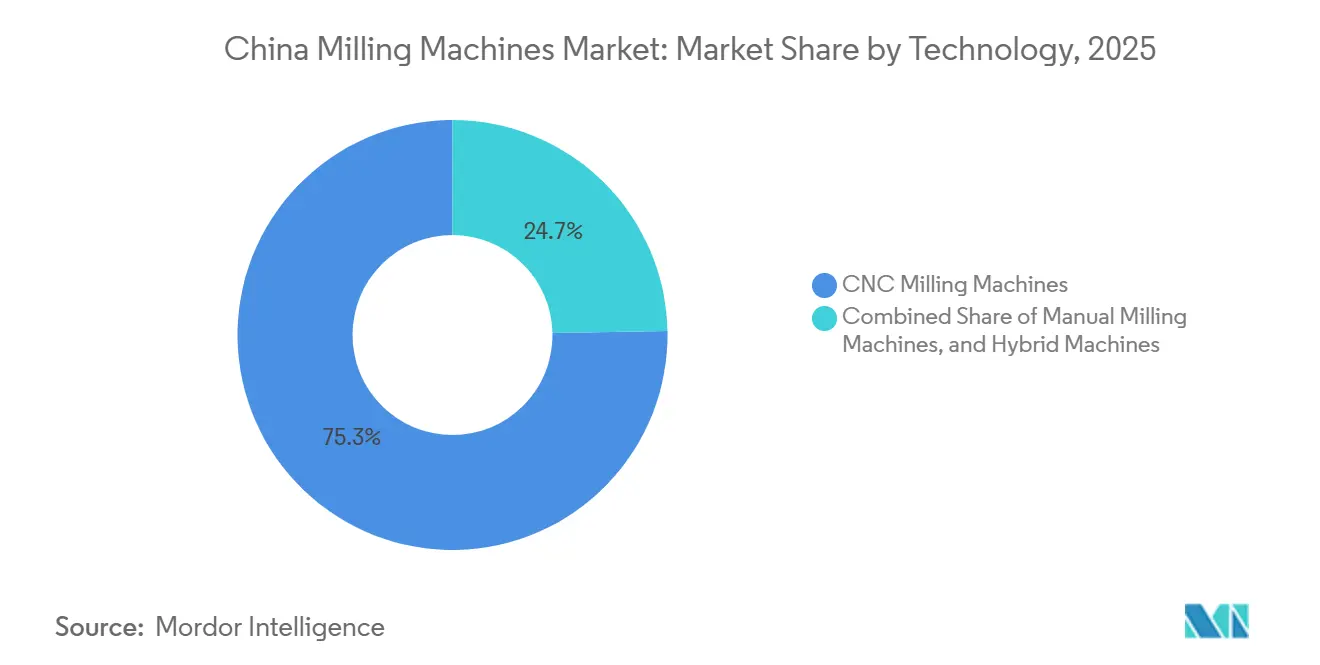
- By technology, CNC machines accounted for 75.30% of the China milling machines market size in 2025 and also recorded the fastest growth outlook of 8.50% through 2031.
- By end-user industry, automotive and transportation represented 35.50% of the China milling machines market size in 2025, while electronics and semiconductor recorded the fastest growth outlook of 10.30% through 2031.
Note: Market size and forecast figures in this report are generated using Mordor Intelligence’s proprietary estimation framework, updated with the latest available data and insights as of January 2026.
China Milling Machines Market Trends and Insights
Drivers Impact Analysis*
| Driver | (~) % Impact on CAGR Forecast | Geographic Relevance | Impact Timeline |
|---|---|---|---|
| Large-scale manufacturing base sustains broad milling-machine demand | +1.5% | National, with concentration in Jiangsu, Zhejiang, Guangdong, and Shandong | Short term (≤ 2 years) |
| EV and automotive capacity expansion increases precision-machining demand | +1.2% | National, led by Guangdong, Jilin, Chongqing, and Zhejiang | Medium term (2-4 years) |
| Factory automation increases demand for CNC machines suited to automated production cells | +1.0% | National, with high density in the Pearl River and Yangtze River Delta clusters | Medium term (2-4 years) |
| Domestic high-end machine-tool development expands demand for advanced milling equipment | +0.9% | National, with early gains in Shenyang, Ningbo, Nanjing, and Chengdu | Long term (≥ 4 years) |
| Industrial equipment renewal accelerates the replacement of aging machining assets | +0.8% | National, with emphasis on designated technology-reform pilot cities | Short term (≤ 2 years) |
| Aerospace, semiconductor, energy, and high-end equipment expansion raises complex-machining demand | +0.5% | Beijing, Shanghai, Xi’an, and Chengdu | Long term (≥ 4 years) |
| Source: Mordor Intelligence | |||
Large-Scale Manufacturing Base Sustains Broad Milling-Machine Demand
China accounted for 29% of global manufacturing output, creating demand for milling equipment across a wide range of industrial activities. Value-added output at machinery enterprises above the designated scale grew 8.2% in 2025. Metal-cutting machine-tool output reached 868,200 units in 2025, which was 9.7% higher than 2024[1]China Machinery Industry Federation, “2025 Machinery Industry Enterprises Above Designated Size Added Value Grew 8.2%,” China Economic Net, ce.cn.. New orders rose 9.3% in 2025, and recorded 7.9% increase in orders on hand. This pattern supports the China milling machines market because demand comes from capacity additions as well as routine replacement. Its wide end-user base reduces the effect that weakness in any one manufacturing sector could have on equipment demand. This diversity gives machine suppliers a broader order base across production cycles.
EV and Automotive Capacity Expansion Is Increasing Demand for Precision Machining
China produced approximately 16 million electric cars in 2025, representing nearly 75% of global electric-car production. Electric models accounted for more than 35% of China’s total car exports in 2025, compared with 20% in 2024. Motor housings, e-axle casings, rotor bores, and battery-tray structures require precision milling across the supplier base. China also produced more than 400,000 electric trucks in 2025, exceeding its combined output during 2020-2024. Higher tolerance requirements are encouraging component suppliers to replace older equipment with more capable CNC machines. This creates a durable demand channel for the China milling machines market as vehicle production and related parts capacity expand. Suppliers that meet automotive accuracy and throughput needs can benefit across several component categories.
Factory Automation Is Increasing Demand for CNC Machines Compatible with Automated Production Cells
China’s industrial equipment renewal plan targets a 75% CNC rate in key processes at enterprises above the designated scale by 2027[2]Ministry of Industry and Information Technology, “Implementation Plan for Industrial Equipment Renewal,” miit.gov.cn.. The same plan targets 90% adoption of digital research and design tools among industrial machine-tool enterprises by 2027. Domestic CNC penetration was 51%, more than thirty percentage points below the global average, leaving substantial room for replacement. Intelligent factory programs are increasing the value of machines that can connect with production systems. Buyers are therefore considering controller openness, network compatibility, and automation-cell integration along with spindle performance. These requirements favor CNC suppliers that can support broader factory automation projects. The effect is strongest where manufacturers are building connected production cells.
Domestic high-end machine-tool development expands demand for advanced milling equipment
The government provides an additional VAT deduction for eligible producers of advanced industrial mother machines, key components, and CNC systems. Foreign suppliers from Japan, Germany, and Switzerland remain important in aerospace and semiconductor-grade five-axis applications. COMAC’s plan to deliver 1,000 C919 aircraft before 2035 establishes a long-term requirement for qualified complex-part machining. Domestic alternatives can gain access to buyers who previously required imported systems once they meet application requirements. The policy focus also supports investment in machine hosts, control systems, and functional components. As local capability improves, the China milling machines market can serve a wider set of high-precision applications. Qualification work will remain important because these applications have demanding performance requirements.
Restraints Impact Analysis*
| Restraint | (~) % Impact on CAGR Forecast | Geographic Relevance | Impact Timeline |
|---|---|---|---|
| Intense domestic competition pressures milling-machine prices and margins | -0.8% | National, most acute in Jiangsu, Zhejiang, and Guangdong | Short term (≤ 2 years) |
| Export controls and trade tensions complicate access to advanced technologies and overseas markets | -0.7% | National, with cross-border effects in North America and Europe | Medium term (2-4 years) |
| Dependence on advanced imported components limits high-end machine development | -0.5% | National, concentrated in high-end CNC and 5-axis equipment | Long term (≥ 4 years) |
| Weak investment conditions among smaller manufacturers can delay machine purchases | -0.4% | National, most pronounced in smaller inland manufacturing clusters | Short term (≤ 2 years) |
| Source: Mordor Intelligence | |||
Intense Domestic Competition Is Putting Pressure on Milling-Machine Prices and Margins
Metal-cutting machine-tool output increased 9.7% in 2025, while new orders increased 9.3%. The combination indicates active demand but also a large domestic supply base. National performance standards establish a quality floor, but they do not limit the number of competitors in lower and mid-range equipment. Fixed-asset investment in the machine-tool and tooling sector declined in 2025. Price competition can restrict the funds that smaller producers can devote to research and development. This pressure may slow the movement of some China milling machines market participants into higher-value categories. Producers with limited resources may find it harder to fund extended product development.
Export Controls and Trade Tensions Complicate Access to Advanced Technologies and Overseas Markets
China introduced stricter export-declaration requirements for industrial machine tools from June 30, 2026. Exporters must provide export-control status, full specifications, manufacturer identity, and end-user details for applicable shipments. A dual-use export license has also been required since June 1, 2026, for defined high-precision 5-axis simultaneous machining centers. These measures add review steps to overseas sales of advanced milling equipment. Restrictions on advanced foreign technology can also affect access to motion-control, metrology, and related components. The China milling machines market must therefore manage longer planning cycles for some high-specification exports and imported inputs. Suppliers need to account for compliance documentation earlier in the delivery process.
*Our forecasts treat driver/restraint impacts as directional, not additive. The impact forecasts reflect baseline growth, mix effects, and variable interactions.
Segment Analysis
By Machine Type: Vertical Machines Retain the Broadest Base
Vertical milling machines held 49.5% of China milling machines market revenue in 2025. Their position reflects broad use in general engineering shops, mold-and-die facilities, and automotive component production. Vertical spindle layouts are familiar to operators and support straightforward programming for many standard parts. They also serve the large, small, and medium-sized machining base that relies on vertical machining centers as core production equipment. The segment’s installed base supports ongoing demand for replacement machines and related upgrades. This makes vertical equipment the volume anchor of the China milling machines market.
Horizontal milling machines are forecast to grow at a 7.3% CAGR through 2031. Automotive original equipment manufacturers and Tier 1 suppliers use these systems where throughput, rigidity, and multi-pallet automation are important. Horizontal layouts can support longer unattended production cycles in automated manufacturing cells. Gantry mills and large-format machining centers serve wind turbine housings, aerospace structures, and energy equipment components. Haitian Precision introduced three 5-axis machining centers at CCMT 2026 for medium and large complex parts, high-efficiency production, and curved-surface machining. This development shows how suppliers are extending their offerings beyond standard vertical platforms.



By Axis Type: 3-Axis Machines Lead the Revenue Base
3-axis machines accounted for 53.5% of the China milling machines market size in 2025. They are widely used for automotive castings, machinery housings, mold cavities, and general-purpose parts. Their cost and application range make them suitable for the broad mid-market. The installed base is substantial, but mature product categories face continued price pressure. 4-axis equipment provides an intermediate option for more complex contours and selected automotive parts. As a result, 3-axis systems remain the central revenue base for the China milling machines market.
5-axis and above machines are forecast to grow at a 10.5% CAGR through 2031. Aerospace blisks, turbine blades, semiconductor equipment housings, and complex NEV drivetrain parts require simultaneous multi-axis motion. These machines sell at three to five times the average price of comparable 3-axis platforms. Chinese suppliers held more than 8% of the high-tier CNC machine market in recent years. This compares with the 80% domestic-market-share target set under Made in China 2025 for 2025. The gap highlights the continuing role of Japanese and European suppliers in the most demanding applications. Fiscal support for industrial mother-machine producers encourages domestic development of 5-axis capabilities.[3]U.S.-China Economic and Security Review Commission, “Made in China 2025: Evaluating China’s Performance,” uscc.gov.
By Technology: CNC Machines Dominate Current Demand
CNC milling machines captured 75.3% of China's milling machine market revenue in 2025. The China milling machines market share held by CNC equipment reflects replacement demand across smaller workshops and demand for connected systems from large industrial buyers. CNC platforms are used where repeatability, program control, and production data are important. The national equipment renewal plan links wider CNC adoption with industrial digitalization. This makes CNC the leading technology segment by current value. Conventional and manual equipment remains in limited use in small job shops and training settings.
CNC equipment is also the fastest-growing technology segment, with an 8.5% CAGR forecast through 2031. Connected machines can act as data points within intelligent factory systems. National machine-tool performance standards set requirements for accuracy, thermal stability, and acceptance testing. These standards raise the baseline for both domestic and foreign participants. Hybrid machines combine additive and subtractive operations and currently serve narrow applications, including aerospace repair, specialized tooling, and medical components. Their broader role in the China milling machines market will depend on improvements in cycle times and material costs.
By End-User Industry: Automotive and Transportation Leads Demand
Automotive and transportation represented 35.5% of China milling machines market revenue in 2025. Vehicle production drives demand for machining of motor housings, gear housings, e-axle casings, and structural battery components. The scale of electric-vehicle output reinforces this demand across component makers. Tighter tolerance requirements for electric vehicles are encouraging investment in higher-specification CNC equipment. Industrial machinery, energy and power, construction and mining equipment also sustain demand for 3-axis and 4-axis systems. Automotive therefore, remains the largest application base in the China milling machines market.
Electronics and semiconductor is forecast to grow at a 10.3% CAGR through 2031. Semiconductor equipment production supports a pipeline for precision mechanical components. Vacuum housings, wafer-handling structures, and metrology stage frames require high-precision milling. Aerospace and defense is another high-value area, supported by C919 production plans and investment in aviation supply chains. Medical device manufacturing also uses precision milling for titanium and stainless-steel components. These applications are increasing the demand for machines with higher accuracy and multi-axis capacity.
Geography Analysis
Eastern China is the leading geography for production and use of advanced milling equipment, although no provincial China milling machines market share was provided. Jiangsu, Zhejiang, and Shanghai combine domestic machine-tool suppliers with customers in automotive molds, consumer electronics, medical devices, and robotics components. Shanghai hosted CCMT 2026, where Haitian Precision introduced 3 new 5-axis machines, and DMG MORI presented automation solutions for semiconductor and robotics customers. The concentration of suppliers, logistics networks, and application engineering capabilities supports the region’s leading position. Northern industrial centers are also investing in higher-value equipment. Shenyang Machine Tool reported USD 30.7 million in 2025 research and development spending and USD 242.8 million in capital raised for high-end capability development.
Southern China, led by Guangdong and the Pearl River Delta, has strong links to electronics, semiconductor, and NEV manufacturing. The region’s demand favors high-speed, fine-tolerance CNC machines for electronics and related equipment. Domestic 5-axis CNC machines have entered mass supply for NEV platforms with important production footprints in Guangdong. Electronics and semiconductor is the fastest-growing end-user segments at a 10.3% CAGR through 2031, while automotive and transportation held 35.5% of 2025 revenue. These two demand streams position Guangdong as a key growth area for the China milling machines market. Semiconductor equipment activity in Guangdong, Jiangsu, and Shanghai supports precision-machining requirements.
Northeastern China remains important through Shenyang and Dalian, where the state-enterprise machine-tool base is being repositioned toward mid-to-high-end CNC capability. Shenyang Machine Tool has reported progress at the 0.01 mm precision level for domestic machining centers. Western China, particularly Chongqing and Sichuan, is expanding as NEV, aerospace, and intelligent manufacturing investment moves inland. Haitian Precision is developing customers in Chongqing and Sichuan across NEV, aerospace, and precision molds. The March 2025 technology reform city pilot program extends fiscal support for eligible upgrades in inland manufacturing locations. This wider geographic demand base can reduce the concentration of new purchases in coastal clusters. Manufacturing clusters in the east and south will continue to be important because they bring equipment suppliers close to demanding end users. Inland locations add another source of opportunity where public support and new industrial projects encourage capital investment. The resulting pattern is not a single uniform national demand profile. It is a set of local markets shaped by the mix of automotive, electronics, aerospace, and machinery production.
Competitive Landscape
The China milling machines market is fragmented in mid-range equipment, while the premium segments are more concentrated around established domestic and international suppliers. Domestic companies have strong positions in vertical 3-axis machining centers and are expanding into horizontal and 5-axis systems. Mazak, Makino, and DMG MORI appeared alongside domestic challengers among the leading metal-cutting machine-tool producers by domestic sales revenue in the first three quarters of 2025. International suppliers retain strengths in simultaneous 5-axis machining, high-speed precision milling, and automation integration. Their revenue position is supported by concentration in high-value applications rather than broad unit volume. This division keeps competitive conditions distinct across technology tiers. Domestic builders compete most directly where customers prioritize cost, delivery, and standard CNC capability. Foreign brands are more exposed to applications where qualification, accuracy, and automation integration carry greater weight. The competitive position of any supplier can therefore vary by machine type, axis configuration, and end-user requirement. This creates room for domestic companies to advance without displacing foreign competitors across every application. It also means that product specialization remains an important feature of the China milling machines market.
Domestic producers are seeking differentiation through broader technology portfolios. Shenyang Machine Tool launched the VMC850Q vertical machining center, HTC40H/500 horizontal machining center, and VMU30P universal machining center in March 2026. Haitian Precision introduced three 5-axis machining centers at CCMT 2026, addressing complex parts, mass production, and curved-surface requirements. Haitian Precision also signed a USD 24.7 million machinery equipment supply agreement with Haitian Plastics Machinery in April 2026. These moves show an effort to improve product depth and serve higher-value applications. They also reduce reliance on standard vertical machines where price competition is strongest. Shenyang Machine Tool’s launches cover vertical, horizontal, and universal formats, which broaden its coverage of customer requirements. Haitian Precision’s 5-axis releases focus on applications that have greater technical and revenue potential. The announced supply agreement also shows continuing demand for processing lines and machining centers within the wider Haitian group. These strategies place greater emphasis on product capability, production efficiency, and application fit. They do not remove price pressure in standard equipment, but they can improve access to less crowded parts of the China milling machines market.
The main opening for local suppliers is in advanced multi-axis equipment, where localization remains limited. The additional VAT deduction policy supports qualifying makers of advanced industrial machine tools, components, and CNC systems. Export compliance has become more relevant for suppliers selling high-specification equipment overseas. Connected CNC platforms, open control architectures, and automation support are becoming practical points of differentiation. Domestic exporters with established compliance processes may be better placed to manage the new licensing requirements. The absence of disclosed combined shares for the leading groups prevents a higher concentration assessment. The competitive evidence instead indicates a wide field of domestic participants in mid-range machines and persistent foreign strength in premium systems. Product development, service capability, compliance readiness, and customer qualification are, therefore, practical competitive variables. The China milling machines market does not show the conditions of a market controlled by a small number of suppliers. Buyers instead face a choice among suppliers with different technical strengths, price positions, and local service capabilities. Competition remains active across product and technology tiers.
China Milling Machines Industry Leaders
Ningbo Haitian Precision Machinery Co., Ltd.
Shenyang Machine Tool Co., Ltd.
Qinchuan Machine Tool and Tool Group Corp.
Shenzhen Create Century Machinery Co., Ltd.
DMG MORI Co., Ltd.
- *Disclaimer: Major Players sorted in no particular order

Recent Industry Developments
- April 2026: Haitian Precision showcased three debut five-axis products at CCMT 2026 in Shanghai - the GFM800 gantry five-axis high-speed milling center, HF08 horizontal five-axis high-speed milling center, and HF125M horizontal five-axis machining center - targeting medium and large complex-part machining, high-volume efficient production, and high-precision complex-surface processing. The company’s 2025 overseas revenue reached approximately USD 79.7 million, reflecting its continued international expansion.
- April 2026: Haitian Precision signed a CNY 173.39 million (USD 24.7 million) machinery equipment purchase agreement with Haitian Plastics Machinery covering automatic processing lines, CNC turning machines, machining centers, and related equipment. The equipment will be used to process components for plastic injection molding machines.
- March 2026: Shenyang Machine Tool introduced the VMC850Q vertical machining center and the VMU30P five-axis vertical machining center, targeting machining requirements for humanoid-robot structural components. The company reported CNY 215 million (USD 30.7 million) in 2025 R&D investment and raised CNY 1.7 billion (USD 242.8 million) through the capital markets as part of its high-end capability development.


China Milling Machines Market Report Scope
The China Milling Machines Market Report is Segmented by Machine Type (Vertical, Horizontal, and Others), by Axis Type (3-Axis, 4-Axis, and 5-Axis and More), by Technology (Conventional / Manual Milling Machines, CNC Milling Machines, and Hybrid Machines), and by End-User Industry (Automotive & Transportation, Industrial Machinery, and More). The Report Offers Market Size and Forecasts in Value (USD) for all the Above Segments.
| Vertical Milling Machines |
| Horizontal Milling Machines |
| Others (Gantry mills, etc.) |
| 3-Axis Machine |
| 4-Axis Machine |
| 5-Axis and More |
| Conventional / Manual Milling Machines |
| CNC Milling Machines |
| Hybrid Machines |
| Automotive & Transportation |
| Aerospace & Defense |
| Industrial Machinery |
| Energy & Power |
| Medical Devices |
| Electronics & Semiconductor |
| Construction & Mining Equipment |
| General Manufacturing |
| Others |
| By Machine Type | Vertical Milling Machines |
| Horizontal Milling Machines | |
| Others (Gantry mills, etc.) | |
| By Axis Type | 3-Axis Machine |
| 4-Axis Machine | |
| 5-Axis and More | |
| By Technology | Conventional / Manual Milling Machines |
| CNC Milling Machines | |
| Hybrid Machines | |
| By End-User Industry | Automotive & Transportation |
| Aerospace & Defense | |
| Industrial Machinery | |
| Energy & Power | |
| Medical Devices | |
| Electronics & Semiconductor | |
| Construction & Mining Equipment | |
| General Manufacturing | |
| Others |


Key Questions Answered in the Report
What is the forecast for China milling machines through 2031?
The sector is projected to grow from USD 4.88 billion in 2026 to USD 6.62 billion by 2031 at a 6.30% CAGR.
Which machine type leads China milling equipment demand?
Vertical milling machines led with 49.5% of revenue in 2025 because of their wide use in general engineering, molds, and automotive components.
Which milling machine category will grow fastest in China?
5-axis and above equipment is forecast to grow at a 10.5% CAGR through 2031, supported by aerospace, semiconductor, and NEV applications.
Why is CNC equipment important in China?
CNC machines held 75.3% of 2025 revenue and are forecast to grow at an 8.5% CAGR as factories adopt connected and automated production systems.
Which end-user sector offers the strongest demand?
Automotive and transportation led with 35.5% of 2025 revenue, while electronics and semiconductor is forecast to grow fastest at a 10.3% CAGR.
What limits growth for milling machine suppliers in China?
Price pressure in mid-range equipment, dependence on advanced imported controls, export requirements, and weaker investment among some smaller manufacturers can delay purchases.
Page last updated on:


 Your data is secure and never sold or shared.


