
China Kiwi Market Size and Share
China Kiwi Market Analysis by Mordor Intelligence
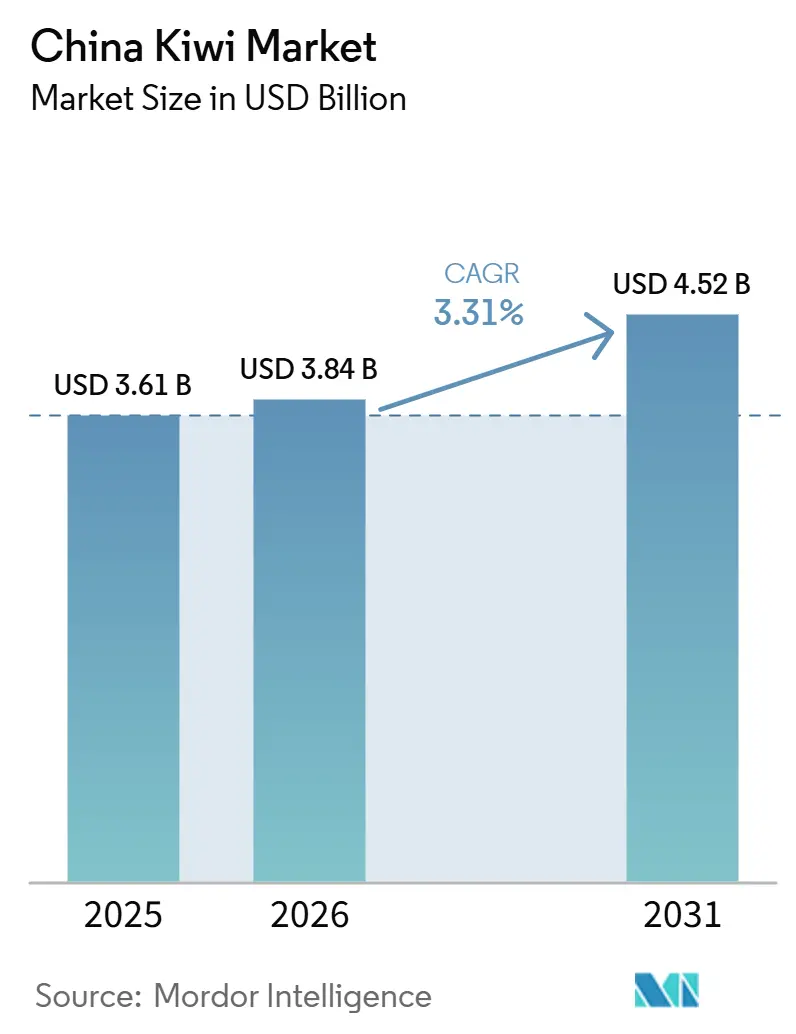
The China kiwi market size was estimated at USD 3.61 billion in 2025 and USD 3.84 billion in 2026, to reach USD 4.52 billion by 2031, at a CAGR of 3.31% during the forecast period from 2026 to 2031. Domestic output had leveled after a long period of orchard expansion, so value growth increasingly depends on quality, grading, and distribution rather than additional planted area. China remained the leading global producer in 2024, with 48.7% of global kiwifruit production, while its domestic supply base remained concentrated in Shaanxi Province[1]. Import demand remained concentrated in premium fruit, as New Zealand supplied 99.3% of kiwifruit import volume in 2025, according to ITC Trade Map. Digital retail channels are requiring stronger grading, traceability, and pre-cooling practices from suppliers, which may widen the gap between certified fruit and ungraded fruit. Disease risk, cold chain weaknesses, and uncertainty surrounding unauthorized Gold3 plantings may continue to affect prices and supply quality across the China kiwi market.
Key Report Takeaways
In 2025, New Zealand accounted for 99.3% of China’s kiwifruit import volume.
Note: Market size and forecast figures in this report are generated using Mordor Intelligence’s proprietary estimation framework, updated with the latest available data and insights as of January 2026.
China Kiwi Market Trends and Insights
Drivers Impact Analysis*
| Driver | (~) % Impact on CAGR Forecast | Geographic Relevance | Impact Timeline |
|---|---|---|---|
| Rising health and immunity-oriented fruit consumption | +1.20% | National, concentrated in first-tier and second-tier cities | Medium term (2-4 years) |
| Premiumization of imported and gold kiwifruit | +0.90% | National, with premium demand centered in Beijing, Shanghai, Guangzhou, and Chengdu | Long term (≥ 4 years) |
| Expansion of online grocery and social-commerce distribution | +0.80% | National, with supply benefits concentrated in Shaanxi and Sichuan | Short term (≤ 2 years) |
| Growth of domestic orchard productivity and cultivar improvement | +0.70% | Second-tier and third-tier cities in Central and Western China | Medium term (2-4 years) |
| Secondary-city adoption of premium fresh fruit | +0.50% | Shaanxi, Sichuan, and Henan | Long term (≥ 4 years) |
| Unauthorized expansion of proprietary gold cultivar plantings | +0.30% | Sichuan, Hubei, and Henan | Short term (≤ 2 years) |
| Source: Mordor Intelligence | |||
Rising Health and Immunity-Oriented Fruit Consumption
Health-focused fruit purchasing has become an important sales theme for kiwifruit sellers in China. The National Health Commission recommends an annual fruit intake of at least 70 kilograms for adults, while reported intake remained between 40 kilograms and 50 kilograms per person. Kiwifruit benefits from its vitamin C content and its established digestive health positioning. A 2024 clinical study found that eating 2 SunGold kiwifruit each day for 6 weeks restored adequate to saturating vitamin C status in 80.0% of adults with a history of severe respiratory infections[2]. Retail buyers serving urban stores and community buying channels are responding with tighter requirements for product traceability, variety certification, and pesticide-residue documentation. These requirements make quality records more valuable during procurement. They also place ungraded smallholder supply at a disadvantage when it cannot consistently meet buyer specifications. The China kiwi market therefore benefits when health messaging is supported by fruit that can be documented and graded for modern retail channels.
Premiumization of Imported and Gold Kiwifruit
Imported gold kiwifruit has maintained a distinct price position relative to mass-market domestic green fruit. China’s average kiwifruit import price stood at USD 3,955 per metric ton in 2025, according to ITC Trade Map, reflecting the premium role of imported fruit[3]. Zespri reported that SunGold prices to Chinese customers declined in 2025, even as premium fruit pricing in China also declined that year. This difference shows the value buyers place on certified origin and consistent quality. The gold fruit category is separating into certified branded supply and unbranded fruit that competes mainly on spot pricing. Certified supply requires cold chain control, fruit grading, origin verification, and reliable pre-cooling. Digital sales channels also increase the need for traceable product records. These operational requirements create a lasting advantage for wholesale operators that can handle premium fruit without compromising quality. The China kiwi market has room for suppliers that can serve premium demand with dependable post-harvest practices.
Expansion of Online Grocery and Social-Commerce Distribution
Online grocery and social-commerce channels are reducing the number of intermediaries between kiwifruit growers and consumers. Douyin recorded gross merchandise value of USD 490 billion in 2024, and fresh produce was among the platform's fast-growing categories[4]. The platform's fresh-produce policies lowered distribution costs for sellers during 2024. This gave cooperatives in Shaanxi and Sichuan greater access to buyers in lower-tier cities. Live selling also places product standards closer to the farm gate. Sellers need consistent sugar content, uniform fruit size, appealing presentation, and traceable lots before a product can be promoted online. These conditions distinguish pre-cooled and certified fruit from commodity-grade supply. Producers that meet those standards can sell more directly, while traditional intermediaries face pressure on their role in the distribution chain. As a result, growers are increasingly investing in cold-chain infrastructure, digital traceability systems, and packaging upgrades to qualify for these higher-margin online channels and capture more value.
Secondary-City Adoption of Premium Fresh Fruit
Demand for premium fresh fruit is extending beyond China’s largest cities. Zespri reported faster sales growth in lower-tier cities than in first-tier cities during the prior two years. The company responded by seeking to expand its retail presence from 100 locations to 150 or more locations per city. This pattern changes how wholesale distributors must serve demand. Smaller and more frequent refrigerated deliveries become more important than large shipments into a small number of urban terminals. Regional distributors in Shaanxi and Sichuan can benefit from shorter transit distances to nearby cities. Lower handling time can also reduce product loss. The China kiwi market can gain value when regional cold chain operators meet these distributed delivery requirements, while improving product availability, maintaining fruit quality, supporting retailer replenishment efficiency, and strengthening supply chain responsiveness across emerging consumption markets.
Restraints Impact Analysis*
| Restraint | (~) % Impact on CAGR Forecast | Geographic Relevance | Impact Timeline |
|---|---|---|---|
| Short fresh-fruit shelf life and post-harvest spoilage | -0.40% | National, with the greatest effect in second-tier and third-tier cities far from production hubs | Medium term (2-4 years) |
| Phytosanitary risk from Pseudomonas syringae pv. actinidiae | -0.30% | Jiangxi, Sichuan, Anhui, and Henan | Long term (≥ 4 years) |
| Fragmented orchard quality and traceability standards | -0.30% | Shaanxi smallholder areas, Henan, and Guizhou | Medium term (2-4 years) |
| Cultivar intellectual-property enforcement and royalty leakage | -0.20% | Sichuan, Hubei, and Henan, with national effects on gold-fruit pricing | Short term (≤ 2 years) |
| Source: Mordor Intelligence | |||
Short Fresh-Fruit Shelf Life and Post-Harvest Spoilage
Short shelf life remains a material operating constraint for wholesale kiwifruit distribution. Kiwifruit is sensitive to ethylene exposure and temperature changes during transit. A break in refrigerated handling can reduce the quality of an entire lot before it reaches the wholesale depot. Price reductions are more common in cities located far from Shaanxi production clusters. These areas have historically received less cold chain investment than major urban markets. China’s 14th Five-Year Plan has supported cold chain network expansion, but coverage in many kiwifruit counties has lagged higher-value horticultural export categories. Imported fruit enters major ports after pre-cooling and certification, which gives it a practical handling advantage. Gross production data can therefore overstate the volume of domestic fruit that reaches buyers in suitable condition. The China kiwi market remains exposed to loss and lower realized prices until cold chain capacity becomes more consistent across production and consumption areas.
Phytosanitary Risk from Pseudomonas Syringae pv. Actinidiae
Bacterial canker caused by Pseudomonas syringae pv. actinidiae presents a continuing supply risk for domestic growers. A 2026 study titled “Prevalence of copper-resistant Pseudomonas syringae pv. actinidiae biovar 3 in Jiangxi Province, China” collected 120 samples across 6 major producing areas in Jiangxi Province and identified 42 strains of the pathogen. The study identified copper-resistant biovar 3 isolates, which reduces the usefulness of a widely available treatment method. Research in Sichuan also found that Pseudomonas syringae pv. actinidiae dominated infections in winter and spring. Pectobacterium carotovorum subspecies actinidiae became more prominent in summer. Growers therefore need disease management methods that reflect seasonal changes. Dense county-level orchard clusters can increase the risk of spread through irrigation water and contaminated pruning equipment. An outbreak in Zhouzhi or Mei County could affect several growers during the same season. This risk may reduce usable volumes and complicate supply planning for wholesalers.
*Our forecasts treat driver/restraint impacts as directional, not additive. The impact forecasts reflect baseline growth, mix effects, and variable interactions.
Geography Analysis
Shaanxi was the leading domestic production region in the China kiwi market, with cultivation area and fresh fruit output among the highest nationally by the end of 2025. Zhouzhi County produced the largest volume in 2025, while Mei County produced the second-largest volume. The two counties are located in a compact production corridor that shapes domestic wholesale supply. Henan’s Xixia County was the largest production zone outside Shaanxi, with extensive area under cultivation. Its yield efficiency remained below the benchmark counties in Shaanxi because of differences in elevation and climate. Sichuan and Guizhou also grew in importance, especially through Gold3 planting activity around Chengdu.
New Zealand held the overwhelming majority of China’s kiwi market share by import volume in 2025, supplying most of the total volume imported. The supply structure reflected Zespri’s controlled cultivar model and the tariff treatment under the Regional Comprehensive Economic Partnership. Italy supplied niche Hayward fruit at a premium price per metric ton in 2024. Zespri confirmed in April 2026 that it would maintain supply at a large volume of standard retail boxes for China across multiple bulk carrier shipments. This commitment reflects the importance of China as the company’s largest single destination. New Zealand’s position remains difficult for other Southern Hemisphere suppliers to challenge.
China’s export geography remained concentrated in nearby and Central Asian destinations. Kyrgyzstan, Russia, and Indonesia absorbed a combined majority share of export volume in 2024. Hong Kong Special Administrative Region recorded the highest average export price per metric ton, while Mongolia recorded the lowest. Malaysia, Vietnam, Uzbekistan, the United Arab Emirates, Nepal, Singapore, and Taiwan formed the secondary export destinations. Domestic fruit therefore competed mainly in price-sensitive adjacent markets rather than premium markets in East Asia or Europe. Better post-harvest handling, certified cultivars, and cold chain investment are needed to improve that position.
Competitive Landscape
The China kiwi market has a split competitive structure between fragmented domestic production and concentrated imports. Domestic production includes many smallholder orchards across Shaanxi, Henan, Sichuan, and Guizhou. County-level grading and packing companies focus on standardizing lots and reaching buyers through digital sales. Zhouzhi Kiwifruit’s Geographical Indication status supports origin-based product positioning. Zespri held the overwhelming majority of China’s import volume through its controlled supply channel. Certified domestic gold fruit remains undersupplied when measured against buyer demand for traceable, high-quality product. A Chinese Zespri distribution partner reported a shortage of G3 boxes during Lunar New Year.
Technology use is becoming more important at the farm-to-wholesale stage. Larger orchards in Zhouzhi and Mei County are adopting artificial intelligence-based crop management, precision irrigation, soil sensors, and yield forecasting. These systems can improve harvest timing and product consistency. Live-streaming operators are also asking suppliers for traceability records before accepting products for their catalogs. Zespri’s licensing and certification system remains a strategic defense for imported SunGold and Green fruit. The company’s decision to commit a large volume of standard retail boxes to China was a direct move to protect supply availability. Zespri also introduced RubyRed into China as part of a broader premium variety strategy.
The Wuhan court decision requiring the removal of unauthorized Gold3 vines was another significant competitive event. It also required damages to Zespri. The appeal filed kept uncertainty in the domestic gold category. Vertically integrated fresh produce platforms are responding by sourcing directly from Shaanxi counties. Regional cold chain operators are pairing refrigerated infrastructure with direct procurement agreements for secondary cities. These models can reduce dependence on the traditional multilevel wholesale chain.
Recent Industry Developments
- April 2026: Zespri Group Ltd. expanded its China supply chain strategy for the 2026/27 season by deploying dedicated charter shipping to Shanghai. The initiative strengthens cold-chain efficiency, ensures consistent availability of premium New Zealand kiwifruit, and supports growing demand in China.
- October 2025: A Wuhan court ruled in favor of Zespri Group Ltd. in a Gold3 plant variety rights case. The ruling ordered the removal of 260 hectares of unauthorized vines and payment of USD 714,240 in damages.
- June 2025: Zespri Group Ltd. signed strategic Memorandums of Understanding (MOUs) with major Chinese distributors and retailers, including Joy Wing Mau, Goodfarmer, Pagoda, and Xianfeng Fruit, to strengthen its kiwifruit presence in China. The partnership aims to double Zespri’s fruit sales value in China over the next decade and expand distribution coverage from 60 to 120 cities by 2034.
China Kiwi Market Report Scope
Kiwi, also known as kiwifruit, is a nutrient-rich edible berry with green, gold, or red flesh and a fuzzy or smooth skin, cultivated commercially for fresh consumption and food processing applications. The China kiwi market report includes production analysis (volume, area harvested, and yield), consumption analysis (value and volume), import analysis (import value, volume, and key supplying markets), export analysis (export value, volume, and key supplying markets), wholesale price trend analysis and forecast, regulatory framework, logistics and infrastructure, and seasonality analysis. The market forecasts are provided in terms of value (USD) and volume (metric tons).
Key Questions Answered in the Report
What is the size of the China kiwi market?
The China kiwi market size was estimated at USD 3.61 billion in 2025 and USD 3.84 billion in 2026.
What is driving demand for kiwifruit in China?
Health-focused consumption, premium gold fruit, online retail, and growth in lower-tier cities are supporting demand.
Which country supplies most kiwifruit to China?
New Zealand accounted for 99.3% of China’s kiwifruit import volume in 2025.
What are the main risks facing kiwi growers in China?
Cold chain gaps, spoilage, fragmented quality standards, and bacterial canker from Pseudomonas syringae pv. actinidiae are key risks.