
China Industrial Manufacturing Logistics Market Size and Share
Market Overview
| Study Period | 2020 - 2031 |
|---|---|
| Forecast Data Period | 2026 - 2031 |
| Base Year Market Size (2025) | USD 524.54 Billion |
| Market Size (2026) | USD 561.83 Billion |
| Market Size (2031) | USD 749.99 Billion |
| Growth Rate (2026 - 2031) | 5.95 % |
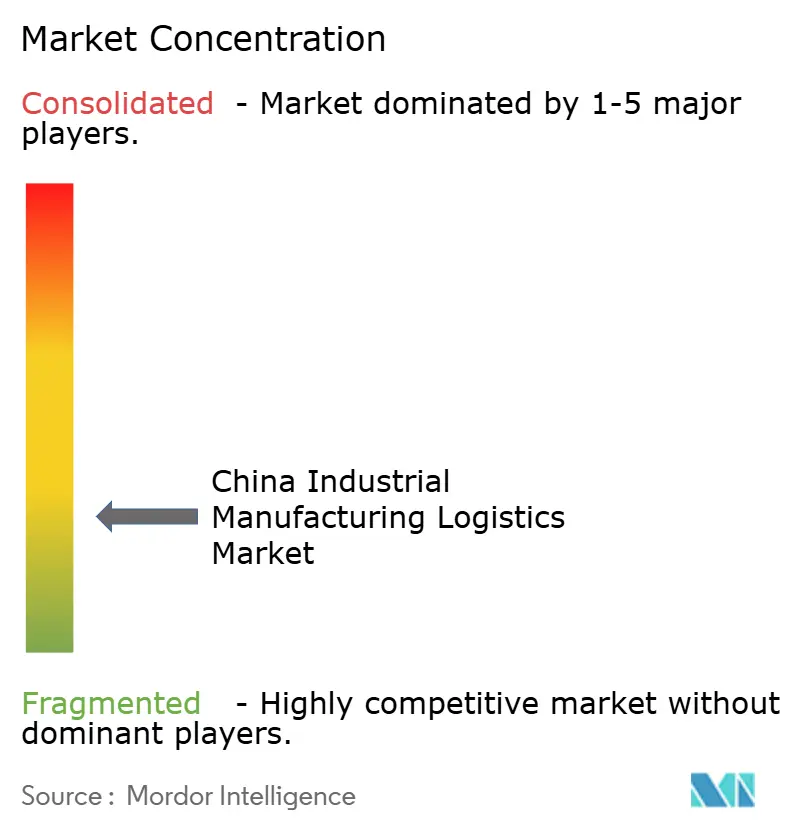
| Market Concentration | Low |
Major Players *Disclaimer: Major Players sorted in no particular order Image © Mordor Intelligence. Reuse requires attribution under CC BY 4.0. | |
China Industrial Manufacturing Logistics Market Analysis by Mordor Intelligence
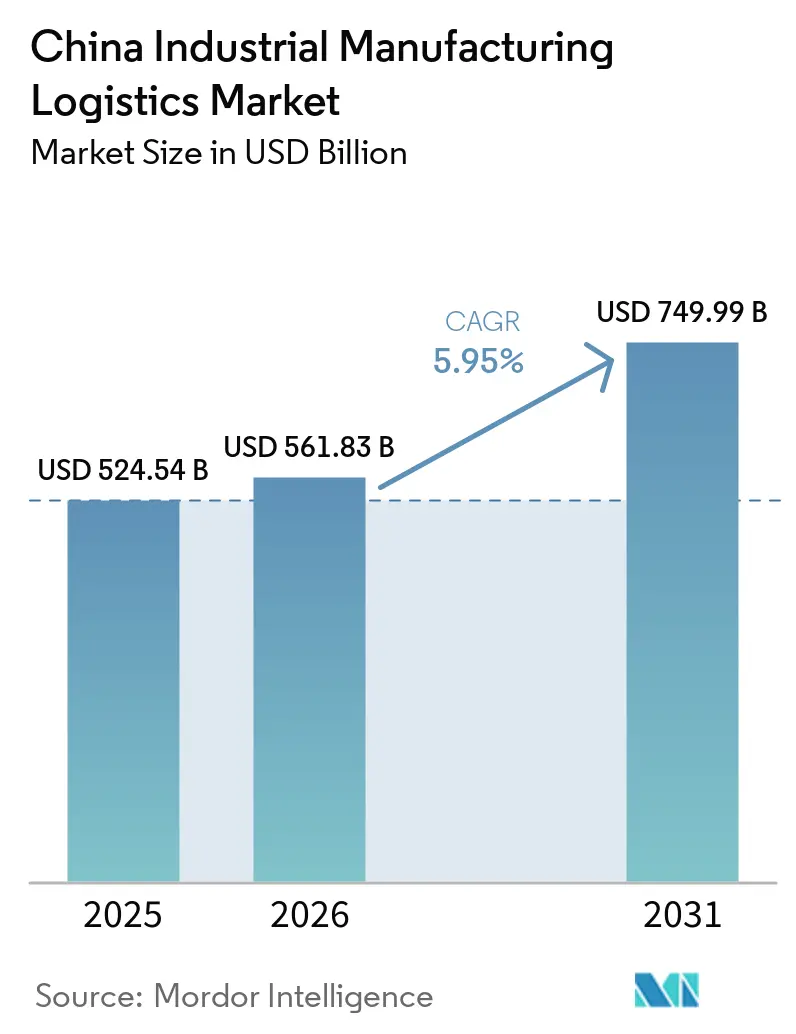
The China industrial manufacturing logistics market size was valued at USD 524.54 billion in 2025 and estimated to grow from USD 561.83 billion in 2026 to reach USD 749.99 billion by 2031, at a CAGR of 5.95% during the forecast period (2026-2031).
Industrial goods logistics remained the backbone of China’s total social logistics system, and industrial goods logistics value rose 5.8% year over year in the first quarter of 2026. China’s carbon-neutrality target for 2060 and export compliance requirements are increasing the importance of low-carbon logistics capabilities. Industrial capacity is also shifting from coastal provinces toward Central and West China, where logistics networks are still developing. These conditions favor providers that can combine industry knowledge, digital systems, and geographic flexibility.
Key Report Takeaways
- By service, transportation held 59.50% of China's industrial manufacturing logistics market share in 2025, while the value-added services and others segment is projected to grow at a CAGR of 7.90% through 2031.
- By end-user industry, automotive accounted for 32.55% of the China industrial manufacturing logistics market size in 2025, while the electronics and semiconductors segment is expected to record a CAGR of 7.25% through 2031.
- By logistics model, asset-light logistics held 53.50% of China's industrial manufacturing logistics share in 2025, while hybrid logistics is forecast to expand at a CAGR of 6.95% through 2031.
- By geography, East China accounted for 37.00% of China's industrial manufacturing logistics share in 2025, while West China is projected to grow at a 7.45% CAGR through 2031.
Note: Market size and forecast figures in this report are generated using Mordor Intelligence’s proprietary estimation framework, updated with the latest available data and insights as of January 2026.
China Industrial Manufacturing Logistics Market Trends and Insights
Drivers Impact Analysis*
| Driver | (~) % Impact on CAGR Forecast | Geographic Relevance | Impact Timeline |
|---|---|---|---|
| Industrial Upgrading in Equipment and High-Tech Manufacturing | +1.2% | East China, South China, North China | Long term (≥ 4 years) |
| Outsourcing of Non-Core Logistics Functions by Manufacturers | +0.9% | National, concentrated in the Yangtze River Delta and Pearl River Delta | Medium term (2-4 years) |
| Rapid Adoption of Digital Freight Visibility and Smart Warehousing | +0.8% | East China, with expansion into Central and West China | Medium term (2-4 years) |
| Green Logistics Investments Under Dual-Carbon Commitments | +0.5% | East China, South China, with expansion into Central China | Long term (≥ 4 years) |
| Cross-Regional Industrial Transfer Into Central and Western China | +0.7% | West China and Central China | Medium term (2-4 years) |
| Export-Oriented Manufacturing Requires Resilient Inbound and Outbound Logistics | +0.6% | East China, South China, and port clusters | Short term (≤ 2 years) |
| Source: Mordor Intelligence | |||
Industrial Upgrading in Equipment and High-Tech Manufacturing
Advanced manufacturing is creating logistics requirements that standard freight services do not always meet. Precision instruments, aerospace components, and semiconductor substrates need temperature control, bonded warehousing, and documented custody arrangements. These requirements raise the importance of specialized handling and reliable process control. Manufacturing companies that use more integrated production systems also need logistics partners to connect with factory systems. This changes vendor selection beyond freight price and delivery time. Providers with interoperable warehouse systems and coordinated digital operations are better positioned to serve these accounts in China's industrial manufacturing logistics market.
Outsourcing of Non-Core Logistics Functions by Manufacturers
Manufacturers in automotive, medical devices, and new energy equipment are assigning more supply chain work to specialist logistics providers. The shift allows manufacturing companies to concentrate on production, product development, and customer commitments. SF Holding reported that comprehensive logistics revenue from high-tech, industrial equipment, automotive, and food sectors grew more than 20% in 2025[1]. The reported growth exceeded the related industry's logistics growth rate, indicating stronger demand for value-added supply chain services. Manufacturers also want visibility data that can support production planning and inventory decisions. This supports larger, more durable service contracts in the China industrial manufacturing logistics market.
Rapid Adoption of Digital Freight Visibility and Smart Warehousing
Digital systems are reducing information gaps across freight, warehousing, and distribution activities. The eight-ministry action plan for leading transport and logistics enterprises encourages the use of the Internet of Things, big data, and 5G to optimize routes and process waybills[2]. Such systems can improve visibility between carriers, warehouses, factories, and customers. They also allow providers to coordinate capacity and route decisions more quickly. Providers that adopt these systems early can build route and warehouse data that supports their operating model. This makes digital capability an important competitive factor in the China industrial manufacturing logistics market.
Cross-Regional Industrial Transfer Into Central and Western China
Manufacturing activity is moving from higher-cost coastal provinces toward Central and West China. Chongqing and Sichuan are attracting electronics, advanced equipment, and new-energy-vehicle component plants. Chongqing’s Liangjiang New Area is developing automotive supply chain clusters supported by domestic vehicle makers. The New International Land-Sea Trade Corridor exceeded 1 million TEUs of annual throughput by September 2025[3]. Connectivity between industrial parks and multimodal hubs remains uneven in several inland locations. Providers that establish integrated capabilities before new plants begin production may secure longer-term customer relationships in the China industrial manufacturing logistics market.
Restraints Impact Analysis*
| Restraint | (~) % Impact on CAGR Forecast | Geographic Relevance | Impact Timeline |
|---|---|---|---|
| Uneven Logistics Infrastructure Across Inland Manufacturing Hubs | -0.5% | West China, Central China, with residual effects in North China | Medium term (2-4 years) |
| Low Service Standardization Across Industrial Verticals | -0.3% | National, most pronounced in Central and West China | Long term (≥ 4 years) |
| Persistent Price-Based Competition Among Providers | -0.4% | National, especially East and South China | Short term (≤ 2 years) |
| Shortage of Hybrid Talent in Operations, Industry Processes, and Digital Systems | -0.3% | National, concentrated in major manufacturing hubs | Medium term (2-4 years) |
| Source: Mordor Intelligence | |||
Uneven Logistics Infrastructure Across Inland Manufacturing Hubs
Industrial relocation is outpacing logistics infrastructure in several regions of Central and West China. Rail and expressway coverage improved during the 14th Five-Year Plan, but connections between industrial parks and intermodal terminals remain inconsistent. Providers in less developed inland zones can face fragmented routes, underused return capacity, and higher operating costs. These issues can slow service expansion in the China industrial manufacturing logistics market.
Shortage of Hybrid Talent in Operations, Industry Processes, and Digital Systems
Digital transformation is increasing the demand for workers who understand logistics operations and digital systems. Industrial customers increasingly need personnel who can connect factory processes with data platforms. This requirement is particularly relevant in automotive, electronics, and pharmaceutical logistics. A limited supply of such workers can delay the launch of specialized services and limit the scale of complex customer accounts. It can also make it harder to maintain process consistency across expanding networks. The talent gap, therefore, constrains the development of specialized operations in the China industrial manufacturing logistics market.
*Our forecasts treat driver/restraint impacts as directional, not additive. The impact forecasts reflect baseline growth, mix effects, and variable interactions.
Segment Analysis
By Service: Transportation Anchors Volume While Value-Added Services Command Premium Growth
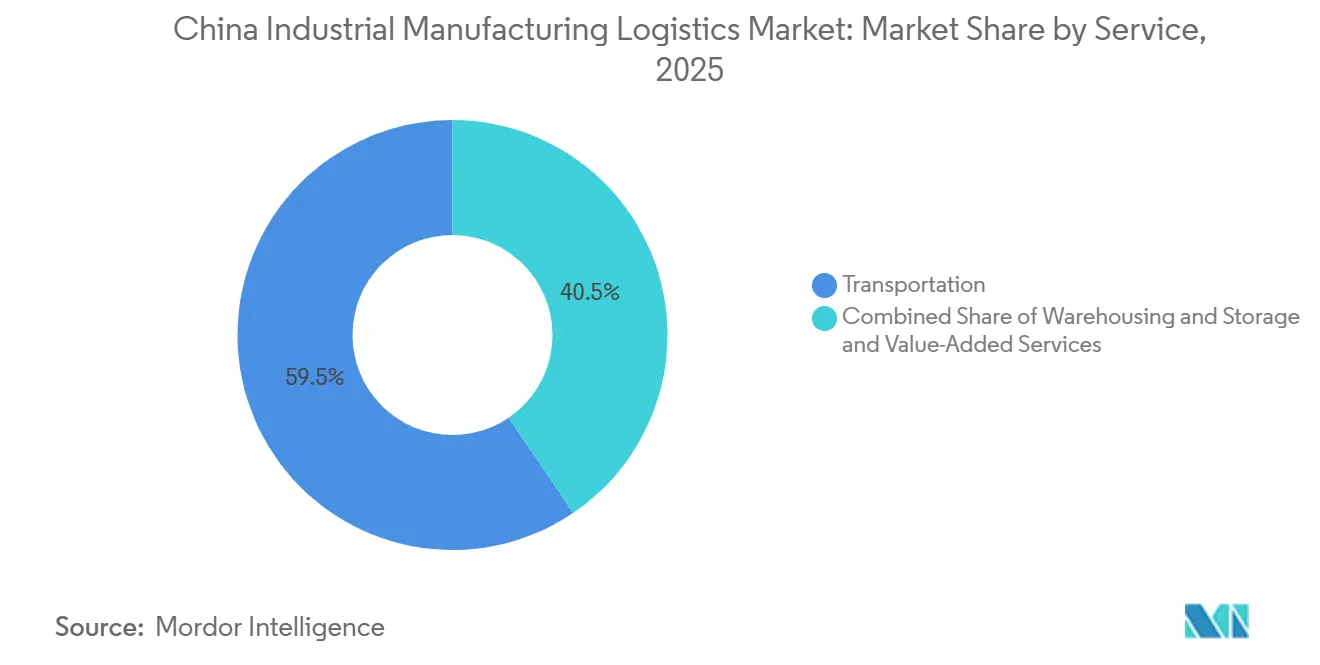
Transportation accounted for 59.50% of the China industrial manufacturing logistics market share in 2025. The segment leads because industrial goods still need physical movement between suppliers, factories, warehouses, ports, and customers. Road freight remains important for short- and medium-distance distribution across manufacturing clusters. Rail is increasingly relevant for longer domestic routes that link coastal and inland production centers. Air freight serves electronics and pharmaceutical cargo, where delivery speed and handling controls are more important than freight cost. River and sea transport also support lower-carbon intermodal options. China’s first river-sea zero-carbon shipping corridor began operations on June 30, 2026, linking Jiaxing Port and Ningbo-Zhoushan Port with electric inland vessels[4]. The corridor reduced carbon emissions by 60 kilograms per container, according to the reported project data.
Value-added services and others segment is forecast to grow at a CAGR of 7.90% through 2031. The segment includes kitting, reverse logistics, cold-chain handling, and supply chain finance integration. Manufacturers are outsourcing more complex activities rather than only freight movement. This increases demand for providers that can manage services around production and distribution. Warehousing and storage remains the connection point between transport nodes and factory inbound flows. Providers that combine warehousing with specialized services can create retained customer relationships. The China industrial manufacturing logistics industry therefore has scope for service bundles that address complex customer requirements. This growth does not reduce the central role of transport, but it increases the value attached to the services that surround it.

By End-User Industry: Automotive Dominance and the Electronics Disruption
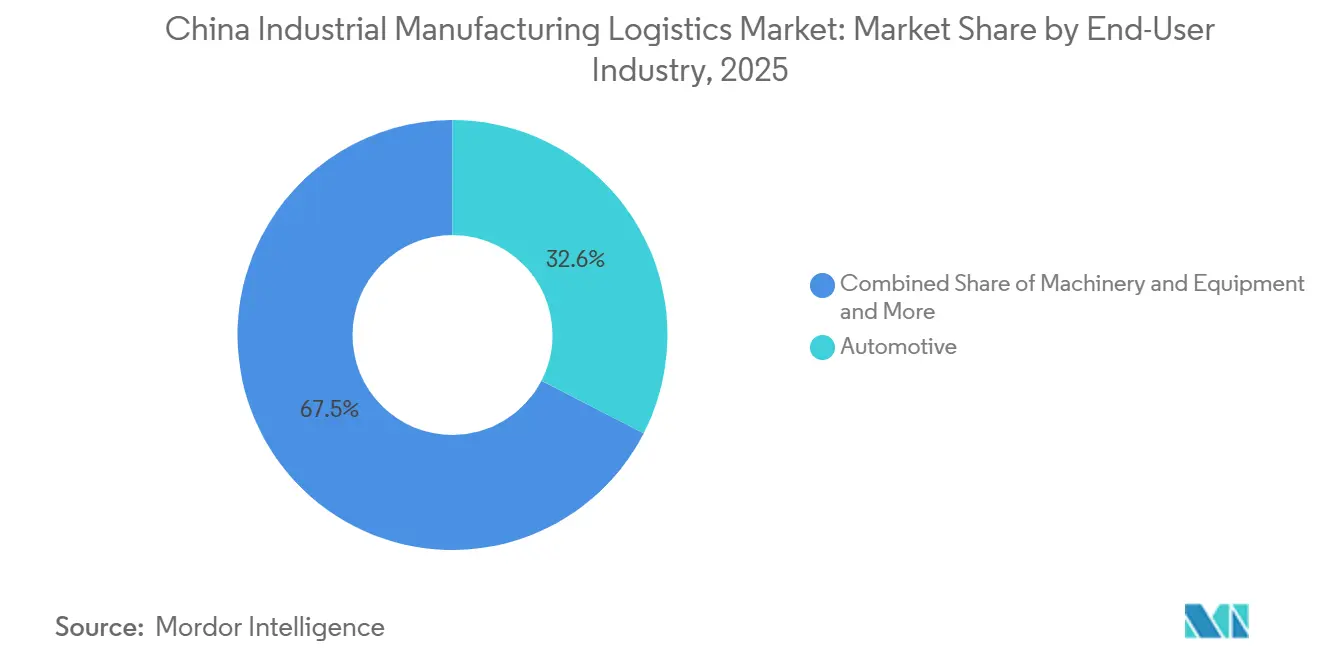
Automotive accounted for 32.55% of the China industrial manufacturing logistics market size in 2025. The segment needs just-in-time delivery of parts to assembly plants, specialized transport for finished vehicles, and coordination across multi-tier supplier networks. The Yangtze River Delta and Pearl River Delta remain dense areas of automotive logistics demand. New energy vehicle production adds requirements for battery modules, power semiconductors, and e-axle components. These materials move alongside conventional automotive parts within complex factory schedules. Localized sourcing also affects replenishment requirements for automotive-grade semiconductors. The result is a logistics environment where transport timing, supplier coordination, and controlled handling remain closely linked. Automotive demand continues to anchor the China industrial manufacturing logistics market.
The electronics and semiconductors segment is expected to grow at a CAGR of 7.25% through 2031. The segment is supported by domestic chip expansion and investments in supply chain resilience. Electronics suppliers need to handle sensitive components under controlled conditions and on shorter replenishment cycles. Chinese equipment makers are also strengthening their chip development activities in consumer electronics and automotive applications. Machinery and industrial equipment, pharmaceuticals and medical devices, and aerospace and defense need specialized logistics controls. Pharmaceuticals require cold-chain integrity, while capital equipment needs coordination around factory acceptance testing and commissioning. Other end-user industries, including steel, chemicals, and energy equipment, represent substantial freight volumes but generally have lower margins. The China industrial manufacturing logistics industry must therefore balance high-volume work with specialized services for regulated or sensitive cargo.
By Logistics Model: Asset-Light Dominance and the Hybrid Growth Wave
The asset-light model accounted for 53.50% of China's industrial manufacturing logistics market share in 2025. These providers use third-party transport networks, leased warehouses, and digital freight platforms rather than relying solely on owned fleets and facilities. The approach can offer pricing flexibility when industrial demand changes. It can also help providers scale operations across different manufacturing locations. Platform-managed capacity is particularly relevant in road freight and express networks. However, the model depends on reliable partner management and effective data sharing. Industrial customers still need consistent service when routes or freight volumes change. Asset-light operations remain central to the China industrial manufacturing logistics market because they bring flexibility to a large and varied logistics network.
Hybrid logistics is projected to grow at a CAGR of 6.95% through 2031. This model combines controlled assets at critical routes or sites with external capacity to respond to changing demand. Manufacturers seek the flexibility of asset-light operations and the service assurance associated with dedicated facilities or fleets. Asset-heavy operations retain a role for hazardous chemicals and heavy industrial equipment that need specialized infrastructure. Leading providers are also using logistics real estate investment trusts to support infrastructure development while retaining operational control. This approach separates asset ownership from operations and can support network expansion. The China industrial manufacturing logistics market is therefore moving toward models that match asset control with customer-specific service needs. The hybrid model reflects the continuing importance of both resilience and cost management.
Geography Analysis
East China accounted for 37% of China's industrial manufacturing logistics share in 2025. Shanghai, Jiangsu, Zhejiang, and Anhui generated 40.2% of China’s total exports in 2025, supporting dense freight activity and mature logistics infrastructure. The region has a large base of manufacturing companies, logistics providers, warehouses, ports, and transport connections. These conditions support high freight density and a broad range of specialized services. Smart logistics systems are also advancing across the Yangtze River Delta. South China is the second-largest cluster, anchored by Guangdong and the Pearl River Delta. Its export-oriented manufacturing base supports substantial demand for inbound and outbound logistics.
West China is projected to grow at a CAGR of 7.45% through 2031. Industrial transfer, investment in multimodal corridors, and customs facilitation are supporting this expansion. China’s customs authorities announced 15 measures in January 2025 to support large-scale development in western regions. Chongqing connects to 563 ports in 127 countries via the New International Land-Sea Trade Corridor. Cargo throughput in this network increased 72.3% year over year by mid-2025. The region offers opportunities for providers that can link new manufacturing sites with established domestic and international routes. West China is becoming more important to the China industrial manufacturing logistics market as production capacity moves inland.
Central China connects coastal and western manufacturing networks through provinces including Hubei, Hunan, Henan, and Jiangxi. Wuhan’s Optics Valley links advanced manufacturing activity with regional transport corridors. North China draws industrial logistics demand from the heavy industrial base in the Beijing-Tianjin-Hebei and Bohai Rim area. Its port and industrial networks support freight activity across the region. Central and North China both remain important to the China industrial manufacturing logistics market because they connect industrial supply chains across major domestic corridors.
Competitive Landscape
The China industrial manufacturing logistics market has a moderate-to-high level of fragmentation. Large integrated providers compete with many regional businesses and sector specialists. State-backed companies have financial scale and government relationships, while global forwarders bring international network capabilities. DSV completed its EUR 14.3 billion (USD 16.8 billion) acquisition of DB Schenker in 2025. Chinese domestic providers retain advantages in customer relationships and local regulatory knowledge. Competition is increasingly based on integrated supply chain capability rather than fleet size alone. Commodity freight margins remain under pressure where providers compete mainly on price.
Leading companies are pursuing specialization in automotive, electronics, and pharmaceutical logistics. They are also expanding into western manufacturing clusters where customer demand is developing alongside industrial relocation. Low-carbon logistics credentials are becoming more relevant for export-focused manufacturers facing carbon-related compliance requirements. Green logistics indicators under GB/T 37099-2026 are influencing procurement criteria for logistics partners. Verified emissions reporting can become important in higher-value customer contracts. Technology-focused platforms are also providing freight matching and load optimization tools. These platforms can reduce the pricing advantage traditionally associated with asset-heavy networks. The China industrial manufacturing logistics market is therefore placing greater value on data visibility, specialized service capability, and geographic reach.
Kuehne+Nagel completed a rollout of its cloud-native KN SwiftLOG warehouse management platform across more than 1,000 sites globally from April 2026. Its first Asia deployment was scheduled for July 2026. SF Holding’s 2025 results also showed strong growth in comprehensive logistics revenue across several industrial customer sectors. DSV expanded its Greater China and Asia-Pacific regional headquarters in Hong Kong after integrating DB Schenker. These actions show how leading providers are strengthening systems, sector coverage, and regional access. The China industrial manufacturing logistics market remains open to differentiated providers because no company market-share data establishes a concentrated leadership group.
China Industrial Manufacturing Logistics Industry Leaders
-
JD Logistics, Inc.
-
Sinotrans Limited
-
SF Holding Co., Ltd.
-
China Logistics Group Co., Ltd.
-
China COSCO SHIPPING
- *Disclaimer: Major Players sorted in no particular order
Recent Industry Developments
- July 2026: DSV completed the expansion of its Greater China and Asia-Pacific regional headquarters in Hong Kong following the integration of DB Schenker, scaling its Hong Kong workforce to over 1,000 employees across 14 operating locations and reinforcing its access to China manufacturing logistics through the Greater Bay Area gateway.
- June 2026: Maersk launched the FI2 dedicated weekly ocean service connecting major Chinese ports to India's western coastline, with the first westbound sailing from Shanghai on June 4, 2026, supporting trade flows in the automotive, chemicals, and technology sectors between the two manufacturing economies.
- April 2026: Sinotrans completed end-to-end logistics for the Huaneng Shandong Peninsula North 504 MW offshore wind project, which achieved full-capacity grid connection on April 7, 2026, marking a landmark in project logistics execution through a three-port supply network spanning Yangzhou, Rushan, and Penglai ports.
- January 2026: NX Group (Nippon Express Holdings) established Nippon Express East Asia Co., Ltd. as a dedicated regional headquarters, effective January 1, 2026, to coordinate group companies across China, Japan, Korea, and Taiwan and accelerate the execution of supply chain strategy and governance in the East Asia manufacturing corridor.
China Industrial Manufacturing Logistics Market Report Scope
| Transportation | Road |
| Rail | |
| Air | |
| Sea/Barge | |
| Warehousing and Storage | |
| Value-added Services and Others |
| Automotive |
| Electronics and Semiconductors |
| Machinery and Industrial Equipment |
| Pharmaceuticals and Medical Devices |
| Aerospace and defense |
| Other End-User Industries |
| Asset-Light |
| Asset-Heavy |
| Hybrid |
| North China |
| East China |
| South China |
| Central China |
| West China |
| By Service | Transportation | Road |
| Rail | ||
| Air | ||
| Sea/Barge | ||
| Warehousing and Storage | ||
| Value-added Services and Others | ||
| By End-User Industry | Automotive | |
| Electronics and Semiconductors | ||
| Machinery and Industrial Equipment | ||
| Pharmaceuticals and Medical Devices | ||
| Aerospace and defense | ||
| Other End-User Industries | ||
| By Logistics Model | Asset-Light | |
| Asset-Heavy | ||
| Hybrid | ||
| By Geography | North China | |
| East China | ||
| South China | ||
| Central China | ||
| West China |
Key Questions Answered in the Report
What is the forecast growth rate for China industrial manufacturing logistics?
The sector is projected to expand at a CAGR of 5.95% from 2026 to 2031, reaching USD 749.99 billion by 2031. Industrial demand is supported by manufacturing activity and the expansion of specialized supply chain services across China.
Which service has the largest role in China industrial manufacturing logistics?
Transportation led with 59.50% share in 2025 because manufacturers depend on road, rail, air, and water transport across production networks. Its role remains essential for inbound materials, factory transfers, and finished-goods distribution between manufacturing locations.
Which end-user segment is growing the fastest?
Electronics and semiconductors is projected to grow at a CAGR of 7.25% through 2031, supported by chip expansion and resilience investment. Controlled handling and shorter replenishment cycles support demand for specialized services in this segment.
Why is West China becoming important for manufacturing logistics?
West China is forecast to expand at a CAGR of 7.45% through 2031 as industrial capacity moves inland and corridor investment improves connectivity. Chongqing and Sichuan are attracting electronics, equipment, and new energy vehicle component production in their industrial clusters.
What logistics model is expanding fastest in China?
Hybrid logistics is forecast to grow at a CAGR of 6.95% through 2031 because it combines controlled assets with flexible external capacity. It addresses manufacturers’ need for cost flexibility and dependable service on critical production and distribution routes.
What are the main constraints on logistics providers?
Uneven inland infrastructure, inconsistent service standards, price competition, and limited cross-functional talent can constrain specialized operations. These constraints are most significant where manufacturing growth outpaces the development of logistics networks and operating capacity.