
China Golf Cart Market Size and Share
Market Overview
| Study Period | 2019 - 2031 |
|---|---|
| Forecast Data Period | 2026 - 2031 |
| Base Year Market Size (2025) | USD 150.49 Million |
| Market Size (2026) | USD 160.01 Million |
| Market Size (2031) | USD 218.01 Million |
| Growth Rate (2026 - 2031) | 6.38 % |
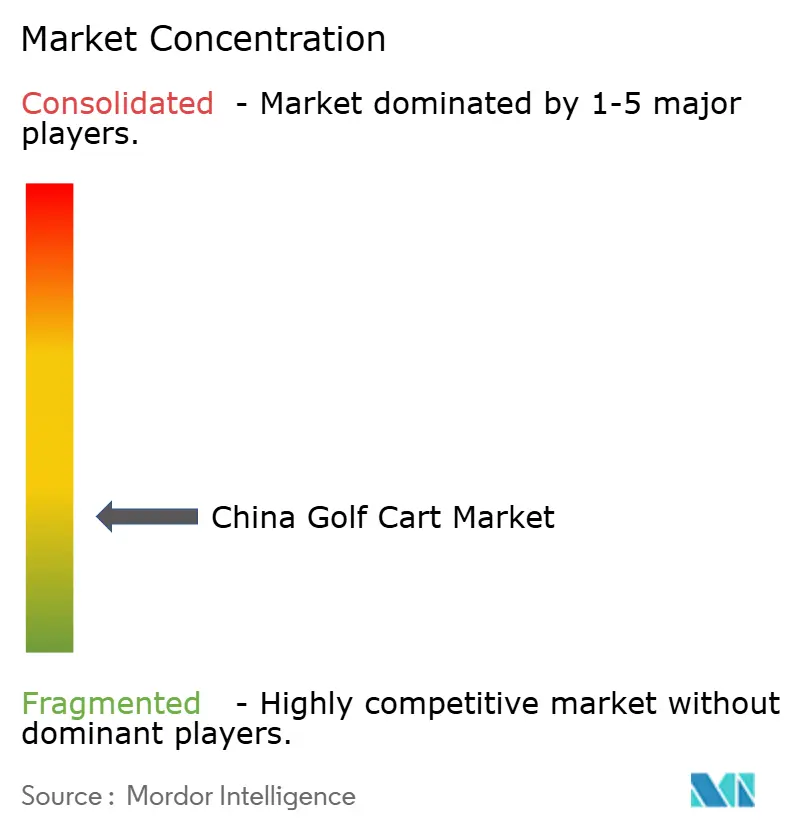
| Market Concentration | Low |
Major Players *Disclaimer: Major Players sorted in no particular order Image © Mordor Intelligence. Reuse requires attribution under CC BY 4.0. | |
China Golf Cart Market Analysis by Mordor Intelligence
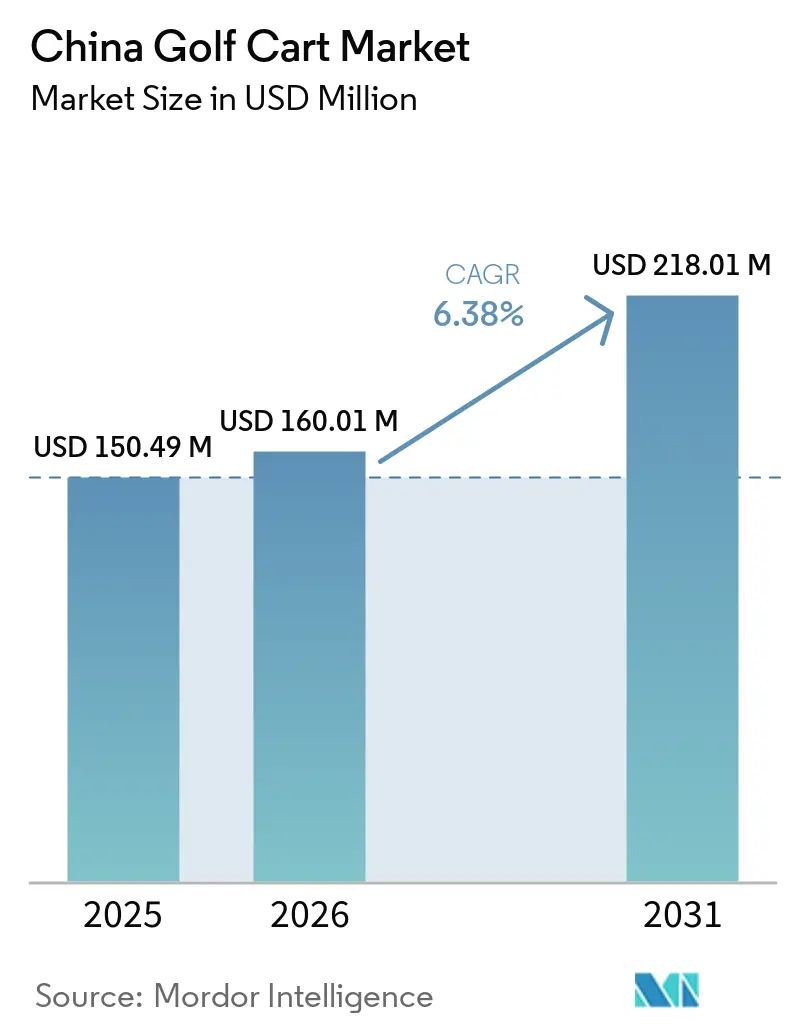
The China golf cart market size was valued at USD 150.49 million in 2025 and estimated to grow from USD 160.01 million in 2026 to reach USD 218.01 million by 2031, at a CAGR of 6.38% during the forecast period (2026-2031). Electric vehicles have become the normal choice for new fleets as policy requirements, battery economics, and operating needs favor low-emission models. Demand is also moving beyond golf courses into resorts, themed parks, industrial campuses, and gated residential communities. Domestic producers benefit from established battery supply chains and export-focused manufacturing scale, which supports pricing and product development. Competition increasingly depends on battery management, fleet monitoring, reliable service, and formats tailored to specific operating conditions. The Chinese golf cart market, therefore, combines replacement demand in established golf facilities with broader use in private-site mobility.
Key Report Takeaways
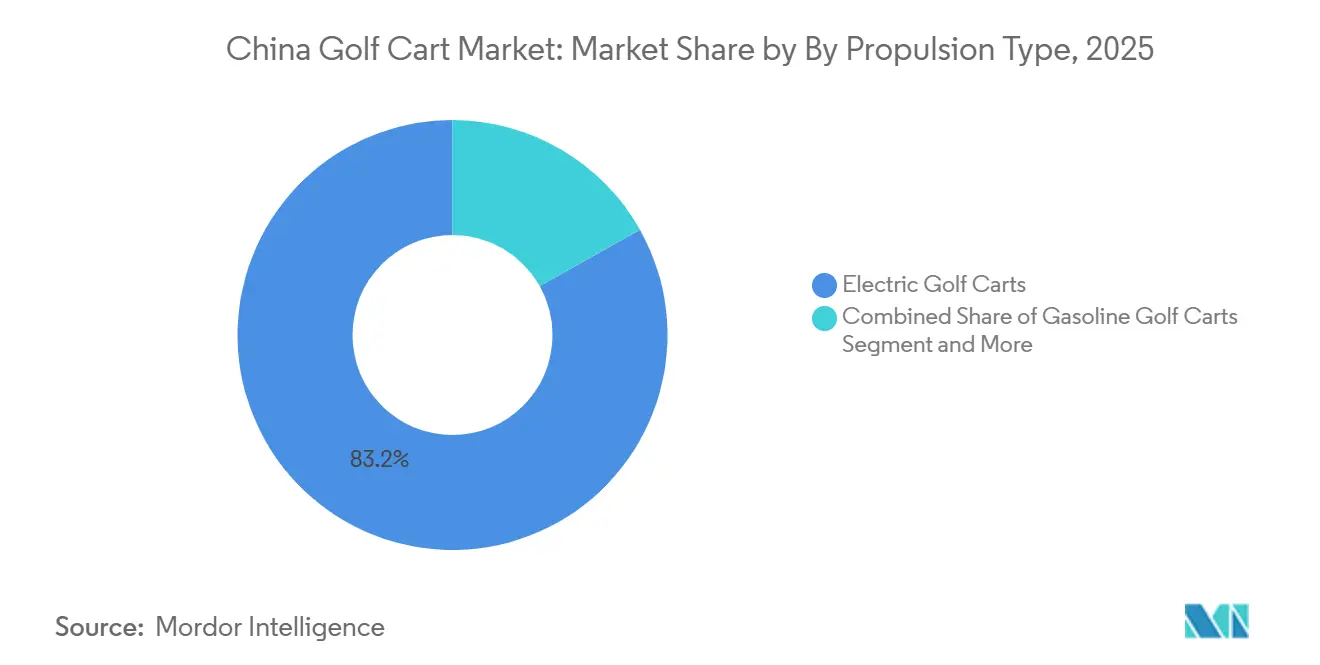
- By propulsion type, electric carts accounted for 83.15% of the Chinese golf cart market share in 2025, while solar-hybrid carts are forecast to grow at an 8.76% CAGR through 2031.
- By seating capacity, 2-seater configurations held 49.03% of the Chinese golf cart market share in 2025, while 4-seater configurations are forecast to grow at a 7.11% CAGR through 2031.
- By vehicle format, open-top carts accounted for 77.13% of the Chinese golf cart market share in 2025, while enclosed and weatherproof carts are forecast to grow at a 7.69% CAGR through 2031.
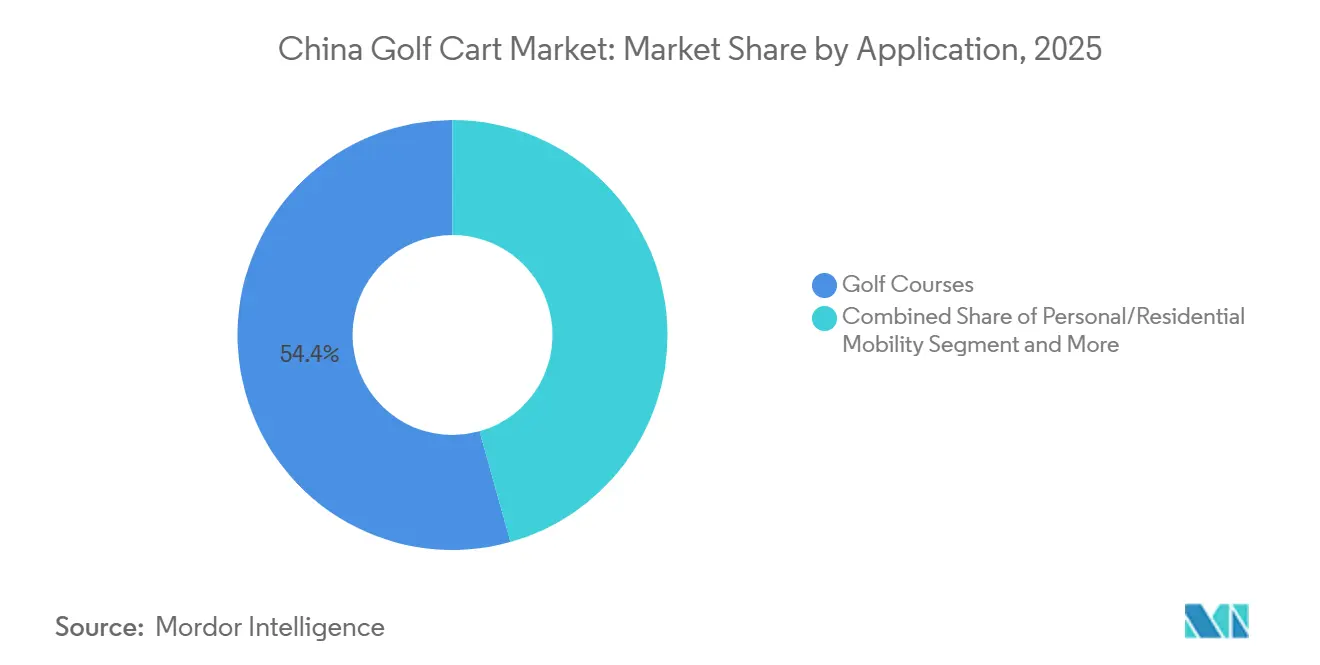
- By application, golf courses held 54.35% of the Chinese golf cart market share in 2025, while commercial services are forecast to grow at an 8.22% CAGR through 2031.
- By sales channel, offline channels held 57.05% of the Chinese golf cart market share in 2025, while online and direct-to-consumer channels are forecast to grow at a 9.04% CAGR through 2031.
- By geography, South China accounted for 36.12% of the Chinese golf cart market share in 2025, while Hainan is projected to grow with 9.45% CAGR through 2031.
Note: Market size and forecast figures in this report are generated using Mordor Intelligence’s proprietary estimation framework, updated with the latest available data and insights as of January 2026.
China Golf Cart Market Trends and Insights
Drivers Impact Analysis*
| Driver | (~) % Impact on CAGR Forecast | Geographic Relevance | Impact Timeline |
|---|---|---|---|
| Electric Mobility and Emissions Policy | +1.4% | National, with early gains in Guangdong, Beijing, and Shanghai | Short term (≤ 2 years) |
| Lithium Battery Cost-Performance | +1.2% | National, with supply concentrated in South and East China | Short term (≤ 2 years) |
| Golf and Leisure Participation | +1.1% | South China and Hainan core, with spillover to East and Southwest China | Medium term (2-4 years) |
| Resort, Park, and Campus Micro-Mobility | +1.0% | Hainan, Yangtze River Delta, and Pearl River Delta | Medium term (2-4 years) |
| Replacement From Battery Aging and Standards | +0.7% | National, concentrated in the South and East China installed base | Medium term (2-4 years) |
| Export-Oriented OEM Scale | +0.6% | South China and East China manufacturing clusters | Long term (≥ 4 years) |
| Source: Mordor Intelligence | |||
Electric Mobility and Emissions Policy Support
The national new-energy vehicle policy framework supports electric golf cart procurement. The 2026 and 2027 tax-exemption requirements raised the technology thresholds that older gasoline and lead-acid vehicles may struggle to satisfy [1]“Technical Requirements for NEV Purchase Tax Exemptions 2026–2027,” Ministry of Industry and Information Technology, miit.gov.cn. China issued GB 36980.1-2025 in May 2025, and the standard became effective in January 2026. The standard tightened the energy-consumption requirements for battery-electric vehicles. Provincial rules that favor electric transport in scenic and ecologically sensitive areas provide a more stable basis for adoption. The Chinese golf cart market may therefore expand first in coastal resorts and scenic parks before inland charging networks become more developed.
Lithium Battery Cost-Performance Gains
Battery costs shape the operating case for electric golf carts and their replacement economics. Lithium iron phosphate battery packs cost more than 40% less per kilowatt-hour than nickel-manganese-cobalt alternatives. China’s scale in lithium iron phosphate cathode production gives local producers a cost advantage in suitable golf cart applications. This cost advantage can improve the economics of electric fleets for institutional buyers. It also helps manufacturers build models that meet range and performance requirements. Longer battery life can reduce replacement needs, while also increasing the value of service, software, and battery-upgrade offerings.
Expanding Golf and Leisure Participation
Golf facilities remain an important source of fleet demand because carts are central to player movement and course operations. Guangdong has a concentrated base of courses, which supports demand for golf carts in South China. The national construction moratorium limits the supply of new outdoor courses outside designated Hainan zones. This shifts attention from new-course construction toward fleet replacement and higher utilization at existing facilities. Leisure facilities also use carts as part of a wider visitor-service offering, rather than only for course circulation. The Chinese golf cart market benefits when operators add hospitality, training, and visitor services around their existing sites.
Resort, Park, and Campus Micro-Mobility
Resorts, scenic parks, retirement communities, and industrial campuses have different operating needs from golf courses. These buyers place greater emphasis on enclosed cabins, cargo capacity, telematics, battery durability, and dependable service. Their requirements create demand for configurations not designed solely for turf use or tight course paths. China’s carbon-peak target for 2030 and carbon-neutrality target for 2060 reinforce the broader policy direction toward electric transport. Electric fleets can also support visible sustainability commitments at premium resorts that work with international hotel brands and investors. This expansion of private-site transport creates a wider set of use cases for the Chinese golf cart market.
Restraints Impact Analysis*
| Restraint | (~) % Impact on CAGR Forecast | Geographic Relevance | Impact Timeline |
|---|---|---|---|
| High Upfront Purchase Cost | -1.3% | National, most acute in Tier-3 cities and inland locations | Medium term (2-4 years) |
| Charging and After-Sales Infrastructure | -0.9% | Northwest, Northeast, and inland Central China | Long term (≥ 4 years) |
| Fragmented Local Road-Use | -0.5% | National, concentrated in lower-tier urban locations | Medium term (2-4 years) |
| Residual Value and Battery-Recycling | -0.4% | National, most acute in off-course applications | Long term (≥ 4 years) |
| Source: Mordor Intelligence | |||
High Upfront Purchase Cost
Lithium-powered carts can offer operating advantages over several years, but their initial purchase price remains higher than lead-acid alternatives. A mid-range 48V lithium golf cart typically costs more than a comparable lead-acid model. Enclosed and solar-hybrid models add further cost for small resorts, county scenic parks, and developing residential communities. Leasing and battery-as-a-service arrangements remain limited outside major metropolitan areas. This can delay purchases even where operators recognize the longer-term operating value of electric fleets. The Chinese golf cart market, therefore, depends on financing options that help smaller commercial buyers manage the upfront commitment.
Charging and After-Sales Infrastructure Gaps
Dedicated charging facilities remain limited outside Tier-1 cities and purpose-built resort complexes. This constraint is particularly important for inland scenic parks and rural resorts. T/HZRZ 004-2025 set technical requirements for lithium-ion golf-cart battery systems in 2025 [2]“Lithium-Ion Power Battery System for Golf Carts,” National Standards Library, cnis.ac.cn. The standard can help improve charger compatibility, but deployment of compatible charging equipment remains inconsistent in rural service networks. Local road-use classifications can also vary, creating uncertainty for operators managing properties across several provinces. These gaps favor suppliers with established dealer relationships and responsive maintenance coverage in the Chinese golf cart market.
*Our forecasts treat driver/restraint impacts as directional, not additive. The impact forecasts reflect baseline growth, mix effects, and variable interactions.
Segment Analysis
By Propulsion Type: Electric Carts Lead Demand and Solar-Hybrid Carts Grow Faster
Electric carts held 83.15% of the Chinese golf cart market share in 2025. Their leading position reflects the shift away from gasoline models and the improving economics of lithium iron phosphate batteries. The 2026 and 2027 new-energy vehicle rules favor efficient electric platforms. Scenic-zone restrictions also make combustion vehicles less suitable for some applications. Electric fleets meet the operating needs of golf courses, resorts, campuses, and residential properties. Suppliers can use battery management capabilities and verified safety performance to differentiate their electric offerings. Battery packs based on lithium iron phosphate chemistry have a cost advantage over nickel-manganese-cobalt alternatives. This helps domestic manufacturers manage the bill of materials for common cart configurations. The established electric base gives producers a clear platform for replacement sales. It also supports further development of connected fleet functions.
Solar-hybrid carts are forecast to expand at an 8.76% CAGR through 2031. The format combines solar charging controls with lithium battery systems for sites that value additional operating range. HKBG presented a series of solar-powered golf carts at the 139th Canton Fair in April 2026. The series included real-time solar charging dashboards, lithium iron phosphate battery integration, and aluminum frames. Solar panels can add 20% to 30% of operating range compared with grid-only models in suitable settings. This benefit is relevant to high-insulation coastal and resort locations, including Hainan and Guangdong. The format can reduce per-kilometer charging costs at properties with regular daytime use. It also provides a practical option for scenic locations with limited grid access. Technical standards for lithium and lead-acid systems increase the value of compliant platforms. This creates room for suppliers that can combine solar capability with dependable service support.



By Seating Capacity: 2-Seater Carts Retain Core Volume While 4-Seater Carts Gain Use Cases
The 2-seater configuration held 49.03% of the Chinese golf cart market share in 2025. It remains well-suited to pair play on golf courses. Its compact footprint also fits course paths and standard storage arrangements. Golf facilities continue to rely on this configuration for routine fleet replacement. The format offers operators a familiar vehicle layout and straightforward deployment. It is therefore likely to remain important where golf remains the primary use. The installed base creates regular demand for maintenance, battery replacement, and fleet renewal. Producers can protect this business through reliable parts availability and local service. Operators also value a predictable range and vehicle uptime during busy periods. These needs preserve the role of 2-seater carts across established golf sites.
The 4-seater segment is projected to grow at a 7.11% CAGR through 2031. Resorts, theme parks, and campuses use larger carts to improve passenger movement within contained properties. Multi-passenger transport can reduce the number of units needed for some routes. These operators often consider seating capacity together with comfort, range, and fleet oversight. Larger vehicles can also support premium specifications such as GPS navigation and digital dashboards. The 6-seater and 8+-seater categories serve shuttle functions at airports, large scenic parks, and convention facilities. Their higher unit values can support longer-term service arrangements. These applications differ from core golf use because passenger movement is often continuous through the day. Product design must therefore emphasize durability and operational availability. This demand broadens the Chinese golf cart industry beyond its traditional two-passenger base.
By Vehicle Format: Open-Top Carts Hold the Installed Base While Enclosed Carts Extend Year-Round Use
Open-top carts accounted for 77.13% of the Chinese golf cart market share in 2025. This share reflects the concentration of warm-climate golf-course operations in southern China. Golfers often accept weather exposure during normal course play. Open-top designs also suit the circulation patterns and visual expectations of many clubs. Their broad installed base supports continued demand for parts, service, and replacements. Manufacturers in southern production centers have experience supplying this established format. The configuration remains relevant for venues with seasonal but predictable visitor activity. It also serves operators who prioritize simple vehicles with proven operating characteristics. Continued demand will depend on fleet aging and course maintenance requirements. The segment, therefore, remains the volume foundation of the Chinese golf cart market.
Enclosed and weather-proof carts are forecast to grow at a 7.69% CAGR through 2031. Corporate campuses, hospitals, ski resorts, and all-weather tourism parks require more dependable year-round operation. Northern locations face conditions that limit the usefulness of open-top carts in winter. The enclosed models are especially relevant to tourism sites in Heilongjiang and Jilin. HVAC systems, GPS tracking, digital information screens, and proximity sensing can be included in these vehicles. Such features make the vehicles suitable for connected mobility operations. Resorts and institutional users can justify the additional purchase cost when utilization continues across seasons. This can improve the value of fleet assets beyond the golf calendar. Suppliers that mainly serve southern courses may need dedicated products for colder locations. The format expands application reach while increasing the importance of maintenance capability.
By Application: Golf Courses Provide Replacement Demand While Commercial Services Expand Faster
Golf courses held 54.35% of the Chinese golf cart market share in 2025. The application remains important because course fleets require periodic replacement and ongoing maintenance. Existing facilities provide a stable base, even where the construction of new courses is limited. Course managers prioritize vehicle uptime, route suitability, and service responsiveness. Their purchasing process tends to favor practical specifications that support daily operations. This creates recurring demand for established fleet configurations. Golf clubs may also use carts to support visitor services around hospitality and training facilities. The Golf Channel remains less exposed to the need for net new site development. It gives manufacturers a dependable customer base for parts and replacement sales. This stability supports the wider Chinese golf cart market.
Commercial services are forecast to grow at an 8.22% CAGR through 2031. Resorts, theme parks, and campuses often require differentiated vehicles for passenger comfort, branding, connectivity, and service contracts. These needs can support more customization than standard golf-course fleets. Enclosed cabins, multi-passenger layouts, and digital fleet tools are especially relevant to these operators. Retirement communities and large eco-residential developments also use electric carts for internal last-mile trips. Industrial and airport sites use carts for specific utility functions, with zero-emission equipment increasingly preferred. The application base, therefore, includes both visitor transport and operational movement. This diversity reduces reliance on the supply-constrained golf-course channel. It also creates demand for specialized service models and product configurations. Commercial use broadens the Chinese golf cart industry across several private-site transport settings.
By Sales Channel: Offline Dealers Retain Institutional Business While Online Sales Reach Smaller Buyers
Offline dealers and distributors held 57.05% of the Chinese golf cart market share in 2025. Large resort and golf-course fleets often require demonstrations before purchase. They also need service commitments, installation support, and financing arrangements. These requirements are difficult for online platforms to provide as a complete service. Dealer relationships remain valuable where fleet downtime carries an immediate operating cost. Offline networks can also help buyers select formats suited to local terrain and weather. Their role is especially important in regions with fragmented coverage of charging and maintenance. Established dealers give manufacturers a local presence after delivery. This supports repeat purchases from institutional accounts. Offline networks will therefore remain important for higher-value fleet transactions.
Online and direct-to-consumer channels are forecast to grow at a 9.04% CAGR through 2031. China’s mature e-commerce infrastructure helps producers reach smaller fleet operators and individual buyers. Digital channels can also support factory-direct sourcing by overseas business buyers. Online catalogs make it easier to present customization choices and product specifications. The channel is suited to single-unit and small-fleet purchases where buyers place greater weight on price and configuration choice. Larger fleet agreements are likely to remain more relationship-based and offline. This creates a split between digital transactions and service-intensive institutional sales. Suppliers can use both routes to address different buyer profiles. The Chinese golf cart market benefits when sales coverage matches the scale and service needs of each customer group.
Geography Analysis
South China held 36.12% of the Chinese golf cart market share in 2025. Guangdong combines a large concentration of golf facilities with a major manufacturing base for golf carts. The Pearl River Delta supports demand from premium clubs, resorts, and scenic parks. Producers also benefit from integrated lithium iron phosphate battery supply chains and established export logistics. These conditions support both domestic deliveries and export-oriented production. The corridor from Guangzhou and Shenzhen to coastal resort zones has varied demand patterns. Golf clubs typically need dependable fleet replacement. Resort and park operators often require passenger-focused or utility configurations. South China remains central to the Chinese golf cart market because production and end-user demand are closely connected. This gives local suppliers a practical advantage in service response and market access.
East China is a significant secondary-demand area because Shanghai, Jiangsu, and Zhejiang host corporate campuses, premium clubs, and international hotel properties. Buyers in this region often favor enclosed models with telematics and fleet-management functions. These specifications support a higher-value product mix than basic course vehicles. Central and Southwest China are emerging demand areas for scenic tourism in mountain and plateau settings. Guizhou, Yunnan, and Sichuan can require higher-torque configurations for uneven terrain. These conditions create an opportunity for products that are not fully addressed by standard coastal catalogs. Suppliers that adapt products for terrain and local maintenance conditions can serve a more diverse customer base. The geographic mix reinforces the need for configuration choices within the China golf cart market.
Hainan is forecast to grow at a 9.45% CAGR through 2031, the fastest regional rate in the China golf cart market. China began full islandwide independent customs operations in the Hainan Free Trade Port in December 2025 [3]“China Turns Hainan Island Into Special Customs Supervision Zone in Opening-Up Drive,” State Council Information Office, gov.cn. Tariff-free import coverage increased to a notable share of goods under the new arrangements. This can lower the landed cost of resort equipment and electric-vehicle components. Hainan’s 2026 to 2030 plan identifies premium tourism, luxury retail, and high-quality leisure infrastructure as development priorities. The island is exempt from the national golf-course construction moratorium. These conditions support demand from leisure facilities and premium resort properties. Hainan can also provide manufacturers with a location for reference deployments before expanding into other resort corridors. The region’s policy and tourism setting, therefore, support stronger fleet demand.
Competitive Landscape
The Chinese golf cart market has a moderately fragmented competitive structure. Leading domestic suppliers include HDK Electric Vehicle, Suzhou Eagle Electric Vehicle, Marshell Electric Vehicle, Guangdong Lvtong New Energy, and Tao Motor. These companies have built scale through export production and are using that scale to strengthen domestic products and services. Western suppliers, including Club Car, Yamaha Golf-Car, and E-Z-GO, maintain positions at premium golf clubs and international hotel properties. Their established relationships and service capabilities remain relevant in these accounts. Domestic alternatives are increasing pressure by improving product quality at lower price points. Buyers can therefore compare local manufacturing scale with premium brand support. The competitive balance favors suppliers that can match pricing with credible service coverage.
Suzhou Eagle completed its Phase 2 manufacturing expansion in Suzhou Industrial Park in July 2026 [4]“Electric Vehicle Plant Completed, Suzhou Eagle Phase 2,” Suzhou Industrial Park Administration Committee, sipac.gov.cn . This investment shows how leading domestic producers are building capacity to meet broader demand. HKBG introduced a series of solar-powered carts at the 139th Canton Fair in 2026. Its product included solar charging dashboards, lithium iron phosphate batteries, and an aluminum-frame design. These moves show that capacity growth and specialized electric products are developing simultaneously.
Suppliers use several approaches to compete in the Chinese golf cart market. Export-focused manufacturers pursue standardized, high-volume production for overseas customers. Other companies focus on premium products with assisted driving functions, connected fleet management, and more refined interiors. Service-oriented suppliers seek recurring revenue through battery services and predictive maintenance agreements. Participation in standards development can also strengthen a supplier’s position by increasing its compliance knowledge. Gaps remain in fleet financing for inland resorts, solar-hybrid options for off-grid scenic sites, and service networks in Northwest and Northeast China. These areas can attract suppliers willing to support localized operational needs. The fragmented structure gives well-prepared companies room to build positions through service quality and product specialization.
China Golf Cart Industry Leaders
Guangdong Lvtong New Energy Electric Vehicle Technology Co., Ltd.
CENGOCAR
Guangdong Yatian Industrial Co., Ltd.
XUNHU
Suzhou Eagle Electric Vehicle Manufacturing Co., Ltd.
- *Disclaimer: Major Players sorted in no particular order

Recent Industry Developments
- June 2026: LVTONG launched an all-new product portfolio, including golf carts and other offerings, to expand its high-end product matrix for golf courses, scenic resorts, private manors, and outdoor adventure sectors. The upgraded golf carts feature optimized chassis structures, high-efficiency power systems, refined interior upholstery, and streamlined exterior designs.
- April 2026: HKBG (Hong Kong Bright Gal International Co.) unveiled a new solar-powered golf cart series at the 139th Canton Fair in Guangzhou, featuring MPPT solar charging dashboards, LFP battery integration, and aluminum-frame construction certified to EU and United States export standards, drawing significant attention from international buyers in the new energy mobility zone.


China Golf Cart Market Report Scope
The scope includes segmentation by propulsion type (electric golf carts, gasoline golf carts, and solar-hybrid golf carts), seating capacity (2-seater, 4-seater, 6-seater, and 8+ seater), vehicle format (open-top and enclosed/weatherproof), application (golf courses, personal/residential mobility, commercial services [resorts, theme parks, and campuses], and industrial and airport utility) and sales channel (offline [dealers and distributors] and online/direct-to-consumer). The analysis also covers regional-level segmentation, including South China, North China, Central China, Southwest China, Northwest China, Northeast China, and Hainan. Market size and growth forecasts are presented by value in USD and volume in Units.
| Electric Golf Carts |
| Gasoline Golf Carts |
| Solar-Hybrid Golf Carts |
| 2 Seater |
| 4 Seater |
| 6 Seater |
| 8+Seater |
| Open-Top |
| Enclosed / Weather-proof |
| Golf Courses |
| Personal / Residential Mobility |
| Commercial Services (Resorts, Theme-Parks, Campuses) |
| Industrial and Airport Utility |
| Offline (Dealers and Distributors) |
| Online / Direct-to-Consumer |
| South China |
| North China |
| Central China |
| Southwest China |
| Northwest China |
| Northeast China |
| Hainan |
| Electric Golf Carts | Golf Courses |
| Personal / Residential Mobility | |
| Commercial Services (Resorts, Theme-Parks, Campuses) | |
| Industrial and Airport Utility | |
| Gasoline Golf Carts | Golf Courses |
| Personal / Residential Mobility | |
| Commercial Services (Resorts, Theme-Parks, Campuses) | |
| Industrial and Airport Utility | |
| Solar-Hybrid Golf Carts | Golf Courses |
| Personal / Residential Mobility | |
| Commercial Services (Resorts, Theme-Parks, Campuses) | |
| Industrial and Airport Utility |
| By Propulsion Type | Electric Golf Carts | |
| Gasoline Golf Carts | ||
| Solar-Hybrid Golf Carts | ||
| By Seating Capacity | 2 Seater | |
| 4 Seater | ||
| 6 Seater | ||
| 8+Seater | ||
| By Vehicle Format | Open-Top | |
| Enclosed / Weather-proof | ||
| By Application | Golf Courses | |
| Personal / Residential Mobility | ||
| Commercial Services (Resorts, Theme-Parks, Campuses) | ||
| Industrial and Airport Utility | ||
| By Sales Channel | Offline (Dealers and Distributors) | |
| Online / Direct-to-Consumer | ||
| By Geography | South China | |
| North China | ||
| Central China | ||
| Southwest China | ||
| Northwest China | ||
| Northeast China | ||
| Hainan | ||
| Propulsion Type by Application | Electric Golf Carts | Golf Courses |
| Personal / Residential Mobility | ||
| Commercial Services (Resorts, Theme-Parks, Campuses) | ||
| Industrial and Airport Utility | ||
| Gasoline Golf Carts | Golf Courses | |
| Personal / Residential Mobility | ||
| Commercial Services (Resorts, Theme-Parks, Campuses) | ||
| Industrial and Airport Utility | ||
| Solar-Hybrid Golf Carts | Golf Courses | |
| Personal / Residential Mobility | ||
| Commercial Services (Resorts, Theme-Parks, Campuses) | ||
| Industrial and Airport Utility | ||


Key Questions Answered in the Report
What is the forecast growth rate for China golf carts?
The Chinese golf cart market is projected to grow at a CAGR of 6.38% from 2026 to 2031, reaching USD 218.01 million by 2031. Growth will be supported by the established demand for golf fleet replacement and the expanding use of golf carts for mobility across private sites.
Which propulsion type leads demand in China?
Electric carts led with 83.15% share in 2025, supported by policy direction and lithium iron phosphate battery economics. Efficient electric platforms are also more suitable for sites that limit combustion vehicle use.
Which vehicle format is growing fastest in colder locations?
Enclosed and weather-proof carts are forecast to grow at a 7.69% CAGR through 2031 because they support year-round operation. HVAC systems and related features help institutional users maintain service through northern winter conditions.
Why are online sales becoming more important for golf carts?
Online and direct-to-consumer sales are projected to grow at a CAGR of 9.04% through 2031, driven by smaller buyers increasingly using digital catalogs and factory-direct purchasing options. Dealer networks remain essential for larger fleets that require product demonstrations, financing, and after-sales support commitments.
Page last updated on:





