
China-Europe Ro-Ro Ocean Freight Transport Market Size and Share
Market Overview
| Study Period | 2020 - 2031 |
|---|---|
| Forecast Data Period | 2026 - 2031 |
| Base Year Market Size (2025) | USD 1.23 Billion |
| Market Size (2026) | USD 1.33 Billion |
| Market Size (2031) | USD 1.93 Billion |
| Growth Rate (2026 - 2031) | 7.84 % |
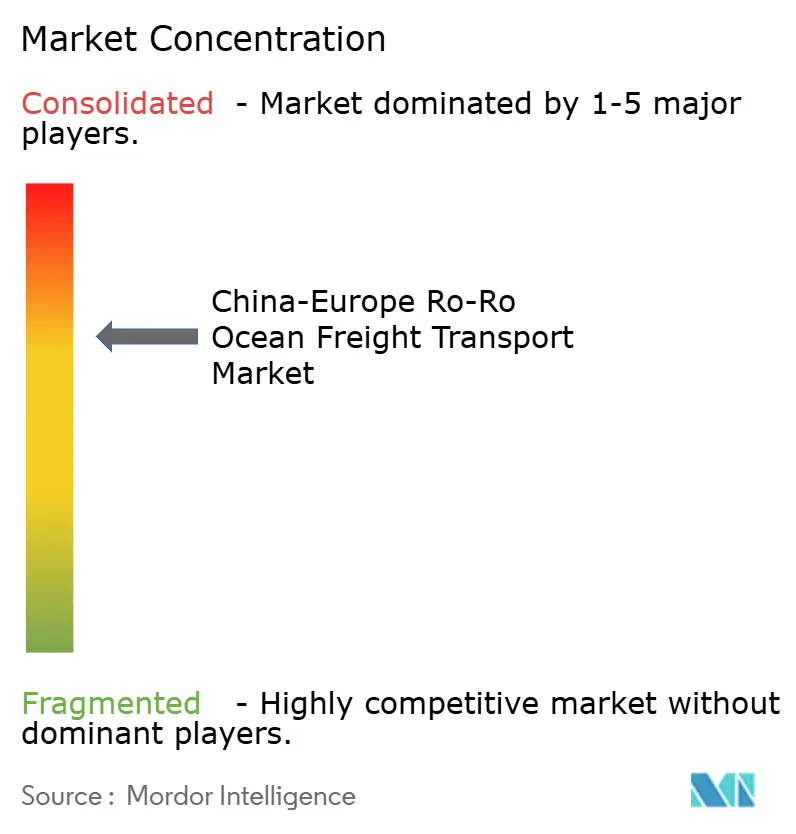
| Market Concentration | Medium |
Major Players *Disclaimer: Major Players sorted in no particular order Image © Mordor Intelligence. Reuse requires attribution under CC BY 4.0. | |
China-Europe Ro-Ro Ocean Freight Transport Market Analysis by Mordor Intelligence
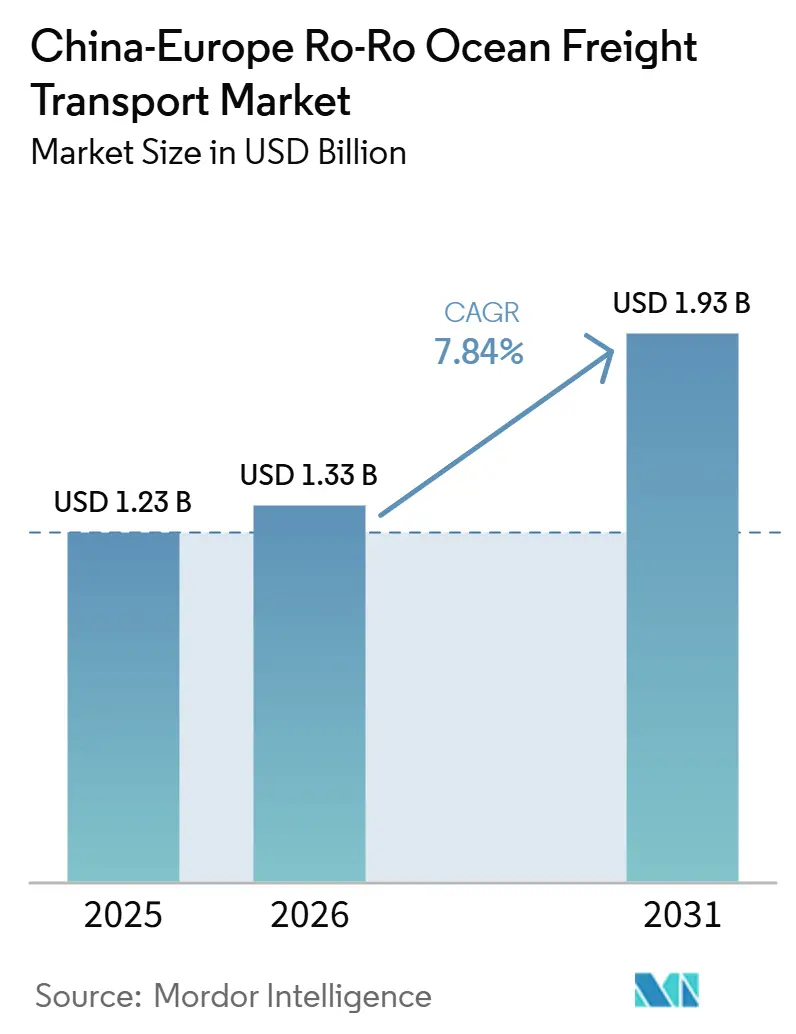
The China-Europe Ro-Ro ocean freight transport market size was valued at USD 1.23 billion in 2025 and is projected to reach USD 1.33 billion in 2026, and reach USD 1.93 billion by 2031, growing at a CAGR of 7.84% from 2026 to 2031.
The China-Europe Ro-Ro ocean freight transport market is expanding on the back of a sharp rise in vehicle exports from China, with passenger vehicle volumes still setting the pace for fleet use and route planning. The market is also being shaped by tight vessel slots, longer sailing distances due to Red Sea rerouting, and a growing shift by Chinese OEMs toward captive fleets that absorb capacity before it reaches the open market. At the same time, the market is moving into a more selective competitive phase, where long-term OEM contracts, larger, fuel-efficient PCTCs, and better compliance with EU emissions rules are becoming the main levers for protecting margins and maintaining network stability. The main upside remains tied to sustained China-origin export growth and deeper European distribution links. In contrast, the main risk comes from tariff uncertainty and the large wave of vessel deliveries now entering service.
Key Report Takeaways
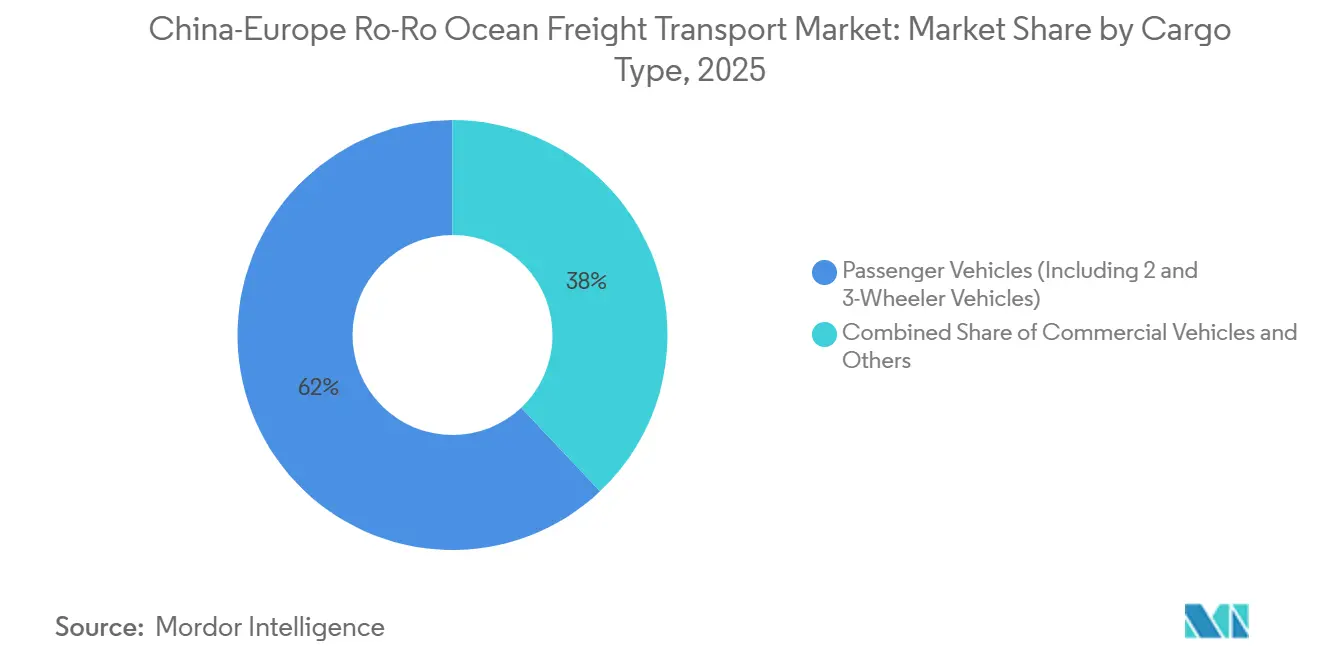
- By cargo type, passenger vehicles led with a 62.04% of the China-Europe Ro-Ro ocean freight transport market share in 2025, while commercial vehicles are forecast to expand at a 9.53% CAGR through 2031.
- By vessel size, large vessels above 4,000 CEU accounted for a 58% of the China-Europe Ro-Ro ocean freight transport market size in 2025, while mid-size vessels are projected to grow at a 9.90% CAGR through 2031.
- By end-user industry, OEMs held 70.13% of the China-Europe Ro-Ro ocean freight transport market share in 2025, while the others segment is expected to grow at a 10.32% CAGR through 2031.
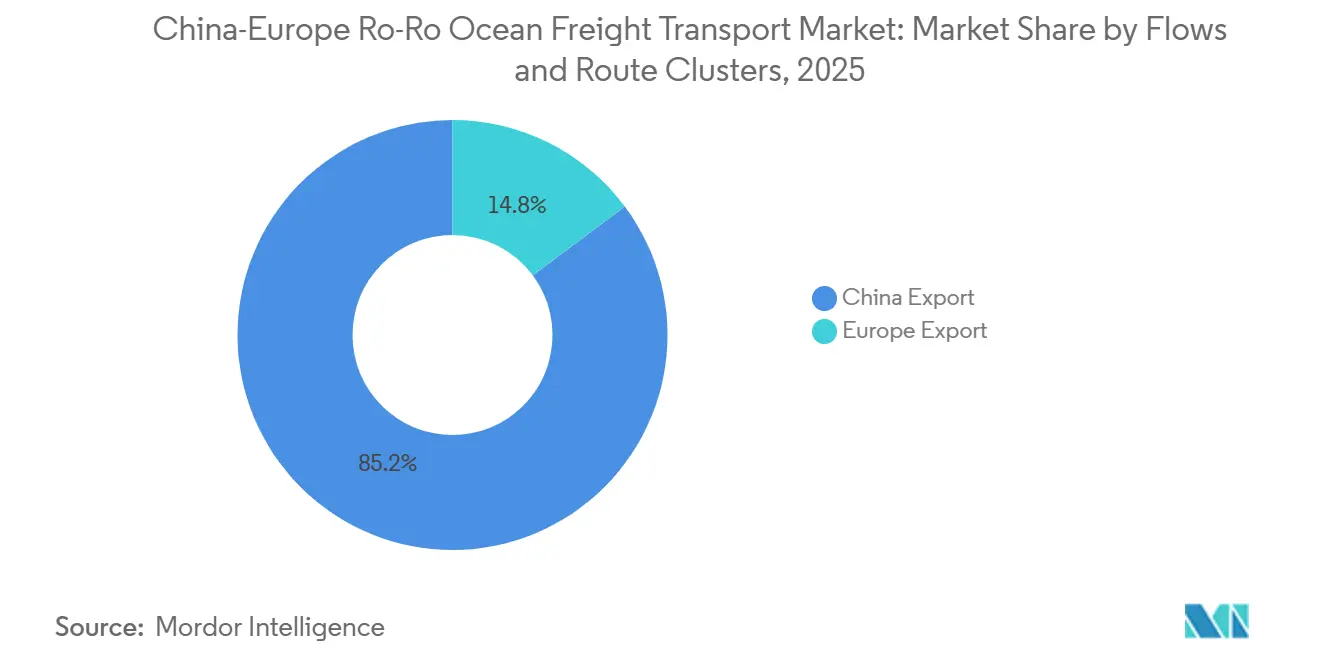
- By flows and route clusters, China export flows accounted for 85.20% of the China-Europe Ro-Ro ocean freight transport market size in 2025 and are forecast to grow at an 8.20% CAGR through 2031.
Note: Market size and forecast figures in this report are generated using Mordor Intelligence’s proprietary estimation framework, updated with the latest available data and insights as of January 2026.
China-Europe Ro-Ro Ocean Freight Transport Market Trends and Insights
Drivers Impact Analysis*
| Driver | (~) % Impact on CAGR Forecast | Geographic Relevance | Impact Timeline |
|---|---|---|---|
| China EV Export Diversion Into Dedicated Ro-Ro Capacity | +2.2% | Global, concentrated on the China-Europe deep-sea lanes | Short term (≤ 2 years) |
| Vehicle Carrier Slot Tightness On China-Europe Lanes | +1.5% | China export ports, including Shanghai, Tianjin, and Lianyungang, and core European gateways | Short term (≤ 2 years) |
| Longer Tonne-Mile Demand From East Asia To Europe | +1.0% | APAC core, with Red Sea diversion affecting all Europe-bound voyages | Medium term (2-4 years) |
| OEM Preference For Damage-Minimizing Ro-Ro Versus Container Substitution | +0.7% | Global, with the strongest effect on China-to-EU premium vehicle flows | Medium term (2-4 years) |
| Fleet Renewal Toward Larger Fuel-Efficient PCTCs | +0.5% | Global, with newbuilding concentrated in Chinese yards | Long term (≥ 4 years) |
| European Port And Hinterland Automotive Connectivity | +0.4% | North Sea and Baltic gateways, including Bremerhaven, Antwerp-Bruges, and Zeebrugge, with spillover to Mediterranean ports | Medium term (2-4 years) |
| Source: Mordor Intelligence | |||
China EV Exports Are Overflowing Available Ro-Ro Capacity
China’s electric car exports doubled to more than 2.5 million units in 2025, and electric models accounted for more than 35% of all Chinese car exports, up from 20% in 2024. That volume has kept the China-Europe Ro-Ro ocean freight transport market under pressure, as the route still relies on dedicated car carriers for the bulk of high-value exports. The ten largest Chinese OEMs have announced combined overseas sales targets of more than 7 million units for 2026, keeping booking demand elevated even as new vessels arrive. OEMs are also absorbing capacity directly through captive fleet strategies, with BYD now operating 8 owned PCTCs that move 300,000 vehicles per year. This means the China-Europe Ro-Ro ocean freight transport market is not only seeing more cargo, but also less flexible open-market capacity than headline export figures suggest.
Vehicle Carrier Slot Tightness On China-Europe Lanes
The China-Europe Ro-Ro ocean freight transport market remains tight because vessel supply is only one part of the problem; berth access, turnaround time, and sailing schedules are equally important. Spot freight rates from China to Europe reached USD 150 per m³ by mid-2026, double the Q4 2025 average, as Chinese OEMs tried to secure available slots. The same report noted that 1 million vehicles were moving on container ships because Ro-Ro capacity could not absorb peak demand, indicating the extent of latent cargo that could return to pure car carriers when supply improves. Red Sea avoidance has added 10 to 14 days to some voyages, reducing the number of annual sailings each ship can complete and keeping utilization firm across the China-Europe Ro-Ro ocean freight transport market. EU ETS costs and IMO 2030 compliance requirements are also making older tonnage less competitive, supporting renewal but keeping operating costs high for operators serving European ports.
Ton-Mile Demand Growth Supports Above-Average PCTC Earnings
The China-Europe Ro-Ro ocean freight transport market is benefiting from ton-mile growth, as both cargo volumes and voyage distances have risen simultaneously. Chinese vehicle exports to Europe reached 940,000 units in 2025, up close to 50% from 2024, which lifted demand even before longer routings were considered. Longer diversions around the Cape of Good Hope have stretched sailing distances, and broader Chinese export coverage across Europe and other overseas destinations has supported global fleet use. Chinese plug-in hybrid registrations in Europe surged 64% in 2025, helping sustain seaborne vehicle flows even as battery electric vehicles faced greater tariff scrutiny. The IEA expects EVs and plug-in hybrids to account for nearly 30% of global vehicle sales in 2026, with total EV sales at 23 million, which will keep the transport base supportive of the China-Europe Ro-Ro ocean freight market.
OEM Preference For Ro-Ro Underpins Structural Volume Stability
Ro-Ro remains the preferred mode in the China-Europe Ro-Ro ocean freight transport market because it reduces damage risk compared with container handling and better fits the technical needs of finished vehicles. That preference matters more for premium models and EVs, where even limited transit damage can affect warranty handling, dealer acceptance, and resale readiness. Battery-electric vehicles also require controlled decks, fire detection systems, and tighter cargo management, which support the use of purpose-built PCTCs rather than general container alternatives. COSCO SHIPPING introduced the autonomous inspection robot “Zhixunkou” in April 2026 to monitor heat, fumes, and fire risks from EV batteries on its car carriers, which shows how vessel design and onboard systems are adapting to cargo needs[1]Source: COSCO SHIPPING Specialized Carriers, “COSCO Shipping Monitors Fire Risk on Car Carriers with Autonomous Robot,” Flows, flows. be. These operating requirements give the market a more durable volume base than a simple price comparison with containers would suggest.
Restraints Impact Analysis*
| Restraint | (~) % Impact on CAGR Forecast | Geographic Relevance | Impact Timeline |
|---|---|---|---|
| Newbuilding Wave Could Ease Rate Tension | -1.5% | Global, with deliveries concentrated at Chinese yards for China-linked operators | Short term (≤ 2 years) |
| Trade Policy And Tariff Volatility Around Chinese Vehicle Exports | -1.2% | EU-China corridor, with spillover to the UK and Norway | Medium term (2-4 years) |
| Port Congestion And Berth Constraints At Core European Gateways | -0.9% | Antwerp-Bruges, Bremerhaven, and Zeebrugge, with spillover to secondary Mediterranean ports | Medium term (2-4 years) |
| Limited Ro-Ro Infrastructure At Secondary European Discharge Ports | -0.5% | Mediterranean periphery, Baltic secondary ports, and secondary UK ports | Long term (≥ 4 years) |
| Source: Mordor Intelligence | |||
A Newbuilding Surge Threatens To Tip The Supply-Demand Balance
The China-Europe Ro-Ro ocean freight transport market is entering a phase where new vessel supply can no longer be treated as a distant risk. Clarksons projected PCTC fleet growth of 8% in 2026, against demand growth of 1% to 2%, narrowing the room for continued rate support if export momentum eases. The same cycle has already produced record deliveries, with 75 PCTCs handed over in 2025 and 133 vessels with nearly 1 million CEU delivered in the 3 years to 2025. Chinese yards account for 80% of the 276 PCTCs delivered or due between 2023 and 2028, indicating a concentrated supply build visible across the trade. If export demand softens due to tariffs or slower vehicle sales, the China-Europe Ro-Ro ocean freight transport market could see weaker utilization from 2027, with smaller and older owners facing the most pressure.
Trade Policy Volatility Creates A Structural Freight Planning Overhang
Trade policy remains a clear restraint on the China-Europe Ro-Ro ocean freight transport market, as vehicle demand has remained firm, but shipment planning has become less predictable. Imports have continued despite those measures, but OEMs are adjusting shipment timing around reviews and pricing decisions, creating uneven booking patterns across the China-Europe Ro-Ro ocean freight transport market. The Commission’s January 2026 move toward a minimum import price framework added another variable for exporters that want to avoid cash duties through company-specific undertakings. A wider policy reach into plug-in hybrids would matter as well, because that category expanded quickly in Europe during 2025 and still depends heavily on sea transport.
*Our forecasts treat driver/restraint impacts as directional, not additive. The impact forecasts reflect baseline growth, mix effects, and variable interactions.
Segment Analysis
By Cargo Type: EV Surge Cements Passenger Vehicle Dominance
Passenger vehicles accounted for 62.04% of the China-Europe Ro-Ro ocean freight transport market size in 2025, reflecting the scale of Chinese battery-electric and plug-in hybrid exports to Europe. EU sales of Chinese-made EVs reached 940,000 units in 2025, up close to 50% from 2024, which kept passenger vehicle stowage at the center of fleet deployment decisions. In 2025, Chinese brands also moved above 70% share of EU imports from China, up from 50% in 2023, indicating how much of the finished vehicle flow is now tied to Chinese marque growth. The passenger base is broader than just Chinese domestic brands, as Volkswagen, BMW, Nissan, Hyundai, and Stellantis also use Chinese production for overseas vehicle exports.
Commercial vehicles are the fastest-growing cargo type in the China-Europe Ro-Ro ocean freight transport market with a 9.53% CAGR through 2031, even though the base remains smaller than that of passenger vehicles. That growth is linked to the steady build-out of European distribution by Chinese truck and bus makers such as BYD, Yutong, and Higer. Off-road vehicles still add meaningful cargo density because construction, agricultural, and mining equipment fit well with Ro-Ro loading patterns and support mixed-vessel utilization on longer routes. The EU battery passport requirement becomes mandatory for all EV battery imports by 2026, and operators are adjusting deck layouts and paperwork processes to meet traceability needs across the China-Europe Ro-Ro ocean freight transport industry.



By Vessel-Size: Scale Economics Drive Large-Vessel Concentration
Large vessels above 4,000 CEU accounted for 58% of the China-Europe Ro-Ro ocean freight transport market share in 2025, underscoring the strong preference for deep-sea scale on long-haul vehicle routes. Hyundai Glovis deployed the Glovis Leader in April 2026 as the world’s first 10,800 CEU PCTC, which marked a clear move toward higher slot density and lower unit costs on Europe-bound services[2]Source: Hyundai Glovis, “Hyundai Glovis Deploys World’s Largest Vehicle Carrier,” Yonhap News Agency, yna.co.kr. Dual-fuel LNG propulsion on these vessels also improves the cost profile for operators calling at European ports where emissions compliance is becoming more expensive. Grimaldi’s ammonia-ready 9,000+ CEU vessel program follows the same logic. It shows that scale and fuel flexibility are now closely linked in the China-Europe Ro-Ro ocean freight transport market.
Mid-size vessels are the fastest-growing class, with a 9.90% CAGR through 2031, reflecting the need for feeder work and secondary port access that mega-carriers cannot always provide. This split means the China-Europe Ro-Ro ocean freight transport market is growing on 2 tracks, with very large ships handling trunk routes and mid-size vessels feeding smaller terminals. “K” LINE ordered four 1,380 CEU LNG dual-fuel PCTCs in June 2026 for its KESS subsidiary, and those ships were specifically designed for smaller European imported-car terminals with size restrictions. Smaller ships below 2,000 CEU also face the oldest fleet profile, with 70% of sub-6,000 CEU PCTCs now over 15 years old, keeping the replacement cycle active across the China-Europe Ro-Ro ocean freight transport industry.
By End-user Industry: OEM Vertical Integration Defines Market Architecture
OEMs held 70.13% of the China-Europe Ro-Ro ocean freight transport market size in 2025, indicating that cargo control and fleet strategy now largely rest with vehicle manufacturers themselves. The captive fleet model has shifted the buyer-seller balance, as BYD, SAIC Anji, and COSCO-linked carriers no longer rely solely on open-market charter access. BYD already operates 8 owned PCTCs that move 300,000 vehicles each year, while SAIC Anji has continued to expand its fleet to support a 2026 annual sea transport target of 600,000 vehicles.
The other segment is the fastest-growing end-user group in the China-Europe Ro-Ro ocean freight transport market, with a 10.32% CAGR through 2031, even though its base is still modest. This category includes rental firms, leasing providers, government fleets, and defense users that are importing larger vehicle batches into Europe. Leasing-led vehicle deployment is helping aggregate cargo in a way that benefits carriers with regular sailings and strong inland links. Dealers remain relevant for independent brand import programs. Still, their role is gradually narrowing as OEMs build more direct distribution models across the China-Europe Ro-Ro ocean freight transport market.
By Flows/Route Clusters: China Export Directionality Is Structural, Not Cyclical
China export flows accounted for 85.20% of the China-Europe Ro-Ro ocean freight transport market size in 2025 and are forecast to grow at an 8.20% CAGR through 2031, keeping them at the center of the market. China overtook Japan as the world’s largest vehicle exporter, shipping more than 7 million units globally in 2025, and the Europe-bound share of that trade depends heavily on deep-sea car carriers. That dominance is reinforced by the fact that vehicles produced in Chinese plants for European and other overseas OEM programs are also counted within China's export flows. The result is a route structure in which the China-Europe Ro-Ro ocean freight transport market remains heavily one-way, even as global vehicle trade expands elsewhere.
These shipments tend to be lower in volume, higher in unit value, and less concentrated than China-origin cargo. German premium vehicles, agricultural equipment, and luxury units remain part of the backhaul mix and reduce the cost of repositioning ships for the stronger east-to-west trade. China’s January 2026 export licensing requirement for battery electric vehicles adds another planning step to outbound logistics, potentially creating timing variability across the China-Europe Ro-Ro ocean freight market.
Geography Analysis
Germany and the Netherlands anchor this gateway cluster through Bremerhaven and the wider Rotterdam-Antwerp-Bruges port system. Bremerhaven’s yard occupancy reached 95% in June 2026, and the 7-day average vessel waiting time stood at 1 day, which shows that landside pressure remains high even when offshore queues look manageable. Antwerp-Bruges has already seen China overtake Japan as the main source of new vehicle imports, confirming the shift in cargo origin across the China-Europe Ro-Ro ocean freight market. Vehicle dwell times at Antwerp-Bruges reached 60 days, and the port is expanding inland rail and barge services to ease pressure on primary berths.
The United Kingdom and the Spain-Italy corridor form the next key geography set in the China-Europe Ro-Ro ocean freight transport market. The Port of Bristol remains an important discharge point for UK-bound cargo, and Grimaldi’s Grande Seoul loaded more than 6,200 vehicles in Shanghai Taicang on its maiden Asia-Europe voyage before calling at Antwerp, Portbury, and Vigo in March 2026. In Southern Europe, Valencia, Vigo, Livorno, and Civitavecchia are acting as major entry points for Chinese vehicle programs. Leapmotor International’s Q1 2026 logistics plan covered 15 sailings to these and other European ports, and Italy alone accounted for more than 20,000 Leapmotor units in the quarter[3]Source: Stellantis, “Leapmotor International and Grimaldi Group Solidify Strategic Partnership to Scale Advanced Logistics Across Europe,” Stellantis Media, media.stellantis.com. Port-La Nouvelle is also adding capacity, with Neptune Lines activating its first dedicated automotive terminal there in 2026, following a May 2025 agreement to handle 20 years of vehicle traffic.
Belgium and Germany remain the main outbound anchors, with Zeebrugge continuing to serve as Europe’s busiest car export port. Return-leg cargo usually includes German premium vehicles, luxury models, and agricultural equipment, which helps offset ship positioning costs back toward Asia. IMO decarbonization rules and EU ETS costs apply across both directions, so geography in the China-Europe Ro-Ro ocean freight transport market is increasingly tied to which ports and operators can handle compliance, dwell time, and inland throughput most efficiently.
Competitive Landscape
The China-Europe Ro-Ro ocean freight transport market shows moderate concentration, with Wallenius Wilhelmsen, Hoegh Autoliners, Grimaldi Group, COSCO SHIPPING Specialized Carriers, Hyundai Glovis, and NYK Line controlling most of the deep-sea PCTC capacity on the lane. BYD has added another competitive layer by moving 300,000 vehicles per year through 8 owned carriers, showing that Chinese OEM-backed shipping is no longer a side activity. This keeps the China-Europe Ro-Ro ocean freight transport market concentrated at the top. Still, it also keeps competitive pressure active because part of the new supply is tied directly to cargo owners.
A clear battleground in the China-Europe Ro-Ro ocean freight transport market is the set of secondary discharge ports that large trunk operators do not always prioritize. Neptune Lines has taken a long-term position at Port-La Nouvelle through a 20-year vehicle traffic agreement and a dedicated automotive terminal, which gives it a stronger foothold in a part of Southwestern Europe where capacity is still developing[4]Source: Neptune Lines, “Neptune Lines Signs 20-Year Vehicle Deal with Port-La Nouvelle,” Ports Europe, portseurope.com. COSCO and UECC also signed a strategic cooperation agreement in April 2026 to connect COSCO’s China-Europe deep-sea services with UECC’s short-sea feeder network, which broadens distribution beyond the main gateways. Long-term customer contracts still matter just as much, and the EUKOR renewal with Hyundai Motor Group shows that stable factory-linked volumes remain one of the strongest defenses against rate swings.
Technology and fuel strategy are now central to competition in the China-Europe Ro-Ro ocean freight transport market. NYK Line’s Elder Leader completed autonomous navigation integration trials with Singapore port systems in 2026, pointing to a future where vessel efficiency and digital operational reliability become direct selling points for OEM shippers. At the same time, Hoegh, Grimaldi, Hyundai Glovis, and Sallaum Lines are all adding LNG dual-fuel, methanol-capable, or ammonia-ready tonnage, which improves emissions compliance and future fuel flexibility. Operators that combine contracted OEM volumes with newer fleets are in the strongest position as the China-Europe Ro-Ro ocean freight market moves from scarcity pricing toward a more balanced, yet still capacity-sensitive, phase. The overall result is a market where scale matters, but execution, fleet quality, and port access now shape the difference between leaders and followers.
China-Europe Ro-Ro Ocean Freight Transport Industry Leaders
Wallenius Wilhelmsen
Grimaldi Group
COSCO SHIPPING Specialized Carriers
Hyundai Glovis
Hoegh Autoliners
- *Disclaimer: Major Players sorted in no particular order

Recent Industry Developments
- June 2026: Sallaum Lines signed a shipbuilding contract with Xiamen Shipbuilding Industry, XSI, for 2+2 next-generation 8,600 CEU dual-fuel ammonia-ready PCTCs, in a significant step in its fleet renewal program targeting the China-Europe and global automotive trade.
- May 2026: Leapmotor International, the Stellantis-Leapmotor joint venture, and Grimaldi Group extended their RoRo logistics partnership after successfully transporting nearly 100,000 vehicles in the prior 18 months, including over 20,000 units to the Italian market in Q1 2026 through 15 structured sailings connecting China with Antwerp, Portbury, Valencia, Vigo, Setubal, Livorno, Civitavecchia, and Gioia Tauro.
- April 2026: COSCO Shipping Car Carriers and UECC signed a strategic cooperation agreement to integrate COSCO's deep-sea China-Europe PCTC services with UECC's European short-sea feeder network, creating an end-to-end intermodal vehicle distribution solution from Chinese ports to inland European destinations.
- March 2026: Wallenius Wilhelmsen renewed a shipping contract with a global automotive distributor at an estimated net freight value of approximately USD 190 million over a 2-year firm period with a 1-year mutual extension option.


China-Europe Ro-Ro Ocean Freight Transport Market Report Scope
| Passenger Vehicles (incl. 2 and 3-wheeler vehicles) |
| Commercial Vehicles |
| Off-road Vehicles |
| Small-size Vessels (Less than 2,000 CEU) |
| Mid-size Vessels (2,000 - 4,000 CEU) |
| Large vessels (More than 4,000 CEU) |
| OEMs |
| Dealers |
| Others (Rental Companies, Fleet leasing companies, Government & Defense Fleets, etc.) |
| China Export Analysis | United Kingdom |
| Germany | |
| Netherlands | |
| Belgium | |
| Spain | |
| Italy | |
| Rest of Europe | |
| Europe Export Analysis | United Kingdom |
| Germany | |
| Netherlands | |
| Belgium | |
| Spain | |
| Italy | |
| Rest of Europe |
| By Cargo Type | Passenger Vehicles (incl. 2 and 3-wheeler vehicles) | |
| Commercial Vehicles | ||
| Off-road Vehicles | ||
| By Vessel-size | Small-size Vessels (Less than 2,000 CEU) | |
| Mid-size Vessels (2,000 - 4,000 CEU) | ||
| Large vessels (More than 4,000 CEU) | ||
| By End-user Industry | OEMs | |
| Dealers | ||
| Others (Rental Companies, Fleet leasing companies, Government & Defense Fleets, etc.) | ||
| By Flows/Route Clusters | China Export Analysis | United Kingdom |
| Germany | ||
| Netherlands | ||
| Belgium | ||
| Spain | ||
| Italy | ||
| Rest of Europe | ||
| Europe Export Analysis | United Kingdom | |
| Germany | ||
| Netherlands | ||
| Belgium | ||
| Spain | ||
| Italy | ||
| Rest of Europe | ||


Key Questions Answered in the Report
What is the 2031 value forecast for China-Europe Ro-Ro ocean freight transport?
The report projects the China-Europe Ro-Ro ocean freight transport market to reach USD 1.93 billion by 2031, up from USD 1.33 billion in 2026, at a 7.84% CAGR.
Which cargo type leads China-Europe vehicle carrier demand?
Passenger vehicles led with a 62.04% revenue share in 2025, supported by strong EV and plug-in hybrid exports from China.
Which vessel class is growing the fastest on this route?
Mid-size vessels are forecast to expand at a 9.90% CAGR through 2031 because they fit feeder roles and smaller European terminals.
Why do OEMs have such a large role in this trade?
OEMs accounted for 70.13% of end-user revenue in 2025, as they control the primary cargo base and increasingly use captive fleets or long-term shipping contracts.
What is the biggest operational pressure point in Europe for vehicle imports from China?
Northern European gateways remain the main pressure point, with Bremerhaven at 95% yard occupancy in June 2026 and vehicle dwell times at Antwerp-Bruges reaching 60 days.
What is the main risk to growth over the next few years?
The main risk comes from the combination of EU tariff uncertainty and the large newbuilding wave, which could weaken utilization if export growth slows.
Page last updated on:





