
Chili Sauce Market Size and Share
Market Overview
| Study Period | 2027 - 2032 |
|---|---|
| Market Size (2027) | USD 3.30 Billion |
| Market Size (2032) | USD 4.55 Billion |
| Growth Rate (2027 - 2032) | 6.60 % |
| Fastest Growing Market | Asia-Pacific |
| Largest Market | North America |
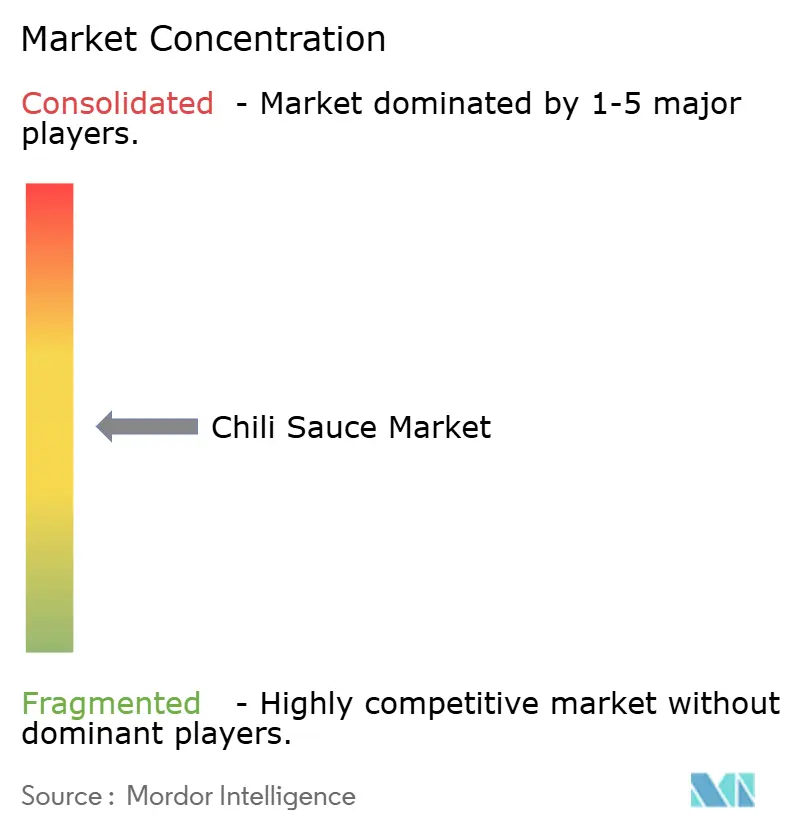
| Market Concentration | Medium |
Major Players *Disclaimer: Major Players sorted in no particular order Image © Mordor Intelligence. Reuse requires attribution under CC BY 4.0. | |
Chili Sauce Market Analysis by Mordor Intelligence
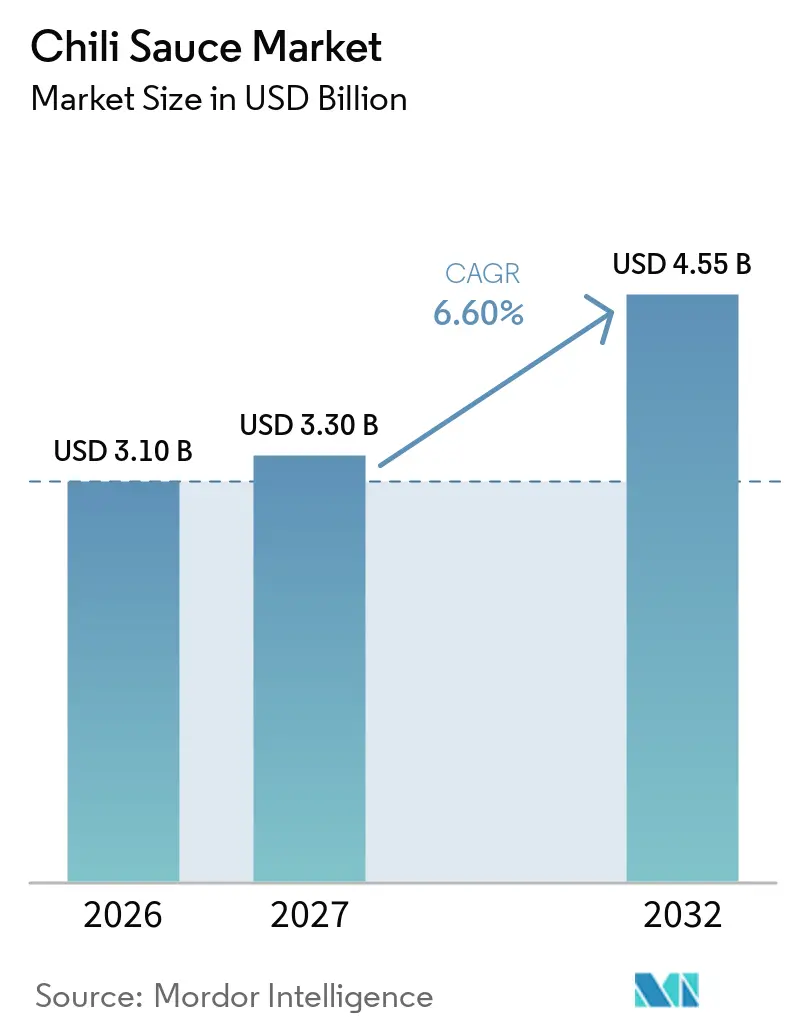
The Chili Sauce Market size is projected to expand from USD 3.10 billion in 2026 and USD 3.30 billion in 2027 to USD 4.55 billion by 2032, registering a CAGR of 6.60% between 2027 and 2032.
The chili sauce market is supported by the growing popularity of spicy and ethnic flavors, expanding quick-service restaurant networks, and rising experimentation with regional condiments. Demand is being reinforced by the wider adoption of hot sauce, sriracha, chili-garlic sauce, and sweet chili sauce across household cooking and foodservice applications. Product innovation is extending beyond flavor profiles to include different heat intensities and convenient packaging formats, creating opportunities for manufacturers to serve diverse consumer preferences. Retail distribution remains anchored by hypermarkets and supermarkets, while online stores are expected to expand more rapidly as digital grocery platforms improve access to niche and international sauce brands. North America holds the largest regional position, while Asia-Pacific is projected to record the fastest regional growth, reflecting opportunities linked to established spicy-food traditions and the commercialization of regional sauce varieties. The competitive landscape includes multinational condiment companies, established regional producers, and specialist hot sauce brands, with product differentiation, brand recognition, and distribution reach shaping competition.
Key Report Takeaways
- By product type, Hot Sauce led the chili sauce market with a 34.08% share in 2026, while Chili-Garlic Sauce is projected to grow at an 8.14% CAGR through 2031, supported by demand for bold flavors.
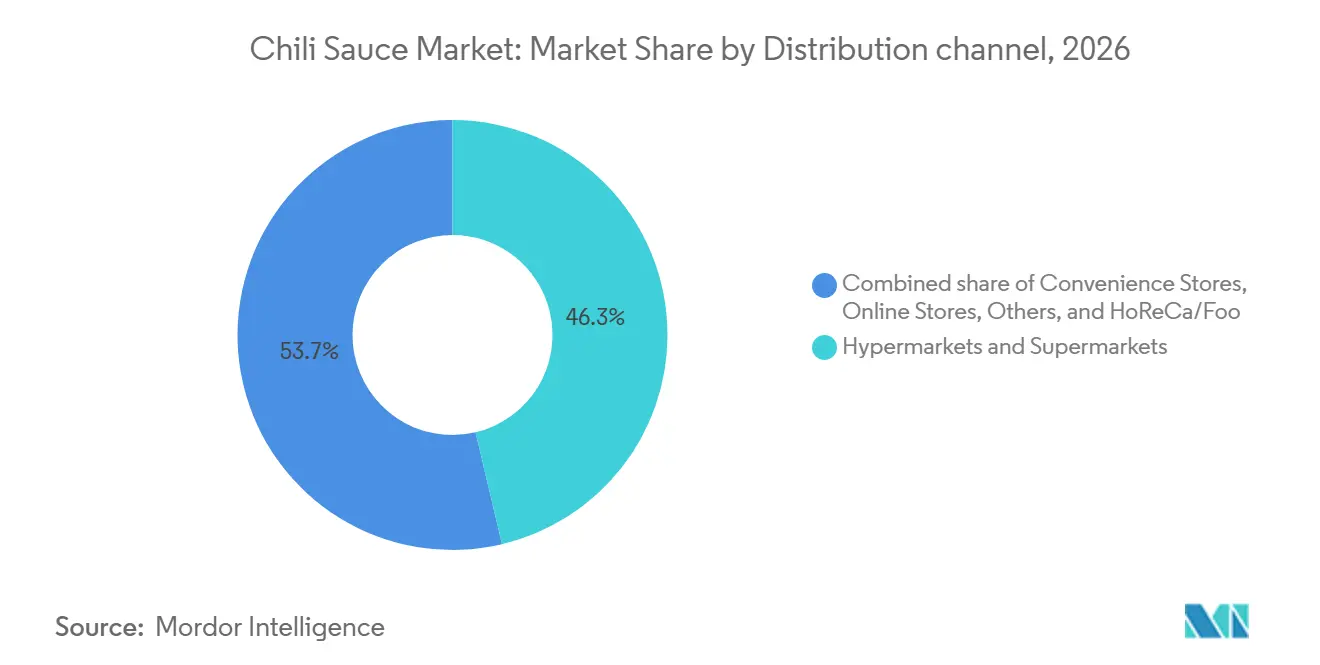
- By distribution channel, Hypermarkets and Supermarkets held the largest chili sauce market share at 46.30% in 2026, while Online Stores are forecast to grow at an 8.50% CAGR through 2031.
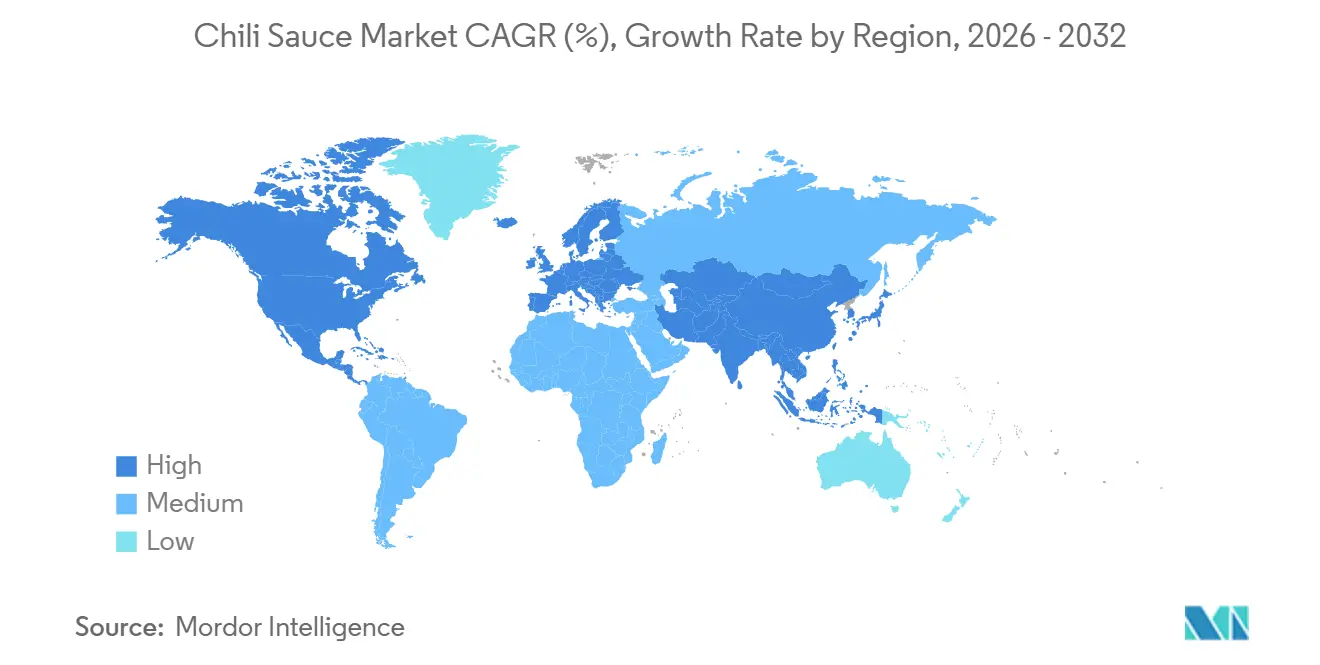
- By geography, North America held the largest chili sauce market share at 41.00% in 2026, while Asia-Pacific is projected to grow at a 7.78% CAGR through 2031, driven by established spicy-food traditions.
- By packaging type, Bottles accounted for the largest chili sauce market share at 46.00% in 2026, while Refill Pouches are projected to grow at a 9.40% CAGR through 2031.
- By heat level, Mild Chili Sauce led the chili sauce market with a 42.70% share in 2026, while Hot and Extra Hot Chili Sauce is forecast to grow at a 7.73% CAGR through 2031, driven by demand for intense heat experiences.
Note: Market numbers in this report are based on Mordor Intelligence's proprietary estimation framework, which combines nine months of actuals with Q4 projections for base year 2026.
Global Chili Sauce Market Trends and Insights
Drivers Impact Analysis*
| Driver | (~) % Impact on CAGR Forecast | Geographic Relevance | Impact Timeline |
|---|---|---|---|
| Globalization of ethnic and spicy flavors | +1.0% | Global; North America and Europe strongly influenced by international cuisine | Medium term (2-4 years) |
| Growth of quick-service restaurants | +0.8% | Global; North America and Asia-Pacific | Medium term (2-4 years) |
| Rising popularity of regional chili sauces | +0.9% | Asia-Pacific core; North America and Europe expanding | Long term (4 years or more) |
| Rising at-home cooking and meal experimentation | +0.7% | Global; North America, Europe, and Asia-Pacific | Short term (2 years or less) |
| Heat-level and flavor personalization | +0.8% | Global; North America and Europe, expanding across Asia-Pacific | Medium term (2-4 years) |
| Innovation in portion-pack formats | +0.6% | Global; North America and Asia-Pacific, particularly foodservice and takeaway channels | Short term (2 years or less) |
| Source: Mordor Intelligence | |||
Globalization of Ethnic and Spicy Flavor
Globalization of ethnic and spicy flavors is broadening demand for chili sauces beyond their traditional consumption markets. Greater exposure to international cuisines through restaurants, foodservice outlets, multicultural retail, and digital food content is encouraging consumers to experiment with regional sauces and incorporate them into everyday meals. Products such as sriracha, chili-garlic sauce, and sweet chili sauce are benefiting from this culinary crossover, as they can be used in marinades, dipping sauces, stir-fries, and ready-to-eat meals. Brands such as Huy Fong Foods[1], Lee Kum Kee, and Flying Goose offer recognizable chili sauce varieties that reflect Asian flavor traditions and cater to different culinary preferences. As international cuisines become more familiar to consumers, manufacturers have opportunities to expand beyond traditional hot sauce formulations through regional flavor profiles, varied heat intensities, and versatile product formats, supporting continued diversification across the chili sauce market.
Growth of Quick-Service Restaurants
The expansion of quick-service restaurants (QSRs) is strengthening demand for chili sauces as convenient, customizable condiments across fast-food menus. Burgers, fried chicken, sandwiches, wraps, tacos, and snack items increasingly incorporate spicy sauces to differentiate flavors and provide consumers with greater choice. Chili sauces also serve as dipping accompaniments and meal toppings, making them suitable for high-throughput foodservice operations that require consistent flavor and easy portioning. Major foodservice brands, including McDonald’s, KFC[2], and Taco Bell, offer examples of how spicy sauces and chili-based condiments can complement quick-service menus and regionalize flavor offerings. As restaurant operators expand spicy menu options and limited-time offerings, sauce manufacturers have opportunities to supply foodservice packs and develop formulations tailored to specific menu applications, heat preferences, and operational requirements.
Rising Popularity of Regional Chili Sauces
The rising popularity of regional chili sauces is diversifying consumer demand beyond conventional hot sauce formulations. Distinctive condiments such as Korean gochujang-inspired sauces, Thai sweet chili sauce, Chinese chili-garlic sauce, and Mexican habanero-based sauces offer different combinations of heat, sweetness, acidity, and texture, reflecting local culinary traditions. Their use in street food, restaurant dishes, marinades, dipping applications, and home cooking is creating opportunities for manufacturers to serve consumers seeking more authentic and region-specific flavors. Companies such as Lee Kum Kee, Flying Goose, and McIlhenny Company offer differentiated sauce portfolios that reflect Asian and Mexican-style flavor preferences, respectively. As consumers explore regional cuisines, manufacturers can broaden their offerings through locally inspired ingredients, distinctive chili varieties, and heat profiles suited to different food applications.
Rising At-Home Cooking and Meal Experimentation
Rising at-home cooking and meal experimentation are creating more opportunities for chili sauces as consumers seek convenient ways to diversify everyday meals. Preparing food at home encourages experimentation with marinades, dipping sauces, stir-fries, sandwiches, and homemade snacks, allowing chili sauces to serve as both condiments and cooking ingredients. Products such as sriracha, chili-garlic sauce, and sweet chili sauce offer different combinations of heat, sweetness, and savory flavor that can complement a wide range of cuisines without requiring complex preparation. Brands such as Huy Fong Foods and Lee Kum Kee[3] provide versatile sauce options for home cooks, while their distinct flavor profiles support applications across Asian-inspired dishes and everyday meals. This trend creates opportunities for manufacturers to emphasize recipe versatility, convenient packaging, and clearly communicated usage suggestions to encourage repeat use across different home-cooking occasions.
Restraints Impact Analysis*
| Restraint | (~) % Impact on CAGR Forecast | Geographic Relevance | Impact Timeline |
|---|---|---|---|
| Raw Material Price Volatility | -0.7% | Global, particularly major chili-producing and processing markets | Short term (≤ 2 years) |
| Stringent Food Safety and Labeling Regulations | -0.5% | North America, Europe, and other regulated import markets | Medium term (2–4 years) |
| Supply Chain Disruptions | -0.8% | Global, particularly markets reliant on cross-border chili and ingredient sourcing | Short term (≤ 2 years) |
| Limited Availability of Quality Chili Peppers | -0.6% | Global, particularly key chili-producing regions and major importing markets | Medium term (2–4 years) |
| Source: Mordor Intelligence | |||
Raw material price volatility
Raw material price volatility can constrain chili sauce manufacturers by creating uncertainty in procurement costs and production planning. Chili peppers, tomatoes, vinegar, sugar, garlic, and edible oils are key inputs whose prices can fluctuate with weather conditions, crop yields, energy costs, and transportation expenses. Adverse growing conditions or seasonal supply shortages can increase the cost of chili peppers and other agricultural ingredients, particularly for manufacturers dependent on specific pepper varieties or sourcing regions. These fluctuations can place pressure on production margins and complicate pricing decisions, especially when retailers and foodservice customers resist frequent price adjustments. Manufacturers may respond through diversified sourcing, longer-term supplier agreements, inventory planning, and recipe optimization, although these measures cannot fully eliminate exposure to agricultural commodity volatility.
Stringent Food Safety and Labeling Regulations
Stringent food safety and labeling regulations can increase compliance requirements for chili sauce manufacturers across production, packaging, and distribution. Products must meet applicable standards for ingredient declarations, allergen disclosure, permitted additives, microbiological safety, and nutritional labeling, with requirements varying across countries and retail markets. For example, manufacturers exporting chili sauces to the United States must comply with applicable Food and Drug Administration (FDA) food labeling and food safety requirements, while products sold in the European Union must follow relevant food information and hygiene legislation. Changes in regulatory requirements can necessitate reformulation, packaging redesign, additional testing, and updated documentation, increasing operating complexity, particularly for smaller producers serving multiple markets. These obligations can also delay product launches and limit the use of certain ingredients or claims, making regulatory monitoring and quality-control systems essential for maintaining market access.
*Our forecasts treat driver/restraint impacts as directional, not additive. The impact forecasts reflect baseline growth, mix effects, and variable interactions.
Segment Analysis
By Product Type: Hot Sauce Anchors Category Growth
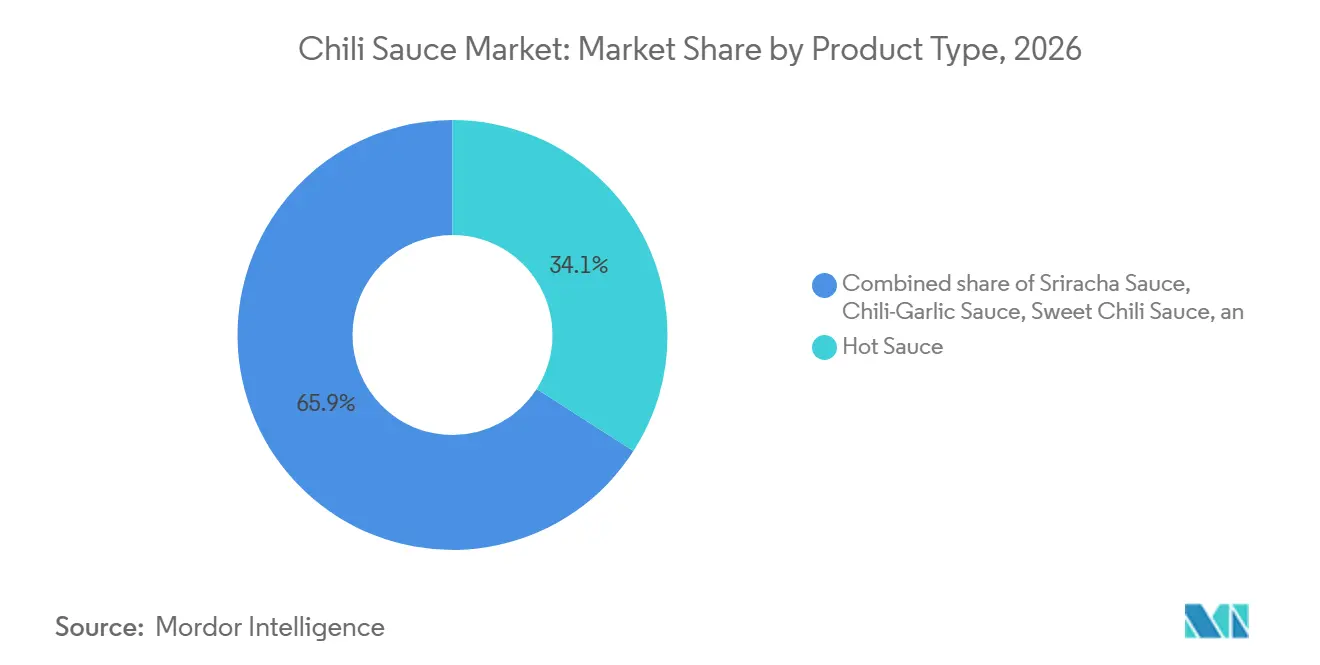
Hot Sauce led the chili sauce market with a 34.08% share in 2026, supported by its broad use as a condiment, cooking ingredient, and flavor enhancer across restaurants, packaged foods, and households. Sriracha Sauce benefits from demand for garlic-forward heat in noodles, burgers, marinades, and dips, while Chili-Garlic Sauce appeals to consumers seeking pungency and spice. Sweet Chili Sauce serves dipping, glazing, and Asian-inspired cooking applications, balancing chili heat with sweetness.
The Others category includes diverse regional and specialty sauces, such as habanero-based, jalapeño, and other pepper-specific formulations. Product differentiation increasingly depends on flavor profiles, heat intensity, ingredient composition, and suitability for different cuisines. Manufacturers offering distinct regional flavors and versatile formats can address varied consumer preferences across retail and foodservice channels.

By Heat Level: Mild Sauce Leads, Hot Varieties Gain Traction
Mild Chili Sauce held the largest segment share at 42.70% in 2026, supported by its broad appeal among consumers seeking balanced heat and everyday versatility. Hot and Extra Hot Chili Sauce caters to heat-seeking consumers, while medium-heat varieties bridge the gap between mild flavor and intense spice. This broad usability helps mild sauces maintain a strong position in mainstream retail and household consumption.
Hot and Extra Hot sauces appeal to consumers seeking stronger pungency, intense flavor experiences, and greater control over meal heat levels. Products made with cayenne, habanero, and other high-heat chili varieties can differentiate through pepper selection, Scoville intensity, and regional flavor profiles. The segment also benefits from the visibility of spicy food challenges, specialty hot sauce brands, and the incorporation of hotter sauces into restaurant dishes, marinades, and snack applications. However, manufacturers must balance heat intensity with flavor quality and clear labeling to help consumers choose products suited to their preferences. Medium-heat sauces bridge these segments by offering noticeable spice without the intensity of extra-hot formulations, serving consumers looking for an intermediate option.
By Packaging Type: Bottles Lead, Flexible Packs Gain Traction
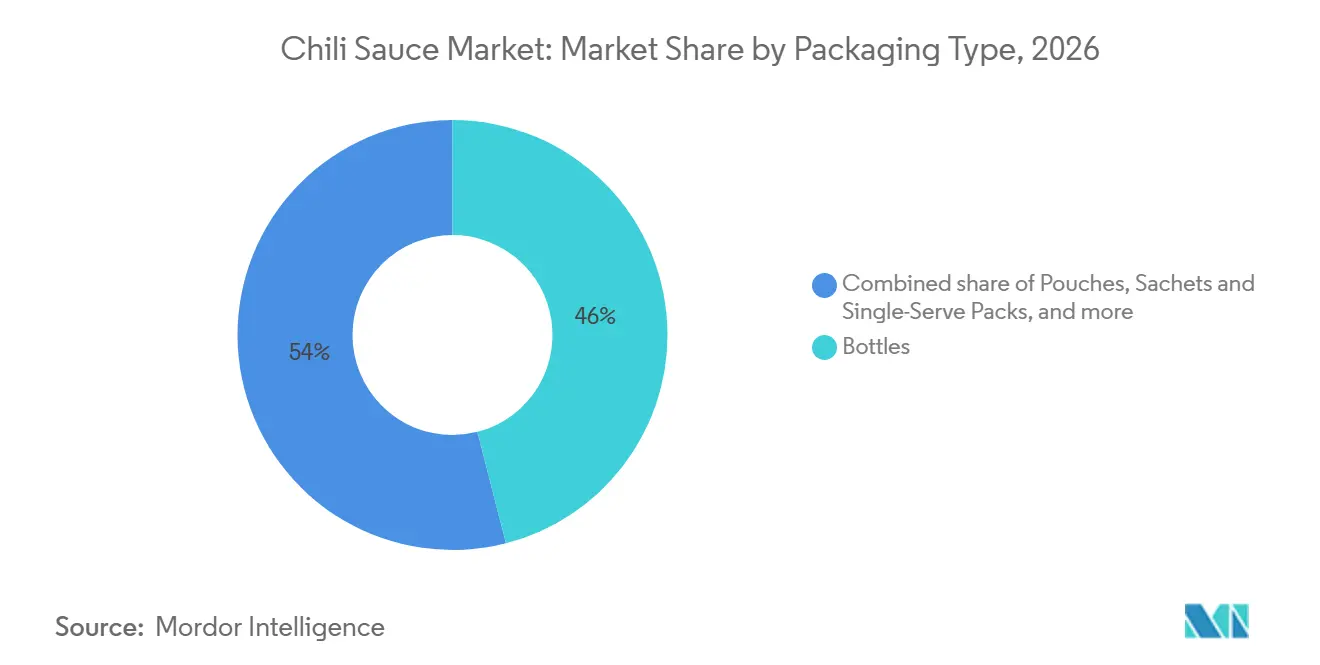
Bottles accounted for 46.00% of the chili sauce market in 2026, supported by convenient dispensing, resealable formats, and visibility on retail shelves. Refill Pouches offer lightweight storage and potential packaging-material savings, appealing to consumers seeking practical refill options. Manufacturers use different bottle sizes, cap designs, and materials to distinguish products and accommodate varying consumption occasions. The format also supports established retail distribution and brand recognition, although packaging cost, material selection, leakage prevention, and recyclability remain important considerations for producers.
Pouches, sachets, and single-serve packs address demand for portability, portion control, and convenient consumption across foodservice, takeaway, and on-the-go occasions. Sachets are particularly suited to restaurants and quick-service outlets that provide individual sauce portions, while larger flexible pouches can serve household refill needs and commercial kitchens. These formats can reduce packaging material requirements in certain applications, but shelf-life protection, sealing integrity, and ease of dispensing remain important design considerations. Other formats, including jars and cans, serve selected products and distribution needs, particularly where packaging durability or specific storage requirements matter. Packaging differentiation therefore depends on balancing convenience, product protection, cost, and sustainability with the intended consumption occasion.
By Distribution Channel: Supermarkets Lead, Online Channels Expand Access
Hypermarkets and Supermarkets accounted for 46.30% of the chili sauce market in 2026, supported by broad product assortments, in-store visibility, and established grocery-shopping habits. Online Stores expand access to specialty and regional sauces, while foodservice channels support demand from restaurants and quick-service outlets. E-commerce also allows brands to communicate product attributes and usage ideas through detailed listings and customer reviews. Other retail channels, including independent grocery stores and specialty food retailers, provide additional access to local and imported chili sauce varieties.
HoReCa and foodservice distribution serves restaurants, hotels, and catering operators that use chili sauces as condiments, cooking ingredients, marinades, and components of signature dishes. Restaurants support demand through dipping sauces, spicy toppings, and cuisine-specific preparations, while hotels and catering businesses require products suited to consistent flavor delivery across larger meal volumes. Foodservice buyers often prioritize dependable supply, standardized taste, practical bulk packaging, and cost efficiency, creating opportunities for manufacturers to supply larger formats and application-specific formulations. As menu diversification and demand for customizable spice levels influence foodservice offerings, suppliers that balance flavor consistency, operational convenience, and flexible pack sizes can serve both commercial kitchens and retail consumers.
Geography Analysis
North America remains a key geography for the chili sauce market, supported by established condiment consumption, a diverse foodservice sector, and demand for both mainstream and specialty spicy flavors. The United States provides a major market for established brands such as McCormick’s Frank’s RedHot and McIlhenny Company’s TABASCO, alongside specialist producers such as Huy Fong Foods. Canada benefits from multicultural food preferences and demand for sauces used in home cooking and restaurant meals, while Mexico’s established chili-based culinary traditions support a broad range of regional sauces and heat profiles. Across the region, manufacturers compete through flavor variety, heat intensity, brand recognition, and product availability across supermarkets, convenience stores, and online channels.
Europe represents a diverse market in which established condiment consumption intersects with growing interest in international cuisines and differentiated flavor profiles. The United Kingdom, Germany, France, Italy, Spain, and the Netherlands provide opportunities for chili sauces across retail and foodservice applications, including dipping, cooking, and meal customization. Brands and suppliers offering products such as sriracha, sweet chili, and chili-garlic sauces can serve consumers exploring Asian-inspired dishes and spicier flavors. Markets including Sweden, Belgium, and Poland also form part of the regional opportunity, although consumer preferences and the prominence of spicy condiments vary by country. Retail assortment, product positioning, ingredient transparency, and packaging formats influence how manufacturers reach consumers across these distinct national markets.
Asia-Pacific is the fastest-growing geography, supported by established chili-based culinary traditions, a large consumer base, and the expanding use of packaged condiments in household cooking and foodservice. China benefits from demand for chili-based sauces used in prepared foods and everyday meals, while India presents opportunities as packaged food consumption and modern retail distribution expand. Thailand and Indonesia have strong foundations in regional chili condiments, including sweet chili and sambal-style sauces, while South Korea contributes demand for gochujang-inspired and spicy flavor profiles. Japan, Singapore, and Australia offer additional opportunities through international cuisine, specialty products, and established retail channels. The region’s diversity requires manufacturers to adapt sweetness, heat intensity, ingredients, and formats to local preferences.
Competitive Landscape
The chili sauce market features established global players including McCormick & Company, McIlhenny Company, Kraft Heinz, Lee Kum Kee, and Huy Fong Foods, alongside regional specialists such as Lao Gan Ma, Grupo Herdez, and Masan Group. Competition increasingly centers on flavor differentiation, heat intensity, regional authenticity, packaging formats, and distribution reach. Established brands leverage consumer familiarity and broad retail presence, while specialist manufacturers compete through distinctive chili varieties and signature formulations, including sriracha, chili-garlic, sweet chili, and habanero sauces. Product development also reflects demand for versatile condiments that can be used in cooking, dipping, marinades, and meal customization across household and foodservice settings.
Recent competitive activity highlights continued investment in globally inspired flavors and portfolio expansion. In February 2025, Kraft Heinz introduced its HEINZ Flavor Tour range, including Thai Inspired Sweet Chili and Korean Inspired Sweet & Tangy BBQ sauces, extending the brand into internationally influenced condiment flavors. McCormick’s acquisition of Cholula, completed in 2020, illustrates how established ingredient and condiment companies can strengthen their hot sauce portfolios by combining distinctive regional flavor identities with broader distribution and marketing capabilities. These strategies highlight how flavor differentiation, brand positioning, and access to established distribution networks are key competitive levers for manufacturers seeking to expand their presence in the chili sauce and hot sauce markets.
Competitive opportunities also exist in specialty sauces, regional formulations, and supply-chain reliability. Huy Fong Foods’ production interruption in 2024, attributed to inadequate availability of suitably mature red jalapeño peppers, highlighted the vulnerability of chili sauce manufacturers to crop quality and sourcing constraints. This creates a strategic incentive for producers to strengthen agricultural sourcing relationships and maintain more resilient procurement arrangements. Meanwhile, brands can differentiate through pepper varieties, heat levels, regional recipes, and convenient packaging, while established players can leverage retail access and foodservice relationships to broaden product reach.
Chili Sauce Industry Leaders
-
McCormick & Company, Incorporated
-
McIlhenny Company
-
The Kraft Heinz Company
-
Huy Fong Foods, Inc.
-
Grupo Herdez, S.A.B. de C.V.
- *Disclaimer: Major Players sorted in no particular order
Recent Industry Developments
- July 2026: Kraft Heinz and The Walt Disney Company announced a multi-year strategic alliance covering Disney parks, resorts, and Disney Cruise Line. HEINZ unveiled four new sauce flavors: Blackberry Bourbon BBQ, Orange Mojo, Brauhaus Mustard, and Maple Sweet Chili, with the sauces set to feature at Disney condiment stations.
- January 2026: Highlander acquired a controlling interest in Tapatío from the Saavedra family, while The Arnold Companies invested a significant minority equity position and the founding family retained a minority stake following the transaction.
- May 2025: McCormick announced Cholula’s launch of 11 new products, including four cooking sauces, two creamy Cremosa toppings, Chamoy, Chili Crisp, two taco seasoning mixes, and Original Hot Salsa. The launch expanded the brand beyond traditional hot sauce into broader Mexican-inspired cooking and condiment applications.
- April 2026: Hot Ones expands into barbecue sauces. First We Feast’s Hot Ones, in collaboration with HEATONIST, launched four new barbecue sauce flavors: Original Hot BBQ, Hot Honey BBQ, Smoky Serrano BBQ, and Caribbean BBQ. The launch extends the brand’s hot sauce portfolio into the barbecue condiment category, targeting consumers seeking smoky, sweet, and spicy flavor combinations.
Global Chili Sauce Market Report Scope
For this study, the chili sauce market is defined as the sales value of commercially produced chili-based sauces manufactured, packaged, distributed, and sold through retail and foodservice channels. The market covers various product types, including hot sauce, sriracha sauce, chili-garlic sauce, sweet chili sauce, and others; heat levels, including mild, medium, and hot and extra hot; packaging types; and distribution channels, including retail and HoReCa/foodservice. The market is analyzed across North America, Europe, Asia-Pacific, South America, and the Middle East and Africa, with market sizing measured in USD terms based on chili sauce sales value across the defined markets.
| Hot Sauce |
| Sriracha Sauce |
| Chili-Garlic Sauce |
| Sweet Chili Sauce |
| Others |
| Mild |
| Medium |
| Hot and Extra Hot |
| Bottles |
| Pouches |
| Sachets and Single-Serve Packs |
| Others (Jars, Cans, etc.) |
| Retail | Hypermarkets and Supermarkets |
| Convenience Stores | |
| Online Stores | |
| Others | |
| HoReCa/Foodservice | Restaurants |
| Hotels | |
| Catering |
| North America | United States |
| Canada | |
| Mexico | |
| Rest of North America | |
| Europe | United Kingdom |
| Germany | |
| France | |
| Italy | |
| Spain | |
| Sweden | |
| Belgium | |
| Poland | |
| Netherlands | |
| Rest of Europe | |
| Asia-Pacific | China |
| Japan | |
| India | |
| Thailand | |
| Singapore | |
| Indonesia | |
| Korea | |
| Australia | |
| Rest of Asia-Pacific | |
| South America | Brazil |
| Argentina | |
| Colombia | |
| Peru | |
| Chile | |
| Rest of South America | |
| Middle East and Africa | South Africa |
| Saudi Arabia | |
| United Arab Emirates | |
| Nigeria | |
| Egypt | |
| Morocco | |
| Turkey | |
| Rest of Middle East and Africa |
| By Product Type | Hot Sauce | |
| Sriracha Sauce | ||
| Chili-Garlic Sauce | ||
| Sweet Chili Sauce | ||
| Others | ||
| By Heat Level | Mild | |
| Medium | ||
| Hot and Extra Hot | ||
| By Packaging Type | Bottles | |
| Pouches | ||
| Sachets and Single-Serve Packs | ||
| Others (Jars, Cans, etc.) | ||
| By Distribution Channel | Retail | Hypermarkets and Supermarkets |
| Convenience Stores | ||
| Online Stores | ||
| Others | ||
| HoReCa/Foodservice | Restaurants | |
| Hotels | ||
| Catering | ||
| By Geography | North America | United States |
| Canada | ||
| Mexico | ||
| Rest of North America | ||
| Europe | United Kingdom | |
| Germany | ||
| France | ||
| Italy | ||
| Spain | ||
| Sweden | ||
| Belgium | ||
| Poland | ||
| Netherlands | ||
| Rest of Europe | ||
| Asia-Pacific | China | |
| Japan | ||
| India | ||
| Thailand | ||
| Singapore | ||
| Indonesia | ||
| Korea | ||
| Australia | ||
| Rest of Asia-Pacific | ||
| South America | Brazil | |
| Argentina | ||
| Colombia | ||
| Peru | ||
| Chile | ||
| Rest of South America | ||
| Middle East and Africa | South Africa | |
| Saudi Arabia | ||
| United Arab Emirates | ||
| Nigeria | ||
| Egypt | ||
| Morocco | ||
| Turkey | ||
| Rest of Middle East and Africa | ||
Key Questions Answered in the Report
1. What is the size of the chili sauce market?
The global chili sauce market is estimated at USD 3.1 billion in 2026 and is projected to reach USD 4.55 billion by 2032.
2. What is the expected growth rate of the chili sauce market?
The market is projected to grow at a CAGR of 6.60% during 2026–2031.
3. Which product type holds the largest share of the chili sauce market?
Hot sauce is the leading product type, accounting for 34.08% of the global chili sauce market in 2026. Its broad use as a condiment, cooking ingredient, and dipping sauce supports its position across retail and foodservice applications.
4. Which heat-level segment dominates the chili sauce market?
Mild chili sauce holds the largest share, accounting for 42.70% of the market in 2026. Its appeal to consumers seeking flavor with less intense heat supports its use across everyday meals and a wide range of food applications.