
Chile Kiwi Market Size and Share
Chile Kiwi Market Analysis by Mordor Intelligence
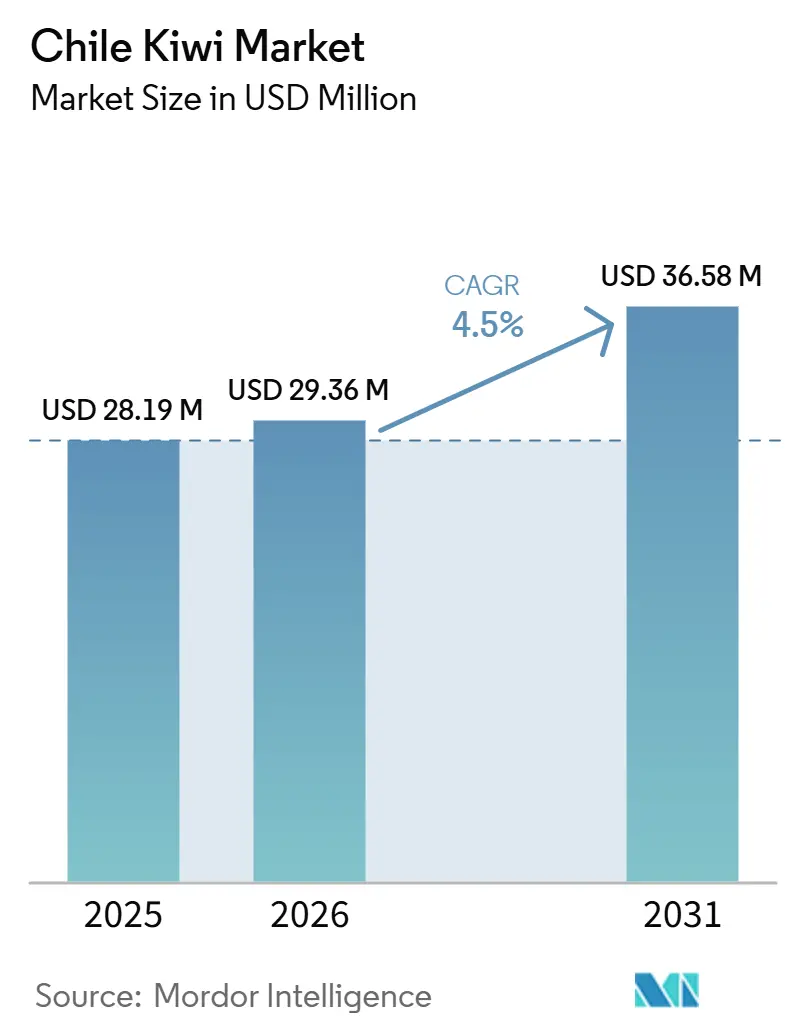
The Chile kiwi market size is USD 28.19 million in 2025, projected to reach USD 29.36 million in 2026, and further anticipated to reach USD 36.58 million by 2031, growing at a CAGR of 4.5% during the forecast period (2026 to 2031). Chile maintained a strong position in global kiwifruit trade by shipping fruit during the March to October window, when Northern Hemisphere supply is limited, and buyers in Europe, North America, and other import markets require fresh product from the Southern Hemisphere. The broader export base also supports the Chile kiwi market, with kiwi export value reaching about USD 292.4 million in 2024 and first-half 2025 exports totaling USD 155 million, up 11.6% year over year, pointing to firm external demand and better pricing for quality fruit[1]Source: ODEPA, “Balanza Comercial de Productos Silvoagropecuarios,” ODEPA, odepa.gob.cl. Demand growth in India, Brazil, and Southeast Asia is expanding the customer base for Chilean kiwi and reducing reliance on a single import region, helping exporters spread commercial risk and sustain shipment growth over time. Competition in the Chile kiwi market is centered on fruit quality, market diversification, and controlled-atmosphere storage, because 98% of plantations still grow Hayward green kiwi, and exporters therefore compete more on execution than on broad varietal differentiation. The Chile kiwi market still faces constraints due to prolonged water scarcity in central Chile, Pseudomonas syringae pv. actinidiae (PSA) disease pressure, and a business model that remains exposed to overseas demand and shipping conditions, which is why growth is steady rather than aggressive.
Note: Market size and forecast figures in this report are generated using Mordor Intelligence’s proprietary estimation framework, updated with the latest available data and insights as of January 2026.
Chile Kiwi Market Trends and Insights
Drivers Impact Analysis*
| Driver | (~) % Impact on CAGR Forecast | Geographic Relevance | Impact Timeline |
|---|---|---|---|
| Growing Asian export demand is driving Chilean kiwi market growth | +1.2% | Asia Pacific, with spillover to global trade flows | Medium term (2-4 years) |
| Modern orchard practices are improving Chilean kiwi productivity | +0.8% | O'Higgins, Maule, and Chile-wide | Long term (≥ 4 years) |
| Strict quality standards strengthening Chilean kiwi export competitiveness | +0.7% | Europe, North America, and South America | Short term (≤ 2 years) |
| Rising yellow kiwi cultivation supporting premium market growth | +0.6% | Global, especially Europe and North America | Medium term (2-4 years) |
| Counter-seasonal production expanding Chilean kiwi export opportunities | +0.5% | European Union, EFTA, United States, and Asia Pacific partners | Short term (≤ 2 years) |
| Free trade agreements enhancing Chilean kiwi export access | +0.4% | Chile-wide, led by O'Higgins and Maule | Long term (≥ 4 years) |
| Source: Mordor Intelligence | |||
Growing Asian Export Demand Driving Chilean Kiwi Market Growth
Asia-Pacific demand is providing the Chile kiwi market with one of its strongest long-term growth opportunities, with India emerging as a priority export destination supported by favorable long-term consumption potential and expanding retail distribution. Rising consumer awareness, improving cold-chain infrastructure, and increasing availability of imported fruit continue to strengthen demand for kiwifruit across major Asian markets. South Korea and several ASEAN countries also represent attractive growth opportunities as consumer preference for premium imported fruit continues to increase. The Chile kiwi market further benefits from ongoing export promotion efforts that prioritize key international markets, including India, the United States, and Brazil, thereby strengthening market presence, diversifying export destinations, and supporting sustained international demand growth.
Modern Orchard Practices Improving Chilean Kiwi Productivity
Modern agronomic practices are increasing production potential in the Chile kiwi market without requiring equivalent expansion of cultivated area, which is increasingly important under water constraints [2] Source: Ben Lastra and others, “Economic Assessment of Chilean Agricultural Land Use, Labor Demand and Input Requirements Using the Delphi Method,” Chilean Journal of Agricultural Research, oes.chileanjar.cl. Growers are increasingly adopting improved fertilization programs, canopy management, precision irrigation, and orchard monitoring techniques to enhance fruit quality, optimize productivity, and improve resource efficiency. Advances in controlled-atmosphere storage and postharvest management have also strengthened export flexibility by extending fruit availability and enabling exporters to better align shipments with favorable market conditions. Improved orchard management remains increasingly important as producers seek to address labor availability challenges, rising production costs, and changing climatic conditions while maintaining consistent fruit quality and export competitiveness.
Counter-Seasonal Production Expanding Chilean Kiwi Export Opportunities
The Chile kiwi market benefits from its ability to supply fresh fruit from March to October, when Italy, Greece, and New Zealand cannot fully meet demand in many import markets. This export window has become increasingly valuable as Moria disease has reduced reliable kiwifruit production in Italy, creating greater opportunities for Southern Hemisphere suppliers. Periodic quality variations and lower export availability from competing Northern Hemisphere suppliers can create additional export opportunities for Chile. The delayed-harvest strategy adopted in April 2026 increased the minimum harvest maturity requirement to 6.5° Brix across most producing regions, extending the marketing season further into the Northern Hemisphere autumn. This approach strengthens the Chile kiwi market by supporting premium pricing through higher fruit quality rather than relying solely on larger shipment volumes.
Free Trade Agreements Enhancing Chilean Kiwi Export Access
Chile's extensive free trade agreement network provides the Chile kiwi market with a lasting competitive advantage by improving market access, reducing trade barriers, and simplifying export procedures. The EU–Chile Interim Trade Agreement, which entered into force on February 1, 2025, expanded tariff-free access to 99.6% of European Union tariff lines, including fresh kiwifruit, strengthening Chile's position in its largest export market[3]Source: European Commission, “EU-Chile Interim Trade Agreement,” Access2Markets, trade.ec.europa.eu. Chile's long-standing free trade agreement with the United States also continues to support tariff-free access for agricultural exports, while the modernized European Free Trade Association (EFTA) agreement concluded in January 2024 further enhances access to Norway, Switzerland, Iceland, and Liechtenstein, reinforcing Chile's presence in high-value European markets.
Restraints Impact Analysis*
| Restraint | (~) % Impact on CAGR Forecast | Geographic Relevance | Impact Timeline |
|---|---|---|---|
| Water scarcity is reducing Chilean kiwi orchard productivity | -1.2% | Central Chile, especially O'Higgins and Maule | Long term (≥ 4 years) |
| Bacterial canker disease increases Chilean kiwi production risks | -0.8% | O'Higgins, Maule, Metropolitan, and other affected orchards | Medium term (2-4 years) |
| Export dependence increases market price volatility | -0.7% | Global, with concentration in Europe, North America, and South America | Short term (≤ 2 years) |
| Rising production costs are reducing Chilean kiwi profitability | -0.6% | Chile-wide | Medium term (2-4 years) |
| Source: Mordor Intelligence | |||
Water Scarcity Reducing Chilean Kiwi Orchard Productivity
Water scarcity remains the most significant structural challenge for the Chile kiwi market, as the country's primary kiwi-producing regions in central Chile have experienced prolonged megadrought conditions. Persistent rainfall deficits and declining water availability have increased irrigation pressure across major production areas, making water management a critical factor influencing orchard productivity and long-term production stability. As kiwifruit is a relatively water-intensive orchard crop, prolonged drought conditions have led some growers to reduce cultivated area and reassess production strategies. Although deficit-precision irrigation and improved orchard management have demonstrated potential to enhance water-use efficiency while maintaining fruit quality, adoption across the Chile kiwi market remains gradual due to capital investment requirements, technical expertise, and farm-level resource constraints.
Export Dependence Increasing Market Price Volatility
The Chile kiwi market relies heavily on export demand, making prices and trade volumes highly sensitive to changing import patterns across major destination markets. Europe remained the largest export destination in 2025, meaning fluctuations in consumer demand, economic conditions, or trade policies can significantly influence overall market performance. Heavy reliance on long-distance sea freight further increases commercial risk, as logistics disruptions may delay deliveries, affect fruit quality, and reduce export returns. Additionally, the New Zealand–India Free Trade Agreement, concluded in late 2025 and signed in 2026, is projected to intensify competition in the Indian market by improving New Zealand's market access, potentially placing additional pressure on Chilean kiwi exporters' profit margins if demand growth fails to keep pace with rising supply.
*Our forecasts treat driver/restraint impacts as directional, not additive. The impact forecasts reflect baseline growth, mix effects, and variable interactions.
Geography Analysis
Europe accounted for 40% of Chile's kiwi export volume in 2025, making it the largest destination region with approximately 59,434 metric tons shipped during the year. The Netherlands imported more than 20,000 metric tons and remained the primary logistics hub for distribution across continental Europe. The United Kingdom imported over 11,000 metric tons, while Italy and Spain each received more than 8,000 metric tons in 2025, demonstrating a diversified customer base rather than dependence on a single market. Europe, therefore, remained the most important export market for Chilean kiwi, strongly influencing pricing, quality standards, and commercial strategies. In 2026, lower Greek availability and continued production constraints in Italy created additional opportunities for Chilean green kiwifruit across European markets.
South America and North America represented the second-largest export destination cluster for the Chile kiwi market in 2025. The Chile kiwi market continues to benefit from established commercial relationships across the Americas, although export performance remains sensitive to changes in consumer demand, market conditions, and international trade dynamics.
Asia-Pacific represents one of the fastest-growing export destinations for the Chile kiwi market, with India emerging as the key growth driver. The broader Asia-Pacific region offers significant long-term growth potential as rising incomes, urbanization, improving cold-chain infrastructure, and increasing consumer preference for premium fresh fruit continue to support imports. However, improved market access for New Zealand kiwifruit in India is likely to intensify competition in the premium segment and increase competitive pressure on Chilean exporters.
Competitive Landscape
The Chile kiwi market is moderately concentrated around a core group of exporters, including Copefrut, Exportadora Subsole, David del Curto, Greenvic, and Unifrutti Traders, with Del Monte Fresh Produce Chile also participating through its multinational fresh produce operations. The industry competes primarily on quality management, destination diversification, and post-harvest storage capabilities rather than extensive varietal diversity, as green Hayward continues to dominate commercial production. This provides established exporters with a competitive advantage through long-standing buyer relationships, advanced post-harvest infrastructure, and well-developed export compliance systems that are more difficult for smaller companies to replicate. The Chile kiwi market also shows a clear distinction between scale-focused exporters and premium-oriented suppliers, rather than a single competitive approach. As a result, competition remains active within a relatively well-defined group of leading exporters.
Copefrut represents the large-scale, brand-focused segment of the industry and continues to strengthen its international market presence through ongoing brand development and production initiatives. Exportadora Subsole follows a premium differentiation strategy by expanding its yellow kiwi portfolio while maintaining a strong commercial focus on green kiwifruit. At the industry level, the Chilean Kiwi Committee is evaluating new yellow kiwi varieties across major production regions, indicating that future varietal development will be supported through coordinated industry collaboration rather than isolated company initiatives. These developments demonstrate that both the scale of production and premium product innovation drive competition in the Chile kiwi market.
Future competitive advantage in the Chile kiwi market is projected to favor exporters with advanced controlled-atmosphere storage infrastructure and greater flexibility in harvest scheduling. Recent industry initiatives emphasizing delayed harvesting further reward companies capable of maintaining fruit quality during extended storage and long-distance transportation. Over the longer term, yellow kiwifruit represents the primary premium growth opportunity, although competition is projected to intensify as global suppliers continue expanding premium yellow kiwi production. Chilean exporters will therefore need differentiated varieties, strong counter-seasonal positioning, and consistent quality execution to remain competitive. The Chile kiwi industry is therefore competitive rather than fragmented, with future market leadership projected to depend on the successful combination of quality management, international market access, and selective premium diversification.
Recent Industry Developments
- April 2026: Chile's Kiwi Committee adopted a delayed-harvest strategy by raising fruit maturity targets to approximately 6.5° Brix, enabling improved fruit quality, longer storage life, and stronger export competitiveness in premium international markets.
- February 2026: Chile's kiwi industry is projected to export around 170,000 metric tons for the 2026 season, reflecting projected production growth driven by orchard recovery, while maintaining strict quality standards to support long-term market expansion.
- February 2026: The Chilean Kiwi Committee identified India, the United States, Mexico, and Brazil as priority export markets, strengthening promotional efforts and market diversification to capitalize on rising global demand for Chilean kiwi fruit.


Chile Kiwi Market Report Scope
Kiwi is an edible fruit of the genus Actinidia. The ellipsoidal Kiwi fruit has furry brownish-green skin, and the green flesh has numerous edible purple-black seeds embedded around a white center.
The Chile Kiwi Fruit Market Report includes Production Analysis (Volume), Consumption Analysis (Value and Volume), Import Analysis (Value and Volume), Export Analysis (Value and Volume), Wholesale Price Trend Analysis and Forecast, List of Key Players, and More. The Market Forecasts are Provided in Terms of Value (USD) and Volume (Metric Tons).
| Production Volume |
| Area Harvested and Yield |
| Import Market Analysis | Import Value and Volume |
| Key Supplying Markets | |
| Export Market Analysis | Export Value and Volume |
| Key Destinations Markets |
| Production Analysis | Production Volume | |
| Area Harvested and Yield | ||
| Trade Analysis (Value and Volume) | Import Market Analysis | Import Value and Volume |
| Key Supplying Markets | ||
| Export Market Analysis | Export Value and Volume | |
| Key Destinations Markets | ||


Key Questions Answered in the Report
What is the current size outlook for the Chile kiwi sector?
The Chile kiwi market size stood at USD 29.36 million in 2026 and is projected to reach USD 36.58 million by 2031 at a 4.5% CAGR.
Why is Chile important in global kiwi trade?
Chile supplies fresh kiwi from March to October, which helps fill seasonal gaps in Europe and other Northern Hemisphere markets when local supply is limited.
What are the biggest risks facing growers and exporters?
The main risks are long-term water scarcity in central Chile, PSA disease pressure, and pricing exposure linked to export demand and shipping conditions.
How are companies trying to improve returns?
Exporters are focusing on stronger maturity standards, better storage, harvest timing, market diversification, and selective expansion into premium yellow kiwi.
Page last updated on:





