
Chile Grapes Harvesters Market Size and Share
Market Overview
| Study Period | 2021 - 2031 |
|---|---|
| Forecast Data Period | 2026 - 2031 |
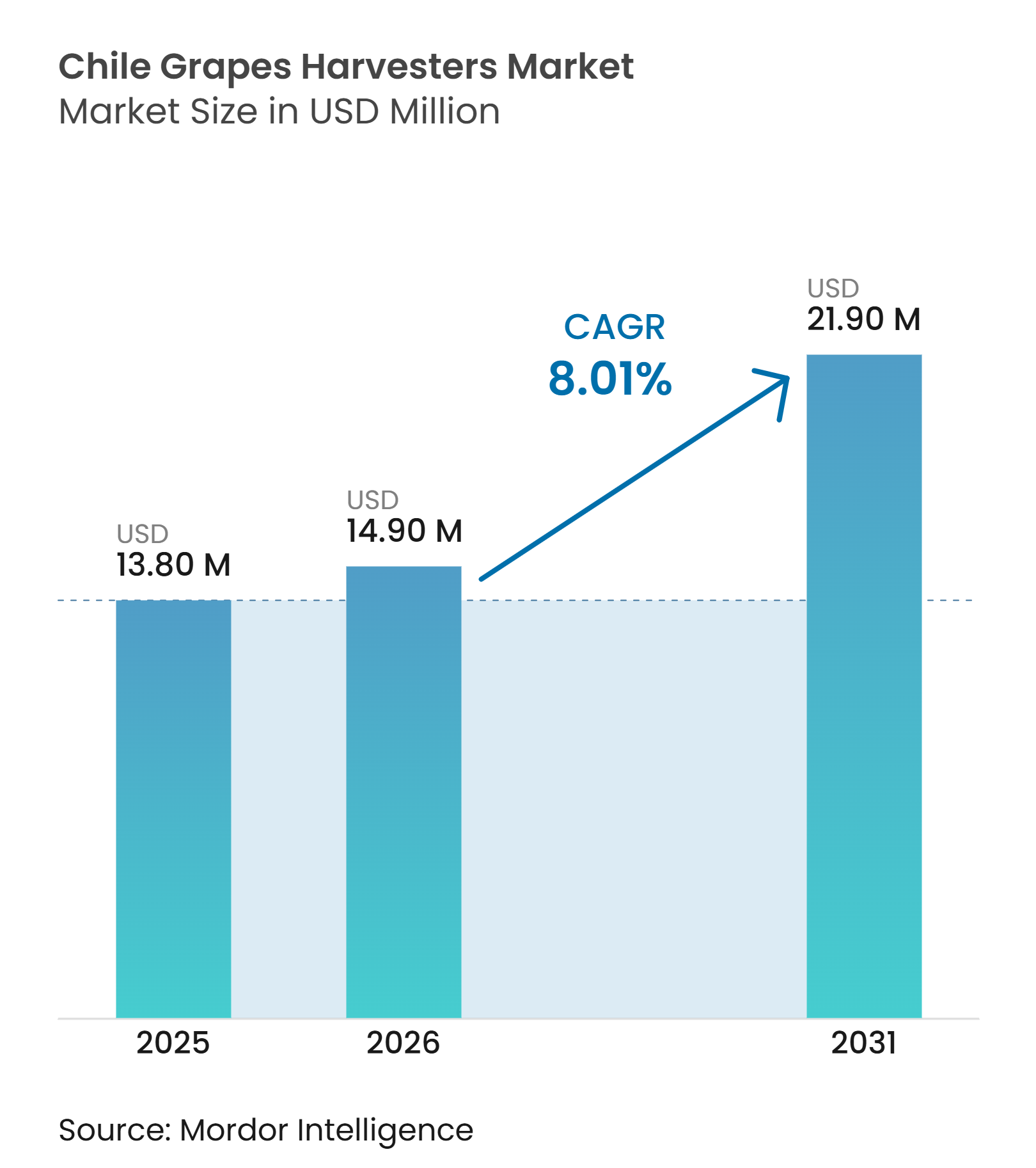
| Base Year Market Size (2025) | USD 13.80 Million |
| Market Size (2026) | USD 14.90 Million |
| Market Size (2031) | USD 21.90 Million |
| Growth Rate (2026 - 2031) | 8.01 % |
| Market Concentration | High |
Major Players *Disclaimer: Major Players sorted in no particular order Image © Mordor Intelligence. Reuse requires attribution under CC BY 4.0. | |
Chile Grapes Harvesters Market Analysis by Mordor Intelligence
The Chile grape harvesters market was valued at USD 13.80 million in 2025 and is estimated to grow from USD 14.90 million in 2026 to reach USD 21.90 million by 2031, at a CAGR of 8.01% during the forecast period (2026-2031). Labor availability, wage pressure, and narrower picking windows are encouraging vineyard operators to replace seasonal labor budgets with equipment investments. Chile's wine export activity makes timely harvesting important, as quality, ripeness records, and delivery commitments depend on coordinated field operations. The market is also moving toward connected equipment that can provide yield data, remote diagnostics, and records for sustainability reporting. Suppliers have an opportunity to support this transition through equipment financing, local service capacity, and machines suited to varied vineyard sizes. Import dependence, limited access to parts, and quality requirements in premium table grapes will continue to shape purchasing decisions.
Key Report Takeaways
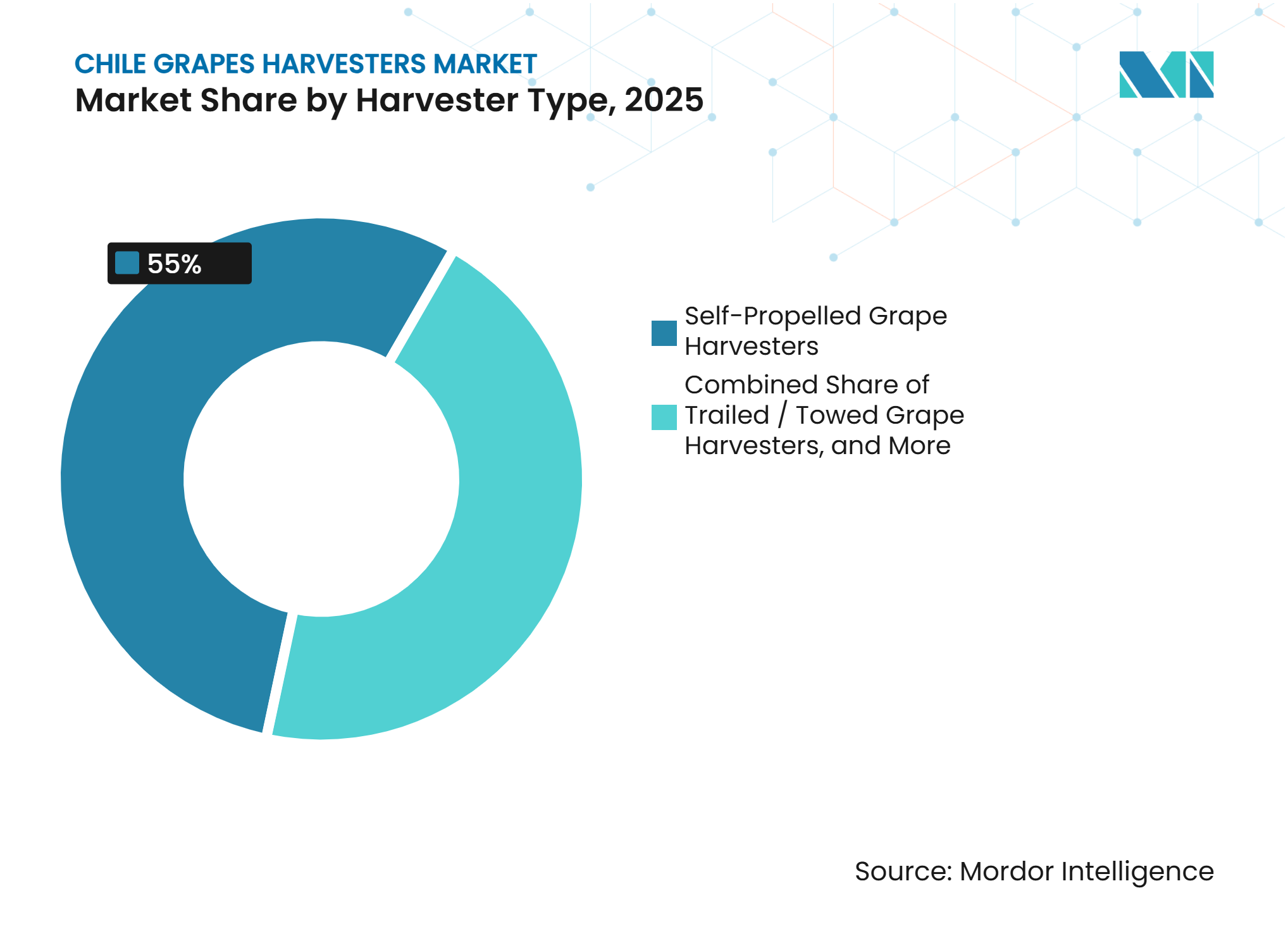
- By harvester type, self-propelled grape harvesters held 55% of the Chile grapes harvesters market share in 2025, while tractor-mounted platforms are forecast to grow at a CAGR of 11.8% from 2026 to 2031.
- By mode of operation, assisted/precision-guided operation accounted for 54.2% of the Chile grapes harvesters market size in 2025, while autonomous/semi-autonomous operations are forecast to grow at a CAGR of 13.2% from 2026 to 2031.
- By power source, diesel-powered harvesters held 66.8% of revenue in 2025, while electric harvesters are forecast to grow at a CAGR of 14.2% from 2026 to 2031.
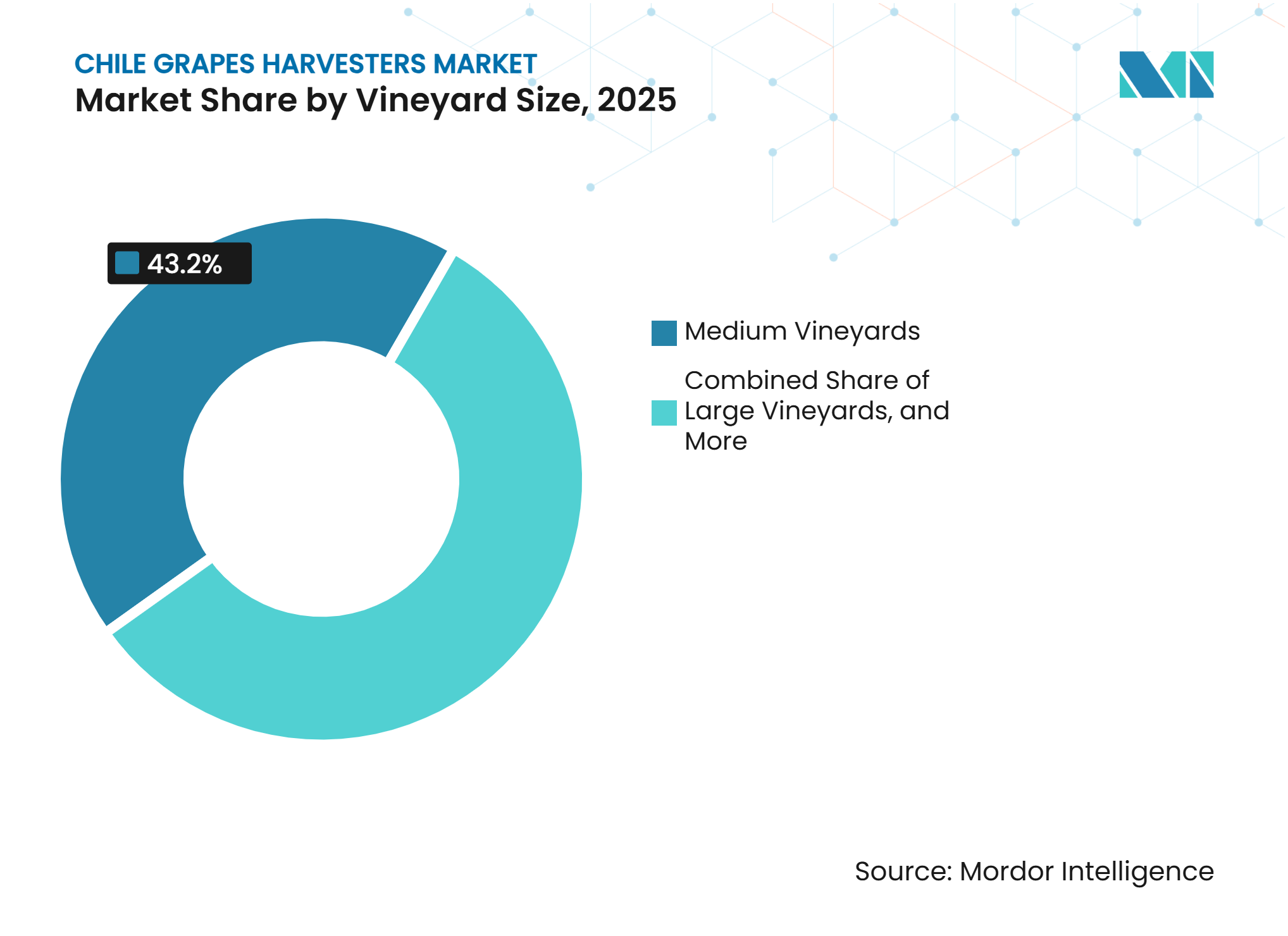
- By vineyard size, medium vineyards accounted for 43.2% of revenue in 2025, while small vineyards are forecast to grow at a CAGR of 12.4% from 2026 to 2031.
- By application, wine grapes accounted for 61% of revenue in 2025.
Note: Market size and forecast figures in this report are generated using Mordor Intelligence’s proprietary estimation framework, updated with the latest available data and insights as of January 2026.
Market Trends and Insights
Drivers Impact Analysis of Chile Grapes Harvesters Market*
| Driver | (~) % Impact on CAGR Forecast | Geographic Relevance | Impact Timeline |
|---|---|---|---|
| Vineyard labor availability and wage pressure | +2.1% | Chile, with relevance across South American wine regions | Short term (≤ 2 years) |
| Export-oriented producers require narrow harvest windows | +1.6% | Chilean export wine regions | Short term (≤ 2 years) |
| Rising adoption of lower-capital tractor-mounted platforms | +1.3% | Chile, with early adoption in Maule and O'Higgins | Medium term (2-4 years) |
| Vineyard data integration and precision-viticulture adoption | +1% | Chile, particularly Maule and Colchagua | Medium term (2-4 years) |
| Night-harvesting demand in heat-stressed valleys | +0.8% | North and Central Chile, including Atacama, Coquimbo, and inland Maule | Medium term (2-4 years) |
| Agricultural equipment financing support | +0.7% | Chile, including Valparaíso, Araucanía, and Ñuble | Long term (≥ 4 years) |
| Source: Mordor Intelligence | |||
Vineyard Labor Availability and Wage Pressure
Formal employment in Chile’s wine supply chain fell from 26,807 workers in 2019 to 25,925 workers in 2022, while harvest volumes remained broadly stable. Grape production workers earned 65.9% of the average remuneration paid to winery workers in 2022.[1] This gap makes seasonal vineyard work harder to staff when workers can seek better-paid roles elsewhere in the value chain. The Chile grape harvesters market, therefore, benefits when estates view mechanization as a way to protect harvest schedules rather than only reduce labor costs. Operators also need personnel who can manage digital equipment, which increases the importance of training and dealer support. As more estates mechanize, remaining seasonal workers may continue moving to higher-paying work, sustaining demand for equipment purchases.
Export-Oriented Producers Requiring Narrow Harvest Windows
Chile exported USD 1.523 billion of wine in 2025, totaling 692 million liters. VSPT Wine Group began harvesting Sauvignon Blanc in Colchagua on February 25, 2025, 3 weeks earlier than in 2024. The report noted that sugar levels rose daily after 18°Brix, leaving a short window for optimal picking. Mechanical harvesters can operate through the night and across consecutive days when weather and maturity conditions require rapid action. This capability helps exporters protect grape quality and maintain the documentation expected by customers. The Chile grape harvesters market gains relevance where producers need consistent field capacity during compressed harvest periods.
Rising Adoption of Lower-Capital Tractor-Mounted Platforms
Tractor-mounted systems give mid-sized estates a lower-cost entry point than dedicated self-propelled machines. The same tractor can support spraying, mulching, and pruning outside the harvest period, improving its annual utilization. This model is particularly relevant for estates with 50 to 200 hectares that cannot justify a dedicated fleet. CORFO’s Desarrolla Inversión Productiva program can cover up to 60% of eligible productive investment costs.[2] This financing support can reduce the initial cost barrier for operators in Valparaíso, Araucanía, and Ñuble. These conditions widen the potential customer base for the Chile grape harvesters market beyond large wine estates.
Vineyard Data Integration and Precision-Viticulture Adoption
Grape harvesters increasingly function as field data collection equipment in addition to harvesting fruit. Grégoire added ISOBUS connectivity to its 2025 product models, enabling data exchange with farm management platforms. Inria Chile, Viña Concha y Toro, and CORFO launched Vendimia 5.0 in April 2024 to combine harvest forecasting, phenology tracking, maturity monitoring, and scheduling.[3] The initial focus on Maule operations gives producers a working example of data-led harvest planning. The Chile grape harvesters market can benefit as producers seek machines that provide yield maps, ripeness records, and carbon-related data.
Restraints Impact Analysis of Chile Grapes Harvesters Market*
| Restraint | (~) % Impact on CAGR Forecast | Geographic Relevance | Impact Timeline |
|---|---|---|---|
| Premium table-grape quality requirements | -1.5% | Northern Chile, especially Atacama and Coquimbo | Long term (≥ 4 years) |
| Fragmented vineyard ownership and seasonal use | -1.2% | Chile, particularly Maule, Itata, and Bio-Bio | Medium term (2-4 years) |
| High upfront investment and limited financing | -1% | Chile and other developing vineyard regions | Medium term (2-4 years) |
| Import dependence for specialized machines and parts | -0.8% | Chile | Short term (≤ 2 years) |
| Source: Mordor Intelligence | |||
Premium Table-Grape Quality Requirements Favoring Manual Picking
Premium table-grape producers in Atacama and Coquimbo operate under strict standards for berry appearance, cluster uniformity, and surface condition. A USDA field visit found that table grapes in the Atacama Region were harvested entirely by hand. Mechanical harvesting can cause abrasion and stem damage that do not meet premium retail requirements, limiting the addressable market for grape harvesters in northern table-grape areas. PELLENC S.A.S. and ERO GmbH are developing lower-damage harvesting heads and optical sorting systems to improve fruit handling. Wider adoption will depend on whether these systems can meet the quality expectations of export buyers.
Fragmented Vineyard Ownership and Seasonal Utilization
Large wine estates can spread a machine’s cost across substantial harvest volumes, while smaller vineyards may use a dedicated harvester for only 2 to 3 weeks each year. This issue is pronounced in Maule, Itata, and Bio-Bio, where many small and mid-sized producers remain dependent on seasonal labor. The ILO reported that labor demand has declined in Chile’s more technologically advanced wine-chain activities, indicating that mechanization has been concentrated in larger operations. Rental and contract-harvesting models can help offset this, but machine availability tightens when multiple valleys reach maturity simultaneously. Long payback periods make financing structure an important consideration for many operators, and this constraint can slow equipment ownership even when the Chile grape harvesters market offers a clear labor-saving benefit.
*Our forecasts treat driver/restraint impacts as directional, not additive. The impact forecasts reflect baseline growth, mix effects, and variable interactions.
Chile Grapes Harvesters Market Segment Analysis
By Harvester Type:
Self-Propelled Grape Harvesters Lead Current DemandSelf-propelled grape harvesters held 55% of the Chile grape harvesters market share in 2025. Large commercial estates in O'Higgins and Maule use these machines because the terrain suits their operating design. Their integrated yield mapping and telematics simplify harvest documentation. New Holland’s Braud 9000 series and PELLENC S.A.S. OPTIMUM range meet Tier 4 Final and Stage V engine requirements. New Holland Agriculture introduced the Braud 9.50L, 9.70L, and 9.70M in November 2025 with a Vari-Control leveling system. The company stated that the system improves productivity by at least 10% at working speeds of up to 13 km/h.
Tractor-mounted grape harvesters are forecast to grow at an 11.8% CAGR from 2026 to 2031. Their lower capital requirement gives mid-tier estates a practical path into mechanized harvesting. Operators can use the tractor host for several vineyard tasks throughout the year, reducing the cost associated with harvest operations. Trailed and towed models provide another option for contractors working across multiple properties. Grégoire S.A.S’s GT3 towed harvester combines ISOBUS integration with 2,000-liter bins on each side and is sold in Chile through Copeval Maquinaria. These choices allow suppliers to match equipment more closely to estate scale and seasonal workload.



By Mode of Operation:
Guided Operation Set the Operating StandardAssisted/precision-guided operation held 54.2% of the Chile grape harvesters market share in 2025. Major wine estates use GPS row following, yield sensors, and remote telematics as part of daily field operations. These systems improve consistency when row lengths and headland geometry vary. The 2026 Braud 9.80N includes terrain-compensating axle geometry and an RS1 GNSS receiver. The receiver supports automated section control in irregular vineyard blocks. Manual systems remain relevant in older machine fleets and operations where automation capabilities are limited.
Autonomous/semi-autonomous operation are forecast to grow at a 13.2% CAGR from 2026 to 2031. Their installed base remains small, but their growth reflects interest in reducing dependence on seasonal operators. PELLENC S.A.S. delivered its first commercial RX-20 autonomous viticulture robot in November 2025. The unit was priced at EUR 150,000 (USD 162,000), and the initial production series included 20 units. The platform supports planning tools that combine weather information, canopy data, and ripeness analysis, strengthening the role of connected harvesters in precision vineyard operations.
By Power Source:
Diesel Retains the Largest Installed BaseDiesel-powered harvesters held 66.8% of the segment revenue in 2025. Remote vineyard locations in Atacama and Coquimbo often lack reliable grid access needed for full-electric operations during concentrated harvest periods. Diesel equipment also supports long working shifts without depending on charging availability. These practical factors preserve diesel demand despite tightening emission requirements. ERO GmbH's Stage V range reflects the continued importance of compliant diesel technology. The company also participated in a 2025 emissions-reduction project with Antonio Carraro S.p.A. and Ecothea.
Electric harvesters are forecast to grow at a 14.2% CAGR from 2026 to 2031. Export-oriented estates are considering lower-emission equipment as buyers and auditors increase attention to supply-chain reporting. On-site charging investment is more feasible for larger estates with predictable operating bases. Hybrid equipment offers a transition option where charging between shifts is possible. It can reduce emissions without creating full dependence on grid capacity. PELLENC’s battery-powered viticulture equipment range gives the company a position among early adopters. Adoption will remain uneven across Chile’s vineyard regions.
By Vineyard Size:
Medium Vineyards Support Revenue TodayMedium vineyards accounted for 43.2% of the Chile grape harvesters market size in 2025. Medium-sized vineyards are often large enough to justify equipment ownership while remaining sufficiently exposed to labor costs to value mechanization. They are a primary audience for supplier financing offers and public co-financing programs. Large vineyards contribute through multi-unit fleet purchases, with buying cycles connected to capital plans, export contracts, and multiyear production forecasts. This group provides a stable foundation for direct equipment sales.
Small vineyards are forecast to grow at a 12.4% CAGR from 2026 to 2031. Tractor-mounted options are expanding access for operators that previously depended entirely on labor contractors. The International Labour Organization (ILO) found that average income in grape production was more than twice as high at companies with 250 or more workers as at companies with 1 to 9 workers. Smaller vineyards may therefore face a proportionally larger burden from labor costs. ODEPA lists a leasing instrument that can finance up to 100% of capital equipment costs for qualifying companies, making machine access more practical for these operators.

By Application:
Wine Grapes Form the Commercial BaseWine grapes accounted for 61% of the Chile grape harvesters market size in 2025. Wineries with modern crushing facilities and export relationships are the most likely buyers of high-capacity equipment. Their operations also value the data records provided by guided harvesting platforms. Chile’s 2025 wine exports totaled USD 1.523 billion and 692 million liters. Concha y Toro began its 2025 Limarí Valley harvest on February 10. These time-sensitive conditions favor continuous overnight harvesting capacity.
Table grapes hold the second-largest application position, but their mechanization rate is limited by export-quality requirements. Other processing grapes for juice, and dried fruit provide an additional outlet for tractor-mounted equipment. These applications can tolerate different quality thresholds while still benefiting from faster collection and lower labor requirements. Vendimia 5.0 connects maturity monitoring with harvest scheduling in wine-grape operations. This approach may be useful for mid-tier producers seeking more disciplined machine dispatch. The application mix keeps the Chile grape harvesters market centered on wine grapes while preserving openings in processing uses.
Geography Analysis
North and Central Chile generated 74% of national revenue in 2025. The commercial vineyard corridor stretches from Valparaíso through Maule and includes a concentration of major wine estates. O'Higgins and Maule have large planted areas for wine varieties. Colchagua, Cachapoal, and Curicó provide the demand density that supports dealer networks and service operations. Coastal appellations in Valparaíso attract investment in precision and assisted equipment. The Metropolitan Region has contractor-operated tractor-mounted units that can serve multiple smaller vineyards.
North and Central Chile also experienced an early and compressed harvest in 2025. VSPT began its Colchagua harvest 3 weeks earlier than in the preceding year. Rising sugar levels in white varieties required rapid coordination across valleys. Mechanized fleets can provide the required capacity when picking dates converge. This gives the Chile grape harvesters market a strong base in areas with established wineries, accessible service support, and mature export operations. It also increases the value of machines that can operate at night and generate reliable harvest records.
Northern Chile has a smaller current revenue base, but activity in the Elqui and Limarí valleys supports future demand. ODEPA’s preliminary 2025 forecast recorded yield increases of up to 30% for selected Cariñena and Malbec varieties in Elqui Valley. Atacama’s Copiapó Valley remains focused on premium table grapes, limiting immediate use of mechanical harvesting. Optical sorting on hybrid machines may offer a future route to partial mechanization. Export documentation requirements can also drive demand for platforms that capture row-level yield and quality information. Regional progress will depend on matching machine design with fruit-quality requirements and local power infrastructure.
Competitive Landscape
Market Concentration

The Chile grape harvesters market is consolidated, with competition concentrated among European specialist original equipment manufacturers. New Holland Agriculture, Grégoire S.A.S., PELLENC S.A.S., ERO GmbH, and other leading suppliers compete based on machine capabilities, dealer and service coverage, and the ability to integrate equipment with farm management systems. Established suppliers use data functions to differentiate higher-value machines from basic harvesting equipment, giving them an advantage in product support and customer relationships.
New Holland Agriculture introduced the Braud 9.50L, 9.70L, and 9.70M at SITEVI in November 2025. The launch included Vari-Control leveling and OptiLeaf cleaning technology, with a 2-year factory warranty. The Braud range had sold more than 19,000 units worldwide by that time. Grégoire S.A.S. has expanded connected-machine capabilities through ISOBUS integration. PELLENC S.A.S. has added remote settings functions and advanced autonomous equipment. These developments indicate that suppliers are competing through machine control, field data, and operator convenience.
Service and parts capacity outside Santiago remains important for competitive performance. Operators in remote valleys can face costly delays when a machine requires imported parts during a short harvest period. ERO GmbH produces 80% of its components internally and uses a digital dispatch and driver-coordination application to support field work. This approach illustrates the value of integrated service in dispersed vineyard areas. Suppliers that improve parts access, technician coverage, and financing can address a clear gap in the Chile grape harvesters market.
Chile Grapes Harvesters Industry Leaders
-
New Holland Agriculture (CNH Industrial N.V.)
-
Grégoire S.A.S. (SDF S.p.A.)
-
PELLENC S.A.S.
-
ERO GmbH
-
Oxbo International Corporation (Ploeger Oxbo Group B.V.)
- *Disclaimer: Major Players sorted in no particular order
Chile Grapes Harvesters Market Companies Covered in this Report
- PELLENC S.A.S.
- New Holland Agriculture (CNH Industrial N.V.)
- Grégoire S.A.S. (SDF S.p.A.)
- ERO GmbH
- Oxbo International Corporation (Ploeger Oxbo Group B.V.)
- Alma S.r.l.
- Andreoli Engineering S.r.l.
- CH Engineering GmbH
- CRF Costruzioni S.r.l.
- PFG Australia Pty Ltd
- NP Seymour Ltd
- Beveratech Pty Ltd
- Agrowiec Sp. z o.o. (Oxbo)
- Alabeurthe (Bobard Frères)
- Selpo
- Cordini Srl
Recent Industry Developments in Chile Grapes Harvesters Market
- November 2025: New Holland Agriculture launched three new high-capacity Braud models, 9.50L, 9.70L, and 9.70M, at SITEVI 2025 in Montpellier. The models included the Vari-Control proportional-leveling system, OptiLeaf leaf-removal technology, and a 2-year factory warranty on Braud machines produced from 2025 onwards.
- April 2024: Inria Chile, Viña Concha y Toro, and CORFO jointly launched Vendimia 5.0, an AI-powered harvest-planning and yield-forecasting system that integrates predictive models for phenological tracking, grape maturity monitoring, and human-machine scheduling optimization.
Chile Grapes Harvesters Market Report Scope
The grape harvesters market covers specialized agricultural machinery used to mechanize grape harvesting operations in vineyards. These machines help automate grape picking and collection, reducing reliance on manual labor and improving harvesting efficiency.
The Chile Grapes Harvesters Report is Segmented by Harvester Type (Self-Propelled Grape Harvesters, Trailed/Towed Grape Harvesters, and Tractor-Mounted Grape Harvesters), by Mode of Operation (Manual Steering and Operation, Assisted/Precision-Guided Operation, and Autonomous/Semi-Autonomous Operation), by Power Source (Diesel-Powered Harvesters, Hybrid Harvesters, and Electric Harvesters), by Vineyard Size (Small Vineyards, Medium Vineyards, and Large Vineyards), and by Application (Wine Grapes, Table Grapes, and Other Processing Grapes). The Market Forecasts are Provided in Terms of Value (USD).
Segmentation Overview
| Self-Propelled Grape Harvesters |
| Trailed / Towed Grape Harvesters |
| Tractor-Mounted Grape Harvesters |
| Manual Steering and Operation |
| Assisted / Precision-Guided Operation |
| Autonomous / Semi-Autonomous Operation |
| Diesel-Powered Harvesters |
| Hybrid Harvesters |
| Electric Harvesters |
| Small Vineyards |
| Medium Vineyards |
| Large Vineyards |
| Wine Grapes |
| Table Grapes |
| Other Processing Grapes |
| By Harvester Type | Self-Propelled Grape Harvesters |
| Trailed / Towed Grape Harvesters | |
| Tractor-Mounted Grape Harvesters | |
| By Mode of Operation | Manual Steering and Operation |
| Assisted / Precision-Guided Operation | |
| Autonomous / Semi-Autonomous Operation | |
| By Power Source | Diesel-Powered Harvesters |
| Hybrid Harvesters | |
| Electric Harvesters | |
| By Vineyard Size | Small Vineyards |
| Medium Vineyards | |
| Large Vineyards | |
| By Application | Wine Grapes |
| Table Grapes | |
| Other Processing Grapes |
Key Questions Answered in the Report
What is the Chile grape harvesters market size?
The Chile grape harvesters market was estimated at USD 14.90 million in 2026 and is forecast to reach USD 21.90 million by 2031, growing at an 8.01% CAGR.
Which harvester type leads Chilean vineyard purchases?
Self-propelled grape harvesters led harvester-type revenue with 55% in 2025, supported by large commercial wine estates in O'Higgins and Maule.
Why are Chilean vineyards investing in mechanical harvesting?
Labor scarcity, wage pressure, compressed harvest windows, and the need for reliable harvest records are encouraging equipment investment.
Which power source is growing fastest for grape harvesters in Chile?
Electric harvesters is forecast to grow at a 14.2% CAGR through 2031, although diesel held 66.8% of revenue in 2025.
What limits mechanical harvesting of table grapes in Chile?
Premium table-grape exports require high berry appearance and surface quality, which keeps hand harvesting important in key northern growing areas.