
Ceramic Thermal Interface Materials Market Size and Share
Market Overview
| Study Period | 2021 - 2031 |
|---|---|
| Market Size (2026) | USD 1.96 Billion |
| Market Size (2031) | USD 3.19 Billion |
| Growth Rate (2026 - 2031) | 10.21 % |
| Fastest Growing Market | Asia-Pacific |
| Largest Market | Asia-Pacific |
| Market Concentration | Medium |
Major Players *Disclaimer: Major Players sorted in no particular order Image © Mordor Intelligence. Reuse requires attribution under CC BY 4.0. | |
Ceramic Thermal Interface Materials Market Analysis by Mordor Intelligence
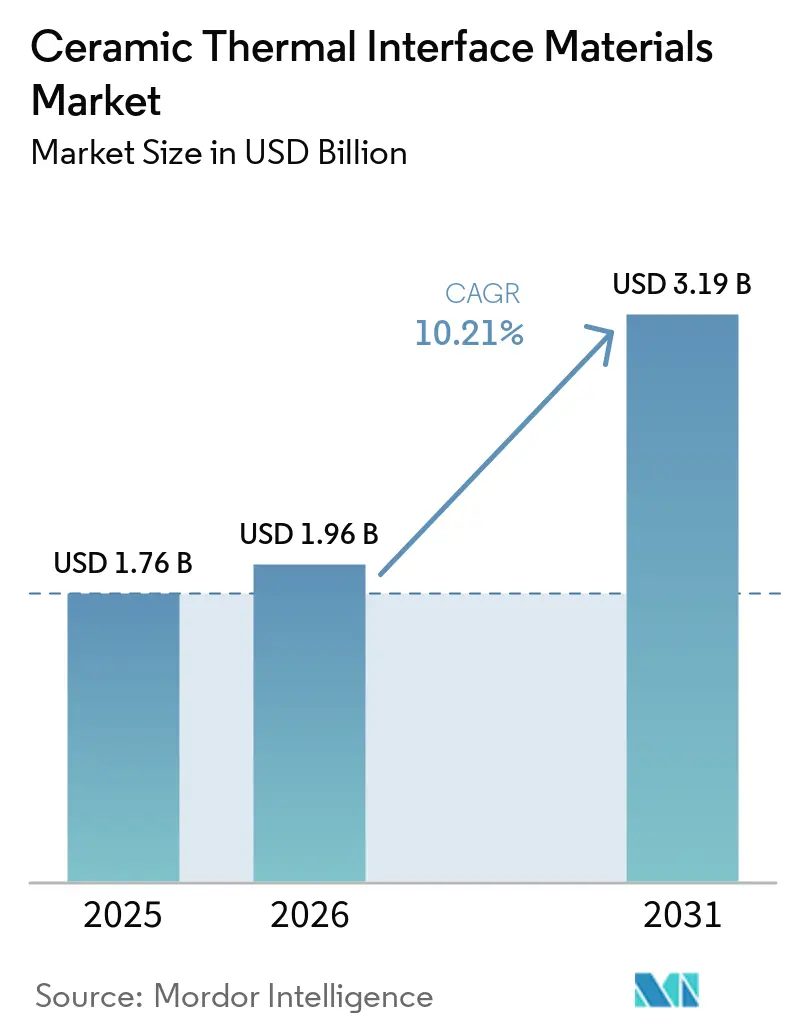
The ceramic thermal interface materials market size is estimated at USD 1.76 billion in 2025 and is estimated to grow from USD 1.96 billion in 2026 to USD 3.19 billion by 2031, at a CAGR of 10.21% during the forecast period (2026-2031). The ceramic thermal interface materials market is growing as AI accelerators, electric vehicle (EV) power modules, and 5G radio equipment generate more heat at critical interfaces. Buyers require materials that provide electrical insulation and reliable heat transfer. Product selection depends on interface resistance, pump-out resistance, and thermal cycling stability, rather than thermal conductivity alone. This shifts competitive emphasis toward suppliers that can qualify durable materials for automotive, telecommunications, and computing applications.
Key Report Takeaways
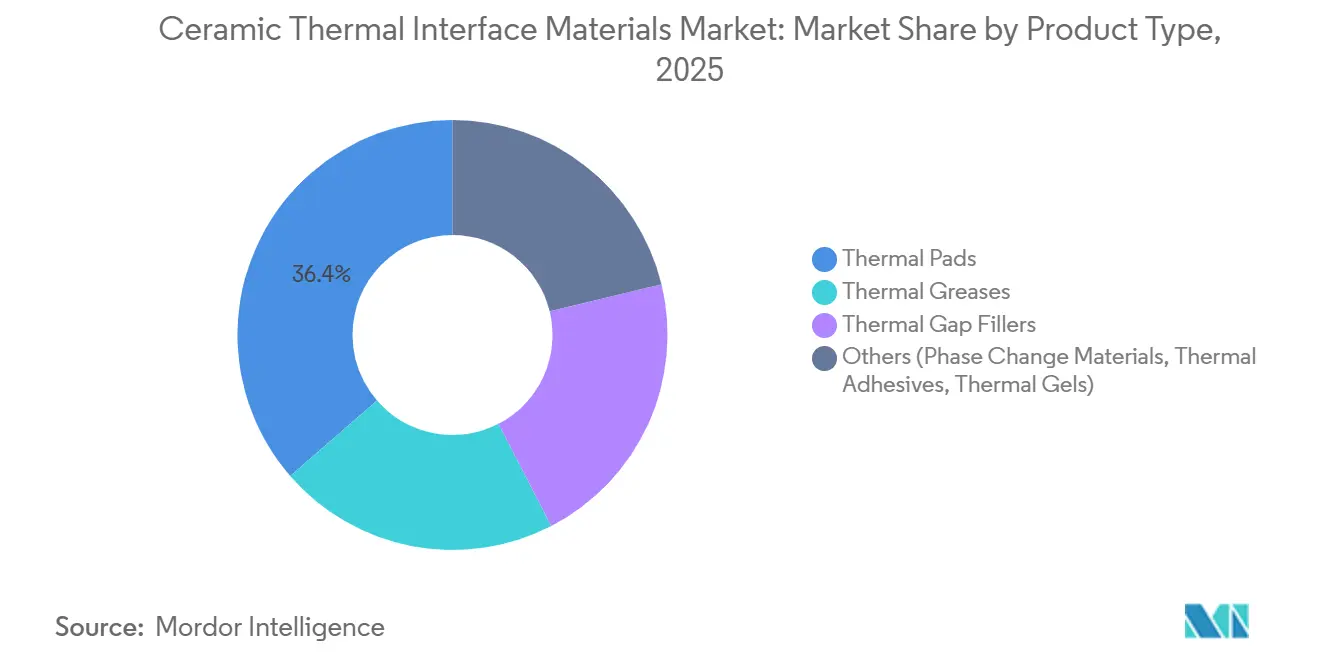
- By product type, thermal pads held 36.38% of the ceramic thermal interface materials market share in 2025, while thermal gap fillers are forecast to grow at a CAGR of 11.52% through 2031.
- By ceramic filler type, aluminum oxide held a 42.06% share in 2025, while boron nitride is forecast to grow at a CAGR of 11.79% through 2031.
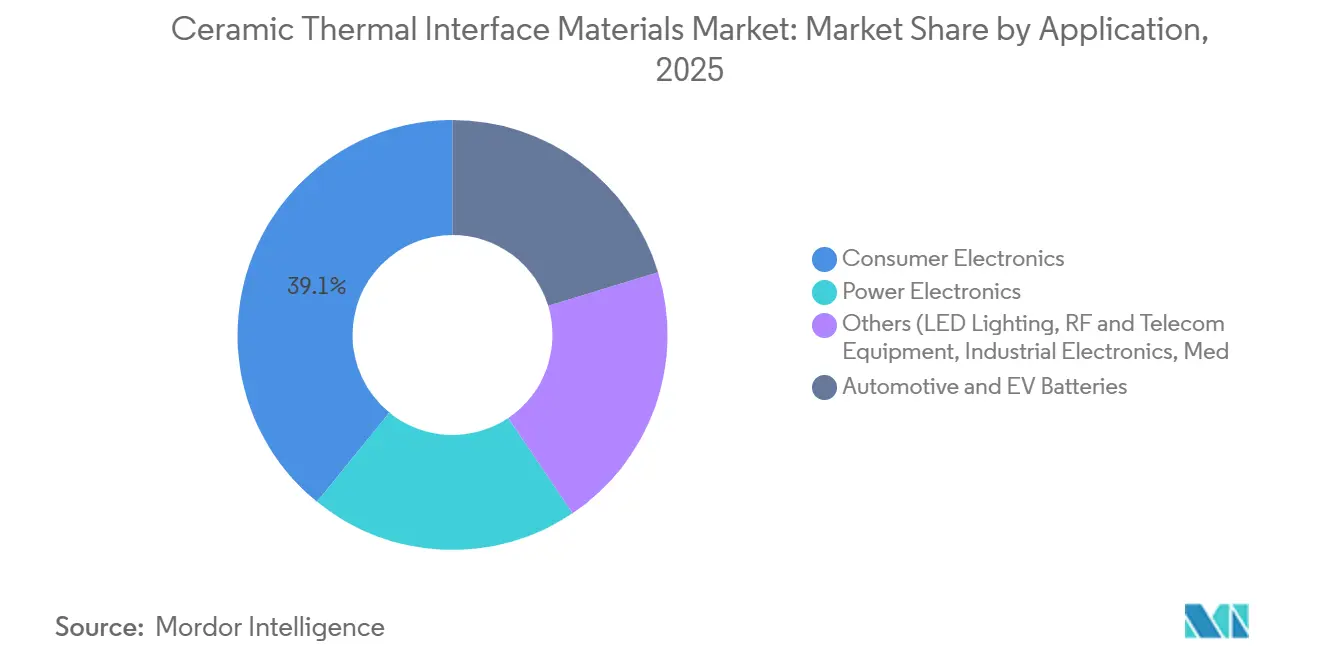
- By application, consumer electronics held a 39.14% share in 2025, while automotive and EV batteries are forecast to grow at a 12.06% CAGR through 2031.
- By geography, Asia-Pacific accounted for 36.68% of the market in 2025 and is forecast to grow at a CAGR of 11.11% through 2031.
Note: Market size and forecast figures in this report are generated using Mordor Intelligence’s proprietary estimation framework, updated with the latest available data and insights as of January 2026.
Market Trends and Insights
Drivers Impact Analysis of Ceramic Thermal Interface Materials Market*
| Drivers | (~) % Impact on CAGR Forecast | Geographic Relevance | Impact Timeline |
|---|---|---|---|
| AI and High-Performance Computing Heat Flux | +2.1% | Global, with the highest pull from North America and East Asia, including the United States, China, South Korea, and Japan | Short term (≤ 2 years) |
| Electrification of Vehicle Power Electronics | +1.8% | Global, with core demand in China, Europe, and North America | Medium term (2-4 years) |
| Use of Electrically Insulating High-Conductivity Fillers | +1.3% | Global, with Asia-Pacific leading filler production and downstream consumption | Medium term (2-4 years) |
| Rising Power Density in 5G and Telecommunications Equipment | +1.0% | Asia-Pacific core, with spillover to the Middle-East and Africa and South America | Short term (≤ 2 years) |
| Cell-to-Pack Battery Architectures | +1.1% | China leads, with North America and Europe following | Medium term (2-4 years) |
| Ceramic Filler Particle Engineering and High-Loading Formulations | +1.2% | Global research hubs in Japan, South Korea, Germany, and the United States | Long term (≥ 4 years) |
| Source: Mordor Intelligence | |||
AI and High-Performance Computing Heat Flux
The shift from intermittent to sustained thermal stress in AI and high-performance computing hardware is supporting demand in the ceramic thermal interface materials market. Advanced AI accelerator modules are approaching thermal design powers of 700 W or higher, increasing heat flux at the chip-to-spreader interface. An IEEE Electronics Packaging Society analysis reported package warpage of 100-300 μm peak to valley and corner deflections above 300-400 μm in advanced multi-chip modules. These mechanical changes can cause conventional greases and phase-change materials to pump out or form voids during thermal cycling. Ceramic-filled Thermal Interface Material 2 (TIM2) products positioned between baseplates and cold plates resist this movement more effectively due to their cured or semi-cured structure. As rack density rises in liquid-cooled hyperscale and edge AI systems, dispensable gap fillers rated above 8 W/m·K are becoming increasingly important.
Electrification of Vehicle Power Electronics
The replacement of silicon Insulated Gate Bipolar Transistor (IGBT) modules with silicon carbide Metal-Oxide-Semiconductor Field-Effect Transistors (MOSFETs) in EV traction inverters and onboard chargers is benefiting the ceramic thermal interface materials market. Silicon carbide MOSFETs operate above 175°C under typical EV duty cycles, compared with a 150°C ceiling for silicon IGBT modules. This creates stronger thermal gradients and greater mechanical stress at the interface with the cooling substrate. In July 2026, Henkel launched the Bergquist Gap Filler TGF 6500LVO, with a conductivity of 6.5 W/m·K, for Advanced Driver Assistance Systems (ADAS), Electronic Control Unit (ECU), and electric-vehicle power-conversion components. Dow announced USD 100 million in specialty silicones capacity investments through 2027 across China, Japan, and the United States, along with expanded Cooling Science Labs in Shanghai and Midland, Michigan. Higher EV production and greater thermal material content per vehicle are supporting growth in the automotive and EV-battery segments.
Rising Power Density in 5G and Telecommunications Equipment
Demand for 5G radio and baseband hardware is increasing in the ceramic thermal interface materials market, as component heat loads exceed the limits of air-cooled designs. A 2025 Thermal Science study reported 5G base station power consumption of 3,000-5,000 W per station and local heat flux densities of 80-120 W/cm². The study also found that a 10°C increase in chip operating temperature raised equipment failure rates by 25%. China had built more than 4 million 5G base stations by 2024 and was adding more than 100,000 stations each month, creating recurring procurement demand for thermal interface products. China's Ministry of Industry and Information Technology issued YD/T 4525-2025 in April 2025, effective in August 2025, which covers general technical requirements for liquid cooling systems in communications facilities[1]. Formal supplier qualification procedures in telecommunications make early specification wins valuable, as they tend to increase customers' switching costs.
Cell-to-Pack Battery Architectures
Cell-to-pack battery designs are changing thermal adhesive and gap filler requirements in the ceramic thermal interface materials market. These designs remove intermediate module housings and attach cells directly to structural cooling plates. The interface material must conduct heat, tolerate repeated thermal expansion, and, in some designs, provide structural support. In May 2026, Henkel introduced Bergquist TGF 2030APS, a silicone-free two-component thermal gap filler, and Loctite TLB 9270APS, a polyurethane-based thermally conductive adhesive, for cell-to-pack and cell-to-chassis designs. These products were presented at The Battery Show North America 2025. Ceramic-loaded polyurethane adhesives and silicone-free gel systems command higher selling prices than conventional thermal pads, as they serve both thermal and structural functions.
Restraints Impact Analysis of Ceramic Thermal Interface Materials Market*
| Restraints | (~) % Impact on CAGR Forecast | Geographic Relevance | Impact Timeline |
|---|---|---|---|
| High Cost of Boron Nitride and Aluminum Nitride | -1.4% | Global, most acute in cost-sensitive markets including India, Southeast Asia, and Eastern Europe | Long term (≥ 4 years) |
| Viscosity and Dispensing Constraints at High Ceramic Loading | -0.9% | Global, most acute in precision-dispensing production environments | Medium term (2-4 years) |
| Filler-Polymer Compatibility and Agglomeration | -0.7% | Global, most acute in research-intensive markets, including the United States, Japan, and Germany | Long term (≥ 4 years) |
| Qualification Cycles and Reliability Validation Requirements | -0.8% | Automotive in Germany and the United States, telecommunications in China, and consumer electronics in South Korea and Japan | Short term (≤ 2 years) |
| Source: Mordor Intelligence | |||
High Cost of Boron Nitride and Aluminum Nitride
The high cost of boron nitride and aluminum nitride limits the broader adoption of premium fillers in the ceramic thermal interface materials market. Boron nitride requires energy-intensive synthesis, limited-scale production, and controlled particle engineering to achieve the platelet morphology needed for high through-plane conductivity. A 2025 peer-reviewed study found that surface-modified boron nitride and nanodiamond had structural cost disadvantages relative to aluminum oxide due to limited large-scale production capacity. Aluminum nitride offers a theoretical thermal conductivity above 320 W/(m·K) and a thermal expansion coefficient close to that of silicon, but it also carries a substantial price premium over alumina[2]. The cost of these fillers keeps commercially viable conductivity levels in many consumer electronics products within the 4-6 W/m·K range. Resonac's surface-treated boron nitride technology aims to enable higher filler loading through surface chemistry rather than higher raw material quantities.
Viscosity and Dispensing Constraints at High Ceramic Loading
High ceramic loading creates a practical processing constraint in the ceramic thermal interface materials market. Loading levels exceeding 6 W/m·K can increase paste viscosity and strain the dispensing equipment used in high-output assembly. At filler loadings above 80%, formulations can challenge pneumatic and screw-auger dispensers, increase defects, and create bond-line thickness variation. A 2025 study reported an AlN/Al₂O₃ hybrid system with an 87% filler loading, a thermal conductivity of 9.74 W/(m·K), and a thermal resistance of 2.86 K·cm²/W, while maintaining adequate fluidity. Achieving that balance requires bimodal particle sizing and targeted surface modification, both of which are difficult to replicate in standard production settings. New dispensing process approvals can take months or years in the automotive and telecommunications sectors, delaying the commercialization of proven formulations.
*Our forecasts treat driver/restraint impacts as directional, not additive. The impact forecasts reflect baseline growth, mix effects, and variable interactions.
Ceramic Thermal Interface Materials Market Segment Analysis
By Product Type:
Gap Fillers Gain as Power Density ClimbsThermal pads held 36.38% of the ceramic thermal interface materials market share in 2025, reflecting their established role in consumer electronics, power supplies, and industrial electronics. Standardized shapes, simple handling, and consistent bond-line thickness support automated high-volume assembly. The segment covers products ranging from commodity 1-3 W/m·K pads to specialty 6-8 W/m·K options, limiting exposure to substitution in any single end market.
Thermal greases and gels are used in installed CPU and GPU cooling systems where reworkability and thin bond-line control are important. Phase-change materials and thermal adhesives form the other product category, with thermal adhesives gaining use in structural EV battery bonding. Thermal gap fillers are the fastest-growing product type, with the ceramic thermal interface materials market size for this segment projected to grow at an 11.52% CAGR through 2031. Their use is increasing in applications with large tolerance gaps and irregular surface profiles, which favor dispensable gels. In May 2026, Dow launched DOWSIL TC-3120 Thermal Gel, offering a thermal conductivity of 12 W/m·K, optical-grade cleanliness, and minimal oil bleed for data center and automotive applications. In December 2025, Henkel launched Bergquist TGF 10000, featuring 10 W/m·K thermal conductivity for high-power automotive, telecommunications, and computing applications.

By Ceramic Filler Type:
Al₂O₃ Leads by Output, BN Leads by Growth RateAluminum oxide accounted for 42.06% of ceramic filler demand in 2025. Its position reflects supply chain maturity and lower cost compared to nitride alternatives. Its spherical morphology supports high filler loading without disproportionate viscosity penalties. Bimodal particle distributions using 10-50 μm coarse alumina with fine fractions below 3 μm improve packing density and reduce inter-particle thermal resistance, supporting use in gel and adhesive matrices.
Aluminum nitride is used in high-end power electronics packaging and specialized telecommunications components. Its thermal expansion coefficient is close to that of silicon, and its dielectric strength supports applications in Insulated Gate Bipolar Transistor (IGBT) and silicon carbide modules. Silicon carbide, magnesium oxide, zinc oxide, and silicon nitride address specialized requirements, including corrosion resistance, radiation stability, and low dielectric constant. Boron nitride is the fastest-growing filler type, with the ceramic thermal interface materials market size for this segment forecast to grow at an 11.79% CAGR through 2031. Hexagonal boron nitride combines in-plane thermal conductivity approaching 300 W/(m·K) with electrical insulation, although vertical particle alignment is required to direct conductivity through the interfacial layer. Magnetic induction, ice templating, and 90° flipping are among the approaches being developed for this purpose. Resonac's surface-treated BN is designed to increase filler loading without undermining processability.
By Application:
Consumer Electronics Anchors Demand, Automotive Records Fastest GrowthConsumer electronics accounted for 39.14% of the application share in 2025. Smartphones, laptops, gaming consoles, and wearables require standardized thermal pads and greases at competitive prices. AI-capable edge system-on-chip processors are increasing conductivity requirements in premium devices, which need ceramic-filled materials in the 4-8 W/(m·K) range, while lower-priced devices continue to use lower-specification products.
Power electronics, including industrial inverters, renewable energy converters, and server power supplies, use ceramic-filled pads and greases at module-to-heatsink interfaces during sustained operation. LED lighting, RF and telecommunications equipment, industrial electronics, and medical electronics form the other application category, requiring reliable, qualified products. Automotive and EV batteries are the fastest-growing applications, with the ceramic thermal interface materials market projected to grow at a 12.06% CAGR through 2031. Growth reflects rising EV penetration, higher material content per vehicle, and a shift toward higher-performance ceramic composites. The adoption of 800 V battery systems supports greater use of silicon carbide power modules and higher-temperature Thermal Interface Material 2 (TIM2) solutions. Automotive-grade materials must meet AEC-Q200 reliability benchmarks through thousands of thermal cycles while maintaining electrical isolation. In April 2026, Wacker Chemie opened a second thermally conductive silicone production line at Tsukuba, Japan, through its joint venture with Asahi Kasei Corporation.
Geography Analysis
APAC Ceramic Thermal Interface Materials Market
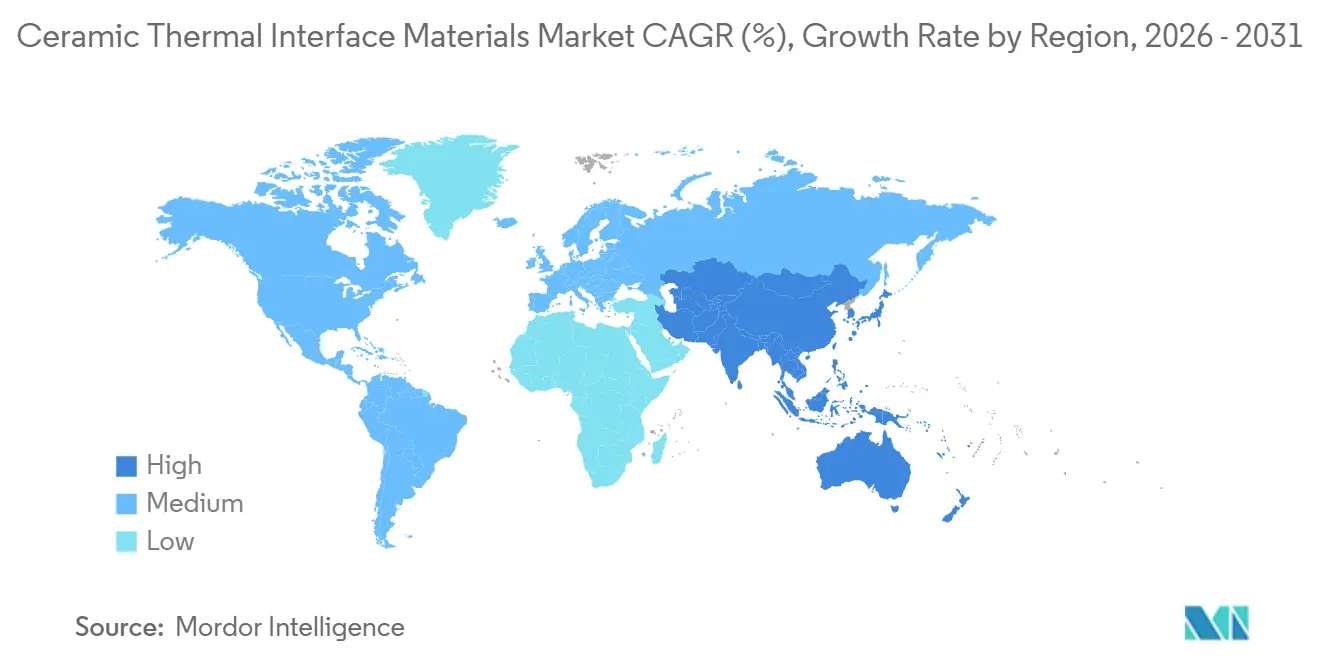
Asia-Pacific accounted for 36.68% of the regional share in 2025 and is forecast to grow at a CAGR of 11.11% through 2031. The region combines China's EV and 5G infrastructure scale with materials manufacturing capacity in Japan and South Korea. China drives demand through its EV production, 5G base station network, and expanding AI computing capacity. These end markets create demand across product types and conductivity levels.
North America and Europe Ceramic Thermal Interface Materials Market
Japan and South Korea contribute to demand through semiconductor and consumer electronics supply chains. Wacker Chemie opened specialty silicone thermal interface material facilities in Tsukuba, Japan, and Jincheon, South Korea, in 2025 to serve automotive and electronics customers. India has an expanding 5G rollout and an emerging EV manufacturing base. Cost-competitive alumina-based formulations suit India's high demand. North America and Europe are the second- and third-largest regional markets, with strengths in premium formulations, automotive OEM demand, and data center development. North America's hyperscale investments are increasing power density at chip-to-heatsink and module-to-cold-plate interfaces. Dow expanded specialty silicone manufacturing capacity in Auburn, Michigan, and Zhangjiagang, China, and expanded Cooling Science Labs in Midland and Shanghai. Germany anchors European demand through automotive OEMs and tier-1 suppliers that require reliable materials for electrified powertrains and Advanced Driver-Assistance Systems (ADAS) electronics.
MEA and South America Ceramic Thermal Interface Materials Market
South America, the Middle-East, and Africa remain smaller but growing parts of the ceramic thermal interface materials market. Near-term demand is linked to 5G deployment and early EV adoption in Brazil, Saudi Arabia, and South Africa. Brazil's consumer electronics manufacturing base and telecommunications investment support early demand in South America. Saudi Arabia and the UAE are expanding data center capacity to support AI and digital transformation programs, creating new demand for high-performance server materials. Limited local manufacturing capacity and shallow supply chains keep both regions import-dependent, giving global suppliers an opportunity to establish supply relationships early.
Competitive Landscape
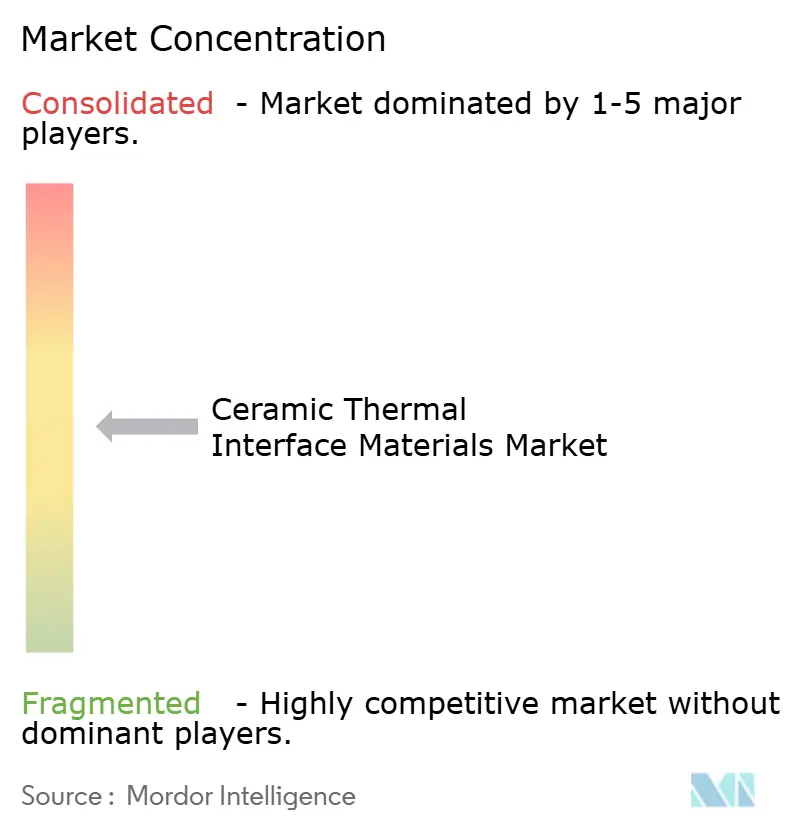
The ceramic thermal interface materials market is moderately fragmented. Henkel, Dow, Wacker Chemie, and Shin-Etsu Chemical hold leading positions in high-volume product categories. Rogers Corporation, DuPont, Parker Hannifin through its Chomerics division, Saint-Gobain, and Resonac hold positions in specialty and niche applications. Suppliers are expanding their conductivity range to include 6, 8, 10, and 12 W/mK, developing application-specific portfolios for EV and AI applications, and adding capacity in Asia to shorten lead times in the region with the strongest demand growth.
Resonac launched the US-JOINT consortium in April 2026, a U.S.-Japanese research platform focused on next-generation semiconductor packaging, giving the company a role in early packaging development and future interface material specification work. Dow launched DOWSIL TC-3120 Thermal Gel in May 2026 for AI server modules, dense electronics, and high-speed datacom applications. Henkel launched TGF 6500LVO in July 2026 for automotive power conversion applications.
The market presents opportunities in dispensable gap fillers with thermal conductivities above 10 W/mK that are qualified for automotive use, silicone-free materials for contamination-sensitive optical and datacom environments, and materials for continuous operation above 200°C that serve silicon carbide EV power modules and industrial converters. AlN/Al₂O₃ composite systems have demonstrated 9.74 W/(m·K) at 87% filler loading in laboratory testing. Qualification requirements favor suppliers with testing infrastructure and established relationships in automotive and telecommunications supply chains.
Ceramic Thermal Interface Materials Industry Leaders
-
Henkel AG & Co. KGaA
-
3M
-
Dow
-
PARKER HANNIFIN CORP
-
Shin-Etsu Chemical Co., Ltd.
- *Disclaimer: Major Players sorted in no particular order
Ceramic Thermal Interface Materials Market Companies Covered in this Report
- 3M
- Aremco
- Denka Company Limited
- Dow
- DuPont
- Fujipoly America, Inc.
- Henkel AG & Co. KGaA
- Indium Corporation
- KYOCERA Corporation
- Momentive
- PARKER HANNIFIN CORP
- Resonac Holdings Corporation
- Rogers Corporation
- Saint-Gobain
- Shin-Etsu Chemical Co., Ltd.
- Wacker Chemie AG
Recent Industry Developments in Ceramic Thermal Interface Materials Market
- July 2026: Henkel Adhesive Technologies launched Bergquist Gap Filler TGF 6500LVO, an automotive thermal gap filler delivering 6.5 W/m·K conductivity for ADAS, ECU, and EV power conversion applications. The product joins a portfolio spanning 2,100-10,000 mW/mK, targeting automotive customers as in-vehicle heat loads increase.
- June 2026: Dow launched DOWSIL TC-3120 Thermal Gel, achieving 12 W/m·K thermal conductivity, the highest among Dow's commercially available silicone gels. The product targets AI server modules, dense electronics, and high-speed datacom applications, with optical-grade cleanliness and minimal oil bleed.
Global Ceramic Thermal Interface Materials Market Report Scope
A ceramic thermal interface material is a substance placed between a heat source (such as a computer processor) and a cooling device (such as a heat sink). It uses microscopic ceramic particles to fill air gaps, enabling efficient heat transfer while maintaining electrical insulation.
The ceramic thermal interface materials market is segmented by product type, ceramic filler type, application, and geography. By product type, the market is segmented into thermal greases, thermal gap fillers, thermal pads, and others (phase change materials, thermal adhesives, thermal gels). By ceramic filler type, the market is segmented into aluminum oxide (Al₂O₃), boron nitride (BN), aluminum nitride (ALN), and others (silicon carbide, magnesium oxide, zinc oxide, silicon nitride, other ceramic fillers). By application, the market is segmented into consumer electronics, automotive and EV batteries, power electronics, and others (LED lighting, RF and telecom equipment, industrial electronics, and medical electronics). The report also covers market size and forecasts for ceramic thermal interface materials across 15 countries in major regions. The market sizes and forecasts are provided in terms of value (USD).
Segmentation Overview
| Thermal Greases |
| Thermal Gap Fillers |
| Thermal Pads |
| Others (Phase Change Materials, Thermal Adhesives, Thermal Gels) |
| Aluminum Oxide (Al₂O₃) |
| Boron Nitride (BN) |
| Aluminum Nitride (AlN) |
| Others (Silicon Carbide, Magnesium Oxide, Zinc Oxide, Silicon Nitride, Other Ceramic Fillers) |
| Consumer Electronics |
| Automotive and EV Batteries |
| Power Electronics |
| Others (LED Lighting, RF and Telecom Equipment, Industrial Electronics, Medical Electronics) |
| Asia-Pacific | China |
| India | |
| Japan | |
| South Korea | |
| Rest of Asia-Pacific | |
| North America | United States |
| Canada | |
| Mexico | |
| Europe | Germany |
| United Kingdom | |
| France | |
| Italy | |
| Rest of Europe | |
| South America | Brazil |
| Argentina | |
| Rest of South America | |
| Middle-East and Africa | Saudi Arabia |
| South Africa | |
| Rest of Middle-East and Africa |
| By Product Type | Thermal Greases | |
| Thermal Gap Fillers | ||
| Thermal Pads | ||
| Others (Phase Change Materials, Thermal Adhesives, Thermal Gels) | ||
| By Ceramic Filler Type | Aluminum Oxide (Al₂O₃) | |
| Boron Nitride (BN) | ||
| Aluminum Nitride (AlN) | ||
| Others (Silicon Carbide, Magnesium Oxide, Zinc Oxide, Silicon Nitride, Other Ceramic Fillers) | ||
| By Application | Consumer Electronics | |
| Automotive and EV Batteries | ||
| Power Electronics | ||
| Others (LED Lighting, RF and Telecom Equipment, Industrial Electronics, Medical Electronics) | ||
| By Geography | Asia-Pacific | China |
| India | ||
| Japan | ||
| South Korea | ||
| Rest of Asia-Pacific | ||
| North America | United States | |
| Canada | ||
| Mexico | ||
| Europe | Germany | |
| United Kingdom | ||
| France | ||
| Italy | ||
| Rest of Europe | ||
| South America | Brazil | |
| Argentina | ||
| Rest of South America | ||
| Middle-East and Africa | Saudi Arabia | |
| South Africa | ||
| Rest of Middle-East and Africa | ||
Key Questions Answered in the Report
What is current market size of Ceramic Thermal Interface Materials Market?
The ceramic thermal interface materials market size is estimated at USD 1.76 billion in 2025 and is estimated to grow from USD 1.96 billion in 2026 to USD 3.19 billion by 2031, at a CAGR of 10.21% during the forecast period (2026-2031).
Which product type is growing fastest?
Thermal gap fillers are projected to expand at an 11.52% CAGR through 2031 as data centers and EV battery systems need conformable materials for irregular gaps.
Why is boron nitride used in thermal interface products?
It offers high thermal conductivity and electrical insulation, but its cost and processing challenges limit its broader use.
Which application has the highest growth rate?
Automotive and EV batteries are forecast to grow at a 12.06% CAGR through 2031 as EV systems require higher thermal performance.