
Central and Eastern Europe ITSM Market Size and Share
Market Overview
| Study Period | 2024 - 2035 |
|---|---|
| Forecast Data Period | 2026 - 2035 |
| Base Year Market Size (2025) | USD 335.70 Million |
| Market Size (2026) | USD 390.63 Million |
| Market Size (2035) | USD 865.30 Million |
| Growth Rate (2026 - 2031) | 17.24 % |
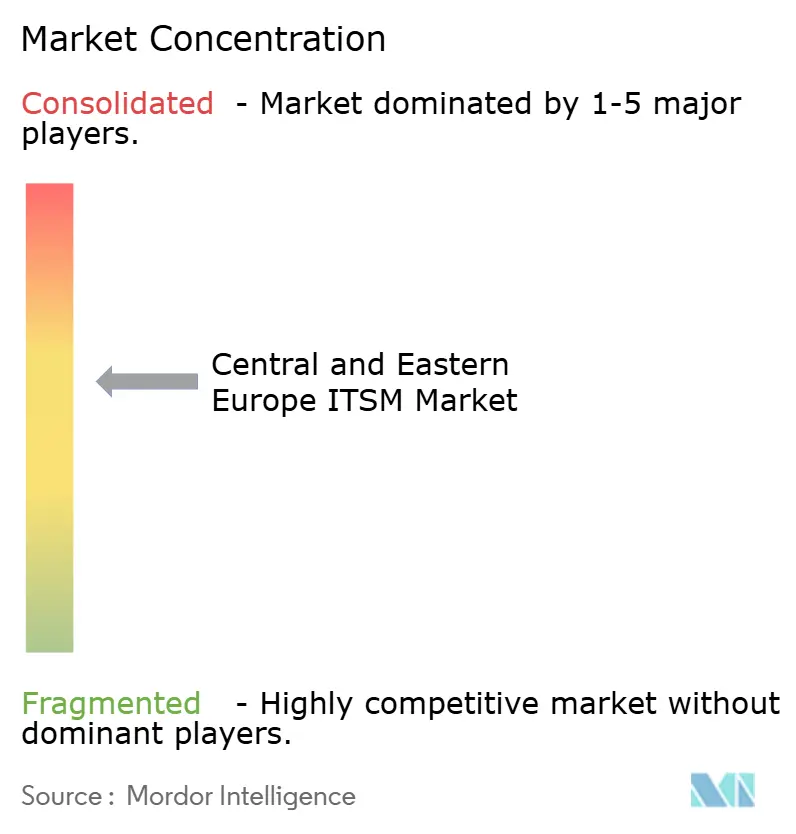
| Market Concentration | Medium |
Major Players *Disclaimer: Major Players sorted in no particular order Image © Mordor Intelligence. Reuse requires attribution under CC BY 4.0. | |
Central and Eastern Europe ITSM Market Analysis by Mordor Intelligence
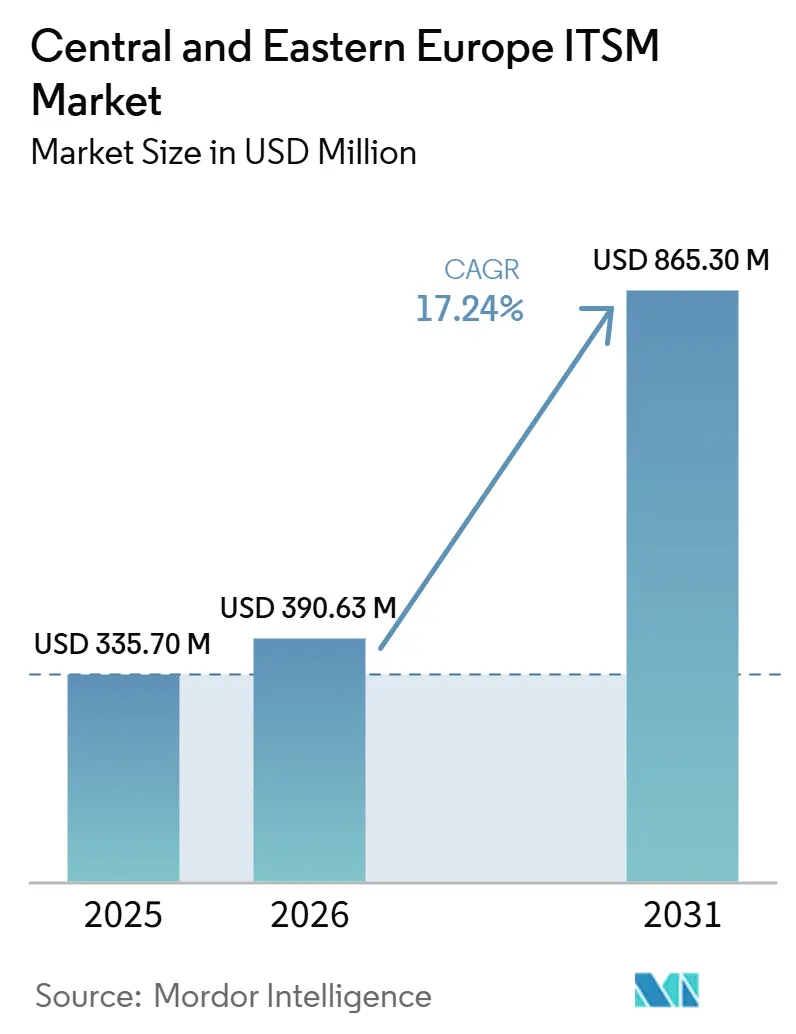
The Central And Eastern Europe ITSM Market size is expected to grow from USD 335.70 million in 2025 to USD 390.63 million in 2026 and is forecast to reach USD 865.30 million by 2035 at 17.24% CAGR over 2026-2035.
The Central and Eastern Europe ITSM market is being supported by stronger cloud-led operating models, tighter cybersecurity compliance requirements, and the large role of cross-border shared service centers in the region. Poland remains the main demand center because large business services operations there use IT service management as a core control layer across several countries. New cybersecurity rules across Poland, the Czech Republic, and Romania are also making audit trails, access controls, and change records harder to manage outside formal ITSM platforms. This is increasing renewal stickiness for incumbent vendors because once compliance workflows are built into day-to-day operations, replacement risk becomes higher. At the same time, later-adopting countries are moving directly toward cloud-native deployments, which is keeping the Central and Eastern Europe ITSM market on a firm expansion path over the forecast period.
Key Report Takeaways
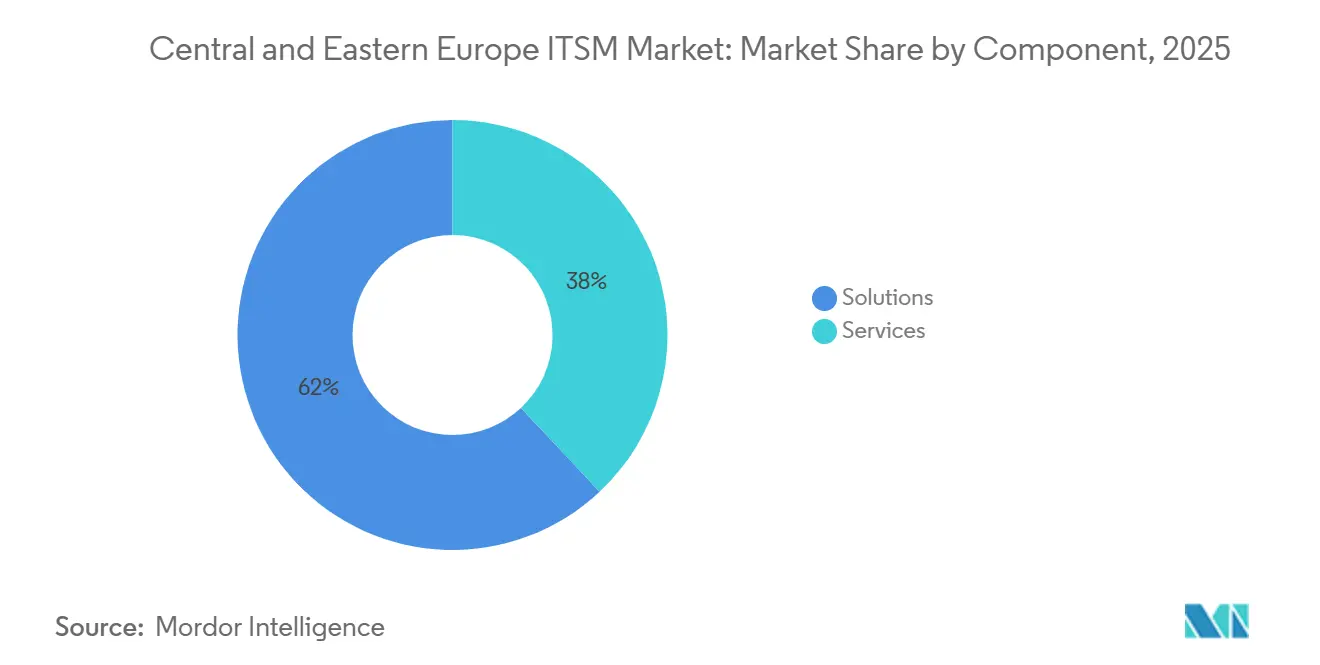
- By component, solutions held 62% share in 2025, while services is projected to expand at an 18.65% CAGR through 2031.
- By deployment, cloud accounted for 64% of the Central and Eastern Europe ITSM market in 2025 and is also expected to record the highest CAGR at 19.30% through 2031.
- By application, Service Desk and Incident Management accounted for 28% share in 2025, while Knowledge Management is projected to grow at an 18.79% CAGR through 2031.
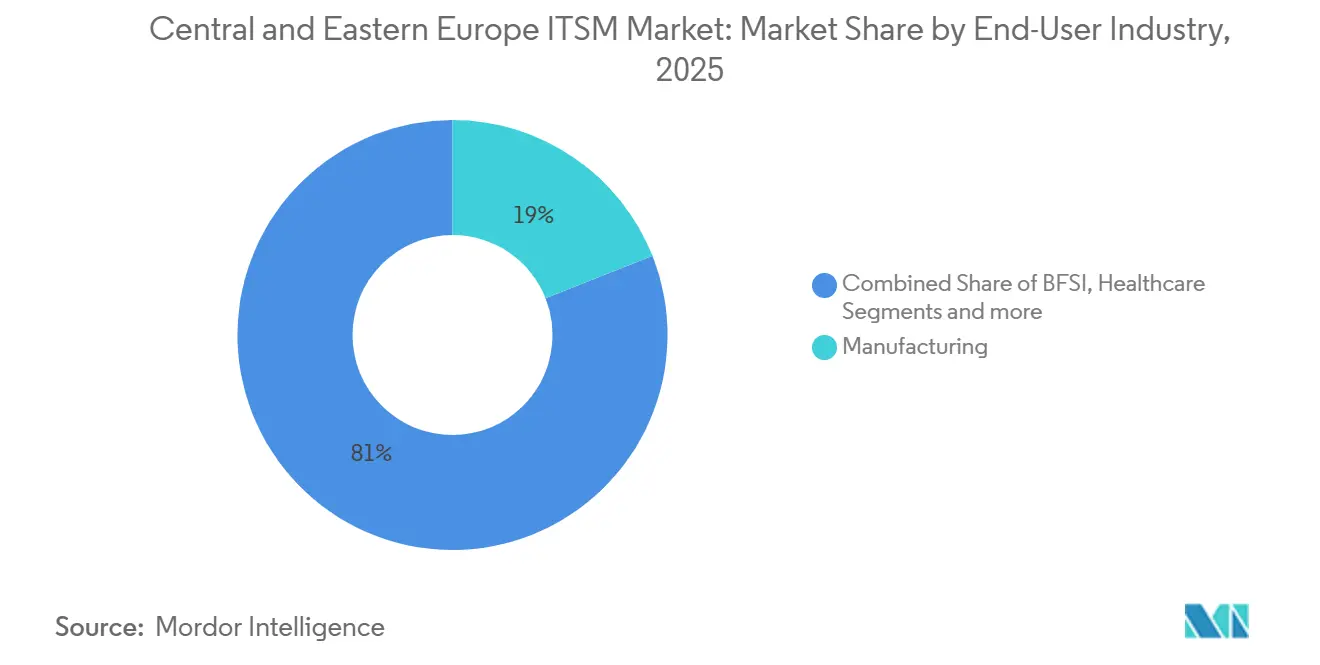
- By end-user industry, manufacturing held 19% share in 2025, while healthcare is expected to expand at a 17.91% CAGR through 2031.
- By enterprise size, large enterprises held 61.00% share in 2025, while SMEs are projected to advance at a 20.40% CAGR through 2031.
- By geography, Poland held 24% share in 2025, while Romania is expected to record the fastest growth at an 18.10% CAGR through 2031.
Note: Market size and forecast figures in this report are generated using Mordor Intelligence’s proprietary estimation framework, updated with the latest available data and insights as of January 2026.
Market Trends and Insights
Drivers Impact Analysis of Central and Eastern Europe ITSM Market*
| Driver | (~) % Impact on CAGR Forecast | Geographic Relevance | Impact Timeline |
|---|---|---|---|
| Rising Adoption of Cloud-Based ITSM Platforms Across Midmarket Enterprises | +5.8% | CEE-wide, with concentrated gains in Poland, Czech Republic, and Hungary | Short term (≤ 2 years) |
| Increasing Need for Workflow Automation and Service Standardization | +3.7% | Global demand anchored in Warsaw, Krakow, Prague, and Bucharest hubs | Medium term (2-4 years) |
| Greater Demand for Hybrid Work Enablement and Self-Service Support | +2.5% | CEE-wide, accelerating fastest in Poland and Czech Republic | Short term (≤ 2 years) |
| Regulatory Pressure for Auditability, Access Control, and Service Traceability | +2.1% | Poland, Czech Republic, Romania, with spillover to Slovakia and Hungary | Medium term (2-4 years) |
| AI-Assisted Ticket Triage and Knowledge Discovery Improving Resolution Efficiency | +1.7% | CEE-wide, led by IT shared service centers in Poland | Long term (≥ 4 years) |
| Cross-Border Shared Service Center Expansion Across Central and Eastern Europe | +1.4% | Poland core market, expanding into Romania and Czech Republic | Medium term (2-4 years) |
| Source: Mordor Intelligence | |||
Rising Adoption Of Cloud-Based ITSM Platforms Across Midmarket Enterprises
Midmarket organizations are becoming a major source of new demand in the Central and Eastern Europe ITSM market because cloud delivery has lowered the need for local infrastructure and shortened deployment cycles. Poland already has a strong cloud foundation inside business services operations, with 93.8% of IT-focused centers using Microsoft Azure and 81.3% using AWS as of the 2025 ABSL sector report[1]Association of Business Service Leaders, “Business Services Sector in Poland 2025,” ABSL, invest.lodz.pl. This installed hyperscaler base makes SaaS ITSM procurement easier because many firms can add service management software without a separate infrastructure build. The same ABSL report also showed that 75% of IT-focused centers in Poland were already using enterprise ITSM platforms, which signals that cloud-led operating models are now part of mainstream regional delivery practice. Vendors with lower entry pricing and faster onboarding are benefiting most in the midmarket because buyers want modern workflow tools without the cost and delay tied to larger enterprise rollouts. That pattern is widening the addressable base of the Central and Eastern Europe ITSM market beyond large accounts and is improving new logo flow across the region.
Increasing Need For Workflow Automation And Service Standardization
The Central and Eastern Europe ITSM market is also moving forward because shared service centers need consistent workflows across countries, teams, and internal systems. ABSL reported that 74.1% of centers in Poland implemented Intelligent Process Automation in 2024, up from 65.2% a year earlier, and the average automation rate reached 22.4% of tasks. As automation spreads, ITSM platforms are becoming the control layer that records events, routes exceptions, and keeps approvals visible across business processes. Freshworks reinforced this direction in Q1 2026 when it reported that Freshservice had integrated Device42 for infrastructure discovery and FireHydrant for incident response into a unified service operations environment. That kind of integration matters because buyers are no longer judging ITSM only by ticket handling; they are using it to govern broader workflow automation across asset, incident, and service processes. In turn, the Central and Eastern Europe ITSM market is seeing stronger renewal logic because platforms tied to automation governance become harder to replace.
Greater Demand For Hybrid Work Enablement And Self-Service Support
Hybrid work has become a lasting operating model across regional service centers, and that is raising the value of self-service, multilingual knowledge access, and low-touch issue resolution in the Central and Eastern Europe ITSM market. ABSL found that 60.1% of business services centers in Poland were operating in a hybrid mode in 2025, with 2 to 3 in-office days being the most common pattern. In that setting, support teams cannot rely on in-person help and need portals, searchable knowledge, and automated routing that work well across distributed employees. Freshworks added to this shift in May 2026 through Freddy AI Agent Studio, which introduced more than 20 prebuilt workflows designed to automate common service actions. Regional and Nordic vendors also gain room to compete because language support in Polish, Czech, Romanian, and Hungarian can materially affect how well self-service works in practice. As a result, the Central and Eastern Europe ITSM market is seeing upgrades from basic ticketing systems toward broader knowledge and virtual agent capabilities.
Regulatory Pressure For Auditability, Access Control, And Service Traceability
Cybersecurity regulation is becoming a direct purchase driver in the Central and Eastern Europe ITSM market because the required controls align closely with change management, access logging, and incident reporting workflows. Poland's amended National Cybersecurity System Act entered into force on April 3, 2026, and expanded the range of entities subject to cybersecurity obligations and periodic audits[2]Ministry of Digital Affairs of Poland, “Amendment to the National Cybersecurity System Act Implementing the NIS2 Directive,” Gov.pl, gov.pl. The Czech Republic's Act No. 264/2025 Coll. took effect on November 1, 2025, and extended the framework to around 150 strategically important services while also adding defense as a regulated sector. Romania's GEO 155/2024 and Law No. 124/2025 brought banking, healthcare, manufacturing, and digital infrastructure entities into a mandatory reporting framework that requires documented controls and traceable records. These legal changes raise the value of configured ITSM deployments because replacing a functioning compliance workflow can create audit risk, which improves platform stickiness for incumbents. That is one reason the Central and Eastern Europe ITSM market is drawing vendor focus in regulated sectors such as BFSI, healthcare, government, and critical infrastructure.
Restraints Impact Analysis of Central and Eastern Europe ITSM Market*
| Restraint | (~) % Impact on CAGR Forecast | Geographic Relevance | Impact Timeline |
|---|---|---|---|
| Legacy Infrastructure and Tool Sprawl Slowing Platform Consolidation | -2.6% | CEE-wide, most acute in Romania, Slovakia, and Hungary | Medium term (2-4 years) |
| Budget Sensitivity Among Small and Medium Enterprises | -1.9% | CEE-wide, with heightened pressure in Romania and Slovakia | Short term (≤ 2 years) |
| Integration Complexity With ERP, Identity, And Monitoring Stacks | -1.5% | Global, with deeper impact in manufacturing-heavy CEE markets | Medium term (2-4 years) |
| Data Residency And Procurement Constraints In Public Sector And Regulated Verticals | -0.9% | Poland, Czech Republic, Romania, with national government procurement constraints | Long term (≥ 4 years) |
| Source: Mordor Intelligence | |||
Legacy Infrastructure And Tool Sprawl Slowing Platform Consolidation
Legacy environments remain a real brake on the Central and Eastern Europe ITSM market because many enterprises still operate several overlapping service, monitoring, and asset tools at once. This is especially visible in manufacturing, utilities, and government settings where older systems have been kept in place across multiple technology cycles. Manufacturing alone held 19% of 2025 revenue, and that matters because OT environments often sit outside standard ITSM designs and require separate integration work. Migration projects also slow down when CMDB records are incomplete or inaccurate, since asset data often needs cleanup before a new platform can deliver the visibility buyers expect. Vendors are responding with discovery and migration tooling, but those add-ons raise total ownership cost for buyers that already face budget pressure. This restraint keeps some demand in the Central and Eastern Europe ITSM market from converting quickly, even when the long-term business case is clear.
Budget Sensitivity Among Small And Medium Enterprises
Budget pressure is another key restraint because the fastest-growing buyer group in the Central and Eastern Europe ITSM market is also the most price-sensitive. SMEs are projected to grow at a 20.40% CAGR through 2031, but many of them operate with small IT teams and limited room for broad module subscriptions. Eurostat reported that only 24.9% of Romanian enterprises used paid cloud services in 2025, which shows that budget willingness and cloud adoption still lag in some parts of the region. ABSL also found that 43.1% of Polish shared service organizations cited deployment and maintenance cost as a barrier to AI adoption, which supports the same pricing concern from another angle. This is helping lower-cost challengers gain traction because modular pricing and faster time to value matter more to SMEs than large suite breadth. Even so, cost sensitivity continues to limit how quickly the Central and Eastern Europe ITSM market can move deeper into smaller accounts.
*Our forecasts treat driver/restraint impacts as directional, not additive. The impact forecasts reflect baseline growth, mix effects, and variable interactions.
Central and Eastern Europe ITSM Market Segment Analysis
By Component:
Solutions Lead Revenue While Services Expand At A Faster PaceSolutions held 62% of the Central and Eastern Europe ITSM market share in 2025, which shows that buyers still place software platforms at the center of service management spending. The largest part of this demand comes from service desk tools, CMDB functions, knowledge modules, and self-service layers that organizations want to own inside their operating model rather than outsource through managed delivery contracts. In practical terms, that preference is strongest in countries with deeper in-house IT capability, especially where shared service centers already manage large regional workloads. Poland stands out in this regard because 75% of IT-focused business service centers were already using enterprise ITSM platforms in 2025.
The Central and Eastern Europe ITSM market is still seeing stronger momentum in services, with that component projected to expand at an 18.65% CAGR through 2031. That growth reflects rising need for implementation, workflow design, AI configuration, and ongoing support for buyers that do not have dedicated ITSM teams. Freshworks showed this service opportunity clearly in Q1 2026 when it described a unified platform that brought together ticketing, assets, incidents, services, and workflows through Freshservice, Device42, and FireHydrant. Midmarket firms in Romania, Slovakia, and Hungary are especially relevant here because they may need compliant workflows but often prefer vendor or partner assistance to keep operations running smoothly. As a result, solutions remain the revenue anchor, while services are becoming the faster layer of growth as deployments become more complex and more closely tied to compliance and automation.


By Deployment:
Cloud Sets The Pace For Both Scale And GrowthCloud accounted for 64% of the Central and Eastern Europe ITSM market in 2025, which made it the dominant deployment model by a clear margin. The appeal is straightforward because SaaS platforms reduce local infrastructure needs, support continuous feature updates, and allow a single tenant to serve multiple countries at once. That model fits the operating reality of shared service centers in Poland, the Czech Republic, Romania, and Slovakia, where support teams often work across borders and need a common service layer. The strength of the underlying cloud base is visible in Poland, where 93.8% of IT-focused centers used Microsoft Azure and 81.3% used AWS in 2025.
Cloud is also projected to grow at a 19.30% CAGR through 2031, so it leads the Central and Eastern Europe ITSM market on both installed base and expansion speed. This dual position suggests that migration is still far from complete and that many organizations remain in transition from on-premise or hybrid environments. On-premise demand remains present in government and defense-related settings where data control and procurement cycles slow movement to public cloud, while hybrid models continue to serve manufacturers and financial institutions that keep sensitive workloads on private infrastructure. Those mixed environments are likely to narrow over time as residency frameworks become more standardized and as vendor AI features continue to arrive first through cloud delivery. The result is a deployment mix that still includes legacy and transitional forms, but one in which cloud is setting the operating standard for the Central and Eastern Europe ITSM market.
By Application:
Service Desk Holds The Base While Knowledge Management Gains SpeedService Desk and Incident Management accounted for 28% of the Central and Eastern Europe ITSM market size in 2025, making it the largest application area in the region. This position reflects how most ITSM programs begin, since organizations usually start with ticket intake, incident routing, and user support before broadening into other workflow areas. The installed base is wide because this module is relevant across large multinational centers in Warsaw and Prague and across smaller domestic enterprises as well. That broad starting role also means later spending tends to come from upgrades such as AI-supported triage, better workflow routing, and more structured service visibility rather than from first-time deployments alone.
Knowledge Management is projected to expand at an 18.79% CAGR through 2031, which makes it the fastest-growing application in the Central and Eastern Europe ITSM market. This shift matters because automated resolution and self-service depend on having well-structured articles and documented fixes that can be surfaced to employees and agents quickly. Freshworks emphasized this direction in May 2026 by launching Freddy AI Agent Studio with prebuilt workflows meant to automate service activity on top of shared operational data. Ivanti moved in a similar direction in January 2026 when it introduced agentic AI capabilities for Neurons for ITSM through persona-based agents designed to resolve incidents and service requests with natural language interaction. Asset and Configuration Management is also gaining support as regulatory demands raise the value of accurate records, while Change and Release Management and Service Request Management continue to expand as organizations mature beyond a basic helpdesk model.
By End-User Industry:
Manufacturing Leads Demand While Healthcare Moves FasterManufacturing held 19% of the market in 2025, which made it the largest end-user group in the Central and Eastern Europe ITSM market. The sector's position reflects its need for reliable service continuity across production systems, supply chain software, and industrial automation tools. It also reflects the regional footprint of automotive, electronics, and food processing operations, especially in Poland and the Czech Republic, where multinational governance standards often shape local IT operations. The main challenge is that manufacturing environments usually combine IT and OT systems, so service management platforms often need custom asset, monitoring, and change structures before they can serve both sides well.
Healthcare is projected to grow at a 17.91% CAGR through 2031, which makes it the fastest-expanding vertical in the Central and Eastern Europe ITSM market. This growth follows the wider digitalization of hospital systems, telemedicine tools, and patient-data environments that create more incidents, requests, and tracked assets than informal support models can handle. Romania, Poland, and the Czech Republic are especially relevant because regulatory expectations and public digitalization programs are raising pressure for traceable workflows in critical services. BFSI remains a strong user because change governance and resilience controls are well established there, while government growth continues at a steadier pace due to tendering complexity. IT and telecom, retail and e-commerce, and travel and hospitality also continue to broaden their use of structured service management as digital operations become harder to support through ad hoc processes alone.

By Enterprise Size:
Large Enterprises Hold The Base While SMEs Advance More QuicklyLarge enterprises held 61.00% of the market in 2025, which gave them the revenue majority in the Central and Eastern Europe ITSM market. Their lead comes from complex multi-country estates that need broad platform coverage across service desk, asset management, change control, and knowledge management at the same time. This group is especially mature in Poland, where multinational business service centers in Warsaw, Krakow, and Wroclaw have been standardizing support models across European and global operations for several years. ABSL confirmed that 75% of IT-focused centers in Poland had already deployed enterprise ITSM platforms in 2025, which helps explain why large-account renewals remain a major revenue base.
SMEs are projected to grow at a 20.40% CAGR through 2031, making them the fastest-moving size segment in the Central and Eastern Europe ITSM market. Their momentum comes from SaaS pricing, faster onboarding, and simpler compliance templates that reduce the time needed to start using a platform. Indirect compliance pressure is also important because suppliers to regulated companies may need stronger incident and change records even when they are not directly covered by law. Freshworks highlighted its growing reach into this part of the buyer base in Q1 2026, when it reported scaling channel partnerships while also closing the 2 largest deals in its history. Even with that opportunity, SME growth does not erase cost pressure, so vendors that combine lower pricing with practical workflow depth are likely to gain the most from this part of the market over the forecast period.
Geography Analysis
Poland and Czech Republic ITSM Market
Poland held 24% of the Central and Eastern Europe ITSM market share in 2025, which kept it in the leading country position. The country's advantage rests on the size of its business services ecosystem, with 2,081 centers and 488,700 professionals recorded in early 2025, while employment rose 6.2% year on year and 61 new centers opened over the prior 12 months. This depth gives vendors a broad pool of enterprise buyers that already view service management as a required governance layer rather than a discretionary tool. ServiceNow's Poland office, established in 2022, also showed that major vendors treat Warsaw as a regional base for operations covering the Czech Republic, Slovakia, Romania, and Hungary[3]ServiceNow, “ServiceNow Expands Commitment to Central and Eastern Europe With New Poland-Based Office and Leadership Team,” ServiceNow Newsroom, newsroom.servicenow.com. The Czech Republic remained the second-largest country market and benefited from its concentration of shared services and from a stronger compliance push under Act No. 264/2025 Coll.
Central and Eastern Europe ITSM Market
Hungary showed a different demand profile because enterprise digital capability there is relatively mature, which supports demand for platforms with stronger analytics and reporting functions. Eurostat reported that 53.2% of Hungarian enterprises used data analytics in 2024, well above the EU average of 33.2%. Slovakia continued to benefit from spillover effects as regional shared service operations aligned local practices with platform decisions made in Warsaw and Prague. Romania is projected to grow at an 18.10% CAGR through 2031, which makes it the fastest-growing geography in the Central and Eastern Europe ITSM market. Eurostat also showed that only 24.9% of Romanian enterprises used paid cloud services in 2025, which indicates that many organizations are still earlier in the transition curve and may move directly to newer cloud-native approaches. Romania's institutional momentum strengthened further in June 2026 when Digi's Romanian subsidiary secured a EUR 196 million (USD 221.5 million) framework agreement under the SAFE program for an AI and cybersecurity integration platform, which points to wider digital infrastructure investment that can support downstream ITSM demand.
Baltics and Southeast Europe ITSM Market
The rest of Central and Eastern Europe, including Bulgaria, Croatia, Slovenia, and the Baltic states, represented a smaller but rising part of the Central and Eastern Europe ITSM market. Growth in these countries is tied largely to foreign investment in IT and business services operations that carry group-wide service standards into local delivery centers. DXC's AI Center of Competence in Warsaw, launched in 2025, reflected how regional delivery hubs can support work across a broader CEE network rather than a single country alone[4]DXC Technology, “DXC Technology Launches Global AI Center of Competence in Warsaw, Poland,” DXC Technology, dxc.com. The Baltic states also offer supportive conditions for public sector ITSM adoption because their digital government foundations are stronger than in many neighboring markets.
Competitive Landscape
The competitive structure of the Central and Eastern Europe ITSM market is moderately fragmented, but buying behavior inside customer accounts is becoming more concentrated as enterprises reduce the number of platforms they use. Global vendors such as ServiceNow, BMC Helix, Ivanti, Atlassian Jira Service Management, and Freshworks remain strongest in large enterprise environments, while regional and Nordic vendors such as Asseco Poland, Comarch, TOPdesk, and Matrix42 compete more actively in public sector, midmarket, and SME settings. This split exists because large enterprises value broad platform depth, while smaller and localized buyers put more weight on language support, implementation speed, and procurement fit. The Central and Eastern Europe ITSM market also has an important compliance angle, since buyers increasingly judge platforms by their ability to support auditability, data control, and workflow traceability across regulated operations. That is one reason localized vendors remain relevant even when global platforms dominate the largest accounts.
Several vendor moves in 2025 and 2026 showed where competitive attention is shifting. Freshworks used its May 2026 Refresh event to present Freddy AI Agent Studio and a unified ITSM, ITAM, and ITOM platform, which signaled a push to deepen its role in automation-led service operations. Ivanti announced agentic AI capabilities for Neurons for ITSM in January 2026, reinforcing the industry's move toward natural-language resolution and service request automation. Matrix42 also updated its portfolio in 2026 through Core and Professional 2025.1 and later Professional 26.1, with stronger AI-assisted service management, governed knowledge management, and event-driven integration features. At the services and channel level, DXC reinforced Warsaw as a long-term regional delivery base, and Relational Group expanded BMC Helix distribution across more than 21 countries in Central and Southeastern Europe. These moves show that the Central and Eastern Europe ITSM market is being contested through product breadth, AI functionality, regional delivery reach, and partner-led access into smaller economies.
There is still open space where compliance needs and service management are not yet fully packaged together for local buyers. No vendor has clearly established a standard offering that combines preconfigured NIS2 workflows, localized reporting templates, and multilingual self-service in a form that is easy for SMEs and public institutions to adopt. Asseco's ITSM Overview training programs in Polish and English also reflected how regional players are using skills development and local process familiarity as part of their competitive positioning. Overall, the Central and Eastern Europe ITSM market remains open enough for challengers and regional firms to win share when they align product design with local compliance, language, and delivery requirements.
Central and Eastern Europe ITSM Industry Leaders
ServiceNow, Inc.
BMC Software, Inc.
Ivanti, Inc.
Atlassian Corporation Plc
Freshworks Inc.
- *Disclaimer: Major Players sorted in no particular order
Central and Eastern Europe ITSM Market Companies Covered in this Report
- ServiceNow, Inc.
- BMC Software, Inc.
- Ivanti, Inc.
- Atlassian Corporation Plc
- Freshworks Inc.
- ManageEngine, a division of Zoho Corporation Pvt. Ltd.
- Microsoft Corporation
- Broadcom Inc.
- OpenText Corporation
- SolarWinds Corporation
- IBM Corporation
- DXC Technology Company
- Accenture plc
- Atos SE
- Tietoevry Oyj
- Asseco Poland S.A.
- Comarch S.A.
- Efecte Oyj
- TOPdesk Holding B.V.

Recent Industry Developments in Central and Eastern Europe ITSM Market
- June 2026: DXC Technology extended its lease at Warsaw's Skyliner office complex through 2032, reinforcing its Poland delivery hub as a long-term base for managed ITSM and digital services delivery across its CEE enterprise client base. The company currently occupies approximately 4,600 m² across 3 floors of the complex.
- May 2026: ServiceNow introduced Otto, a unified AI experience combining Now Assist, Moveworks, and AI Experience capabilities at the Knowledge 2026 event in Las Vegas. Otto enabled employees, partners, and customers to submit natural-language requests across all departments and systems, positioning ServiceNow as an AI control tower for enterprise operations beyond IT service management.
- May 2026: ServiceNow launched Autonomous Security and Risk at Knowledge 2026, integrating Armis for continuous asset intelligence across IT, OT, and IoT environments and Veza for identity and access governance. This product directly extended ITSM audit and access-control capabilities into the security and compliance layer, addressing NIS2 and DORA obligations for European enterprise customers.
- May 2026: Freshworks presented Freddy AI Agent Studio and a unified ITSM, ITAM, and ITOM platform at Refresh 2026, integrating Device42's infrastructure discovery and FireHydrant's incident response natively into Freshservice. The unified operations platform consolidated tickets, assets, incidents, services, and workflows into a single source of truth for IT teams.
- April 2026: ServiceNow reported Q1 2026 financial results reflecting the integration of Moveworks following the USD 2.85 billion acquisition, introducing ServiceNow EmployeeWorks for nearly 200 million employees and completing the rollout of the L1 Service Desk AI Specialist as the first generally available Autonomous Workforce product.
- April 2026: Poland's amended National Cybersecurity System Act entered into force on April 3, 2026, implementing the EU NIS2 Directive and significantly expanding the catalogue of essential and important entities subject to cybersecurity obligations, accelerating ITSM-based compliance workflow demand across Polish enterprises and their supply-chain partners.
- February 2026: ServiceNow launched Autonomous Workforce at a dedicated event on February 26, 2026, introducing AI specialists that executed enterprise jobs end to end with built-in governance. The L1 Service Desk AI Specialist autonomously monitored incident queues, self-assigned resolvable tickets, executed workflows, respected approval chains, and created complete audit records for every action.
- February 2026: Salesforce reported that more than 180 organizations adopted Agentforce IT Service within 4 months of its general availability launch, achieving purchase-to-production cycles measured in weeks rather than months. This adoption rate represented a significant new competitive entry into the enterprise ITSM segment from a vendor with an established CEE enterprise footprint in BFSI and manufacturing.


Central and Eastern Europe ITSM Market Report Scope
The Central and Eastern Europe IT Service Management (ITSM) Market Report is Segmented by Component (Solutions, Services), Deployment (Cloud, On-Premises, Hybrid), Application (Service Desk and Incident Management, Asset and Configuration Management, and More), End-User Industry (BFSI, Manufacturing, and More), and Enterprise Size (Large Enterprises, Small and Medium Enterprises). The Market Forecasts are Provided in Terms of Value (USD).
| Solutions |
| Services |
| Cloud |
| On-Premise |
| Hybrid |
| Service Desk |
| Asset And Configuration Management |
| Change And Release Management |
| Service Request Management |
| Knowledge Management |
| Other Applications |
| BFSI |
| Manufacturing |
| Government |
| IT And Telecom |
| Retail And E-Commerce |
| Healthcare |
| Travel And Hospitality |
| Other Industries |
| Large Enterprises |
| Small And Medium Enterprises |
| Poland |
| Czech Republic |
| Hungary |
| Romania |
| Slovakia |
| Rest Of Central And Eastern Europe |
| By Component | Solutions |
| Services | |
| By Deployment | Cloud |
| On-Premise | |
| Hybrid | |
| By Application | Service Desk |
| Asset And Configuration Management | |
| Change And Release Management | |
| Service Request Management | |
| Knowledge Management | |
| Other Applications | |
| By End-User Industry | BFSI |
| Manufacturing | |
| Government | |
| IT And Telecom | |
| Retail And E-Commerce | |
| Healthcare | |
| Travel And Hospitality | |
| Other Industries | |
| By Enterprise Size | Large Enterprises |
| Small And Medium Enterprises | |
| By Geography | Poland |
| Czech Republic | |
| Hungary | |
| Romania | |
| Slovakia | |
| Rest Of Central And Eastern Europe |


Key Questions Answered in the Report
What is the current size and forecast outlook for the Central and Eastern Europe ITSM space?
The Central and Eastern Europe ITSM market was valued at USD 335.70 million in 2025, reached USD 390.63 million in 2026, and is forecast to reach USD 865.30 million by 2031 at a 17.24% CAGR.
Which deployment model leads across Central and Eastern Europe?
Cloud led with 64% share in 2025 and is also projected to post the fastest growth at a 19.30% CAGR through 2031.
Why does Poland remain the leading country for IT service management demand?
Poland held 24% share in 2025 and benefits from a deep business services base with 2,081 centers and 488,700 professionals, which supports large-scale platform adoption.
Which buyer group is expanding fastest across the region?
SMEs are projected to grow at a 20.40% CAGR through 2031 because SaaS pricing and simpler onboarding are making adoption easier for smaller organizations.
Which application area is seeing the strongest momentum after service desk deployments?
Knowledge Management is expected to grow at an 18.79% CAGR as self-service and AI-supported resolution depend on structured and searchable knowledge bases.
How are cybersecurity rules affecting vendor selection in this region?
NIS2-related laws in Poland, the Czech Republic, and Romania are pushing buyers toward platforms that support audit trails, change records, access controls, and incident reporting with clearer workflow traceability.
Page last updated on:





