
Canned Tomatoes Market Size and Share
Market Overview
| Study Period | 2022 - 2032 |
|---|---|
| Market Size (2027) | USD 11.95 Billion |
| Market Size (2032) | USD 15.27 Billion |
| Growth Rate (2027 - 2032) | 5.02 % |
| Fastest Growing Market | Asia-Pacific |
| Largest Market | Europe |
| Market Concentration | Medium |
Major Players *Disclaimer: Major Players sorted in no particular order Image © Mordor Intelligence. Reuse requires attribution under CC BY 4.0. | |
Canned Tomatoes Market Analysis by Mordor Intelligence
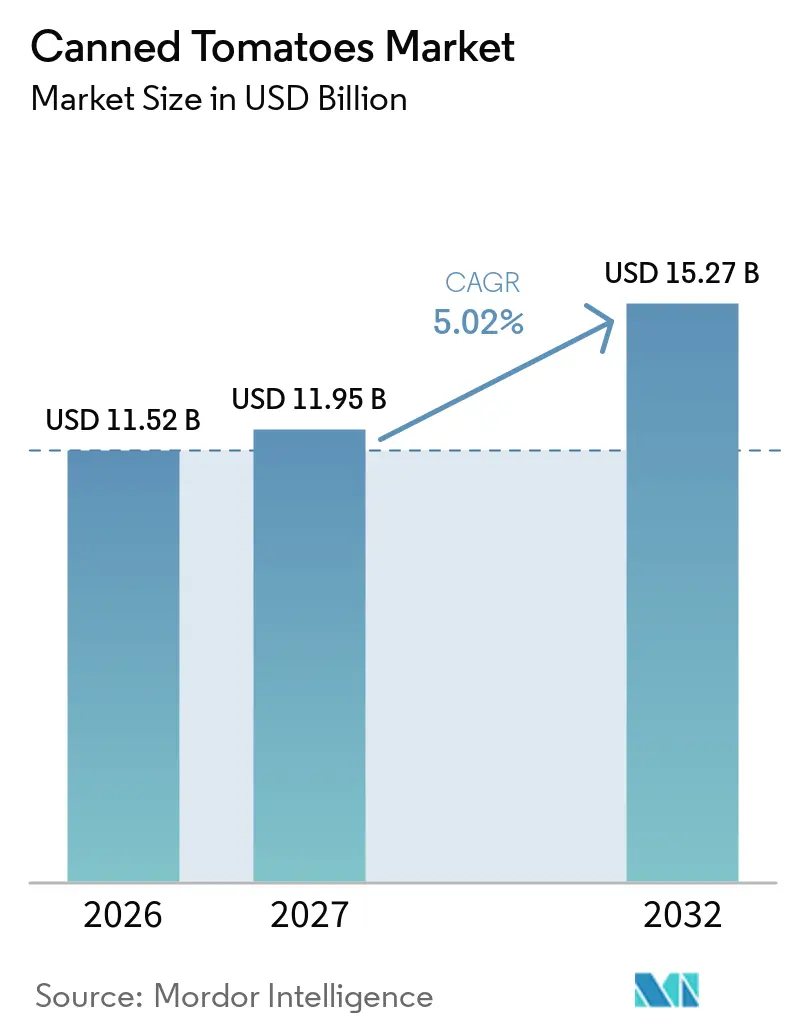
The canned tomatoes market size grew from USD 11.52 billion in 2026 to USD 11.95 billion in 2027, and is forecast to reach USD 15.27 billion by 2032 at a 5.02% CAGR over 2027-2032. The canned tomatoes market benefits from its widespread use in household cooking, foodservice kitchens, and food manufacturing, where shelf stability enables regular purchasing and efficient inventory planning. Consumer demand for convenient ingredients used in sauces, soups, pizzas, and prepared meals supports market growth. The expansion of the foodservice industry further increases demand for bulk packs and puree formats, while retailers sustain sales volumes through branded and private-label offerings. However, uneven raw material availability remains a challenge, making diversified sourcing, processing efficiency, and product format flexibility key components of supplier strategies.
Key Report Takeaways
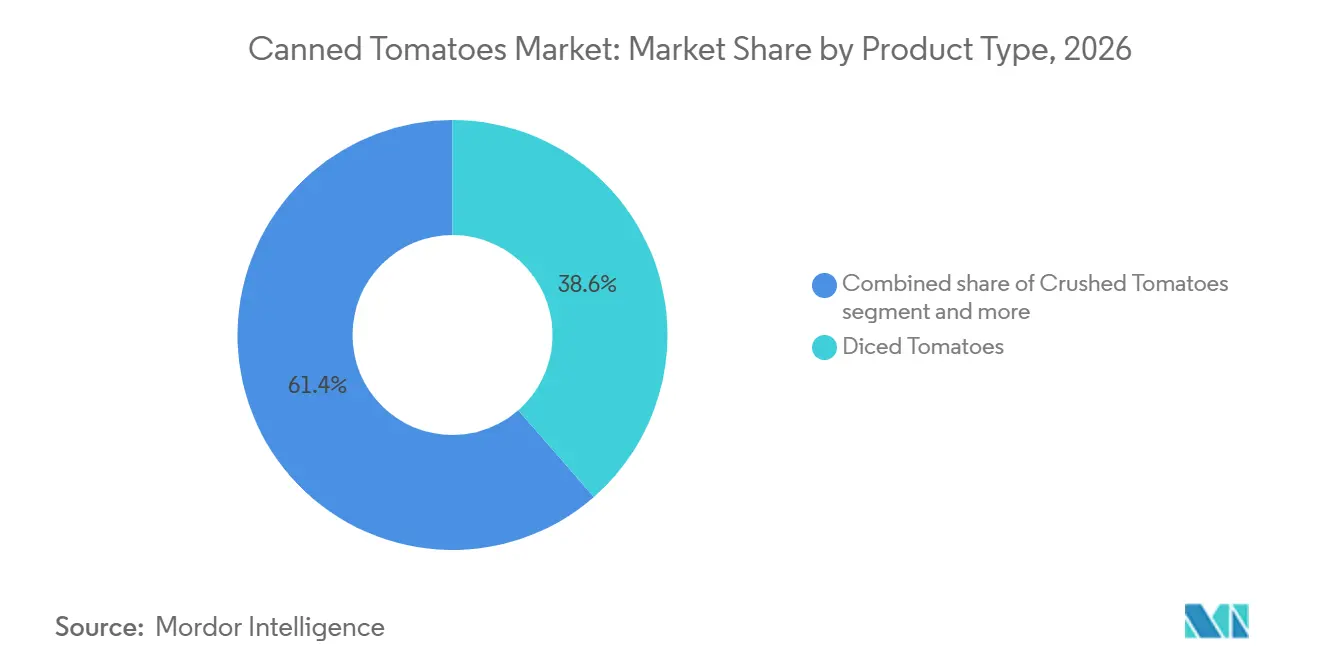
- By product type, diced tomatoes led the canned tomatoes market with a 38.57% share in 2026, while tomato puree is projected to grow at a CAGR of 6.37% during 2027–2032.
- By packaging, metal cans dominated the market with a 76.35% share in 2026, while aseptic cartons are projected to expand at the fastest CAGR of 6.21% during 2027–2032.
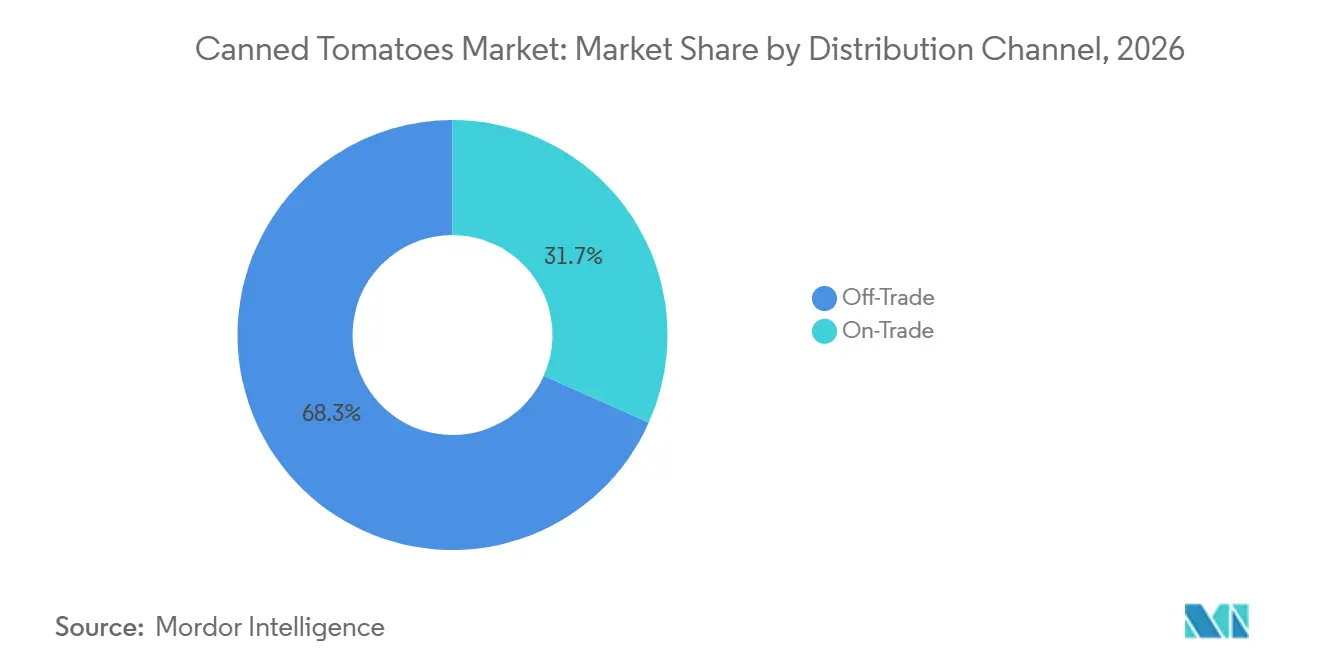
- By distribution channel, off-trade led the market with a 68.32% share in 2026, while on-trade is anticipated to register the fastest CAGR of 6.52% during 2027–2032.
- By geography, Europe dominated the canned tomatoes market with a 37.12% share in 2026, while Asia-Pacific is projected to register the fastest CAGR of 6.82% during 2027–2032.
Note: Market numbers in this report are based on Mordor Intelligence's proprietary estimation framework, which combines nine months of actuals with Q4 projections for base year 2026.
Market Trends and Insights
Drivers Impact Analysis of Canned Tomatoes Market of Canned Tomatoes Market*
| Driver | (~) % Impact on CAGR Forecast | Geographic Relevance | Impact Timeline |
|---|---|---|---|
| Rising demand for convenience and ready-to-cook food products | +1.2% | Global, concentrated in North America, Western Europe, and Asia-Pacific urban centers | Short term (≤ 2 years) |
| Expansion of the global foodservice and restaurant industry | +0.8% | Global, strongest in Asia-Pacific and the Middle East | Medium term (2-4 years) |
| Growing popularity of italian, mediterranean, and other international cuisines | +0.5% | North America, the United Kingdom, and Asia-Pacific | Short term (≤ 2 years) |
| Technological advancements in canning and food processing operations | +0.6% | Global, with early gains in Italy, Spain, Greece, and California | Medium term (2-4 years) |
| Longer shelf life and year-round availability of canned tomatoes | +0.7% | Global, particularly North America, Europe, and Asia-Pacific | Medium term (2–4 years) |
| Increasing consumption of processed and packaged food products | +0.9% | Global, with strong demand across North America, Europe, and Asia-Pacific | Short term (≤ 2 years) |
| Source: Mordor Intelligence | |||
Rising Demand for Convenience and Ready-to-Cook Food Products
Changing consumer lifestyles, busier work schedules, and limited time for meal preparation are driving demand for convenient, ready-to-cook food products. Canned tomatoes provide a practical ingredient for households and commercial kitchens, as they are pre-processed, require minimal preparation, and can be directly used in pasta sauces, soups, curries, pizzas, and ready meals. According to the Ministry of Food Processing Industries, Government of India, in its 2025 assessment, organized consumer food industry sales grew by 13% between April 2024 and January 2025[1]. The Ministry also states that ready-to-eat and ready-to-cook products will maintain strong demand in fiscal year 2026, supported by convenience-driven business-to-consumer consumption and demand from hotels, restaurants, and catering services. This shift toward time-saving food preparation is creating additional opportunities for canned tomato manufacturers across household retail, foodservice, and industrial food processing applications.
Expansion of the Global Foodservice and Restaurant Industry
Restaurants, hotels, caterers, and pizza operators represent key purchasers in the canned tomatoes market, as they require consistent quality and a reliable supply. Professional kitchens use diced tomatoes, peeled tomatoes, puree, and concentrated formats in high-volume recipes. The expansion of quick-service restaurants and delivery-led meal occasions supports demand for tomato-based menu items and prepared ingredients. Foodservice buyers often prefer bulk packs and concentrated products because they improve kitchen handling and reduce per-unit transportation costs. Suppliers that offer both institutional and retail formats can address this demand while continuing to serve supermarket customers effectively.
Growing Popularity of Italian, Mediterranean, and Other International Cuisines
The growing popularity of Italian, Mediterranean, and other international cuisines is driving demand for canned tomatoes across household and foodservice applications. Tomatoes are key ingredients in widely consumed dishes, including pasta, pizza, lasagna, Mediterranean stews, and Mexican sauces. The expansion of international restaurant chains, food delivery services, and home cooking trends is further increasing the use of convenient tomato-based ingredients. Canned tomatoes offer consistent texture and flavor, along with year-round availability, making them suitable for preparing a wide range of international recipes. According to Italy's Ministry of Agriculture, Food Sovereignty and Forestry, Italian cuisine generated approximately EUR 251 billion in global value in 2024, representing year-on-year growth of 4.5% reported in 2025[2]. The global popularity of tomato-based cuisines continues to support demand for canned tomatoes among households, restaurants, and food manufacturers.
Technological Advancements in Canning and Food Processing Operations
Technological advancements in thermal processing, automated sorting, sterilization, and aseptic packaging are improving efficiency across the global canned tomato industry. Modern processing systems automate tomato washing, peeling, cutting, filling, and sealing, helping manufacturers maintain consistent product quality and reduce processing losses. Innovations in high-temperature short-time (HTST) treatment and aseptic processing also preserve product flavor, color, and nutritional properties while extending shelf life. According to the Institute of Food Technologists (IFT) in May 2025, aseptic processing is an established technology for producing shelf-stable food products, including purees, concentrates, and soups, without refrigeration[3]. These advancements are encouraging food manufacturers to adopt advanced preservation and packaging systems, supporting greater production efficiency and wider distribution of canned and processed tomato products.
Restraints Impact Analysis of Canned Tomatoes Market of Canned Tomatoes Market*
| Restraint | (~) % Impact on CAGR Forecast | Geographic Relevance | Impact Timeline |
|---|---|---|---|
| Fluctuations in raw tomato prices and seasonal supply constraints | -0.8% | Global, most acute in Europe and California | Short term (≤ 2 years) |
| Packaging waste and regulatory compliance costs | -0.4% | European Union and North America, extending to export markets | Long term (≥ 4 years) |
| Competition from fresh tomatoes and consumer preference for fresh produce | -0.6% | Global, particularly North America, Europe, and Asia-Pacific | Medium term (2–4 years) |
| High energy consumption and processing costs | -0.5% | Global, with greater pressure in Europe and North America | Short term (≤ 2 years) |
| Source: Mordor Intelligence | |||
Fluctuations in Raw Tomato Prices and Seasonal Supply Constraints
Fluctuations in raw tomato prices and crop conditions can affect processor margins, as tomatoes must be harvested and processed within a short seasonal window. Although lower tomato prices may provide short-term relief, they often follow periods of elevated costs and do not eliminate the risk of weather-related yield losses. The canned tomatoes market is more resilient when processors maintain long-term relationships with growers and source tomatoes from multiple production regions. Crop planning, water availability, and contracting practices can therefore influence the reliability of supply to retail and foodservice channels. Additionally, rising costs of fertilizers, agricultural inputs, labor, and transportation can increase procurement expenses and create uncertainty in production planning. Unfavorable weather conditions, including droughts and excessive rainfall, may also disrupt harvesting schedules and reduce the availability of tomatoes suitable for processing.
Packaging Waste and Regulatory Compliance Costs
Packaging waste and environmental regulations pose additional challenges for canned tomato manufacturers, particularly those that rely on metal cans and other single-use packaging formats. Manufacturers must comply with evolving requirements for packaging recyclability, material safety, waste management, and extended producer responsibility, which increase operational and compliance costs. Metal can production and recycling are energy-intensive, while can linings and coatings may face scrutiny over chemical safety and food-contact standards. Stricter packaging regulations may require manufacturers to invest in alternative materials, enhanced recycling systems, and redesigned packaging formats. These factors can raise production costs, influence product pricing, and create operational challenges for manufacturers serving multiple regulatory jurisdictions.
*Our forecasts treat driver/restraint impacts as directional, not additive. The impact forecasts reflect baseline growth, mix effects, and variable interactions.
Canned Tomatoes Market Segment Analysis
By Product Type:
Diced Tomatoes Lead, Puree AcceleratesDiced tomatoes accounted for 38.57% of the category share in 2026, making them the leading product type. Their widespread use in pasta sauces, soups, pizza toppings, and prepared foods drives demand across retail and foodservice channels. Consumers recognize the format, which suits recipes requiring visible tomato pieces. Whole peeled tomatoes occupy a more premium position in many cooking applications, particularly when product origin and texture influence purchasing decisions. The combination of everyday use and broad availability supports the market size of diced tomatoes within the canned tomatoes market.
Tomato puree is projected to grow at a CAGR of 6.37% through 2032. This format is well suited for foodservice and manufacturing applications, as it serves as a base ingredient in sauces, soups, and prepared meals. Puree can also improve transport efficiency when processors and buyers use concentrated products. Its versatility in formulation and compatibility with large-scale food production further support its adoption among commercial food manufacturers. Therefore, product portfolios need to include both retail-ready formats and larger formats designed for institutional customers.

By Packaging:
Metal Cans Entrenched, Aseptic Formats Reshape MarginsMetal cans accounted for 76.35% of the category share in 2026. Their leading position reflects established filling infrastructure, strong barriers against oxygen and moisture, and widespread consumer familiarity. Cans also support the long shelf life stated by retailers and foodservice distributors for tomato products. Their ability to withstand high-temperature sterilization and maintain packaging integrity during transportation further strengthens their suitability for large-scale tomato processing. Metal packaging will remain important where processors require reliable preservation for acidic products.
Aseptic cartons are projected to grow at a CAGR of 6.21% through 2032. SIG introduced a 1-liter aseptic carton that provides full barrier protection without an aluminum layer, demonstrating the advancement of carton technology for products requiring high levels of protection. Cartons offer processors an alternative way to address retailer and consumer expectations regarding packaging materials. Glass jars will continue to serve specialty and premium products, where product visibility and presentation are important. Packaging decisions in the canned tomatoes market will increasingly depend on the product type, customer channel, and local recycling infrastructure rather than on a single packaging format.
By Distribution Channel:
Off-Trade Commands Volume, On-Trade Gains MomentumOff-trade channels accounted for 68.32% of category revenue in 2026. Supermarkets, hypermarkets, convenience stores, and online grocery platforms make canned tomato products accessible through routine household shopping trips. These channels also enable manufacturers to offer multipacks, private-label products, and premium imported lines across different price points. Online grocery services further support bulk purchases, as shelf-stable products are easy to store. This leading position reflects the continued importance of household pantry demand.
The on-trade segment is forecast to grow at a CAGR of 6.52% through 2032. Hotels, restaurants, caterers, and pizza chains use tomato products in larger pack sizes and in puree or concentrate formats. Their requirements differ from those of retail buyers, as kitchen throughput, recipe consistency, and product handling are more important than front-of-pack presentation. Dedicated foodservice product ranges enable suppliers to serve professional kitchens without altering their core retail packaging. Suppliers that can maintain both consumer and institutional pack formats are likely to be better positioned as the canned tomatoes market evolves.
Geography Analysis
Europe
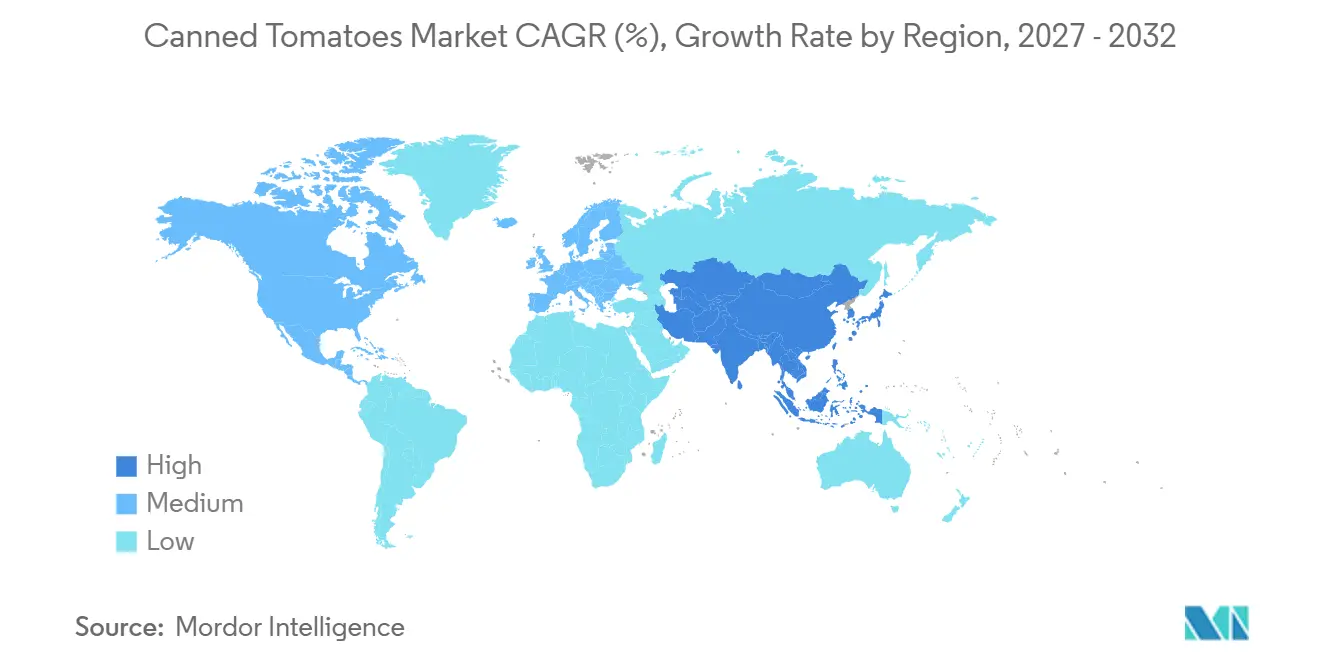
Europe holds 37.12% of the canned tomatoes market share in 2026. Italy underpins the region’s position through its processing capacity, grower network, and established export relationships. The region benefits from well-recognized culinary traditions that support demand for peeled, diced, and pureed tomato products. Regulation (EU) 2025/40 represents a key compliance factor, as packaging requirements will apply across the European Union from August 2026. These requirements encourage processors to invest in recyclable materials and improved packaging documentation. European suppliers can also leverage quality certifications and origin designations to safeguard their premium positioning. The European canned tomatoes market will continue to depend on crop resilience and export demand.
Asia-Pacific
Asia-Pacific is forecast to grow at a CAGR of 6.82% through 2032. Urbanization, broader retail distribution, and expanding restaurant networks are increasing consumer exposure to tomato-based foods across China, India, Indonesia, and Australia. The region offers significant potential for further household adoption, as per capita consumption remains lower than in many Western markets. Japan continues to represent a high-value destination for imported processed tomato products, particularly those positioned around Italian quality and foodservice applications. The category's share in the region is expected to increase as suppliers tailor product formats to local cooking habits and restaurant demand.
North America, South America, and the Middle East and Africa
North America represents a major consumption base for canned tomatoes, supported by retail pantry use, demand from pizza and restaurants, and the presence of branded and private-label products. Processors in the United States also face cost pressures from packaging inputs and seasonal agricultural conditions. In South America, tomato sauces remain a key application, particularly in countries with high pasta consumption. The Middle East and Africa offer additional opportunities for foodservice-led demand as international hotel and quick-service restaurant networks expand. Although these regions vary in market maturity, each supports the canned tomatoes market through a combination of retail, foodservice, and local processing opportunities.
Competitive Landscape
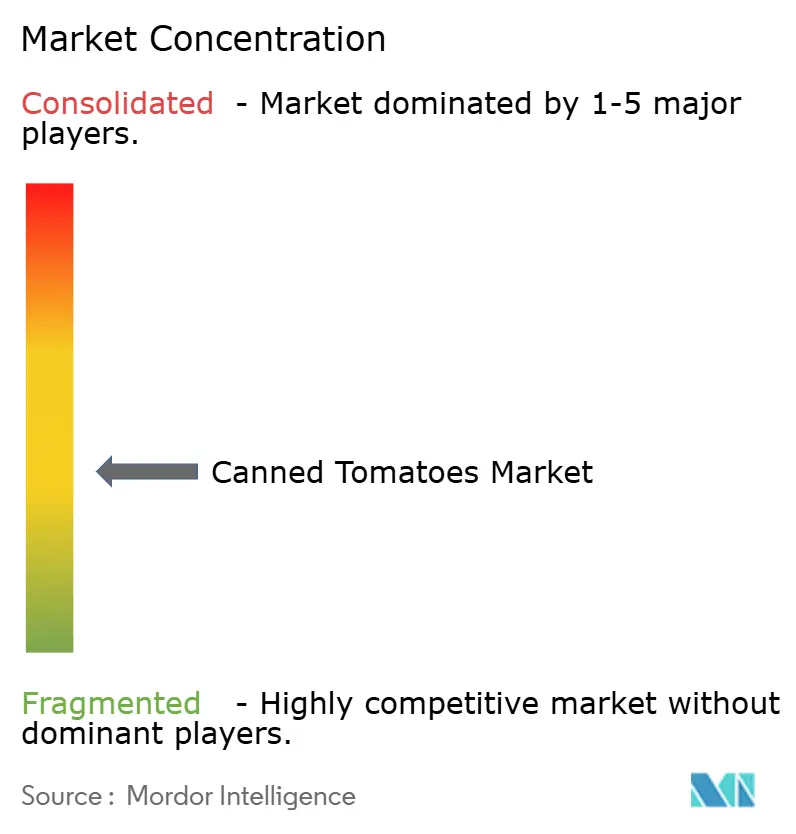
The canned tomatoes market is moderately fragmented, with competition among established food processing companies, specialist tomato producers, and diversified packaged food manufacturers. Key participants include Conagra Brands, Del Monte Foods, Mutti, Cento Fine Foods, The Kraft Heinz Company, La Doria, Red Gold, Princes Limited, and Conserve Italia. These companies compete based on product quality, pricing, processing capabilities, packaging formats, and distribution networks. Their product portfolios include whole peeled, diced, crushed, chopped, and pureed tomato products for household, foodservice, and industrial customers. Established brands benefit from long-standing retailer relationships and strong consumer recognition across key regional markets.
Raw tomato sourcing, processing efficiency, product consistency, and the ability to maintain year-round supply significantly influence competition. Manufacturers with established relationships with tomato growers and access to large-scale processing facilities can manage seasonal procurement requirements more effectively. Companies such as Mutti, La Doria, Red Gold, Stanislaus Food Products, and Sugal Group focus on tomato-based product portfolios and serve retail and foodservice customers. Packaging differentiation also plays a key role, with manufacturers offering metal cans, glass jars, and aseptic formats to meet varying customer preferences. Product innovation, organic product offerings, private-label manufacturing, and premium tomato varieties provide further opportunities for competitive differentiation.
Regional expansion, strategic partnerships, production investments, and distribution agreements remain important competitive strategies. Companies are expanding their international presence by developing export networks and responding to growing demand for convenient, shelf-stable tomato products. Larger food manufacturers leverage diversified product portfolios and established retail distribution channels, while specialist producers compete through tomato sourcing expertise, product authenticity, and processing specialization. Foodservice and industrial customers also shape competition through bulk purchasing requirements, consistent product specifications, and competitive pricing. Consequently, manufacturers that combine reliable raw material procurement, efficient processing operations, diversified packaging options, and strong distribution capabilities are better positioned to strengthen their market presence.
Canned Tomatoes Industry Leaders
-
Conagra Brands, Inc.
-
Mutti S.p.A.
-
The Kraft Heinz Company
-
The Pastene Companies, Ltd.
-
Red Gold, Inc.
- *Disclaimer: Major Players sorted in no particular order
Canned Tomatoes Market Companies Covered in this Report
- Conagra Brands, Inc.
- Del Monte Foods, Inc.
- Mutti S.p.A.
- Cento Fine Foods, Inc.
- The Kraft Heinz Company
- The Pastene Companies, Ltd.
- La Doria S.p.A.
- Red Gold, Inc.
- Princes Limited
- Conserve Italia Societa Cooperativa Agricola
- Bianco DiNapoli
- The Morning Star Company
- Furmano Foods, Inc.
- Sugal Group
- Kagome Co., Ltd.
- Stanislaus Food Products
- Olam Group Limited
- Tat Gıda Sanayi A.Ş.
- Rodolfi Mansueto S.p.A.
- Goya Foods, Inc.
Recent Industry Developments in Canned Tomatoes Market
- March 2026: Earthling Consumer Products introduced Royal Grove Peeled Tomatoes at AAHAR 2026 in India. The product targeted professional kitchens, including hotels, restaurants, cafés, cloud kitchens, and catering businesses, and was made from selected tomatoes, contained no artificial additives or preservatives, and was suitable for sauces, soups, stews, and pasta dishes.
- February 2026: Kato Sangyo launched Mutti Fine Cut Tomatoes nationwide in Japan. The product comes in a convenient 210 g can and uses a specialized fine-cut processing method without peeling or adding citric acid. This launch expanded Mutti’s canned tomato portfolio by introducing a smaller, single-use packaging format for household cooking.
- April 2025: Pomi launched its Crushed Tomato product line in the United States with four flavor variants: Basil, Onion, Garlic, and Chili Pepper. The products contain 100% Italian tomatoes and are available in 13.8-ounce Tetra Pak packaging. This launch expanded the company’s flavored tomato portfolio and offers consumers convenient ingredients for preparing sauces and other tomato-based dishes.
Global Canned Tomatoes Market Report Scope
Canned tomatoes are fresh tomatoes processed and preserved in airtight, sealed cans to extend their shelf life while retaining their flavor, color, and nutritional properties.
The canned tomatoes market is segmented by product type, packaging, distribution channel, and geography. By product type, the market is segmented into whole peeled tomatoes, diced tomatoes, crushed tomatoes, tomato puree, and other product types. By packaging, the market is segmented into metal cans, aseptic cartons, glass jars, and other packaging types. By distribution channel, the market is segmented into off-trade (supermarkets/hypermarkets, convenience/grocery stores, online retailers, and other distribution channels) and on-trade. Geographically, the market is classified into North America, Europe, South America, Asia-Pacific, and the Middle East and Africa. The market forecasts are provided in terms of value (USD).
Segmentation Overview
| Whole Peeled Tomatoes |
| Diced Tomatoes |
| Crushed Tomatoes |
| Tomato puree |
| Other Product Types |
| Metal Cans |
| Aseptic Cartons |
| Glass Jars |
| Other Packaging Type |
| Off-Trade | Supermarkets/Hypermarkets |
| Convenience/Grocery Stores | |
| Online Retailers | |
| Other Distribution Channels | |
| On-Trade |
| North America | United States |
| Canada | |
| Mexico | |
| Rest of North America | |
| Europe | Germany |
| United Kingdom | |
| Italy | |
| France | |
| Spain | |
| Netherlands | |
| Rest of Europe | |
| Asia-Pacific | China |
| India | |
| Japan | |
| Australia | |
| Indonesia | |
| Thailand | |
| Rest of Asia-Pacific | |
| South America | Brazil |
| Argentina | |
| Rest of South America | |
| Middle East and Africa | South Africa |
| Saudi Arabia | |
| United Arab Emirates | |
| Turkey | |
| Rest of Middle East and Africa |
| By Product Type | Whole Peeled Tomatoes | |
| Diced Tomatoes | ||
| Crushed Tomatoes | ||
| Tomato puree | ||
| Other Product Types | ||
| By Packaging | Metal Cans | |
| Aseptic Cartons | ||
| Glass Jars | ||
| Other Packaging Type | ||
| By Distribution Channel | Off-Trade | Supermarkets/Hypermarkets |
| Convenience/Grocery Stores | ||
| Online Retailers | ||
| Other Distribution Channels | ||
| On-Trade | ||
| By Geography | North America | United States |
| Canada | ||
| Mexico | ||
| Rest of North America | ||
| Europe | Germany | |
| United Kingdom | ||
| Italy | ||
| France | ||
| Spain | ||
| Netherlands | ||
| Rest of Europe | ||
| Asia-Pacific | China | |
| India | ||
| Japan | ||
| Australia | ||
| Indonesia | ||
| Thailand | ||
| Rest of Asia-Pacific | ||
| South America | Brazil | |
| Argentina | ||
| Rest of South America | ||
| Middle East and Africa | South Africa | |
| Saudi Arabia | ||
| United Arab Emirates | ||
| Turkey | ||
| Rest of Middle East and Africa | ||
Key Questions Answered in the Report
What was the size of the canned tomatoes market in 2026, and what is its projected value by 2032?
The canned tomatoes market was valued at USD 11.52 billion in 2026 and is projected to reach USD 15.27 billion by 2032, growing at a CAGR of 5.02% during 2027-2032.
Which product type held the largest share of the canned tomatoes market in 2026?
Diced tomatoes held the largest market share in 2026, accounting for 38.57% of the market.
Which packaging format dominated the canned tomatoes market in 2026?
Metal cans dominated the market in 2026, holding a 76.35% share.
Which distribution channel accounted for the largest market share in 2026?
The off-trade segment led the canned tomatoes market in 2026, accounting for 68.32% of total revenue.
Which region held the largest share of the canned tomatoes market in 2026?
Europe was the leading regional market in 2026, capturing 37.12% of market.