
Market Overview
| Study Period | 2020 - 2031 |
|---|---|
| Forecast Data Period | 2026 - 2031 |
| Base Year Market Size (2025) | USD 15.67 Billion |
| Market Size (2026) | USD 16.59 Billion |
| Market Size (2031) | USD 22.04 Billion |
| Growth Rate (2026 - 2031) | 5.84 % |
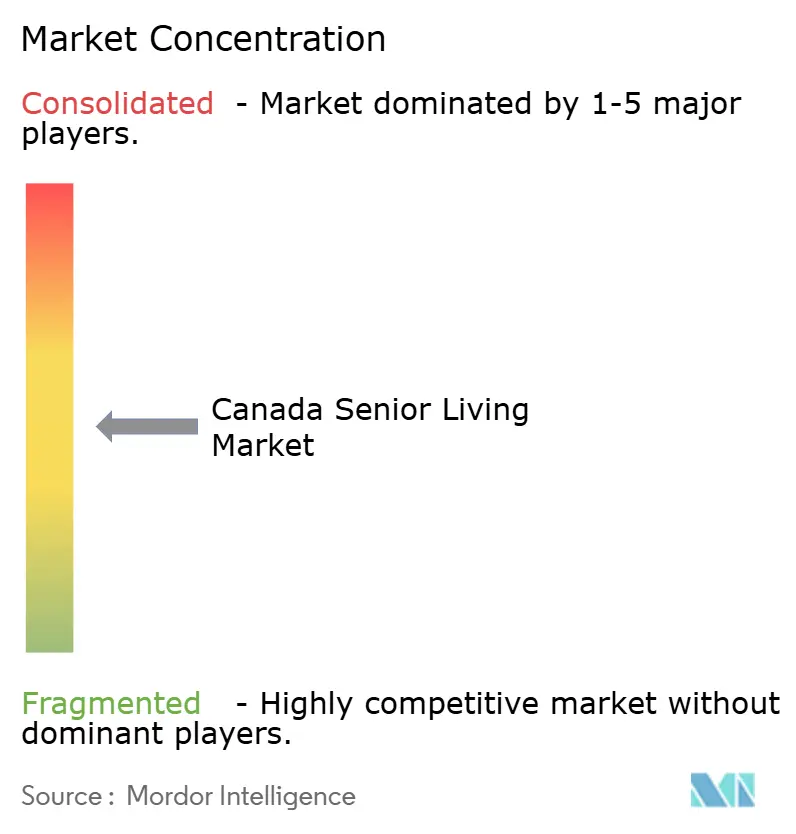
| Market Concentration | Medium |
Major Players *Disclaimer: Major Players sorted in no particular order Image © Mordor Intelligence. Reuse requires attribution under CC BY 4.0. | |
Canada Senior Living Market Analysis by Mordor Intelligence
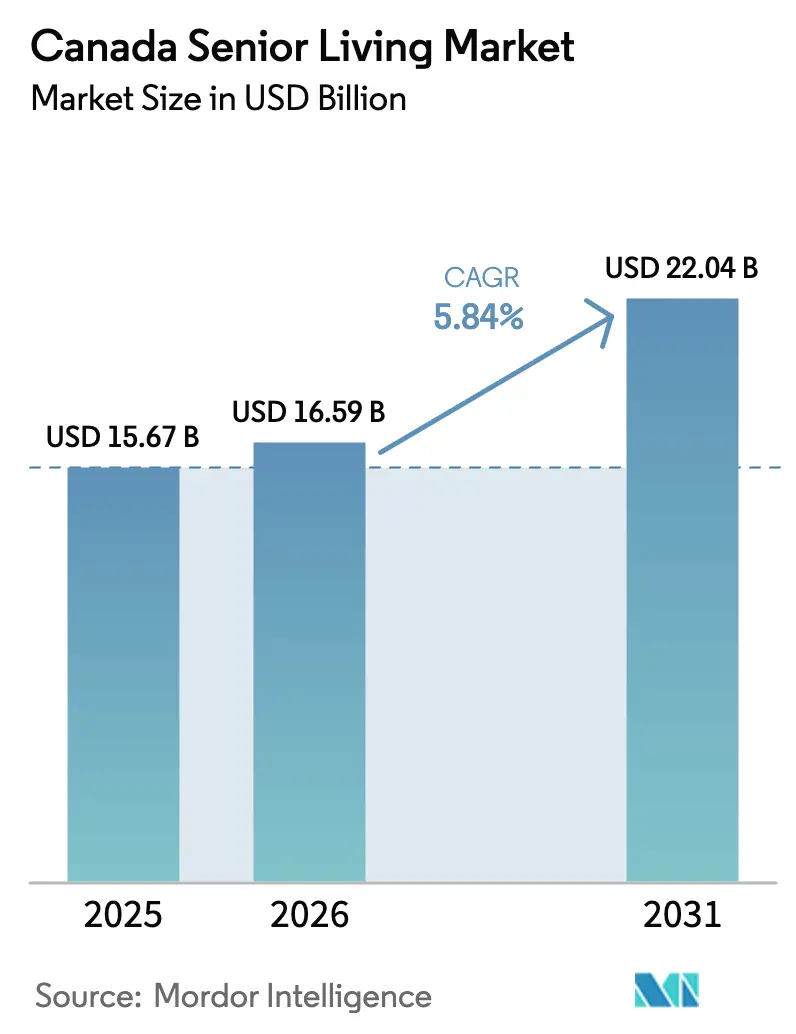
The Canada Senior Living Market size was valued at USD 15.67 billion in 2025 and estimated to grow from USD 16.59 billion in 2026 to reach USD 22.04 billion by 2031, at a CAGR of 5.84% during the forecast period (2026-2031). Demand is propelled by the rapid expansion of the 85-plus cohort, growing hospital discharge backlogs, and the preference of affluent baby boomers for purpose-built communities that integrate health care, hospitality, and social programming. The accelerating shift away from single-family homes toward service-rich, age-in-place residences is deepening penetration rates in urban cores. Meanwhile, operators are grappling with an acute labor shortage—35,000 nursing vacancies nationwide—and rising wage pressure even as occupancy recovers to pre-pandemic levels. Capital continues to flow into the Canada senior living market from REITs and infrastructure funds, with technology-enabled care models and sustainability retrofits emerging as critical differentiators.
Key Report Takeaways
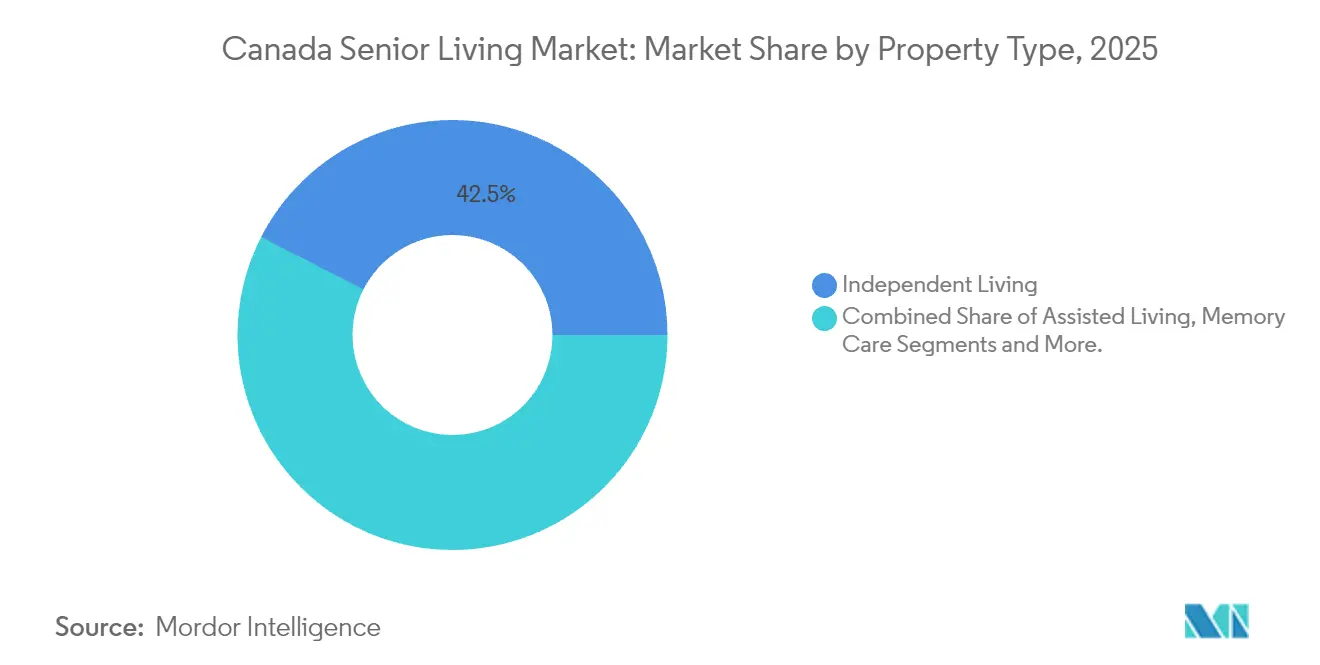
- By property type, Independent Living led with 42.46% of Canada's senior living market share in 2025, while Memory Care is advancing at a 6.33% CAGR through 2031.
- By business model, Long-Lease/Rental commanded 79.28% share of the Canada senior living market size in 2025; Hybrid (Sale + Lease) is growing fastest at 6.55% CAGR.
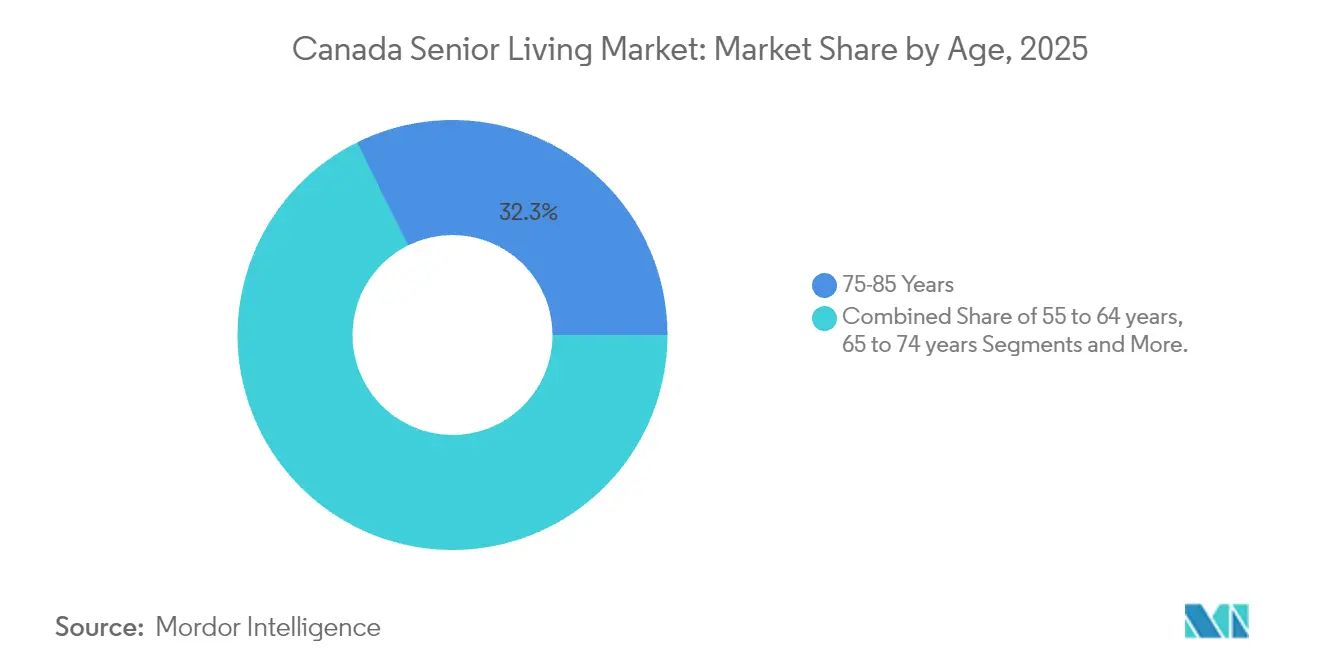
- By age, the 75-85 cohort accounted for 32.32% of demand in 2025, whereas the above-85 bracket is expanding at a 6.74% CAGR.
- By province, Ontario held a 45.02% share in 2025, yet British Columbia is the fastest-growing geography at 6.98% CAGR.
Note: Market size and forecast figures in this report are generated using Mordor Intelligence’s proprietary estimation framework, updated with the latest available data and insights as of 2026.
Market Trends and Insights
Drivers Impact Analysis of Canada Senior Living Market*
| Drivers | (~) % IMPACT ON CAGR FORECAST | Geographic Relevance | Impact Timeline |
|---|---|---|---|
| Rapid aging of the 75–85+ cohort boosting demand for independent, assisted, and memory care | +1.8% | National; strongest in Ontario and British Columbia | Long term (≥ 4 years) |
| High household wealth among Boomers enabling private-pay options and premium amenities | +1.2% | National; peaks in Vancouver and GTA | Medium term (2–4 years) |
| Shift from single-family homes to service-rich, age-in-place communities near healthcare and transit | +0.9% | Toronto, Vancouver, Montreal, Calgary | Medium term (2–4 years) |
| Hospital and home-care capacity pressure driving referrals toward seniors housing | +0.7% | National; acute in Ontario and Quebec | Short term (≤ 2 years) |
| Technology-enabled care improving outcomes and operating efficiency | +0.5% | National; early adoption in British Columbia and Ontario | Medium term (2–4 years) |
| Source: Mordor Intelligence | |||
Rapid Aging of the 75–85+ Cohort Boosting Demand for Independent, Assisted, and Memory Care
The 85-plus population is set to triple by 2073, creating a long runway of need for housing that can scale care intensity. Residents over 80 present higher rates of chronic disease, mobility limits, and dementia, shifting demand toward assisted living and memory care. Operators have responded by allocating more capital to high-acuity suites and by embedding nursing partnerships to manage complex clinical profiles. Sustained demographic momentum shields the Canada senior living market from cyclical swings and underpins development pipelines. Staffing strategy now centers on building nurse pipelines before rising acuity outpaces available labor.
High Household Wealth Among Boomers Enabling Private-Pay Options and Premium Amenities
Seniors control 61% of national household wealth, with a median senior family net worth of USD 806,000, supporting a willingness to pay for upscale communities. Luxury operators such as Amica achieve occupancy above 90% by bundling chef-driven dining, wellness clinics, and concierge services. The wealth effect is most pronounced in Greater Vancouver and the GTA, where home equity unlocks liquidity to fund entry fees. Regional disparities persist, leaving Atlantic markets underserved. Investors view high-net-worth segments as insulated from pricing pushback, reinforcing a two-tier supply pattern across the Canada senior living market.
Shift from Single-Family Homes to Service-Rich, Age-in-Place Communities Near Healthcare and Transit
Urban land shortages and escalating home upkeep costs are persuading retirees to trade detached houses for purpose-built towers situated near hospitals and transit nodes. Verve’s Don Mills Residence in Toronto, featuring integrated medical suites and smart-building systems, reached stabilized occupancy in record time. Co-located health services lower emergency readmissions and reduce caregiver burden, bolstering public-sector referrals. CMHC-insured 50-year debt at sub-4% rates further encourages rental formats that promise long-term tenure. The locational premium has become a decisive factor in lease-up velocity across the Canada senior living market.
Hospital and Home-Care Capacity Pressure Driving Referrals Toward Seniors Housing and Transitional Care Models
Emergency rooms are running at 120-140% capacity, with 92% of alternate-level-of-care patients aged 55 plus[1]. Provinces now fund transitional beds inside private retirement residences to alleviate hospital gridlock. Extendicare opened 448 long-term care beds through such partnerships in 2024-25. Discharge planners are embedded in hospitals to route patients directly to licensed communities, creating a predictable referral funnel. Operators that integrate electronic medical records and 24/7 nursing capture higher per diems and strengthen payer relationships, enhancing the resilience of the Canada senior living market.
Restraints Impact Analysis of Canada Senior Living Market*
| Restraints | (~) % IMPACT ON CAGR FORECAST | Geographic Relevance | Impact Timeline |
|---|---|---|---|
| Affordability gaps and limited middle-market product in high-cost provinces | −0.5% | British Columbia, Ontario urban cores, Alberta | Medium term (2–4 years) |
| Acute staffing shortages and rising wages for nurses/PSWs squeezing margins and service levels | −0.6% | National; most severe in Quebec and Atlantic provinces | Short term (≤ 2 years) |
| Complex, province-by-province regulations and licensing slowing approvals and expansion | −0.4% | National; acute in Ontario, Quebec, British Columbia | Long term (≥ 4 years) |
| Source: Mordor Intelligence | |||
Affordability Gaps and Limited Middle-Market Product in High-Cost Provinces
Monthly assisted-living fees range from USD 2,565 to USD 4,030, a level 40% of older Canadians cannot meet without selling assets or leaning on relatives[2]. Land prices, construction inflation, and municipal charges push new rents even higher in Vancouver and Toronto, widening the divide between luxury towers and subsidized nursing beds. Households earning USD 36,650 to USD 58,640 fall into an underserved “middle” that finds few purpose-built options. Quebec’s private RPA model proves that scale can trim costs—average rates sit near USD 2,418—yet even this level excludes the two lowest income quintiles. Operators must cut unit sizes, share amenities, or partner with provinces on rent supplements to unlock this latent demand.
Acute Staffing Shortages and Rising Wages for Nurses/PSWs Squeezing Margins and Service Levels
Canada is short 35,000 nurses, and one in five plans to leave the profession, driving heavy reliance on agency labor at a 30–50% markup. Personal support workers earn only USD 13.20-16.10 an hour, making it hard to compete with retail and hospitality wages. Staffing gaps curb service quality and force some homes to cap new admissions despite healthy demand. Rural and Atlantic markets struggle most as caregivers migrate to higher-pay urban centers. Operators are trying wage bumps, retention bonuses, and college partnerships, but results will take up to two years to materialize.
*Our forecasts treat driver/restraint impacts as directional, not additive. The impact forecasts reflect baseline growth, mix effects, and variable interactions.
Canada Senior Living Market Segment Analysis
By Property Type:
Independent Living Dominates, Memory Care AcceleratesIndependent Living captured 42.46% of Canada's senior living market share in 2025, underscoring its role as the entry point for the young-old segment. Suites emphasize social engagement, dining choice, and wellness, allowing operators to run lean clinical staffing. Memory Care, however, is the growth engine, advancing at a 6.33% CAGR through 2031 as dementia prevalence climbs and families pursue specialized settings. Sienna’s USD 880 million purchase of Aspira’s portfolio signaled the premium investors assign to higher-acuity models. Average monthly fees in dedicated memory wings reach USD 4,398–5,864, out-earning independent units by 40-60%.
Developers now favor continuum-of-care sites that combine independent, assisted, and memory options under one roof, boosting lifetime value and retention. Verve’s Don Mills community exemplifies this vertical integration, housing 94 independent suites, 23 assisted units, and 17 secure memory beds. By 2031, multi-level campuses are expected to supply more than half of the new beds in the Canada senior living market. Nursing Care, while heavily regulated, benefits from provincial capacity mandates; Extendicare’s pipeline illustrates the public-private alignment needed to expand long-term care inventory.

By Business Model:
Rental Remains Pre-eminent, Hybrid Gains MomentumLong-Lease/Rental communities controlled 79.28% of the Canada senior living market size in 2025, reflecting consistent CMHC financing and resident preference for liquidity. The structure permits operators to refresh service packages and adjust rents without resale complications. Hybrid Sale + Lease formats, though smaller, are advancing at a 6.55% CAGR as wealthy downsizers seek to preserve equity while accessing care. Fengate’s acquisition of Arbutus Walk and Wesbrook Village, totaling 88 condo and 295 rental suites, illustrates investor belief in mixed-tenure yield stacking.
Hybrid contracts commonly offer residents a 50–70% refundable life-lease stake, balancing estate planning with monthly fee flexibility. Regulatory complexity is higher—life-lease deals can fall under securities law—limiting adoption to sophisticated developers. Outright sale remains niche at under 5% share due to illiquidity concerns. Over the forecast horizon, the hybrid model is expected to widen geographic reach, particularly in Greater Vancouver, where average home sale proceeds exceed USD 732,600, supplying capital for entry fees.
By Age:
75-85 Holds the Crown, Above 85 ExplodesThe 75-85 cohort represented 32.32% of residents in 2025, confirming its status as the largest customer block. Individuals in this bracket often transition from independent to assisted living as mobility declines, supplying a pipeline to higher-acuity units. The above-85 segment is the fastest-growing, charting a 6.74% CAGR through 2031 on the back of longer life expectancy and increased frailty. Lease-up velocity in memory wings mirrors this demographic surge, with some Vancouver and Toronto communities posting six-month wait lists.
Operators now craft marketing aimed at adult children, who typically drive decisions for parents over 85. Lifetime value is substantial: an early-seventies entrant who ages in place across care levels may generate USD 1–2 million in cumulative revenue. The 65-74 band remains an emerging niche, generally attracted to lifestyle-led campuses with preventive health programming. Active-adult villages targeting the 55-64 group continue to supply a feeder channel into the broader Canada senior living market, but volume remains comparatively small.
Geography Analysis
Ontario retained the lion’s share at 45.02% in 2025, reflecting its 14.8 million residents and a mature licensing regime under the Retirement Homes Act 2010. Leading chains locate flagship campuses near Toronto teaching hospitals, benefiting from deep nurse pools and transit links. Nevertheless, land scarcity and development fees are moderating growth, pushing developers toward secondary markets such as London and Kingston, where Extendicare recently added 448 long-term care beds through public-private partnerships.
British Columbia is the pacesetter, expanding at a 6.98% CAGR as Vancouver’s USD 732,600 median home value frees equity for entry fees and REIT capital targets limited high-density supply. Welltower’s USD 3.4 billion acquisition of Amica emphasized coastal luxury, while Fengate’s hybrid projects underscore investor appetite for mixed tenure. The province’s Green Buildings mandate accelerates heat-pump retrofits, raising capex but unlocking CMHC-backed debt at favorable terms.
Quebec’s 1,449 private RPAs deliver more affordable monthly rates of USD 2,418 but impose bilingual staffing and MSSS certification, deterring some anglophone entrants. Incumbents such as Cogir achieve economies of scale via standardized 300-plus suite towers outside Montreal’s core. Alberta benefits from lower land costs and energy wealth, yet trails British Columbia in growth due to its smaller population base. Atlantic provinces and the Prairies remain underserved; operators prepared to settle for slimmer margins and partner with provincial authorities can tap latent demand in these regions of the Canada senior living market.
Regulatory Landscape
Senior living regulation in Canada is largely provincial and territorial, which creates a fragmented compliance environment across retirement living and long-term care. In Ontario, the Retirement Homes Act, 2010 and O. Reg. 166/11 set licensing, resident rights, and operational requirements for retirement homes, with oversight by the Retirement Homes Regulatory Authority (RHRA). Long-term care frameworks vary by province (for example, Ontario's Fixing Long-Term Care Act, 2021), affecting approvals, staffing rules, and care standards that shape expansion timelines and operating models.
At the federal level, Health Canada has been advancing consultation work toward a Safe Long-Term Care Act, building on national long-term care standards released in 2023 by the Standards Council of Canada, Health Standards Organization, and CSA Group. While the Canada Health Act defines insured health services, long-term care is treated as an extended health care service, so funding and accountability structures remain primarily provincial. This reinforces the need for province-by-province operating playbooks for multi-site operators.
Value Chain Analysis
The Canada senior living value chain starts with land sourcing, development, and construction, then moves into licensing and commissioning, followed by lease-up and day-to-day operations across independent living, assisted living, memory care, and nursing care. Capital providers (REITs, pension funds, and infrastructure-style investors) shape supply through acquisitions, ownership structures, and sale-leaseback or joint-venture models, while operators such as Chartwell, Sienna, Revera, and Extendicare convert the real estate platform into hospitality, care delivery, and resident experience.
Operational performance depends on resident acquisition and marketing, clinical and hospitality staffing, and centralized procurement for food, housekeeping, and medical supplies. Technology is increasingly embedded into care workflows. Many operators also rely on platform scale to standardize training, recruit across regions, and deploy tools such as electronic records and remote monitoring, helping manage labor intensity and support service consistency despite staffing tightness and rising wage pressure.
Competitive Landscape
Competition is moderate, with the top three operators—Chartwell, Sienna, and Revera—controlling roughly one-third of national beds. Scale enables preferred lender terms, centralized procurement, and national staffing pipelines. Nonetheless, the field remains open: more than half of properties are owned by regional chains, nonprofits, or single-site operators, creating room for roll-ups. Technology investment is a key separator; chains deploying EMR and remote monitoring gain operating leverage and stronger payer relations.
Institutional capital is reshaping ownership. Welltower’s USD 3.4 billion Amica takeover positions the REIT as the premium urban landlord, layering in management fees while securing luxury exposure. Sienna’s USD 880 million Aspira purchase highlights a strategic focus on dementia care that commands higher per diems and exhibits lower turnover. Extendicare’s revenue rose 11.8% in Q4 2024 as newly built public-funded beds came online, illustrating how clinical expertise and government partnerships can offset exposure to private-pay volatility.
Smaller independents compete by targeting cultural niches—Mandarin-speaking or South Asian communities—and by planting flags in secondary cities where conglomerates lack local knowledge. Sustainability retrofits and modular construction are emerging as cost-control levers, especially for mid-market entrants. Consolidation momentum is expected to quicken as succession-ready owners exit and REIT cost of capital stays low, reinforcing a gradual uptick in concentration across the Canada senior living market.
Canada Senior Living Industry Leaders
-
Chartwell Retirement Residences
-
Sienna Senior Living
-
Revera Inc.
-
Extendicare Inc.
-
Atria Senior Living
- *Disclaimer: Major Players sorted in no particular order
Canada Senior Living Market Companies Covered in this Report
- Chartwell Retirement Residences
- Sienna Senior Living
- Revera Inc.
- Extendicare Inc.
- Atria Senior Living
- Sunrise Senior Living
- All Seniors Care Living Centres
- Amica Senior Lifestyles
- Seasons Retirement Communities
- Groupe Sélection
- Verve Senior Living
- Signature Retirement Living
- Optima Living
- Welltower Inc.
- Ventas Inc.
- Harrison Street
- Diversicare Canada
- Park Place Seniors Living
- Berwick Retirement Communities
- A Place for Mom
Market Opportunities and Future Outlook
A key whitespace in Canada senior living is the replacement and upgrading of aging inventory, supported by the removal of about 1.2% of private-pay inventory in 2024. That reduces the stock of older homes and increases the need for modern, purpose-built residences that can support integrated care capability. Portfolio optimization activity by major operators reinforces this shift, with platforms reweighting toward newer assets and core markets where resident preferences continue to favor service-rich, age-in-place communities. At the same time, the national debate on long-term care standards and the federal Safe Long-Term Care Act consultation process keeps quality, safety, and reporting requirements in focus, which benefits operators with strong compliance systems and scalable clinical governance.
Institutional capital partnerships also open acquisition and development pathways that smaller operators may struggle to finance independently. For example, Chartwell and Fengate announced a joint venture in May 2026 tied to gaining exposure to the Seasons Retirement Communities portfolio, reflecting a model where capital providers fund growth while operators focus on operational optimization and lease-up. Operators continue to pursue NOI-focused initiatives, and Sienna reported same-property NOI growth in its retirement segment in Q1 2026, pointing to the commercial value of occupancy recovery, pricing discipline, and cost management alongside targeted asset additions.
Recent Industry Developments in Canada Senior Living Market
- July 2026: Sienna Senior Living redevelops the Streetsville Community in Mississauga, Ontario (256-bed project) with an estimated cost of 125 million. The project starts in Q1 2027 and is slated for completion in late 2029, expanding high quality, purpose-built senior living capacity in the GTA. Strengthens urban core platform and signals shift toward newer assets and higher per diem potential.
- June 2026: Chartwell Retirement Residences closes the acquisition of Palermo Village Retirement Residence in Oakville, Ontario for 43.0 million. The acquisition adds mid-to-upper mid-market capacity in a key Ontario corridor. Portfolio expansion in desirable Ontario markets enhances scale and diversification of the retirement asset base.
- May 2026: Chartwell Retirement Residences enters into a definitive agreement to acquire a 30% interest in the Seasons Retirement Communities portfolio through a joint venture with Fengate Asset Management. The arrangement represents institutional-capital backed portfolio expansion. Accelerates growth via partnership, expands Seasons platform, and aligns with capital and portfolio diversification.
Canada Senior Living Market Report Scope and Research Methodology
Market Definition and Coverage
This study covers paid senior living residences in Canada, focusing on purpose-built communities where seniors pay for housing that is bundled with services and care support, to varying degrees across independent living, assisted living, and memory care.
Scope exclusions: We exclude informal caregiving delivered in private homes, and general home healthcare provided without a senior living residence stay.
Segments Covered in This Report
- By Property Type
- Assisted Living
- Independent Living
- Memory Care
- Nursing Care
- By Business Model
- Outright Sale (Freehold)
- Long-Lease / Rental
- Hybrid (Sale + Lease)
- By Age
- 55 to 64 years
- 65 to 74 years
- 75 to 85 years
- Above 85 years
- By Province
- Ontario
- Quebec
- British Columbia
- Alberta
- Rest of Canada
Data Sources, Market Sizing, and Validation
Desk Research
Desk research was used to set the model structure and to build inputs that fit the Canada context, especially around senior population trends, housing inventory, and care capacity. Public sources such as Statistics Canada, Canada Mortgage and Housing Corporation (CMHC) releases, provincial health and long-term care ministry publications, and the Government of Canada open data portal were referenced to understand demand pressure and the cadence of supply additions. We also reviewed Canada-wide inspection and licensing guidance published at the provincial level to avoid counting non-licensed formats as senior living residences.
To translate activity into market value, we relied on operator disclosures like annual reports, MD&A, and investor presentations, then cross-checked key operating markers reported in reputable press and association websites (including seniors housing and health care groups). In parallel, we used paid subscriptions for company financials and intelligence, news and financials, and a patent database when technology-enabled care topics appeared in operator updates. The desk research sources listed here are illustrative only, and additional public and paid references were used to collect data points, validate assumptions, and clarify open questions.
Primary Interviews and Surveys
Primary work was completed through expert interviews and structured surveys with operators, developers, lenders, advisors, and senior housing focused real estate participants, which helped confirm how pricing and occupancy move in Canada. We also gathered input from professionals connected to care delivery and referrals, so the final value build-up reflects service intensity differences across independent living versus assisted living and memory care.
Distribution of primary research fieldwork respondents
| Company type | Respondent position |
|---|---|
| Top tier: 27% | CXOs: 15% |
| Mid tier: 58% | Functional/Unit leaders: 34% |
| Smaller Players: 15% | Managers: 51% |
Market-Sizing & Forecasting
Market sizing used a top-down approach. We started with the senior population pool and the available seniors housing inventory to reconstruct addressable demand and revenue potential by care intensity, then converted results into USD. After building the Canada total, we sanity-checked it with selective bottom-up approximations, such as sampled monthly fees by care type multiplied by estimated occupied suites in key provinces, to flag and adjust outliers.
We monitored specific fingerprints closely because they shift market value in a visible way, including growth across the 75-plus and 85-plus cohorts, occupancy and absorption direction, newly added units and the construction pipeline, typical monthly fee ranges by care level, and staffing availability that can cap sellable capacity. Where fee data was not consistently available across operators, we used ranges from primary discussions and applied them conservatively by province using inventory and positioning cues. Forecasts used scenario analysis tied to occupancy recovery and rent escalation expectations, and were then aligned with expert feedback on how quickly new capacity can come online under permitting and labor constraints.
Data Validation & Update Cycle
Outputs were checked against independent signals, including Canada demographic trends, publicly tracked seniors housing inventory movements, and operator-level performance commentary, to ensure the total remains aligned with real operating conditions. Any large variances were reviewed, assumptions were revisited, and follow-up calls were triggered when interview feedback did not match the desk research evidence.
Before sign-off, the model and write-up were reviewed through multi-step analyst checks, followed by consistency tests across definitions, currency timing, and growth logic. Reports are refreshed annually, and interim updates are made when material changes affect pricing, occupancy, regulation, or supply, followed by a final pass before delivery so clients receive the latest updated view.
Mordor Intelligence's Canada Senior Living Market Analysis Market Sizing Compared With Other Published Estimates
Published market sizes for Canada senior living can differ even when they appear to cover the same segment, largely because the definition of what counts as a senior living residence is not always consistent. Variation also comes from how providers treat private pay versus subsidized care, and whether estimates rely on occupancy-led revenue logic or apply a broader healthcare spend ratio.
The main gap drivers are typically scope and pricing mechanics, including whether long-term care and nursing care facilities are fully included, and whether the estimate is built from suite inventory times occupied units times monthly fees, versus aggregated industry revenue that can omit certain care categories. Currency conversion timing and update cadence matter too, since rent growth and occupancy shifts change the current-year value. For that reason, the market value is anchored to inventory, care mix, and fee reality before being finalized by Mordor Intelligence.
Benchmark comparison
| Source | Market Size | Gaps in Research Methodology |
|---|---|---|
| Mordor Intelligence | USD 15.67 B (2025) | |
| Industry Database A | USD 12.30 B (2026) | Uses industry revenue for retirement communities and typically excludes facilities that are primarily nursing and skilled care, which can undercount higher-acuity senior living formats included in broader definitions. |
| Advisory Brief B | USD 18.10 B (2025) | Often blends seniors housing with adjacent elderly care services and applies rent growth assumptions without consistently tying them back to occupied suites, care mix, and province-level inventory constraints. |
Taken together, the spread is explained by what each estimate counts as senior living and how revenue is constructed, not by a single math choice. Our approach stays traceable to a repeatable demand and capacity build-up, which helps keep the value aligned with care mix, occupancy reality, and fee levels that can be cross-checked year to year.
Key Questions Answered in the Report
How large is the Canada senior living market in 2026?
The Canada senior living market size is USD 16.59 billion in 2026, with a projected value of USD 22.04 billion by 2031.
What is driving the fastest growth in Canada’s senior living property types?
Memory Care is leading growth at a 6.33% CAGR as dementia prevalence rises and operators seek higher-margin, high-acuity offerings.
Which province shows the strongest growth prospects?
British Columbia is advancing at a 6.98% CAGR to 2031, buoyed by high household wealth and aggressive REIT investment.
How are staffing shortages affecting operators?
Nursing and PSW vacancies inflate agency labor costs by up to 50%, squeezing margins and compelling greater use of technology-enabled care.
What strategic moves are reshaping market ownership?
Welltower’s USD 3.4 billion acquisition of Amica and Sienna’s USD 880 million memory-care purchase highlight REIT-driven consolidation toward premium and high-acuity assets.