
Canada Robotic Lawn Mower Market Size and Share
Market Overview
| Study Period | 2021 - 2031 |
|---|---|
| Forecast Data Period | 2026 - 2031 |
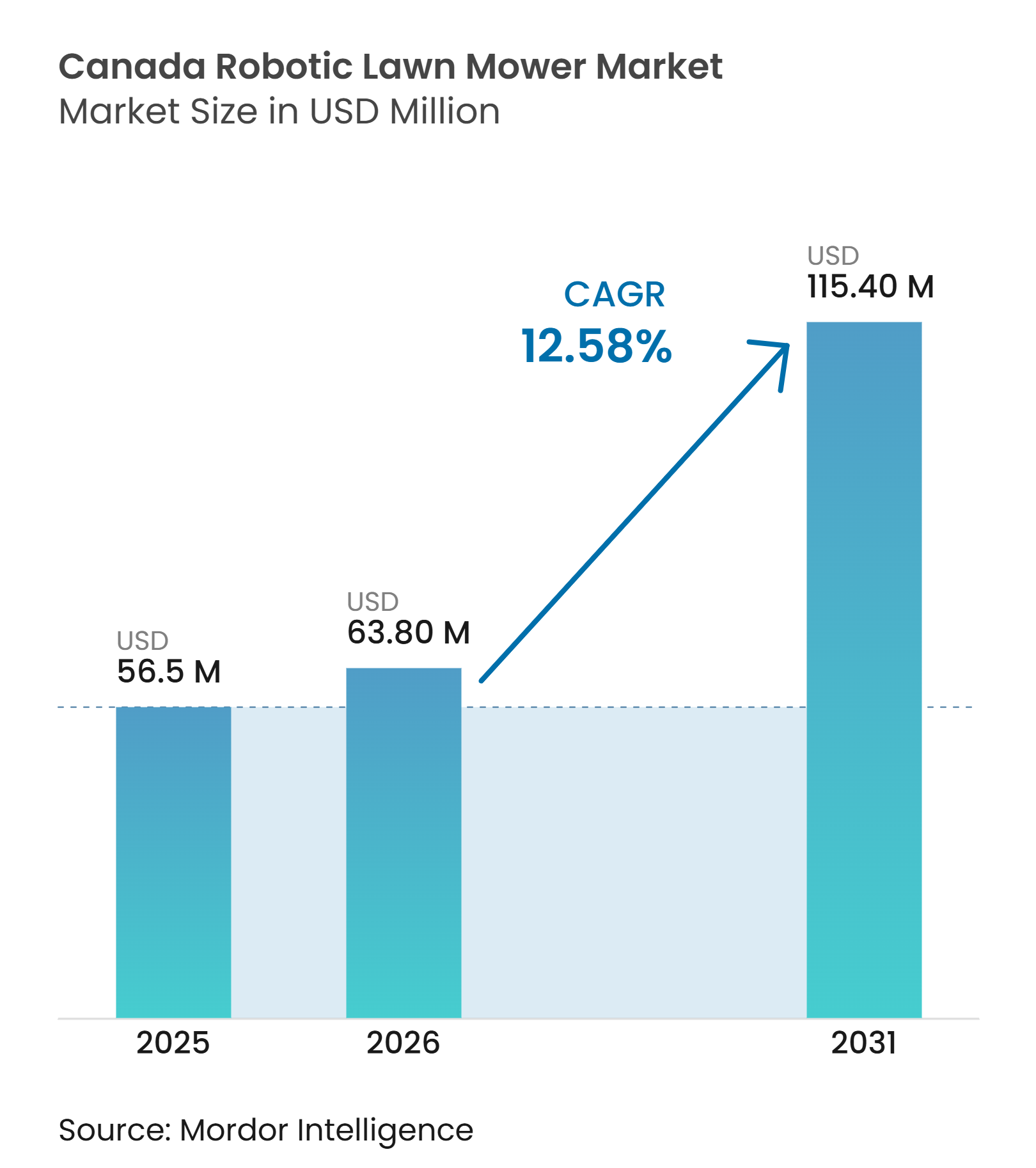
| Base Year Market Size (2025) | USD 56.5 Million |
| Market Size (2026) | USD 63.80 Million |
| Market Size (2031) | USD 115.40 Million |
| Growth Rate (2026 - 2031) | 12.58 % |
| Market Concentration | Medium |
Major Players *Disclaimer: Major Players sorted in no particular order Image © Mordor Intelligence. Reuse requires attribution under CC BY 4.0. | |
Canada Robotic Lawn Mower Market Analysis by Mordor Intelligence
The Canada robotic lawn mower market size is projected to expand from USD 56.5 million in 2025 and USD 63.8 million in 2026 to USD 115.4 million by 2031 and is forecast to grow at a CAGR of 12.6% from 2026 to 2031. The Canada robotic lawn mower market is supported by labor shortages, higher wage pressure, and growing interest in battery-powered lawn care. Demand is shifting toward units that reduce installation work and can manage changing lawn layouts. Commercial users are assessing fleets for golf courses, parks, sports grounds, and managed properties, where scheduled operation can reduce dependence on seasonal crews. Product suppliers are responding with connected features, remote monitoring, and wire-free navigation, which can raise the value of each sale. The Canadian climate limits operating months and increases the value of models with weather-aware settings, protected charging, and storage support.
Key Report Takeaways
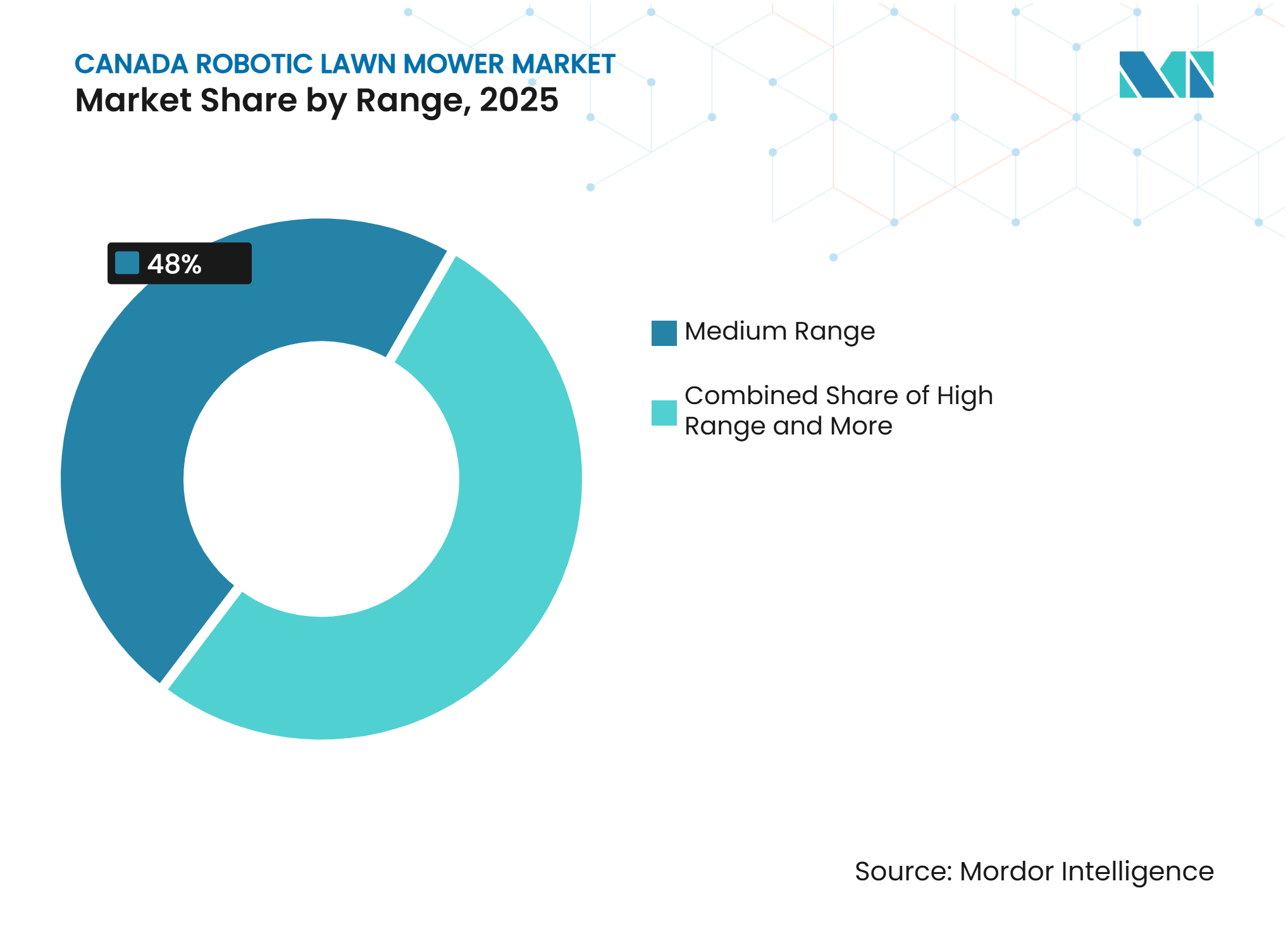
- By range, medium-range products held the largest position with 48% of Canada robotic lawn mower market share in 2025, while the market size for high-range products is forecast to grow at a CAGR of 15.5% from 2026 to 2031.
- By battery capacity, 20 to 30 V units held the largest position with 52% of 2025 revenue, while more than 30 V units are forecast to grow at a CAGR of 16.5% from 2026 to 2031.
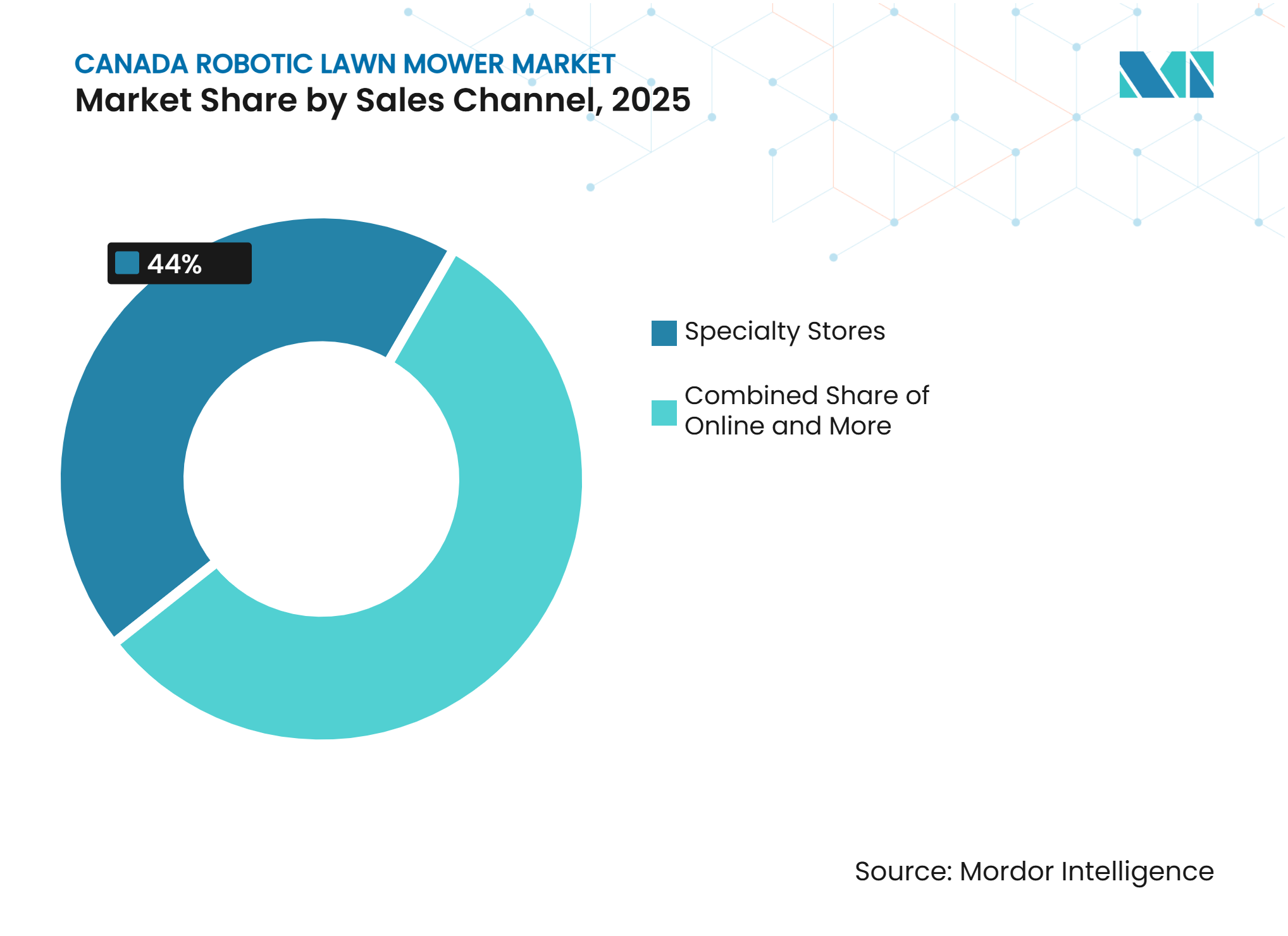
- By sales channel, specialty stores held the largest position with 44% of 2025 sales, while online sales are forecast to grow at a CAGR of 17.5% from 2026 to 2031.
- By application, residential use held the largest position with 62% of Canada robotic lawn mower market size in 2025, while commercial use is forecast to grow at a CAGR of 16.6% from 2026 to 2031.
- By end user, homeowners held the largest position with 56% of 2025 revenue, while municipalities are forecast to grow at a CAGR of 18.5% from 2026 to 2031.
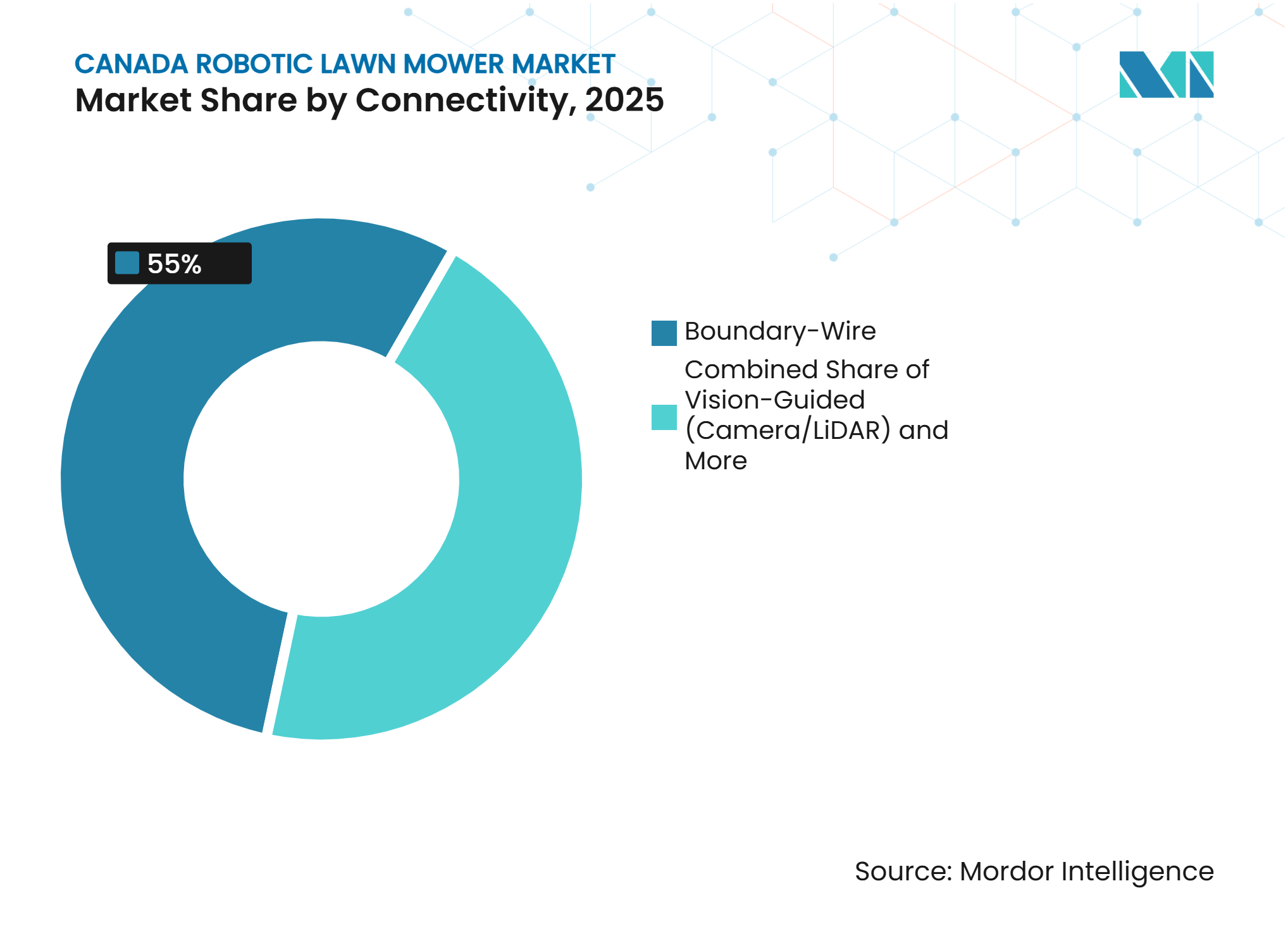
- By connectivity, boundary-wire systems held the largest position with 55% of 2025 revenue, while vision-guided systems are forecast to grow at a CAGR of 20% from 2026 to 2031.
Note: Market size and forecast figures in this report are generated using Mordor Intelligence’s proprietary estimation framework, updated with the latest available data and insights as of January 2026.
Market Trends and Insights
Drivers Impact Analysis of Canada Robotic Lawn Mower Market*
| Driver | (~) % Impact on CAGR Forecast | Geographic Relevance | Impact Timeline |
|---|---|---|---|
| Landscaping Labour Shortages and Wage Pressure | +2.8% | National, concentrated in Ontario, British Columbia, and Alberta | Short term (≤ 2 years) |
| Demand for Convenient Residential Lawn Maintenance | +2.5% | National, with early gains in Greater Toronto Area, Metro Vancouver, and Calgary | Short term (≤ 2 years) |
| Transition Toward Lower-Emission Outdoor Power Equipment | +2.2% | Urban and suburban centers, strongest in Ontario and British Columbia | Medium term (2-4 years) |
| Winter-to-Summer Equipment Utilization Through Modular Platforms | +1.9% | National, with emphasis on prairie and Atlantic provinces | Medium term (2-4 years) |
| Commercial Adoption on Golf Courses, Sports Grounds, and Municipal Turf | +2.5% | National, with early adoption in southern Ontario, British Columbia, and Saskatchewan | Short term (≤ 2 years) |
| Winter-Ready Scheduling and Frost Management Create Demand for Smarter Connected Models | +2.5% | National, with relevance across climate zones | Medium term (2-4 years) |
| Source: Mordor Intelligence | |||
Landscaping Labour Shortages and Wage Pressure
Labor availability is a direct constraint on lawn maintenance businesses that depend on seasonal field crews. In Alberta, 56.1% of employers in landscaping and grounds maintenance reported hiring difficulties in 2025, and 12% had vacancies open for more than 4 months[1]. The Canadian Nursery and Landscape Association reported continued wage escalation since 2018 in its 2024 wage survey, including for management and supervisory positions. Autonomous mowing gives an operator a way to cover routine turf work with fewer crew hours. That operating model can be more attractive when recruitment and retention remain difficult across the Canada robotic lawn mower market. The benefit is greatest when a company can move workers from repetitive mowing to tasks requiring on-site judgment.
Demand for Convenient Residential Lawn Maintenance
Homeowners are considering robotic mowing when it reduces recurring manual work and fuel use. Time-constrained suburban households are a central audience for battery-powered and robotic lawn care. Lower-complexity products can make robotic mowing more accessible for smaller suburban properties. Buyer interest is not limited to convenience, because physical limitations and seasonal time constraints can also affect the appeal of automation. Clear setup instructions and dependable local support remain important at the first purchase. This residential demand supports a larger installed base for the Canada robotic lawn mower market.
Transition Toward Lower-Emission Outdoor Power Equipment
Public policy and user preferences are drawing increasing attention to battery-powered outdoor equipment. The City of Toronto recommended a transition toward zero-emission outdoor power equipment in an April 2025 staff report and proposed phasing out 2-stroke engine devices by January 1, 2030. Robotic mowers fit this shift because they use rechargeable batteries rather than gasoline engines. The transition does not remove the need for battery storage, charging access, and responsible end-of-life management. It nevertheless gives product suppliers a practical basis for positioning robotic mowers within lower-emission grounds maintenance.
Commercial Adoption on Golf Courses, Sports Grounds, and Municipal Turf
Commercial sites can use autonomous equipment to maintain defined turf areas on repeatable schedules. The United States Golf Association documented the use of autonomous mowers at golf courses and identified labor savings and overnight operation as potential operating benefits. This use case is relevant to Canadian operators who need to make productive use of a short mowing season. A fleet can be evaluated against scheduled labor, equipment, fuel, and the consistency of routine mowing. Municipal or course pilots may lead to larger procurement only after operators validate reliability and service arrangements. Commercial adoption, therefore, gives the Canada robotic lawn mower market a route to higher-value unit sales.
Restraints Impact Analysis of Canada Robotic Lawn Mower Market*
| Restraint | (~) % Impact on CAGR Forecast | Geographic Relevance | Impact Timeline |
|---|---|---|---|
| High Upfront Purchase and Installation Cost | -1.80% | National, with strongest friction in rural and small-town areas | Short term (≤ 2 years) |
| Lawn-Layout, Boundary, and Installation Constraints | -1.60% | National, including densely landscaped suburban properties | Short term (≤ 2 years) |
| Cold-Weather Battery and Charging Limitations | -1.60% | National, most acute in prairie and Atlantic provinces | Medium term (2-4 years) |
| Short Effective Mowing Season and Seasonal Revenue Concentration | -1.60% | National, with greatest effect in northern and inland areas | Long term (≥ 4 years) |
| Source: Mordor Intelligence | |||
High Upfront Purchase and Installation Cost
Initial purchase cost remains a barrier for price-sensitive households and smaller landscaping firms. Wire-free residential models can involve hardware, installation, connectivity, and service costs that require a multi-season ownership assessment. Buyers must compare those costs with several seasons of labor and fuel savings, which can delay first-time adoption. The issue is more acute for small properties where the time saved is limited. Municipal and golf-course buyers can assess equipment across longer maintenance cycles and larger managed areas. The Canada robotic lawn mower market must therefore offer clearer ownership-cost information and service options for buyers who focus on initial price.
Cold-Weather Battery and Charging Limitations
Cold conditions reduce the practical operating window for battery-powered robotic mowers. Users may experience shorter runtimes, increased storage needs, and charging limits when temperatures fall. Ottawa’s Noise By-law 2017-255 restricts outdoor power equipment operation to 7:00 AM through 10:00 PM on weekdays, which can further narrow usable operating hours in an urban setting. The constraint is relevant beyond Ottawa because weather and local operating rules can influence scheduling across Canadian cities. Models with frost sensing, battery management, and automated seasonal storage routines can reduce some uncertainty for buyers. These conditions make reliable cold-weather guidance a necessary part of product support.
*Our forecasts treat driver/restraint impacts as directional, not additive. The impact forecasts reflect baseline growth, mix effects, and variable interactions.
Canada Robotic Lawn Mower Market Segment Analysis
By Range:
Mid-Market Products Support Broad Residential DemandMedium-range products held 48% of 2025 revenue and formed the largest range category in the Canada robotic lawn mower market. These models address typical suburban lots, balancing cutting capacity, battery runtime, and purchase cost. Low-range models remain relevant for smaller urban lawns and for households testing automated mowing for the first time. Their role is to lower the entry threshold rather than replace higher-capacity models at larger properties. Portfolio breadth matters because a buyer may upgrade after gaining confidence in autonomous operation.
High-range models are forecast to grow at a CAGR of 15.5% from 2026 to 2031. This tier is suited to multi-zone sites, larger residential properties, and commercial grounds that require greater area coverage. MAMMOTION lists its LUBA mini AWD for Canada in 2026, indicating that wire-free navigation is moving into lower price tiers. Navimow lists the i2 AWD series in Canada in 2026[2]. High-range suppliers must therefore differentiate through area capacity, slope handling, multi-zone control, and service support.



By Battery Capacity:
Higher-Voltage Models Meet Commercial Operating NeedsThe 20 to 30 V category held 52% of 2025 revenue and was the largest battery-capacity segment. It includes a substantial installed base of residential robotic mowers with capacity suited to common lawn sizes. STIHL’s iMOW EVO range is listed in Canada in 2026 for lawns up to 5,000 square meters. Products with less than 20 V retain a role in entry-level residential use. They face pressure when longer-running products are offered at similar prices.
More than 30 V products are forecast to grow at a CAGR of 16.5% from 2026 to 2031. Longer runtime can reduce charging interruptions and the number of units needed for a managed commercial site. MAMMOTION states that in 2026 its LUBA 3 AWD has a 15 Ah battery, up to 215 minutes of runtime per charge, and a coverage of 501.7 square meters per hour. These claimed specifications show why higher-capacity equipment can be evaluated as a commercial tool rather than only as a household convenience. Battery performance, charging access, and cold-weather management will determine how consistently that value is realized in Canadian conditions.
By Sales Channel:
Digital Selling Expands Buyer AccessSpecialty stores held 44% of 2025 sales and were the largest sales channel. Dealer networks have traditionally provided demonstrations, installation assistance, and post-sale service for equipment that required boundary-wire setup. Retailers provide another route to consumers who want to see products through mass-market outlets. Specialty stores accounted for a material part of the Canada robotic lawn mower market size in 2025, reflecting continued buyer demand for installation support. Channel choice can affect buyer confidence as much as product price.
Online sales are forecast to grow at a CAGR of 17.5% from 2026 to 2031. Direct-to-consumer sellers benefit when wire-free systems reduce installation work and can be configured by the user. WORX lists its Landroid Vision Cloud in Canada in 2026 through its own online channel, presenting a cloud-enabled wire-free option to consumers. Online buyers still need prompt software support, firmware updates, replacement parts, and clear warranty processes. Brands that combine digital selling with dependable local service can reduce the advantage long held by traditional dealers.

By Application:
Commercial Use Gains on a Large Residential BaseResidential applications held 62% of 2025 revenue and were the largest application segment. The segment benefits from the broad base of owner-occupied suburban homes and earlier adoption of boundary-wire units. Residential users usually assess a product against personal time, seasonal lawn work, and the effort required for setup. Their purchase decisions often place high weight on ease of use and local support. This installed base continues to provide the central volume foundation for the Canada robotic lawn mower market.
Commercial applications are forecast to grow at a CAGR of 16.6% from 2026 to 2031. Golf courses, municipalities, sports grounds, and landscaping firms can use fleet management to organize repeat mowing across larger turf areas. Landscape Ontario identified autonomous mowers as a leading trend for 2025 in its industry survey of landscape businesses. Commercial buyers need reliable area coverage, service response, and scheduling that fits limited seasonal operating time. Their transition from trial units to fleet procurement can materially increase the value of each account.
By End User:
Municipal Buyers Have the Fastest Growth OutlookHomeowners held 56% of 2025 end-user revenue and were the largest buyer group. Specialty stores, online outlets, and mass retailers provide several paths for households to acquire a robotic mower. A wider range of residential models broadens the choice set for suburban yards, although buyers still consider site preparation and seasonal storage. Homeowner demand favors intuitive controls, flexible zoning, and clear maintenance guidance. This segment keeps the Canada robotic lawn mower industry linked to consumer lawn-care purchasing patterns.
Municipalities are forecast to grow at a CAGR of 18.5% from 2026 to 2031. Municipal use can begin with controlled trials before procurement teams establish specifications for more parks or facilities. Early municipal tests show the value of assessing equipment across more than 1 operating season. A public buyer also considers noise, public safety, operating reliability, and the availability of trained service support. Successful pilots can make the equipment a recurring capital item rather than a one-time technology test.
By Connectivity:
Vision-Guided Navigation Changes Installation EconomicsBoundary-wire systems held 55% of 2025 revenue and were the largest connectivity category. Their position reflects the installed base of earlier models that use a physical perimeter to define the mowing area. The approach remains useful for stable lawns where the owner accepts the initial installation process. Smart global positioning system (GPS) and Wi-Fi systems provide a middle option with connected control and satellite-based positioning. Connectivity choices now shape the installation experience as much as the mower’s cutting function.
Vision-guided systems are forecast to grow at a CAGR of 20% from 2026 to 2031. Camera, light detection and ranging (LiDAR), and positioning inputs can allow models to operate without a physical boundary wire. Dreame lists robotic lawn mowers in Canada in 2026 with sensor-led navigation options. MAMMOTION also sells wire-free robotic lawn mowers in Canada in 2026. Buyers may value the ability to revise mowing zones after landscaping changes without reinstalling wire, but performance on shaded, complex, and frost-affected sites remains important.
Geography Analysis
Ontario was the leading demand center for the Canada robotic lawn mower market in 2025, supported by dense suburban housing and established specialty-store networks. The Greater Toronto Area combines a large residential base with commercial properties that require regular turf maintenance. Toronto’s April 2025 staff report on zero-emission outdoor power equipment sends a policy signal favoring battery-powered products. British Columbia is another major center, where Metro Vancouver’s milder climate can provide a longer mowing season than much of the country. Alberta also supports demand through its suburban markets and commercial landscaping activity in Calgary and Edmonton.
Quebec has a substantial residential base, but buyers place particular weight on winter storage, frost timing, outlet access, and French-language support. These factors can make the sales process more complex than in provinces with longer operating seasons. Product documentation and customer service that address local operating conditions can improve purchase confidence. Saskatchewan and Manitoba remain earlier-stage locations where municipal use can demonstrate practical performance. Shorter seasons and fewer specialized dealers can limit residential adoption in these provinces.
Atlantic Canada and the northern territories represented limited near-term volume in 2025 because of lower utilization and challenging weather. Equipment that supports more than one outdoor task may improve the ownership case in low-utilization areas. Yarbo positions its modular platform in Canada for mowing and snow-clearing attachments, which aligns with this need for broader seasonal use[3]. Regional conditions do not create separate market segments, but they influence product selection, charging arrangements, and service requirements.
Competitive Landscape
Market Concentration
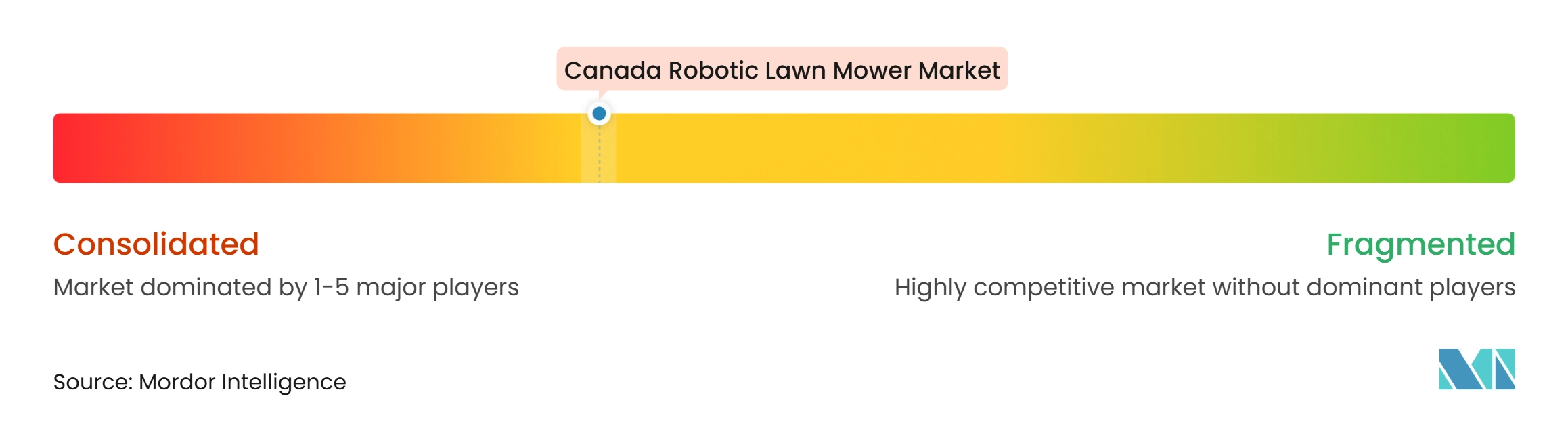
The Canada robotic lawn mower market is moderately concentrated, with established dealers and newer direct sellers serving different buyer needs. Husqvarna has broad brand recognition and a deep Canadian dealer presence. In 2025, Husqvarna introduced 13 new boundary-wire-free robotic lawn mowers, its largest launch of this type. STIHL sells its iMOW EVO products through its Canadian dealer network. Positec’s WORX range uses national retail and online access for its connected robotic mower offer.
Product strategy is moving toward wire-free navigation, remote control, and simpler buyer setup. In March 2025, Husqvarna launched 4 Automower iQ Series models in Canada with support from its Husqvarna Cloud network. In June 2025, STIGA unveiled the A4 and A8 autonomous mowers, featuring real-time kinematic autonomous guidance system technology for gardens up to 400 and 800 square meters, respectively. MAMMOTION, Navimow, Dreame, ECOVACS, and Anker Innovations have expanded consumer choice through wire-free models and online-led selling. Competitive differentiation increasingly depends on performance in complex lawns, service availability, and the quality of digital support.
Professional suppliers also compete where area coverage and fleet management matter more than consumer convenience. In October 2024, Husqvarna presented 4 professional boundary-wire-free models for sports fields, golf courses, and large facility maintenance, with global availability from March 2025. YAMABIKO Corporation’s Belrobotics and Zucchetti Centro Sistemi’s Ambrogio Robot address professional and large-area use cases. Yarbo differentiates through a modular approach intended to support mowing and snow clearing in Canadian conditions. The competitive field will remain active as suppliers balance direct sales, dealer support, product reliability, and commercial fleet capabilities.
Canada Robotic Lawn Mower Industry Leaders
-
Husqvarna AB
-
STIHL Pty Ltd
-
Navimow
-
Positec Group Ltd.
-
Greenworks Tools Canada Inc.
- *Disclaimer: Major Players sorted in no particular order
Canada Robotic Lawn Mower Market Companies Covered in this Report
- Husqvarna AB
- STIHL Pty Ltd
- Navimow
- Positec Group Ltd.
- Greenworks Tools Canada Inc
- MAMMOTION
- ECOVACS
- Dreame Global
- Yarbo CA
- Anker Innovations Canada Co., Ltd
- YAMABIKO Corporation (Belrobotics)
- Zucchetti Centro Sistemi S.p.a. (Ambrogio Robot )
- Reliable Robots
- Cleva Canada
- STIGA S.p.A.
Recent Industry Developments in Canada Robotic Lawn Mower Market
- July 2026: MAMMOTION launches iNavi Service across Canada, eliminating the need for on-site real-time kinematic (RTK) antenna installation by delivering centimeter-level positioning through a network-based correction service.
- February 2026: ECOVACS launches the GOAT A3000 LiDAR PRO, featuring HoloScope 360 Dual-LiDAR navigation and an integrated TruEdge trimmer.
- June 2025: STIGA S.p.A. unveiled the A4 and A8 autonomous robot mowers, wire-free models using patented RTK AGS technology for gardens up to 400 square meters and 800 square meters, respectively.
Canada Robotic Lawn Mower Market Report Scope
A robotic lawn mower is an autonomous device equipped with sensors and programming to perform grass-cutting tasks without human intervention. These are used for residential and commercial purposes by homeowners, apartment owners, in parks and playgrounds, and in other places.
The Canada Robotic Lawn Mower Market Report is Segmented by Range (Low Range, Medium Range, and High Range), by Battery Capacity (Less Than 20 V, 20 to 30 V, and More Than 30 V), by Sales Channel (Retailers, Specialty Stores and Online), by Application (Residential and Commercial), by End-User (Homeowners, Landscaping Companies, Sports Grounds and Parks, Municipalities, Golf Courses and Others), and by Connectivity (Boundary-Wire, Smart-GPS / Wi-Fi and Vision-Guided). The Market Forecasts are Provided in Terms of Value (USD).
Segmentation Overview
| Low Range |
| Medium Range |
| High Range |
| Less Than 20 V |
| 20 to 30 V |
| More Than 30 V |
| Retailers |
| Specialty Stores |
| Online |
| Residential |
| Commercial |
| Homeowners |
| Landscaping Companies |
| Sports Grounds and Parks |
| Municipalities |
| Golf Courses |
| Others |
| Boundary-Wire |
| Smart-GPS / Wi-Fi |
| Vision-Guided (Camera/LiDAR) |
| By Range | Low Range |
| Medium Range | |
| High Range | |
| By Battery Capacity | Less Than 20 V |
| 20 to 30 V | |
| More Than 30 V | |
| By Sales Channel | Retailers |
| Specialty Stores | |
| Online | |
| By Application | Residential |
| Commercial | |
| By End-User | Homeowners |
| Landscaping Companies | |
| Sports Grounds and Parks | |
| Municipalities | |
| Golf Courses | |
| Others | |
| By Connectivity | Boundary-Wire |
| Smart-GPS / Wi-Fi | |
| Vision-Guided (Camera/LiDAR) |
Key Questions Answered in the Report
What is the projected value of robotic lawn mower sales in Canada by 2031?
The Canada robotic lawn mower market size is forecast to reach USD 115.4 million by 2031, from USD 63.8 million in 2026.
What is driving adoption of robotic lawn mowers in Canada?
Labor shortages, demand for less manual lawn work, and interest in lower-emission equipment are key demand factors.
Which application is expanding fastest in Canada?
Commercial use is forecast to grow at a CAGR of 16.6% from 2026 to 2031, supported by golf courses, parks, and landscaping operations.
What factors limit use of robotic mowers in Canada?
Upfront cost, complex lawn layouts, cold-weather battery performance, and a short mowing season can delay adoption.