
Canada Plastic Waste Management Services Market Size and Share
Market Overview
| Study Period | 2020 - 2031 |
|---|---|
| Forecast Data Period | 2026 - 2031 |
| Base Year Market Size (2025) | USD 1.05 Billion |
| Market Size (2026) | USD 1.09 Billion |
| Market Size (2031) | USD 1.34 Billion |
| Growth Rate (2026 - 2031) | 4.22 % |
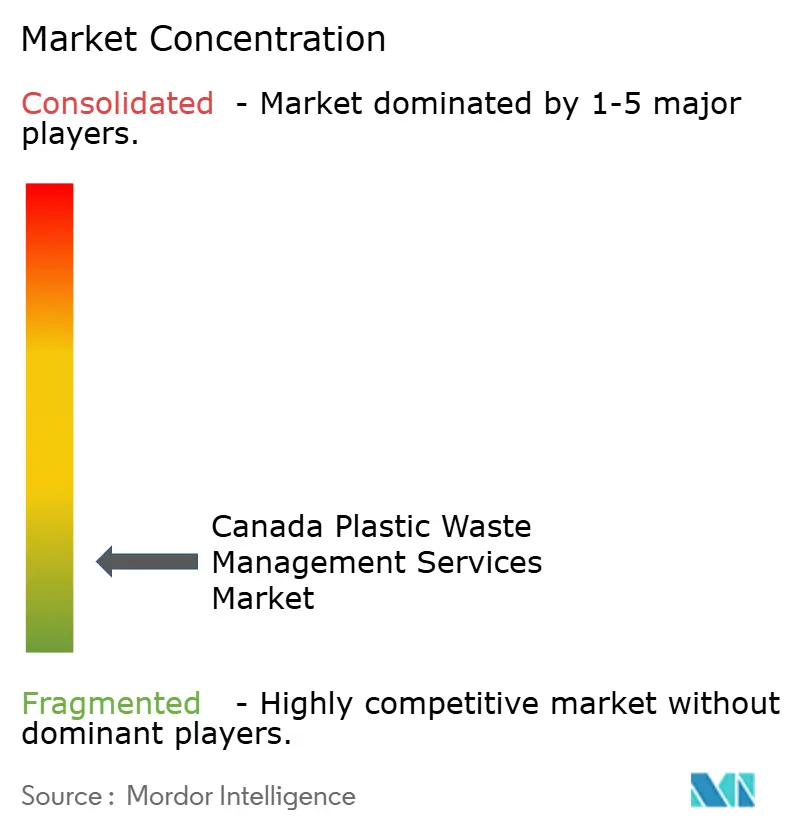
| Market Concentration | Low |
Major Players *Disclaimer: Major Players sorted in no particular order Image © Mordor Intelligence. Reuse requires attribution under CC BY 4.0. | |
Canada Plastic Waste Management Services Market Analysis by Mordor Intelligence
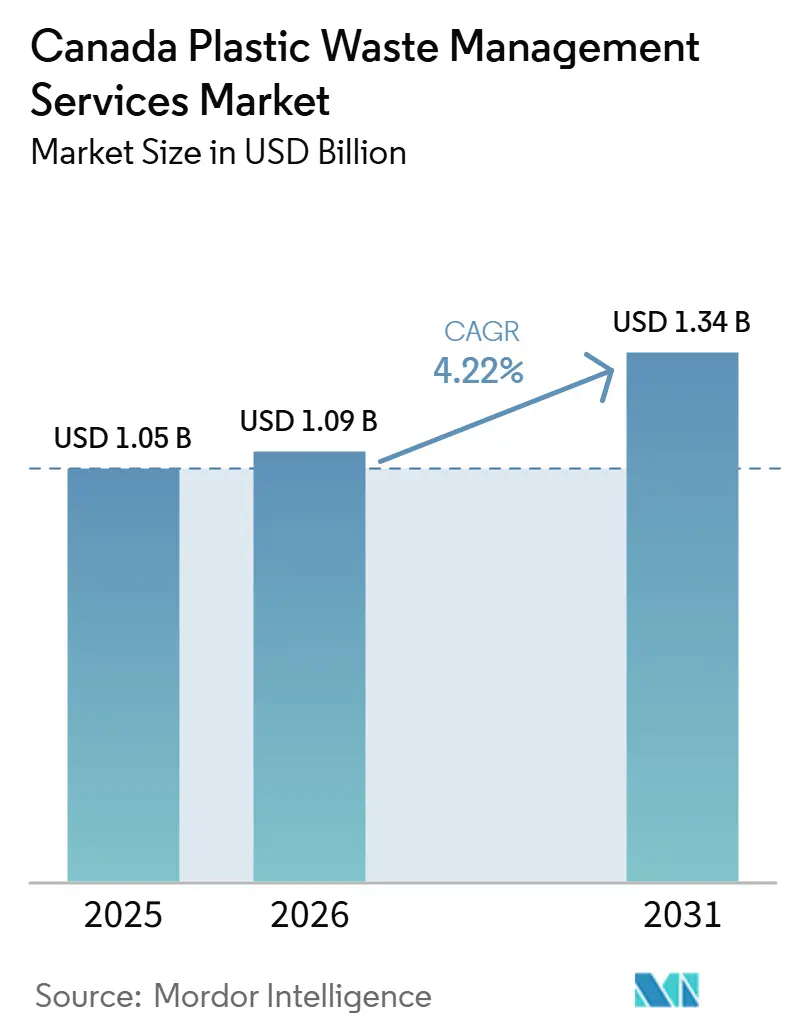
The Canada Plastic Waste Management Services Market size is expected to grow from USD 1.05 billion in 2025 to USD 1.09 billion in 2026 and is forecast to reach USD 1.34 billion by 2031 at 4.22% CAGR over 2026-2031.
The Canada plastic waste management services market is being shaped by the full rollout of producer responsibility systems, the start of mandatory plastics reporting, and faster adoption of AI-led sorting infrastructure across major provinces. Ontario’s Blue Box transition, Quebec’s modernized selective collection model, and Nova Scotia’s packaging EPR launch have widened the contract base for collection, sorting, processing, and compliance support services. The Canada plastic waste management services market is also seeing stronger technology-led competition as larger operators and specialized processors invest in optical sorting, bale quality recognition, and molecular recycling capacity to improve output quality and service scope. Competitive conditions remain fragmented because municipal entities, private operators, and producer responsibility organizations continue to share influence over contract awards, procurement structures, and material standards. Growth through 2031 will still be moderated by contamination in residential streams, uneven provincial program structures, and limited recovery economics for lower-value resins, even as federal and provincial actions continue to expand the formal service base.
Key Report Takeaways
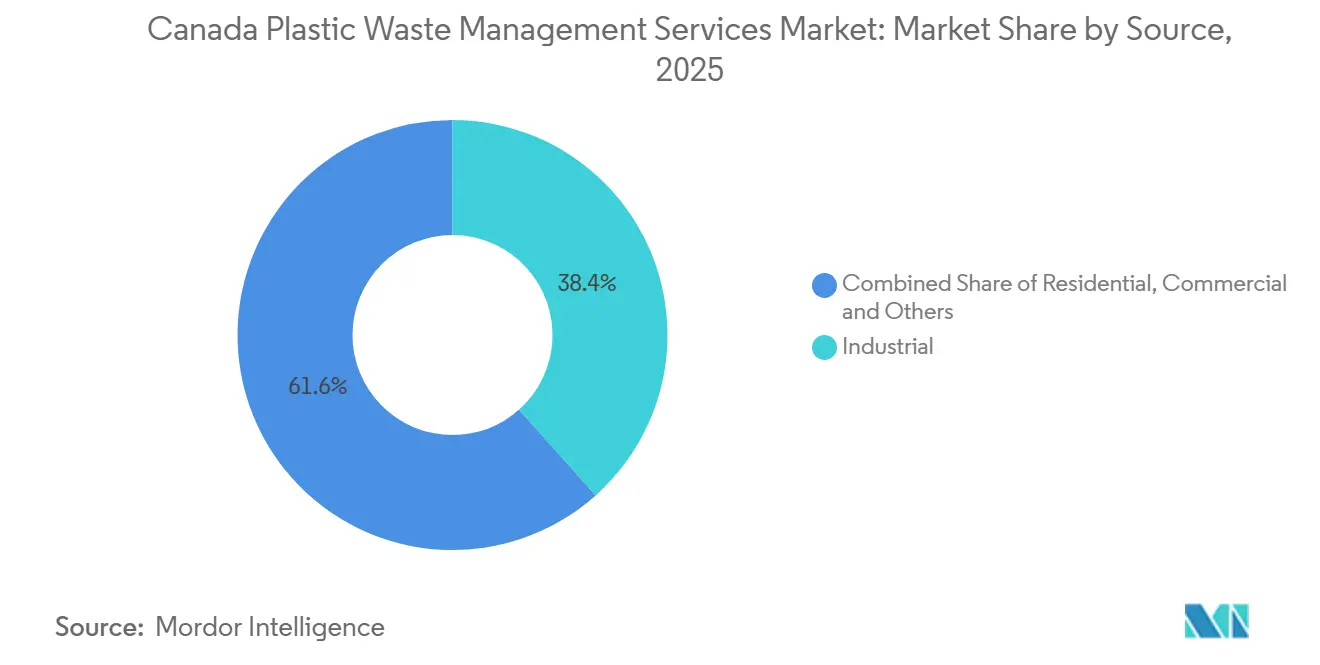
- By source, industrial held 38.4% of the Canada plastic waste management services market share in 2025, while residential is forecast to expand at a 5.2% CAGR through 2031.
- By service provider, public and municipal operators accounted for 45.7% share of the Canada plastic waste management services market size in 2025, while private waste management companies are projected to grow at a 5.9% CAGR through 2031.
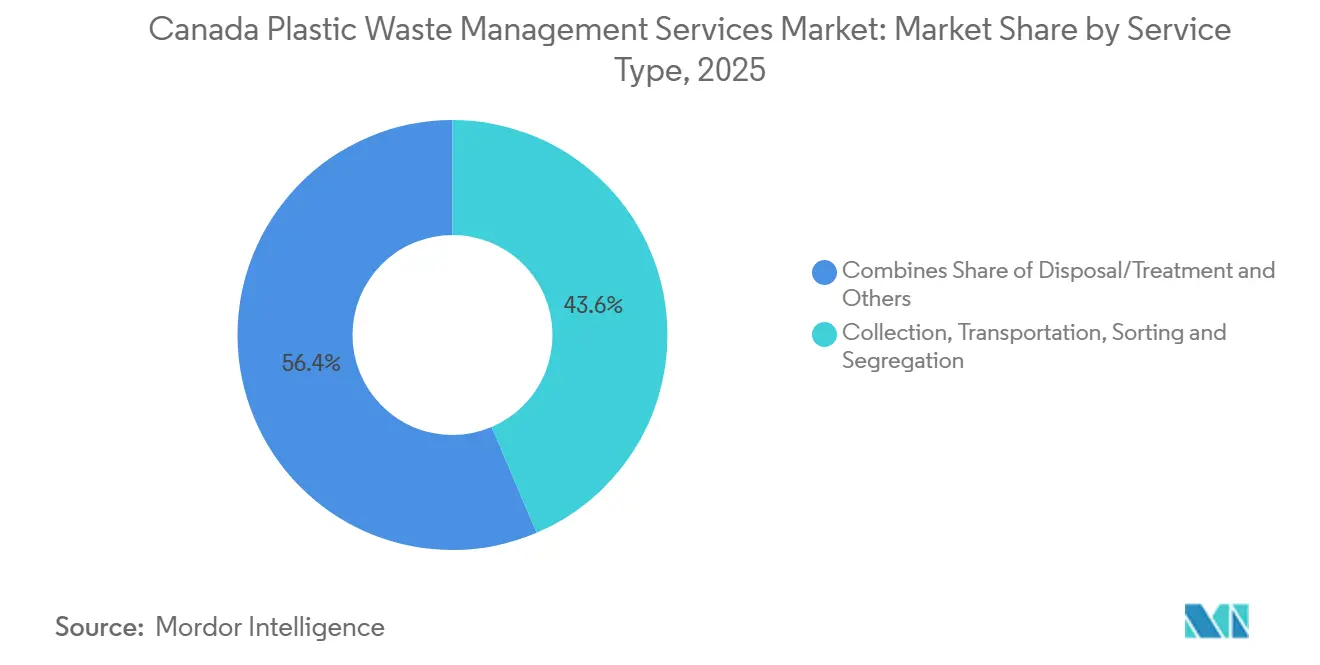
- By service type, collection, transportation, sorting & segregation represented 43.6% share of the Canada plastic waste management services market size in 2025, while disposal & treatment is expected to rise at a 6.2% CAGR through 2031.
Note: Market size and forecast figures in this report are generated using Mordor Intelligence’s proprietary estimation framework, updated with the latest available data and insights as of January 2026.
Canada Plastic Waste Management Services Market Trends and Insights
Drivers Impact Analysis*
| Driver | (~) % Impact on CAGR Forecast | Geographic Relevance | Impact Timeline |
|---|---|---|---|
| Federal Single-Use Plastics Regulations Increasing Collection and Recovery Needs | +1.1% | National | Short term (≤ 2 years) |
| Growing Investments in Circular Economy and Plastics Recovery Infrastructure | +0.9% | Ontario, Quebec, British Columbia | Medium term (2-4 years) |
| Increasing Commercial and Institutional Demand for Zero-Waste Programs | +0.7% | Ontario, Quebec, British Columbia | Medium term (2-4 years) |
| Federal Plastics Registry Driving Data-Driven Waste Management | +0.5% | National | Short term (≤ 2 years) |
| Rapid Adoption of AI-Enabled Material Recovery Facilities | +0.4% | Ontario, Quebec, Atlantic Canada | Medium term (2-4 years) |
| Rising Plastic Packaging Waste from E-commerce and Food Delivery | +0.3% | Ontario, British Columbia, Quebec | Long term (≥ 4 years) |
| Source: Mordor Intelligence | |||
Federal Single-Use Plastics Regulations Increasing Collection and Recovery Needs
The Canada plastic waste management services market is seeing stronger demand for collection and recovery support because the Single-Use Plastics Prohibition Regulations are now fully in force across the covered product categories.[1]Environment and Climate Change Canada, “Federal Plastics Registry,” Government of Canada, canada.ca The rules cover checkout bags, cutlery, certain foodservice ware, ring carriers, stir sticks, and straws, which have already changed the mix of materials entering Canadian waste streams. Environment and Climate Change Canada estimated that the regulations would reduce plastic waste by 1.3 million tons over the 10-year analytical period, suggesting a broad shift in collection and end-of-life handling rather than a narrow product ban effect. As substitute materials enter the stream, material recovery facilities need improved identification, separation, and handling capabilities, which support demand for upgraded sorting lines and technical support services. This is pushing the Canada plastic waste management services market toward higher-value contracts tied to material quality and system compliance, rather than just basic pickup and hauling.
Growing Investments in Circular Economy and Plastics Recovery Infrastructure
The Canada plastic waste management services market is benefiting from steady public and blended investment in circular infrastructure, which has improved the funding base for recovery projects.[2]Canada Infrastructure Bank, “CIB Commits $277 Million Towards Biorefinery and Canada’s Largest Electrolyzer,” Canada Infrastructure Bank, cib-bic.ca Environment and Climate Change Canada has provided over USD 10 million to 55 projects since 2018 under its Advancing a Circular Plastics Economy for Canada initiative, including over USD 1.8 million to 13 recipients in 2025. These projects cover reuse and refill systems, textile recycling, healthcare plastics reduction, and materials innovation, broadening the range of service opportunities available to operators. The Canada Infrastructure Bank has also backed the Varennes Carbon Recycling biorefinery project in Quebec, which converts non-recyclable waste into renewable methanol and circular plastics. It shows that larger-scale waste-diversion assets are now attracting structured capital. As these projects move from pilot activities to operating assets, the Canada plastic waste management services market gains a larger pool of bankable contracts for processing, feedstock supply, and plant support services.
Increasing Commercial and Institutional Demand for Zero-Waste Programs
The Canada plastic waste management services market is also expanding due to commercial and institutional demand, as these waste streams are harder to manage through standard residential collection systems. Ontario requires source separation for designated industrial, commercial, and institutional generators, providing a formal basis for plastic recovery services beyond curbside programs. The Canada Plastics Pact reported that the IC&I sector recycled only 11% of plastic packaging, leaving a significant performance gap for service providers that can collect, sort, and verify commercial volumes more effectively. Zero Waste Canada’s facility certification program is creating a visible demand signal from hotels, health care sites, office buildings, and distribution centers seeking formal recognition for their diversion performance. This pushes the Canada plastic waste management services market toward recurring, account-based contracts, which are usually more stable than one-time hauling work and less exposed to residential participation swings.[3]Canada Plastics Pact, “Canada-wide Plastic Packaging Flows, A 2024 Progress Report,” Canada Plastics Pact, plasticspact.ca
Federal Plastics Registry Driving Data-Driven Waste Management
The Canada Plastic Waste Management Services Market is becoming increasingly data-driven as the Federal Plastics Registry transforms plastics reporting into a structured annual compliance activity. By requiring businesses to submit detailed information on plastic products and packaging entering the residential waste stream, the registry is improving data transparency and enabling more accurate tracking of plastic waste generation, collection, and management. The first reporting deadline in September 2025 marked an important step toward strengthening data-based decision-making and improving the efficiency of waste management services across Canada. The program now requires repeated annual reporting, which means producers need more structured systems for waste data capture, reconciliation, and recordkeeping. The federal government also announced changes to later reporting phases in late 2025. It signaled a new notice for the 2027 to 2029 reporting years, indicating that the system is still being refined while maintaining compliance obligations. That is creating durable demand in the Canada plastic waste management services market for data handling, audit support, and service models that more closely tie collection operations to producer reporting needs.
Restraints Impact Analysis*
| Restraint | (~) % Impact on CAGR Forecast | Geographic Relevance | Impact Timeline |
|---|---|---|---|
| High Contamination Levels in Residential Recycling Streams | -0.8% | National, concentrated in urban centers of Ontario, Quebec, and British Columbia. | Long term (≥ 4 years) |
| Fragmented Provincial Regulations and Recycling Standards | -0.6% | National, across all provinces and territories | Medium term (2-4 years) |
| Long Transportation Distances in Remote and Northern Communities | -0.4% | Nunavut, Northwest Territories, Yukon, Northern Ontario, and Northern Quebec | Long term (≥ 4 years) |
| Limited Domestic Markets for Certain Low-Value Plastic Resins | -0.3% | Ontario and Quebec, with spillover to other provinces | Medium term (2-4 years) |
| Source: Mordor Intelligence | |||
High Contamination Levels in Residential Recycling Streams
The Canada plastic waste management services market continues to face quality pressure because contamination remains high in residential single-stream systems. Recycle BC’s audit work showed in 2024 that single-stream contamination is nearly double that of multi-stream collection, lowering bale quality and reducing downstream recovery value. The Canada Plastics Pact also reported in 2024 that Canada’s plastic packaging recycling rate remained at 16%, showing that more collection effort has not yet produced broad improvement in system output quality. This raises reprocessing cost and weakens pricing for recovered material, especially for operators working under fixed-fee or tightly specified producer-funded contracts. The result is that the Canada plastic waste management services market must invest more in sorting accuracy and quality control before it can capture the full value of higher material recovery volumes.
Fragmented Provincial Regulations and Recycling Standards
The Canada plastic waste management services market also faces cost pressure because producer responsibility systems are mandatory across most jurisdictions, but remain operationally uneven. Provinces differ in material definitions, reporting schedules, fee methods, and designated organizations, so a provider working across several provinces must still manage multiple compliance models simultaneously. British Columbia has operated its packaging EPR system since 2014; Alberta launched Phase 1 in April 2025 and is advancing Phase 2 in 2026; and Nova Scotia launched its own program in December 2025, showing how uneven the transition path has been across Canada. These staggered rollouts make service pricing harder to standardize and reduce the benefits of scale for operators that want a national or multi-province footprint. As a result, the Canada plastic waste management services market continues to develop in a patchwork pattern even as EPR coverage expands across the country.
*Our forecasts treat driver/restraint impacts as directional, not additive. The impact forecasts reflect baseline growth, mix effects, and variable interactions.
Segment Analysis
By Source: Industrial Volumes Anchor Market Revenue, Residential Streams Drive Growth
Industrial accounted for 38.4% of the Canada plastic waste management services market share in 2025, which made it the largest source segment by revenue. The segment benefits from concentrated volumes generated across manufacturing, automotive, warehousing, and resource-linked facilities, which are easier to aggregate than household streams. Industrial plastics are also more likely to arrive in cleaner, more homogeneous batches, which supports more efficient sorting, treatment, and higher-value recovery. This keeps industrial feedstock important to the Canada plastic waste management services market even as policy attention moves more strongly toward packaging and post-consumer collection. The segment’s value position is therefore tied as much to material quality as to the scale of waste generation.
Residential is the fastest-growing source segment and is projected to expand at a 5.2% CAGR through 2031 as EPR rollouts continue to channel more funding into curbside systems, processing contracts, and participation support. Alberta’s 2025 launch, Ontario’s 2026 transition, and Nova Scotia’s 2025 program start all increase the formal residential contract base in different parts of the country. Commercial sources are also becoming more important because the IC&I sector recycled only 11% of plastic packaging in the 2024 Canada Plastics Pact assessment, indicating a clear service gap for account-based recovery programs. The others category, including specialized institutional and smaller non-household streams, remains less developed but should gain attention as producers and regulators push for wider recovery coverage beyond standard residential packaging programs.



By Service Provider: Municipal Programs Dominate, Private Operators Expand Through EPR Transition
Public and municipal providers are expected to account for a 45.7% share of the Canada plastic waste management services market in 2025, supported by their long-standing role in residential collection and established links with provincial and local waste systems. This leading position remains important, but it is becoming less secure as producer-funded EPR shifts operational control away from municipalities in several provinces. Ontario’s transition, along with similar changes in other jurisdictions, is expanding access to contracts that were historically tied to municipal procurement structures. As a result, the Canada plastic waste management services market remains anchored in large-scale public systems, while commercial control over service delivery gradually moves outward.
Private waste management companies represent the fastest-growing provider group, with a projected CAGR of 5.9% through 2031, as they can bid on newly tendered EPR work and invest in sorting and processing upgrades faster than many municipal systems. In Quebec, Éco Entreprises Québec is set to assume responsibility for modernized selective collection from January 1, 2025, which will change how service procurement is organized and give producer-backed administration a stronger role in contract design. Producer responsibility organizations, such as Circular Materials, Recycle BC, and Éco Entreprises Québec, now influence material standards, collection design, and processing expectations across the service chain. This shift gives the Canada plastic waste management services market a structure in which organizations that aggregate producer obligations and channel them into multi-year service contracts increasingly shape operational demand.
By Service Type: Collection Leads in Scale, Treatment Services Register Fastest Growth
Collection, transportation, sorting & segregation accounted for 43.6% of the 2025 market, making it the largest service type in the Canada plastic waste management services market. This segment leads because every downstream activity still depends on strong upstream capture, movement, and separation of materials. Each province moving deeper into EPR creates new or renewed tenders for pickup, transfer, and sorting, thereby expanding the contract base for these services. Quebec’s modernization program and Scale AI’s 2025 project to deploy automated bale quality recognition across around 25 EPR-regulated material recovery facilities show that sorting quality is becoming a larger part of service differentiation, not just a support function.
Disposal & treatment is the fastest-growing service type. It is projected to grow at a 6.2% CAGR through 2031, as landfill pressure, improved recovery economics, and greater demand for secondary materials support investment in recycling and conversion assets. GreenMantra Technologies received a USD 10 million loan in September 2025 to expand output at its Brantford facility, indicating that capital is moving into molecular recycling capacity rather than remaining focused solely on collection infrastructure. That makes treatment a more active growth lane within the Canada plastic waste management services market, as operators can capture value from processing capabilities, feedstock conversion, and higher-grade outputs. Advisory, audit, and training work also continues to expand as producers and service operators need more formal support to meet registry, EPR, and material quality requirements.
Geography Analysis
Ontario and Quebec were the most active centers of the Canada plastic waste management services market in 2025 and 2026 due to their scale, policy intensity, and concentration of industrial and household plastic flows. Ontario’s EPR transition has expanded the field for service contracting, while Quebec’s modernized selective collection system has moved decision-making more directly into a producer-backed structure. These 2 provinces also carry a large share of the country’s packaging, commercial, and logistics activity, which supports both collection scale and processing density. The Canada plastic waste management services market in these provinces is also more likely to adopt AI-enabled sorting and reporting systems early, as contract sizes are large enough to support technology payback. That keeps Central Canada at the front of both service demand and operating model change.
British Columbia remains the most mature EPR geography in the Canada plastic waste management services market because Recycle BC has been operating the province’s packaging and paper product system since 2014 under the Recycling Regulation. The program operates a large province-wide supply chain with 148 curbside and multi-family collectors, giving British Columbia a more established operating base than newer EPR regions. Alberta has become the main Western growth province because Phase 1 launched in April 2025 and Phase 2 is advancing in 2026, steadily expanding formal producer-funded service demand. Saskatchewan and Manitoba are moving more gradually, which means service opportunities remain concentrated in urban areas while rural and specialized streams remain less developed. Agricultural plastics across the Prairie provinces add another unmet need because they do not fit neatly into standard residential packaging systems and often require specialized collection approaches.
Atlantic Canada is becoming more relevant to the Canada plastic waste management services market as late-stage EPR rollouts create new infrastructure demand in a region that previously had a thinner service base. Nova Scotia launched its packaging and paper product EPR program in December 2025, which immediately increased the need for collection and processing readiness. Circular Materials and REgroup selected CP Group to design, build, and operate a new 112,000-square-foot material recovery facility in Halifax, with operations expected in early 2027 for Nova Scotia and New Brunswick. Northern and remote communities remain the least served part of the Canadian plastic waste management market because distance, low population density, and transport costs continue to limit the business case for conventional recovery models.
Competitive Landscape
The Canada plastic waste management services market is fragmented because demand is split across municipal systems, private operators, and producer responsibility organizations rather than being controlled by a single national service model. Large integrated firms are strongest in collection, hauling, and broad waste treatment, while specialist recyclers and program administrators shape the more targeted layers of plastics recovery. GFL Environmental’s April 2026 agreement to acquire SECURE Waste Infrastructure was the largest recent consolidation move in the wider Canadian waste space and added more than 80 locations, including 12 landfills, 55 waste treatment facilities, and 12 recycling facilities across Western Canada and North Dakota. That deal strengthens GFL’s platform and raises the pressure on mid-tier operators that compete through regional reach rather than national scale. In the Canada plastic waste management services market, this kind of consolidation matters most where customers want one operator to combine collection, transfer, treatment, and compliance support.
Producer responsibility organizations are increasingly important in the Canada plastic waste management services market because they now influence service design, material standards, and contract terms more directly than in the earlier municipal-led model. Recycle BC, Circular Materials, and Éco Entreprises Québec all act as demand aggregators that connect producer obligations to operating contracts, which means technical performance now carries more weight in procurement outcomes. Technology is becoming a clearer separator as Scale AI funded automated bale quality recognition systems across Quebec facilities in 2025, giving operators a better way to audit output quality in real time. This favors firms that can prove material quality and process control, not just move tonnage. The Canada plastic waste management services market is therefore becoming more selective in the segments where EPR contract compliance and audited recovery quality are central to award decisions.
Strategic moves in 2025 and 2026 show how competition is widening across both infrastructure and processing. GreenMantra’s September 2025 financing to expand molecular recycling capacity in Ontario shows that recovered plastic value can also be built through specialty output rather than only through scale in hauling and sorting. The Halifax MRF project announced in December 2025 shows that late-adopting EPR provinces are now opening space for new regional processing hubs. Together, these moves suggest that the Canada plastic waste management services market still leaves room for focused growth in advanced recycling, regional buildouts, and specialized accounts that remain underserved by broad national systems.
Canada Plastic Waste Management Services Industry Leaders
Cascades Recovery
Circular Materials
EFS-Plastics Inc.
Emterra Environmental
Enviroplast Inc.
- *Disclaimer: Major Players sorted in no particular order

Recent Industry Developments
- April 2026: GFL Environmental announced the acquisition of SECURE Waste Infrastructure in a transaction valued at approximately CAD 6.4 billion (USD 4.6 billion). SECURE operates over 80 locations across Western Canada, including 12 landfills, 12 recycling facilities, and 55 waste treatment facilities, significantly densifying GFL's service capability across the Prairies and British Columbia. The acquisition is expected to boost GFL's adjusted EBITDA margin to 31.6%, up from 30% reported for full-year 2025.
- December 2025: REgroup and CP Group were selected by Circular Materials to design, build, and operate a new 112,000-square-foot MRF in Halifax, Nova Scotia, to serve Nova Scotia and New Brunswick. The facility will feature advanced imaging systems, dual infeeds, and CP Group's patented Auger Screens, with operations expected to commence in early 2027.
- December 2025: Nova Scotia launched its packaging and paper product EPR program under Circular Materials, making it one of the last major Canadian provinces to implement residential packaging EPR. The program launched without a phased approach, requiring the collection and processing infrastructure to be in place immediately.
- September 2025: GreenMantra Technologies received a USD 10 million loan from Closed Loop Infrastructure Group to expand equipment and processing capacity at its Brantford, Ontario, molecular recycling facility. The investment is expected to increase specialty wax and polymer additive output by approximately 50%, supporting geographic expansion plans.


Canada Plastic Waste Management Services Market Report Scope
The Canada Plastic Waste Management Services Market Report is Segmented by Source (Residential, Commercial, Industrial, and Others), by Service Provider (Public/Municipal, Private Waste Management Companies, and Others), by Service Type (Collection, Transportation, Sorting & Segregation, Disposal / Treatment, and Others). The Report Offers Market Size and Forecasts in Value (USD) for all the Above Segments.
| Residential |
| Commercial (Retail, Office, etc.) |
| Industrial |
| Others (Institutional, Agricultural, etc) |
| Public/Municipal |
| Private Waste Management Companies |
| Others - Producer Responsibility Organizations (PROs), etc. |
| Collection, Transportation, Sorting & Segregation | |
| Disposal / Treatment | Landfill |
| Recycling & Resource Recovery | |
| Incineration & Waste-to-Energy | |
| Others (Chemical Treatment, etc.) | |
| Others (Consulting, Audit & Training, etc.) |
| By Source | Residential | |
| Commercial (Retail, Office, etc.) | ||
| Industrial | ||
| Others (Institutional, Agricultural, etc) | ||
| By Service Provider | Public/Municipal | |
| Private Waste Management Companies | ||
| Others - Producer Responsibility Organizations (PROs), etc. | ||
| By Service Type | Collection, Transportation, Sorting & Segregation | |
| Disposal / Treatment | Landfill | |
| Recycling & Resource Recovery | ||
| Incineration & Waste-to-Energy | ||
| Others (Chemical Treatment, etc.) | ||
| Others (Consulting, Audit & Training, etc.) | ||


Key Questions Answered in the Report
What is the 2031 value forecast for plastic waste management services in Canada?
The Canada plastic waste management services market is forecast to reach USD 1.34 billion by 2031 from USD 1.09 billion in 2026, with a 4.22% CAGR over 2026 to 2031.
Which source segment leads revenue generation in Canada?
Industrial was the largest source segment in 2025, with a 38.4% share, because its waste streams are more concentrated and easier to process at scale.
Which service category is growing the fastest through 2031?
Disposal & treatment is the fastest-growing service type with a projected 6.2% CAGR as more value shifts toward recycling, recovery, and processing capacity.
Why are EPR programs changing the competitive environment in Canada?
EPR programs shift financial and operating responsibility to producers and producer responsibility organizations, opening more contracts to private operators and increasing the importance of compliance and material quality.
What is holding back better recycling performance in Canada?
High contamination in single-stream recycling and uneven provincial rules are the main barriers. In contrast, the national plastic packaging recycling rate remained at 16% in the latest data cited by the association.
Which provinces are the most active for new service opportunities?
Ontario, Quebec, British Columbia, Alberta, and now Nova Scotia are the most active because they combine policy rollout, established collection systems, and new infrastructure demand.
Page last updated on:





