
Size and Share of Canada Nickel Metal Hydride Battery Market For Electric Vehicle Application
Market Overview
| Study Period | 2021 - 2031 |
|---|---|
| Forecast Data Period | 2026 - 2031 |
| Base Year Market Size (2025) | USD 108.04 Million |
| Market Size (2026) | USD 117.21 Million |
| Market Size (2031) | USD 176.2 Million |
| Growth Rate (2026 - 2031) | 8.49 % |
| Market Concentration | High |
Major Players *Disclaimer: Major Players sorted in no particular order Image © Mordor Intelligence. Reuse requires attribution under CC BY 4.0. | |
Analysis of Canada Nickel Metal Hydride Battery Market For Electric Vehicle Application by Mordor Intelligence
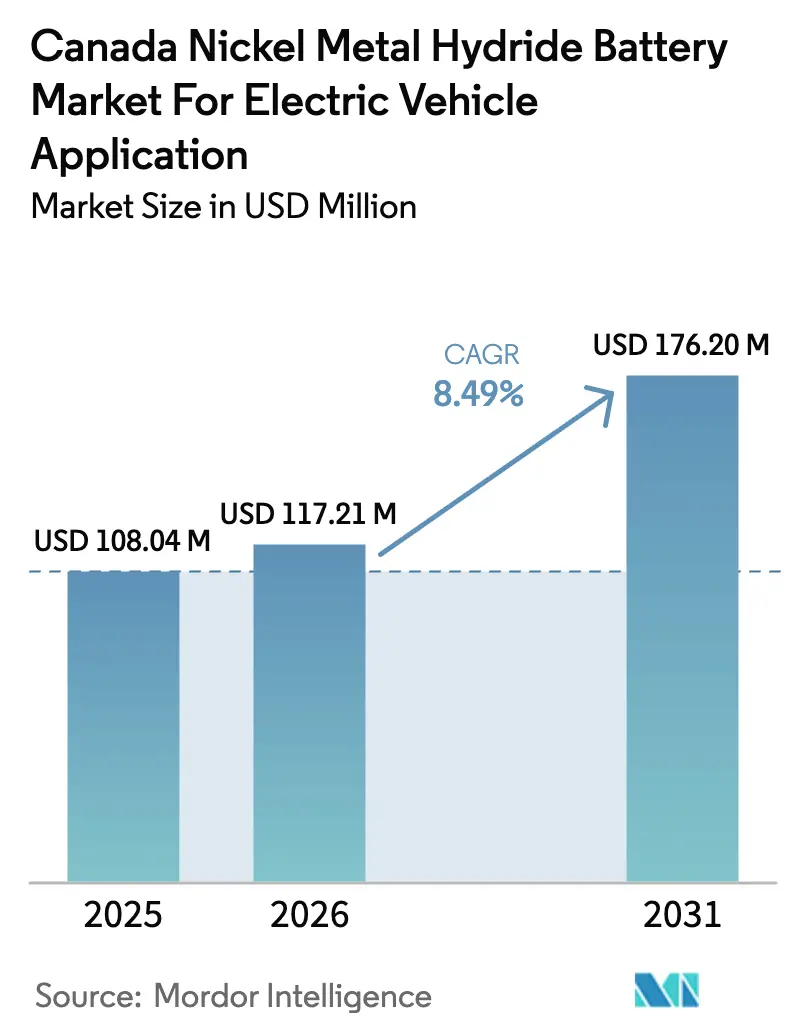
The Canada Nickel Metal Hydride Battery Market size for Electric Vehicle Application was valued at USD 108.04 million in 2025 and estimated to grow from USD 117.21 million in 2026 to reach USD 176.2 million by 2031, at a CAGR of 8.49% during the forecast period (2026-2031).
- Over the medium term, factors such as the growth of hybrid electric vehicles (HEV) and suppotive government initiatives are expected to drive the market during the forecast period.
- On the other hand, competetion from lithium-ion batteries are likely to hinder the market growth during the forecast period.
- Nevertheless, technological davancements are expected to provide significant opportunities for the market in the coming years.
Note: Market size and forecast figures in this report are generated using Mordor Intelligence’s proprietary estimation framework, updated with the latest available data and insights as of 2026.
Future direction is shaped by developments occurring across multiple countries and regions, with Canada contributing to the overall trajectory. The outlook on worldwide nickel metal hydride battery for electric vehicles market reflects how these are expected to evolve collectively.
Insights and Trends of Canada Nickel Metal Hydride Battery Market For Electric Vehicle Application
Growth of Hybrid Electric Vehicles (HEV)
- Hybrid Electric Vehicles (HEVs) integrate an internal combustion engine with an electric motor and battery, enhancing fuel efficiency and curbing emissions. In markets like Canada, HEVs serve as an affordable, eco-friendly choice for drivers hesitant to transition to fully electric vehicles. The cost-effectiveness, longevity, and strong performance of Nickel-Metal Hydride (NiMH) batteries under diverse driving conditions make them the preferred choice for HEVs.
- Canada registered 1,714,356 new motor vehicles in 2023, a 13.4% uptick from 2022. Multipurpose vehicles, including SUVs and crossovers, accounted for 59.7% of these registrations, up from 56% the previous year. Registrations for hybrid electric vehicles jumped by 67.2%, fueled by a growing consumer preference for greener alternatives.
- Battery-electric vehicles (BEVs) and plug-in hybrid electric vehicles (PHEVs) also experienced notable surges, with registration increases of 41.5% and 80.5%, respectively. The rising demand for hybrids and plug-in hybrids directly boosts the need for NiMH batteries, given their crucial role in enhancing the efficiency, power density, and eco-friendliness of HEVs and PHEVs.
- Several factors underpin this trend. Canadian regulations targeting emission reductions, a consumer shift towards fuel-efficient vehicles, and government incentives for green vehicles all bolster HEV adoption. Furthermore, provinces like Ontario, Quebec, and British Columbia, with their larger populations and urban centers, are championing sustainable transportation, evident from their vehicle registration numbers.
- Ontario recorded 677,043 new registrations, marking a 13.9% rise from the prior year, while British Columbia saw a notable 15.3% increase. The overall uptick in vehicle registrations signals a rebound in consumer purchasing power, leading to heightened investments in cleaner technologies like HEVs, further fueling the demand for NiMH batteries.
- With regulatory backing, shifting consumer preferences, and technological advancements, NiMH batteries are poised to play a pivotal role in Canada's expanding hybrid and plug-in hybrid landscape. The consistent rise of HEVs not only shapes the Canadian NiMH battery market but also aligns with national and provincial ambitions of emission reductions and a shift towards cleaner vehicles.

Passenger Cars are Expected to Dominate
- In Canada, the passenger car segment plays a significant role in driving the Nickel-Metal Hydride (NiMH) battery market for electric vehicle (EV) applications. NiMH batteries are widely used in hybrid electric vehicles (HEVs) within this segment due to their cost-effectiveness, reliability, and compatibility with hybrid systems. Canadian consumers are increasingly opting for HEVs as an affordable, fuel-efficient alternative to fully electric vehicles, helping to boost NiMH battery demand.
- In 2023, Canadian motorists purchased around 262,200 passenger cars, reflecting a modest increase from the 258,500 units sold in 2022, according to the Organisation Internationale des Constructeurs d’Automobiles (OICA). This growth in passenger car sales indicates a recovering automotive market and heightened consumer interest in sustainable vehicle options. Hybrid electric vehicles (HEVs), which typically rely on NiMH batteries, have become a popular choice within this segment, supported by government incentives and consumer demand for greener vehicles .
- Several factors contribute to the demand for NiMH batteries in Canada’s passenger car market. First, government policies and incentives aimed at reducing emissions and promoting cleaner transportation options are encouraging consumers to consider hybrids. For instance, under the new law, Canada established its inaugural 2030 Emissions Reduction Plan (2022). This plan delineates a sector-specific roadmap, aiming for a 40 to 45% reduction in emissions from 2005 levels by 2030, and targeting net-zero emissions by 2050.
- Second, NiMH batteries offer a balance of cost-effectiveness and longevity, which makes them particularly suited to hybrid passenger cars that do not require the high energy density of lithium-ion batteries.
- Moreover, NiMH batteries align well with Canada’s cold climate, as they are relatively robust in low-temperature conditions, a feature valued by Canadian drivers. As hybrid vehicle adoption rises in Canada, particularly in provinces like Ontario, Quebec, and British Columbia, the passenger car segment is expected to remain a major driver for the NiMH battery market in EV applications. This aligns with the broader market shift toward eco-friendly vehicles and Canada’s goals for emission reductions.

Competitive Landscape
The Canada nickel metal hydride battery market For electric vehicle application is semi-consolidated. Some of the major players include (not in particular order) VARTA AG, Panasonic Holdings Corporation, Energizer CA, Saft, and JYH Battery, among others.
Leaders of Canada Nickel Metal Hydride Battery Market For Electric Vehicle Application
-
VARTA AG
-
Panasonic Holdings Corporation
-
Energizer CA
-
JYH Battery
-
Saft
- *Disclaimer: Major Players sorted in no particular order

Recent Industry Developments
- September 2024: Panasonic Energy debuted its innovative nickel-metal hydride battery system for railway vehicles. This cutting-edge modular Ni-MH battery system was designed to serve as an auxiliary power supply for railway vehicles, boasting a suite of features that distinguished it from conventional systems.
- September 2023: Toyota unveiled plans for a new battery electric vehicle factory, set to commence production in 2026. These upcoming models will feature distinct designs and constructions, powered by an array of cutting-edge batteries.
Scope of Report on Canada Nickel Metal Hydride Battery Market For Electric Vehicle Application
A Nickel-Metal Hydride (NiMH) battery is a type of rechargeable battery commonly used in hybrid electric vehicles (HEVs). In EV applications, NiMH batteries use a nickel oxide hydroxide cathode and a hydrogen-absorbing alloy anode, offering several advantages, including good durability, moderate energy density, and enhanced safety due to their resistance to overcharging and thermal runaway.
The Canada nickel metal hydride battery market For electric vehicle application is segmented by propulsion type and vehicle type. By propulsion type, the market is segmented into battery electric vehicles, hybrid electric vehicles, plug-in hybrid electric vehicles, and fuel cell electric vehicles. By vehicle type, the market is segmented into passenger cars and commercial vehicles.
For each segment, the market sizing and forecasts have been done based on market size in USD.
| Battery Electric Vehicles |
| Hybrid Electric Vehicles |
| Plug-In Hybrid Electric Vehicles |
| Fuel Cell Electric Vehicles |
| Passenger Cars |
| Commercial Vehicles |
| Propulsion Type | Battery Electric Vehicles |
| Hybrid Electric Vehicles | |
| Plug-In Hybrid Electric Vehicles | |
| Fuel Cell Electric Vehicles | |
| Vehicle Type | Passenger Cars |
| Commercial Vehicles |
Key Questions Answered in the Report
How big is the Canada Nickel Metal Hydride Battery Market For Electric Vehicle Application Industry?
The Canada Nickel Metal Hydride Battery Market For Electric Vehicle Application Industry size is expected to reach USD 117.21 million in 2026 and grow at a CAGR of 8.49% to reach USD 176.2 million by 2031.
What is the current Canada Nickel Metal Hydride Battery Market For Electric Vehicle Application Industry size?
In 2026, the Canada Nickel Metal Hydride Battery Market For Electric Vehicle Application Industry size is expected to reach USD 117.21 million.
Who are the key players in Canada Nickel Metal Hydride Battery Market For Electric Vehicle Application Industry?
VARTA AG, Panasonic Holdings Corporation, Energizer CA, JYH Battery and Saft are the major companies operating in the Canada Nickel Metal Hydride Battery Market For Electric Vehicle Application Industry.
What years does this Canada Nickel Metal Hydride Battery Market For Electric Vehicle Application Industry cover, and what was the market size in 2025?
In 2025, the Canada Nickel Metal Hydride Battery Market For Electric Vehicle Application Industry size was estimated at USD 117.21 million. The report covers the Canada Nickel Metal Hydride Battery Market For Electric Vehicle Application Industry historical market size for years: 2019, 2020, 2021, 2022, 2023 and 2024. The report also forecasts the Canada Nickel Metal Hydride Battery Market For Electric Vehicle Application Industry size for years: 2026, 2027, 2028, 2029, 2030 and 2031.