
Canada Microgreens Market Size and Share
Market Overview
| Study Period | 2021 - 2031 |
|---|---|
| Forecast Data Period | 2026 - 2031 |
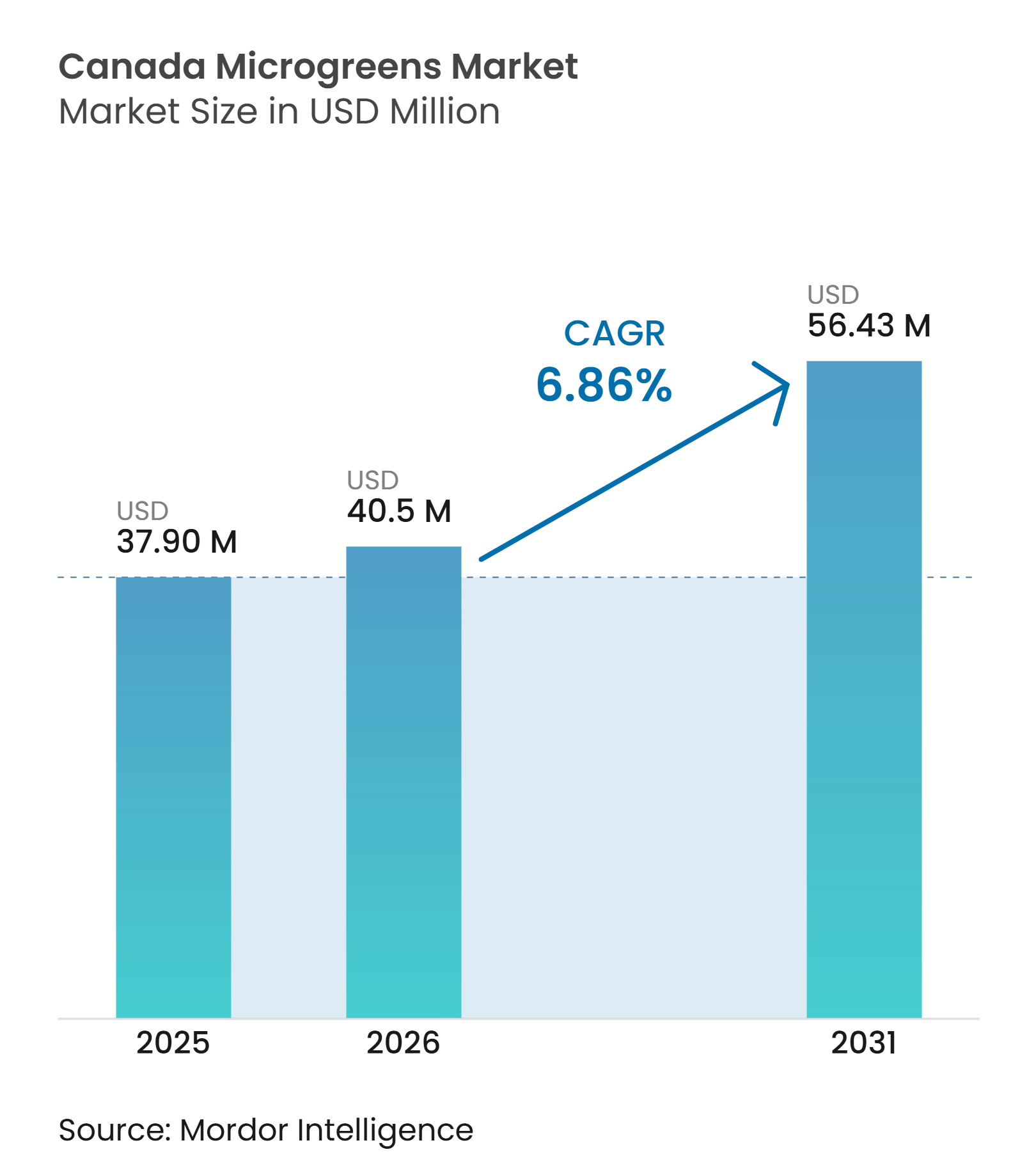
| Base Year Market Size (2025) | USD 37.90 Million |
| Market Size (2026) | USD 40.5 Million |
| Market Size (2031) | USD 56.43 Million |
| Growth Rate (2026 - 2031) | 6.86 % |
| Market Concentration | Medium |
Major Players *Disclaimer: Major Players sorted in no particular order Image © Mordor Intelligence. Reuse requires attribution under CC BY 4.0. | |
Canada Microgreens Market Analysis by Mordor Intelligence
The Canada microgreens market was valued at USD 37.90 million in 2025 and is projected to grow from USD 40.50 million in 2026 to USD 56.43 million by 2031, registering a CAGR of 6.86% during the forecast period 2026–2031. Canada's 6-month winter period limits domestic outdoor produce supply, which supports demand for controlled-environment crops such as microgreens. Producers can harvest locally throughout the year, giving retailers and foodservice buyers a fresher alternative to products transported over long distances. Urban demand is concentrated in Toronto, Montreal, Vancouver, and Calgary, where restaurants and grocery stores represent the most established routes to market. In 2025, increased consumer preference for Canadian-grown produce raised the visibility of domestic suppliers following trade measures that affected selected United States fresh produce imports. The Canada microgreens market therefore favors operators that combine nearby production, reliable cold-chain handling, and established retail or chef-direct relationships.
Key Report Takeaways
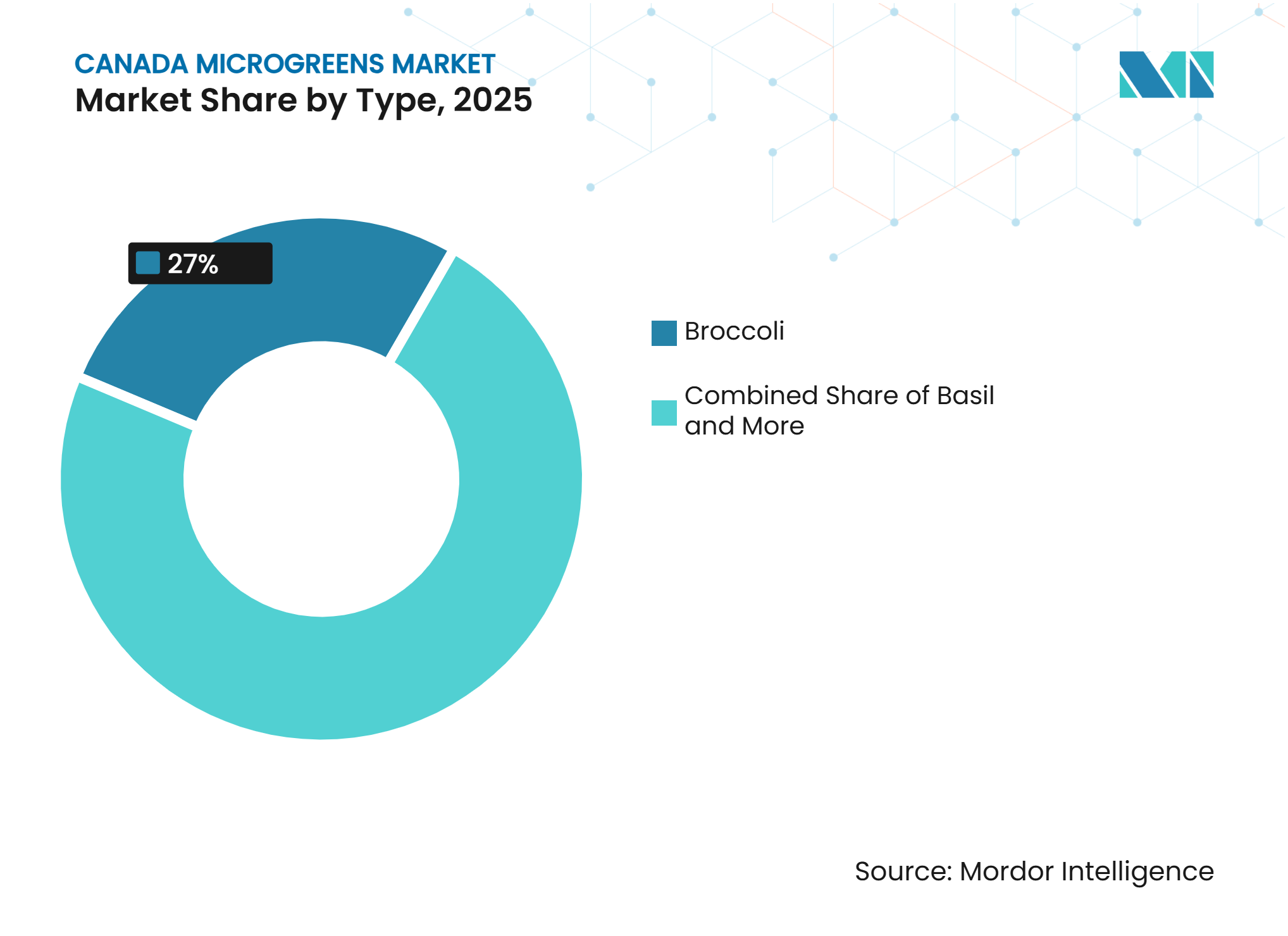
- By type, broccoli was the largest segment and held 27.0% of the Canada microgreens market share in 2025, while basil is the fastest-growing segment and is forecasted to expand at 14.5% CAGR between 2026 and 2031.
- By farming method, indoor farming was the largest segment and held 48.0% of the Canada microgreens market size in 2025, while vertical farming is the fastest-growing segment and is forecasted to expand at a 19.7% CAGR between 2026 and 2031.
- By growth medium, peat moss was the largest segment and held 33.2% of the market share in 2025, while coconut coir is the fastest-growing segment and is forecasted to expand at a 15.5% CAGR between 2026 and 2031.
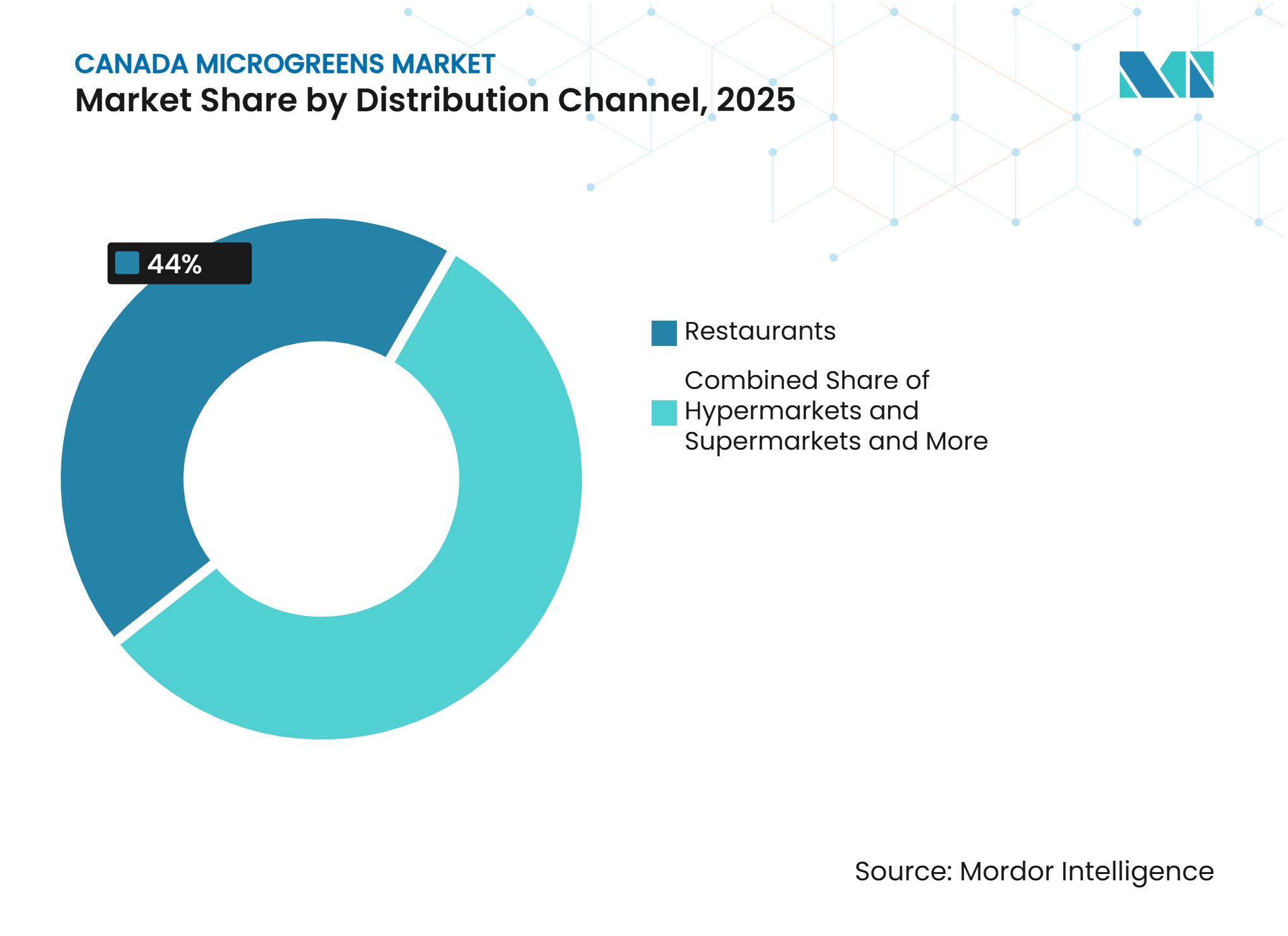
- By distribution channel, restaurants were the largest segment and held 44.0% of the market share in 2025, while supermarkets and hypermarkets are the fastest-growing segment and are forecasted to expand at a 11.7% CAGR between 2026 and 2031.
Note: Market size and forecast figures in this report are generated using Mordor Intelligence’s proprietary estimation framework, updated with the latest available data and insights as of January 2026.
Market Trends and Insights
Drivers Impact Analysis of Canada Microgreens Market*
| Driver | (~) % Impact on CAGR Forecast | Geographic Relevance | Impact Timeline |
|---|---|---|---|
| Winter-season demand for locally produced microgreens | +1.2% | National, strongest in Ontario and Quebec from November to April | Short term (≤ 2 years) |
| Indoor production expansion in Ontario, Quebec, Alberta, and British Columbia | +1.5% | Ontario, Quebec, Alberta, and British Columbia | Medium term (2-4 years) |
| Chef and foodservice adoption in Toronto, Montreal, Vancouver, and Calgary | +1.1% | Toronto, Montreal, Vancouver, and Calgary | Short term (≤ 2 years) |
| Grocery retail placement of Canadian-grown packaged microgreens | +1.0% | Ontario and British Columbia, with expansion into Quebec | Medium term (2-4 years) |
| Domestic supply resilience during cross-border fresh-produce disruptions | +0.9% | National, with early gains in Ontario and British Columbia | Short term (≤ 2 years) |
| Year-round production near high-density Canadian consumption centers | +0.7% | Toronto, Montreal, Vancouver, and Ottawa-Gatineau | Medium term (2-4 years) |
| Source: Mordor Intelligence | |||
Winter-Season Demand for Locally Produced Microgreens
Canada's cold climate and seasonal limitations on outdoor fresh-produce production support demand for locally produced microgreens during the winter season. Controlled-environment agriculture (CEA) facilities can maintain year-round production under controlled temperature, lighting, humidity, and irrigation conditions, enabling growers to supply fresh microgreens when outdoor cultivation is constrained. Statistics Canada reported that Canada's total greenhouse area increased 1.4% to 35.9 million square metres in 2025, while greenhouse areas dedicated to lettuce and fine herbs increased 8.1% and 11.2%, respectively, indicating continued investment in protected cultivation[1]. This expanding production infrastructure supports the availability of locally grown fresh greens during winter and can reduce reliance on products transported from distant growing regions. GoodLeaf Farms reported that demand for its Canadian-grown greens nearly doubled by April 2025, reflecting stronger consumer interest in locally produced fresh greens. The combination of winter production constraints, expanding CEA capacity, and consumer preference for Canadian-grown produce therefore supports winter-season demand for microgreens in Canada.
Indoor Production Expansion in Ontario, Quebec, Alberta, and British Columbia
The expansion of controlled-environment agriculture (CEA) capacity across major Canadian provinces is strengthening the domestic supply base for microgreens and other fresh greens. Ontario, Quebec, Alberta, and British Columbia have established urban and indoor-farming activity, with facilities located near major population and foodservice centres. Quebec provides a clear indication of this trend. AU/LAB's 2025 portrait identified 202 urban agricultural enterprises, up from 175 in 2024, while more than 60% of enterprises produced in controlled environments, including leafy vegetables and microgreens. The number of indoor vegetable-growing enterprises also increased from 20 in 2024 to 38 in 2025. The concentration of indoor production around major urban markets can shorten delivery distances, improve harvest-to-market speed, and enable growers to provide consistent local supply to restaurants, retailers, and other foodservice buyers. Consequently, continued investment in distributed indoor-farming capacity across Canada's major population centres is expected to support the availability and commercial adoption of locally produced microgreens.
Chef and Foodservice Adoption in Toronto, Montreal, Vancouver, and Calgary
Growing adoption of microgreens by restaurants and foodservice operators is supporting demand for fresh, locally supplied products in Canada's major urban markets. Chefs can use microgreens as ingredients in salads, entrées, sandwiches, and plated dishes, with requirements often varying by variety, flavour, appearance, and harvest freshness. Goldfarm Canada Inc. supplies microgreens directly to chefs and restaurants in the Toronto area from its Guelph-based farm, while Kyan Culture Inc. produces microgreens in Vankleek Hill and serves customers across the Montreal–Ottawa-Gatineau corridor. These farm-direct models allow growers to compete through freshness, product variety, customized orders, and delivery responsiveness rather than scale alone. As restaurants and premium foodservice operators increasingly incorporate locally grown specialty greens into menus, established urban demand centres and surrounding production corridors can provide microgreens growers with opportunities to develop recurring B2B relationships without requiring nationwide distribution networks.
Grocery Retail Placement of Canadian-Grown Packaged Microgreens
Grocery retail provides an important route for branded packaged microgreens to reach a broad consumer base, while the expansion of Canadian-grown produce can strengthen the positioning of locally produced alternatives. In March 2025, the Government of Canada announced 25% tariffs on USD 20.9 billion of goods imported from the United States, with fruits and vegetables included in a broader list considered for additional countermeasures, highlighting the importance of domestic food supply resilience[2]. However, the initial tariffs on the March 4 list were subsequently removed effective September 1, 2025. GoodLeaf Farms had already established a broad retail footprint, with its microgreens and baby greens available through major Ontario retailers including Loblaws, Sobeys, Metro, Whole Foods, and Real Canadian Superstore. In Quebec, Avril Supermarché Santé operates an in-store vertical farming system at its Laval location that produces microgreens for all eight stores and their bistros, while reporting a 20–25% increase in sales in the microgreens category after introducing its own production. Such established retail relationships and integrated in-store production models can create barriers for smaller growers seeking supermarket shelf space, although regional retailers and underserved markets continue to provide opportunities for Canadian-grown packaged microgreens.
Restraints Impact Analysis of Canada Microgreens Market*
| Restraint | (~) % Impact on CAGR Forecast | Geographic Relevance | Impact Timeline |
|---|---|---|---|
| Short shelf life during interprovincial distribution | -0.7% | National, most acute in Atlantic Canada and the Prairies | Short term (≤ 2 years) |
| Electricity, heating, and labor costs in Canadian controlled-environment farms | -0.8% | Alberta, Ontario, and Atlantic Canada | Long term (≥ 4 years) |
| Site-specific HACCP and microbial-control requirements | -0.4% | National | Medium term (2-4 years) |
| Uneven retail and distribution infrastructure outside core provinces | -0.4% | Atlantic Canada, the Prairies, and the territories | Long term (≥ 4 years) |
| Source: Mordor Intelligence | |||
Short Shelf Life During Interprovincial Distribution
The short post-harvest shelf life of microgreens creates a significant logistics constraint for interprovincial distribution in Canada, as product quality can deteriorate rapidly without appropriate temperature control and careful handling. Longer distribution routes can reduce the commercially available selling window for retailers and foodservice buyers, particularly when products are transported from major production centres to distant markets such as Atlantic Canada and the Prairie provinces. Maintaining freshness across these routes can also increase requirements for refrigerated transportation, protective packaging, inventory coordination, and rapid delivery, raising distribution costs for producers. Consequently, the Canada microgreens market remains more commercially favourable to producers operating close to major consumption centres, where shorter delivery distances can help preserve product quality and reduce post-harvest losses.
Electricity, Heating, and Labor Costs in Canadian Controlled-Environment Farms
Rising electricity, heating, and labor costs are increasing operating pressures for controlled-environment growers in Canada, particularly for facilities that require continuous environmental control and year-round production. Statistics Canada reported that total greenhouse operating expenses increased 4.3% to CAD 4.2 billion (USD 3.1 billion) in 2025, reflecting higher input and production costs. Electricity costs increased 21.2% during the year, while natural gas, other fuels, and heating oil costs also increased, adding pressure to production margins[3]. Smaller microgreens operators may have less capacity to absorb these increases or invest in energy-efficient lighting, climate-control systems, and automation. Consequently, the Canada microgreens market places greater importance on energy-efficient production systems, optimized crop cycles, and labor productivity, while higher operating costs can constrain expansion in regions where controlled-environment production is more expensive.
*Our forecasts treat driver/restraint impacts as directional, not additive. The impact forecasts reflect baseline growth, mix effects, and variable interactions.
Canada Microgreens Market Segment Analysis
By Type:
Broccoli Leads While Basil Records the Fastest GrowthBroccoli held 27.0% of the Canada microgreens market share by type in 2025, supported by its established use in retail blends, salads, and restaurant menus. Its familiar flavour and nutritional positioning make it accessible to consumers who are new to microgreens, while its compatibility with mixed packs supports broader retail adoption. Cabbage, arugula, and pea microgreens form the next established group, with arugula providing a peppery flavour, peas offering mild sweetness, and cabbage serving as a relatively neutral base for blended products. Radish remains relevant for visual contrast and stronger flavour in fine dining, while sunflower and other varieties support artisan, subscription, and farmers' market channels.
Basil is forecast to expand at a 14.5% CAGR between 2026 and 2031, the fastest growth rate among types in the Canada microgreens market. Its distinctive aroma and flavour support applications in Mediterranean and Italian cuisine, premium foodservice, salads, and garnishes, while its compatibility with hydroponic and controlled-environment production supports year-round cultivation. Cress, mizuna, chervil, and other specialty varieties continue to serve chefs seeking differentiated flavours, colours, and textures. Their smaller production volumes make direct relationships with restaurants and specialty retailers important, particularly in major urban markets. The Canada microgreens market therefore combines established demand for broccoli with faster-growing opportunities for basil and other specialty varieties, with product differentiation and reliable year-round supply supporting expansion across retail and foodservice channels.



By Farming Method:
Indoor Farming Leads While Vertical Farming Expands FastestIndoor farming held 48.0% of the Canada microgreens market size by farming method in 2025, supported by year-round production, controlled growing conditions, and proximity to major urban demand centres. The method allows growers to manage lighting, temperature, humidity, irrigation, and harvest schedules independently of outdoor weather conditions, which is particularly important for microgreens requiring frequent production cycles and reliable deliveries. Controlled indoor facilities can also support multiple varieties within the same production environment, allowing growers to supply restaurants, retailers, and direct-to-consumer channels with consistent product quality. Greenhouses remain an important alternative for regional producers because they can provide year-round production with lower infrastructure requirements than fully indoor systems, particularly where access to capital and energy costs constrain vertical-farm development.
Vertical farming is forecast to expand at a 19.7% CAGR between 2026 and 2031, the fastest growth among farming methods in the Canada microgreens market. Multi-level cultivation enables growers to increase production within a limited footprint, while automated environmental controls allow precise management of crop conditions and harvest timing. GoodLeaf Farms' commercial operations demonstrate the potential of controlled vertical production to supply Canadian retailers with microgreens and other fresh greens throughout the year. The model is particularly suited to densely populated markets where proximity to consumers can support shorter delivery times and fresher products. In-store growing systems represent another emerging format, with Avril Supermarché Santé using vertical growing technology across its Quebec stores to produce fresh microgreens close to the point of purchase. The Canada microgreens market therefore supports multiple production models, with indoor farming providing the established production base and vertical farming offering faster expansion through higher space efficiency, year-round cultivation, and proximity to urban consumers.
By Growth Medium:
Peat Moss Leads While Coconut Coir Gains GroundPeat moss held 33.2% of the Canada microgreens market share by growth medium in 2025, supported by its established use in short-cycle cultivation and its moisture-retention and pH-management properties. Its consistent physical characteristics allow growers to maintain suitable moisture conditions during the rapid growth period of microgreens, supporting reliable production across common varieties. Soil remains relevant for greenhouse and small-scale producers, particularly where growers use conventional cultivation practices, while tissue paper and other inert media serve specialty producers seeking clean and easily handled growing substrates. The choice of medium depends on crop requirements, irrigation practices, food-safety procedures, and the production system used by the grower. The Canada microgreens market therefore retains multiple growth-medium options as producers balance cultivation performance, operating requirements, and customer preferences.
Coconut coir is forecast to expand at a 15.5% CAGR between 2026 and 2031, the fastest growth among growth media in the Canada microgreens market. Its water-holding capacity, renewable origin, and suitability for soilless cultivation make it an alternative to established peat-based production. Coir can also support growers seeking to reduce reliance on peat while maintaining moisture availability during short production cycles. CanadaGAP's Greenhouse Manual 11.0, published in 2026, identifies microgreens as a crop that can be produced in substrate or aeroponically and includes growing media within greenhouse food-safety planning. This reinforces the importance of selecting and managing growing media as part of the overall production system rather than solely as an input-purchasing decision. The Canada microgreens market is therefore likely to see increasing adoption of coconut coir alongside established peat moss, with growers selecting media according to production performance, food-safety requirements, sustainability objectives, and customer specifications.
By Distribution Channel:
Restaurants Lead While Supermarkets and Hypermarkets Expand FastestRestaurants held 44.0% of the Canada microgreens market share by distribution channel in 2025, supported by demand for variety-specific products, fresh harvests, and direct relationships with growers. Premium kitchens can specify requirements such as variety, flavour, appearance, harvest stage, packaging format, and delivery timing, favouring producers located close to major foodservice centres. Direct chef relationships also allow growers to supply specialty varieties and adjust order volumes according to menu requirements. This channel can support premium pricing because microgreens are often incorporated into menu presentation and dish preparation rather than purchased as a standardized commodity. The Canada microgreens market therefore benefits from restaurant demand for freshness, product differentiation, and responsive farm-to-chef supply models.
Supermarkets and hypermarkets are forecast to expand at an 11.7% CAGR between 2026 and 2031, the fastest-growing distribution channel in the Canada microgreens market. Established grocery networks provide growers with access to a broader household consumer base and create opportunities for packaged microgreens to move beyond restaurant and specialty channels. Major retailers such as Loblaws, Sobeys, and Metro provide nationwide or multi-provincial distribution, although suppliers must meet standardized requirements for packaging, food safety, delivery consistency, and shelf life. Farmers' markets, community-supported agriculture subscriptions, and direct-to-consumer delivery remain relevant for regional producers seeking closer customer relationships and greater product differentiation. The Canada microgreens market therefore combines restaurant-led specialized demand with expanding supermarket and hypermarket access, allowing packaged microgreens to reach a wider consumer base while regional channels continue to support smaller and specialty growers.

Geography Analysis
Ontario held 39.0% of the Canada microgreens market share by geography in 2025, making it the largest provincial market. Its position is supported by established controlled-environment production, Toronto's large restaurant and foodservice base, and broad grocery access. GoodLeaf's microgreens and baby greens were available in more than 600 Ontario retail locations, including Loblaws, Sobeys, Metro, Zehrs, Real Canadian Superstore, Foodland, Longo's, and other grocery banners. GoodLeaf's production and distribution network, together with its retail presence across major grocery banners, strengthens Ontario's position as a mature market for both foodservice and packaged retail sales.
Quebec is forecast to expand at an 8.5% CAGR between 2026 and 2031, the highest rate among geographic segments. AU/LAB's 2025 portrait identified 202 urban agricultural enterprises, compared with 175 in 2024, while slightly more than 60% of these enterprises operated in controlled environments, including production of leafy vegetables and microgreens. The number of indoor vegetable-production enterprises increased from 20 to 38 during 2025, while Quebec's urban agricultural enterprises generated approximately CAD 60 million (USD 43.8 million) in revenue. These developments indicate a growing urban production ecosystem that can support microgreens and other short-cycle crops close to major population centres. Alberta provides Western Canadian production through GoodLeaf's Calgary operations, while British Columbia supports specialty growers serving major markets such as Vancouver and Victoria. The Canada microgreens market therefore combines Ontario's established scale with Quebec's expanding urban-farming ecosystem and regional production bases across Western Canada.
Other provinces and territories, including Atlantic Canada, Saskatchewan, Manitoba, and the northern territories, represent smaller markets with more localized production and distribution networks. Nova Scotia has year-round greenhouse production serving regional foodservice and retail customers, while investments in refrigerated logistics can improve connections between production and consumption centres. In October 2025, CN and Congebec announced plans to develop a state-of-the-art cold-storage facility at CN's Calgary Logistics Park, while Americold opened an integrated cold-chain facility at Port Saint John in June 2026, connecting temperature-controlled storage with port and rail infrastructure. These developments can improve refrigerated distribution reliability, although longer transportation distances can still reduce the usable selling window for microgreens. Consequently, regional production remains important in smaller markets, while Ontario, Quebec, Alberta, and British Columbia offer stronger opportunities because of their population concentration, foodservice demand, controlled-environment capacity, and established fresh-produce distribution networks.
Competitive Landscape
Market Concentration
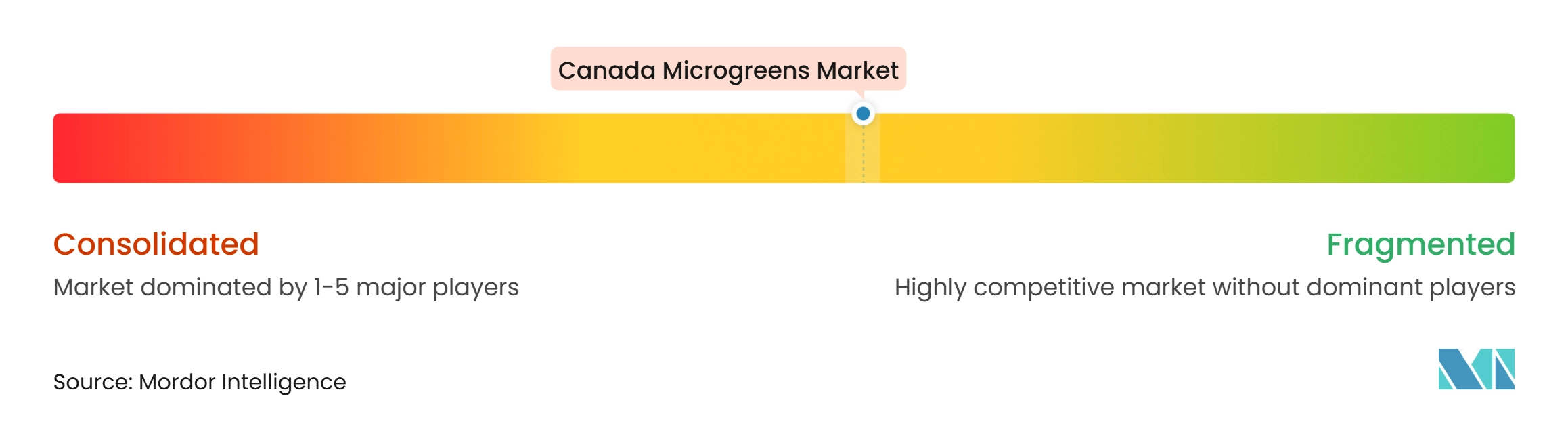
The Canada microgreens market is moderately consolidated, with competition distributed among established controlled-environment growers, regional specialty farms, and smaller local producers serving restaurants, retailers, farmers' markets, and direct customers. GoodLeaf Community Farms Limited, Kyan Culture Inc., Goldfarm Canada Inc., Living Earth Farm Inc., and Bramble Hill Farm Inc. are among the companies operating in the market. GoodLeaf Community Farms Limited, a wholly owned subsidiary of TruLeaf Sustainable Agriculture Ltd., combines vertical farming with broad grocery distribution and operates production facilities serving multiple Canadian markets. Goldfarm Canada focuses on chef-direct supply from its Guelph-based farm to restaurants in the Toronto area, while Kyan Culture produces microgreens in Vankleek Hill and supplies customers across the Montreal–Ottawa-Gatineau corridor. Bramble Hill Farm serves the Atlantic Canadian market through locally produced microgreens and related growing products. The market therefore accommodates both operators with multi-market distribution capabilities and regional specialists competing through freshness, product variety, customized supply, and proximity to customers.
Technology, production expansion, and channel partnerships are also shaping competitive positioning. In November 2025, GoodLeaf Farms announced a CAD 52 million (USD 38 million) equity financing to support capacity expansion at its Alberta and Quebec farms and establish an Agricultural Centre of Excellence in Guelph, Ontario, linking commercial production with research and development. GoodLeaf's parent company, TruLeaf Sustainable Agriculture Ltd., developed the Smart Plant System used in its controlled-environment farming operations. Retail-oriented production is also emerging through in-store vertical farming, with Avril Supermarché Santé operating an in-store system that produces microgreens for its eight Quebec stores and their bistros. Goldfarm Canada and Kyan Culture demonstrate another competitive approach by maintaining direct relationships with chefs and foodservice customers, allowing growers to supply specialty varieties and respond to customer-specific harvest and delivery requirements.
The competitive structure is therefore divided between larger controlled-environment operators with broader retail distribution, regional growers with established foodservice relationships, and smaller producers serving localized markets. Larger suppliers can compete through year-round production, controlled growing conditions, standardized packaging, food-safety capabilities, and distribution reach, while regional operators can differentiate through shorter delivery distances, harvest freshness, customized varieties, and direct relationships with chefs and retailers. Organic positioning provides an additional avenue for differentiation, with Infinity Greens & Produce Ltd. in British Columbia holding certified-organic status and supplying retail and foodservice customers. Smaller producers such as Bramble Hill Farm and Petite Rivière Farming Company also compete through localized production and specialized product offerings. Consequently, the Canada microgreens market remains accessible to regional specialists and emerging indoor growers, although expansion into major grocery and foodservice accounts increasingly requires dependable year-round supply, consistent quality, appropriate food-safety practices, and efficient refrigerated distribution.
Canada Microgreens Industry Leaders
-
GoodLeaf Community Farms Limited (TruLeaf Sustainable Agriculture Ltd.)
-
Kyan Culture Inc.
-
Goldfarm Canada Inc.
-
Living Earth Farm Inc.
-
Bramble Hill Farm Inc.
- *Disclaimer: Major Players sorted in no particular order
Canada Microgreens Market Companies Covered in this Report
- GoodLeaf Community Farms Limited (TruLeaf Sustainable Agriculture Ltd.)
- Goldfarm Canada Inc.
- Living Earth Farm Inc.
- Kyan Culture Inc.
- Micro Verdure Inc.
- Micro Acres Ltd.
- Bramble Hill Farm Inc.
- Petite Riviere Farming Company Ltd.
- Infinity Greens & Produce Ltd.
- MPA Farm LTD
- Ugrogreens Ltd.
Recent Industry Developments in Canada Microgreens Market
- June 2026: The Government of Canada launched its National Food Security Strategy, including CAD 750 million (USD 547 million) to expand year-round fruit and vegetable production through greenhouses, vertical farms, and other enclosed growing systems. The strategy aims to reduce dependence on imported produce and shorten long supply chains, creating a favourable policy environment for Canadian controlled-environment growers, including microgreens producers.
- November 2025: GoodLeaf Farms completed CAD 52 million (USD 38 million) in equity financing. The funding is being used to expand production capacity at its Alberta and Quebec farms and establish an Agricultural Centre of Excellence in Guelph, Ontario. GoodLeaf stated that the two largest farms were planned to double capacity in 2026, supporting additional production of baby greens and microgreens. Investors included Farm Credit Canada, Power Sustainable Lios, and McCain Foods.
- January 2025: GoodLeaf announced Farm Credit Canada as a new strategic investor. The investment followed GoodLeaf's expansion to more than 280,000 square feet of production capacity across three farms, including its recently commercialized Alberta and Quebec facilities.
Canada Microgreens Market Report Scope
Microgreens are young, edible plants harvested shortly after germination, typically after the development of the cotyledon leaves and, in some species, the first true leaves. They are produced from the seeds of vegetables, herbs, grains, and other edible plants and are generally harvested at an early growth stage, before reaching maturity.
The Canada Microgreens Market Report is Segmented by Type (Broccoli, Lettuce and Chicory, Arugula, Basil, Fennel, and More), by Farming Method (Indoor Farming, Vertical Farming, and More), by Growth Medium (Peat Moss, Soil, Coconut Coir, and More), and by Distribution Channel (Hypermarkets/Supermarkets, Restaurants, and More). The Market Forecasts are Provided in Terms of Value (USD).
Segmentation Overview
| Broccoli |
| Lettuce and Chicory |
| Arugula |
| Basil |
| Fennel |
| Carrots |
| Sunflower |
| Radish |
| Peas |
| Other Types |
| Indoor Farming |
| Vertical Farming |
| Commercial Greenhouses |
| Other Farming Methods |
| Peat Moss |
| Soil |
| Coconut Coir |
| Tissue Paper |
| Other Growth Media |
| Hypermarkets and Supermarkets |
| Restaurants |
| Other Channels |
| By Type | Broccoli |
| Lettuce and Chicory | |
| Arugula | |
| Basil | |
| Fennel | |
| Carrots | |
| Sunflower | |
| Radish | |
| Peas | |
| Other Types | |
| By Farming Method | Indoor Farming |
| Vertical Farming | |
| Commercial Greenhouses | |
| Other Farming Methods | |
| By Growth Medium | Peat Moss |
| Soil | |
| Coconut Coir | |
| Tissue Paper | |
| Other Growth Media | |
| By Distribution Channel | Hypermarkets and Supermarkets |
| Restaurants | |
| Other Channels |
Key Questions Answered in the Report
What is the Canada microgreens market size?
The Canada microgreens market size is USD 40.50 million in 2026 and is forecasted to reach USD 56.43 million by 2031 at a 6.86% CAGR.
Which province has the largest microgreens sales base in Canada?
Ontario led with 39.0% of revenue in 2025, supported by controlled-environment capacity, restaurant demand, and grocery distribution.
Which distribution channel leads microgreens sales in Canada?
Restaurants are the largest channel, while retail is forecasted to grow fastest at an 11.7% CAGR between 2026 and 2031.
What are the main challenges for Canadian microgreens growers?
A 7 to 14 day shelf life and higher electricity, heating, and labor costs make distant distribution and small-scale operations more difficult.