
Canada Golf Cart Market Size and Share
Market Overview
| Study Period | 2019 - 2032 |
|---|---|
| Forecast Data Period | 2027 - 2032 |
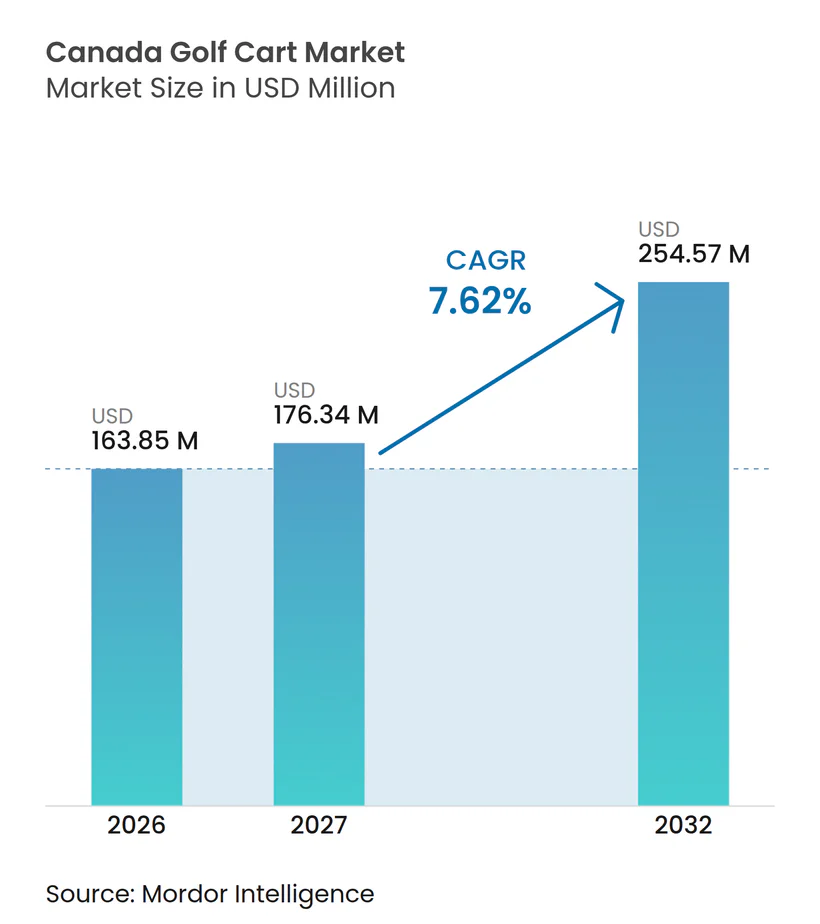
| Base Year Market Size (2026) | USD 163.85 Million |
| Market Size (2027) | USD 176.34 Million |
| Market Size (2032) | USD 254.57 Million |
| Growth Rate (2027 - 2032) | 7.62 % |
| Market Concentration | Medium |
Major Players *Disclaimer: Major Players sorted in no particular order Image © Mordor Intelligence. Reuse requires attribution under CC BY 4.0. | |
Canada Golf Cart Market Analysis by Mordor Intelligence
The Canada golf cart market size was valued at USD 163.85 million in 2026 and is expected to grow from USD 176.34 million in 2027 to USD 254.57 million by 2032, at a CAGR of 7.62% during 2027-2032. Higher golf participation and course use have supported replacement demand. In contrast, broader resort, campus, and commercial use has expanded the customer base, strengthened the rationale for multi-purpose fleets, and reduced the market’s dependence on a single end-use setting. Canadian operators are increasingly evaluating electric equipment to reduce maintenance requirements and improve fleet availability, especially when winter storage, morning operating windows, staff workload, battery performance, and repeat customer experience determine whether a course or resort fleet can meet daily demand. Provincial road-use programs create localized openings for low-speed vehicles. Still, they also complicate distribution and compliance planning, as operators must address route eligibility, documentation, insurance, vehicle configuration, service support, and the status of local pilot arrangements before committing capital. Established manufacturers rely on dealer service networks, while newer suppliers compete through electric models, connected fleet features, custom configurations, and products designed for Canadian operating conditions, making product availability and after-sales support closely connected competitive considerations. The Canada golf cart market also faces uneven service coverage and uncertainty around provincial pilot programs, which may slow fleet investment outside major provinces and increase the value of suppliers that can provide parts, technicians, compliance guidance, cold-weather equipment, and ongoing support across different regions.
Key Report Takeaways
- By vehicle type, standard golf carts held 58.23% of the Canada golf cart market share in 2026, while neighborhood electric vehicles and street-legal low-speed vehicles are projected to grow at a 10.11% CAGR through 2032.
- By powertrain, battery electric vehicles accounted for 67.87% of the Canada golf cart market share in 2026, while other powertrains are projected to grow at a 9.38% CAGR through 2032.
- By battery type, lithium iron phosphate batteries held 45.18% of the Canada golf cart market share in 2026 and are projected to grow at a 10.62% CAGR through 2032, the fastest among battery types.
- By battery voltage, 48-volt configurations accounted for 57.91% of the Canada golf cart market share in 2026, while 72-volt configurations are projected to grow at an 8.67% CAGR through 2032.
- By seating capacity, 2-seater vehicles accounted for 56.84% of the Canada golf cart market share in 2026, while 6-seater vehicles are projected to grow at a 7.89% CAGR through 2032.
- By application, golf courses and country clubs accounted for 51.54% of the Canada golf cart market share in 2026, while commercial and industrial facilities are projected to grow at a 7.91% CAGR through 2032.
- By ownership and business model, new vehicle purchase accounted for 57.62% of the Canada golf cart market share in 2026, while fleet leasing is projected to grow at an 8.28% CAGR through 2032.
- By sales channel, offline channels accounted for 81.48% of the Canada golf cart market share in 2026, while online channels are projected to grow at an 8.11% CAGR through 2032.
- By geography, Ontario held 38.38% of the Canada golf cart market share in 2026, while Alberta is projected to grow at a 7.98% CAGR through 2032.
Note: Market numbers in this report are based on Mordor Intelligence's proprietary estimation framework, which combines nine months of actuals with Q4 projections for base year 2026.
Market Trends and Insights
Drivers Impact Analysis of Canada Golf Cart Market*
| Driver | (~) % Impact on CAGR Forecast | Geographic Relevance | Impact Timeline |
|---|---|---|---|
| Electrification Driven by Lower Fleet Operating Costs | +2.3% | National, with concentrated impact in Ontario and British Columbia | Medium term (2–4 years) |
| Rising Golf Participation and Course Utilization | +2.1% | National, with strongest gains in Western and Atlantic Canada | Short term (≤ 2 years) |
| Cold-Climate Engineering and Winter-Ready Lithium Differentiation | +1.0% | National, with outsized impact in Prairies and Northern Canada | Medium term (2–4 years) |
| Expansion of Municipal and Controlled-Road Golf Cart Pilots | +0.9% | Alberta, Ontario, Quebec, Saskatchewan | Short term (≤ 2 years) |
| Resort, Campground, and Master-Planned Community Mobility Demand | +0.8% | British Columbia, Ontario, Alberta, Atlantic Canada | Medium term (2–4 years) |
| Golf Cart Telematics and Data-Driven Fleet Optimization | +0.5% | National, with early gains in Ontario and British Columbia | Long term (≥ 4 years) |
| Source: Mordor Intelligence | |||
Electrification Driven by Lower Fleet Operating Costs
Lower maintenance needs are moving electric fleets from an environmental preference to an operating decision in the Canada golf cart market. The lithium-electric cart costs significantly less to operate over time than a comparable gasoline cart. LiFePO4 batteries can provide substantially more cycles than flooded lead-acid batteries under comparable use. Their lower self-discharge can reduce off-season charging needs, which is relevant during Canada's extended winter storage period. A lithium fleet can also reduce watering, corrosion checks, and charging interruptions that limit availability during peak tee-time periods. These operating benefits are particularly relevant for courses and resorts that manage larger fleets and require predictable daily utilization.
Rising Golf Participation and Course Utilization
Golf participation remains above pre-pandemic levels, supporting a broader base of fleet demand in the Canada golf cart market. Golf Canada reported a record 11.2 million scores posted in 2025, with more than 360,000 members across 1,550 member clubs [1]. Increased annual usage has shortened fleet replacement cycles at high-volume facilities, particularly those where carts serve multiple rounds per day. Facilities also recorded increased green-fee and cart revenue, enhancing their ability to finance fleet renewals. NGCOA Canada’s 2026 Pulse Report points to continued revenue growth for Canadian golf facilities, supporting ongoing procurement activity [2].
Cold-Climate Engineering and Winter-Ready Lithium Differentiation
Cold-weather performance is an important product consideration in the Canada golf cart market. LiFePO4 batteries retain a significantly higher share of rated capacity at very low temperatures, while flooded lead-acid batteries deliver considerably less under similar conditions. Peer-reviewed research has documented the effect of temperature on lithium-iron-phosphate battery charge and discharge performance. Lead-acid batteries can also suffer freeze damage when discharged during cold storage. Lithium batteries require protection during charging in sub-zero temperatures, as low-temperature charging can damage cells. Manufacturers that integrate battery-management systems with self-heating capability offer a more suitable configuration for the Prairies and Northern Canada. This distinction can affect equipment selection where reliable winter storage and spring readiness are central purchasing requirements.
Expansion of Municipal and Controlled-Road Golf Cart Pilots
Provincial road-use rules are creating new demand beyond golf courses in the Canada golf cart market. Alberta’s golf cart program permits municipalities to authorize use on designated public roads with speed limits of 50 km/h or less. The 2026 change includes commercial resort and hotel operations where municipal bylaws permit them [3]. Ontario’s low-speed vehicle pilot runs until June 29, 2027, while Quebec permits low-speed vehicles on certain roads with limits up to 50 km/h. These frameworks give resorts, retirement communities, and campground operators a clearer basis for fleet procurement. They also require suppliers to manage provincial differences in vehicle specification, insurance, operating rules, and dealer support.
Restraints Impact Analysis of Canada Golf Cart Market*
| Restraint | (~) % Impact on CAGR Forecast | Geographic Relevance | Impact Timeline |
|---|---|---|---|
| High Upfront Purchase and Battery Replacement Costs | -2.0% | National, most acute in Atlantic Canada and smaller markets | Short term (≤ 2 years) |
| Fragmented Provincial Road-Use Rules and Seasonal Operating Constraints | -1.2% | National, with cross-provincial operators most affected | Medium term (2–4 years) |
| Cold-Weather Charging, Storage, and Range Limitations | -0.8% | Prairies, Northern Canada, Quebec | Medium term (2–4 years) |
| Limited Canadian Service and Parts Coverage Outside Major Provinces | -0.5% | Northern Canada, Atlantic Canada, Saskatchewan, Manitoba | Long term (≥ 4 years) |
| Source: Mordor Intelligence | |||
High Upfront Purchase and Battery Replacement Costs
High acquisition costs remain a limiting factor for smaller operators in the Canada golf cart market. Battery replacement costs for flooded lead-acid systems are notably lower than those for installed LiFePO4 kits. Currency differences, logistics, and provincial taxes can further increase equipment costs in Canada. Operators that select lead-acid systems to reduce initial expenditure may face more frequent battery replacements, watering labor, and winter-related maintenance costs. This constraint is most visible in standard-cart fleets, where flooded lead-acid batteries still account for a significant share of revenue. Higher-voltage lithium vehicles can offer stronger operating performance, but their higher upfront costs can delay fleet replacement at budget-constrained facilities.
Fragmented Provincial Road-Use Rules and Seasonal Operating Constraints
Varying provincial regulations complicate national planning for suppliers and fleet owners in the Canada golf cart market. Permitted routes, operator age requirements, insurance rules, speed limits, and reporting obligations differ by jurisdiction. Ontario's low-speed vehicle pilot is scheduled to expire in the near term, creating planning uncertainty for operators considering multi-year investments. Seasonal conditions limit on-road use to a few months in many provinces, extending investment payback periods. Transport Canada sets the national equipment baseline for low-speed vehicles, but provinces control where vehicles can operate. This compliance burden favors distributors that can provide local advice, service, and documentation in each province.
*Our forecasts treat driver/restraint impacts as directional, not additive. The impact forecasts reflect baseline growth, mix effects, and variable interactions.
Canada Golf Cart Market Segment Analysis
By Vehicle Type:
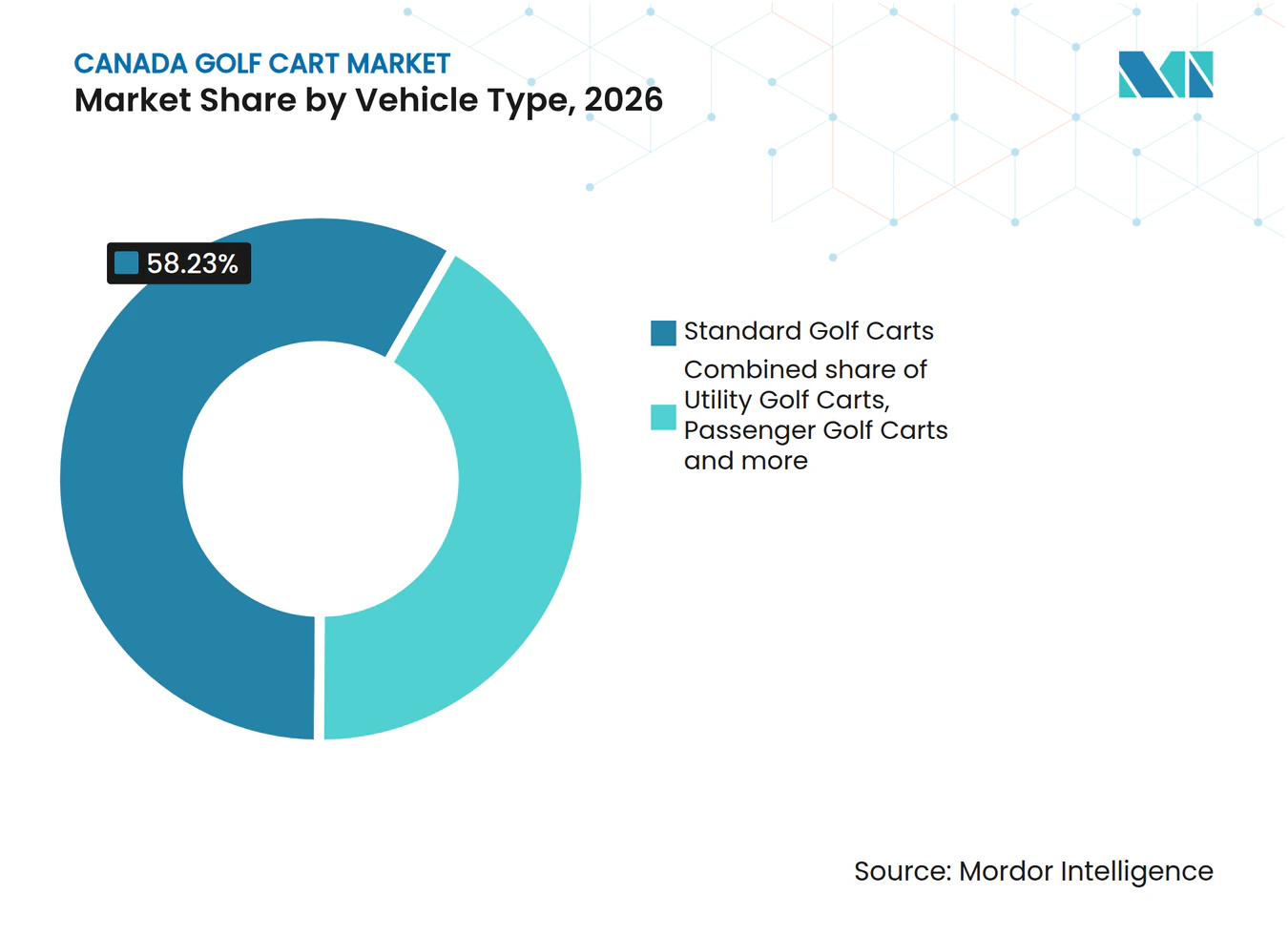
NEVs Expand Demand Beyond Course FleetsStandard golf carts commanded 58.23% of Canada golf cart market revenue in 2026. Their leading position reflects established course-fleet requirements and operators' familiarity with this vehicle format. Neighborhood electric vehicles and street-legal low-speed vehicles are projected to be the fastest-growing vehicle category, at a 10.11% CAGR through 2032. Alberta’s revised program and Ontario’s active pilot have widened potential use at resorts, retirement communities, and campgrounds. These vehicles can meet local mobility needs that standard course carts may not always meet on public roads. The Canada golf cart market, therefore, has a broader set of vehicle requirements than course-only fleets do.
Utility golf carts continue to play a stable role in grounds maintenance and material movement on large properties. Passenger golf carts and cargo variants also serve airport transport, industrial campuses, and resort operations. Simolo Customs began delivering a large fleet of carts to Predator Ridge Resort, with an on-site service center to support them. This deployment demonstrated how resort operators can use purpose-built electric fleets across varied terrain and operating conditions. Vehicle selection increasingly depends on road eligibility, passenger capacity, payload, and local service support. These factors are shifting procurement decisions beyond the traditional choice between a basic two-seat cart and a utility unit.



By Powertrain:
Battery Electric Leads as Remote Sites Add Solar OptionsBattery electric vehicles accounted for 67.87% of Canada golf cart market revenue in 2026. Their leading role reflects lower operating requirements and increasing fleet interest in lithium technology. Other powertrains are projected to grow at a 9.38% CAGR through 2032, the fastest among powertrains. Within battery electric, solar-assisted models appeal to campgrounds and remote properties where access to fixed charging can be limited. A recent academic study found that an automatically expandable solar charging system reduced charging time by several hours compared with a fixed-panel system. Solar panels function primarily as range extenders rather than a replacement for conventional charging, helping operators keep vehicles available during extended outdoor use.
Gasoline-powered carts retain a role where charging infrastructure is unavailable, particularly in remote areas. However, their position is under pressure from lithium battery operating economics and the growing availability of cold-weather electric configurations. Remote operators must balance refueling convenience against maintenance costs, energy use, and evolving local sustainability requirements. Solar-assisted systems can address specific operational challenges without requiring changes to the site power infrastructure. The Canada golf cart market is therefore not defined solely by a shift from gasoline to electric vehicles, but also encompasses a range of charging and energy approaches suited to seasonal properties, campgrounds, and dispersed facilities.
By Battery Type:
LFP Improves Winter Fleet PerformanceLithium iron phosphate batteries accounted for 45.18% of Canada golf cart market revenue in 2026 and are projected to grow at a 10.62% CAGR through 2032, the fastest among battery types. Flooded lead-acid batteries held 37.94%, as their lower purchase cost remains important for price-sensitive fleet replacements. LFP batteries retain a significant portion of their rated capacity in sub-zero temperatures and can provide several thousand cycles.
Flooded lead-acid batteries require regular watering and corrosion checks, adding labor costs across larger fleets. Absorbent glass mat and gel lead-acid batteries offer an intermediate option with better cold-weather capacity retention than flooded products. However, their shorter service life compared with LFP weakens the long-term ownership case for high-use fleets. Other lithium-ion chemistries remain relevant for higher-energy applications, including some performance-focused low-speed vehicles and airport shuttle use. Fire and storage requirements can also influence battery decisions at enclosed fleet facilities. Battery selection increasingly depends on a combination of upfront cost, cold-weather performance, maintenance workload, charging requirements, and expected vehicle service life.
By Battery Voltage:
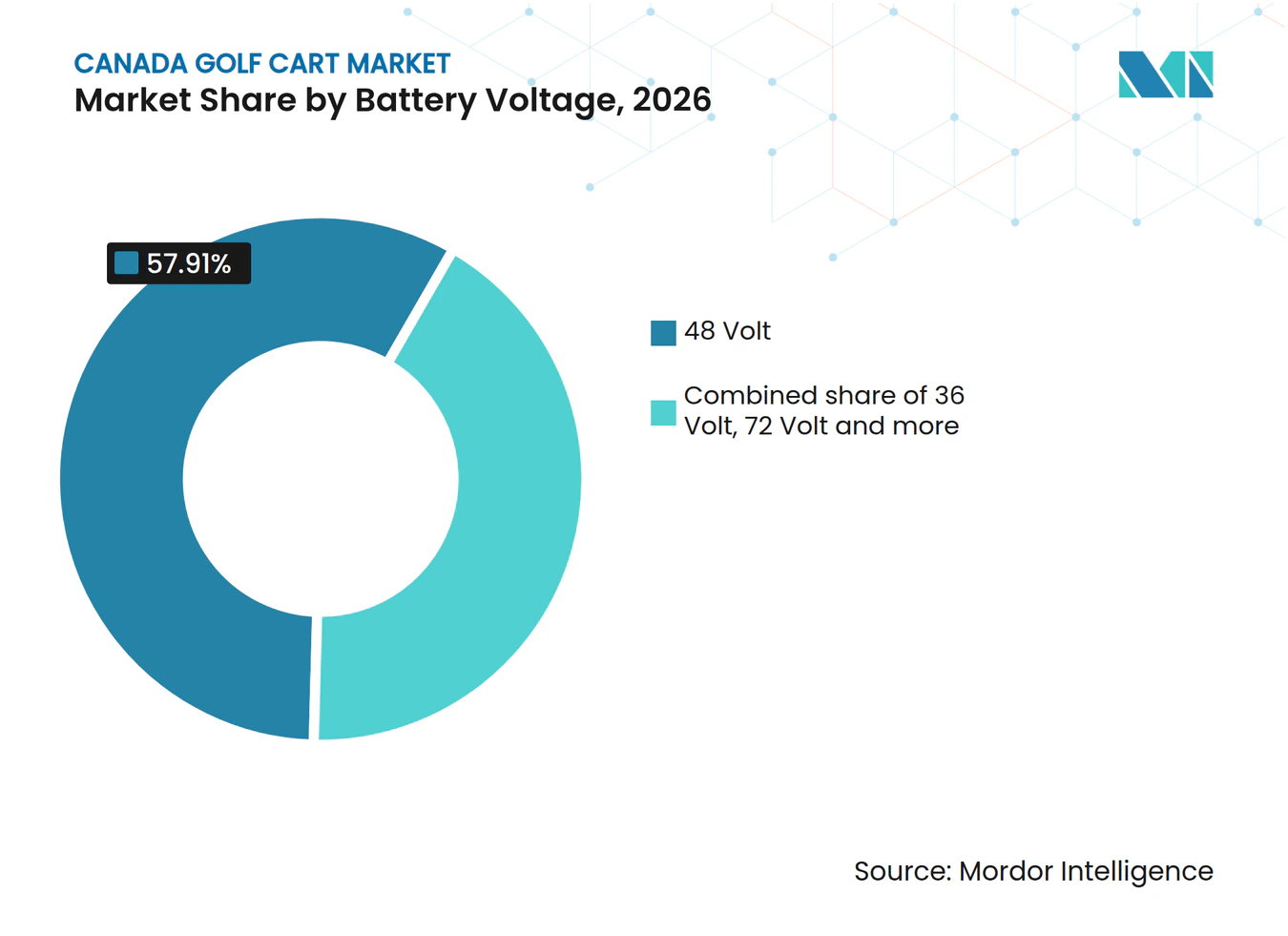
72 Volt Systems Meet Higher-Duty NeedsThe 48-volt configuration accounted for 57.91% of Canada golf cart market revenue in 2026. It remains the standard platform for many golf-course fleets and personal electric carts. The 72-volt segment is projected to grow at an 8.67% CAGR through 2032, the fastest among voltage tiers. The development of higher-voltage systems is linked to the greater power requirements of low-speed vehicles operating in hillier resort terrain and commercial applications. Simolo's NXT lithium models pair higher-voltage battery systems with AC motors. Higher-voltage configurations support extended range and stronger hill-climbing performance.
The mid-voltage platform benefits from the broad availability of chargers, aftermarket parts, and solar controllers, making it a practical choice for operators replacing existing fleets without major infrastructure changes. WAEV launched its Fusion commercial family in mid-2025 with insulated and heated lithium batteries designed for cold-weather use. The lower-voltage category is more closely associated with older lead-acid fleets and budget-focused replacements. Systems above the mid-voltage range remain a smaller category, serving industrial and airport settings with heavier payload and duty-cycle requirements. Voltage selection is likely to continue reflecting the distinction between standard golf use and more demanding commercial mobility applications.

By Seating Capacity:
Larger Vehicles Support Resort TransportThe 2-seater segment accounted for 56.84% of Canada golf cart market revenue in 2026, matching the standard need to carry two golfers and their equipment across course fleets. The 6-seater configuration is projected to grow at a 7.89% CAGR through 2032, the fastest among seating formats. Resorts, campuses, and commercial operators use larger vehicles to move more passengers with fewer units. WAEV’s Fusion family includes 2+2, 4+2, and 6+2 passenger versions with flip-seat cargo conversion. This flexibility supports properties that need passenger transport at some times and cargo capacity at others.
Four-seat vehicles, which held 32.47% of revenue in 2026, serve personal buyers, families, and residential communities that need extra passenger room. Eight-seat and larger vehicles address a specialized need in airports and major resort shuttle operations. Higher passenger capacity can improve route efficiency where stops are planned, and vehicles operate on repeat schedules. Yamaha’s integration with Joyride provides connected features for keyless access, vehicle tracking, and digital rentals. These tools can help operators manage larger fleets with varying passenger loads. Seating choices are becoming more closely tied to property logistics, not only to conventional golf-course use.
By Application:
Commercial Facilities Broaden the Customer BaseGolf courses and country clubs accounted for 51.54% of Canada golf cart market revenue in 2026. Golf remains the central application because facilities need reliable fleet availability throughout the playing season. Commercial and industrial facilities are projected to grow at a 7.91% CAGR through 2032, the fastest among applications. Logistics sites, warehouses, airports, and university campuses use carts for short-distance movement within large properties. These buyers focus on duty-cycle endurance, payload, and total operating requirements. WAEV, Club Car, and Textron E-Z-GO have portfolios that address both commercial and golf-related uses.
Resorts and hospitality properties are an important middle application because they require fleet-scale and often seek a distinct guest experience. Locally built and custom-finished vehicles can be relevant where resort branding and on-site service affect purchasing decisions. Airports and transportation hubs have lower unit volumes but can provide visible demonstrations of broader site electrification. Federal and provincial agencies also rent golf carts and low-speed vehicles for large events. Personal recreation use is also expanding as road rules allow more residential community use. Institutional fleets remain the larger demand base because they require multi-vehicle purchasing, service arrangements, and defined operating routines.
By Ownership and Business Model:
Fleet Leasing Gains AcceptanceNew vehicle purchase accounted for 57.62% of Canada golf cart market revenue in 2026. Direct ownership remains familiar to golf-course operators who want control over fleet replacement and asset use. Fleet leasing is projected to grow at an 8.28% CAGR through 2032, the fastest among ownership models. Leasing can reduce initial capital requirements and provide more predictable replacement planning for lithium vehicles. It can also help operators match fleet size to seasonal use or major event requirements. This approach is relevant where residual values for newer battery systems are still becoming established. The Canada golf cart market is seeing more interest in service-based fleet arrangements alongside direct ownership.
Used vehicle purchase serves buyers seeking lower-cost access to retired course fleets. Short-term rental is important at resorts and campgrounds where use peaks during the summer months. Long-term rental and fleet subscription remain less established but can benefit from connected fleet platforms. Yamaha’s Joyride integration supports keyless access, GPS tracking, fleet analytics, and digital rentals. These features can help operators allocate vehicles and monitor use across resorts, campuses, and event venues. Ownership decisions are becoming more closely linked to cash flow, seasonal demand, battery risk, and the availability of dealer-supported fleet programs.
By Sales Channel:
Digital Buying Grows Alongside Dealer NetworksOffline channels accounted for 81.48% of Canada golf cart market sales in 2026. Dealer networks remain essential for larger fleet orders that require demonstrations, maintenance, parts, and local service. Online channels are projected to grow at an 8.11% CAGR through 2032, the fastest among sales routes. Digital channels are more relevant to personal buyers and low-speed vehicle customers who compare configurations before visiting a dealer. ICON EV introduced its X-Series at the PGA Show 2026, using the event and digital promotion to generate interest before production availability. This approach shows how product launches can reach buyers outside traditional dealership visits. Online research also helps buyers assess vehicle features, range, seating, and accessories.
Offline sales are expected to remain the leading route for institutional fleet procurement because local service is a central requirement. Course operators usually need a dealer relationship that can support parts, technician access, and scheduled maintenance. Online growth is more likely to affect the personal and neighborhood electric vehicle segments than the overall sales structure. Manufacturers must balance direct digital engagement with the dealer support needed for larger Canadian fleets. The Canada golf cart market is expected to continue using both routes as buyer needs differ by application. The channel mix will depend on whether customers prioritize immediate vehicle comparison or ongoing service coverage.
Geography Analysis
Ontario accounted for 38.38% of Canada golf cart market revenue in 2026. Its leading position reflects a dense network of golf facilities, retirement communities, and master-planned residential development. Ontario’s Golf Car pilot and Low-Speed Vehicle pilot create defined opportunities for local road use in participating communities. The low-speed vehicle pilot runs until June 29, 2027, creating a visible deadline for operators assessing longer-term fleet investments. Ontario also has concentrated dealer and technician coverage for Club Car and E-Z-GO fleets. This support is important for corporate and institutional buyers operating multiple lithium vehicles.
Alberta is projected to grow at a 7.98% CAGR through 2032, the fastest among provinces, supported by its municipal road-use framework and the 2026 commercial resort and hotel change. British Columbia has a different opportunity profile, shaped by resort density and local production. Simolo’s 200-cart Predator Ridge delivery in the Okanagan Valley established a large locally built fleet with dedicated on-site service. These deployments give resort operators a reference point for electric cart adoption and Canadian service models.
Quebec allows low-speed vehicles on certain roads with speed limits of up to 50 km/h, though bilingual compliance and distribution requirements remain applicable to suppliers. Saskatchewan, Manitoba, and Atlantic Canada are smaller areas with potential for use in campgrounds, resorts, and local mobility. WAEV offers its Fusion commercial line to Canadian public buyers through the Canoe procurement program. Northern Canada faces the most demanding battery and service conditions because winter temperatures can reach −30°C to −40°C. Vehicles in these areas need effective battery heating, winter storage capability, and dependable parts support. Growth outside the largest provinces will depend on provincial rules, localized dealer capacity, and products suited to cold-weather operations.
Competitive Landscape
Market Concentration
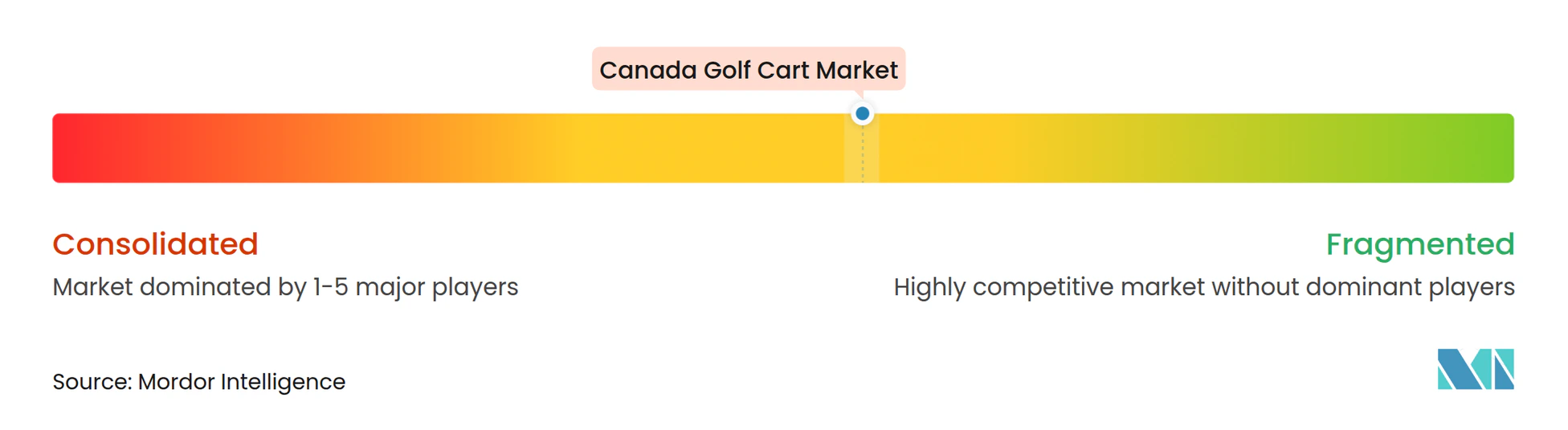
The Canada golf cart market is moderately concentrated, with Club Car, Textron E-Z-GO, and Yamaha serving golf courses through established dealer and service networks. Competition is more intense in personal-use, low-speed vehicle, and commercial utility categories. ICON EV, WAEV, Star EV, Evolution Electric Vehicles, and HDK Electric Vehicles compete on product features, styling, price, and electric configurations. Club Car launched the CRU Lithium option in July 2025, stating that it can travel three times farther through more efficient energy use. Textron E-Z-GO introduced the enhanced RXV for the 2026 model year with Samsung SDI ELiTE lithium batteries and an eight-year warranty.
Cold-climate low-speed vehicle supply, connected fleet functions, and service coverage in Atlantic and Northern Canada remain areas with room for further development. Simolo Customs holds a distinct position as a domestic manufacturer of Transport Canada-compliant low-speed vehicles. Its Predator Ridge installation combined a locally built 200-cart fleet with on-site service, addressing a need that imported vehicles often cannot meet. WAEV launched six Fusion commercial models in July 2025, including passenger and utility configurations featuring heated, insulated lithium batteries. These launches indicate that manufacturers are adapting product offerings for commercial use and winter operation. Suppliers without localized service or Canadian compliance knowledge may face a weaker position in fleet tenders.
Connected services are also becoming part of competition among established manufacturers and software providers. Yamaha's integration with Joyride introduced keyless access, real-time GPS tracking, geofencing, fleet analytics, and digital rental functions for golf cars. Transport Canada's low-speed vehicle requirements form a national equipment threshold, while provincial rules determine where compliant vehicles can operate. This two-level regulatory system makes compliance capability an important element of a Canadian distribution strategy. Competitive advantage depends on vehicle performance, local parts access, dealer coverage, and the ability to support customers after delivery. The Canada golf cart market therefore includes both vehicle manufacturers and service networks capable of meeting regional operating needs.
Canada Golf Cart Industry Leaders
-
Club Car LLC
-
Textron Inc.
-
Yamaha Motor Co., Ltd.
-
ICON EV
-
Simolo Customs Ltd.
- *Disclaimer: Major Players sorted in no particular order
Canada Golf Cart Market Companies Covered in this Report
- Club Car LLC
- Textron Inc.
- Yamaha Motor Co., Ltd.
- ICON EV
- Simolo Customs Ltd.
- Garia ApS
- Polaris Inc.
- Star EV Corporation
- Evolution Electric Vehicles
- HDK Electric Vehicles
- Columbia Vehicle Group Inc.
- WAEV Inc.
- FTR Golf
- Albion Golf Cars
- Westrock Battery Ltd.
Recent Industry Developments in Canada Golf Cart Market
- June 2026: ICON EV launched the i40FX, a forward-facing four-passenger electric golf cart with a 10.1-inch touchscreen and Apple CarPlay and Android Auto, sold through its North American dealer network.
- April 2026: Predator Ridge Resort in British Columbia opened its 2026 golf season with a fleet of 200 locally built golf carts from Vernon-based Simolo Customs, supported by on-site sales and service.
- January 2026: ICON EV unveiled its X-Series golf cart line, comprising the i20X, i40X, and i60LX, at the 2026 PGA Show.
- August 2025: E-Z-GO introduced its enhanced RXV golf car for the 2026 model year, with ELiTE models using Samsung SDI lithium batteries backed by an eight-year battery warranty.
Canada Golf Cart Market Report Scope
The Canada Golf Cart Market Report is Segmented by Vehicle Type (Standard Golf Carts, Utility Golf Carts, Neighborhood Electric Vehicles and Street-Legal Low-Speed Vehicles, Passenger Golf Carts, and Cargo and Maintenance Golf Carts), Powertrain (Battery Electric, Gasoline, and Other), Battery Type (Flooded Lead-Acid, Absorbent Glass Mat and Gel Lead-Acid, Lithium Iron Phosphate, and Other Lithium-Ion Chemistries), Battery Voltage (36 Volt, 48 Volt, 72 Volt, and Above 72 Volt), Seating Capacity (2-Seater, 4-Seater, 6-Seater, and 8-Seater and Above), Application (Golf Courses and Country Clubs, Resorts and Hospitality, Commercial and Industrial Facilities, Airports and Transportation Hubs, Personal Recreation and Leisure, and Other), Ownership and Business Model (New Vehicle Purchase, Used Vehicle Purchase, Fleet Leasing, Short-Term Rental, and Long-Term Rental and Fleet Subscription), Sales Channel (Offline and Online), and Geography (Ontario, Quebec, British Columbia, Alberta, Saskatchewan, Manitoba, Atlantic Canada, and Northern Canada). Market Forecasts are Provided in Terms of Value (USD) and Volume (Units).
Segmentation Overview
| Standard Golf Carts |
| Utility Golf Carts |
| Neighborhood Electric Vehicles and Street-Legal Low-Speed Vehicles |
| Passenger Golf Carts |
| Cargo and Maintenance Golf Carts |
| Battery Electric |
| Gasoline |
| Other |
| Flooded Lead-Acid |
| Absorbent Glass Mat and Gel Lead-Acid |
| Lithium Iron Phosphate |
| Other Lithium-Ion Chemistries |
| 36 Volt |
| 48 Volt |
| 72 Volt |
| Above 72 Volt |
| 2-Seater |
| 4-Seater |
| 6-Seater |
| 8-Seater and Above |
| Golf Courses and Country Clubs |
| Resorts and Hospitality |
| Commercial and Industrial Facilities |
| Airports and Transportation Hubs |
| Personal Recreation and Leisure |
| Other |
| New Vehicle Purchase |
| Used Vehicle Purchase |
| Fleet Leasing |
| Short-Term Rental |
| Long-Term Rental and Fleet Subscription |
| Offline |
| Online |
| Ontario |
| Quebec |
| British Columbia |
| Alberta |
| Saskatchewan |
| Manitoba |
| Atlantic Canada |
| Northern Canada |
| By Vehicle Type | Standard Golf Carts |
| Utility Golf Carts | |
| Neighborhood Electric Vehicles and Street-Legal Low-Speed Vehicles | |
| Passenger Golf Carts | |
| Cargo and Maintenance Golf Carts | |
| By Powertrain | Battery Electric |
| Gasoline | |
| Other | |
| By Battery Type | Flooded Lead-Acid |
| Absorbent Glass Mat and Gel Lead-Acid | |
| Lithium Iron Phosphate | |
| Other Lithium-Ion Chemistries | |
| By Battery Voltage | 36 Volt |
| 48 Volt | |
| 72 Volt | |
| Above 72 Volt | |
| By Seating Capacity | 2-Seater |
| 4-Seater | |
| 6-Seater | |
| 8-Seater and Above | |
| By Application | Golf Courses and Country Clubs |
| Resorts and Hospitality | |
| Commercial and Industrial Facilities | |
| Airports and Transportation Hubs | |
| Personal Recreation and Leisure | |
| Other | |
| By Ownership and Business Model | New Vehicle Purchase |
| Used Vehicle Purchase | |
| Fleet Leasing | |
| Short-Term Rental | |
| Long-Term Rental and Fleet Subscription | |
| By Sales Channel | Offline |
| Online | |
| By Geography | Ontario |
| Quebec | |
| British Columbia | |
| Alberta | |
| Saskatchewan | |
| Manitoba | |
| Atlantic Canada | |
| Northern Canada |
Key Questions Answered in the Report
What is the forecast for the Canada golf cart market through 2032?
The Canada golf cart market is projected to reach USD 254.57 million by 2032 from USD 176.34 million in 2027, growing at a 7.62% CAGR.
Which vehicle category leads golf cart sales in Canada?
Standard golf carts led with 58.23% of revenue in 2026, supported by established golf-course fleet demand.
Why are electric golf carts gaining traction in Canada?
Electric fleets can reduce maintenance needs and suit facilities that are evaluating lower-cost, more reliable daily fleet operation.
What is driving demand for neighborhood electric vehicles in Canada?
Provincial road-use frameworks are increasing use at resorts, retirement communities, and campgrounds where eligible routes are available.
What challenges affect electric cart adoption in colder Canadian regions?
Cold weather can reduce battery performance, and lithium batteries need protected charging below 0°C, making battery heating and local service important.