
Canada Commercial Greenhouse Market Size and Share
Market Overview
| Study Period | 2021 - 2031 |
|---|---|
| Forecast Data Period | 2026 - 2031 |
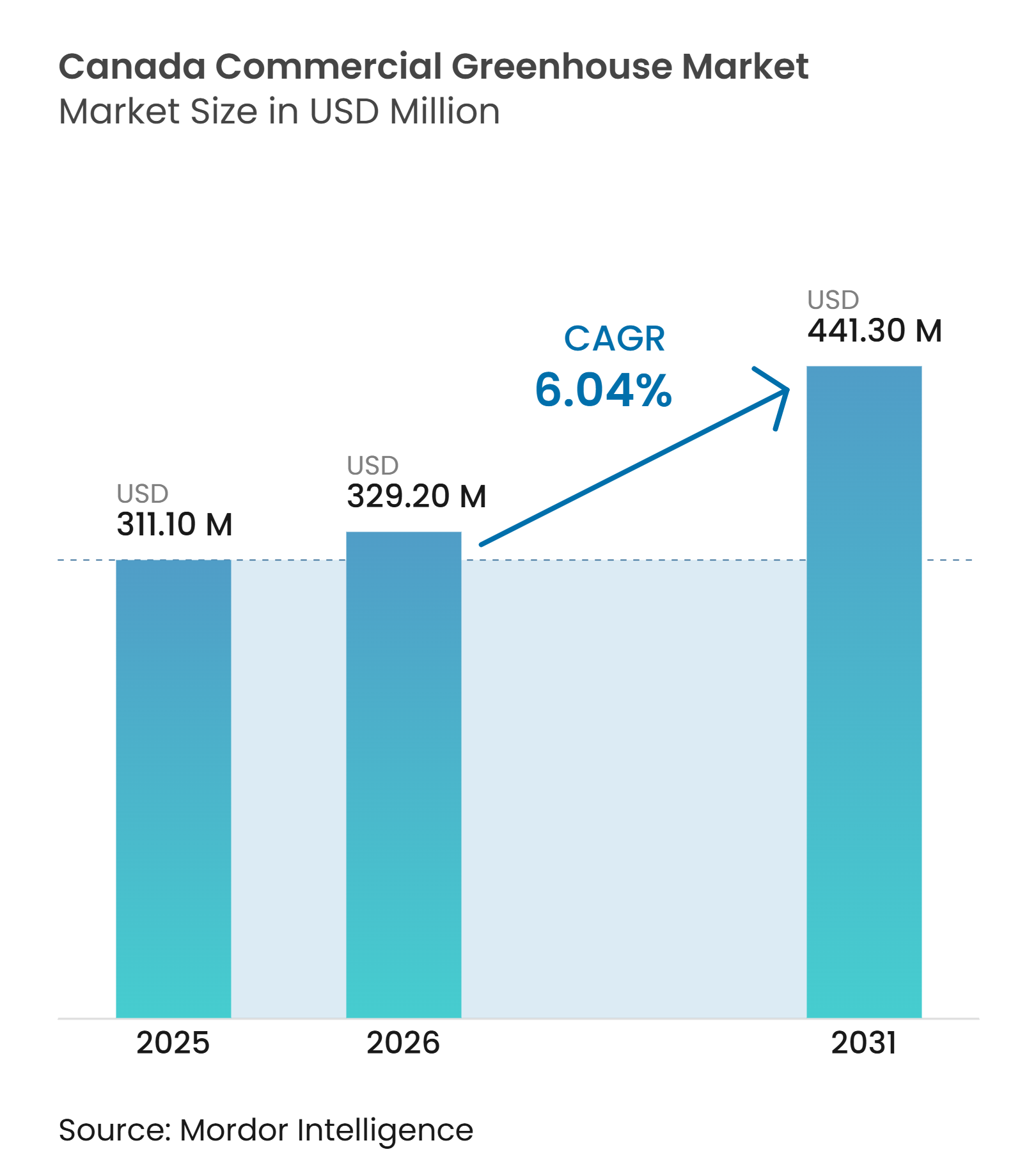
| Base Year Market Size (2025) | USD 311.10 Million |
| Market Size (2026) | USD 329.20 Million |
| Market Size (2031) | USD 441.30 Million |
| Growth Rate (2026 - 2031) | 6.04 % |
| Market Concentration | Medium |
Major Players *Disclaimer: Major Players sorted in no particular order Image © Mordor Intelligence. Reuse requires attribution under CC BY 4.0. | |
Canada Commercial Greenhouse Market Analysis by Mordor Intelligence
The Canada commercial greenhouse market size was valued at USD 311.1 million in 2025, is projected to be USD 329.2 million in 2026, and is forecast to grow at a CAGR of 6% from 2026 to 2031, reaching USD 441.3 million by 2031. Domestic year-round produce demand is supporting investment in complete structures that protect production during the winter season, when the limited availability of field crops gives greenhouse output a direct supply role for retailers and food-service buyers. In 2024, Agriculture and Agri-Food Canada recorded 974 commercial greenhouse vegetable operations that produced 866,484 metric tons, 5% more than in 2023. Buyers are moving toward integrated structures because energy management, labor use, and crop consistency increasingly depend on the fit between the building envelope and control systems, rather than on the structure or the equipment package in isolation. Higher electricity and natural gas expenses continue to tighten project economics, directing procurement toward structures with stronger thermal performance. This operating balance shapes purchasing priorities across the Canada commercial greenhouse market.
Key Report Takeaways
- By equipment type, Structural Components held 42% of the Canda commercial greenhouse market share in 2025, while Climate Control and Automation Software is forecast to grow at the fastest CAGR of 9.5% from 2026 to 2031.
- By crop type, Fruits and Vegetables held 71% of the Canada commercial greenhouse market size in 2025, while Cannabis and Specialty Crops is forecast to grow at the fastest CAGR of 8.7% from 2026 to 2031.
- By greenhouse type, Glass Greenhouses held 46% of the 2025 market, while the Hybrid and Semi-closed Greenhouses segment is forecast to grow at the fastest CAGR of 9.6% from 2026 to 2031.
- By cultivation technology, Hydroponic systems held 63% of the 2025 market, while Hybrid and Vertical Integration is forecast to grow at the fastest CAGR of 10.8% from 2026 to 2031.
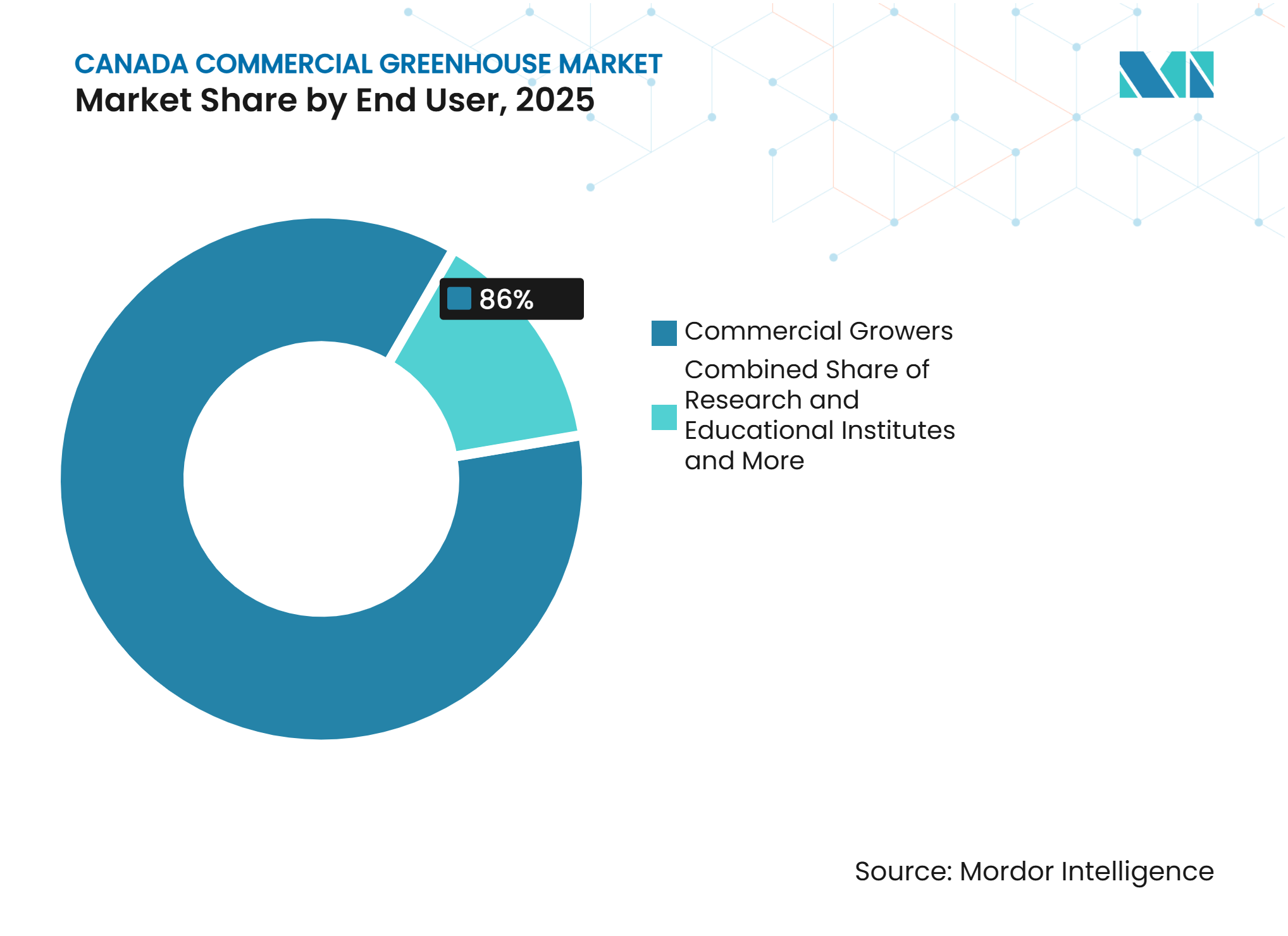
- By end user, Commercial Growers held 86% of the 2025 market, while the Research and Educational Institutes segment is forecast to grow at the fastest CAGR of 8.6% from 2026 to 2031.
Note: Market size and forecast figures in this report are generated using Mordor Intelligence’s proprietary estimation framework, updated with the latest available data and insights as of January 2026.
Market Trends and Insights
Drivers Impact Analysis of Canada Commercial Greenhouse Market*
| Driver | (~) % Impact on CAGR Forecast | Geographic Relevance | Impact Timeline |
|---|---|---|---|
| Year-Round Domestic Produce Demand and Import Substitution | +1.2% | National, with strong relevance in Ontario and Quebec where dense consumer markets and domestic procurement agreements support new capacity. | Medium term (2-4 years) |
| Expanding Greenhouse Produce and Export Economics | +1.0% | Ontario and British Columbia benefit from established logistics corridors and export-oriented production clusters. | Short term (≤ 2 years) |
| Federal CEA Funding and Accelerated Greenhouse Expensing | +0.8% | National, with early uptake in Ontario and Quebec because established operators have projects ready for execution. | Short term (≤ 2 years) |
| Automation-Led Labor and Productivity Improvement | +0.9% | Southern Ontario and British Columbia face high payroll exposure and persistent competition for agricultural workers. | Medium term (2-4 years) |
| Climate-Resilient Structures for Canada’s Extreme Weather Conditions | +0.7% | National, with the highest engineering needs in northern Ontario, Quebec, and the Prairie provinces because of snow, wind, and temperature cycles. | Medium term (2-4 years) |
| Localized Manufacturing and Integrated Project Delivery | +0.5% | Quebec and Ontario benefit from the concentration of fabrication and project-delivery capacity. | Medium term (2-4 years) |
| Source: Mordor Intelligence | |||
Year-Round Domestic Produce Demand and Import Substitution
Canada imported 72% of its vegetables, with the United States supplying 40% of that volume, according to Agriculture and Agri-Food Canada[1]. This import exposure gives domestic structures a clear role during months when field production is unavailable. Retail and food-service procurement agreements give growers greater visibility into off-season demand and support investment decisions in the Canadian commercial greenhouse market. Greenhouse strawberry harvested area rose 45.5% to 1.2 million m² in 2025, while lettuce and fine herb areas also increased. A wider crop mix requires layouts that accommodate varying light, irrigation, and climate requirements across commercial production sites, including bays that support shifting crop schedules without extensive rebuilding. New capacity is therefore shifting beyond legacy tomato and cucumber programs toward structures designed for multiple premium crop categories, with operational zones that support leafy greens, berries, herbs, and other crops with different harvesting and environmental requirements.
Expanding Greenhouse Produce and Export Economics
Canadian greenhouse vegetable exports rose from USD 1.6 billion in 2020 to more than USD 2.3 billion in 2025, with 99% of the export volume going to the United States. Ontario generated CAD 1.71 billion (USD 1.23 billion) in greenhouse vegetable exports in 2024, led by shipments of cucumbers and tomatoes. These returns support large projects near Southern Ontario logistics routes, where access to buyers, packing capacity, and border infrastructure reduces distribution friction and supports regular shipment schedules. Tariff exposure also increases the value of diversified sales channels and facilities built to meet demanding crop and quality standards. The Canada commercial greenhouse market benefits when export-focused growers select high-specification structures that preserve production consistency. The same trade reliance remains a constraint because a change in bilateral policy quickly affects the revenue base for expansion projects, prompting suppliers and growers to consider structures that accommodate crops and production standards suited to a broader set of customers.
Federal CEA Funding and Accelerated Greenhouse Expensing
The Government of Canada's National Food Security Strategy, in place since June 2026, provides CAD 750 million (USD 548 million) for the Controlled Environment Agriculture Growth Pathway over 7 years. Its CAD 650 million (USD 475 million) Technology Adoption Stream supports the complete construction of greenhouses, retrofits, and automation. A separate CAD 100 million (USD 73 million) rural stream directs support toward communities with geographical constraints. Immediate expensing allows qualifying operators to deduct construction costs in the year of acquisition when production occupies at least 90% of the floor space. The policy lowers the effective timing burden of capital investment and gives established projects a clearer path from planning to procurement, particularly where a grower is combining structural renewal with a control-system upgrade. Farm Credit Canada also provides a CAD 1 billion (USD 730 million) financing facility for controlled environment agriculture projects.
Automation-Led Labor and Productivity Improvement
The Canadian Agri-Food Automation and Intelligence Network has invested nearly CAD 41 million (USD 29.5 million) across 55 projects through 2026. More than half of the completed projects reached commercial scale, which shows the operational relevance of automation in Canadian growing environments. Integrated systems support more consistent crop management and reduce the labor intensity of routine greenhouse tasks, including environmental monitoring, irrigation adjustment, and routine crop movement. In July 2025, the Independent Electricity System Operator reported that autonomous climate control reduced energy use across multiple cucumber crop cycles without reducing yield at a commercial operation. This evidence shifts climate control from a discretionary retrofit item toward a core requirement in new projects. Suppliers in the Canada commercial greenhouse market, therefore, face greater demand for structures designed around sensors, controls, lighting access, and service routes, because an integrated layout makes it easier to use operational data throughout the crop cycle.
Restraints Impact Analysis of Canada Commercial Greenhouse Market*
| Restraint | (~) % Impact on CAGR Forecast | Geographic Relevance | Impact Timeline |
|---|---|---|---|
| High Energy Consumption and Carbon Costs | -1.20% | National, with acute exposure in Ontario and Alberta because high-density and natural-gas-intensive operations carry sizable heating and power costs. | Short term (≤ 2 years) |
| Labor Shortages and High Operating Labor Costs | -0.90% | Southern Ontario and British Columbia experience the highest pressure because greenhouse clusters compete for the same agricultural labor pool. | Medium term (2-4 years) |
| Grid, Water, and Regional Infrastructure Bottlenecks | -0.70% | Alberta and rural areas face interconnection delays, natural gas limits, and local water constraints. | Long term (≥ 4 years) |
| Fragmented Permitting, Tax, and Development Requirements | -0.50% | National, because provincial and municipal rules differ across project locations. | Medium term (2-4 years) |
| Source: Mordor Intelligence | |||
High Energy Consumption and Carbon Costs
Greenhouse electricity expenses rose 21.2% to CAD 181.9 million (USD 131 million) in 2025, while natural gas expenses increased 4.7% to CAD 265.4 million (USD 191 million)[2]. These costs directly influence the investment case for structures that require year-round heating and lighting, especially for projects whose crop plans depend on continuous winter harvests. Carbon charges add pressure for operators that rely on conventional heating systems. Lower-specification plastic-film structures face greater exposure where heat loss is high. Energy costs also increase interest in insulated glazing, tight envelopes, and systems that control heating demand with greater precision. Capital shifts toward efficient builds, although high operating costs still delay projects for those with limited access to finance and favor established growers with the funds to undertake larger upgrades in the Canadian commercial greenhouse market.
Grid, Water, and Regional Infrastructure Bottlenecks
High-energy greenhouse projects require reliable electrical service, access to natural gas, and sufficient water capacity before construction begins. Alberta faces particular pressure from aging grid infrastructure and constrained natural gas connections for intensive operations. Rural locations across Canada also face longer electrical interconnection processes and local water-table concerns. These issues lengthen development schedules and increase the cost of preparing a site for a complete commercial greenhouse, which is particularly material when civil works and utility upgrades must be completed before installation. Project sponsors must resolve utility capacity before committing to greenhouse equipment and structural procurement. Infrastructure conditions reduce the speed of expansion of Canada's commercial greenhouse market beyond established production clusters and increase the value of sites where utilities, water access, and local approvals already support intensive protected cultivation.
*Our forecasts treat driver/restraint impacts as directional, not additive. The impact forecasts reflect baseline growth, mix effects, and variable interactions.
Canada Commercial Greenhouse Market Segment Analysis
By Equipment Type:
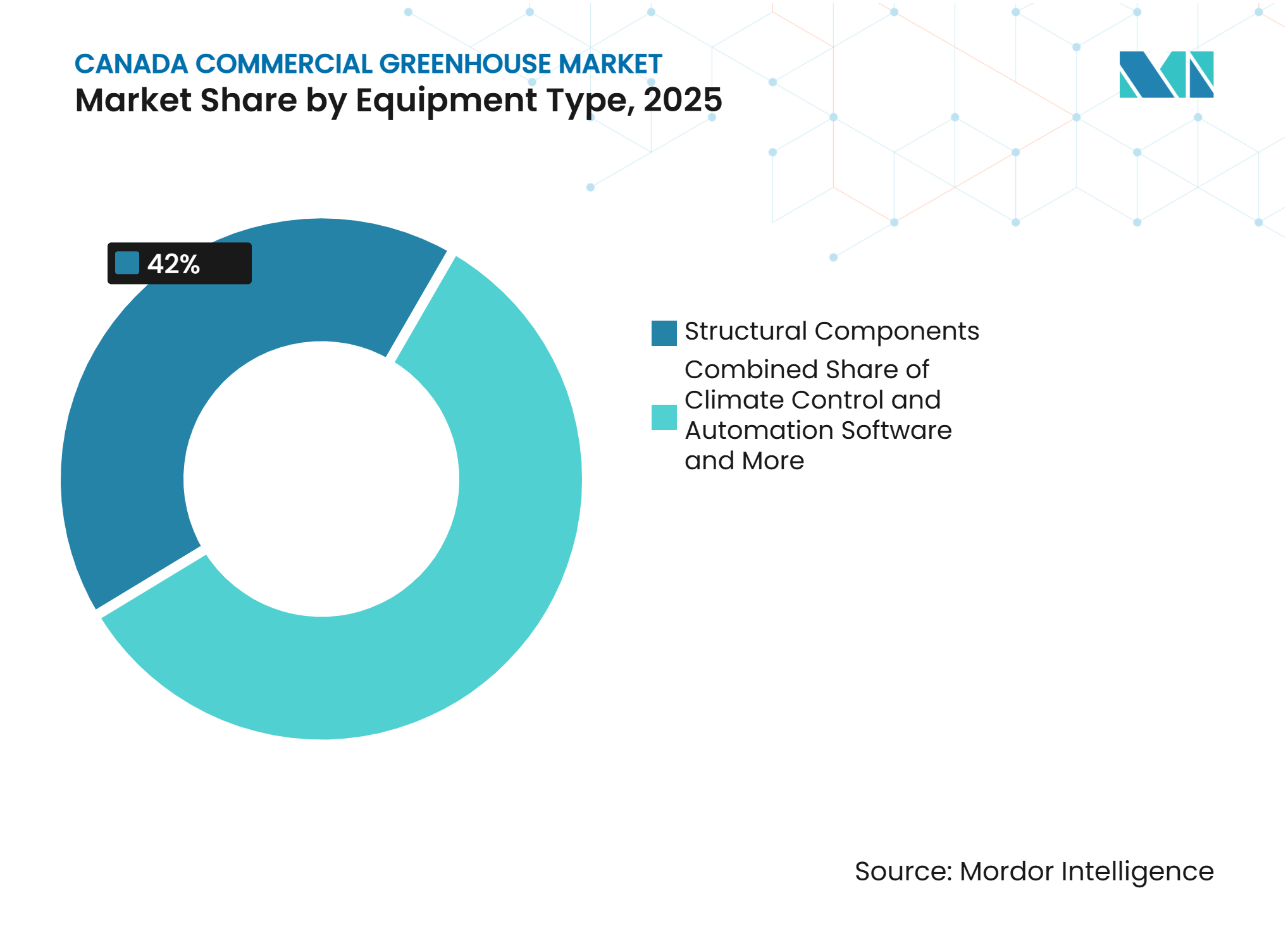
Structural Components Lead While Automation Software AdvancesStructural Components held 42% of the 2025 Canada commercial greenhouse market share by equipment type. Their lead reflects the capital intensity of frames, trusses, glazing supports, and load-bearing assemblies needed for Canadian conditions, where the structure must safely carry both environmental loads and attached production equipment. Snow, wind, and temperature cycling raise the required engineering specification for these systems. Heating, Cooling, and Ventilation Systems also account for a substantial part of project design because facilities operate through long, cold seasons. Screening and Shading Systems, plus Irrigation and Fertigation Systems, provide control over light and nutrient delivery throughout the structure.
Climate Control and Automation Software is forecast to grow at the fastest CAGR of 9.5% from 2026 to 2031. Its adoption is tied to the need to lower energy use per kilogram of output while preserving crop conditions. Climate control platforms combine sensor inputs with operating routines to manage temperature, humidity, ventilation, and irrigation across changing crop conditions. Light-emitting diode (LED) grow lighting is gaining relevance in leafy green sites that require winter production under low natural light. The Canada commercial greenhouse market is consequently shifting toward equipment packages in which building design and digital control are specified together.



By Crop Type:
Fruits and Vegetables Anchor Demand While Specialty Crops Grow FastestFruits and Vegetables held 71% of the 2025 market, making this the largest crop segment. Tomatoes produced 350,907 metric tons in 2024 and generated a CAD 938 million (USD 688 million) farm gate value. Cucumbers generated CAD 955 million (USD 701 million), while peppers accounted for 22.7% of greenhouse vegetable farm gate value. These crops support large, repeatable structures with dedicated climate and irrigation layouts. Flowers and Ornamentals require different configurations that suit retail-facing cut flowers, potted plants, and bedding plants.
Cannabis and Specialty Crops are forecast to grow at the fastest CAGR of 8.7% from 2026 to 2031. Health Canada recorded 1.45 million m² of licensed indoor cannabis growing area in late 2024. Canada exported 276 metric tons of medical cannabis in 2025, a sixth consecutive annual record. This segment requires controlled environments that align with pharmaceutical production standards and export certification. Herbs, Microgreens, Seedlings, and Propagation Crops increase demand for smaller, more specialized structures near urban and horticultural customers.
By Greenhouse Type:
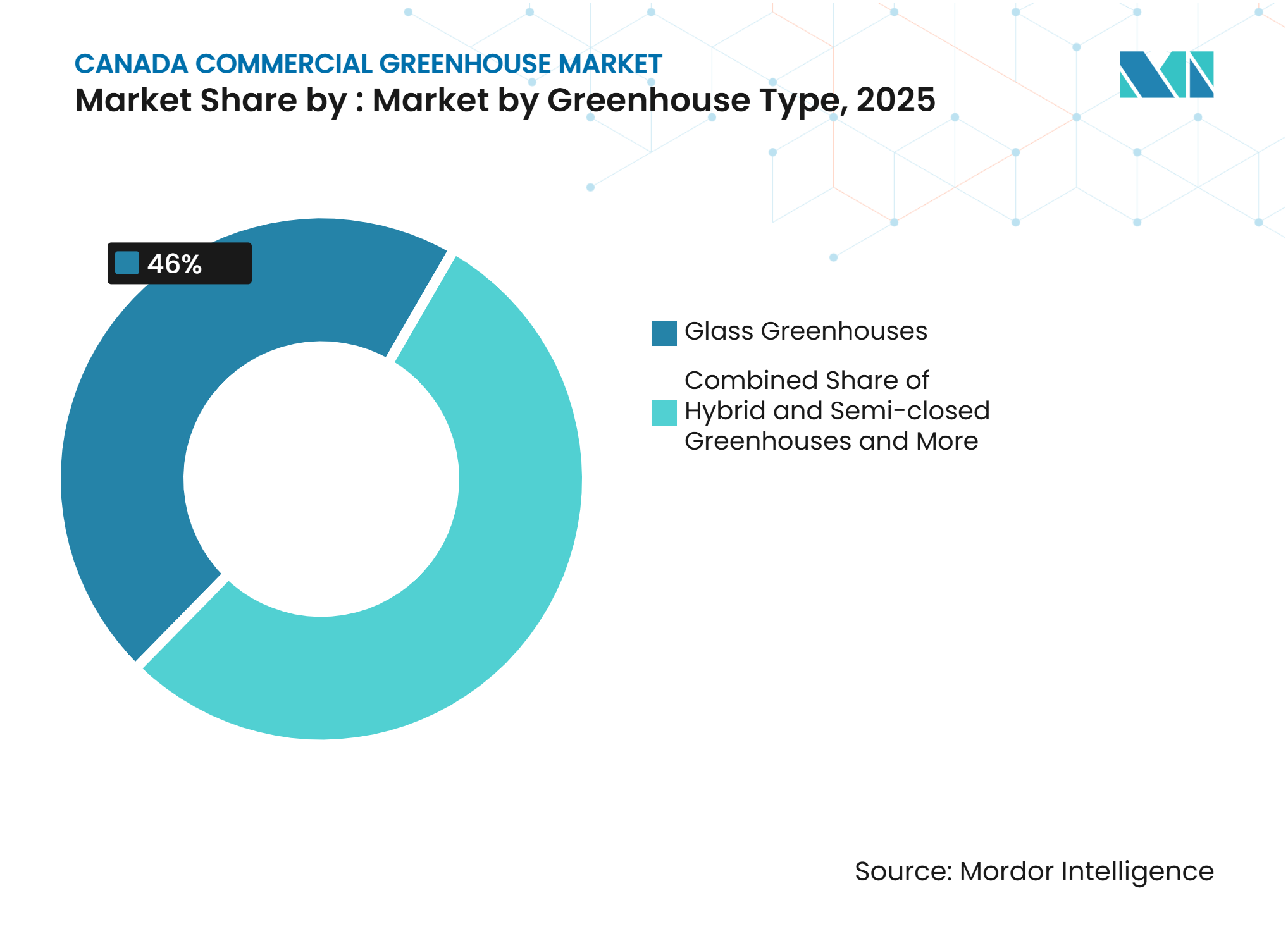
Glass Structures Hold the Largest Position While Hybrid Designs Gain GroundGlass Greenhouses held 46% of the 2025 market and represented the largest greenhouse type. Their light transmission, long service life, and suitability for high-value crops support investment by large commercial operators. The commercial greenhouse market size in Canada for glass structures reflects the need for designs that accommodate advanced environmental systems. Glass is also relevant to growers pursuing exacting export and medical cannabis production standards. Plastic-film Greenhouses retain a role where fast installation and lower initial capital requirements outweigh long-term envelope performance.
The Hybrid and Semi-closed Greenhouses segment is forecast to grow at the fastest CAGR of 9.6% from 2026 to 2031. These facilities combine a more stable internal climate with a controlled-ventilation structure. Their design reduces heating demand during shoulder seasons and supports consistent conditions for premium crops. Rigid Polycarbonate Greenhouses occupy a middle position, offering stronger insulation than plastic film while costing less than glass. Greenhouse type now affects the full equipment package because structure selection determines the feasible lighting, climate, and automation configuration.

By Cultivation Technology:
Hydroponic Systems Set the Current Standard While Vertical Integration ExpandsHydroponic systems held 63% of the 2025 market, making them the largest cultivation technology segment. Nutrient Film Technique, Deep Water Culture, and Drip Hydroponics each shape the internal layout of a facility. Their use affects structural spans, water handling, climate infrastructure, and automation routes, making the choice of cultivation a central input to facility design rather than a downstream operating decision. Non-hydroponic Soil and Substrate systems remain relevant for ornamental plants and cannabis crops, where soil, coco coir, or rockwool influences production choices. The Canada commercial greenhouse industry uses these distinct cultivation systems to match structures with crop-specific operating requirements.
Hybrid and Vertical Integration is forecast to grow at the fastest CAGR of 10.8% from 2026 to 2031. Multi-tier leafy green production uses vertical space in peri-urban areas where land availability is constrained. In April 2025, a fully automated leafy-greens greenhouse opened in King City, Ontario, using mobile gully technology, radio-frequency identification (RFID) for crop tracking, and touchless processing. These facilities require reinforced load-bearing structures, uniform climate control, and access for tiered lighting systems. The technology supports a distinct high-specification category within the Canada commercial greenhouse market.
By End User:
Commercial Growers Set the Investment Base While Research Institutes ExpandCommercial Growers held 86% of the 2025 market and represented the largest end-user group. Their position reflects the capital and technical requirements of year-round production at scale, including site development, utility access, crop systems, and ongoing operating management. Total greenhouse operating expenses reached CAD 4.2 billion (USD 3.02 billion) in 2025[3]. Plant material costs increased 16.3% to CAD 759.5 million (USD 547 million), showing the operating scale managed by commercial production sites. Retail Garden Centers and Nurseries buy configurations suited to shorter ornamental production cycles and retail demand.
The Research and Educational Institutes segment is forecast to grow at the fastest CAGR of 8.6% from 2026 to 2031. Universities and government agricultural stations are commissioning commercial-scale environments to assess hydroponic, automated, and vertical cultivation methods. Research programs increasingly connect controlled trials with facility designs that growers use at a commercial scale. These sites require reproducible conditions and integrated systems that resemble grower specifications. This buyer group broadens the addressable base for full-specification systems in the Canada commercial greenhouse market.
Geography Analysis
Ontario accounted for 64.9% of Canada’s total greenhouse area in 2025 and produced 72% of the country’s vegetables. This concentration makes Southern Ontario the core demand center for the Canada commercial greenhouse market. The Leamington area combines specialized installation capability, cold-chain infrastructure, and access to United States border crossings. Ontario’s greenhouse vegetable farm gate value reached CAD 1.85 billion (USD 1.36 billion) in 2024. The province supports large integrated projects that serve both domestic retailers and export customers, allowing suppliers to draw on an established base of installation, maintenance, and logistics expertise.
British Columbia held 17.4% of the greenhouse area, while Quebec held 10.4% in 2025. British Columbia’s Fraser Valley supports vegetable and ornamental operations and generated CAD 373 million (USD 274 million) in greenhouse vegetable farm gate value during 2024. A 5.2-hectare glass greenhouse was inaugurated in Sherrington, Quebec, in April 2025 as part of a CAD 135 million (USD 97 million) investment. Ontario, British Columbia, and Quebec accounted for 50.7%, 25.8%, and 12.4% of ornamental greenhouse sales in 2025, respectively.
Ontario, British Columbia, and Quebec accounted for 50.7%, 25.8%, and 12.4% of ornamental greenhouse sales in 2025, respectively. Alberta produced CAD 127 million (USD 93 million) in greenhouse vegetable farm gate value during 2024. Grid reliability and natural gas connections remain important development constraints for intensive facilities in the province. Atlantic Canada and the Prairie provinces together produced 6% of national vegetables, with smaller sites serving local substitution needs where transport costs reduce the competitiveness of distant supply.
Competitive Landscape
Market Concentration
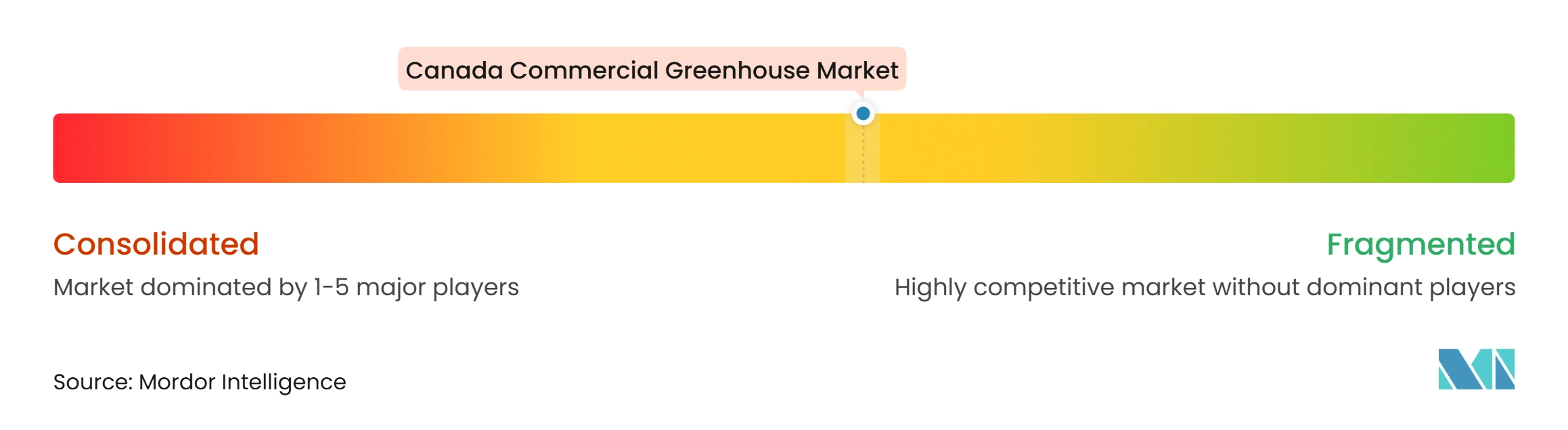
The Canada commercial greenhouse market is moderately fragmented, with competition based on engineering reliability, integrated delivery, localized manufacturing, and post-installation support. Harnois Greenhouses, Prospiant LLC, GGS Structures Inc., SEF, and Westland Greenhouse Solutions Inc. are leading participants. Firms also compete with Paul Boers Ltd. (OMNI Canada), Rogers Greenhouse, Ruthven Greenhouse Construction Ltd., Koning Greenhouses Ltd., Slip Tube Enterprises Ltd., CDN Buildings, KUBO Greenhouse Projects B.V. (KUBO Group B.V.), Dalsem B.V., Van der Hoeven Horticultural Projects, and Havecon Horticultural Projects. Supplier qualification depends on the ability to meet Canadian structural loads, insulation requirements, and glazing standards. The competitive field, therefore, favors companies that combine local project knowledge with complete commercial greenhouse delivery.
Harnois Greenhouses completed 12 Ovaltech III freestanding structures at a British Columbia nursery in July 2025 for the first phase of a multi-phase expansion. Prospiant LLC operates an expanded powder-coating facility in Kingsville, Ontario, which has added Canadian fabrication capacity since February 2026 and extends the service to external suppliers. European suppliers, including KUBO Greenhouse Projects B.V. (KUBO Group B.V.), Dalsem B.V., Van der Hoeven Horticultural Projects, and Havecon Horticultural Projects, compete on technology-intensive projects with Venlo-style engineering and integrated horticultural systems. These strategic positions make turnkey execution, rather than structure supply alone, an important differentiator in the Canada commercial greenhouse market.
Retrofit work for older plastic-film facilities creates a distinct area of competition because operators need envelope upgrades and automation integration without losing production time. Remote and northern projects create demand for designs that suit constrained utility access and the rural funding stream. Prefabricated modular systems target smaller commercial sites that sit below the usual scale of large integrated projects. Suppliers that coordinate structural design, equipment integration, commissioning, and field support through one contract limit handoffs during construction. These requirements favor providers that align engineering capability with local project delivery.
Canada Commercial Greenhouse Industry Leaders
-
Harnois Greenhouses
-
Prospiant LLC
-
GGS Structures Inc.
-
SEF
-
Westland Greenhouse Solutions Inc.
- *Disclaimer: Major Players sorted in no particular order
Canada Commercial Greenhouse Market Companies Covered in this Report
- Harnois Greenhouses
- Prospiant LLC
- GGS Structures Inc.
- Paul Boers Ltd. (OMNI Canada)
- Westland Greenhouse Solutions Inc.
- Rogers Greenhouse
- Ruthven Greenhouse Construction Ltd.
- SEF
- Koning Greenhouses Ltd.
- Slip Tube Enterprises Ltd.
- CDN Buildings
- KUBO Greenhouse Projects B.V. (KUBO Group B.V.)
- Dalsem B.V.
- Van der Hoeven Horticultural Projects
- Havecon Horticultural Projects
Recent Industry Developments in Canada Commercial Greenhouse Market
- February 2026: Prospiant LLC operates an expanded powder-coating facility at its Kingsville, Ontario location, adding fabrication capacity and extending the service to external industrial suppliers.
- July 2025: Harnois Greenhouses completed installation of 12 Ovaltech III freestanding commercial greenhouse structures at a British Columbia nursery during the first phase of a multi-phase expansion.
- April 2025: A 5.2-hectare Vermax glass greenhouse was inaugurated in Sherrington, Quebec, as part of a CAD 135 million (USD 97 million) investment.
Canada Commercial Greenhouse Market Report Scope
The study counts revenue generated by purpose-built glass or plastic structures where temperature, humidity, light, and fertigation are actively regulated to grow fruits, vegetables, flowers, ornamentals, herbs, and other specialty crops for sale to retailers, food-service buyers, or processors.
Scope exclusion: Backyard hobby houses and purely academic installations below 200 m² are not included.
The Commercial Greenhouse Market Report is Segmented by Equipment Type (Heating Systems, Cooling and Ventilation Systems, LED Grow Lighting, Irrigation and Fertigation Systems, Climate Control and Automation Software, Screening and Shading Systems, and Structural Components), by Crop Type (Fruits and Vegetables, Flowers and Ornamentals, Herbs and Microgreens, and Cannabis and Specialty Crops), by Greenhouse Type (Glass Greenhouse, Plastic-film Greenhouses, Rigid Polycarbonate Greenhouses, and Hybrid and Semi-closed Greenhouses), by Cultivation Technology (Hydroponic, Non-hydroponic Soil and Substrate, and Hybrid and Vertical Integration), and by End User (Commercial Growers, Research and Educational Institutes and Retail Garden Centers and Nurseries). The Market Forecasts are Provided in Terms of Value (USD).
Segmentation Overview
| Heating Systems | |
| Cooling and Ventilation Systems | |
| LED Grow Lighting | |
| Irrigation and Fertigation Systems | |
| Climate Control and Automation Software | |
| Screening and Shading Systems | |
| Structural Components | Glazing Systems |
| Frames and Trusses |
| Fruits and Vegetables | Tomatoes |
| Cucumbers | |
| Lettuce and Leafy Greens | |
| Peppers | |
| Strawberries and Berries | |
| Flowers and Ornamentals | Cut Flowers |
| Potted Plants and Bedding Plants | |
| Herbs and Microgreens | |
| Cannabis and Specialty Crops | Medical Cannabis |
| Seedlings and Propagation Crops |
| Glass Greenhouses |
| Plastic-film Greenhouses |
| Rigid Polycarbonate Greenhouses |
| Hybrid and Semi-closed Greenhouses |
| Hydroponic | Nutrient Film Technique |
| Deep Water Culture | |
| Drip Hydroponics | |
| Non-hydroponic Soil and Substrate | Soil-based |
| Coco Coir and Rockwool Substrate | |
| Hybrid and Vertical Integration |
| Commercial Growers |
| Research and Educational Institutes |
| Retail Garden Centers and Nurseries |
| By Equipment Type | Heating Systems | |
| Cooling and Ventilation Systems | ||
| LED Grow Lighting | ||
| Irrigation and Fertigation Systems | ||
| Climate Control and Automation Software | ||
| Screening and Shading Systems | ||
| Structural Components | Glazing Systems | |
| Frames and Trusses | ||
| By Crop Type | Fruits and Vegetables | Tomatoes |
| Cucumbers | ||
| Lettuce and Leafy Greens | ||
| Peppers | ||
| Strawberries and Berries | ||
| Flowers and Ornamentals | Cut Flowers | |
| Potted Plants and Bedding Plants | ||
| Herbs and Microgreens | ||
| Cannabis and Specialty Crops | Medical Cannabis | |
| Seedlings and Propagation Crops | ||
| By Greenhouse Type | Glass Greenhouses | |
| Plastic-film Greenhouses | ||
| Rigid Polycarbonate Greenhouses | ||
| Hybrid and Semi-closed Greenhouses | ||
| By Cultivation Technology | Hydroponic | Nutrient Film Technique |
| Deep Water Culture | ||
| Drip Hydroponics | ||
| Non-hydroponic Soil and Substrate | Soil-based | |
| Coco Coir and Rockwool Substrate | ||
| Hybrid and Vertical Integration | ||
| By End User | Commercial Growers | |
| Research and Educational Institutes | ||
| Retail Garden Centers and Nurseries | ||
Key Questions Answered in the Report
What is the size of Canada’s commercial greenhouse sector?
Canada’s commercial greenhouse market is projected to be USD 329.2 million in 2026.
Why do crop-specific layouts matter in Canadian commercial greenhouses?
They align climate, lighting, irrigation, and harvesting needs with the crop being produced.
What delays Canadian commercial greenhouse projects?
Utility limits, water constraints, and permitting requirements extend project timelines.
Why does localized delivery matter for Canadian commercial greenhouses?
It improves access to fabrication, replacement parts, field support, and warranty coordination.