
Calcium Silicate Market Size and Share
Market Overview
| Study Period | 2021 - 2031 |
|---|---|
| Market Size (2026) | USD 1.86 Billion |
| Market Size (2031) | USD 2.38 Billion |
| Growth Rate (2026 - 2031) | 5.05 % |
| Fastest Growing Market | Asia-Pacific |
| Largest Market | Asia-Pacific |
| Market Concentration | Medium |
Major Players *Disclaimer: Major Players sorted in no particular order Image © Mordor Intelligence. Reuse requires attribution under CC BY 4.0. | |
Calcium Silicate Market Analysis by Mordor Intelligence
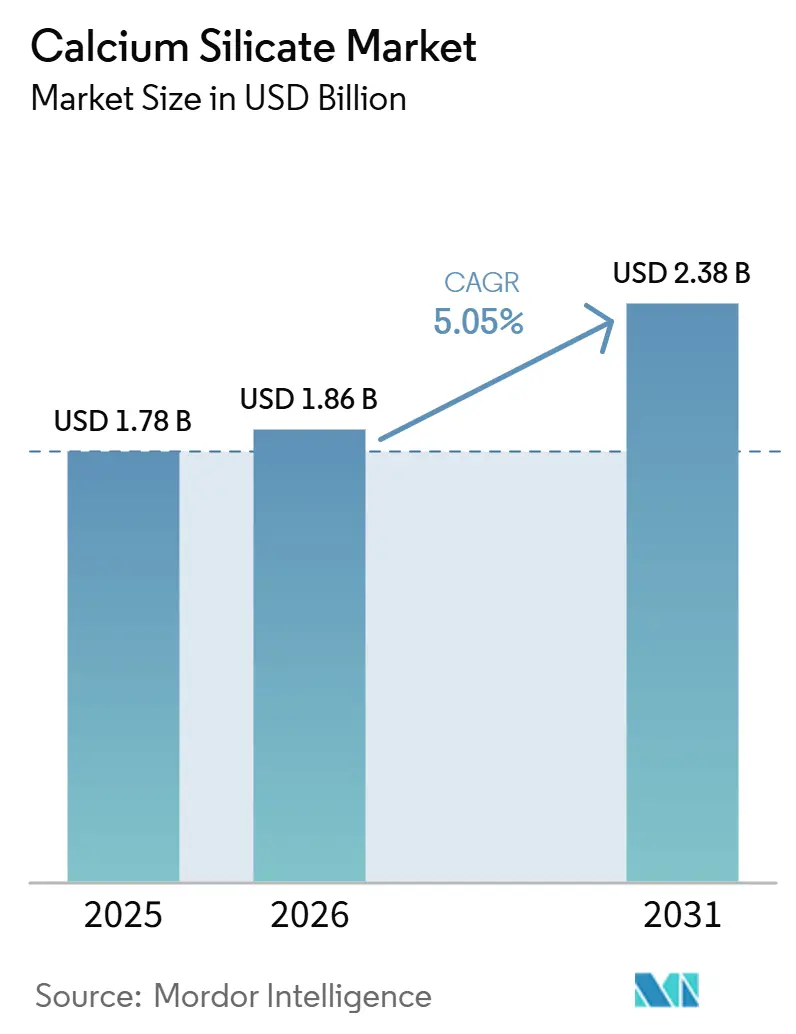
The Calcium Silicate Market size was valued at USD 1.78 billion in 2025 and is estimated to grow from USD 1.86 billion in 2026 to reach USD 2.38 billion by 2031, at a CAGR of 5.05% during the forecast period (2026-2031). The calcium silicate market is supported by replacement demand in refineries, steel mills, cement kilns, and power plants, where operators need insulation that remains stable in long periods of high-temperature service. Fire resistance is also becoming a more important purchasing requirement in building projects, especially where passive fire protection is specified. Infrastructure and industrial investment in Asia-Pacific broadens the addressable base across construction, power, and petrochemical uses. Suppliers are responding through local production, distribution partnerships, and product portfolios that serve both industrial insulation and fire protection. Rising energy and raw material costs still place pressure on producers that do not control key inputs or have access to competitive energy prices.
Key Report Takeaways
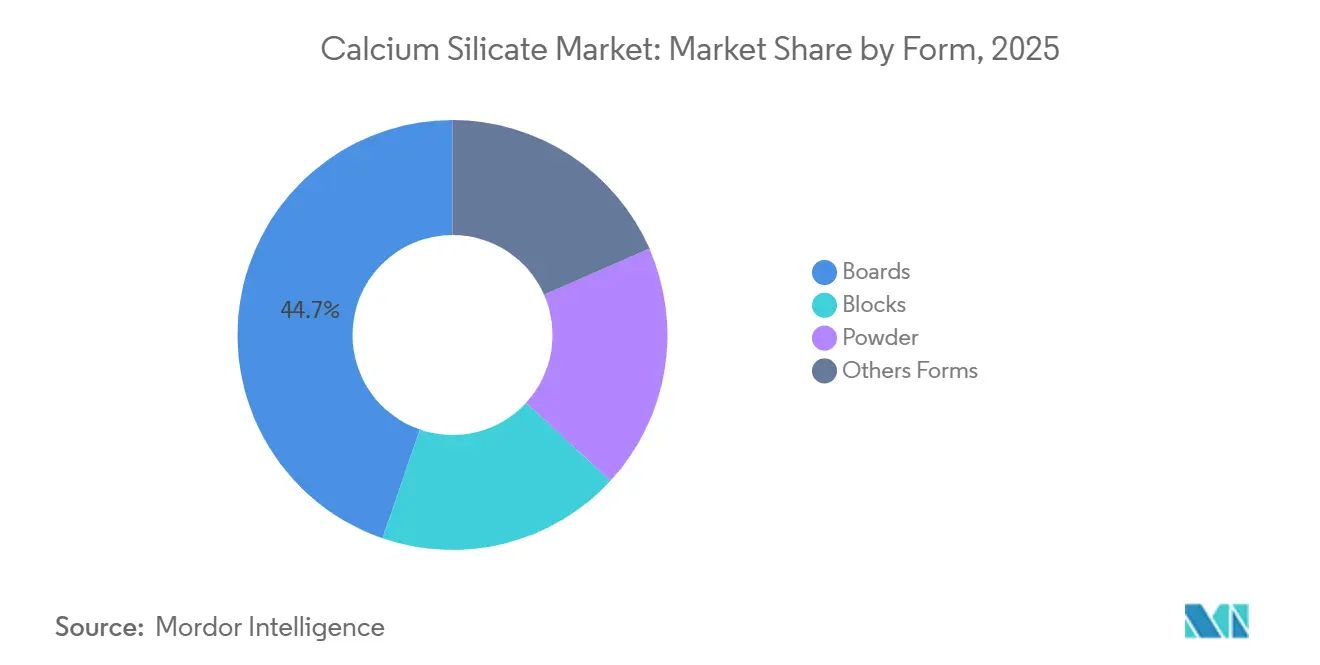
- By form, boards held 44.72% of the calcium silicate market share in 2025, while powder is forecast to grow at a 6.13% CAGR through 2031.
- By application, building and construction accounted for 32.93% of the calcium silicate market share in 2025, while fire protection is projected to advance at a 6.04% CAGR through 2031.
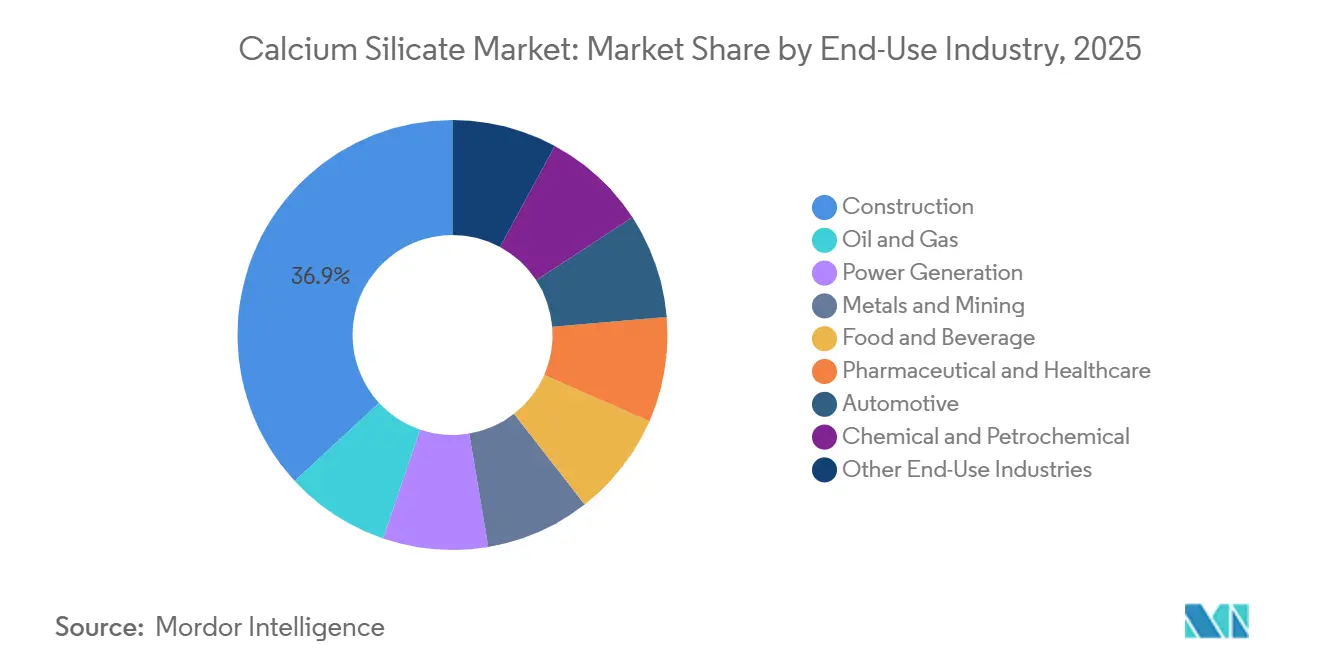
- By end-use industry, construction held 36.88% of the calcium silicate market share in 2025, while chemical and petrochemical is projected to expand at a 5.79% CAGR through 2031.
- By geography, Asia-Pacific held 43.72% of the calcium silicate market share in 2025 and is forecast to grow at a 5.88% CAGR through 2031.
Note: Market size and forecast figures in this report are generated using Mordor Intelligence’s proprietary estimation framework, updated with the latest available data and insights as of January 2026.
Global Calcium Silicate Market Trends and Insights
Drivers Impact Analysis*
| Driver | (~) % Impact on CAGR Forecast | Geographic Relevance | Impact Timeline |
|---|---|---|---|
| Growing Demand for High-Performance Thermal Insulation Materials Across Industrial Facilities | +1.5% | Global, with intensity in APAC and MEA | Medium term (2–4 years) |
| Increasing Adoption of Fire-Resistant Building Materials in Commercial and Residential Construction | +1.2% | Global; strongest in APAC and EU | Medium term (2–4 years) |
| Expansion of Oil & Gas, Power Generation, and Petrochemical Infrastructure | +1.0% | Asia-Pacific, Middle East, South Asia | Medium term (2–4 years) |
| Growing Utilization of Calcium Silicate in High-Temperature Refractory Applications | +0.7% | Global; intensive in China, India, Japan | Long term (≥ 4 years) |
| Stringent Building Safety and Fire Protection Regulations Supporting Product Adoption | +0.5% | EU, North America; early gains in GCC and Southeast Asia | Short term (≤ 2 years) |
| Source: Mordor Intelligence | |||
Growing Demand for High-Performance Thermal Insulation Materials Across Industrial Facilities
Industrial decarbonization is changing how operators select insulation for high-temperature equipment. Many buyers now consider service life and heat-loss performance alongside the initial product price. Calcium silicate can retain dimensional stability through repeated thermal cycles, which supports use in boilers, kilns, process vessels, and piping. Its expected 20-25-year service life can reduce replacement needs when compared with lower-cost materials that need more frequent attention. The calcium silicate market therefore benefits where industrial sites are upgrading equipment and seeking more consistent thermal performance. U.S. requirements for industrial equipment and technical standards for high-temperature pipe insulation provide an established compliance base for these uses[1]Occupational Safety and Health Administration, “1910 Occupational Safety and Health Standards,” U.S. Department of Labor, osha.gov.
Increasing Adoption of Fire-Resistant Building Materials in Commercial and Residential Construction
Construction specifications increasingly require materials with verified fire performance. Calcium silicate is non-combustible, which makes it relevant for facades, structural protection, ceilings, partitions, and fire-separating assemblies. The European Commission updated fire resistance performance classifications for construction products in 2024, which can affect specification choices across these applications. Amendments to Approved Document B published in 2025 also reinforced fire-safety requirements for building elements in Wales[2]Welsh Government, “Amendments to Approved Document B Fire Safety Volumes 1 and 2,” Welsh Government, gov.wales. These rules favor manufacturers that can document product performance and maintain consistent quality. The calcium silicate market also gains from construction projects where fire protection is treated as core building infrastructure rather than an optional addition.
Expansion of Oil & Gas, Power Generation, and Petrochemical Infrastructure
Industrial projects in Asia and the Middle East require insulation for pipelines, reactors, vessels, processing units, and high-temperature equipment. These applications value products that combine thermal efficiency with mechanical strength and stable dimensions. Vietnam’s Long Son project contracted for an ethane conversion development that is scheduled for completion in 2027, illustrating the type of petrochemical investment that can create demand for related insulation systems. The calcium silicate market has a practical logistics advantage when manufacturing is located near project activity in India, Vietnam, Indonesia, and Thailand. Producers in these locations can serve projects with shorter delivery routes than suppliers shipping from Europe or Japan. This makes local capacity and distribution reach important competitive factors for industrial suppliers.
Growing Utilization of Calcium Silicate in High-Temperature Refractory Applications
Calcium silicate is used as backup insulation in high-temperature equipment such as cement kilns, glass furnaces, aluminum facilities, and petrochemical units. The material can operate at temperatures up to 1,100°C in suitable applications. Low-density and microporous grades can support thinner insulation systems where operators seek higher thermal efficiency. These features keep the calcium silicate market connected to refractory demand in steel, cement, energy, and process industries. The overlap between insulation and refractory requirements gives suppliers an opportunity to offer broader thermal-management systems.
Restraints Impact Analysis*
| Restraint | (~) % Impact on CAGR Forecast | Geographic Relevance | Impact Timeline |
|---|---|---|---|
| Volatility in Raw Material and Energy Costs Impacting Manufacturing Expenses | -0.7% | Global; most acute in Europe and East Asia | Short term (≤ 2 years) |
| Competition from Alternative Thermal Insulation Materials Such as Mineral Wool and Aerogels | -0.5% | North America and Europe; emerging in APAC premium industrial segments | Medium term (2–4 years) |
| High Installation and Maintenance Costs for Industrial Insulation Systems | -0.3% | Global; more pronounced in emerging markets with limited skilled labor | Medium term (2–4 years) |
| Source: Mordor Intelligence | |||
Volatility in Raw Material and Energy Costs Impacting Manufacturing Expenses
Calcium silicate production depends on silica, lime, and energy-intensive processing. Natural gas and electricity, therefore, have a direct effect on manufacturing costs, particularly at facilities without lower-cost energy arrangements. Lime production also reflects energy costs because calcination requires substantial heat. The calcium silicate market can face margin pressure when input inflation cannot be passed through to customers under fixed contracts. Producers with secured raw material supply or efficient production lines are better placed to manage this exposure. Cost control also matters when projects compare calcium silicate with lower-priced insulation materials.
Competition from Alternative Thermal Insulation Materials Such as Mineral Wool and Aerogels
Mineral wool remains a strong alternative in cost-sensitive building work because it benefits from large-scale supply and broad availability. Aerogel-based systems can be attractive in space-constrained industrial environments because they offer high thermal performance with thinner profiles. These alternatives can limit calcium silicate market adoption where temperature requirements are moderate or installation space is the main design constraint. Calcium silicate retains a stronger position in demanding applications above 650 °C and where dimensional stability under moisture cycling is important. Its compressive strength can also be useful where corrosion-under-insulation risk requires more robust systems. Product selection will continue to depend on the operating temperature, space limits, installation method, and lifecycle cost.
*Our forecasts treat driver/restraint impacts as directional, not additive. The impact forecasts reflect baseline growth, mix effects, and variable interactions.
Segment Analysis
By Form: Boards Lead Established Uses While Powder Serves Specialty Applications
Boards held 44.72% of the calcium silicate market share by form in 2025. Their leading position reflects broad use across industrial insulation, construction assemblies, and fire-protection systems. Prefabricated boards can reduce installation time compared with custom-cast options. They are also suited to modular construction and industrial skid assemblies where dimensions must be controlled. Certified boards are used in commercial ceilings, partitions, and structural steel protection. Technical standards and non-combustibility requirements support demand for products with documented performance. This keeps boards central to the calcium silicate industry across both building and industrial end uses. The format is familiar to installers and can be cut or assembled for different project requirements. That practicality supports its use in both new installations and replacement work. Suppliers also benefit when boards are specified as part of a complete tested system rather than as a stand-alone material. These characteristics explain why board demand is spread across several end-use categories.
Powder is projected to be the fastest-growing form, at a 6.13% CAGR through 2031. It is used as an additive in paints, coatings, cement formulations, and specialty ceramics. These uses place powder in process-chemistry applications rather than only insulation projects. Improvements in hydrothermal synthesis and microstructure control can improve temperature tolerance and mechanical properties. Blocks remain useful in furnace and steel-casting applications that need custom refractory backup insulation. Their role is smaller but important, where equipment geometry and load tolerance are specific. The range of forms allows suppliers to address established construction volumes and smaller technical applications. Powder is especially relevant where formulators need a material that can be integrated into a larger compound or coating system. Blocks serve projects that need tailored insulation shapes and stable thermal performance. The availability of several forms reduces reliance on one application pathway. It also gives producers a reason to maintain separate technical and sales capabilities for construction and specialty customers.



By Application: Building and Construction Leads While Fire Protection Grows Faster
Building and construction accounted for 32.93% of the calcium silicate market size by application in 2025. Demand comes from renovation work in mature economies and greenfield projects in developing regions. Commercial buildings use calcium silicate boards in ceilings, partitions, facade systems, and structural protection. The material supports fire and thermal requirements in applications where non-combustible components are specified. This broad application base gives the segment a stable role in the calcium silicate market. Industrial thermal insulation, refractories, and high-temperature components form another differentiated group of uses. These uses depend more heavily on performance under continuous heat than on general building volumes. They are often selected through engineering specifications that define operating temperature, mechanical requirements, and installation conditions. This can make qualification periods longer than in routine construction projects. Once approved, a product may remain in service through long maintenance cycles. That pattern supports a more technical position for suppliers serving industrial applications.
Fire protection is projected to be the fastest-growing application at a 6.04% CAGR through 2031. Building codes are converting passive fire protection from an optional design choice into a required element in more project types. Paints, coatings, and cement additives are smaller applications with demand patterns linked to chemical production. Ceramics is also an emerging use for active calcium silicate grades in specialized industrial equipment and furnace linings. Calderys offers HYSIL for industrial pipe outer insulation and refractory backup, illustrating the connection between insulation and refractory specifications. The application mix provides exposure to construction, process industries, and specialty material uses. It also limits dependence on a single building cycle or industrial investment cycle. Applications with fire-safety requirements can provide a different demand base from refractory uses in heavy industry. Suppliers need product documentation and technical support because the requirements vary across these applications. A broader application portfolio can therefore support more balanced demand over the forecast period.
By End-Use Industry: Construction Anchors Revenue, While Chemical and Petrochemical Activity Leads Growth
Construction held 36.88% of the calcium silicate market share by end-use industry in 2025. The segment benefits from the scale of building activity in Asia-Pacific and the need to meet minimum thermal and fire-performance requirements. Calcium silicate boards can serve walls, ceilings, partitions, and protective assemblies. Their non-combustible properties are relevant where building standards require documented fire performance. Suppliers can strengthen their position by providing certified systems and dependable distribution to contractors. Product consistency is especially important where specifications are tied to safety compliance. Contractors and designers need confidence that the supplied material matches the performance stated in project documents. This gives established manufacturers an advantage when they can provide testing records and dependable local support. Construction demand is also distributed across many projects rather than concentrated in a small number of sites.
Chemical and petrochemical is forecast to be the fastest-growing end-use industry at a 5.79% CAGR through 2031. Growth is linked to capacity additions in Southeast Asia and India and to refinery modernization in the Middle East. These facilities use insulation for process equipment, pipework, reactors, and high-temperature services. Oil and gas, power generation, and metals and mining also depend on heavy-industry capital spending. Pharmaceutical, healthcare, food and beverage, and automotive uses are smaller and have more specialized requirements. NICHIAS offers ECOLUX boards made with recycled materials and certified for non-combustibility under Japanese standards, which supports green-building procurement needs. Industrial buyers often assess materials against equipment reliability, maintenance schedules, and operating conditions. Smaller end uses can require more specialized grades or documentation. This combination creates distinct routes to market for suppliers that sell boards, blocks, and technical insulation products. It also explains why end-use demand does not move in the same pattern across all customer groups.
Geography Analysis
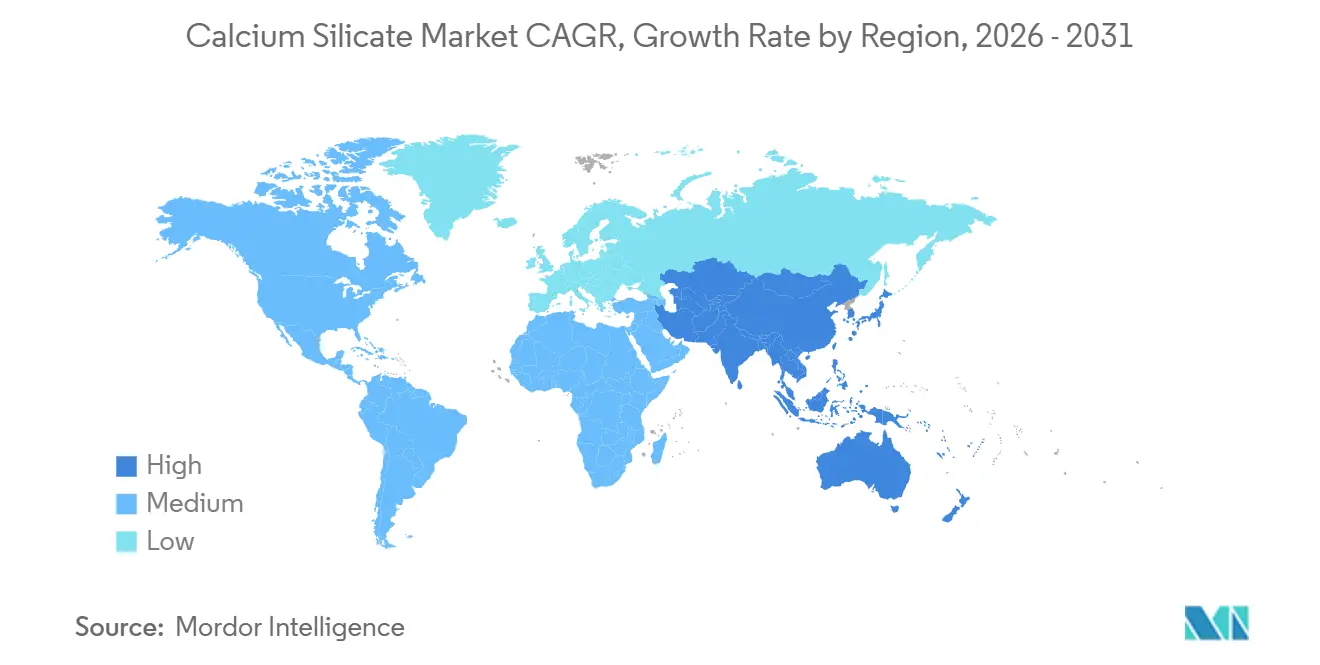
Asia-Pacific held 43.72% of the calcium silicate market share in 2025 and is forecast to expand at a 5.88% CAGR through 2031. The region combines construction activity, industrial capacity additions, and demand for refractory retrofit work. China has a substantial base of calcium silicate board production, while India and Southeast Asia offer new industrial and infrastructure opportunities. Japan contributes replacement demand from aging power, refinery, and manufacturing assets. South Korea supports specialized demand from advanced manufacturing and power generation. The regional mix makes Asia-Pacific the main source of both revenue and forecast growth for the calcium silicate market. Construction demand is broad across several countries, while industrial projects add demand for specialized thermal insulation. This reduces dependence on a single national market. Regional producers can use short supply routes to compete for time-sensitive project orders. International producers must balance their technology position with the need for local availability and service.
North America is mature in absolute consumption and remains supported by petrochemical plants, power generation, and commercial construction. OSHA requirements and ASTM C533 standards help maintain a technical baseline for high-temperature pipe insulation. Canada’s LNG export infrastructure and Mexico’s manufacturing corridor offer additional project opportunities. Europe is shaped more directly by regulation and energy-efficiency requirements. The European Commission’s 2024 regulation updates fire-resistance performance classifications for construction products. Germany remains important because chemical processing and steelmaking sites need insulation for heat-intensive equipment. European customers also face a combination of safety, energy-efficiency, and product-performance requirements. These factors can favor products with reliable documentation and long service lives.
South America has demand from oil and gas extraction, steel production, and pharmaceutical facilities, although project financing can cause volatility. The Middle-East and Africa represent a smaller share but remain important for refining, power generation, desalination, and construction. High ambient temperatures and severe operating conditions support the use of durable pipe and equipment insulation. Saudi Arabia and the United Arab Emirates are progressing industrial diversification programs that require thermal-management systems. Regional demand is linked to large industrial facilities as well as commercial and public construction. Project conditions can require materials that perform in high ambient temperatures and demanding outdoor environments. Suppliers with local manufacturing or regional distribution can shorten delivery times and support specification work. This can be particularly important where projects have strict schedules and material approval requirements. The region also brings together building-materials demand and high-temperature industrial applications, which may require different product forms and sales channels. Suppliers must therefore balance broad construction distribution with technical support for refinery, power, and desalination projects. Etex’s Oman partnership is specifically focused on gypsum-based industrial activity, but it signals a wider interest in serving Gulf construction-materials demand through local operations.

Competitive Landscape
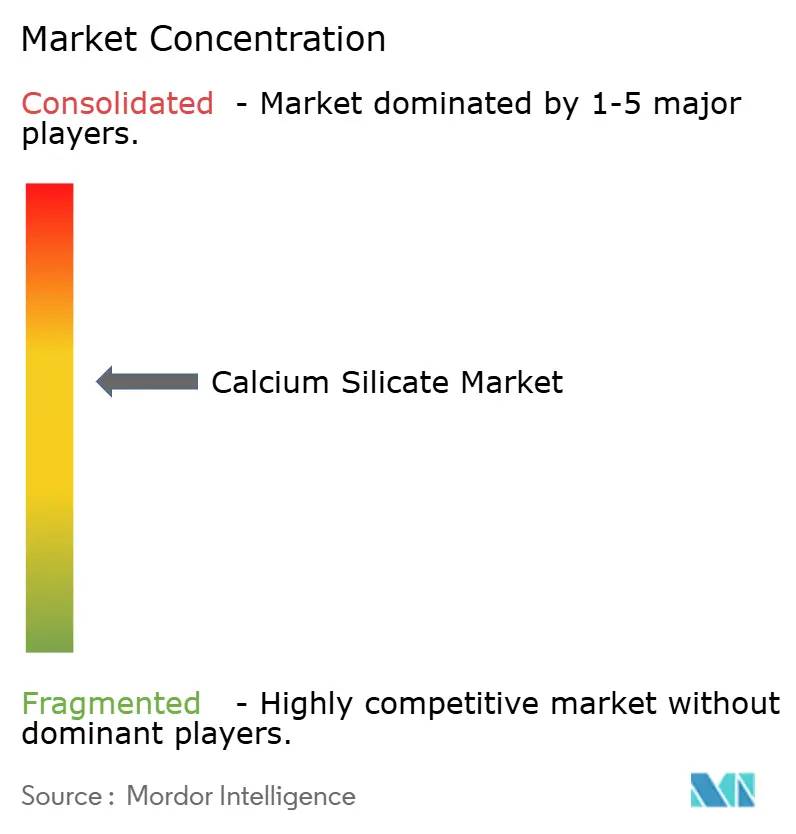
The calcium silicate market is moderately fragmented, with top players including Etex Group, Johns Manville, American Elements, Morgan Advanced Materials plc, and Calderys. Etex operates Promat for industrial and fire-protection applications and Skamol for microporous calcium silicate products. Its 2025 results reported operations across more than 45 countries and a broad manufacturing footprint, supporting its ability to serve international specifications. Johns Manville has a strong North American position in mechanical insulation and commercial construction. NICHIAS and Calderys compete through technical product portfolios for industrial, furnace, energy, and refractory applications. Competition is based on certification, product performance, local availability, and the ability to meet project delivery needs.
Large suppliers are using geographic expansion and portfolio investment to build stronger specification positions. Etex’s January 2026 joint venture with Kunooz Oman Holding extended the group’s manufacturing presence into Oman. Etex also acquired Drumarkon in December 2025, strengthening its fire-protection portfolio for marine and offshore use. Calderys has expanded its Odisha facility as an export base for East and Southeast Asia, with HYSIL included in its product offering. These actions show how manufacturers are placing production and product development closer to growing industrial markets.
Regional producers in China compete primarily through price and local access in construction uses. International suppliers retain a stronger role in premium industrial and fire-protection specifications where certification and system performance carry greater weight. The calcium silicate market also has a potential future use in battery thermal management, although the supplied material did not include an eligible primary source to support a quantified market assessment. This leaves established construction, industrial insulation, and refractory applications as the current basis for competitive positioning. Manufacturers that combine technical support with reliable supply can reduce the risk of substitution in demanding projects. Overall, rivalry is active, but the absence of a dominant global supplier preserves room for regional specialists and focused technical providers. Market leaders can use their broader portfolios to address complex projects that need several types of thermal or fire-protection materials. Smaller companies can compete where they have lower logistics costs or long-standing local customer relationships. The competitive result differs by region and application rather than following one uniform global pattern. This supports the description of a fragmented supplier base. Etex reported EUR 3.8 billion (~USD 4.32 billion) in revenue for 2024, which demonstrates the scale of a diversified construction-materials group that can support fire-protection and insulation specifications across multiple countries. Its scale does not establish a dominant global calcium silicate position because suppliers serve different applications and regional channels. NICHIAS reported JPY 251.9 billion (~1.54 billion) in net sales for the fiscal year ended March 2026 and identified further growth targets for fiscal 2027, supporting continued investment capacity across its wider insulation and building-materials operations. Morgan Advanced Materials’ efficiency program also shows that high-temperature materials suppliers are improving their cost structures while positioning for recovery in industrial end markets. These company actions reinforce the importance of financial capacity, technical development, and regional production in supplier competition.
Calcium Silicate Industry Leaders
Etex Group
Johns Manville
American Elements
Calderys
Morgan Advanced Materials plc
- *Disclaimer: Major Players sorted in no particular order

Recent Industry Developments
- April 2026: Calderys officially launched CAPES in Odisha, a 45-acre greenfield facility for refractories and steel casting fluxes. The facility is designed as an export hub for East Asia, Southeast Asia, and the wider Asia-Pacific region, with HYSIL calcium silicate insulation in its product portfolio.
- January 2026: Etex Group entered a joint venture with Kunooz Oman Holding to develop gypsum-based industrial activities in Oman, including the acquisition of 25% of Kunooz Gypsum. The joint venture expands Etex Group's presence in the Middle East, enabling the company to combine standard gypsum products from Oman with its high-temperature calcium silicate fire protection boards (Promat) to serve regional industrial and construction markets.


Global Calcium Silicate Market Report Scope
Calcium silicate is a noncombustible inorganic compound manufactured from lime and silica. It functions as a moisture-absorbing anti-caking agent in food and pharmaceutical applications, and is widely used in passive fire protection, high-temperature industrial insulation, cement manufacturing, and agricultural soil conditioning.
The Calcium Silicate Market is segmented by form, application, end-use industry, and geography. By form, the market is segmented into boards, blocks, powder, and other forms. By application, the market is segmented into building and construction, industrial thermal insulation, refractories and high-temperature components, fire protection, paints and coatings, cement additives, ceramics, and other applications. By end-use industry, the market is segmented into construction, oil & gas, power generation, metals & mining, food & beverage, pharmaceutical & healthcare, automotive, chemical & petrochemical, and other end-use industries. The report also covers the market size and forecasts for calcium silicate in 16 countries across major regions. For each segment, the market sizing and forecasts have been done on the basis of value (USD).
| Boards |
| Blocks |
| Powder |
| Other Forms |
| Building and Construction |
| Industrial Thermal Insulation |
| Refractories and High Temperature Components |
| Fire Protection |
| Paints and Coatings |
| Cement Additives |
| Ceramics |
| Other Applications |
| Construction |
| Oil & Gas |
| Power Generation |
| Metals & Mining |
| Food & Beverage |
| Pharmaceutical & Healthcare |
| Automotive |
| Chemical & Petrochemical |
| Other End-Use Industries |
| Asia-Pacific | China |
| India | |
| Japan | |
| South Korea | |
| Rest of Asia-Pacific | |
| North America | United States |
| Canada | |
| Mexico | |
| Europe | Germany |
| United Kingdom | |
| France | |
| Italy | |
| Russia | |
| Rest of Europe | |
| South America | Brazil |
| Argentina | |
| Rest of South America | |
| Middle-East and Africa | Saudi Arabia |
| South Africa | |
| Rest of Middle-East and Africa |
| By Form | Boards | |
| Blocks | ||
| Powder | ||
| Other Forms | ||
| By Application | Building and Construction | |
| Industrial Thermal Insulation | ||
| Refractories and High Temperature Components | ||
| Fire Protection | ||
| Paints and Coatings | ||
| Cement Additives | ||
| Ceramics | ||
| Other Applications | ||
| By End-Use Industry | Construction | |
| Oil & Gas | ||
| Power Generation | ||
| Metals & Mining | ||
| Food & Beverage | ||
| Pharmaceutical & Healthcare | ||
| Automotive | ||
| Chemical & Petrochemical | ||
| Other End-Use Industries | ||
| By Geography | Asia-Pacific | China |
| India | ||
| Japan | ||
| South Korea | ||
| Rest of Asia-Pacific | ||
| North America | United States | |
| Canada | ||
| Mexico | ||
| Europe | Germany | |
| United Kingdom | ||
| France | ||
| Italy | ||
| Russia | ||
| Rest of Europe | ||
| South America | Brazil | |
| Argentina | ||
| Rest of South America | ||
| Middle-East and Africa | Saudi Arabia | |
| South Africa | ||
| Rest of Middle-East and Africa | ||


Key Questions Answered in the Report
What is the size of the calcium silicate market?
The calcium silicate market stands at USD 1.86 billion in 2026 and is expected to reach USD 2.38 billion by 2031.
Which calcium silicate form led the market share in 2025?
Boards led by form with a 44.72% share in 2025 because they are widely used in industrial insulation, construction, and fire-protection systems.
Which application is expected to grow fastest through 2031?
Fire protection is projected to grow at a 6.04% CAGR through 2031 as building requirements increasingly specify passive fire-protection systems.
Which region leads calcium silicate demand?
Asia-Pacific led with a 43.72% share in 2025 and is forecast to expand at a 5.88% CAGR through 2031.
Page last updated on:





