
Brine Concentration Technology (BCT) Market Size and Share
Market Overview
| Study Period | 2022 - 2032 |
|---|---|
| Market Size (2027) | USD 19.03 Billion |
| Market Size (2032) | USD 26.36 Billion |
| Growth Rate (2027 - 2032) | 6.73 % |
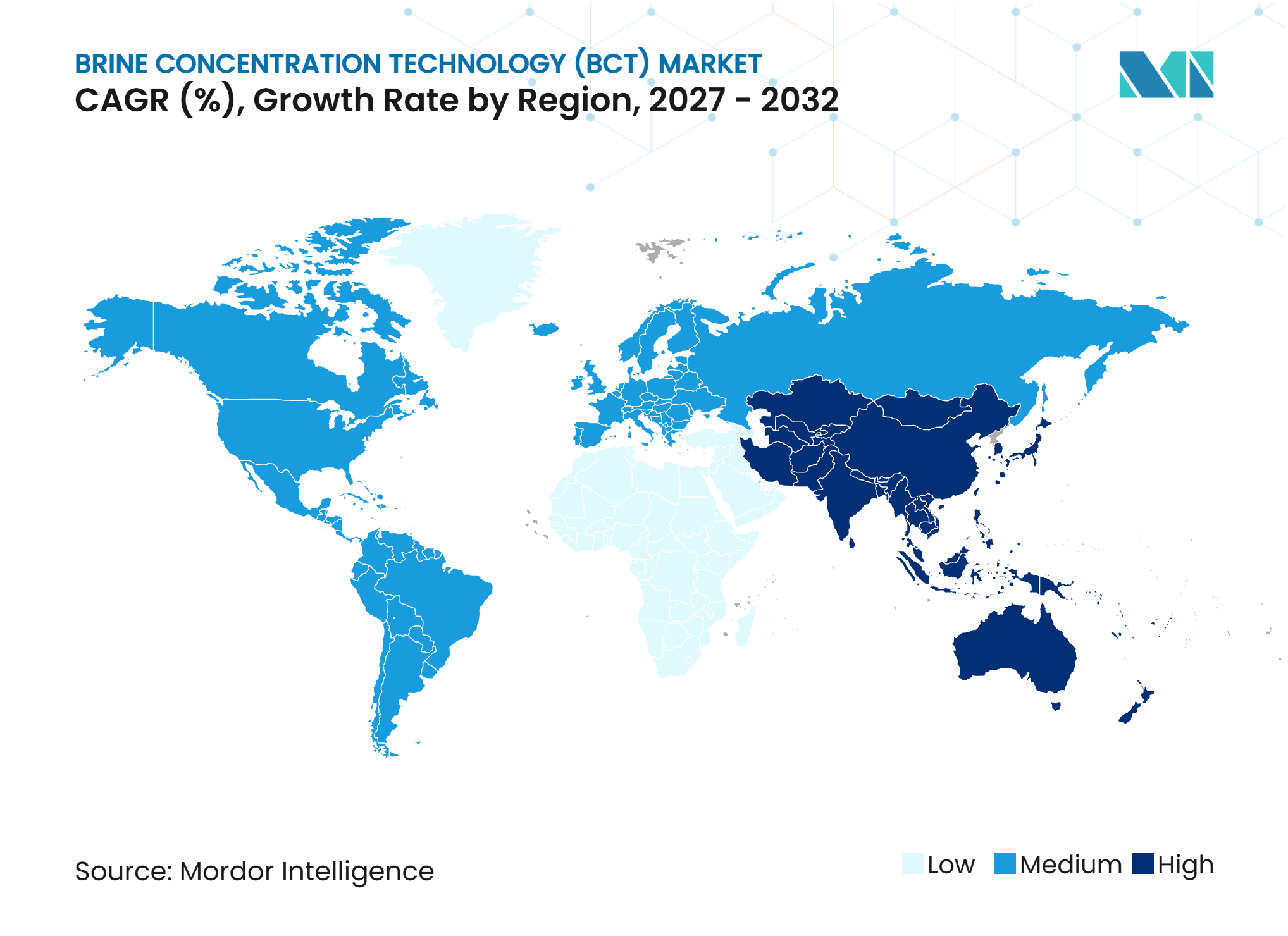
| Fastest Growing Market | Asia-Pacific |
| Largest Market | Asia-Pacific |
| Market Concentration | Medium |
Major Players *Disclaimer: Major Players sorted in no particular order Image © Mordor Intelligence. Reuse requires attribution under CC BY 4.0. | |
Brine Concentration Technology (BCT) Market Analysis by Mordor Intelligence
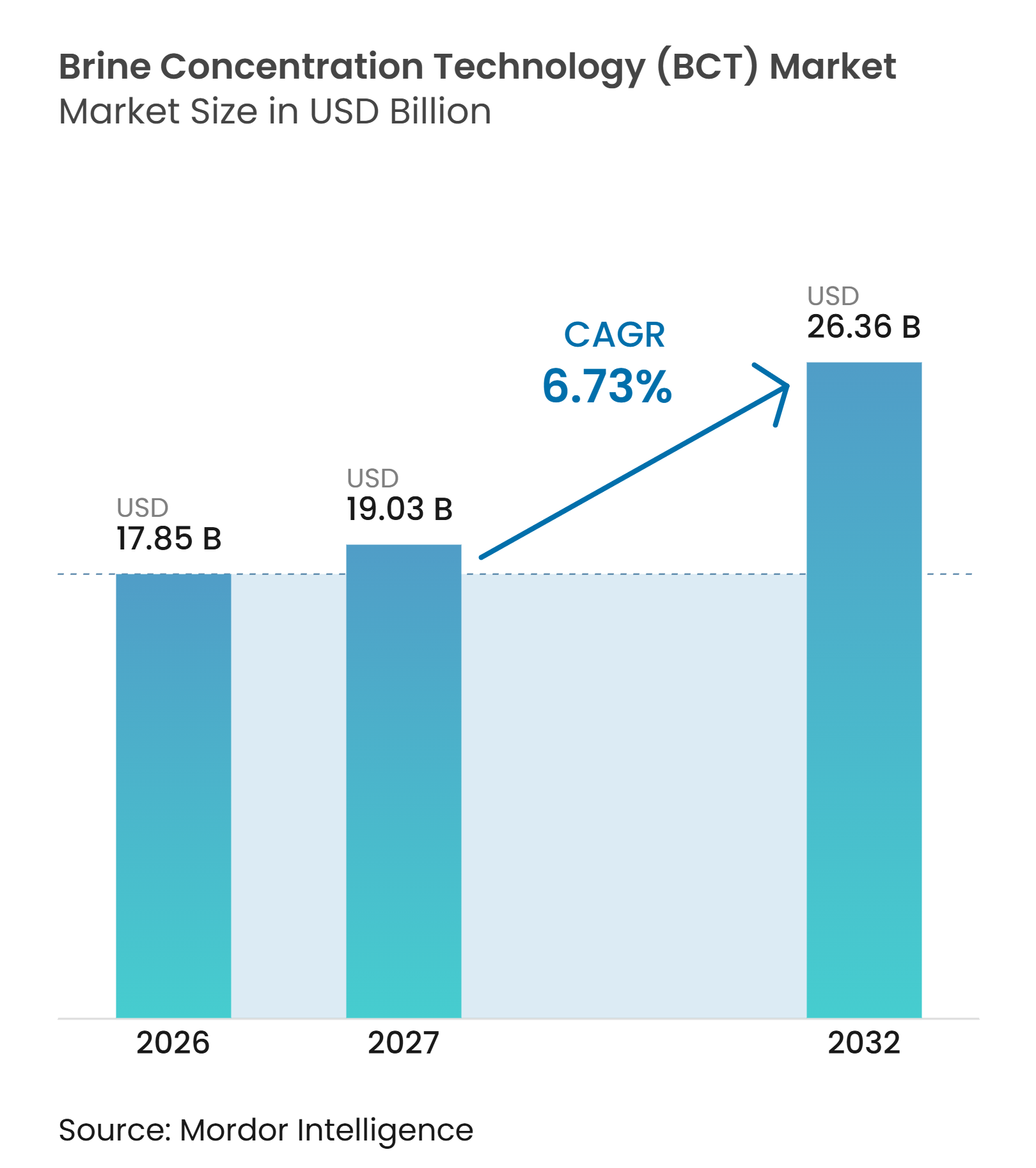
The Brine Concentration Technology (BCT) market size was valued at USD 17.85 billion in 2026 and is estimated to grow from USD 19.03 billion in 2027 to reach USD 26.36 billion by 2032, at a CAGR of 6.73% during the forecast period (2027-2032). The Brine Concentration Technology (BCT) market is moving beyond disposal-focused treatment as industrial operators increasingly seek water reuse and usable mineral streams. Zero liquid discharge requirements, water scarcity, and the economics of recovered salts are shaping demand across power generation, chemicals, mining, and battery-material manufacturing. These forces reinforce each other, as lower freshwater availability increases the cost of make-up water, while controlled salt recovery can reduce the burden of residual disposal. Compliance deadlines are shortening industrial capital-planning cycles in several major economies, increasing the cost of delaying investment in concentration, recovery, and crystallization systems. Vendors are responding through integrated process trains, modular delivery, and controls that help operators manage complex brines. This favors solutions that can adapt to variable feed chemistry while maintaining water recovery and the quality of recovered material under demanding industrial operating conditions.
Key Report Takeaways
- By type, Calcium Chloride held 38.61% of the Brine Concentration Technology (BCT) market share in 2026 and is forecast to grow at a CAGR of 7.26% through 2032.
- By technology, High-Energy Reverse Osmosis held 35.78% of the Brine Concentration Technology (BCT) market share in 2026 and is forecast to grow at a CAGR of 7.58% through 2032.
- By application, Power Generation held a 33.16% market share in the Brine Concentration Technology (BCT) market in 2026, while Chemical is forecast to grow at a CAGR of 7.82% through 2032.
- By geography, Asia-Pacific held 34.93% of the Brine Concentration Technology (BCT) market share in 2026 and is forecast to grow at a CAGR of 7.67% through 2032.
Note: Market numbers in this report are based on Mordor Intelligence's proprietary estimation framework, which combines nine months of actuals with Q4 projections for base year 2026.
Market Trends and Insights
Drivers Impact Analysis of Brine Concentration Technology (BCT) Market*
| Drivers | (~) % Impact on CAGR Forecast | Geographic Relevance | Impact Timeline |
|---|---|---|---|
| Industrial Water Reuse and Zero Liquid Discharge Adoption | +1.8% | Global, concentrated in Asia-Pacific, China, India, and North America | Medium term (2-4 years) |
| Freshwater Scarcity and Desalination Expansion | +1.5% | Asia-Pacific core, Middle East and Africa, with spillover to South America | Long term (≥ 4 years) |
| Stricter Salinity and Industrial Effluent Compliance | +1.2% | North America and Europe, with growing enforcement in Asia-Pacific | Medium term (2-4 years) |
| Mining Water Recovery and Brine Valorization | +0.9% | South America, Middle East and Africa, and Australia | Long term (≥ 4 years) |
| Hybrid Membrane-Thermal System Efficiency Gains | +0.8% | Global | Short term (≤ 2 years) |
| Source: Mordor Intelligence | |||
Industrial Water Reuse and Zero Liquid Discharge Adoption
Zero liquid discharge mandates are expanding from China's textile and coal-to-chemicals industries into Indian pharmaceutical clusters, U.S. Gulf Coast petrochemicals, and Gulf Cooperation Council industrial zones. Higher feed salinity can improve the economics of pre-concentration by reducing the quantity sent to downstream evaporation equipment. This gives high-recovery membranes a greater role in facilities facing water constraints and strict discharge requirements. A 2025 review found that maximizing reverse osmosis brine reduction remains the most cost-effective route to zero liquid discharge, while membrane distillation and electrodialytic crystallization have not displaced it in that role[1]. Energy Recovery reported that a lithium iron phosphate (LFP) cathode plant in Binzhou, Shandong, combined reverse osmosis and ultra-high-pressure reverse osmosis to treat 3,100 m³ per hour of ammonium sulfate brine and achieve more than 95% water reuse. Such projects illustrate why the Brine Concentration Technology (BCT) market is increasingly tied to production continuity and environmental compliance.
Freshwater Scarcity and Desalination Expansion
Large reverse osmosis desalination plants produce concentrated residual streams that require careful management through discharge or further treatment. Regulators in water-stressed areas are narrowing the allowable salinity range in receiving waters. The U.S. Environmental Protection Agency's 2025 permit for the Taunton River desalination facility limits effluent salinity to within 2 parts per thousand of ambient intake conditions. Saudi Aramco's 2025 field-testing program targeted at least 70% recovery from produced-water streams with total dissolved solids above 100,000 mg/L, underscoring the relevance of high-salinity recovery in oil and gas operations. The Saudi Water Authority stated that recovering high-demand salts could offset desalination production costs by up to 50%, which positions concentrated brine as a potential resource stream. These conditions extend the Brine Concentration Technology (BCT) market beyond buyers that invest solely to meet discharge obligations.
Stricter Salinity and Industrial Effluent Compliance
Effluent regulations are advancing faster than many industrial sites can complete engineering and capital approval processes. China's 2025 T/CIECCPA 065-2025 group standard sets zero-discharge and resource-recovery requirements for coal-chemical high-salinity wastewater. It calls for membrane concentration, salt crystallization, and concurrent construction of zero liquid discharge systems alongside main production facilities. In the United States, 40 CFR Part 436 requires zero discharge of process wastewater for processors in the Salines from Brine Lakes Subcategory. California's 2025 waste discharge requirements also apply performance-based salinity limits to industrial dischargers. These regulations favor systems that reduce brine quantity and produce controlled solid outputs rather than dilute wastewater for release.
Mining Water Recovery and Brine Valorization
Lithium extraction in South America and metal mining in arid regions are changing the role of brine handling within site water management. Operators increasingly evaluate water recovery alongside the potential value of iodine, lithium, and saleable salts. A 2025 study found that ultra-high-pressure, low-salt-rejection reverse osmosis at 120 bar concentrated sodium chloride to 170 g/L, reducing the quantity requiring thermal treatment. Iofina agreed in 2025 with Western Midstream Partners to build an IOsorb facility capable of processing up to 50,000 barrels per day of Permian Basin brine for crystalline iodine extraction, with commissioning expected in the second half of 2026. A 2025 assessment of seawater reverse osmosis brine found that mineral recovery could offset USD 0.5/m³ or more of desalination operating cost under favorable conditions. This supports demand in the Brine Concentration Technology (BCT) market, where the value of recoverable resources can justify investment before regulations make it compulsory.
Restraints Impact Analysis of Brine Concentration Technology (BCT) Market*
| Restraints | (~) % Impact on CAGR Forecast | Geographic Relevance | Impact Timeline |
|---|---|---|---|
| High Capital and Energy Intensity of Thermal Concentration | -1.5% | Global, most acute where low-grade waste heat is unavailable | Short term (≤ 2 years) |
| Scaling, Fouling, and Corrosion in High-Total Dissolved Solids (TDS) Streams | -0.9% | Global, particularly severe at mining and complex-brine industrial sites | Medium term (2-4 years) |
| Shortage of Skilled Operations and Maintenance Personnel | -0.5% | Asia-Pacific emerging markets, Middle East and Africa, and South America | Medium term (2-4 years) |
| Source: Mordor Intelligence | |||
High Capital and Energy Intensity of Thermal Concentration
Mechanical vapor compression and multi-effect evaporation remain capital-intensive components of many high-recovery systems. This can prevent smaller industrial operators from pursuing projects, particularly where subsidized power or waste heat is unavailable. A 2025 study found that Osmotically Assisted Reverse Osmosis (OARO) configurations delivering concentrations comparable to high-pressure reverse osmosis consumed 13.4-19.5 kWh/m³, compared with 7.8 kWh/m³ for high-pressure reverse osmosis. Thermal finishing is still required for the highest concentration duties, but its energy and equipment costs can extend project payback periods. This creates a gap between sites with accessible energy integration options and those dependent on grid-powered thermal assets. As a result, the Brine Concentration Technology (BCT) market faces slower deployment among prospective adopters with limited capital flexibility.
Scaling, Fouling, and Corrosion in High-TDS Streams
Scaling, fouling, and corrosion increase maintenance requirements and reduce availability in complex brine applications. Calcium, magnesium, silica, sulfate, and organic material can combine in ways that are difficult to manage through standard antiscalant programs. These risks are particularly relevant in mining streams, where feed composition can vary over time. A 2025 pilot study at the Yuma Desalting Plant achieved 82.6% recovery from sulfate-rich concentrate without scaling-related performance loss, indicating the potential of newer reverse osmosis designs. However, these designs are not yet standardized across commercial sites. Facilities without specialized operating expertise may face more frequent cleaning, membrane replacement, and corrosion-related maintenance costs.
*Our forecasts treat driver/restraint impacts as directional, not additive. The impact forecasts reflect baseline growth, mix effects, and variable interactions.
Brine Concentration Technology (BCT) Market Segment Analysis
By Type:
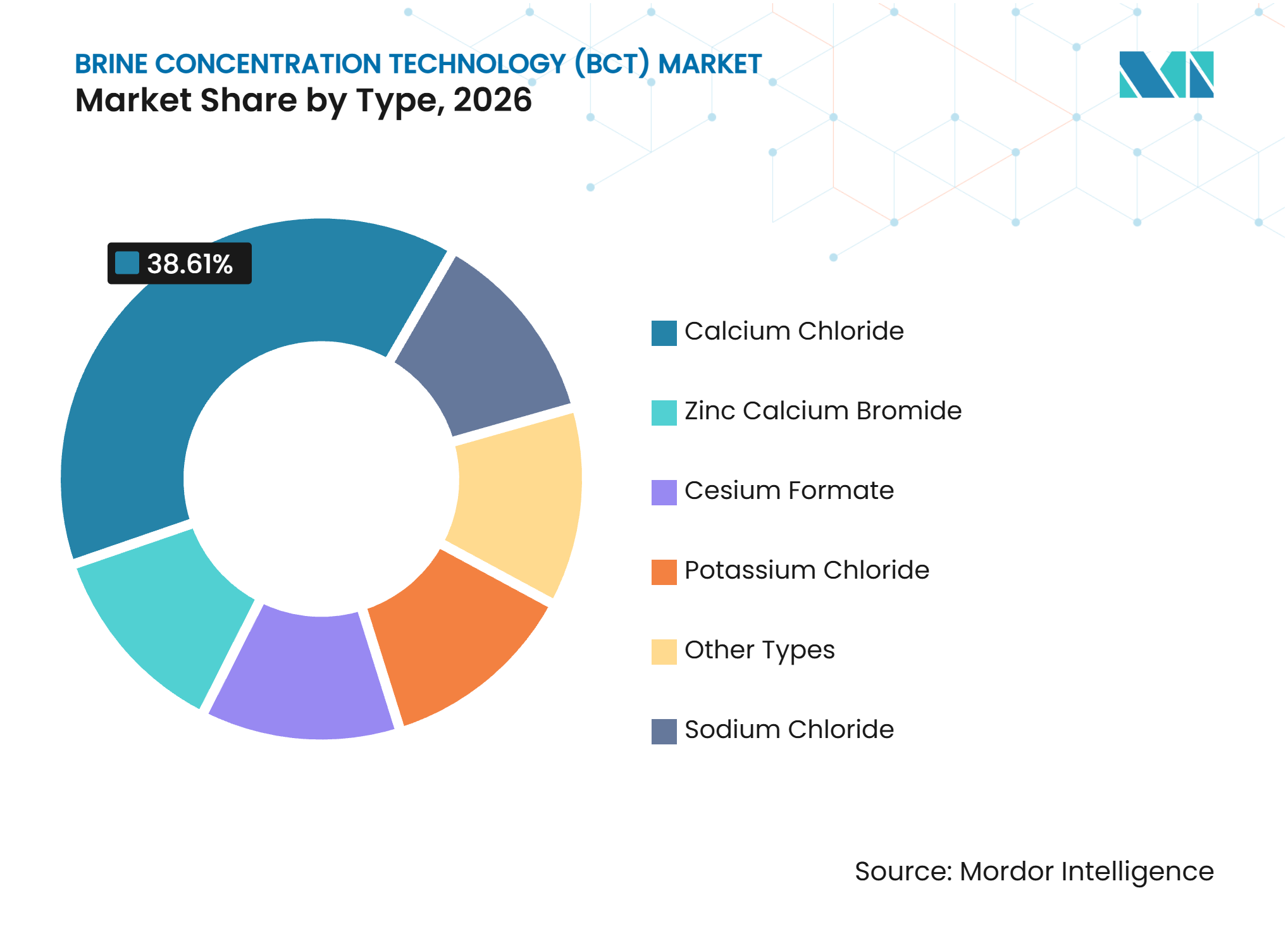
Calcium Chloride Holds the Largest Position and Supports Higher-Value RecoveryCalcium chloride accounted for 38.61% of the Brine Concentration Technology (BCT) market share in 2026 and is projected to grow at a 7.26% CAGR through 2032. Demand is supported by its use in drilling fluids, road de-icing, food processing, and construction. These end uses create recurring requirements for concentration and crystallization capacity. The segment also benefits from demand for higher-purity grades. Pharmaceutical-grade and food-grade calcium chloride require stricter controls on purity, traceability, and moisture content, which pushes producers toward more precise recovery systems than those used for commodity-grade output. The calcium chloride segment remains a core part of the BCT market because its application base spans both industrial and regulated uses.
Sodium chloride is the second-largest type, with demand from food processing, chemicals, and produced-water applications. Recovery of sodium chloride from oilfield brine is becoming more viable where the recovered material has a defined end use. Zinc calcium bromide and cesium formate serve smaller, high-value applications in high-pressure, high-temperature completion fluids, where concentration precision and consistent fluid density are critical. Potassium chloride supports fertilizer and specialty chemical production. China's GB/T 5462 standard sets purity thresholds for refined industrial salt and sodium sulfate recovered through zero liquid discharge (ZLD) processes. Compliance requirements for recovered salts influence the process design selected by producers serving commercial salt markets.



By Technology:
High-Energy Reverse Osmosis Leads Hybrid System DesignHigh-energy reverse osmosis accounted for 35.78% of the BCT market share in 2026 and is projected to grow at a 7.58% CAGR through 2032. It serves as both a standalone concentration step and a pre-concentration stage in hybrid ZLD systems. Its primary purpose is to reduce feed before the stream enters thermal equipment, thereby lowering evaporator size, steam demand, and capital requirements. A 2025 study showed that ultra-high-pressure, low-salt-rejection reverse osmosis can concentrate sodium chloride to 170 g/L, extending the role of membrane systems in treating high-salinity streams. The technology's share reflects its importance in integrated BCT market projects.
Mechanical vapor compression remains necessary for final concentration where membrane systems cannot reach the required solids level. Its role is shifting toward modular finishing capacity that receives pre-concentrated feed, allowing operators to more closely match thermal equipment to the remaining duty. A 2026 study of a 1,000 m³/d textile facility in Tiruppur found that a CLRO-OARO crystallizer system had a ZLD cost of EUR 1.33/m³, 27% lower than staged reverse osmosis and mechanical vapor compression. Technology selection is therefore becoming a significant cost-management decision. Other systems remain relevant where feed chemistry, energy source, or required product quality does not favor high-energy reverse osmosis.
By Application:
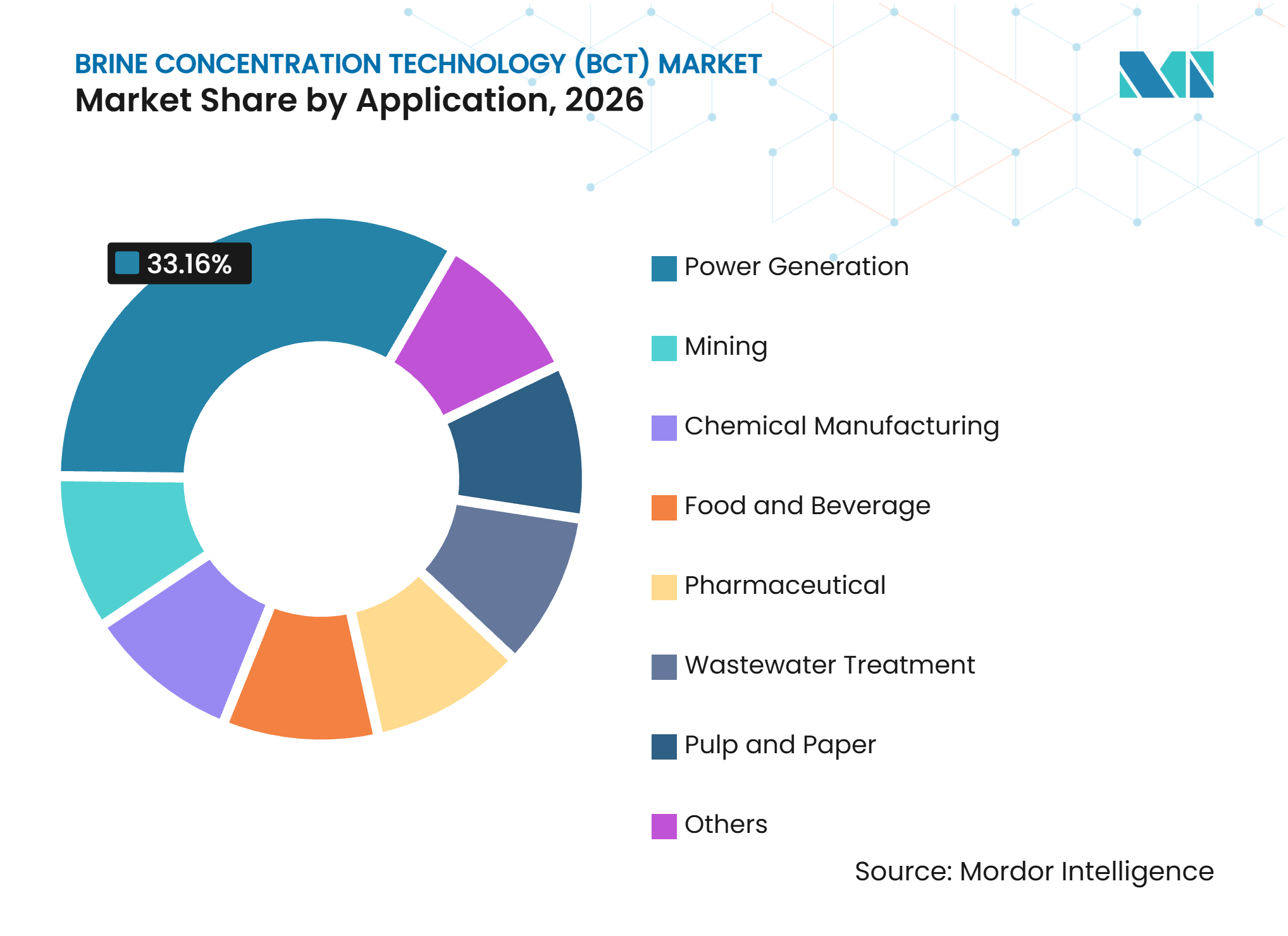
Power Generation Holds the Largest Share While Chemicals Grow FasterPower generation accounted for 33.16% of the BCT market share in 2026, while chemical manufacturing is forecast to expand at a 7.82% CAGR through 2032. Power facilities manage concentrated cooling tower blowdown and flue gas desulfurization wastewater. These streams carry high total dissolved solids and are subject to strict discharge requirements. Their scale makes water management a significant operating consideration. An Arizona 580 MW combined-cycle plant achieved 88% water recovery through a high-recovery reverse osmosis retrofit, extending the life of evaporation ponds. This demonstrates why power operators may invest in BCT before a direct ZLD requirement applies. The BCT market benefits from this focus on water availability and disposal risk.
Chemical manufacturing is growing faster because producers face wastewater compliance deadlines, freshwater costs, and opportunities to recover water and reagents in closed loops. Chemical sites often require solutions that can accommodate changing process chemistry and high-salinity waste streams. Wastewater treatment is the third-largest application, serving municipal and industrial operators seeking compliance and reuse. Mining is gaining relevance in lithium extraction and arid-region metal operations where mineral recovery can accompany water treatment. Pharmaceutical applications require high purity, traceability, and multi-barrier treatment designs. Food and beverage applications include whey concentration, edible salt recovery, and process water reuse. Pulp and paper demand remains strong, with recovery boilers providing a natural energy link to concentration systems.

Geography Analysis
Asia-Pacific: Largest Regional Demand Base
Asia-Pacific held 34.93% of the Brine Concentration Technology (BCT) market share in 2026 and is forecast to grow at a 7.67% CAGR through 2032. Demand in China is driven by zero-liquid-discharge regulations for coal-to-chemicals operations, battery supply chain wastewater management, and semiconductor water recovery. Jiangsu Province's 2025 water-saving technology directory includes integrated membrane and evaporation systems with more than 97% clean-water recovery and more than 98% desalination rates, providing local industrial users with a formal reference for selecting approved water-saving systems. Toyobo MC Corporation reports that its hollow-fiber Brine Concentration (BC) membrane systems can concentrate sodium chloride to concentrations exceeding 20 wt%, supporting zero liquid discharge applications in batteries, chemicals, and salt manufacturing. In India, textile and pharmaceutical clusters continue to drive compliance-led project activity. South Korea's battery manufacturing capacity represents an additional source of demand for high-salinity wastewater management.
North America: Compliance and Mineral Recovery Support Demand
North America's BCT market combines compliance-driven projects in power, chemicals, and mining with resource recovery projects in produced-water management. The U.S. Environmental Protection Agency's 2025 permit condition for the Taunton River desalination facility limits effluent salinity to within 2 parts per thousand of ambient intake conditions, encouraging upstream concentration where discharge flexibility is limited. The Permian Basin generates substantial produced water, with water-to-oil ratios ranging from 3 to 11 times. Iofina's planned IOsorb plant will process up to 50,000 barrels of brine per day for the extraction of crystalline iodine. In October 2026, Lilac Solutions completed a Great Salt Lake lithium pilot that achieved 87% lithium recovery from 69 mg/L brine, with plans to build a 5,000-ton-per-annum (tpa) commercial facility in 2027. These projects illustrate how critical-mineral and iodine recovery can complement regulatory demand.
Europe, South America, and Middle East and Africa: Different Drivers Shape Project Demand
In Europe, demand is linked to water-scarcity compliance and industrial reuse in the chemicals, pharmaceuticals, and pulp and paper sectors. A German research consortium reported that its RIKovery project demonstrated a sodium chloride concentration of 170 g/L using ultra-high-pressure, low-salt-rejection reverse osmosis, achieving 60% energy savings compared with thermal evaporation. Alfa Laval and Hydros commissioned a zero-liquid-discharge system at Tecnoparco Valbasento in Italy that recovers 95%-97% of the crystallized, dehydrated salt from industrial wastewater. In South America, demand centers on lithium brine operations in Argentina, Chile, and Bolivia, where pre-concentration can reduce freshwater demand. Veolia manages Chile's first municipal and industrial desalination plant in Valparaíso under a contract extending through 2040. In the Middle East and Africa, Saudi Arabia's water strategy identifies mineral recovery as a means to offset up to 50% of desalination production costs. South African mining and Gulf petrochemical operations also present applications for high-salinity wastewater treatment.
Competitive Landscape
Market Concentration
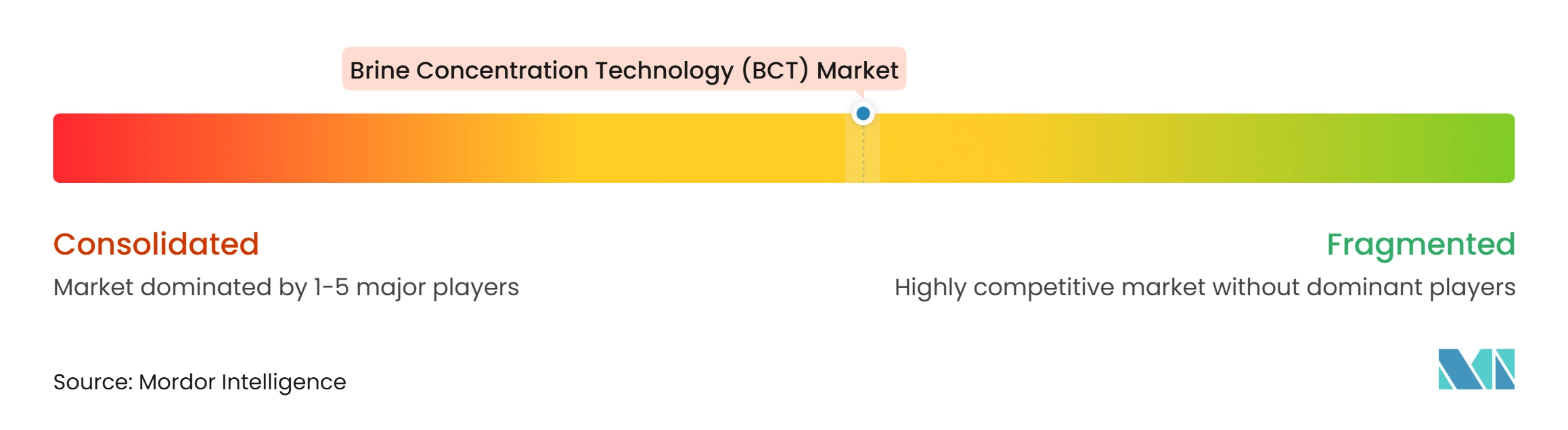
The Brine Concentration Technology (BCT) market is moderately fragmented. Veolia, Aquatech, Alfa Laval, GEA Group, and Saltworks Technologies are active in large zero-liquid-discharge engineering, procurement, and construction projects. Gradiant, Thermax, SUEZ, and Samco Technologies compete through application-specific capabilities and regional delivery. Procurement decisions increasingly consider process integration, modular construction, and operational controls alongside equipment reliability. This favors providers that can combine membranes, evaporation, crystallization, and water reuse within a single plant design.
Saltworks has combined XtremeRO, Xtract ion exchange, and SaltMaker mechanical vapor recompression systems into standardized packages for off-site delivery. The company received a semiconductor zero-liquid-discharge award in March 2026, indicating demand for packaged recovery systems[2]. GEA introduced its meVap portfolio at IFAT 2026, covering mechanical vapor recompression, evaporation, and crystallization, with electrified utility integration. These developments reflect a focus on reducing steam consumption and improving the predictability of site execution. The BCT market is also creating opportunities for suppliers capable of supporting critical mineral recovery alongside wastewater treatment.
Brine valorization offers a growth path for systems that produce saleable minerals rather than disposal solids. Aquafortus represents a non-thermal approach based on absorbent chemistry, while thermodiffusion is another alternative for hypersaline feeds. A 2025 study found thermodiffusion could be cost-competitive with evaporation ponds for feed concentrations above 95 parts per thousand. These alternatives remain at an early stage for large-scale industrial deployment. Established thermal and hybrid suppliers have an advantage when reliability and operating references matter. Competitive differentiation will depend on the ability to improve water recovery while reducing energy use and operational complexity.
Brine Concentration Technology (BCT) Industry Leaders
-
Veolia
-
Xylem
-
Aquatech
-
ALFA LAVAL
-
GEA Group Aktiengesellschaft
- *Disclaimer: Major Players sorted in no particular order
Brine Concentration Technology (BCT) Market Companies Covered in this Report
- ALFA LAVAL
- Aquatech
- GEA Group Aktiengesellschaft
- Gradiant
- H2O Innovation
- IDE
- Koch Separation Solutions
- Lenntech B.V.
- Praj Industries
- Saltworks Technologies Inc.
- Samco Technologies, Inc.
- SUEZ
- Thermax Limited
- Veolia
- Xylem
Recent Industry Developments in Brine Concentration Technology (BCT) Market
- May 2026: GEA Group introduced its meVap portfolio at IFAT 2026, comprising mechanical vapor recompression (MVR)-based evaporation, distillation, and crystallization systems designed to reduce energy intensity and integrate with electrified industrial utility setups. The launch targets industrial customers pursuing zero liquid discharge (ZLD) architectures with reduced steam demand.
- May 2026: Aquatech acquired FTS H2O, establishing the Oregon facility as Aquatech's global Center of Excellence for membrane-driven brine concentration and resource recovery. The acquisition adds RecovOAR Osmotically Assisted Reverse Osmosis (OARO), OsmoBC forward osmosis, and membrane-brine crystallization capabilities to Aquatech's ZLD and lithium-processing portfolio, strengthening its brine-concentration technology offerings.
Global Brine Concentration Technology (BCT) Market Report Scope
Brine Concentration Technology (BCT) refers to a set of industrial processes and systems used to treat and reduce the volume of high-salinity wastewater (brine) generated by activities such as desalination, mining, power generation, and chemical manufacturing.
The brine concentration technology (BCT) market is segmented by type, technology, application, and geography. By type, the market is segmented into calcium chloride, sodium chloride, zinc calcium bromide, cesium formate, potassium chloride, and other types. By technology, the market is segmented into high-energy reverse osmosis, mechanical vapor compression, and other technologies. By application, the market is segmented into mining, chemical manufacturing, food and beverage, pharmaceutical, wastewater treatment, power generation, pulp and paper, and others. The report also covers market sizes and forecasts for the brine concentration technology (BCT) across 15 countries in major regions. The market sizes and forecasts are provided in terms of value (USD).
Segmentation Overview
| Calcium Chloride |
| Sodium Chloride |
| Zinc Calcium Bromide |
| Cesium Formate |
| Potassium Chloride |
| Other Types |
| High-Energy Reverse Osmosis |
| Mechanical Vapor Compression |
| Other Technologies |
| Mining |
| Chemical Manufacturing |
| Food and Beverage |
| Pharmaceutical |
| Wastewater Treatment |
| Power Generation |
| Pulp and Paper |
| Others |
| Asia-Pacific | China |
| India | |
| Japan | |
| South Korea | |
| ASEAN Countries | |
| Rest of Asia-Pacific | |
| North America | United States |
| Canada | |
| Mexico | |
| Europe | Germany |
| United Kingdom | |
| France | |
| Italy | |
| NORDIC Countries | |
| Rest of Europe | |
| South America | Brazil |
| Argentina | |
| Rest of South America | |
| Middle East and Africa | Saudi Arabia |
| South Africa | |
| Rest of Middle East and Africa |
| By Type | Calcium Chloride | |
| Sodium Chloride | ||
| Zinc Calcium Bromide | ||
| Cesium Formate | ||
| Potassium Chloride | ||
| Other Types | ||
| By Technology | High-Energy Reverse Osmosis | |
| Mechanical Vapor Compression | ||
| Other Technologies | ||
| By Application | Mining | |
| Chemical Manufacturing | ||
| Food and Beverage | ||
| Pharmaceutical | ||
| Wastewater Treatment | ||
| Power Generation | ||
| Pulp and Paper | ||
| Others | ||
| By Geography | Asia-Pacific | China |
| India | ||
| Japan | ||
| South Korea | ||
| ASEAN Countries | ||
| Rest of Asia-Pacific | ||
| North America | United States | |
| Canada | ||
| Mexico | ||
| Europe | Germany | |
| United Kingdom | ||
| France | ||
| Italy | ||
| NORDIC Countries | ||
| Rest of Europe | ||
| South America | Brazil | |
| Argentina | ||
| Rest of South America | ||
| Middle East and Africa | Saudi Arabia | |
| South Africa | ||
| Rest of Middle East and Africa | ||
Key Questions Answered in the Report
What is current market size of Brine Concentration Technology (BCT) Market?
The Brine Concentration Technology (BCT) market size was valued at USD 17.85 billion in 2026 and is estimated to grow from USD 19.03 billion in 2027 to reach USD 26.36 billion by 2032, at a CAGR of 6.73% during the forecast period (2027-2032).
Why do industrial sites use zero liquid discharge systems?
Industrial sites use zero liquid discharge systems to recover water, control high-salinity waste streams, and meet tighter discharge obligations. They may also recover salts or minerals when an economic end use is available for the recovered material, rather than treating all remaining solids as a disposal liability. This can help align environmental compliance with plant resource-management goals. It also reduces the dependence on evaporation ponds and conventional liquid disposal routes where those options are constrained.
Which application is expanding fastest in this field?
Chemical Manufacturing is forecast to grow at a 7.82% CAGR through 2032. Producers are responding to effluent compliance deadlines, water costs, and the value of recovering water and reagents in closed process loops that can reduce freshwater intake and support more consistent plant operations. Chemical plants also need systems that can accommodate changing process chemistry and high total dissolved solids in wastewater streams.
Which region has the strongest demand outlook for brine concentration systems?
Asia-Pacific held a 34.93% share in 2026 and is forecast to record a 7.67% CAGR through 2032. China, India, Japan, and South Korea provide demand from chemicals, textiles, battery manufacturing, semiconductor production, and industrial water reuse projects, supported by formal water-saving programs and industrial wastewater requirements. China combines coal-to-chemicals demand with wastewater needs in the battery supply chain, while India’s textile and pharmaceutical clusters support compliance-focused projects.