
Brazil Table Grapes Market Size and Share
Brazil Table Grapes Market Analysis by Mordor Intelligence
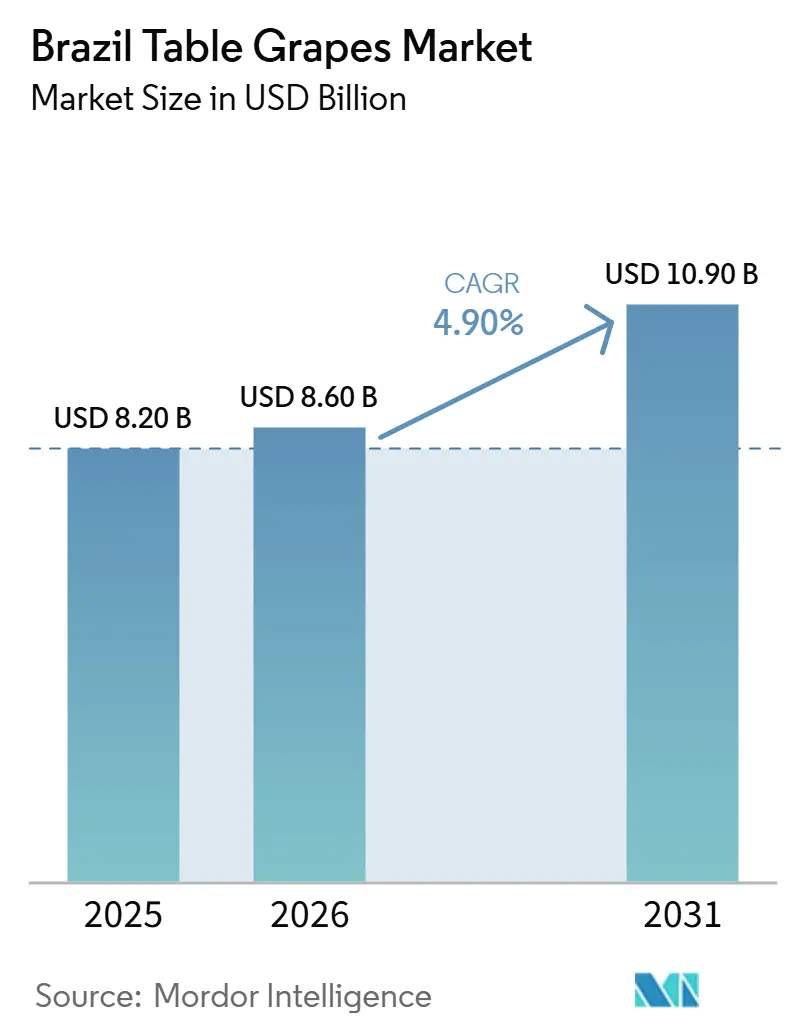
The Brazil table grapes market is forecast to grow from USD 8.20 billion in 2025 to USD 8.60 billion in 2026, and is anticipated to reach USD 10.90 billion by 2031, at a CAGR of 4.90% during the forecast period 2026-2031. Growth is supported by stronger consumer demand for fresh, convenient fruit and improved export conditions following Brazil's zero-tariff access to the European Union (EU) in February 2026[1]Source: United States Department of Agriculture Foreign Agricultural Service, "EU-Mercosur Trade Agreement - The Brazilian Perspective and Agricultural Impacts," apps.fas.usda.gov. The market also benefits from the São Francisco Valley's irrigated production system, which enables multiple harvest cycles per year and gives Brazilian suppliers a timing advantage in export trade. Competitive behavior among leading growers, exporters, and licensed variety holders remains disciplined, with focus on pricing, quality, certification, and channel control rather than volume expansion. The market is also seeing new opportunities in premium domestic retail and online grocery channels, where seedless varieties, traceability, and packaging quality are key purchasing factors. At the same time, weather variability, labor constraints, freight pressure, and narrower export windows continue to influence operating decisions across the market, making domestic premium demand an important buffer when export conditions weaken.
Key Report Takeaways
- By geography, the state of Pernambuco led production with 755.2 thousand metric tons in 2025, reinforcing the São Francisco Valley's position as the primary source of Brazil's export supply.
Note: Market size and forecast figures in this report are generated using Mordor Intelligence’s proprietary estimation framework, updated with the latest available data and insights as of January 2026.
Brazil Table Grapes Market Trends and Insights
Drivers Impact Analysis*
| Driver | (~) % Impact on CAGR Forecast | Geographic Relevance | Impact Timeline |
|---|---|---|---|
| Rising health consciousness and snackification | +0.7% | Brazil-wide, strongest in São Paulo, Rio de Janeiro, and Belo Horizonte metro areas | Short term (≤ 2 years) |
| Expansion of premium seedless and proprietary varieties | +1.2% | São Francisco Valley in Pernambuco and Bahia, and Serra Gaúcha in Rio Grande do Sul | Medium term (2-4 years) |
| E-commerce and modern retail penetration | +0.6% | Urban Brazil, especially São Paulo, Rio de Janeiro, Brasília, and Recife | Medium term (2-4 years) |
| Year-round production from irrigated export zones | +0.9% | Pernambuco and Bahia in the São Francisco Valley | Short term (≤ 2 years) |
| Zero tariff access to the European union for Brazilian table grapes | +1.1% | São Francisco Valley and other export-oriented growing zones | Short term (≤ 2 years) |
| Adoption of farm-level traceability and quality control systems | +0.5% | Export-oriented farms in the São Francisco Valley and Serra Gaúcha | Medium term (2-4 years) |
| Source: Mordor Intelligence | |||
Rising Health Consciousness and Snackification
Brazilian consumers increasingly treat fresh fruit as a practical snack, supporting demand for table grapes due to their portability, sweetness, and minimal preparation requirements. According to United States Department of Agriculture Foreign Agricultural Services (USDA FAS) data, per capita grape consumption reached 7.71 pounds in 2025, reflecting stronger domestic acceptance of table grapes in everyday food purchases[2]Source: United States Department of Agriculture Foreign Agricultural Service, "Brazilian Grape and Wine Market Overview," apps.fas.usda.gov. This shift is significant as premium domestic retailers now compete more directly with export buyers for higher-quality fruit from the São Francisco Valley. Brazil's retail network provides broad volume absorption, with 30 million consumers visiting food retail outlets daily in 2025[3]Source: United States Department of Agriculture Foreign Agricultural Service, "Retail Foods Annual ," apps.fas.usda.gov. This domestic demand provides the Brazil table grapes market with a more stable sales outlet when export conditions are less favorable.
Expansion of Premium Seedless and Proprietary Varieties
Variety strategy has become an increasingly important competitive differentiator in the Brazil table grapes market, as premium genetics support product differentiation, higher value realization, and stronger export positioning. In February 2026, Embrapa Uva e Vinho launched BRS Pérola, a white seedless cultivar developed for Southern Brazil with a productive potential of up to 30 metric tons per hectare under protected cultivation. The introduction of new cultivars, together with the growing adoption of licensed grape varieties by commercial producers, is expanding the range of premium offerings available to both domestic and export markets. As a result, genetics and varietal innovation are becoming increasingly important in shaping product positioning, export competitiveness, and access to premium retail programs.
E-Commerce and Modern Retail Penetration
The digitalization of grocery shopping is creating a faster-growing sales channel for the Brazil table grapes market, particularly for premium fruit in urban households. The continued expansion of e-commerce and rising adoption of online grocery shopping are improving consumer access to premium fresh produce, supporting demand for table grapes through digital retail channels. Seedless table grapes are well-suited to benefit from direct ordering, premium packaging, and curated delivery. As a result, the Brazil table grapes market is gaining a channel where better margin capture can occur outside traditional wholesale price negotiations.
Year-Round Production from Irrigated Export Zones
The São Francisco Valley provides Brazil's table grape market with a structural supply advantage, as irrigation and production management allow growers to schedule harvests across the year. Producers in the region can commonly achieve approximately two crops annually, enabling supply during periods when many competing origins are between harvest seasons. According to the United States Department of Agriculture Foreign Agricultural Service, Brazil's total grape cultivation area reached approximately 85,000 hectares in 2025 and is projected to increase to 86,711 hectares in 2026. These figures cover Brazil's wider grape industry, including table, wine, and processing grapes, and indicate continued investment across the market. Post-harvest infrastructure is also improving at the cooperative level. Coopexvale reported BRL 272 million (USD 48.2 million) in revenue in 2025, with sales exceeding 21,300 metric tons. Its infrastructure included six cold tunnels, nine cold-storage chambers, and a solar power system. Such investments support more reliable cooling, packing, storage, and commercial programs, although weather variability continues to affect harvest timing and fruit quality.
Restraints Impact Analysis*
| Restraint | (~) % Impact on CAGR Forecast | Geographic Relevance | Impact Timeline |
|---|---|---|---|
| Weather volatility in key production belts | -0.6% | Pernambuco and Bahia in the São Francisco Valley, and Rio Grande do Sul in Serra Gaúcha | Short term (≤ 2 years) |
| Labor scarcity during harvest and packing peaks | -0.5% | São Francisco Valley in Pernambuco and Bahia, with spillover into Paraná | Medium term (2-4 years) |
| High dependence on export windows and freight conditions | -0.6% | Export-oriented zones in Pernambuco and Bahia and logistics corridors to ports | Short term (≤ 2 years) |
| Pest, disease, and post-harvest loss pressure | -0.4% | São Paulo, Rio Grande do Sul, Paraná, and Pernambuco | Medium term (2-4 years) |
| Source: Mordor Intelligence | |||
Labor Scarcity During Harvest and Packing Peaks
Labor shortages continue to pressure the Brazil table grapes market, as pruning, thinning, harvesting, and packing remain heavily dependent on skilled manual work. Producers in Pernambuco and Bahia reported persistent unfilled positions during key seasonal periods in 2025. Export-oriented farms face greater exposure, as certified operations cannot easily rely on informal labor practices that smaller local growers may still use. The impact is commercial rather than administrative, as even short delays can reduce berry size, sugar content, and export classification. This makes the Brazil table grapes market more vulnerable to labor cost inflation than crops with stronger mechanization options.
Pest, Disease, and Post-Harvest Loss Pressure
Disease pressure continues to limit margins in the Brazil table grapes market, as vineyard losses and post-harvest issues affect both domestic sales and export eligibility. In 2025, joint action by Embrapa and local authorities reduced ripe grape rot infestation by 95% in São Paulo's Circuito das Frutas, following heavy damage in 2024. Downy mildew remains a persistent problem in Paraná and Rio Grande do Sul, particularly under weather conditions favorable to pathogen spread. Fungal threats such as ripe rot, downy mildew, and Botrytis-related decay require preventive vineyard practices, fungicide programs, careful harvesting, rapid cooling, and controlled storage throughout the supply chain. Gray mold during storage and shipment adds to costs, as protective measures must be integrated into commercial handling. As a result, phytosanitary control in the Brazil table grapes market requires year-round management rather than seasonal intervention.
*Our forecasts treat driver/restraint impacts as directional, not additive. The impact forecasts reflect baseline growth, mix effects, and variable interactions.
Geography Analysis
Table grape production in Brazil plays a strategic role in the country's fruit-growing industry, both economically and socially. In 2025, the state of Pernambuco led production with 755.2 thousand metric tons (41.5% of the total), reinforcing the São Francisco Valley's position as the primary source of Brazil's export supply. Rio Grande do Sul follows with 686.6 thousand metric tons (nearly 38%), with a strong presence in both the processed and fresh markets. The São Francisco Valley's irrigated system allows producers to schedule harvests more flexibly than many competing origins, enabling the region to support supply programs across a wider portion of the calendar than most seasonal zones. This is a key reason the region remains central to the Brazil table grapes market.
Bahia operates alongside Pernambuco within the same valley structure, strengthening the region's role as one of the primary export platforms for table grapes. The shared irrigation perimeter provides growers in both states a stable production framework and supports commercial continuity across multiple crop cycles. In 2026, rainfall delays and reduced pruned area are affecting short-term supply conditions, demonstrating that irrigation reduces but does not eliminate production risk. Producers are responding with more protective structures and tighter operational planning to maintain fruit quality. The tariff removal in the European Union (EU) is particularly significant for this corridor, as it improves price competitiveness for the region that already handles the bulk of export-oriented fruit in the Brazil table grapes market.
Rio Grande do Sul plays a different role in the Brazil table grapes market, as much of its broader grape economy is tied to wine, sparkling wine, and juice processing rather than export-led fresh fruit programs. The state nonetheless remains important for fresh table grape diversification and for the development of Southern seedless cultivation. Embrapa's BRS Pérola launch in 2026 directly targeted this region, creating a new genetics option for growers that had long depended on seeded varieties. Rural tourism and direct sales also provide Serra Gaúcha producers an alternative route to higher unit value without full dependence on wholesale channels. The regional structure of the Brazil table grapes market thus combines an export-focused northeast with a more diversified southern base.
Competitive Landscape
The Brazil table grapes market is characterized by growers, exporters, cooperatives, breeding companies, and multinational fresh produce marketers, each performing distinct functions along the value chain. Companies such as Agrivale, Valexport, Special Fruit, Itaueira Agropecuária, and El Ciruelo S.L. play important roles in production, post-harvest handling, export marketing, and international distribution. Agrivale has strengthened its position through internationally recognized certifications, export capabilities, and access to licensed grape varieties, enabling it to serve premium export markets. Valexport operates through a coordinated grower network that supports aggregation, quality management, and export logistics, facilitating market access for producers in the São Francisco Valley.
A clear strategic pattern in the Brazil table grapes market is the increasing adoption of licensed grape varieties developed by global breeding companies. Sun World International has expanded its licensing network in Brazil, partnering with major producers and cooperatives in the São Francisco Valley to commercialize proprietary varieties. These licensed cultivars support improved fruit quality, extended shelf life, and differentiated product offerings, while enabling growers to participate in branded retail programs across international markets. Producers such as Agrivale have also adopted commercial strategies focused on maintaining pricing discipline and optimizing market returns rather than maximizing export volumes during periods of weaker demand.
Distribution and market access are supported by multinational fresh produce companies and established export channels. Global marketers such as Dole plc strengthen sourcing networks, retail relationships, and supply continuity through their international procurement and distribution capabilities. At the same time, regional exporters, producer cooperatives, and independent growers continue to play a significant role in supplying export markets by leveraging certifications, cold-chain infrastructure, logistics capabilities, and long-standing relationships with international buyers. Consequently, competitive positioning in the Brazil table grapes market is primarily determined by production quality, access to proprietary varieties, export infrastructure, certification standards, and customer relationships across domestic and international value chains.
Recent Industry Developments
- May 2026: The European Union-Mercosur Interim Trade Agreement entered provisional application on May 1, 2026, immediately extending preferential tariff treatment to Brazilian table grapes with no transition period. Brazilian industry body Abrafrutas (Brazilian Association of Producers and Exporters of Fruits and Derivatives) confirmed that grapes are among the first fresh fruit products from Mercosur to receive immediate tariff reduction under the agreement.
- May 2026: Agrícola Famosa launched a circa R$100 million (USD 18 million) expansion into table grape production in Chapada do Apodi, Ceará, Brazil, targeting up to 600 hectares of cultivated area by the second half of 2026. The initiative aims to establish Vale do Jaguaribe as a new Brazilian grape export hub, with direct European market supply targeted from 2026, diversifying production geography beyond the established São Francisco Valley.
- February 2026: After more than 18 years of research, Brazil's national agricultural research body Embrapa introduced BRS (Brazilian Agricultural Research Corporation Cultivar) Pérola, a new white seedless table grape cultivar designed for Brazil's southern growing regions. The variety has a reported production potential of up to 30 metric tons per hectare under plastic-covered cultivation and is positioned as a replacement for the traditional seeded Italia variety.


Brazil Table Grapes Market Report Scope
Table grapes are varieties of grapes cultivated primarily for fresh consumption, rather than for wine, juice, or raisin production. They are typically characterized by large, firm berries, thin skins, and a sweet flavor, often seedless, and are marketed for their freshness, appearance, and eating quality.
The Brazil table grapes market report includes production analysis (volume, area harvested, and yield), consumption analysis (value and volume), import analysis (value and volume), export analysis (value and volume), wholesale price trend analysis and forecast, regulatory framework, logistics and infrastructure, and seasonality analysis. The market forecasts are provided in terms of value (USD) and volume (metric tons).
| Production Volume | Area Harvested and Yield | |
| Consumption Analysis, Value and Volume | ||
| Trade Analysis, Value and Volume | Import Market Analysis | Import Value and Volume |
| Key Supplying Markets | ||
| Export Market Analysis | Export Value and Volume | |
| Key Destinations Markets | ||
| Wholesale Price Trend Analysis and Forecast | ||
| Regulatory Framework | ||
| Logistics and Infrastructure | ||
| Seasonality Analysis | ||
| Production Analysis | Production Volume | Area Harvested and Yield | |
| Consumption Analysis, Value and Volume | |||
| Trade Analysis, Value and Volume | Import Market Analysis | Import Value and Volume | |
| Key Supplying Markets | |||
| Export Market Analysis | Export Value and Volume | ||
| Key Destinations Markets | |||
| Wholesale Price Trend Analysis and Forecast | |||
| Regulatory Framework | |||
| Logistics and Infrastructure | |||
| Seasonality Analysis | |||


Key Questions Answered in the Report
What is the current outlook for Brazil table grapes in value terms
The Brazil table grapes market size stood at USD 8.60 billion in 2026.
Why is the São Francisco Valley so important for Brazilian grapes
The region supports year-round irrigated production, multiple harvest cycles, and the bulk of export-oriented supply, making it the main operational base for commercial shipments.
How did the EU tariff change affect Brazilian exporters
From May 2026, Brazilian table grapes entered the European Union without the prior 11% import tariff, improving price competitiveness against established exporting countries.
What are the main risks affecting growers and exporters
Weather variability, labor shortages, freight cost pressure, pest and disease control, and tighter export windows remain the main operating risks across production and distribution.
Page last updated on:





