
Brazil Roofing Market Size and Share
Market Overview
| Study Period | 2021 - 2032 |
|---|---|
| Forecast Data Period | 2027 - 2032 |
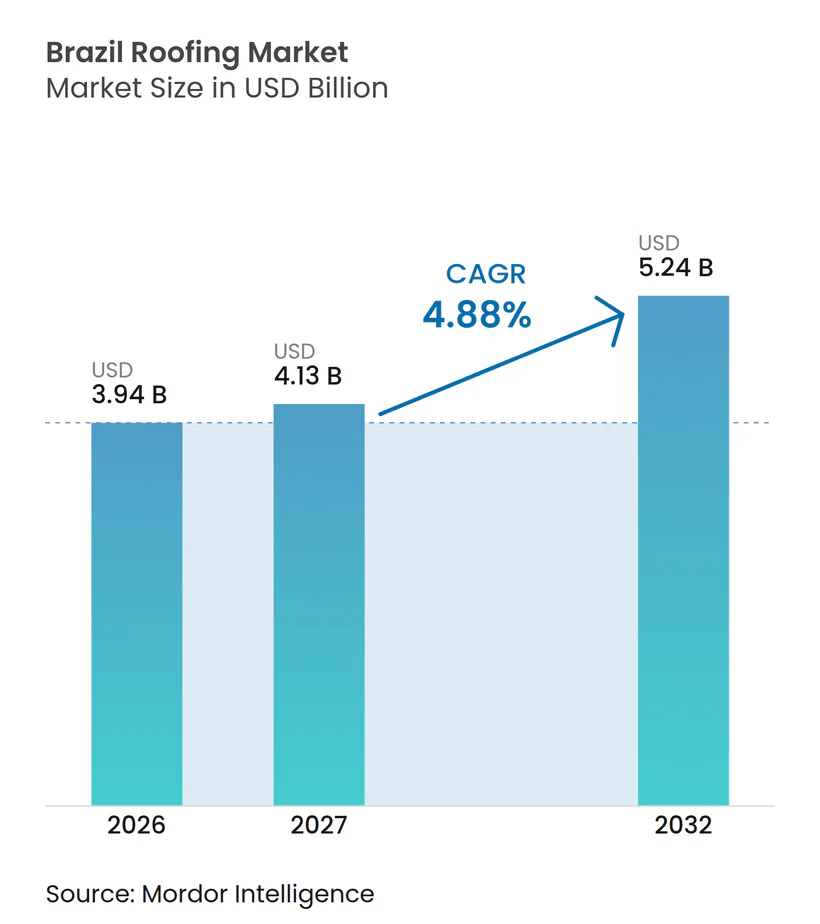
| Base Year Market Size (2026) | USD 3.94 Billion |
| Market Size (2027) | USD 4.13 Billion |
| Market Size (2032) | USD 5.24 Billion |
| Growth Rate (2027 - 2032) | 4.88 % |
| Market Concentration | Low |
Major Players *Disclaimer: Major Players sorted in no particular order Image © Mordor Intelligence. Reuse requires attribution under CC BY 4.0. | |
Brazil Roofing Market Analysis by Mordor Intelligence
The Brazil Roofing Market size is expected to grow from USD 3.94 billion in 2026 to USD 4.13 billion in 2027 and is forecast to reach USD 5.24 billion by 2032 at 4.88% CAGR over 2027-2032.
Demand is supported by public housing activity, replacement needs across older buildings, and new logistics and agricultural facilities. The Brazil roofing market also benefits from a broad installed base that needs periodic repair or replacement, which softens the effect of weaker private construction financing. Higher interest rates continue to delay some privately financed projects, particularly housing and commercial work outside public programs. Product suppliers are responding by emphasizing certified thermal performance, installer support, and local distribution rather than competing only on price. The new building-efficiency rules also create an opportunity for suppliers of insulated, reflective, and other thermally effective roofing systems.
Key Report Takeaways
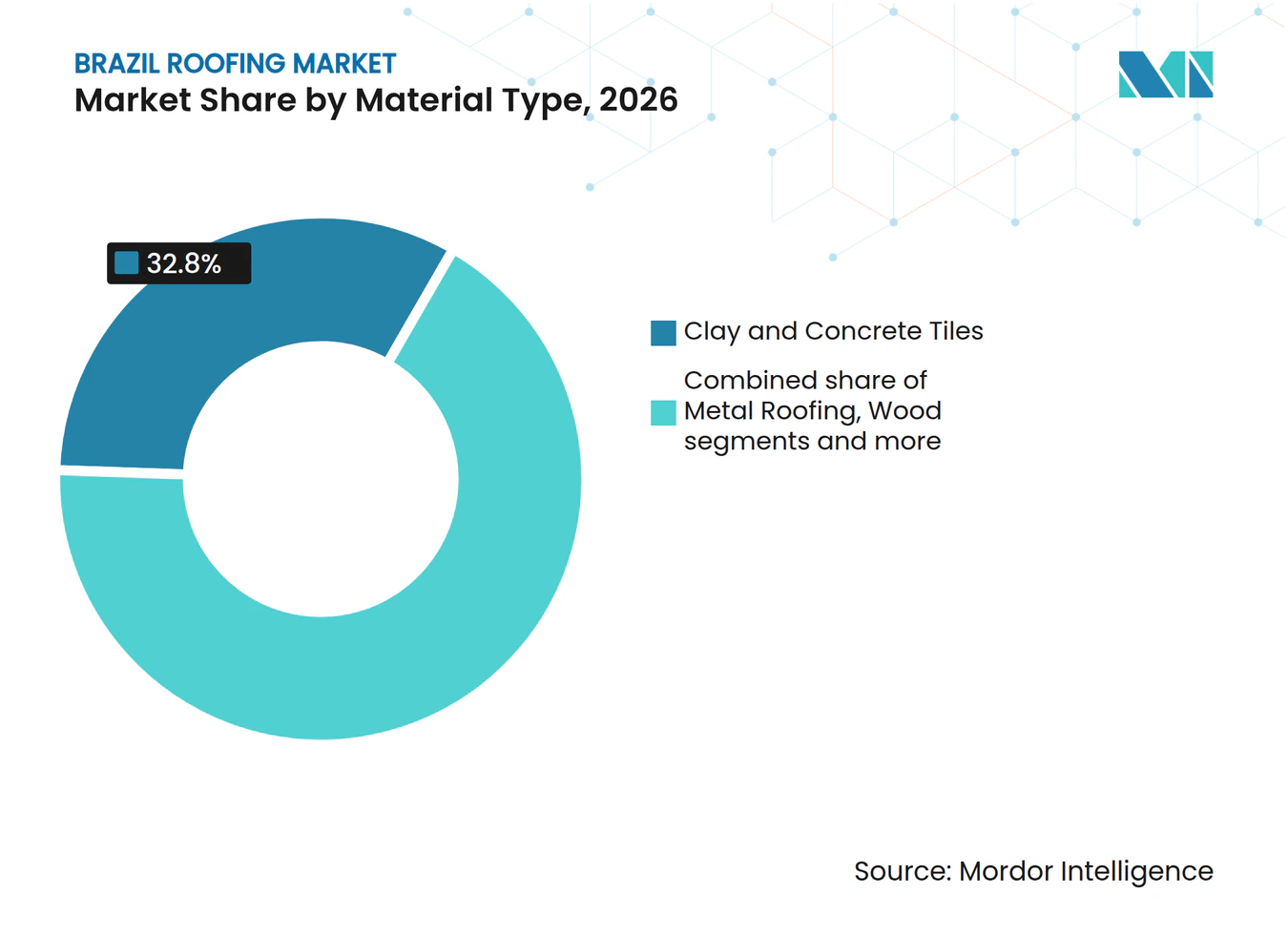
- By material type, clay and concrete tiles accounted for 32.8% of the Brazil roofing market share in 2026, while metal roofing is forecast to expand at a 5.89% CAGR through 2032.
- By construction type, reroofing and replacement accounted for 56.7% of the Brazil roofing market share in 2026, while new construction is forecast to expand at a 5.45% CAGR through 2032.
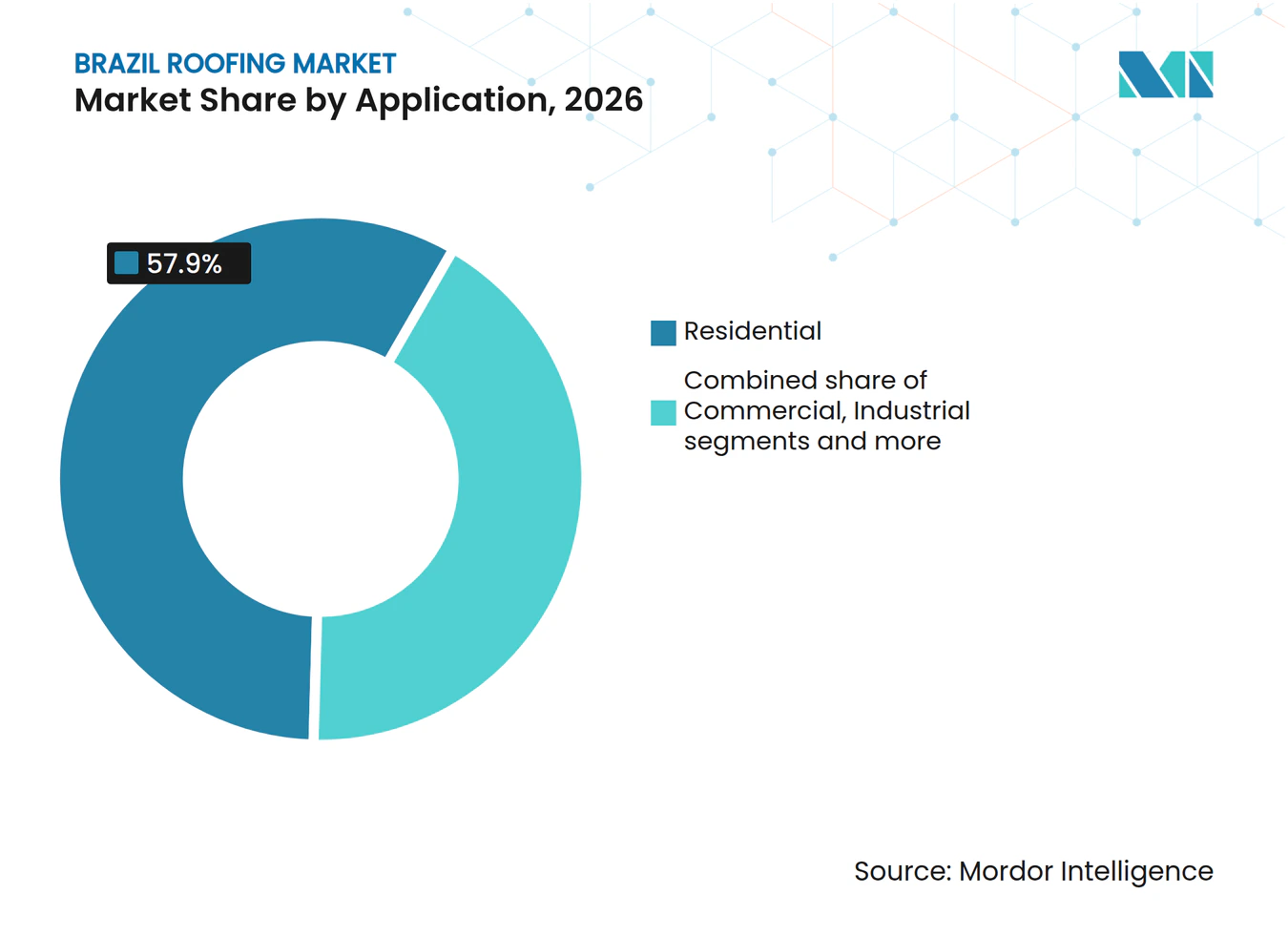
- By application, residential roofing accounted for 57.9% of the Brazil roofing market size in 2026, while industrial roofing is forecast to expand at a 5.98% CAGR through 2032.
- By geography, the rest of Brazil accounted for 61.2% of the Brazil roofing market size in 2026, while Salvador is forecast to expand at a 6.12% CAGR through 2032.
Note: Market numbers in this report are based on Mordor Intelligence's proprietary estimation framework, which combines nine months of actuals with Q4 projections for base year 2026.
Market Trends and Insights
Drivers Impact Analysis of Brazil Roofing Market*
| Drivers | (~) % Impact on CAGR Forecast | Geographic Relevance | Impact Timeline |
|---|---|---|---|
| Minha Casa, Minha Vida and Novo PAC Housing Pipeline | +1.4% | National, with concentration in the São Paulo interior, Northeast, and Center-West | Short term (≤ 2 years) |
| Industrial, Logistics and Agribusiness Construction | +0.9% | São Paulo, Minas Gerais, the Center-West Mato Grosso corridor, Pará, and Santa Catarina | Medium term (2-4 years) |
| Aging Roof Stock and Reroofing Demand | +0.8% | National, especially the Southeast and South | Medium term (2-4 years) |
| Demand for Energy-Efficient and Sustainable Roofing | +0.6% | Federal buildings nationally from 2027, then larger municipalities from 2030 | Long term (≥ 4 years) |
| Modular and Roll-Formed Roofing for Installation Productivity | +0.5% | Industrial and logistics corridors in São Paulo, Rio de Janeiro, Minas Gerais, and Paraná | Medium term (2-4 years) |
| Municipal Cool-Roof and Heat-Resilience Specifications | +0.4% | Salvador, Recife, Fortaleza, Belém, and other Northeast and North urban centers | Long term (≥ 4 years) |
| Source: Mordor Intelligence | |||
Minha Casa, Minha Vida and Novo PAC Housing Pipeline
Federal housing spending gives the Brazil roofing market a steadier source of demand than private credit alone. The Associação Brasileira de Incorporadoras Imobiliárias reported that more than 680,000 Minha Casa, Minha Vida units were contracted in 2025. Standard project designs used by Caixa Econômica Federal commonly support fiber-cement and clay-tile use in large housing developments. The second Novo PAC Seleções stage directed funding toward 110,000 further Minha Casa, Minha Vida units, extending the visible new-build pipeline. This supports suppliers that can serve dispersed projects with dependable materials, technical documentation, and distributor coverage[1].
Industrial, Logistics and Agribusiness Construction
Industrial, logistics, and agricultural facilities continue to support demand for large-span roofing systems. The Brazilian Centre for Steel Construction reported that 63% of surveyed metal-structure production in 2025 went to industrial projects, while gross revenue rose 8.1% versus 2023. Metal roofs fit these facilities because they cover large areas quickly and can be specified with insulation and protective coatings. Roll-formed systems also help contractors shorten installation time when labor availability is limited. The Brazil roofing market therefore has demand outside the mortgage-dependent residential cycle, particularly along logistics and agricultural processing corridors[2].
Aging Roof Stock and Reroofing Demand
Older residential and commercial buildings make replacement work a durable source of activity. Much of the building stock was installed during earlier construction cycles, and many roofs now face heat exposure, biological growth, and physical wear. Owners replacing older asbestos-cement or early fiber-cement products can move to coated metal or thermoacoustic systems with improved thermal performance. This replacement cycle helps maintain demand when new housing starts weaken. Suppliers with established contractor relationships and local inventory retain an advantage because installers in smaller cities often influence the material selected for a reroofing project.
Municipal Cool-Roof and Heat-Resilience Specifications
Municipal attention to heat resilience is increasing the relevance of cool-roof and reflective roofing measures. These measures are most relevant in warm urban centers such as Salvador, Recife, Fortaleza, and Belém. Local rules can encourage public authorities and developers to consider roof reflectivity and thermal comfort earlier in project design. Formosa’s 2026 urban heat-island mitigation policy allows cool-roof and reflective-roofing measures in urban projects. Such local policy action can gradually strengthen demand for products with clear thermal-performance information.
Restraints Impact Analysis of Brazil Roofing Market*
| Restraints | (~) % Impact on CAGR Forecast | Geographic Relevance | Impact Timeline |
|---|---|---|---|
| High Interest Rates and Construction-Financing Constraints | -1.0% | National, especially private residential and commercial projects outside government programs | Short term (≤ 2 years) |
| Volatility in Steel, Asphalt, Polymer and Coating Costs | -0.7% | National for steel and polymers, with asphalt exposure in road-linked supply corridors | Medium term (2-4 years) |
| Logistics Complexity and Installer Shortages | -0.5% | Interior states, Northeast, and North | Medium term (2-4 years) |
| Fragmented Informal Construction and Inconsistent Specification Practices | -0.4% | Smaller cities and peri-urban areas nationally | Long term (≥ 4 years) |
| Source: Mordor Intelligence | |||
High Interest Rates and Construction-Financing Constraints
High borrowing costs are limiting the pace of privately financed construction. The Banco Central do Brasil maintained the Selic benchmark rate at 15% in 2026 after a series of increases beginning in September 2024. The Câmara Brasileira da Indústria da Construção reduced its 2025 construction growth projection to 1.3%, citing weaker credit conditions. It also reported that construction financing funded through the Brazilian savings and loan system declined 53% from January through August 2025 compared with the same period a year earlier[3]. Public housing, short-cycle reroofing work, and industrial projects partly reduce pressure on the Brazil roofing market, although delayed private projects can still make orders less predictable.
Volatility in Steel, Asphalt, Polymer and Coating Costs
Changes in raw-material costs affect margins and make large project quotes harder to manage. The National Department of Transport Infrastructure recorded declines in its asphalt indices from January to November 2025, providing some relief to membrane producers. This relief can be temporary because asphalt costs remain linked to broader oil-price conditions. ArcelorMittal’s acquisition of the remaining Tuper stake strengthened its position from raw steel to finished metallic roofing products. Smaller fabricators must manage purchasing, inventory, and price commitments carefully when serving the Brazil roofing market.
*Our forecasts treat driver/restraint impacts as directional, not additive. The impact forecasts reflect baseline growth, mix effects, and variable interactions.
Brazil Roofing Market Segment Analysis
By Material Type:
Clay and Concrete Tiles Lead While Metal Roofing Grows FastestClay and concrete tiles accounted for 32.8% of the Brazil roofing market share in 2026. They remain important in residential construction because their use matches local design preferences and materials are widely available. Housing-program designs also support their use in many large developments. Regional tile producers have distribution networks that serve rural areas and secondary cities at accessible delivery costs. Fiber-cement remains relevant in mainstream housing because it meets cost and installation needs. These strengths keep traditional materials central to the Brazil roofing value for residential projects.
Metal roofing is projected to grow at a 5.89% CAGR through 2032, the highest rate among material types. Industrial sheds, warehouses, and agricultural structures favor metal systems because they cover wide spans with efficient installation. Asphalt shingles remain concentrated in premium homes and resort developments. Bituminous membranes continue to serve flat and low-slope commercial and industrial roofs. Single-ply membranes, including thermoplastic polyolefin, ethylene propylene diene monomer, and polyvinyl chloride systems, are gaining use where chemical resistance and longer warranties matter. Building-efficiency requirements will increase the value of tested thermal and reflective performance across material choices.



By Construction Type:
Reroofing and Replacement Work Leads While New Construction Gains MomentumReroofing and replacement accounted for 56.7% of the Brazil roofing market sales share in 2026. This reflects the large existing stock of homes, shops, and commercial buildings that need maintenance or complete roof replacement. It also provides a more stable base of demand when mortgage-financed construction slows. Replacement projects can encourage a move toward coated-metal, insulated, or thermoacoustic products. Many owners seek longer service life and better heat performance during this work. The Brazil roofing value for reroofing is therefore supported by maintenance needs as well as product upgrades.
New construction is forecast to advance at a 5.45% CAGR through 2032. Public housing, warehouse development, and agricultural processing facilities support this growth. The construction mix differs by project because homes often use tile and fiber-cement while industrial facilities usually favor metal systems. New buildings are also more likely to include thermal criteria at the specification stage. Credit conditions remain a constraint for private housing and commercial projects. Reformed housing finance rules could support a later improvement in new-build demand if financing becomes more available.
By Application:
Residential Demand Provides Scale While Industrial Roofing Expands FasterResidential roofing held 57.9% of the Brazil roofing market sales share in 2026. Brazil’s large urban housing base supports demand from both new homes and replacement work. Clay and concrete tile and fiber-cement products remain common because they are familiar to installers and accessible to mid- and lower-income buyers. Public housing activity adds regular project volume across several regions. Commercial projects create demand for membranes and urban metal-roof systems. Residential activity therefore provides the largest volume base in the Brazil roofing market.
Industrial roofing is forecast to grow at a 5.98% CAGR through 2032. Warehouses, cold storage, grain processing, and other large facilities require broad roof coverage and often need insulation. Metal systems are suited to these requirements and can be installed quickly over wide spans. Institutional buildings will also need stronger energy-performance documentation once federal requirements take effect. Commercial and industrial buyers are more likely to prioritize documented warranties and thermal specifications. This raises the importance of technical sales support and qualified installation networks.

Geography Analysis
The rest of Brazil accounted for 61.2% of Brazil's roofing market sales share in 2026. The region includes many interior housing markets where public programs and distributor networks shape material demand. It also includes the Center-West agricultural corridor, where grain, biofuel, and processing investments need large covered structures. The South industrial belt adds demand from manufacturing and logistics sites. These areas favor suppliers that can manage freight, inventory, and installer access across long distances.
Salvador is forecast to expand at a 6.12% CAGR through 2032. Its growth reflects infrastructure needs, logistics activity around the Port of Salvador, and the industrial base around Camaçari. Northeast cities also face higher demand for heat-resilient building measures. Local policy interest in cool roofs and green roofs can increase attention to thermal performance. This creates an opening for reflective coatings, insulated panels, and other systems with clear technical data.
São Paulo remains the largest individual city market in absolute value because it combines dense commercial property, logistics activity, and an older building stock. Its size supports steady replacement work as well as demand from new industrial and distribution facilities. Rio de Janeiro’s logistics demand is less immediate than in São Paulo and agricultural interior states. Market participants must therefore adapt product mix and distributor support to local project conditions. The Brazil roofing market benefits from this geographic diversity because housing, logistics, agriculture, and replacement work do not move in the same cycle.
Competitive Landscape
Market Concentration
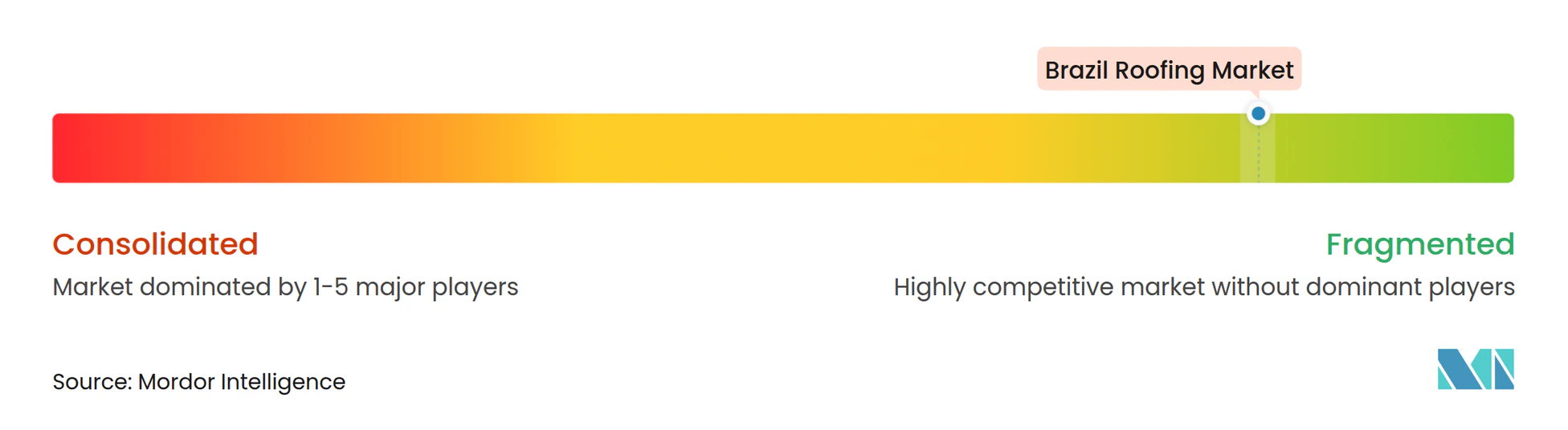
The Brazil roofing market is fragmented across fiber-cement, clay tile, metal, membrane, and insulated-panel suppliers. No single manufacturer controls a dominant share. Competition is often decided before purchase, when architects, engineers, contractors, and developers select the specification. Product certification, technical documentation, and installer support can therefore be as important as price. Domestic suppliers have an advantage where local distribution and contractor familiarity shape material choice.
Eternit remains important in fiber-cement roofing and reported 23.6% year-on-year roofing revenue growth in the second quarter of 2026. The company also discontinued its concrete-tile line in late 2025 to focus on industrialized construction and fiber-cement systems. ArcelorMittal completed full ownership of Tuper in 2025, bringing metallic roofing tiles, galvanized profiles, and tubular products closer to an integrated steel supply chain. This move strengthens its ability to coordinate raw materials and finished products. These actions show that portfolio focus and vertical coordination are important competitive strategies.
The competitive opportunity is strongest where buyers need certified thermoacoustic or energy-efficient roof systems. Manufacturers that prepare products for the 2027 building-efficiency requirements can gain access to better-specified projects. Contractors and distributors will remain important because local installation quality affects system performance. Larger firms can use technical sales resources and broader product portfolios to serve complex industrial jobs. Smaller firms can compete through local service, faster delivery, and specialist knowledge.
Brazil Roofing Industry Leaders
-
Eternit
-
Saint-Gobain Brasilit
-
Grupo R. Casagrande / Perkus
-
Tuper
-
Viapol
- *Disclaimer: Major Players sorted in no particular order
Brazil Roofing Market Companies Covered in this Report
- Eternit
- Saint-Gobain Brasilit
- Grupo R. Casagrande / Perkus
- Tuper
- Viapol
- Dânica
- Marko Sistemas Metálicos
- ArcelorMittal Perfilor
- Imbralit
- Grupo Multilit
- Roofway
- Kingspan Group
- Sika AG
- Carlisle Construction Materials
- Johns Manville
- Owens Corning
- Etex
- Votorantim Cimentos
- Ciser
- Metalfrio Solutions
- Vedacit
Recent Industry Developments in Brazil Roofing Market
- August 2026: ArcelorMittal Brasil announced an investment in a cold rolling mill and continuous coating line at its Tubarão unit in Serra, Espírito Santo. The facility will process 560,000 tonnes of metallic-coated steel annually and strengthen supply for roofing subsidiaries Tuper, Dânica, and Perfilor. Construction begins in 2026, with operations targeted for the first half of 2030.
- July 2026: Soprema Brasil launched the Sopraguard ethylene propylene diene monomer membrane in 3 variants: One, Geo, and Stick, for Brazilian flat-roof and green-roof applications. Its operating range is minus 45°C to 130°C, and its flame-free installation is suited to logistics-shed and agricultural roofing projects.
- June 2026: Eternit S.A. relocated its headquarters from Faria Lima to Hortolândia, São Paulo, and disclosed USD 5.2 million in cumulative production-line conversions for steel-frame and wood-frame industrialized construction systems. The segment recorded 50.3% year-on-year net revenue growth in the second quarter of 2026, showing the company’s shift from standalone tiles toward building-envelope system solutions.
Brazil Roofing Market Report Scope
Segmentation Overview
| Asphalt Shingles |
| Clay and Concrete Tiles |
| Metal Roofing |
| Bituminous / Modified Bitumen Membranes |
| Single-Ply Membranes (TPO, EPDM, and PVC) |
| Wood |
| Others |
| New Construction |
| Reroofing and Replacement |
| Residential |
| Commercial |
| Industrial |
| Institutional |
| Others |
| São Paulo |
| Rio de Janeiro |
| Salvador |
| Rest of Brazil |
| By Material Type | Asphalt Shingles |
| Clay and Concrete Tiles | |
| Metal Roofing | |
| Bituminous / Modified Bitumen Membranes | |
| Single-Ply Membranes (TPO, EPDM, and PVC) | |
| Wood | |
| Others | |
| By Construction Type | New Construction |
| Reroofing and Replacement | |
| By Application | Residential |
| Commercial | |
| Industrial | |
| Institutional | |
| Others | |
| By City | São Paulo |
| Rio de Janeiro | |
| Salvador | |
| Rest of Brazil |
Key Questions Answered in the Report
What is the Brazil roofing value?
The Brazil roofing value is projected to rise from USD 3.94 billion in 2026 to USD 5.24 billion by 2032, at a 4.88% CAGR.
Which roofing material leads demand in Brazil?
Clay and concrete tiles lead with a 32.8% share in 2026, supported by residential demand and housing-program specifications.
Which roofing segment is growing the fastest in Brazil?
Metal roofing is the fastest-growing material segment, with a projected 5.89% CAGR through 2032. Its use is supported by warehouse, industrial, and agricultural projects.
Why is reroofing important in Brazil?
Reroofing and replacement held a 56.7% share in 2026 because older homes and commercial buildings need ongoing maintenance and upgrades. This work can also prompt a move to thermally improved materials.
What is driving industrial roofing demand in Brazil?
Warehouses, agricultural processing, cold storage, and logistics facilities support industrial roofing growth at a projected 5.98% CAGR through 2032. These projects often require wide spans, insulation, and documented system performance.
How do energy-efficiency rules affect roofing demand in Brazil?
Mandatory building-efficiency requirements from 2027 increase demand for roofing systems with documented thermal performance. The framework favors suppliers that can provide tested data for reflective and insulated systems.
How do energy-efficiency rules affect roofing demand in Brazil?
Mandatory building-efficiency requirements from 2027 increase demand for roofing systems with documented thermal performance. The framework favors suppliers that can provide tested data for reflective and insulated systems.