
Brazil Prefabricated Product Logistics Market Size and Share
Market Overview
| Study Period | 2020 - 2031 |
|---|---|
| Forecast Data Period | 2026 - 2031 |
| Base Year Market Size (2025) | USD 98.10 Million |
| Market Size (2026) | USD 102.02 Million |
| Market Size (2031) | USD 132.11 Million |
| Growth Rate (2026 - 2031) | 5.31 % |
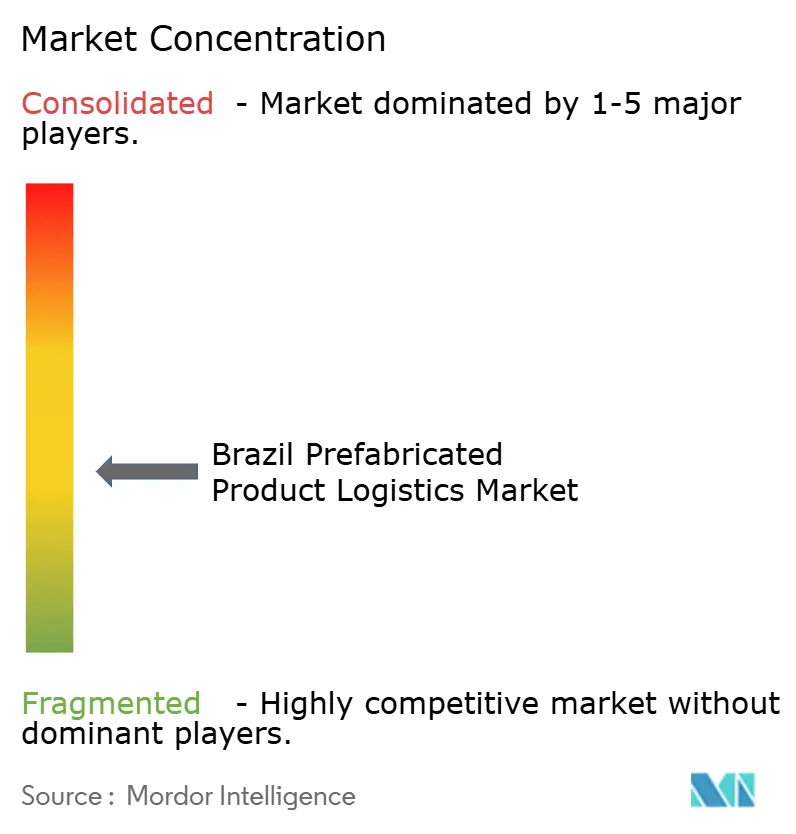
| Market Concentration | Medium |
Major Players *Disclaimer: Major Players sorted in no particular order Image © Mordor Intelligence. Reuse requires attribution under CC BY 4.0. | |
Brazil Prefabricated Product Logistics Market Analysis by Mordor Intelligence
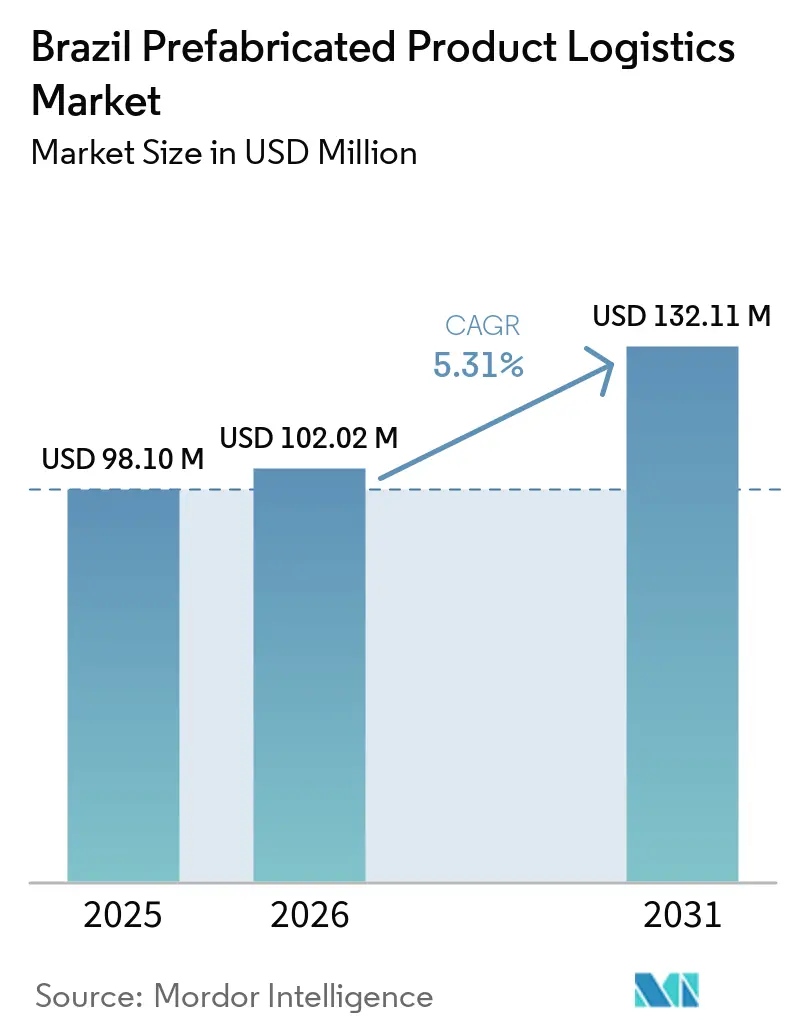
The Brazil Prefabricated Product Logistics Market size was valued at USD 98.10 million in 2025 and is estimated to grow from USD 102.02 million in 2026 to reach USD 132.11 million by 2031, at a CAGR of 5.31% during the forecast period (2026-2031).
It covers transportation, storage, and handling services for factory-built structural elements moving from plants to construction sites. Residential construction remains an important source of demand, while logistics buildings and data centers broaden the customer base. Delivery planning has become more important because project schedules depend on coordinated truck movements, site access, crane availability, and permits. Production remains concentrated in the Southeast, while demand is spreading into regions with fewer nearby factories. The Brazil prefab product logistics market, therefore, depends on providers that can combine specialized transport capacity with reliable site coordination.
Key Report Takeaways
- By service, transportation held 54.10% of the Brazil prefabricated product logistics market share in 2025, while value-added services are forecast to increase at a 6.96% CAGR through 2031.
- By product type, modular buildings accounted for 42.55% of the Brazil prefabricated product logistics market size in 2025, while panelized and componentized systems are forecast to grow at a 7.01% CAGR through 2031.
- By application, residential buildings held 51.70% of the Brazil prefabricated product logistics market share in 2025, while commercial buildings are forecast to grow at a 7.22% CAGR through 2031.
Note: Market size and forecast figures in this report are generated using Mordor Intelligence’s proprietary estimation framework, updated with the latest available data and insights as of January 2026.
Brazil Prefabricated Product Logistics Market Trends and Insights
Drivers Impact Analysis*
| Driver | (~) % Impact on CAGR Forecast | Geographic Relevance | Impact Timeline |
|---|---|---|---|
| Housing Deficit and Rapid Delivery Requirements | +1.8% | National, concentrated demand in Northeast and Southeast urban peripheries | Short term (≤ 2 years) |
| E-Commerce, Logistics Real Estate, and Data Center Expansion | +0.9% | Southeast core, with spillover to the Northeast | Medium term (2-4 years) |
| Public Sector Adoption of Schools, Clinics, and Disaster Response Units | +0.7% | National, with early gains in the Northeast and North | Medium term (2-4 years) |
| Industrialized Construction and Factory Quality Control | +0.8% | National, anchored in Sao Paulo and Parana prefab manufacturing hubs | Long term (≥ 4 years) |
| Multimodal Corridor and Inland Infrastructure Development | +0.5% | Center-West, North, and Northeast corridors | Long term (≥ 4 years) |
| Factory-Integrated BIM and Supply-Chain Coordination | +0.4% | National, with early gains in federally funded programs in Sao Paulo and Brasilia | Long term (≥ 4 years) |
| Source: Mordor Intelligence | |||
Housing Deficit and Rapid Delivery Requirements
Brazil registered a record housing deficit of 5.77 million units in 2024, equal to 7.4% of the occupied housing stock. The scale of unmet housing need supports a continuing need for prefabricated building deliveries across several states. Caixa guidelines for Minha Casa Minha Vida set requirements for projects financed under the program and support formal planning of construction activity.[1]“Minha Casa Minha Vida 2025 Diretrizes,” Caixa Economica Federal, caixa.gov.br Faster delivery requirements place greater value on the timed arrival of panels and steel systems. This favors logistics firms that can schedule repeated deliveries to active sites and coordinate handling equipment. The Brazil prefab product logistics market benefits when developers seek predictable supply arrangements rather than isolated freight bookings.
E-Commerce, Logistics, Real Estate, and Data Center Expansion
Logistics, real estate, and data-center construction are extending demand beyond housing projects. These facilities use structural panels, raised-floor elements, modular power enclosures, and steel-frame components that require planned transport and site delivery. The United States Commercial Service identified opportunities for modular construction in Brazil, including demand tied to construction needs and industrialized building methods.[2]“Brazil Engineering and Modular Construction,” International Trade Administration, trade.gov Large distribution facilities need staged component arrivals so building work can proceed without extended storage at the site. Data-center projects also place a premium on physical protection and accurate sequencing for sensitive equipment enclosures. These requirements give the Brazil prefab product logistics market a broader set of commercial customers with complex delivery needs.
Multimodal Corridor and Inland Infrastructure Development
Brazilian freight movement remains dependent on roads, which raises costs for long routes serving the Center-West and North. The USDA described infrastructure and transport constraints that affect freight flows across Brazil.[3] “Infrastructure Challenges in Brazil's Agricultural Sector,” GAIN Report BR2026-0026, fas.usda.gov Rail and port connections can reduce the road distance needed for high-volume panel movements. Improved inland corridors could support shipments from manufacturing centers to intermodal terminals before final road delivery. This is particularly relevant for panel systems that can be loaded efficiently and moved in larger batches. The Brazil prefab product logistics market could gain from routes that reduce the cost and scheduling risk of long-distance projects.
Factory-Integrated BIM and Supply-Chain Coordination
Federal Decree 11,888 reinstated the BIM BR strategy in January 2024 and established a framework for wider use of building information modeling in public works. ANTT made BIM use mandatory for engineering projects across federally concessioned road contracts in July 2025. ABDI expanded implementation support for BIM across Brazilian states under its 2025 to 2027 work plan. Digital project data can help carriers plan delivery orders, crane windows, module positioning, and permit timing before dispatch. Providers using compatible dispatch and tracking systems can better meet tender requirements and site scheduling needs. This makes coordination capability more relevant to the Brazil prefab product logistics market as public projects adopt digital workflows.
Restraints Impact Analysis*
| Restraint | (~) % Impact on CAGR Forecast | Geographic Relevance | Impact Timeline |
|---|---|---|---|
| ICMS Classification and Cross-State Tax Complexity | -0.8% | National, amplified on interstate freight movements | Medium term (2-4 years) |
| Oversized-Load Permitting and Route Constraints | -0.7% | National, most acute on interstate routes and secondary roads in the North and Northeast | Short term (≤ 2 years) |
| Fragmented Carrier Capacity and Specialized Handling Scarcity | -0.6% | National, most severe in the North and Center-West | Medium term (2-4 years) |
| Regional Factory Concentration and Long-Haul Cost Exposure | -0.5% | Center-West, North, and Northeast destination markets | Long term (≥ 4 years) |
| Source: Mordor Intelligence | |||
ICMS Classification and Cross-State Tax Complexity
Interstate transport of prefabricated goods involves state tax requirements that vary by shipment origin and destination. Constitutional Amendment 132/2023 established a tax reform process that replaced existing consumption taxes through a transition period. Logistics operators need to manage requirements under both the existing and new systems while the transition continues. This increases administrative work for carriers serving routes from southeastern plants to distant project locations. Documentation quality remains important because contract pricing depends on accurate tax treatment and records. The Brazil prefab product logistics market faces added complexity when factory-to-site shipments cross several state boundaries.
Oversized-Load Permitting and Route Constraints
Many prefabricated elements exceed standard road dimensions and require an Autorizacao Especial de Transito, or AET, for travel on federal roads. DNIT Resolution 01/2026 sets requirements for these special transit authorizations.[4]“Resolution No. 01/2026, Special Transit Authorization,” Diario Oficial da Uniao, gov.br AET permits can limit movements to approved routes and daylight hours and may require pilot vehicle escorts. These conditions reduce flexibility for deliveries that need to match narrow construction windows. State and municipal roads can add separate approval requirements and weight limits near the final destination. The Brazil prefab product logistics market needs to account for these restrictions before confirming project schedules and freight prices.
*Our forecasts treat driver/restraint impacts as directional, not additive. The impact forecasts reflect baseline growth, mix effects, and variable interactions.
Segment Analysis
By Service: Transportation Leads, Value-Added Services Reshape Margins
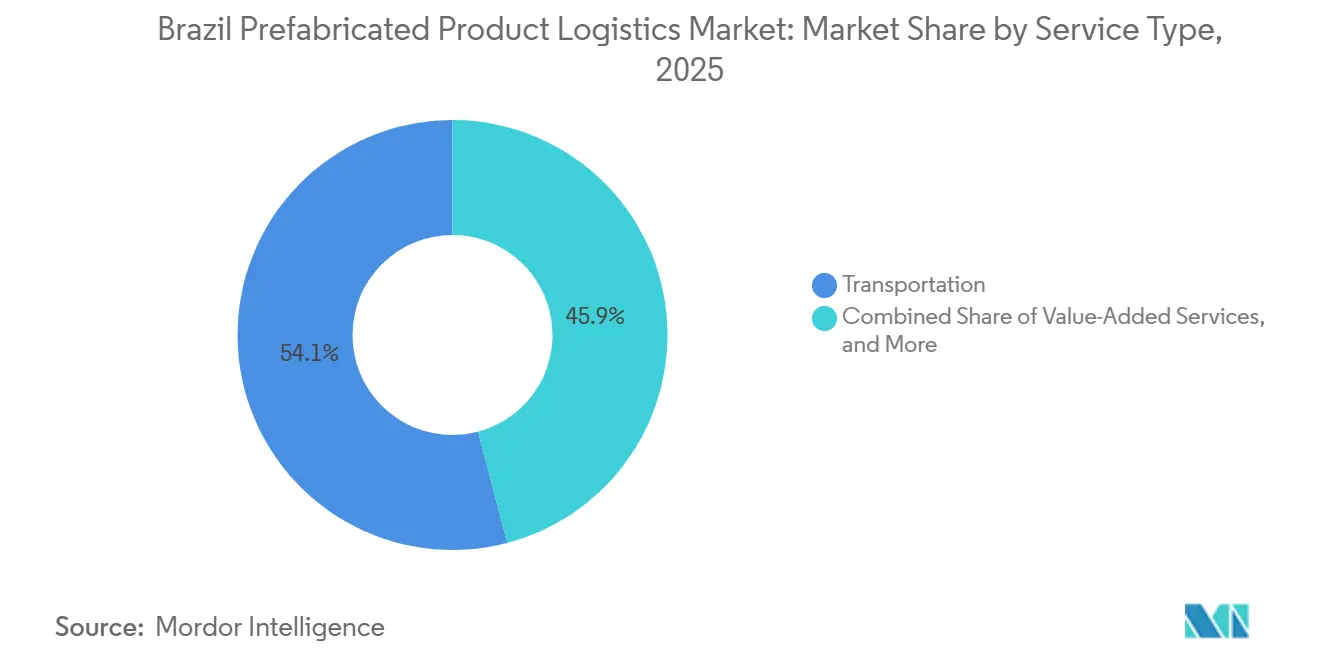
Transportation held 54.10% of the Brazil prefabricated product logistics market share in 2025. Road freight supported this position because it provides direct connections between factories, staging locations, and construction sites. The USDA reported that infrastructure limitations continued to affect freight movement in Brazil. Rail has a growing role in corridors that can move large volumes of panels toward intermodal terminals. Warehousing and Storage provides protected staging for deliveries that must wait for permits, site access, or installation windows. Sea and inland waterways remain a specialized option for sites in the North where road access is limited.
Value-added services are forecast to grow at a 6.96% CAGR through 2031. Developers increasingly seek freight management, craneage, rigging, and permit support under a single service arrangement. Digital construction information can be used to align transport schedules with module placement and site preparation. ANTT requirements for BIM in federal road concession engineering projects reinforce the relevance of compatible planning systems. Quality requirements for prefabricated construction also increase the value of careful handling and documented delivery processes. Providers that manage permits and dispatch in the same workflow are better placed to serve these contracts.



By Product Type: Modular Buildings Anchor Revenue, Panelized Systems Gain Ground
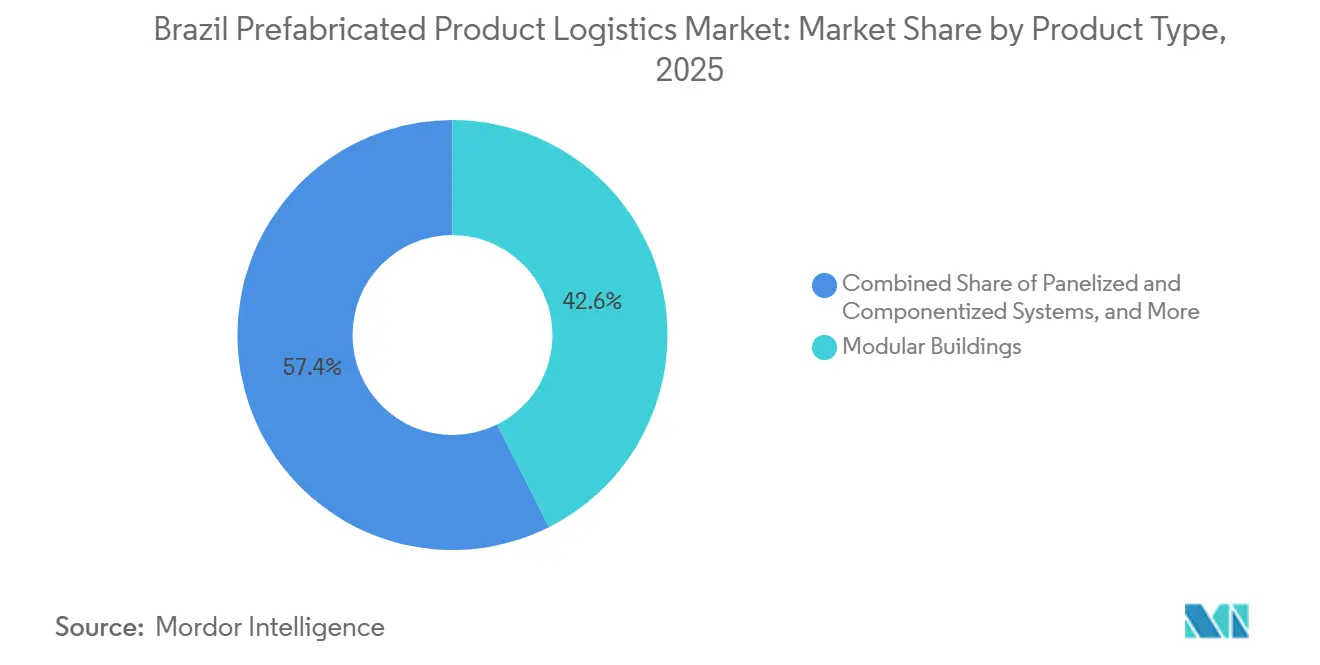
Modular buildings accounted for 42.55% of the Brazil prefabricated product logistics market size in 2025. Fully assembled units often require dedicated flatbeds, special permits, and escort vehicles because of their dimensions. Residential projects in Greater Sao Paulo and Rio de Janeiro supported a large share of this activity. The units are indivisible, which can limit truck utilization and increase logistics costs per square meter. Other prefab types include pre-stressed beams, hollow-core slabs, and bridge segments that need specialized lifting and transport. These products remain important in infrastructure corridors that require heavy-load planning.
Panelized and componentized systems are forecast to grow at a 7.01% CAGR through 2031. Panels can fit standard flatbed configurations more easily than fully volumetric modules. This can improve truck utilization and make transport pricing more competitive. Phased delivery and on-site assembly suit data-center construction and large logistics facilities. Public projects such as schools, clinics, and disaster-response units may also prefer panelized systems where secondary roads cannot accommodate wider modular units. Structural certification requirements for precast concrete work further increase the need for consistent handling standards during transport.
By Application: Residential Holds Scale, Commercial Buildings Accelerates
Residential buildings held 51.70% of the Brazil prefabricated product logistics market share in 2025. Social housing projects require frequent deliveries to dispersed sites in urban peripheries. This pattern favors regional road carriers that maintain dense local networks and understand neighborhood access limits. The United States Commercial Service noted Brazil's continuing need for construction and modular building solutions. New precast plants in Bahia and Pernambuco are reducing plant-to-site distances for some projects. This gradually shifts part of the demand away from longer Southeast-to-Northeast freight movements.
Commercial buildings are forecast to expand at a 7.22% CAGR through 2031. Warehouse development, data-center construction, and retail modernization are increasing the use of factory-built structural elements. These projects often use longer spans, heavier panels, and modular power infrastructure. Larger individual consignments can generate more logistics revenue per square meter than residential projects. Developers also value predictable delivery dates because construction delays can affect building occupancy and operating plans. The Brazil prefabricated product logistics industry, therefore, has opportunities in commercial projects that need coordinated, time-sensitive deliveries.
Geography Analysis
The Southeast was the leading supply base for the Brazil prefabricated product logistics market in 2025. Sao Paulo concentrated precast plants, modular fabricators, and specialized flatbed carriers. Guarulhos, Cajamar, and Barueri served as important freight origins for national shipments. Rio de Janeiro added demand from suburban housing programs and commercial construction. The Port of Santos, major highway links, and rail services gave Southeast-based operators a cost advantage. This manufacturing and infrastructure density supported the region's role as the main freight hub.
The Northeast is becoming a more active corridor for the Brazil prefabricated product logistics market. Bahia and Pernambuco licensed new precast plants, which shortened delivery distances for social-housing projects. A larger local supplier base can reduce long-haul exposure for projects in the region. The United States Commercial Service identified broader opportunities for industrialized construction in Brazil. The North and Northeast also face more demanding secondary-road conditions, which increases the need for route planning. Growth in these regions depends on local production capacity and access to specialized carriers.
The South and Center-West had different logistics conditions in 2025 and 2026. Parana and Santa Catarina established prefabricated-housing activity and mature local carrier networks. Rio Grande do Sul continued to require emergency modular housing logistics after the 2024 floods. Wilson Sons presented port and logistics solutions for Brazil's supply chain in early 2026. The Center-West remained underserved because of its distance from Southeast manufacturing centers. Higher freight costs can reduce prefab's price advantage against on-site masonry. Better intermodal links may improve access to this construction pipeline.
Competitive Landscape
The Brazil prefabricated product logistics market was moderately fragmented in 2025. Global third-party logistics providers, regional road freight firms, rail operators, and port operators each held positions in different parts of the service chain. Larger providers compete through national coverage, integrated services, and digital dispatch capabilities. Smaller carriers retain relevance because they know local routes and can serve dispersed construction sites. Specialized oversized-load handling requires equipment, permit knowledge, and experienced crews. These conditions keep the Brazil prefabricated product logistics market open to different types of providers rather than a single dominant operator.
JSL reorganized its operations into JSL Dedicated Services, Intralog, and JSL Digital in 2025, allowing it to pursue specialized contracts through separate business units. The structure supports more focused service offerings while retaining a national logistics presence. CEVA Logistics opened an Amazon fulfillment center in Santa Maria, Federal District, in November 2025, expanding its Brazilian warehousing footprint. MRS Logistica reported financial and operating results for the second quarter of 2026, reflecting its continuing role in rail freight corridors. These moves show how national logistics and rail operators can support projects that need coordinated freight networks. Companies that connect road, storage, and site delivery can address more of the customer requirement.
Opportunities remain in last-mile delivery for residential prefab projects in Northeast cities with constrained roads. Rail-road solutions can also serve panel shipments traveling more than 800 kilometers from manufacturing centers. Asset-light platforms can link independent flatbed operators with prefab manufacturers for standard panel loads. Dedicated heavy-haul fleets remain better suited to oversized movements that require AET expertise. Digital freight platforms cannot easily replicate this capability at scale. The Brazil prefabricated product logistics market may continue to reward providers that combine reliable capacity with specialized handling knowledge.
Brazil Prefabricated Product Logistics Industry Leaders
Cassol Pre-Fabricados
Mtech Premoldados Protendidos
JSL S.A.
DHL Group
CMA CGM Group (Including CEVA Logistics)
- *Disclaimer: Major Players sorted in no particular order

Recent Industry Developments
- September 2026: Brookfield completed the purchase of eight logistics parks from Marq Logistics for approximately BRL 1.4 billion (USD 270 million), adding 560,000 square meters of gross leasable area and increasing its Brazilian warehouse portfolio by 56% to approximately 1.9 million square meters.
- August 2026: Tidewater completed its USD 500 million acquisition of Wilson Sons Ultratug, incorporating 22 platform supply vessels and expanding its Brazilian fleet from 6 to 28 vessels. The transaction, finalized August 31, 2026, directly repositions the combined entity for offshore logistics contracts linked to energy-sector prefab and modular platform work.
- July 2026: MRS Logistica and DP World launched a multimodal logistics solution connecting Brazil's Central-West to the Port of Santos via REDEX customs facilities, offering manufacturers in that region, including prefab producers, a cost-competitive rail-to-port freight alternative for the first time.
- April 2026: DHL Supply Chain inaugurated two new e-commerce distribution centers in Cajamar, Sao Paulo, and Brasilia, Federal District, expanding its Brazilian fulfillment network to five facilities and extending coverage into the Central-West logistics market.


Brazil Prefabricated Product Logistics Market Report Scope
| Transportation | Road |
| Rail | |
| Air | |
| Sea and Inland Waterways | |
| Warehousing and Storage | |
| Value-Added Services |
| Modular Buildings |
| Panelized and Componentized Systems |
| Other Prefab Types |
| Residential Buildings |
| Commercial Buildings |
| Others |
| By Service | Transportation | Road |
| Rail | ||
| Air | ||
| Sea and Inland Waterways | ||
| Warehousing and Storage | ||
| Value-Added Services | ||
| By Product Type | Modular Buildings | |
| Panelized and Componentized Systems | ||
| Other Prefab Types | ||
| By Application | Residential Buildings | |
| Commercial Buildings | ||
| Others |


Key Questions Answered in the Report
What is the forecast for Brazil prefab product logistics through 2031?
The sector was valued at USD 98.10 million in 2025 and is forecast to reach USD 132.11 million by 2031 at a 5.31% CAGR.
Which service had the largest share in 2025?
Transportation led with 54.10% of revenue in 2025 because road freight directly connected factories and construction sites.
Which service is expected to grow the fastest?
Value-added services are forecast to grow at a 6.96% CAGR through 2031 as developers combine freight, permits, craneage, and sequencing.
Which prefab product type led logistics demand?
Modular buildings accounted for 42.55% of value in 2025, while panelized and componentized systems are forecast to grow at a 7.01% CAGR.
What applications support demand for these logistics' services?
Residential buildings held 51.70% of value in 2025, and commercial buildings are forecast to expand at a 7.22% CAGR through 2031.
What is the main operational challenge for providers?
Oversized components require AET permitting and route planning, which can restrict delivery timing and increase coordination needs.
Page last updated on:





