
Brazil Ocean Freight Transport Market Size and Share
Market Overview
| Study Period | 2021 - 2032 |
|---|---|
| Forecast Data Period | 2027 - 2032 |
| Base Year Market Size (2026) | USD 18.24 Billion |
| Market Size (2027) | USD 19.26 Billion |
| Market Size (2032) | USD 25.05 Billion |
| Growth Rate (2027 - 2032) | 5.40 % |
| Market Concentration | Low |
Major Players *Disclaimer: Major Players sorted in no particular order Image © Mordor Intelligence. Reuse requires attribution under CC BY 4.0. | |
Brazil Ocean Freight Transport Market Analysis by Mordor Intelligence
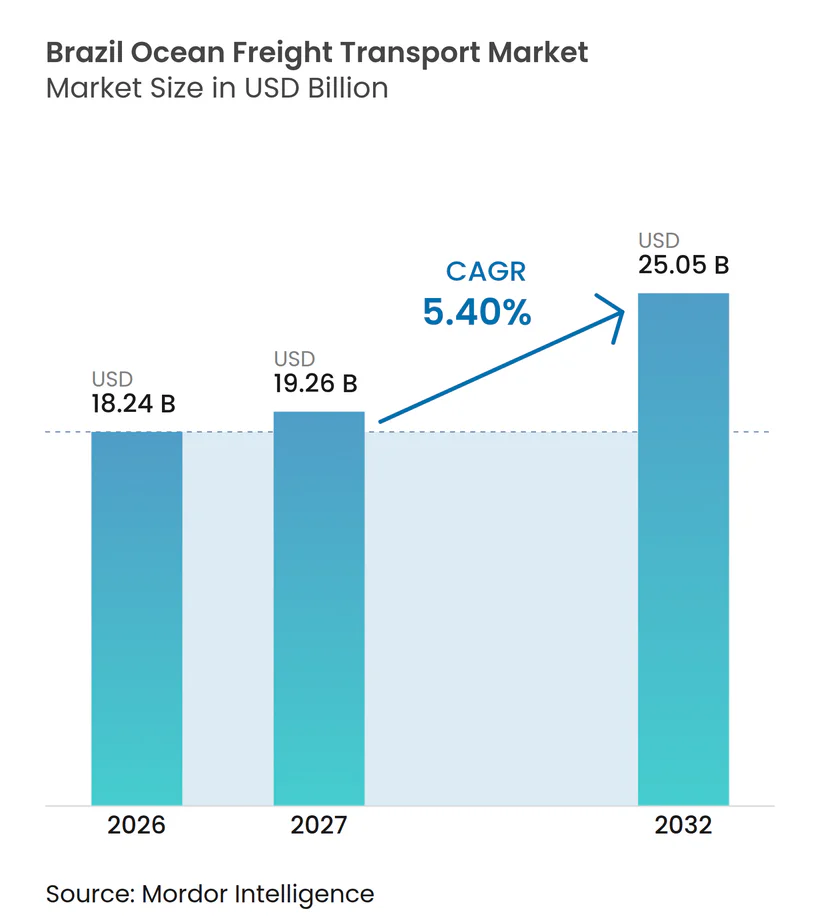
The Brazil ocean freight transport market size is valued at USD 18.24 billion in 2026 and estimated to grow from USD 19.26 billion in 2027 to reach USD 25.05 billion by 2032, at a CAGR of 5.40% during the forecast period (2027-2032).
Brazil’s exports of soybeans, poultry, iron ore, and beef continue to create a broad base of demand for seaborne transport. The country’s export structure also limits the ability of road and rail services to replace ocean freight on international routes. Rising agricultural output is increasing the value of reliable port access, vessel scheduling, and cargo handling capacity. Port investment is spreading beyond Santos, which can reduce pressure on the country’s largest gateway and create additional routing choices. At the same time, inland congestion and unstable freight rates can raise operating costs and weaken the benefits of new terminal capacity.
Key Report Takeaways
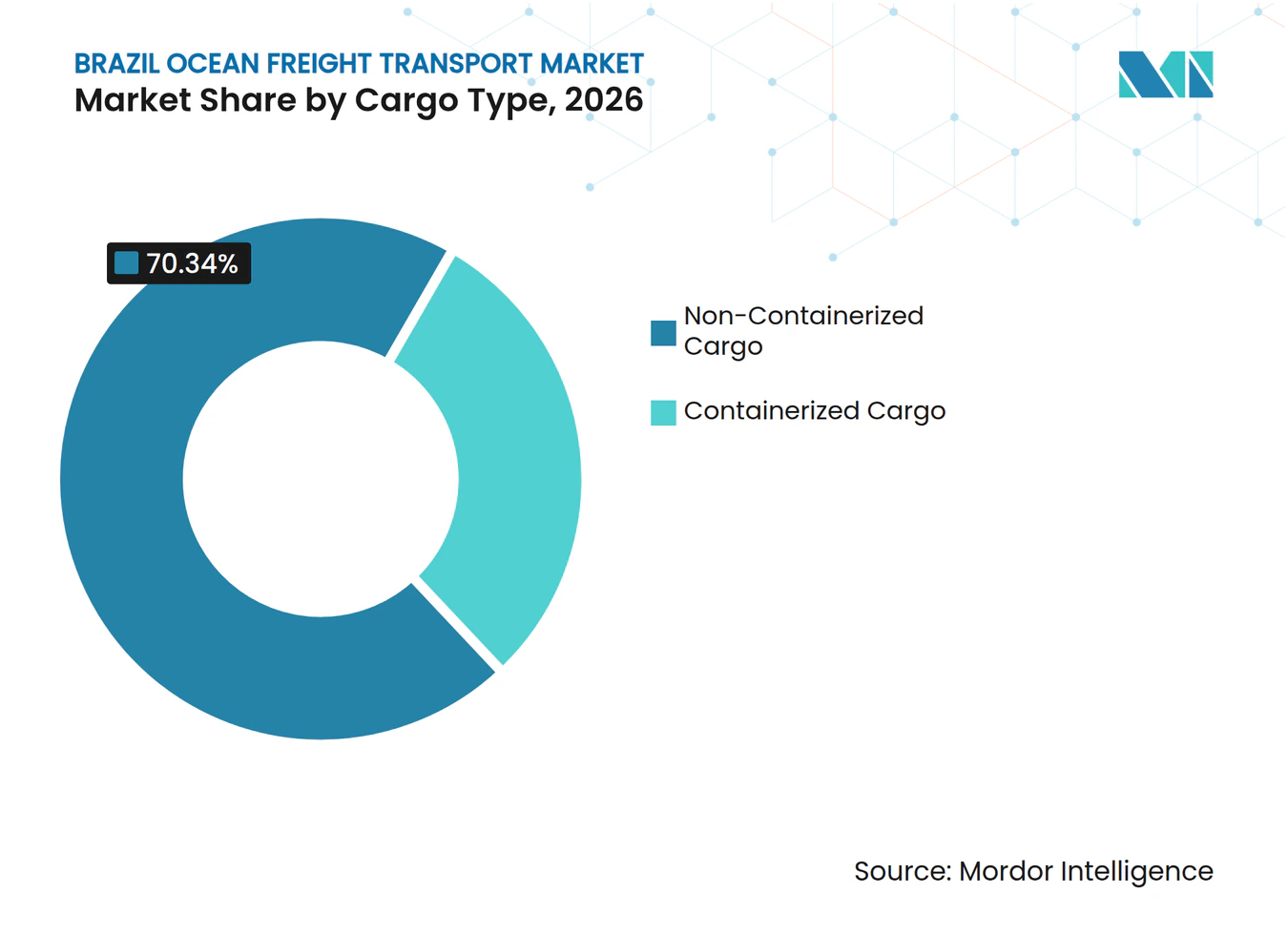
- By cargo type, non-containerized cargo accounts for 70.34% of the Brazil ocean freight transport market share in 2026, while containerized cargo is projected to register a 7.12% CAGR through 2032.
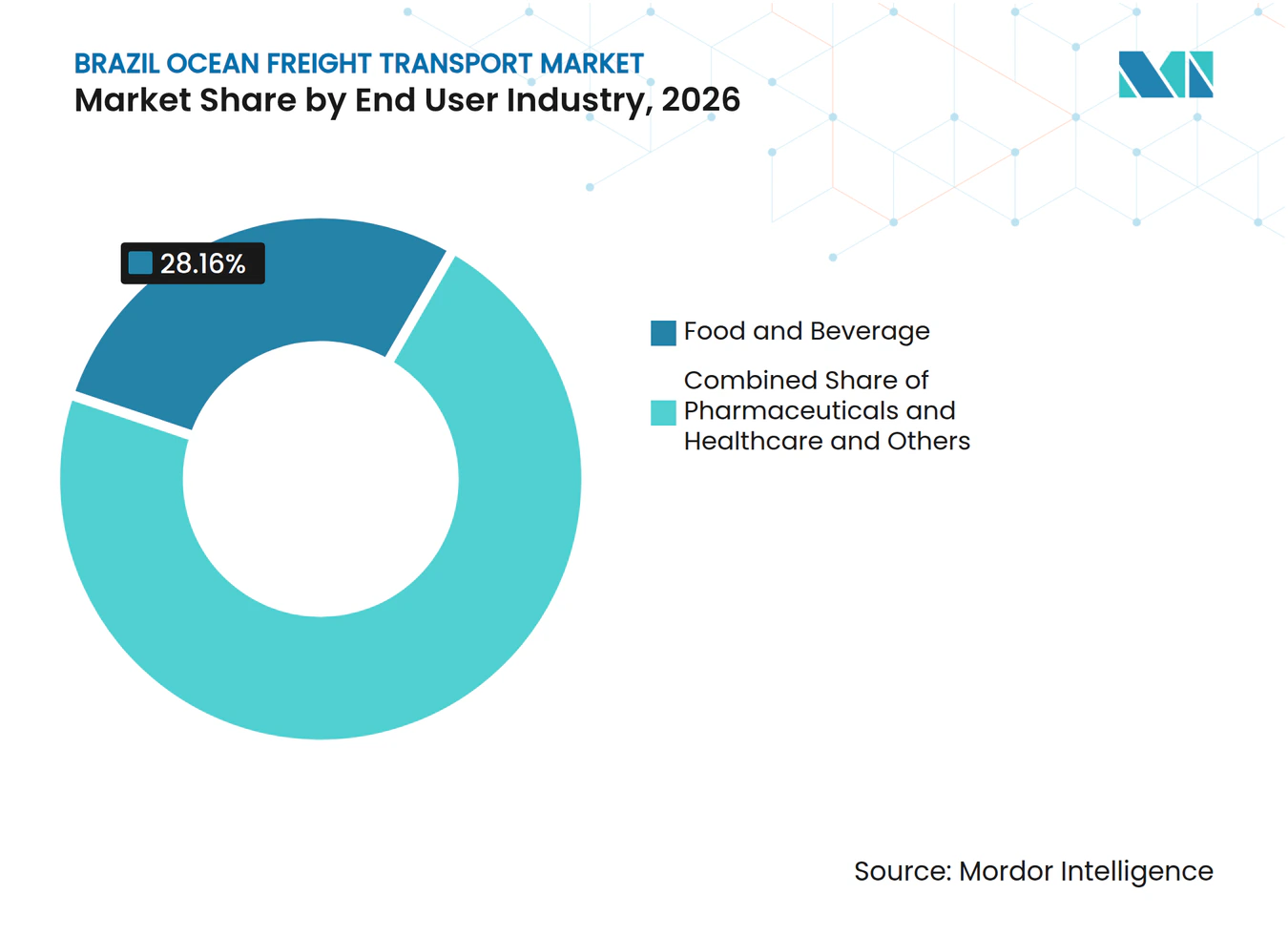
- By end-user industry, food and beverage accounts for 28.16% of the Brazil ocean freight transport market size in 2026, while pharmaceuticals and healthcare is forecast to expand at a 7.98% CAGR through 2032.
- By geography, Southeast Brazil accounts for 45.69% of the Brazil ocean freight transport market share in 2026, while the North region is forecast to register an 8.34% CAGR through 2032.
Note: Market numbers in this report are based on Mordor Intelligence's proprietary estimation framework, which combines nine months of actuals with Q4 projections for base year 2026.
Market Trends and Insights
Drivers Impact Analysis of Brazil Ocean Freight Transport Market*
| Driver | (~) % Impact on CAGR Forecast | Geographic Relevance | Impact Timeline |
|---|---|---|---|
| Agribusiness Growth Expanding Ocean Freight Export Volumes | +1.5% | National, concentrated in Center-West, North, and South-Southeast corridors. | Medium term (2-4 years) |
| Containerization Increasing Processed and Specialized Cargo Shipments | +0.9% | National, driven by Southeast ports and Arco Norte feeder networks | Long term (≥ 4 years) |
| Port Expansion Improving Maritime Cargo Handling Capacity | +0.8% | Southeast, Northeast, and North | Medium term (2-4 years) |
| Cabotage Growth Strengthening Domestic Multimodal Freight Connectivity | +0.6% | Coastal, with core nodes in Southeast and growing reach into North and Northeast | Short term (≤ 2 years) |
| Northern Corridors Expanding Alternative Export Gateway Capacity | +0.5% | North, Northeast, and Center-West hinterland connected to Arco Norte ports. | Long term (≥ 4 years) |
| Digitalization Improving Port Visibility and Cargo Efficiency | +0.4% | National, with early gains in Santos, Suape, São Sebastião, and Paranaguá | Medium term (2-4 years) |
| Source: Mordor Intelligence | |||
Agribusiness Growth and Northern Corridor Capacity
Brazil produced 171.5 million metric tons of soybeans and exported 108.2 million metric tons in 2025, with 79% of exports destined for China, sustaining demand for vessels and export terminals. Ocean freight rates from Brazil’s southern ports to Shanghai rose 8-9% in 2025, showing how higher agricultural volumes supported carrier revenue on this route. The 2026/27 soybean production forecast of 181.64 million tons points to continued cargo availability for the Brazil ocean freight transport market. The North’s port network grew 10.33% in 2025, and the Arco Norte handled 39.5% of combined soybean and corn exports, strengthening its role as an alternative to southern gateways. This movement can improve route selection for shippers when inland links, river terminals, and deep-sea services develop together. The commercial benefit will depend on whether road access keeps pace with the additional grain-handling capacity planned across the corridor.
Containerization and Cabotage Strengthen Specialized Shipments
Container traffic reached 15.3 million TEUs in 2025, up by 10.2% from the previous year, while containerized cabotage grew 23.6% to 1.92 million TEUs after the BR do Mar program widened access for new operators[1]. Higher container use reflects expanding movement of processed food, health care products, consumer goods, and specialized chemicals that require more controlled handling. This shift gives carriers opportunities to build service offerings around reefer capacity, temperature monitoring, and reliable feeder connections. The feeder segment grew 31.6% in 2025, indicating that one container can create revenue across several domestic port calls before entering an export service. Cabotage also gives northern and northeastern cargo owners another way to reach larger export hubs, rather than relying solely on long road movements.
Port Capacity and Digital Operations Improve Cargo Handling
The Tecon Santos 10 project targets BRL 6.4 billion (USD 1.16 billion) in investment and 3.5 million additional TEUs of annual capacity, which would expand Santos container handling by 50%. The planned capacity increase can relieve berth pressure and support more direct calls, but its value will be shaped by access roads and the auction’s competitive design. Rio Brasil Terminal is also undergoing a BRL 948 million (USD 171.29 million) expansion from 440,000 to 750,000 TEUs of annual capacity between 2025 and 2029. The Ministry of Ports and Airports has approved 2 new liquid-bulk berths in Santos’ Alemoa district with an annual capacity of 3 million tons. Investments in berth planning, digital schedule alignment, and terminal data exchange can help prevent vessel bunching when cargo volumes rise.
Cabotage Growth Strengthening Domestic Multimodal Freight Connectivity
Cabotage is strengthening domestic freight connections by moving cargo between Brazil’s coastal ports and reducing dependence on long-haul trucking. Containerized cabotage grew 23.6% to 1.92 million TEUs in 2025 after the BR do Mar program opened the sector to new entrants. This growth allows cargo from northern and northeastern production areas to move through coastal networks before connecting with deep-sea export services in the Southeast. The feeder segment grew 31.6% in 2025, which shows that containers can create value across several domestic port calls before leaving Brazil[2]. Wider use of coastal shipping can ease pressure on congested road corridors and give shippers another option when inland capacity is constrained.
Restraints Impact Analysis of Brazil Ocean Freight Transport Market*
| Restraint | (~) % Impact on CAGR Forecast | Geographic Relevance | Impact Timeline |
|---|---|---|---|
| Hinterland Bottlenecks Limiting Port Access and Efficiency | -1.1% | National, acute in Center-West to Arco Norte corridors and Santos road access | Long term (≥ 4 years) |
| Freight Volatility Increasing Shipping and Terminal Costs | -0.9% | Asia-Brazil and Middle East-Brazil trade lanes, broadly transmitted across all segments. | Short term (≤ 2 years) |
| Reefer Equipment Imbalances Constraining Cold-Chain Cargo Capacity | -0.6% | National, with peak stress in Q1-Q2 harvest and Q3-Q4 protein export seasons | Medium term (2-4 years) |
| Schedule Reliability Risks Disrupting Asia-Brazil Trade Flows | -0.5% | Asia-East Coast South America trade lane, with secondary impact on Santos and Paranaguá call windows. | Short term (≤ 2 years) |
| Source: Mordor Intelligence | |||
Hinterland Bottlenecks and Equipment Availability
New berths and cranes cannot achieve full productivity when trucks and rail services do not reach ports reliably. During the recent soybean peak, long queues on the BR-163 highlighted the strain on access to Arco Norte terminals. Brazil’s relatively high logistics costs, compared with more developed markets, and its limited use of rail for soybean movements increase the risk that rainfall, harvest peaks, or local disruptions will delay vessels and generate demurrage costs. Refrigerated equipment is another limiting factor because peak protein and produce exports may not match the timing of global container repositioning.
Freight Volatility and Schedule Reliability
Asia-Brazil freight rates rose sharply as geopolitical disruption, peak demand, and Panama Canal constraints affected the route. The rate movement increases the cost of imported inputs and can weaken the price position of Brazilian exports that rely on containers. Delayed calls and blank sailings also reduce confidence in delivery schedules for retailers, manufacturers, and pharmaceutical shippers. The Brazil ocean freight transport market is particularly exposed because its trade routes connect long-distance Asian services with export flows that have narrow seasonal windows. The effect is not limited to container lines because unreliable arrival times can congest terminal yards, road access, and customs operations. Carriers and terminals can reduce this exposure by aligning schedules earlier, allocating equipment before harvest peaks, and keeping capacity information visible to cargo owners.
*Our forecasts treat driver/restraint impacts as directional, not additive. The impact forecasts reflect baseline growth, mix effects, and variable interactions.
Brazil Ocean Freight Transport Market Segment Analysis
By Cargo Type:
Bulk Cargo Retains Scale While Containers Build MomentumNon-containerized cargo accounts for 70.34% of the Brazil ocean freight transport market share in 2026, reflecting the importance of soybeans, corn, iron ore, crude oil, and fertilizer shipments. Dry bulk cargo across Brazilian waterways totaled 839.7 million tons in 2025. Liquid bulk reached 333 million tons and increased 6.1% in 2025, supported by pre-salt crude exports and domestic movements of petroleum products. Breakbulk and general cargo added 65.8 million tons, with project cargo and automotive imports supporting this traffic. The segment depends on specialized terminals, reliable dredging, and efficient vessel turnaround because a large share of cargo moves in high volumes. Its scale also means changes in crop yields, mining output, and energy shipments remain central to the Brazil ocean freight transport market.
Containerized cargo is forecast to register at a 7.12% CAGR through 2032, exceeding the expansion expected for bulk cargo. Processed meats, specialty foods, chemicals in ISO tanks, consumer goods, and pharmaceutical products support this growth because they require regular services and more controlled cargo conditions. Brazil’s containerized cabotage expansion supports domestic distribution and helps build consolidated volumes for export services. Reefer shortages can constrain this opportunity when export peaks overlap with equipment being positioned on other global trades. Carriers that position empty equipment ahead of seasonal demand can capture higher-value cargo without relying only on spot market conditions. The Brazil ocean freight transport industry therefore combines a large bulk base with a container segment that calls for differentiated service design.



By End-User Industry:
Food and Beverage Provides Volume While Health Care Requires Specialized HandlingFood and beverage accounts for 28.16% of Brazil ocean freight transport market share in 2026, supported by substantial shipments of poultry, beef, pork, grain products, and fruit. The country’s food exports require both bulk vessels and reefer containers, giving this end-user group a broad relationship with ports and carriers. Brazil’s chicken and pork export systems also depend on close coordination between processing facilities, inland cold storage, port terminals, and vessel availability. Reliable reefer supply is important because late shipment or temperature deviations can create direct commercial losses. Strong agricultural production therefore gives food and beverage shippers leverage to seek more service options, but it also concentrates seasonal pressure on port capacity. This demand supports specialized services in the Brazil ocean freight transport market, particularly on routes to Asia, Europe, and the Middle East.
Pharmaceuticals and health care are forecast to record a 7.98% CAGR through 2032, the fastest rate among end-user groups. ANVISA Resolution RDC 982/2025 requires enhanced good distribution practice standards, increasing the need for qualified distribution and temperature control. This requirement makes cargo integrity, real-time monitoring, and validated handling processes more important in carrier selection. Chemicals and petrochemicals continue to depend on liquid-bulk routes and specialized tanks, while electronics, retail, and e-commerce depend mainly on imported container services from Asia. These import-heavy groups are more sensitive to sudden rate increases and missed sailing windows. Operators that can demonstrate compliance and maintain predictable handling can earn a premium in this part of the Brazil ocean freight transport market.

Geography Analysis
Southeast ports account for 45.69% of the Brazil ocean freight transport market in 2026, anchored by container, liquid-bulk, and industrial facilities across São Paulo, Rio de Janeiro, and Espírito Santo. The Southeast moved 699.8 million tons in 2025, and exports increased 10.15%, faster than import growth. Santos is receiving additional liquid-bulk capacity through 2 planned berths in Alemoa that are designed to handle 3 million tons annually. Rio Brasil Terminal’s expansion to 750,000 TEUs by 2029 also spreads container capacity across the region. Regulatory influence from ANTAQ will remain important as the Tecon Santos 10 concession is structured to support capacity expansion and competition.
The North region’s 8.34% forecast CAGR reflects continued investment in a route that connects northern ports to grain production in the Center-West. The Arco Norte handled 39.5% of Brazil’s combined soybean and corn exports in 2025[3]. The freight difference for a Shanghai-bound soybean shipment from Santos and São Luís was USD 3.49 per metric ton in 2025, which makes infrastructure gains meaningful for routing decisions. CONAB expects the corridor’s grain-handling capacity to rise from 60 million to 100 million tons within 5 years. This increase could make the North a more regular location for direct services rather than a seasonal overflow route. Continued BR-163 congestion remains the decisive operational risk because the corridor’s port investment needs matching land-side access.
The Northeast is developing as a reefer-export and transshipment location because of its position between South America, Europe, and West Africa. The Ministry of Ports and Airports reported that northeastern cabotage moved 60.7 million tons in 2025, showing the region’s value for domestic coastal connections. The South continues to support processed proteins and grain exports, while the Center-West determines the volume available for northern, southeastern, and southern routes. This structure means changes in crop output or truck access in Mato Grosso can affect several coastlines at once. The Brazil ocean freight transport market size is therefore shaped by inland production patterns as well as coastal terminal capacity. Emerging coastal services and improved terminal data links can help these regions balance cargo flows more efficiently, provided operators meet ANTAQ rules and food and health cargo requirements where applicable.
Competitive Landscape
Market Concentration
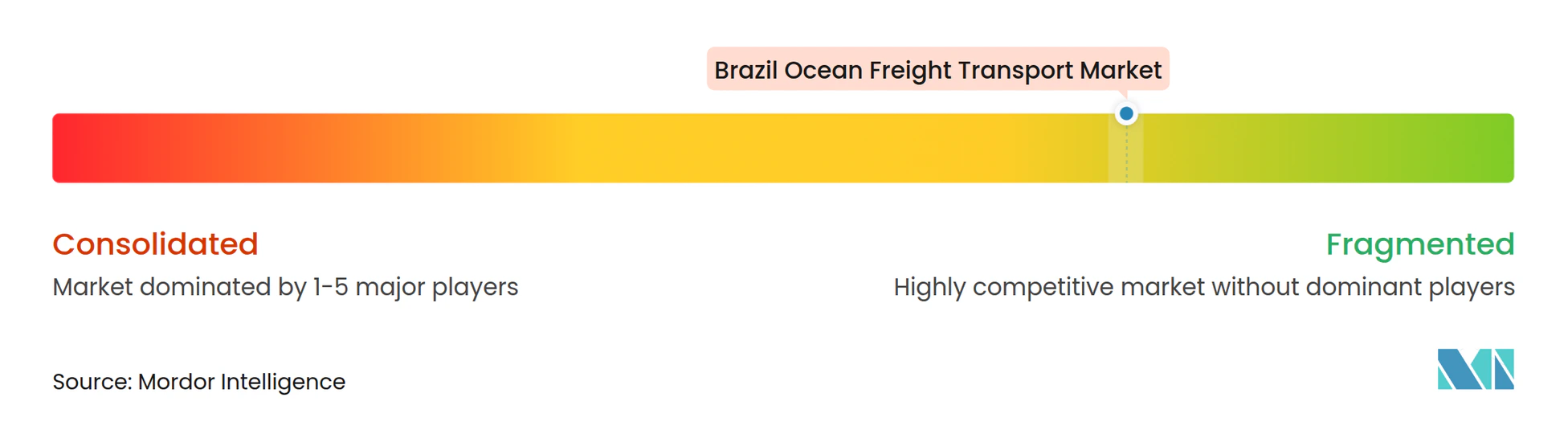
The Brazil ocean freight transport market is fragmented and combines global container carriers with specialized bulk, vehicle, and domestic coastal operators. MSC, A.P. Moller-Maersk, and CMA CGM are important on deep-sea container routes, while the operating environment differs materially for bulk cargo and cabotage. CMA CGM became the majority shareholder of Santos Brasil with a 51% stake in September 2025, linking a global carrier more closely to South America’s largest container-terminal operator. The transaction increases the importance of transparent terminal access and competitive service conditions at Santos. ANTAQ’s approach to the Tecon Santos 10 concession will influence whether future capacity broadens the field of terminal operators.
Operators are responding through longer-term terminal partnerships and route additions. DP World and A.P. Moller-Maersk signed an 8-year agreement in March 2025 that introduced 6 services and 8 weekly calls, with plans for 7 services and 10 weekly calls in 2026 after terminal expansion. DP World and Hapag-Lloyd also renewed their Santos terminal agreement for 10 years in September 2025, tied to a quay expansion to 1,290 meters[4]. ZIM launched its Falcon Service in 2026 with weekly calls linking Chinese ports to Rio de Janeiro, Santos, Paranaguá, and Itajaí, including reefer capability. These moves show that reliable terminal access and differentiated services are becoming as important as fleet scale.
Competitive opportunities remain in validated pharmaceutical logistics, reefer equipment positioning, northern feeder networks, and schedule-management systems. ANVISA’s distribution standards favor operators that can provide documented cold-chain control and monitoring. Norcoast expanded its regular cabotage route to Rio de Janeiro in July 2026, adding another connection at Rio Brasil Terminal. COSCO SHIPPING also announced a third weekly Far East to East Coast South America service, with feeder coverage for Salvador and Vitória in Brazil.
Brazil Ocean Freight Transport Industry Leaders
-
A.P. Moller - Maersk AS
-
Mediterranean Shipping Company
-
CMA CGM SA
-
Log-In Logística Intermodal SA
-
Norsul Navegação SA
- *Disclaimer: Major Players sorted in no particular order
Brazil Ocean Freight Transport Market Companies Covered in this Report
- Mediterranean Shipping Company SA
- A.P. Moller - Maersk AS
- CMA CGM SA
- COSCO SHIPPING Lines Co. Ltd
- Hapag-Lloyd AG
- Petrobras Transporte SA (Transpetro)
- Ocean Network Express
- Norsul
- Evergreen Marine Corp.
- HMM Co. Ltd
- ZIM Integrated Shipping Services
- Yang Ming Marine Transport Corp.
- Pacific International Lines
- Empresa de Navegação Elcano SA
- Grimaldi Group
- Flumar Transportes de Químicos e Gases
- Wallenius Wilhelmsen
- Höegh Autoliners
- Mitsui O.S.K. Lines
- NYK Line
- BBC Chartering
- Posidonia Shipping & Trading
Recent Industry Developments in Brazil Ocean Freight Transport Market
- October 2026: COSCO SHIPPING announced the ESA3 service, its third weekly Far East to East Coast South America connection, with feeder services to Salvador and Vitória.
- July 2026: ZIM Integrated Shipping Services launched the ZIM Falcon Service with weekly calls between China and Rio de Janeiro, Santos, Paranaguá, and Itajaí.
- April 2026: DP World launched the Brazil–Africa Link, an integrated logistics corridor connecting Brazilian exports through the Port of Santos with its operations in Angola and Mozambique, supported by its wider network in South Africa.
- September 2025: CMA CGM became the majority shareholder of Santos Brasil with a 51% stake, strengthening its position in Brazilian terminal operations.
Brazil Ocean Freight Transport Market Report Scope
Segmentation Overview
| Containerized Cargo | Dry |
| Reefer | |
| Non-Containerized Cargo | Dry Bulk Cargo |
| Liquid Bulk Cargo | |
| Breakbulk and General Cargo |
| Electronics and Semiconductors |
| Chemicals and Petrochemicals |
| Food and Beverage |
| Pharmaceuticals and Healthcare |
| Retail and E-commerce |
| Others |
| North |
| Northeast |
| Central-west |
| Southeast |
| South |
| By Cargo Type | Containerized Cargo | Dry |
| Reefer | ||
| Non-Containerized Cargo | Dry Bulk Cargo | |
| Liquid Bulk Cargo | ||
| Breakbulk and General Cargo | ||
| By End-User Industry | Electronics and Semiconductors | |
| Chemicals and Petrochemicals | ||
| Food and Beverage | ||
| Pharmaceuticals and Healthcare | ||
| Retail and E-commerce | ||
| Others | ||
| By Region | North | |
| Northeast | ||
| Central-west | ||
| Southeast | ||
| South | ||
Key Questions Answered in the Report
What is the projected value of Brazil ocean freight transport by 2032?
The sector is projected to reach USD 25.05 billion by 2032, rising from USD 19.26 billion in 2027 at a 5.40% CAGR.
Which cargo type currently generates the largest revenue?
Non-containerized cargo leads with 70.34% of revenue in 2026 because Brazil exports large volumes of bulk commodities and liquid cargo.
Which cargo type is expected to grow the fastest?
Containerized cargo is projected to register at a 7.12% CAGR through 2032, supported by processed goods, reefer demand, and coastal feeder services.
Which end-user group has the strongest growth outlook?
Pharmaceuticals and health care are expected to register at a 7.98% CAGR through 2032 as ANVISA requirements raise demand for qualified cold-chain transport.
Why is the North becoming more important for Brazilian ocean freight?
The Arco Norte handled 39.5% of Brazil’s combined soybean and corn exports in 2025, and its ports are expanding to serve Center-West agricultural output.
What are the main constraints on maritime freight growth in Brazil?
Inland road congestion, reefer shortages, volatile shipping rates, and inconsistent sailing schedules can raise costs and limit dependable cargo movement.