
Brazil Less-than Truckload (LTL) Market Size and Share
Market Overview
| Study Period | 2021 - 2032 |
|---|---|
| Forecast Data Period | 2027 - 2032 |
| Base Year Market Size (2026) | USD 10.49 Billion |
| Market Size (2027) | USD 11.06 Billion |
| Market Size (2032) | USD 14.24 Billion |
| Growth Rate (2027 - 2032) | 5.20 % |
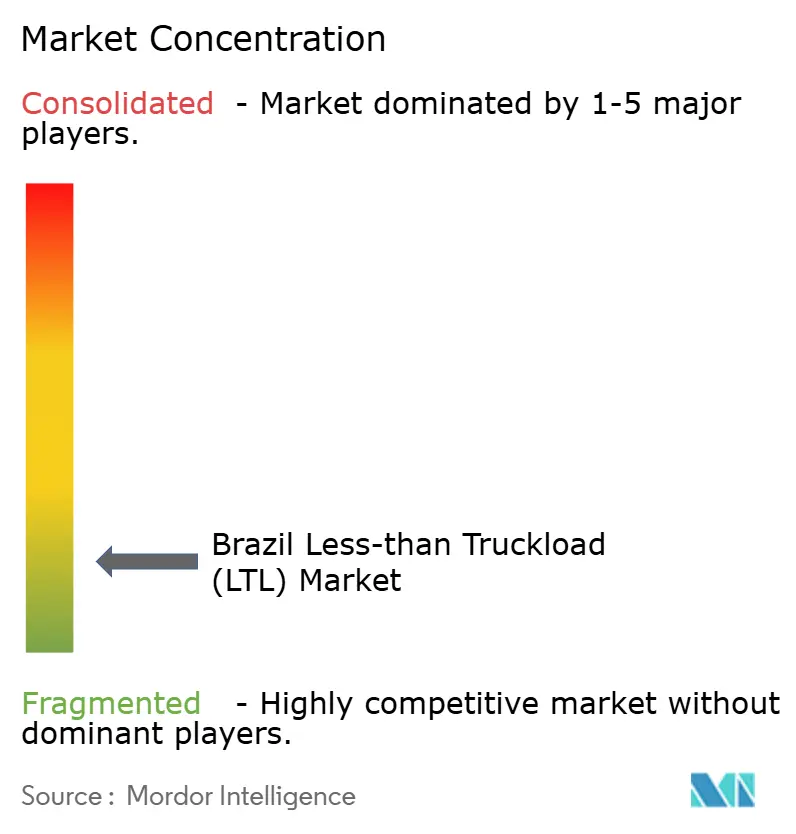
| Market Concentration | Low |
Major Players *Disclaimer: Major Players sorted in no particular order Image © Mordor Intelligence. Reuse requires attribution under CC BY 4.0. | |
Brazil Less-than Truckload (LTL) Market Analysis by Mordor Intelligence
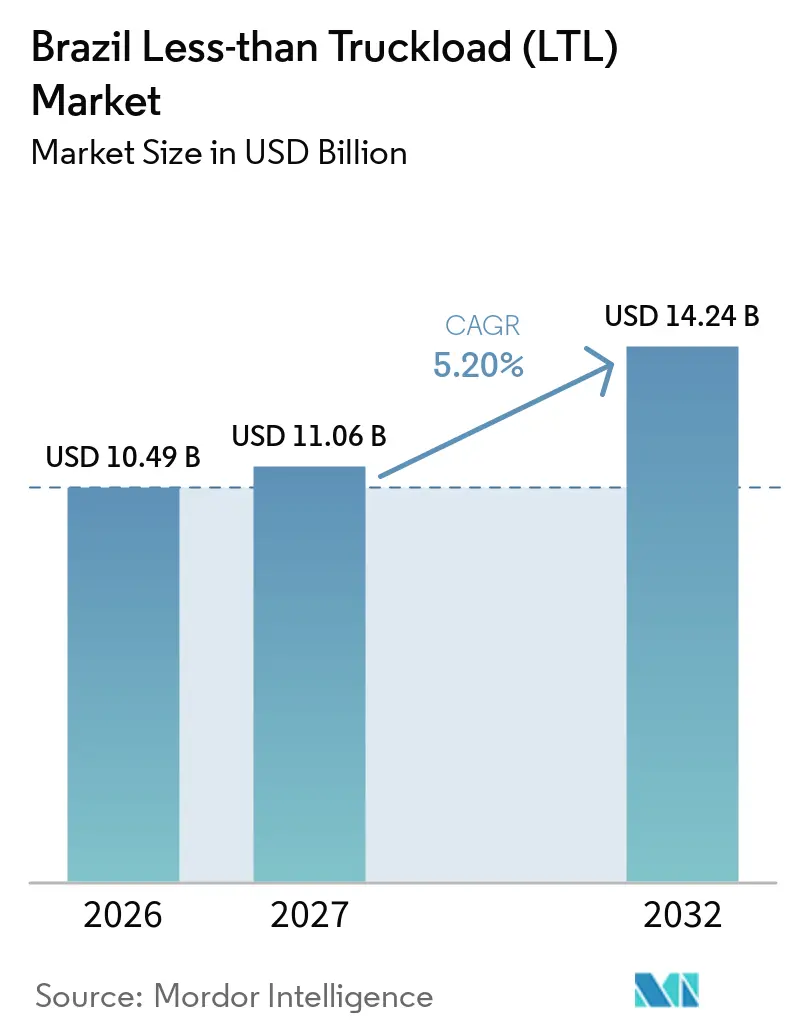
The Brazil less-than truckload (LTL) market size is valued at USD 10.49 billion in 2026 and is estimated to grow from USD 11.06 billion in 2027 to USD 14.24 billion by 2032, at a CAGR of 5.20% during the forecast period from 2027 to 2032.
The Brazil less-than truckload (LTL) market is shaped by a shift toward smaller, more frequent shipments as online retail, multi-site manufacturing, and temperature-controlled distribution change freight requirements. Road transport remains central to national distribution, which keeps carriers important for connecting production sites, distribution centers, and customers across routes that are not well served by rail or inland waterways, and makes terminal networks central to service coverage. The Brazil less-than-truckload market also benefits when manufacturers widen their operating footprint beyond the traditional São Paulo corridor, because suppliers and distributors need cost-effective transport for sub-truckload loads and regular connections between regional locations.
Key Report Takeaways
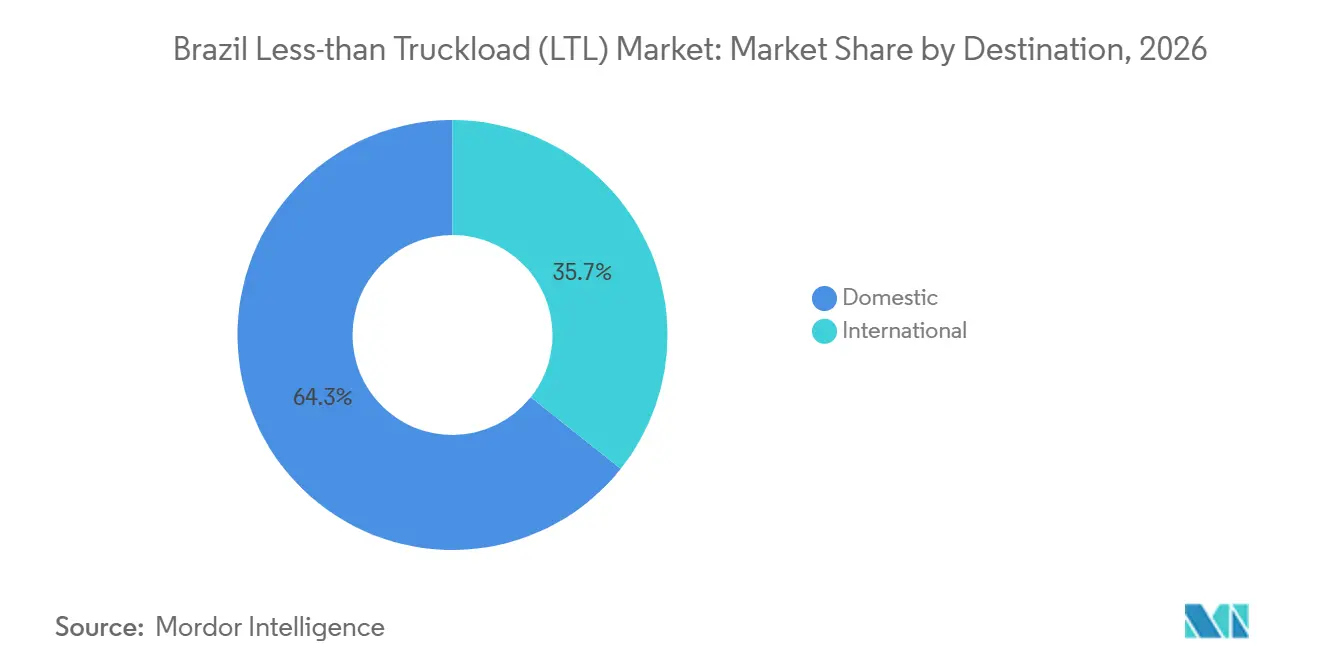
- By destination, domestic LTL accounts for 64.31% of the Brazil less-than truckload (LTL) market share in 2026, while international LTL is projected to register a 6.87% CAGR through 2032.
- By truckload, dry accounts for 91.47% of the Brazil less-than truckload (LTL) market share in 2026, while reefer LTL is projected to register a 7.38% CAGR through 2032.
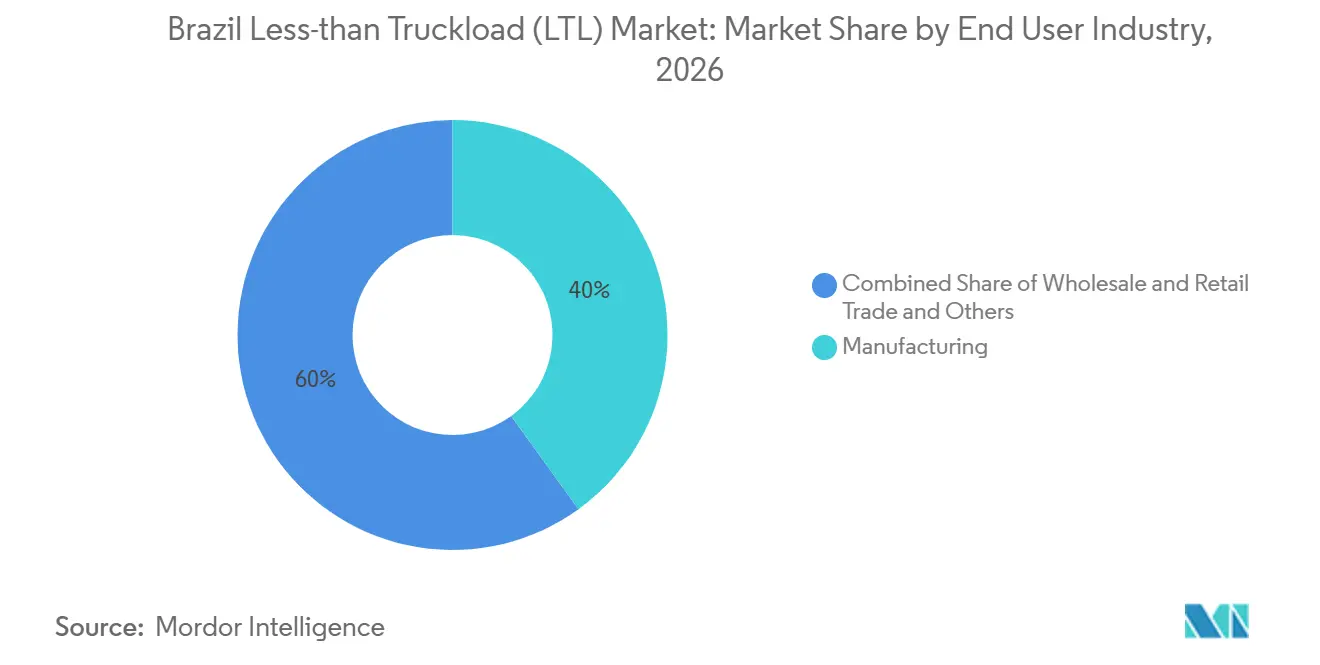
- By end-user industry, manufacturing accounts for 40.03% of the Brazil less-than truckload (LTL) market share in 2026, while wholesale and retail trade is projected to register an 8.24% CAGR through 2032.
- By geography, the Southeast accounts for 51.24% of the Brazil less-than truckload (LTL) market size in 2026, while the Northeast is projected to register a 7.34% CAGR through 2032.
Note: Market numbers in this report are based on Mordor Intelligence's proprietary estimation framework, which combines nine months of actuals with Q4 projections for base year 2026.
Market Trends and Insights
Drivers Impact Analysis of Brazil Less-than Truckload (LTL) Market*
| Driver | (~) % Impact on CAGR Forecast | Geographic Relevance | Impact Timeline |
|---|---|---|---|
| E-Commerce Growth Increasing Fragmented Shipment Volumes | +2.0% | National, concentrated in Southeast and South, accelerating in interior cities of Minas Gerais, Paraná, and Rio Grande do Norte. | Short term (≤ 2 years) |
| Manufacturing Diversification Expanding Multi-Site Distribution Demand | +1.2% | Southeast, South, and emerging poles in Goiás and Pará | Medium term (2-4 years) |
| Highway Investment Improving Middle-Mile Freight Reliability | +0.8% | National, with near-term gains on BR-163 and Mercosur corridors | Medium term (2-4 years) |
| Temperature-Sensitive Distribution Expanding Specialized LTL Demand | +0.6% | National, with the Southeast leading cold storage capacity and the Northeast and Central-West growing faster | Medium term (2-4 years) |
| Digital Consolidation Improving Fixed-Route Load Density | +0.4% | National, with early gains in São Paulo, Curitiba, and Ribeirão Preto | Short term (≤ 2 years) |
| Reverse Logistics Growth Increasing Return Shipment Volumes | +0.3% | National, with the Southeast and South leading volumes and the Northeast accelerating | Short term (≤ 2 years) |
| Source: Mordor Intelligence | |||
E-Commerce Growth Increasing Fragmented Shipment Volumes
Brazil’s growing e-commerce sector is reshaping less-than-truckload freight demand by increasing the need to consolidate smaller shipments from a wider range of origins. The geographic spread of small and medium-sized merchants creates more varied freight flows beyond established shipping hubs, making collection flexibility and network reach increasingly important. Carriers that can combine low-volume consignments, maintain regular pickup schedules, and provide reliable deliveries across emerging routes are better positioned to serve this demand.
Manufacturing Diversification Expanding Multi-Site Distribution Demand
Industrial activity is becoming more geographically distributed, which expands the need for shipments between plants, suppliers, and regional distributors and gives carriers more origin-destination combinations to manage. Brazil’s industrial production increased 0.6% in 2025, its third consecutive year of growth, while Espírito Santo, Rio de Janeiro, Santa Catarina, and Goiás recorded some of the strongest gains, showing that activity is not confined to the traditional São Paulo corridor[1]. Mining companies plan USD 10.9 billion in logistics investments between 2025 and 2029, supporting freight flows to facilities outside the main industrial corridors and increasing the need for supporting supplies. Manufacturing sites in multiple states need regular shipments of inputs and finished products that do not fill an entire truck, while distributors need replenishment at locations closer to regional demand.
Highway Investment Improving Middle-Mile Freight Reliability
Highway investment can improve transit reliability on routes used for fixed-schedule freight services, where missed arrival times can disrupt connections at terminals and customer delivery windows. ANTT’s BR-163/MS concession provides for BRL 9.9 billion (USD 1.79 billion) in investment, 203 km of road duplication, and 4G LTE coverage across 847 km, combining physical capacity improvements with better communications. The concession supports real-time cargo tracking on a corridor that serves agribusiness and Mercosur freight, enabling operators to monitor vehicles and communicate status changes more consistently. ANTT also renegotiated the BR-163/MT-PA corridor to prioritize capacity additions where traffic has exceeded projections. Better pavement and connectivity can reduce vehicle wear, limit operational disruption, and make scheduled transit commitments more credible to shippers. These improvements can expand the routes on which the Brazil less-than truckload (LTL) market can offer dependable service to manufacturing and pharmaceutical customers.
Temperature-Sensitive Distribution Expanding Specialized LTL Demand
Temperature-controlled freight is a specialized part of the Brazil less-than truckload (LTL) market because food, pharmaceutical, and export flows require controlled handling from collection through delivery. Refrigeration equipment is fitted to 4% of Brazil’s truck fleet, compared with 20% in Europe, which limits available capacity outside major freight centers and makes equipment availability a practical constraint for shippers. Brazil’s cold-storage capacity reached 18.3 million m³ across 271 units in 2025, indicating an expanding base for cargo that must remain under controlled conditions. Reefer container throughput at the Port of Paranaguá reached 69,290 units in the first half of 2025, with beef shipments rising 48% from the prior-year period, illustrating the scale of temperature-sensitive export flows. ANVISA’s phased traceability rules add pressure for certified handling of pharmaceutical and perishable cargo. This creates an advantage for carriers that build reefer capacity, monitoring processes, and trained handling capability before compliance requirements become more widely enforced.
Restraints Impact Analysis of Brazil Less-than Truckload (LTL) Market*
| Restraint | (~) % Impact on CAGR Forecast | Geographic Relevance | Impact Timeline |
|---|---|---|---|
| Diesel Volatility Increasing Transport Cost Pressure | -1.8% | National, with the strongest exposure on non-concessioned routes with limited cost pass-through | Short term (≤ 2 years) |
| Road Quality Gaps Reducing Network Reliability | -1.0% | National, most acute in the North and Northeast | Long term (≥ 4 years) |
| Cargo Theft Increasing Insurance and Security Costs | -0.7% | Southeast, with North-region financial losses rising | Medium term (2-4 years) |
| Backhaul Imbalances Weakening Low-Density Lane Economics | -0.4% | Most pronounced on North- and Northeast-bound lanes | Medium term (2-4 years) |
| Source: Mordor Intelligence | |||
Diesel Volatility Increasing Transport Cost Pressure
Fuel price changes remain a direct pressure on carrier margins because diesel represents a large share of transport costs and is used on every collection, line-haul, and final delivery movement. Petrobras increased diesel prices by BRL 0.22 (USD 0.04) per liter in February 2025, which led ANTT to adjust minimum freight floors by 2.13% to 2.99% depending on service type. A further ANTT update in July 2025 changed the floors by 0.82% to 3.55% based on inflation and diesel prices. Regulated freight floors provide a minimum, but contract rates can take weeks to reflect current fuel costs, leaving a timing gap between expense changes and revenue adjustments. Carriers with fixed contracts and no fuel-adjustment clauses face the greatest exposure because they have fewer immediate ways to recover added cost. The Brazil less-than-truckload (LTL) industry also has limited room to absorb these changes when price competition is strong on established lanes, and customers can compare services across several carriers.
Road Quality Gaps Reducing Network Reliability
Poor road conditions add cost and reduce the predictability that scheduled LTL services require, since delays can affect terminal cutoffs and downstream delivery sequences. The CNT’s 2025 survey found that 62.1% of 114,197 km of paved roads were rated regular, poor, or very poor, leaving many carriers to operate through routes with persistent physical constraints[2]. On public highways, pavement defects were recorded on 64.4% of surveyed segments, and the operating-cost increase relative to optimal roads reached 35.8%. The same survey estimated annual diesel waste at 1.2 billion liters, equivalent to BRL 7.2 billion (USD 1.30 billion) in added fuel costs, which demonstrates that the effect extends beyond isolated maintenance events.
*Our forecasts treat driver/restraint impacts as directional, not additive. The impact forecasts reflect baseline growth, mix effects, and variable interactions.
Brazil Less-than Truckload (LTL) Market Segment Analysis
By Destination:
International Lanes Gain Share as the Domestic Base MaturesDomestic LTL accounts for 64.31% of the Brazil less-than truckload (LTL) market share in 2026, making it the operating base for major national carriers. Domestic demand is tied to regular flows between production sites, distribution centers, and customer markets. São Paulo’s consumption base and established carrier networks support much of that volume. New intra-domestic lanes are also forming in the North and Central-West as mining, agribusiness processing, and infrastructure projects extend freight activity beyond the older network perimeter. These repeat movements support the Brazil less-than truckload (LTL) market size for domestic service because consignments often require consolidation rather than dedicated trucks.
International LTL is projected to register at a 6.87% CAGR through 2032 as Mercosur trade lanes require more border-gateway consolidation. Uruguaiana and Foz do Iguaçu are important gateways for cross-border cargo, where carriers coordinate documentation, local handling, and onward transport. BBM Logística has stated that it plans a Paraguay subsidiary for 2027 as part of its Mercosur expansion. Smaller shipment sizes can lower revenue per consignment, which increases the value of automated sorting, accurate documentation, and high-fill consolidation. Carriers that develop lane density before demand matures can improve asset use and customer service on cross-border routes. The Brazil less-than truckload (LTL) market also depends on carriers being able to integrate border movements into domestic networks rather than operating those lanes as isolated services.

By Temperature Control:
Dry Freight Leads While Reefer Services ExpandDry freight accounts for 91.47% of the Brazil less-than truckload (LTL) market share in 2026 and remains the main transport mode for manufacturing inputs, consumer goods, and general merchandise. Its large base reflects the broad range of cargo that does not require controlled temperatures or specialized equipment, allowing carriers to combine different consignments on regular routes. National carriers rely on dry freight to maintain fixed routes and high stop density, since these services create the volume base for sorting, line-haul operations, and local delivery coverage. Dry freight's large share also shows why improvements in sorting, line-haul scheduling, and crossdock coverage remain central to carrier operations. Manufacturing and retail customers continue to provide regular dry-freight volumes across the country, while the variety of cargo requires consistent handling and departure discipline.
Reefer LTL is forecast to register at a 7.38% CAGR through 2032, faster than the overall Brazil less-than-truckload (LTL) market. Demand comes from food safety needs, pharmaceutical cold chains, and perishable exports, each of which requires consistent temperature control through handovers between facilities and vehicles. The small refrigerated share of the truck fleet creates a supply constraint, particularly outside São Paulo, where fleet availability and terminal infrastructure can be less developed. Traceability requirements can shift some ambient flows into certified refrigerated services, strengthening the case for early capacity investment by operators able to meet handling requirements.
By End-User Industry:
Manufacturing Anchors Volume While Retail Changes Shipment PatternsManufacturing accounts for 40.03% of the market in 2026 and provides steady demand for inbound materials and outbound parts distribution. Multi-site production networks rely on recurring sub-truckload movements between plants, suppliers, and distributors. This demand is generally more predictable than shipment flows linked to seasonal consumer orders. The Brazil less-than-truckload (LTL) industry serves manufacturing customers through fixed routes that combine multiple consignments. Activity in agriculture, forestry, construction, oil and gas, mining, and quarrying also produces specialized flows linked to production and investment cycles.
Wholesale and retail trade is projected to register an 8.24% CAGR through 2032 as omnichannel operations require more frequent replenishment. Convenience formats, drugstore chains, and specialty retailers need smaller deliveries on time-sensitive schedules, often to locations with limited receiving capacity. These shipments reward reliable transit and freight-rating systems that can reflect service requirements, delivery timing, and the cost of managing multiple stops. E-commerce and retail led new warehouse-space demand in 2025, with Mercado Livre and Shopee among the largest occupancy transactions. Each distribution-site activation can create inbound replenishment flows that support LTL demand and can shift traffic toward regional crossdocks. The Brazil less-than truckload (LTL) market therefore benefits when retailers expand regional inventory networks and need regular connections between fulfillment sites, stores, and local delivery partners.
Geography Analysis
The Southeast accounts for 51.24% of the market in 2026, making it the largest regional base in the Brazil less-than-truckload (LTL) market. São Paulo, Rio de Janeiro, Minas Gerais, and Espírito Santo have dense industrial activity, crossdock networks, and broad next-day delivery coverage, which support regular services with shorter terminal-to-customer distances. São Paulo accounted for 50% of the 3 million m² of industrial-park inventory delivered nationally in 2025. The South is another high-density region, supported by automotive production, agribusiness processing, and consumer-goods manufacturing, and it gives national carriers an important connection between domestic markets and Mercosur trade routes.
The Northeast is projected to register a 7.34% CAGR through 2032, the highest rate among the regional segments in the Brazil less-than-truckload (LTL) market. Reefer activity is growing around fruit exports, with the Port of Pecém projecting 200 refrigerated containers per week during the 2025-26 season. The North has historically been less served by paved-road networks and therefore faces longer and less predictable overland journeys on some routes. Braspress launched air cargo service on the Campinas-Manaus route in 2025, reducing transit times for high-value cargo from more than 15 days to under 48 hours[3].
The Central-West is a major agricultural freight origin, though bulk grain movements are more commonly handled through full truckload or rail services. Soy processing, meat packing, and sugar-ethanol operations create growing demand for inbound sub-truckload supplies. BR-163 investment programs can improve transit times on a corridor that carries more than 20% of Brazil’s agricultural exports. Connectivity requirements on the BR-163/MS concession can also improve shipment visibility. South-to-North cargo imbalances remain a constraint because return loads are not consistently available. Digital load-sharing platforms seek to improve the use of empty-return capacity on these routes.
Competitive Landscape
The Brazil less-than truckload (LTL) market is fragmented, with Braspress, Grupo Rodonaves, Jamef, Patrus Transportes, BBM Logística, and Geopost/Jadlog operating across much of the country. These carriers compete with regional operators that serve specific corridors through aggregation or franchise models, so a national footprint does not remove the importance of local route knowledge. Technology has become more important because e-commerce and retail accounts value visibility, sorting speed, and reliable delivery performance when selecting freight partners. Jadlog opened the Nexus 87 hub in São Paulo in May 2026 with a BRL 200 million (USD 36.13 million) investment and a Fives GENI-Belt sorter that processes up to 16,500 packages per hour[4]. The facility doubled processing capacity and reduced delivery times by up to 1 day on selected routes, demonstrating how terminal automation can strengthen service consistency in the Brazil less-than-truckload (LTL) market.
Competition is strongest where carriers can combine broad networks with specialized capabilities and adapt operations to a shipper’s required delivery pattern. Refrigerated LTL for pharmaceutical and fresh-food cargo is less developed in the North and Northeast, where capacity gaps remain and where equipment availability can constrain service design. Secondary city pairs can also provide room for digitally brokered services when established hubs lack load density or regular collection patterns. Jadlog’s partnership with SHEIN and Loggi’s pickup-and-drop-off network show the importance of reverse-logistics density. Loggi expanded its network from 1,000 to 1,700 pickup-and-drop-off points across 18 states by January 2026. These investments make returns easier to consolidate, which can support more regular backhaul volumes and reduce the operational mismatch between outbound and return freight.
BBM Logística launched its 2026-2028 plan after restructuring its operations and targets 20% annual revenue growth from Paraná, with a Paraguay subsidiary planned for 2027. Grupo Rodonaves opened a 7,000 m² hub in Farroupilha in May 2026 to improve connections across the Serra Gaúcha. Patrus added terminals in Paraná and invested in an urban distribution fleet that includes electric vehicles. The ANTT freight-floor mechanism also limits deep discounting on commodity lanes, which can help prevent price-based competition from setting service levels below sustainable operating costs. Carriers that combine network investment with equipment, digital systems, and specialized services are better placed to win business from operators competing only on price, especially where shippers require traceability, consistent handovers, and reliable information during transit. Their decisions on terminal coverage, equipment allocation, and service standards will remain important because each choice affects whether a carrier can retain volume as freight patterns change across regions.
Brazil Less-than Truckload (LTL) Industry Leaders
-
Braspress Transportes Urgentes
-
Grupo Rodonaves
-
Jamef Transportes
-
Geopost
-
BBM Logística SA (including Translovato)
- *Disclaimer: Major Players sorted in no particular order
Brazil Less-than Truckload (LTL) Market Companies Covered in this Report
- Braspress Transportes Urgentes
- Grupo Rodonaves
- Jamef Transportes
- BBM Logística SA (including Translovato)
- Expresso São Miguel
- Patrus Transportes
- Geopost (including Jadlog)
- Correios
- Total Express
- Expresso Princesa dos Campos
- TW Transportes
- Sequoia Logística e Transportes SA (including Transportadora Americana)
- Loggi
- Transportes Bertolini
- Transzilli Expresso e Logística
- Transportadora Minuano
- Aceville Transportes
- Ociani Transportadora
- Cargojet Logística
- Atual Logística
- DHL Group
- Kuehne+Nagel
Recent Industry Developments in Brazil Less-than Truckload (LTL) Market
- May 2026: Jadlog inaugurated its Nexus 87 logistics hub in the Perus district of São Paulo with an investment of BRL 200 million (USD 36.13 million), the largest in the company’s 20-year history. The 20,000 m² facility features a 310-meter Fives GENI-Belt automated sorter processing up to 16,500 packages per hour, doubling operational processing capacity and reducing delivery times by up to 1 day to Rio de Janeiro, Belo Horizonte, Curitiba, and Porto Alegre.
- May 2026: ANTT formalized the BR-163/MS concession modernization under Motiva Pantanal, confirming BRL 9.31 billion (USD 1.68 billion) in capital expenditure over 29 years, including 203 km of duplication, 150 km of additional lanes, and full 4G LTE coverage across 847 km.
- March 2026: BBM Logística launched its 2026-2028 strategic plan, targeting 20% annual revenue growth from Paraná and planning a Paraguay subsidiary for 2027.
- April 2025: Loggi invested BRL 28 million (USD 5.06 million) to add 1,200 LoggiPonto pickup-and-drop-off locations, with a BRL 102 million (USD 18.42 million) Finep credit facility supporting AI-powered route optimization.
Brazil Less-than Truckload (LTL) Market Report Scope
Segmentation Overview
| Domestic |
| International |
| Dry |
| Reefer |
| Agriculture, Fishing, and Forestry |
| Construction |
| Manufacturing |
| Oil and Gas, Mining and Quarrying |
| Wholesale and Retail Trade |
| Others |
| North |
| Northeast |
| Central-west |
| Southeast |
| South |
| By Destination | Domestic |
| International | |
| By Temperature Control | Dry |
| Reefer | |
| By End-User Industry | Agriculture, Fishing, and Forestry |
| Construction | |
| Manufacturing | |
| Oil and Gas, Mining and Quarrying | |
| Wholesale and Retail Trade | |
| Others | |
| By Region | North |
| Northeast | |
| Central-west | |
| Southeast | |
| South |
Key Questions Answered in the Report
What is the forecast growth rate for Brazil’s less-than-truckload sector?
The sector is forecast to register at a 5.20% CAGR from 2027 to 2032, rising from USD 11.06 billion in 2027 to USD 14.24 billion by 2032.
Which destination segment is larger in Brazil’s LTL freight business?
Domestic LTL is larger, holding 64.31% of the market in 2026. International LTL is expected to grow at a 6.87% CAGR through 2032.
Why is reefer LTL growing faster than dry freight in Brazil?
Reefer LTL is forecast to register at 7.38% CAGR because food, pharmaceutical, and perishable cargo need controlled handling and certified transport.
Which end-user segment creates the most LTL freight volume in Brazil?
Manufacturing held 40.03% of the market in 2026, supported by recurring movements of materials and parts across multi-site production networks.
Which Brazilian region has the highest LTL freight demand?
The Southeast held 51.24% of the market in 2026 due to its concentration of industrial activity, consumption, and crossdock networks.
What factors limit carrier profitability in Brazil?
Diesel-price changes, road conditions, cargo theft, and weak return-load availability can increase costs and reduce service reliability.