
Brazil Less-than Container Load Market Size and Share
Market Overview
| Study Period | 2021 - 2032 |
|---|---|
| Forecast Data Period | 2027 - 2032 |
| Base Year Market Size (2026) | USD 3.46 Billion |
| Market Size (2027) | USD 3.65 Billion |
| Market Size (2032) | USD 4.77 Billion |
| Growth Rate (2027 - 2032) | 5.50 % |
| Market Concentration | Low |
Major Players *Disclaimer: Major Players sorted in no particular order Image © Mordor Intelligence. Reuse requires attribution under CC BY 4.0. | |
Brazil Less-than Container Load Market Analysis by Mordor Intelligence
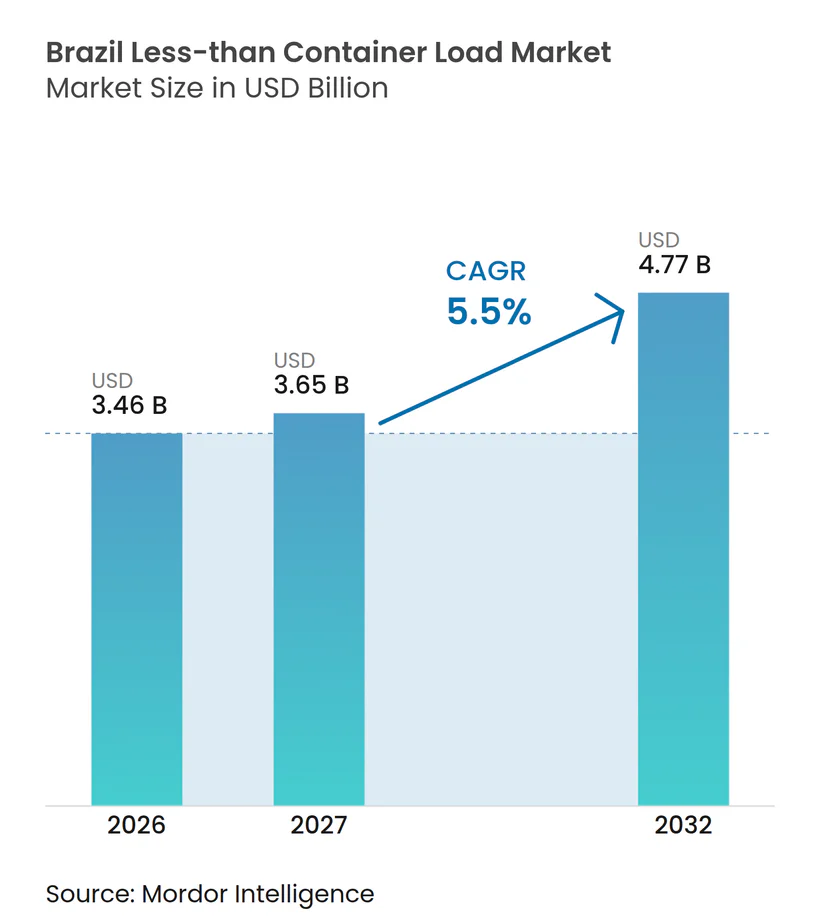
The Brazil less-than container load market size is valued at USD 3.46 billion in 2026 and is estimated to grow from USD 3.65 billion in 2027 to reach USD 4.77 billion by 2032, at a CAGR of 5.50% during the forecast period (2027-2032).
Growth reflects changes in Brazil's foreign trade and the rising use of smaller replenishment orders by importers. Consolidated shipments remain important because small and medium-sized firms can move cargo without committing to a full container. Port investment at Santos and new gateway capacity in the Northeast are widening the range of locations available to consolidators. Digital booking, rate management, and shipment visibility are becoming more important competitive tools for the Brazil less-than container load market. Customs documentation, port congestion, and repeated cargo handling continue to add cost and uncertainty for operators and their customers.
Key Report Takeaways
- By service type, consolidation services account for 56.78% of the Brazil less-than container load market size in 2026, while de-consolidation and distribution is projected to record the highest CAGR at 7.25% through 2032.
- By destination, international LCL accounts for 78.54% of the Brazil less-than container load market share in 2026, while domestic LCL is projected to record the highest CAGR at 6.98% through 2032.
- By nature of business, freight forwarding accounts for 73.12% of the Brazil less-than container load market share in 2026, while NVOCCs are projected to record the highest CAGR at 7.65% through 2032.
- By end user, manufacturing and automotive accounts for 32.47% of the Brazil less-than container load market size in 2026, while healthcare and pharmaceuticals is projected to record the highest CAGR at 7.97% through 2032.
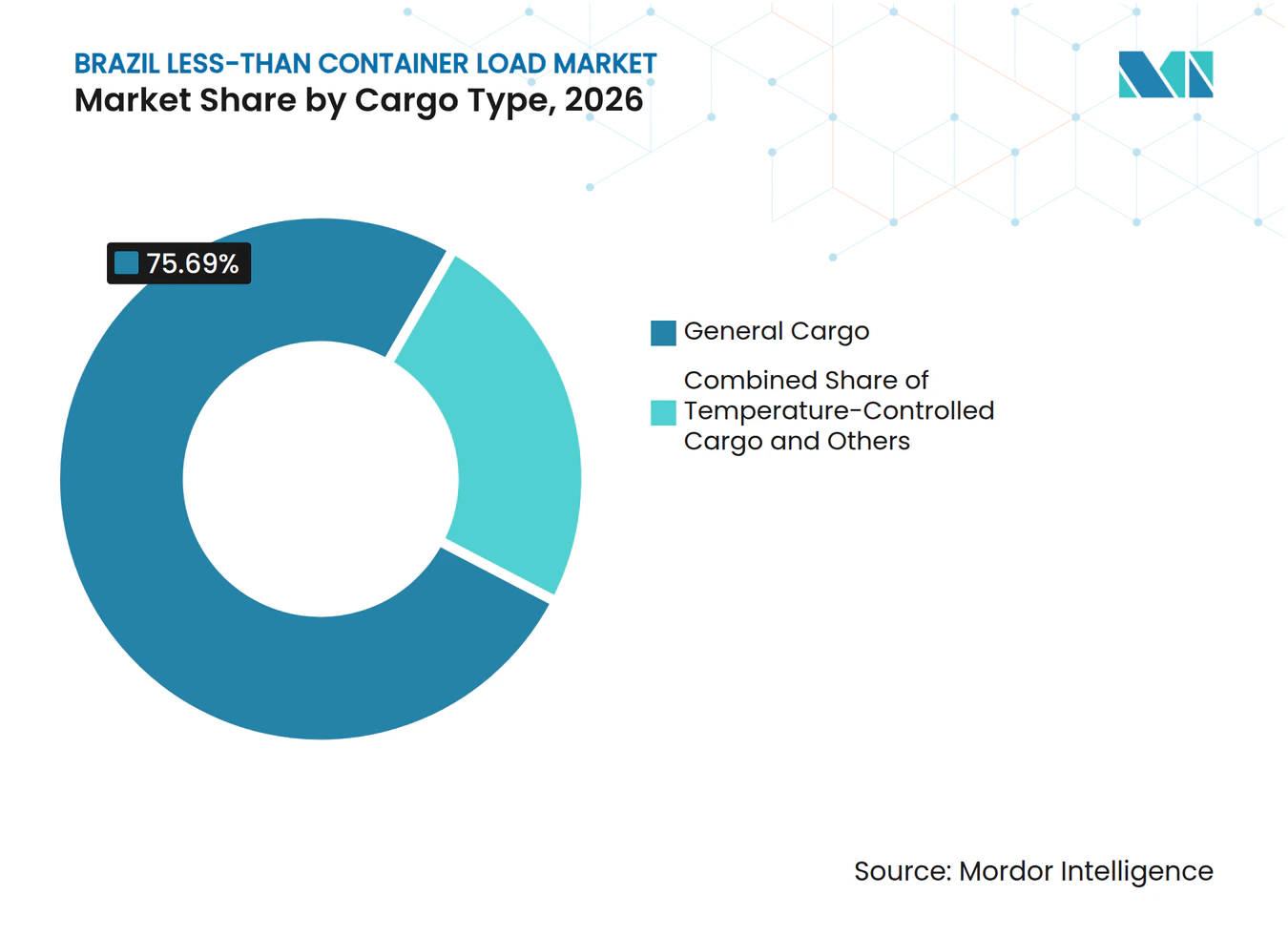
- By cargo type, general cargo accounts for 75.69% of the Brazil less-than container load market size in 2026, while temperature-controlled cargo is projected to record the highest CAGR at 7.54% through 2032.
- By region, Southeast accounts for 42.37% of the Brazil less-than container load market share in 2026, while North is projected to record the highest CAGR at 8.32% through 2032.
Note: Market numbers in this report are based on Mordor Intelligence's proprietary estimation framework, which combines nine months of actuals with Q4 projections for base year 2026.
Market Trends and Insights
Drivers Impact Analysis of Brazil Less-than Container Load Market*
| Driver | (~) % Impact on CAGR Forecast | Geographic Relevance | Impact Timeline |
|---|---|---|---|
| E-Commerce Growth Increasing Cross-Border LCL Shipment Demand | +1.5% | National, with early gains in São Paulo, Rio de Janeiro, and the Manaus Free Trade Zone | Short term (≤ 2 years) |
| Smaller Production Batches Increasing Consolidated Freight Requirements | +0.9% | Southeast industrial corridor, with spillover to South and Central-West | Medium term (2-4 years) |
| Port Modernization Expanding Container Consolidation Capacity | +0.8% | Santos, Suape, Itajaí, and Paranaguá | Medium term (2-4 years) |
| Multimodal Integration Strengthening LCL Network Connectivity | +0.7% | Southeast and South, with growing Central-West reach | Medium term (2-4 years) |
| Direct LCL Lanes Improving Port-to-Port Service Options | +0.4% | Northeast, North, and South | Short term (≤ 2 years) |
| Lower Inventory Commitment Increasing LCL Shipping Preference | +0.4% | National | Short term (≤ 2 years) |
| Source: Mordor Intelligence | |||
E-Commerce Growth Increasing Cross-Border LCL Shipment Demand
Commercial e-commerce flows support demand for consolidated import shipments when order cycles exceed direct-to-consumer parcel volumes. Mid-sized platforms often import 2 to 15 CBM per order cycle, which fits the operating range of LCL services. Smaller parcel flows under Remessa Conforme do not create the same demand because they move through a separate channel. Commercial consignments above USD 1,000 must follow customs declaration procedures, which direct qualifying cargo toward commercial clearance processes. This creates recurring demand among importers that need to replenish inventory without filling an entire container. The Brazil less-than container load market therefore benefits from the expansion of commercial online retail, rather than from every cross-border parcel shipment.
Smaller Production Batches Increasing Consolidated Freight Requirements
Brazilian manufacturers are reducing inventory commitments and receiving components in smaller batches. This practice raises the frequency of shipments that are too small for full-container transport. Operators that can combine cargo from multiple customers can make frequent deliveries more workable for importers. The Brazil less-than container load industry consequently depends on warehouse capacity, predictable handling, and reliable inland connections as much as it depends on ocean services. Strong consolidation networks and digital visibility can further reduce transit variability, improve cargo traceability, and help importers manage working capital more effectively.
Port Modernization Expanding Container Consolidation Capacity
Port investment is creating additional capacity for container handling and related consolidation activity. The Port of Santos handled 186.4 million tons in 2025, and the Ministry of Ports and Airports reported plans that would expand container capacity through the Tecon Santos 10 project[1]. DP World approved a BRL 1.6 billion (USD 289.04 million) investment cycle at Santos in December 2025, with a new berth, inspection capacity, reefer towers, quay cranes, and RTGs planned to lift terminal capacity to 2.1 million TEUs by 2028. These assets can improve the physical conditions for container freight stations and consolidated cargo handling. The Port of Santos Authority is also advancing VTMIS, 5G, and Digital Twin initiatives under its Smart Port program. Better port operations can reduce dwell-time risk and give LCL providers a service-quality basis for competition in the Brazil less-than container load market.
Multimodal Integration Strengthening LCL Network Connectivity
Multimodal links extend consolidated cargo beyond Brazil's coastal industrial centers. Importers and exporters increasingly need a service that combines port handling, customs activity, warehousing, and inland delivery. This is particularly relevant for cargo moving between ports and interior destinations in the Central-West. DSV expanded road consolidation services in September 2026, including weekly LTL services from São Paulo to Buenos Aires and Santiago. The development shows how ocean consolidation can connect with overland networks for door-to-door shipments. Such integrated offerings can compete with traditional road freight for cargo between 1 and 8 metric tons. The Brazil less-than container load market has greater reach when operators coordinate the ocean leg with warehouse and inland transport services.
Restraints Impact Analysis of Brazil Less-than Container Load Market*
| Restraint | (~) % Impact on CAGR Forecast | Geographic Relevance | Impact Timeline |
|---|---|---|---|
| Port Congestion Increasing LCL Transit Time Uncertainty | -0.8% | Santos, with secondary effects across Asia-Brazil port pairs | Medium term (2-4 years) |
| Customs Complexity Delaying Consolidated Cargo Clearance | -0.6% | National, with highest intensity at Santos, Itajaí, and Paranaguá | Long term (≥ 4 years) |
| Handling Frequency Increasing Cargo Damage Exposure | -0.4% | National, across all LCL container freight station deconsolidation points | Short term (≤ 2 years) |
| Low Cargo Density Weakening Secondary-Lane Economics | -0.3% | North and Central-West | Long term (≥ 4 years) |
| Source: Mordor Intelligence | |||
Port Congestion Increasing LCL Transit Time Uncertainty
Congestion at Santos affects LCL cargo differently from full-container cargo because one delayed container can hold shipments for several consignees. Operators must then manage longer lead-time estimates and additional inventory buffers for customers. DP World's Santos expansion includes 190 meters of quay and automated gate systems, with works expected to add capacity by mid-2027[2]. New capacity can ease pressure, but the timing of terminal projects and supporting infrastructure remains important. Until capacity is operational, transit variability can increase landed costs for importers with time-sensitive supply chains. This can make full-container shipping more attractive once a customer's volume reaches a viable threshold.
Customs Complexity Delaying Consolidated Cargo Clearance
Consolidated containers require customs documentation for each consignee, which adds administrative work as the number of co-loaders rises. The Brazilian customs environment uses Siscomex processes and Receita Federal requirements that shape how cargo is cleared. The study from the Universidade de Caxias do Sul identified documentation fragmentation as a leading operational concern in Brazilian LCL logistics. Separate filings can delay cargo release even when the physical container reaches the port on time. Importers also incur a compliance burden that does not arise in the same way for a single-consignee full container.
*Our forecasts treat driver/restraint impacts as directional, not additive. The impact forecasts reflect baseline growth, mix effects, and variable interactions.
Brazil Less-than Container Load Market Segment Analysis
By Service Type:
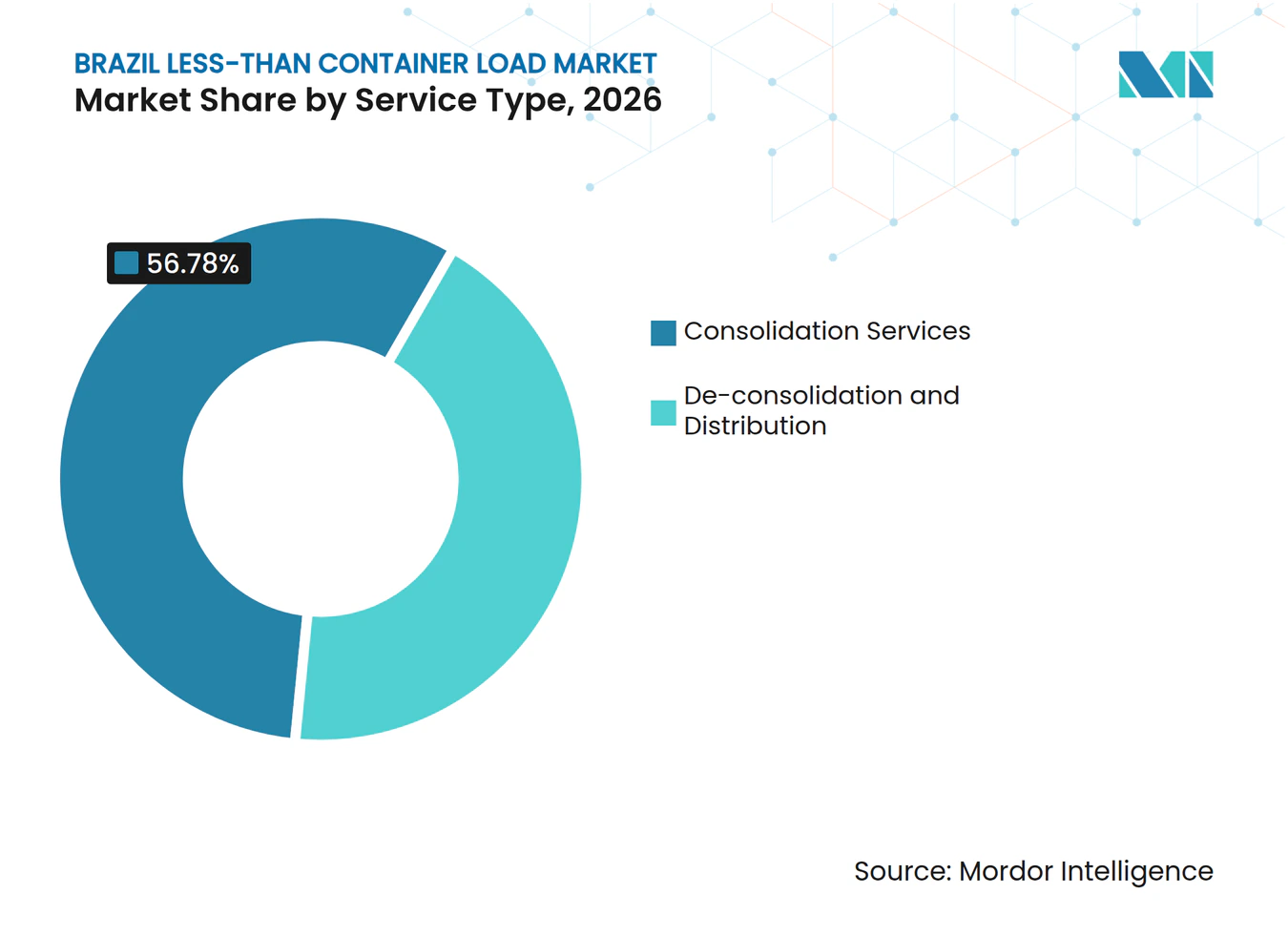
Consolidation Remains the Core ActivityConsolidation services account for 56.78% of the Brazil less-than container load market share in 2026. The share reflects the collect model, where a consolidator gathers cargo at an origin container freight station before ocean departure. This model allows several shippers to share a container and divide transport costs. It remains the central service for cargo that does not justify a full container. Consolidation also gives providers control over booking, loading coordination, and origin documentation. The activity requires dependable warehouse processes because mistakes can affect several consignees in the same box. Origin facilities also need clear cargo identification and cut-off procedures before loading. These routine controls help a consolidator maintain service consistency across frequent smaller shipments.
De-consolidation and distribution is projected to grow at a 7.25% CAGR through 2032. Growth follows the need to separate cargo after clearance and move it toward inland destinations. CEVA Logistics opened an Amazon fulfillment center in Santa Maria in November 2025 that supports up to 135,000 packages a day[3]. CEVA also expanded its Brazilian warehousing footprint to nearly 300,000 m² and planned additional capacity. This type of infrastructure moves de-consolidation closer to population centers and supports distribution after port release. Rhenus opened a Santos branch in January 2026 to support LCL consolidation on Europe-Brazil and Asia-Brazil corridors and inland links to Paraguay, Uruguay, and Argentina. This gives the operator a local point for coordinating port handling with regional transport.



By Destination:
International Lanes Retain the Larger RoleInternational LCL lanes account for 78.54% of the Brazil less-than container load market size in 2026. International activity includes European trade in manufactured goods and specialized industrial inputs. The larger share reflects Brazil's import needs for components, consumer products, and equipment. Global operators can use their overseas consolidation networks to aggregate cargo before it reaches Brazilian ports. This makes international lanes a core part of the service model for large freight forwarders and NVOCCs. The model also depends on scheduled origin consolidation and dependable destination clearance. Delays at either end can affect the value of a shared-container service for all cargo owners.
Domestic LCL is projected to register at a 6.98% CAGR through 2032. The segment benefits from cabotage, intermodal movement, and redistribution from Southeast hubs to the Northeast and North. Domestic movements can create room for local operators and cabotage specialists that know regional delivery networks. Maersk reported that its Brazilian export container volumes more than doubled in the first 8 months of 2026 compared with the same period of 2025. Its port, warehouse, and inland transport offerings show how vertically integrated providers are approaching Brazilian logistics. Shifts in China-Brazil trade flows also place pressure on container freight station capacity around the China-Santos corridor. Secondary gateways such as Suape and Itajaí can become more relevant when congestion or limited slots affect the main gateway. Their role grows when shipping lines, warehouses, and inland carriers can offer a coordinated alternative.
By Nature of Business:
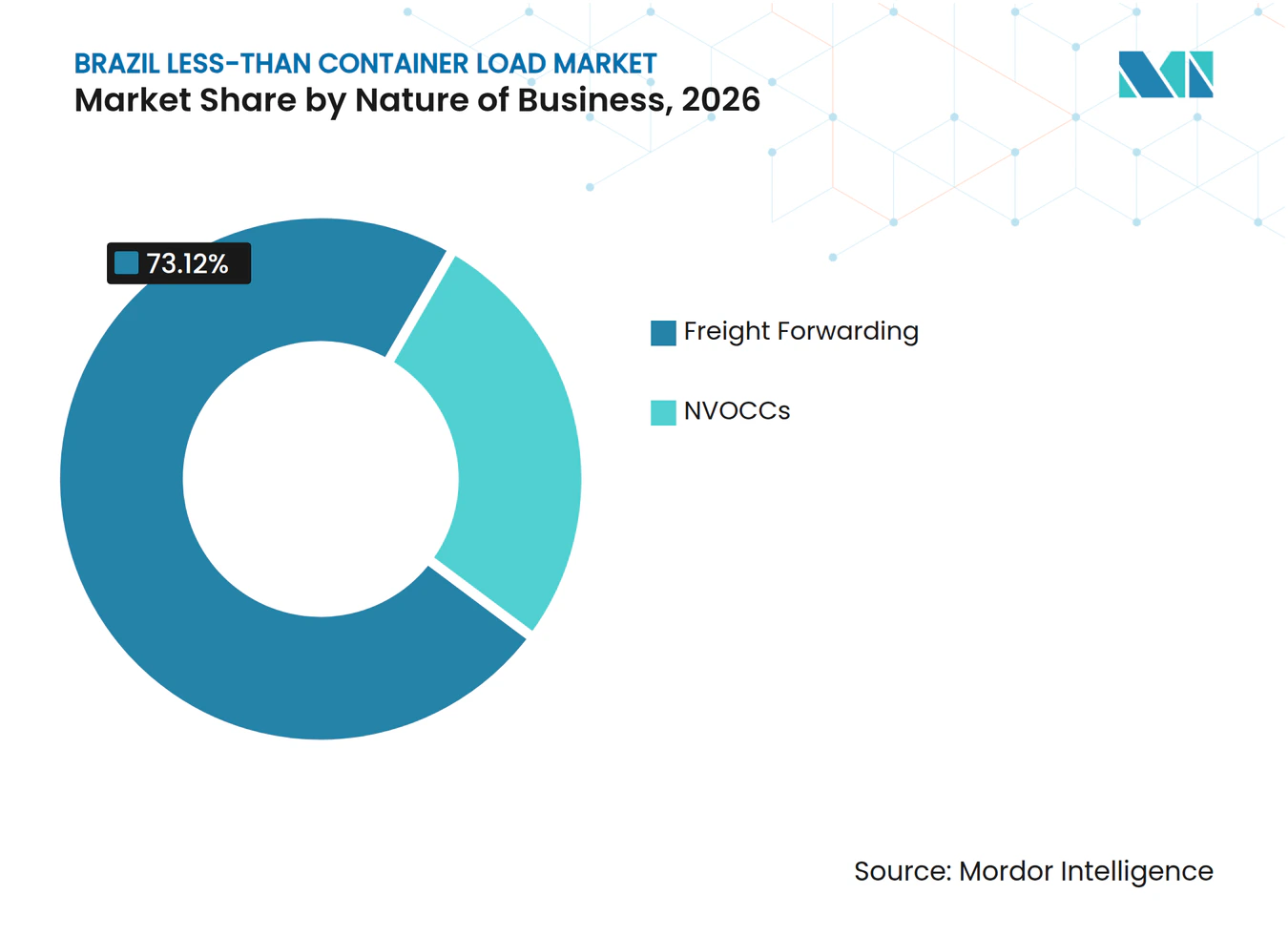
Forwarders Lead and NVOCCs ExpandFreight forwarding accounts for 73.12% of the Brazil less-than container load market share in 2026. Full-service forwarders combine customs support, documentation, inland transport, and shipment coordination. This bundled model is useful for importers that do not want to manage each part of a consolidated shipment separately. Forwarders can also coordinate cargo across several trade lanes and transport modes. Their established customer relationships and local brokerage capabilities reinforce the position of this category. The Brazil less-than container load industry relies on this service depth because customs compliance and inland movement can be as important as the ocean booking. Forwarders can reduce complexity for customers by managing these activities through one operating plan. This remains a practical advantage for firms with limited internal logistics resources.
NVOCCs are projected to register at a 7.65% CAGR through 2032. They can operate container freight stations, issue house bills of lading, manage de-consolidation schedules, and exercise tighter control over rates. Asia Shipping handled 157,838 TEUs in the January-August 2026 import rankings, a 13.8% increase from the prior-year period. Local providers can still compete through trade-lane knowledge, customer relationships, and specialized cargo capability. Their position is strongest where customers need direct access to a specific origin, port, or inland destination.

By End User:
Manufacturing Is the Largest User GroupManufacturing and automotive account for 32.47% of the Brazil less-than container load market share in 2026. The segment imports components, precision tools, and specialty chemicals in volumes that may not fill a container. Manufacturers also use consolidation when they need regular replenishment rather than large inventory purchases. This makes the category a long-standing source of demand for freight forwarders and NVOCCs. The mix of end users limits dependence on a single customer sector. It also requires providers to tailor documentation, packaging, and delivery arrangements to the shipment type.
Healthcare and pharmaceuticals are projected to register a 7.97% CAGR through 2032. ANVISA requirements for temperature control and traceability make handling more complex for pharmaceutical consignments. Healthcare growth raises the standard for temperature records, packaging, and delivery control. Providers must preserve these controls from origin pickup through final handover. This makes healthcare cargo a service category where operating quality is closely tied to commercial growth.
By Cargo Type:
General Cargo Has the Broadest BaseGeneral cargo accounts for 75.69% of the Brazil less-than container load market share in 2026. The category covers manufactured goods, consumer products, industrial materials, and other common import items. Its scale reflects the broad mix of goods entering Brazil in quantities below a full container. Providers can build regular consolidations around these recurring cargo flows. General cargo also gives operators a base load that can support fixed schedules on major lanes. The category remains important even as specialized services grow faster. Its volume base helps consolidators plan container loads and maintain regular departures. It also gives customers a familiar option for standard goods that do not require controlled transport.
Temperature-controlled cargo is projected to register a 7.54% CAGR through 2032. The category serves products that need controlled conditions throughout consolidation, port handling, de-consolidation, and inland delivery. Hazardous cargo requires compliance with the International Maritime Dangerous Goods Code, which restricts service eligibility to operators with suitable processes and facilities. High-value and sensitive cargo includes electronics, precision instruments, and luxury goods that fit the cost-sharing nature of LCL. These cargo types create opportunities for providers that can manage quality control alongside shipment consolidation. They also increase the importance of clear operating procedures at each handoff. Specialized capability can help an operator defend pricing where standard services are less suitable.
Geography Analysis
The Southeast accounts for 42.37% of the Brazil less-than container load market share in 2026. Santos is the main national gateway because it connects large port capacity with the industrial and consumer base around São Paulo. The port's 2025 throughput of 186.4 million tons demonstrates the scale of the freight ecosystem that supports consolidated cargo. DP World's planned terminal expansion and the Maersk service agreement support additional handling capacity and service frequency. The Port of Santos Authority is pursuing VTMIS, 5G, and Digital Twin infrastructure, which can improve vessel and terminal coordination. ANTAQ's oversight of port tariffs and concession conditions remains relevant to terminal access and cost structures.
North is projected to expand at an 8.32% CAGR through 2032. The Manaus Free Trade Zone creates a strong import base that supports consolidated cargo flows. The region needs dedicated transport and warehouse capacity because distances from Southeast gateways are long. DP World's stated plans for an office in Manaus point to greater operator interest in this regional network. More localized freight management can help providers coordinate cargo closer to customers rather than routing every movement through Santos. Customs requirements administered by Receita Federal remain central because multi-consignee consignments require complete and timely documentation. The region's growth depends on turning expanding import demand into regular service density and reliable inland delivery.
The Northeast is gaining options as direct Suape services and new terminal capacity change the traditional concentration of traffic at Santos. A direct Shanghai-Suape service provides a route for cargo destined for the Northeast and supports access to Salvador and Fortaleza. The South combines export activity with rising imports of consumer products and industrial inputs through Itajaí, Navegantes, Paranaguá, and Porto Alegre. Rhenus reported more than 55% growth in Asia-Latin America TEU volumes in 2025, which supports the importance of these trade lanes. Central-West remains comparatively underserved because it is landlocked and relies on road connections from coastal ports. It can benefit as e-commerce distribution infrastructure extends from São Paulo, but lower cargo density can limit direct-service economics. The Brazil less-than container load market will increasingly rely on integration between regional ports, container freight stations, and inland networks.
Competitive Landscape
Market Concentration
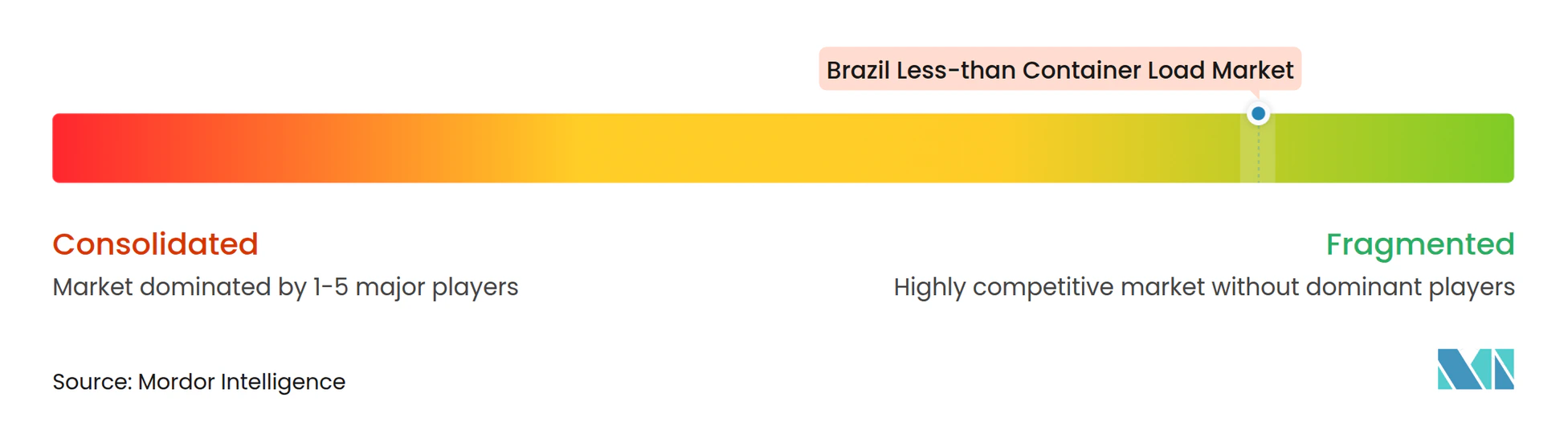
The Brazil less-than container load market is fragmented. DSV, Kuehne+Nagel, DHL, and Maersk compete with domestic and specialist providers such as Asia Shipping, Allog, and ES Logistics. Global integrators bring broader networks, warehousing, customs support, and technology resources. Domestic NVOCCs can respond quickly on specific corridors and use local trade knowledge to serve customers. This structure gives customers a choice between broad integrated services and more focused lane specialization.
Strategic activity centers on scale, digital tools, specialized handling, and network coverage. ECU Worldwide launched iTopaz in September 2025 to provide cloud-based booking, rate management, and operational visibility across its network. Kuehne+Nagel expanded its healthcare logistics position through the Opella partnership and a GDP-compliant Brazilian distribution center. These moves place greater value on shipment visibility, compliance, and services for sensitive cargo.
Specialization offers another route to differentiation. Operators serving hazardous cargo need IMDG capability, while healthcare providers need cold-chain and GDP-compliant processes. Scan Global Logistics received OEA-Segurança certification in October 2025, which strengthened its customs-security compliance position. Röhlig acquired a 10% stake in OnBoard Logistics in October 2025 to extend Latin American coverage across 11 additional countries[4]. The Brazil less-than container load market remains open to regional providers because customer service, lane knowledge, and cargo specialization can offset the scale advantages of global groups.
Brazil Less-than Container Load Industry Leaders
-
DSV AS
-
DHL Group
-
Kuehne+Nagel International AG
-
Asia Shipping
-
Allink
- *Disclaimer: Major Players sorted in no particular order
Brazil Less-than Container Load Market Companies Covered in this Report
- DSV AS
- DHL Group
- Kuehne+Nagel International AG
- A.P. Moller - Maersk
- CEVA Logistics (CMA CGM Group)
- Asia Shipping
- Scan Global Logistics
- Allink
- ECU Worldwide
- GEODIS
- Expeditors International
- Rhenus Logistics
- Savino Del Bene
- Nippon Express Holdings Inc.
- JAS Worldwide
- Hellmann Worldwide Logistics
- C.H. Robinson Worldwide Inc.
- Allog Group
- DC Logistics Brasil
- ES Logistics
- AMTrans Logistics
- Rohlig Logistics
Recent Industry Developments in Brazil Less-than Container Load Market
- August 2026: TCP, operator of the Paranaguá Container Terminal, reported handling 851 containers carrying consolidated LCL imports between January and July 2026. Its 9,000 m² bonded warehouse enabled an average cargo release within 48 hours, with direct delivery services available to customers in Curitiba and surrounding areas.
- June 2026: Ocean Network Express (ONE), in partnership with Norcoast, introduced the 9BR feeder service connecting Santos, Paranaguá, Salvador, Suape, Pecém, and Manaus. Dedicated to international import and export cargo, the service expanded regional port connectivity and provided additional routing options for LCL consolidators serving northern and northeastern Brazil.
- April 2026: DP World launched the Brazil–Africa Link, integrating ocean freight, customs clearance, container freight station services, warehousing, and inland transportation. Connecting Santos with logistics networks in Angola, Mozambique, and South Africa, the corridor strengthened multimodal service options available to Brazilian exporters, including those using consolidated shipments.
- January 2026: Rhenus Logistics opened a Santos branch to reinforce Europe-Brazil and Asia-Brazil LCL services and inland links to Paraguay, Uruguay, and Argentina.
Brazil Less-than Container Load Market Report Scope
Segmentation Overview
| Consolidation Services |
| De-consolidation and Distribution |
| Domestic |
| International |
| Freight Forwarding |
| NVOCCs |
| Manufacturing and Automotive |
| Retail and E-commerce |
| Healthcare and Pharmaceuticals |
| Agriculture and Forestry |
| Other End Users |
| General Cargo |
| Temperature-Controlled Cargo |
| Hazardous Cargo |
| High-Value and Sensitive Cargo |
| Others |
| North |
| Northeast |
| Central-west |
| Southeast |
| South |
| By Service Type | Consolidation Services |
| De-consolidation and Distribution | |
| By Destination | Domestic |
| International | |
| By Nature of Business | Freight Forwarding |
| NVOCCs | |
| By End User | Manufacturing and Automotive |
| Retail and E-commerce | |
| Healthcare and Pharmaceuticals | |
| Agriculture and Forestry | |
| Other End Users | |
| By Cargo Type | General Cargo |
| Temperature-Controlled Cargo | |
| Hazardous Cargo | |
| High-Value and Sensitive Cargo | |
| Others | |
| By Region | North |
| Northeast | |
| Central-west | |
| Southeast | |
| South |
Key Questions Answered in the Report
What is the projected growth rate for Brazil less-than container load services?
The Brazil less-than container load market is projected to register a 5.50% CAGR from 2027 to 2032, rising from USD 3.65 billion in 2027 to USD 4.77 billion by 2032. This expansion depends on trade flows, smaller replenishment orders, and more integrated delivery services.
Which service type has the largest share in Brazil LCL logistics?
Consolidation services held a 56.78% share in 2026. The Brazil less-than container load market uses this model to pool cargo before departure and share container costs among shippers.
Which customer sector is growing fastest in Brazil LCL shipping?
Healthcare and pharmaceuticals are projected to register a 7.97% CAGR through 2032. The Brazil less-than container load market serves this demand through temperature control, traceability, and GDP-compliant handling.
Why is Santos important for consolidated cargo?
Santos accounted for 63% of Brazil's LCL import traffic in 2025 and supports the largest regional share in the Southeast. Brazil less-than container load market activity benefits from its port capacity, warehouses, and inland connections.
What is slowing LCL shipment growth in Brazil?
Customs documentation, port congestion, repeated cargo handling, and low density on secondary lanes can increase cost and transit uncertainty. These factors can limit the Brazil less-than container load market when service reliability matters most.
How are logistics companies improving LCL services in Brazil?
Companies are adding port capacity, warehousing, direct regional lanes, digital booking tools, and specialized cold-chain capability. These actions support the Brazil less-than container load market by improving network coverage and shipment control.