
Bonded Cross-Border Trucking Market Size and Share
Market Overview
| Study Period | 2020 - 2031 |
|---|---|
| Market Size (2026) | USD 85.48 Billion |
| Market Size (2031) | USD 111.21 Billion |
| Growth Rate (2026 - 2031) | 5.41 % |
| Fastest Growing Market | Asia-Pacific |
| Largest Market | North America |
| Market Concentration | Medium |
Major Players *Disclaimer: Major Players sorted in no particular order Image © Mordor Intelligence. Reuse requires attribution under CC BY 4.0. | |
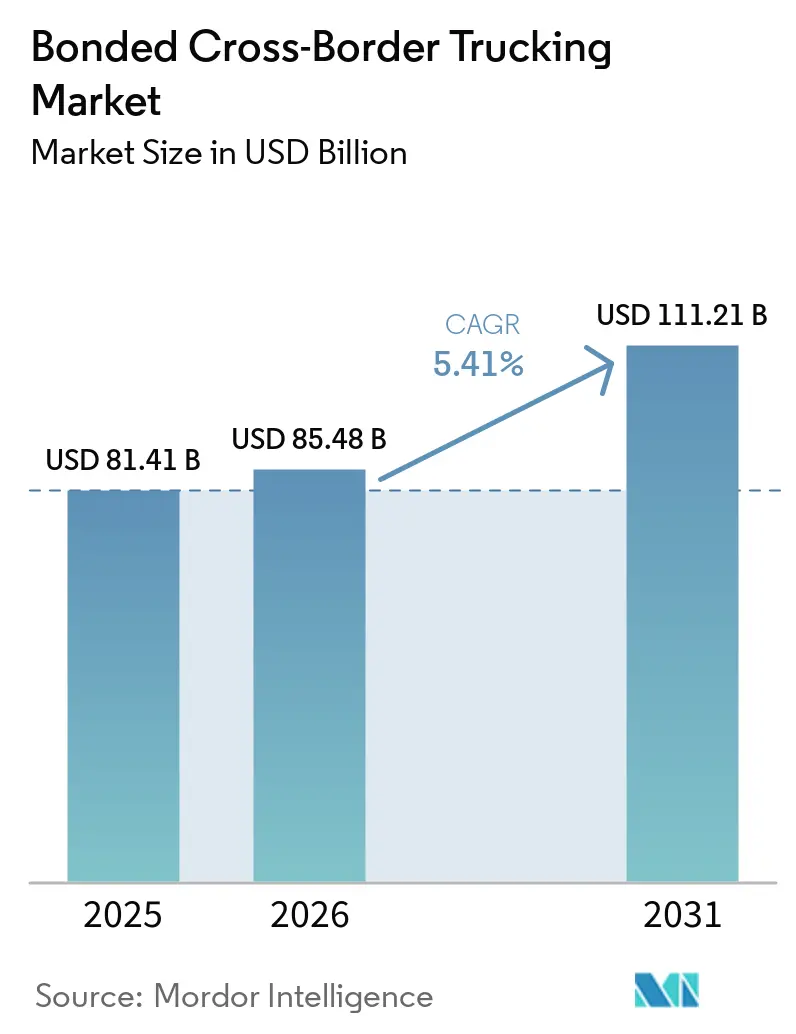
Bonded Cross-Border Trucking Market Analysis by Mordor Intelligence
The bonded cross-border trucking market size was valued at USD 81.41 billion in 2025 and is estimated to grow from USD 85.48 billion in 2026 to reach USD 111.21 billion by 2031, at a CAGR of 5.41% during the forecast period (2026-2031).
The bonded cross-border trucking market is being shaped by deeper regional production links, especially across the United States, Mexico, and Canada. Duty deferral has become more important as importers manage exposure to changing tariffs and seek greater control over inventory release. The bonded cross-border trucking market also benefits when carriers combine transport with customs brokerage, bonded warehousing, transload services, and local delivery. Digital customs processes are raising the value of accurate documentation and advance cargo data.[1] Capacity constraints at key crossings, driver shortages, and policy uncertainty continue to influence routing choices and contract terms.
Key Report Takeaways
- By end user industry, manufacturing held 34.50% of the bonded cross-border trucking market share in 2025, while wholesale and retail trade recorded the highest projected CAGR at 7.28% through 2031.
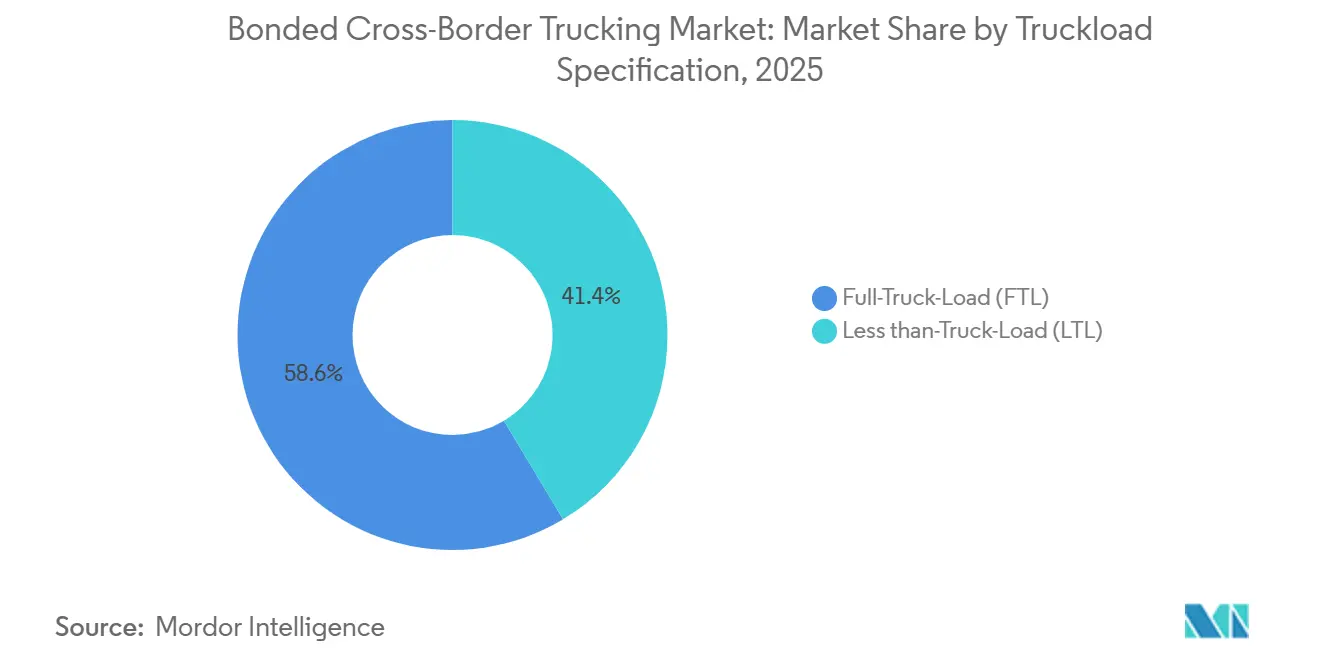
- By truckload specification, full-truck-load held 58.60% of the bonded cross-border trucking market share in 2025, while less-than-truck-load recorded the highest projected CAGR at 6.95% through 2031.
- By containerization, non-containerized freight held 56.70% of the bonded cross-border trucking market share in 2025, while containerized freight recorded the highest projected CAGR at 7.15% through 2031.
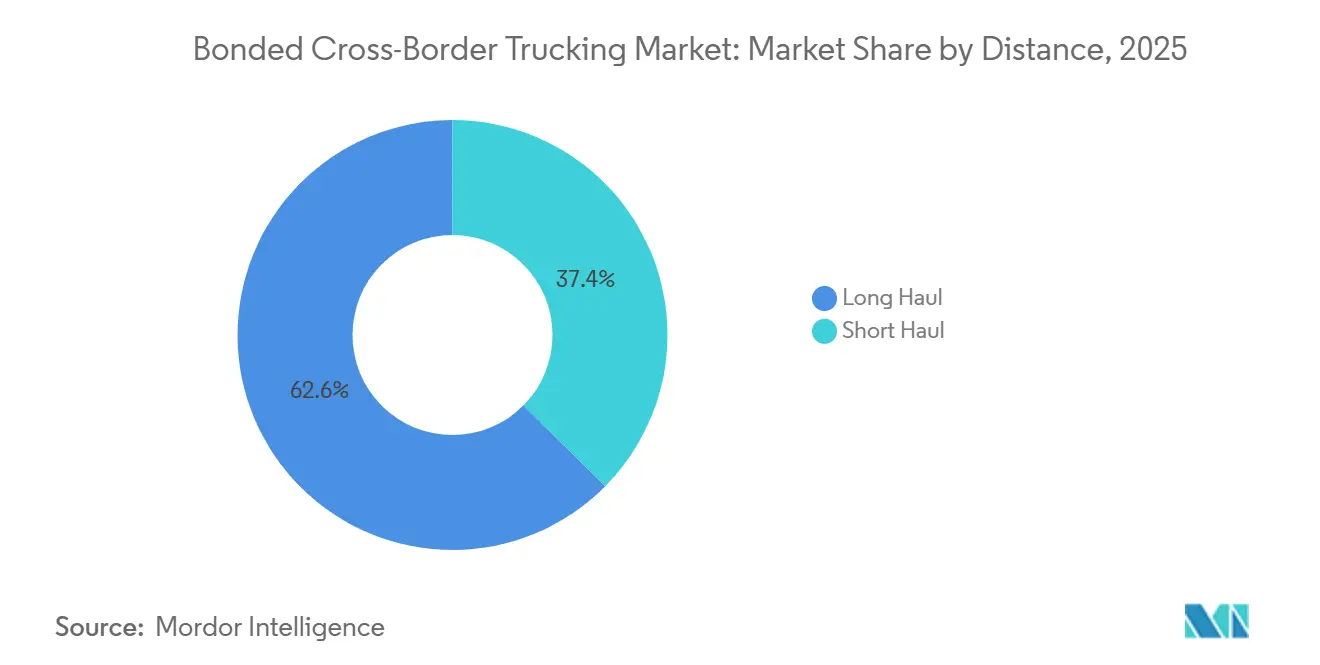
- By distance, long haul held 62.55% of the bonded cross-border trucking market size in 2025, while short haul recorded the highest projected CAGR at 7.06% through 2031.
- By goods configuration, solid goods held 73.25% of the bonded cross-border trucking market size in 2025, while fluid goods recorded the highest projected CAGR at 7.12% through 2031.
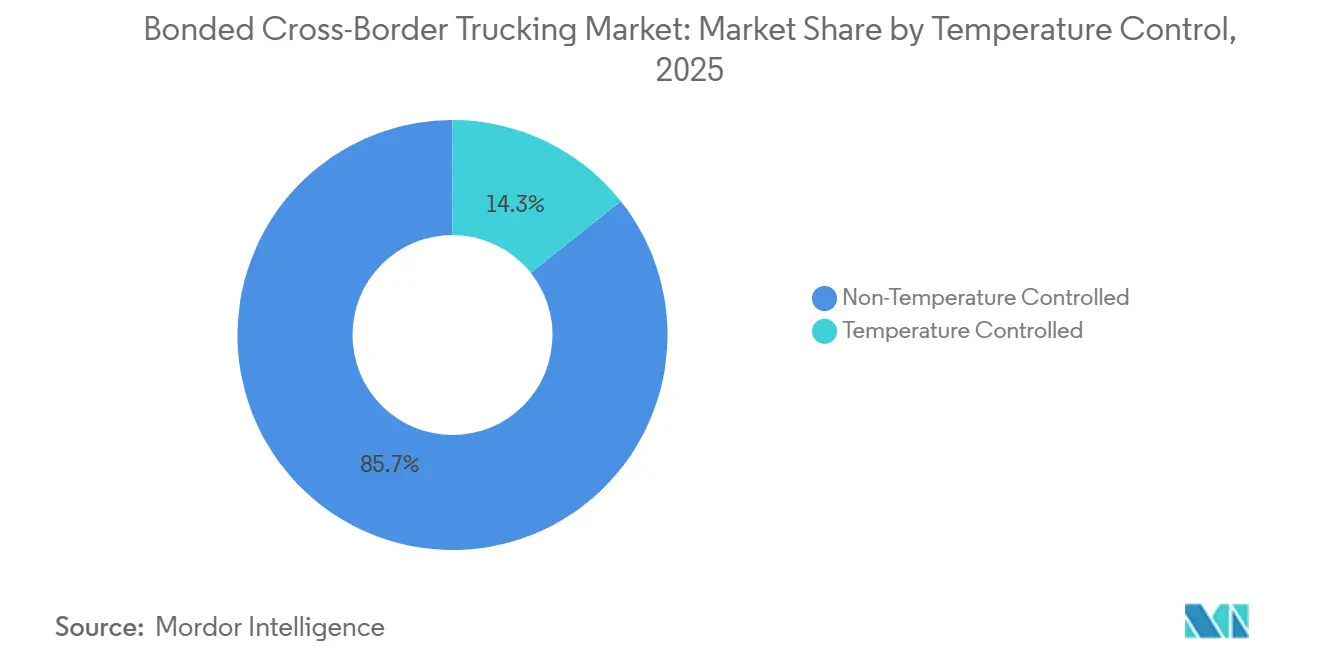
- By temperature control, non-temperature controlled shipments held 85.65% of the bonded cross-border trucking market share in 2025, while temperature controlled freight recorded the highest projected CAGR at 6.87% through 2031.
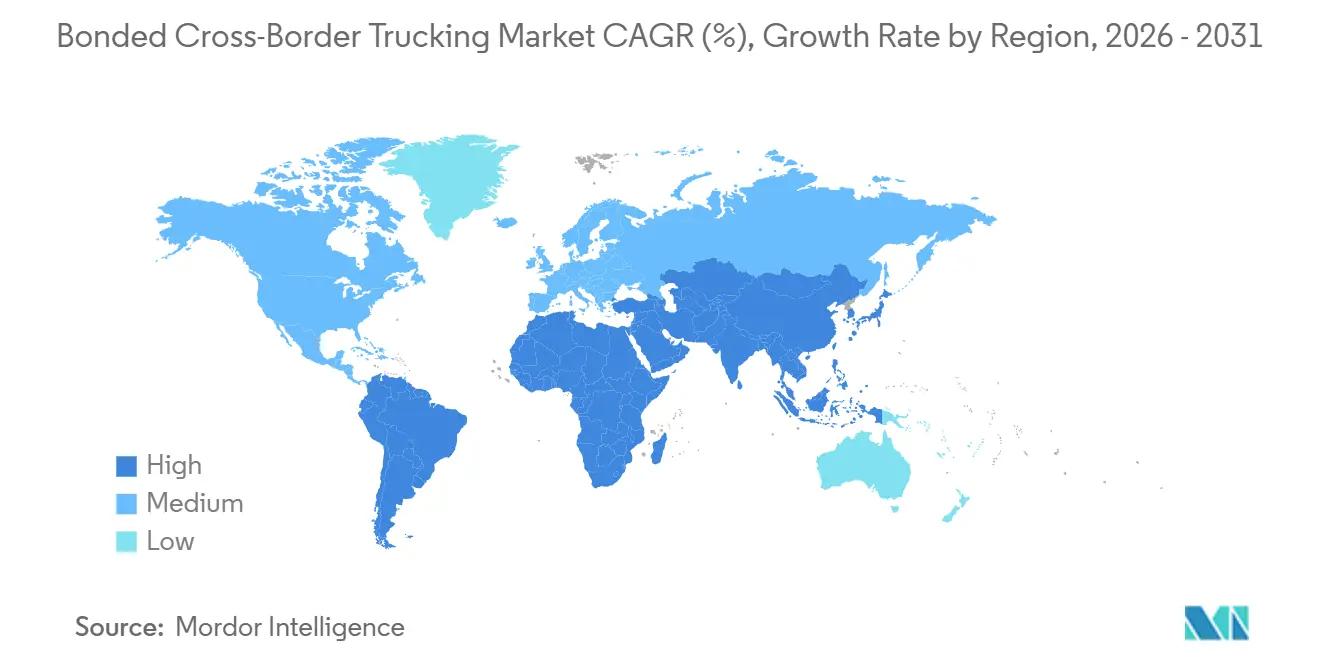
- By geography, North America held 31.50% of the bonded cross-border trucking market share in 2025, while Asia-Pacific recorded the highest projected CAGR at 6.93% through 2031.
Note: Market size and forecast figures in this report are generated using Mordor Intelligence’s proprietary estimation framework, updated with the latest available data and insights as of January 2026.
Global Bonded Cross-Border Trucking Market Trends and Insights
Drivers Impact Analysis*
| Driver | (~) % Impact on CAGR Forecast | Geographic Relevance | Impact Timeline |
|---|---|---|---|
| Nearshoring and Regional Manufacturing Expansion | +1.3% | North America, ASEAN, South Asia | Short term (≤ 2 years) |
| E-commerce Parcel Consolidation and Returns | +0.9% | Global, particularly North America, Europe, and Asia-Pacific | Medium term (2-4 years) |
| Duty Deferral and Tariff Optimization Requirements | +0.8% | North America and Europe | Short term (≤ 2 years) |
| Growth of Time-Sensitive and Regulated Cargo | +0.6% | Global, with Europe and North America leading | Medium term (2-4 years) |
| Digitization of Customs Documentation and Border Processing | +0.5% | Global, with Europe, North America, and ASEAN advancing fastest | Medium term (2-4 years) |
| Expansion of Multi-Country Landbridge and Third-Country Transit Corridors | +0.4% | ASEAN, Central Asia, and EU-Eastern Europe | Long term (≥ 4 years) |
| Source: Mordor Intelligence | |||
Nearshoring and Regional Manufacturing Expansion
Mexico recorded USD 40.87 billion in foreign direct investment in 2025, while announced factory projects exceeded USD 80 billion. Industrial development under Plan Mexico supported automotive, aerospace, electronics, medical device, and logistics activity across 10 states. These facilities create repeat freight flows once production begins and reinforce demand for reliable border services. The bonded cross-border trucking market gains when manufacturers need to move components through multiple jurisdictions without immediate duty payment. Laredo remained central to this activity and handled 46% of the value of truck-transported bilateral United States-Mexico trade during 2025-2026. Electronics and advanced manufacturing increased the need for frequent, high-value freight movements. Mexican electrical and electronic equipment exports rose 134% year-over-year in July 2026.[2] Such cargo can carry a larger duty exposure per truckload than many conventional shipments. Carriers with bonded staging capacity near crossings can therefore offer a more useful working-capital proposition. This pattern is expanding the bonded cross-border trucking market beyond traditional automotive lanes. It also increases the need for dependable customs records, secure handling, and predictable border handoffs.
E-Commerce Parcel Consolidation and Returns
Changes to the United States de minimis treatment in early 2025 required parcel consolidators to strengthen customs-clearance capabilities. This shifted more small consignments toward formal bonded handling and consolidated movement. The bonded cross-border trucking market benefits when carriers can pool shipments before final distribution. Consolidated transport reduces fragmented border transactions and makes documentation easier to manage. It also makes bonded warehouse locations near parcel hubs more valuable. In June 2026, UPS and Flexport launched a hybrid consolidation network that moved international freight through bonded warehouse nodes before entry into the UPS ground network. The arrangement reduced exposure to transcontinental zone pricing on origin-to-United States hub movements. The European Union's 2026 de minimis change also encouraged bulk fulfillment within the region. France implemented the Obligatory Logistics Envelope from April 2026 for cross-Channel trucks, requiring a single scannable barcode for customs and security documents before the port approach. These changes favor providers that can manage both freight consolidation and documentation in one operating process.
Duty Deferral and Tariff Optimization Requirements
Tariff changes since 2025 have increased the practical value of moving inventory under bond. Bonded warehouse usage rose from 10% of United States customs entries in 2024 to 16% in 2025. Importers use duty deferral to control the timing of payments and retain options for re-export. This has shifted the bonded cross-border trucking market from a specialized service toward a wider supply-chain choice. It has also made customs knowledge more relevant to carrier selection. Bonded routes can help shippers withdraw inventory when duty conditions change or move it onward without duty payment when export remains the preferred option. The Federal Register announced a United States Customs and Border Protection electronic export manifest test for truck cargo in September 2026.[3] The test requires export manifest information at least 24 hours before departure and is intended to improve cargo security and reduce post-loading inspections. Carriers with mature data processes are better placed to support this requirement. The bonded cross-border trucking market is, therefore, becoming more dependent on systems that turn customs information into operational decisions.
Digitization of Customs Documentation and Border Processing
Digital border systems are changing the speed and reliability of cross-border cargo release. The system links operator logistics systems with Austrian Customs and uses pre-notified cargo data and truck license plate recognition. India's Land Ports Authority introduced its Land Port Management System in June 2026. The platform connects cargo processing, slot booking, payment, tracking, and single-window clearances across land ports. System reliability remains important because service failures can quickly disrupt freight. The Canadian Trucking Alliance reporting on the 2025 Canada Border Services Agency outages showed how digital failures forced paper processing and delayed drivers at the border. Descartes introduced document-management capabilities for customs and shipment processing in August 2026. The bonded cross-border trucking market needs these systems to reduce manual entry and improve release preparation. Better integration can lower error rates and improve capacity use at busy crossings. It can also make smaller operators more competitive when they connect to shared compliance tools.
Restraints Impact Analysis*
| Restraint | (~) % Impact on CAGR Forecast | Geographic Relevance | Impact Timeline |
|---|---|---|---|
| Fragmented Customs Procedures and Documentation Requirements | -0.5% | Global, with high friction in the Middle East and Africa, South America, and intra-ASEAN corridors | Medium term (2-4 years) |
| Border Congestion and Limited Bonded Cross-Dock Capacity | -0.4% | North America and Europe | Short term (≤ 2 years) |
| Bond Liability, Cargo Theft, and Insurance Exposure | -0.3% | North America and the Middle East and Africa | Short term (≤ 2 years) |
| Divergent Zero-Emission Trucking Rules Across Jurisdictions | -0.2% | Europe and North America | Long term (≥ 4 years) |
| Source: Mordor Intelligence | |||
Fragmented Customs Procedures and Documentation Requirements
A single bonded movement across several jurisdictions can involve separate filing formats, classifications, and pre-arrival requirements. A document error can lead to inspection, detention, or re-bonding at an intermediate crossing. This creates costs that rise quickly when more borders are involved. The bonded cross-border trucking market remains easier to scale on corridors with predictable customs procedures. Carriers consequently direct volume toward established crossings and proven brokerage relationships. Canada Border Services Agency system outages in September 2025 interrupted digital pre-clearance and sent carriers back to paper processes. The Canadian Trucking Alliance said the disruptions added costs and strained supply chains. Delays can persist after an outage because accumulated shipments still require processing. Less-used crossings can remain underutilized even when they have physical capacity. The result is uneven throughput across regional networks. Harmonized data standards and reliable contingency procedures would reduce this constraint for the bonded cross-border trucking market.
Border Congestion and Limited Bonded Cross-Dock Capacity
Laredo handled 38.8% of inbound commercial trucks from Mexico, and the World Trade Bridge processed 15,000 to 18,000 commercial truck movements daily during 2025. The scale of this traffic leaves little room for disruption during peak operating periods. Extended Saturday hours beginning September 2026 reflected the need for more crossing availability. Congestion can raise waiting times, weaken equipment use, and make schedules less dependable. The bonded cross-border trucking market is especially exposed because freight often needs secure holding areas before clearance or transload. Limited cross-dock capacity adds pressure around major border points. Multi-shipper staging facilities can also face cargo theft risks when access control is inconsistent. CargoNet recorded a 60% increase in cargo theft losses in 2025 to nearly USD 725 million in North America. Security needs can increase insurance costs and require carriers to invest in monitored yards, verified handoffs, and stricter operating controls.[4] These requirements favor operators with established local infrastructure. They can also limit entry into high-value bonded freight routes.
*Our forecasts treat driver/restraint impacts as directional, not additive. The impact forecasts reflect baseline growth, mix effects, and variable interactions.
Segment Analysis
By End User Industry: Manufacturing Anchors Volume, Retail Accelerates
Manufacturing accounted for 34.50% of the bonded cross-border trucking market share in 2025. Integrated supplier networks for automotive, electronics, and industrial production support this position. Components can move under bond before the final consumption entry triggers duty payment. This supports working-capital management in supply chains that cross several borders. Manufacturing demand is tied to scheduled production cycles and frequent component movements.
Wholesale and retail trade is forecast to register at a CAGR of 7.28% through 2031. Retailers are using cross-border bonded staging closer to demand centers rather than relying only on domestic safety stock. Agriculture, fishing, and forestry, construction, oil and gas, mining, and quarrying also generate meaningful freight volumes. Their demand is more sensitive to commodity and project cycles. The bonded cross-border trucking industry is, therefore, broadening its customer base while manufacturing remains the main source of volume.
By Truckload Specification: FTL Leads on Volume, LTL Outpaces on Growth
Full-truck-load held 58.60% of the bonded cross-border trucking market share in 2025. Automotive parts, industrial equipment, and agricultural bulk shipments often fit dedicated trailer movements. A full trailer can simplify customs documentation and reduce transload exposure at the border. FTL remains useful for high-volume consignments with stable schedules. It also aligns with the operating needs of established manufacturing corridors.
Less-than-truckload is forecast to advance at a CAGR of 6.95% through 2031. Smaller consignments are becoming more common as retail replenishment and e-commerce distribution expand. C.H. Robinson introduced a Mexico cross-border consolidation service in September 2025 that combined consolidation, transport, customs brokerage, and bonded warehousing. The service addressed broker-related consolidation limits for Mexico movements. Mexico's cargo truck fleet declined 0.2% year-over-year in 2025, which supports the case for better equipment use through consolidation.
By Containerization: Non-Containerized Dominates, Containerized Set to Narrow the Gap
Non-containerized freight held 56.70% of the bonded cross-border trucking market share in 2025. Dry vans and flatbeds remain the standard equipment for much of the United States-Mexico and United States-Canada trade. These units suit highway-based freight and direct facility-to-facility movement. They also fit the established operating model of North American land transport. This structure explains the continued lead of non-containerized freight.
Containerized freight is forecast to register at a CAGR of 7.15% through 2031. Rail-truck services and Asia-to-North America routing are bringing more ISO-format containers into inland bonded corridors. J.B. Hunt, BNSF, and GMXT launched Quantum de Mexico in May 2025 with a 95%+ on-time delivery rate and transit up to 1 day faster than traditional intermodal service. The service covered 6 border interchange points and 24 Mexican states. This expands the practical use of containerized freight where shippers value predictable long-distance movement.
By Distance: Long Haul Commands Share, Short Haul Gains Momentum
Long haul represented 62.55% of the bonded cross-border trucking market size in 2025. Major corridors include links from Mexico City to Chicago and from central Mexico to eastern United States distribution centers. Multi-country China-ASEAN routes also rely on longer movements. The value of duty deferral can grow when a load travels a long distance before its final consumption entry. This sustains the lead of long-haul bonded services.
Short-haul is forecast to register at a CAGR of 7.06% through 2031. Industrial parks near borders are creating more demand for transload, cross-docking, and local bonded distribution. The Pharr Bridge expansion in Tamaulipas targeted completion by mid-2026 and aimed to nearly double trade capacity on the Reynosa-South Texas corridor. The World Trade Bridge extended-hours pilot also supports faster-turnaround movements in 2026. These investments give the bonded cross-border trucking market more capacity for near-border freight cycles. They also support shorter movements between plants, staging sites, and ports of entry.
By Goods Configuration: Solid Goods Dominate, Fluid Freight Accelerates
Solid goods constituted 73.25% of the bonded cross-border trucking market size in 2025. Automotive parts, electronics, packaged consumer goods, construction materials, and industrial machinery account for much of this traffic. Standard dry vans and flatbeds can serve these goods across major corridors. The broad range of cargo types maintains a large addressable base for solid-goods carriers. Electrical and electronic equipment exports from Mexico rose 134% year-over-year in July 2026, supporting this lead.
Fluid goods are forecast to register at a CAGR of 7.12% through 2031. Liquid chemicals, petrochemicals, food-grade liquids, and crude derivatives require specialized equipment and handling. Tank containers and ISO-tank trailers can require specific carrier certification and hazardous-material classification. Some routes also require dedicated crossing procedures. These barriers concentrate fluid movements among carriers with established compliance infrastructure. Growth in oil and gas, mining, and agro-industrial trade supports demand for these specialized services.
By Temperature Control: Conventional Freight Leads, Cold Chain Outgrows the Market
Non-temperature-controlled shipments accounted for 85.65% of the bonded cross-border trucking market size in 2025. Dry goods remain the largest part of cross-border truck traffic. Conventional equipment supports most automotive, industrial, and packaged consumer freight. This gives non-temperature-controlled movement the largest installed equipment base. It also reflects the continued weight of standard dry-van services in land trade.
Temperature-controlled freight is forecast to register at a CAGR of 6.87% through 2031. Pharmaceutical logistics, fresh produce, biologics, vaccines, and refrigerated food support demand for controlled transport. In June 2026, UPS covered 27 temperature-controlled freight cross-dock facilities across the United States, Europe, Asia, and the Americas. Carrier participation depends increasingly on Good Distribution Practice procedures and International Air Transport Association CEIV Pharma requirements. These conditions create a higher operational threshold for serving regulated cold-chain freight.
Geography Analysis
North America held 31.50% of the bonded cross-border trucking market share in 2025. United States-Mexico trade by truck exceeded USD 480 billion in 2025, according to the Bureau of Transportation Statistics. Mexican exports to the United States rose 13% year-over-year in the first half of 2026. Electronics, automotive, and advanced manufacturing contributed to this activity. The Gordie Howe International Bridge opened in July 2026 and added a commercial crossing option between Windsor and Detroit.
Asia-Pacific is forecast to register at a CAGR of 6.93% through 2031. China-ASEAN cross-border movements exceeded 11,000 truck trips between January and October 2025. Cargo value exceeded USD 2.12 billion over the same period. Friendship Pass Smart Port began trial operations in April 2026 and enabled 24-hour customs clearance. Kuehne+Nagel added nearly 40 prime movers and 100 containers in Thailand through its 2025 and 2026 investment program.
Europe, the Middle East and Africa, and South America also offer relevant trade corridors for the bonded cross-border trucking market. France's Obligatory Logistics Envelope and Austria's planned Smart Border Austria system are standardizing advance data and documentation processes. Nippon Express and cargo-partner launched the ONE Road network in May 2025 to integrate groupage, LTL, and FTL services across Europe. South America, the Middle East, and Africa face weaker infrastructure and less developed digital clearance systems, but corridor investment can improve long-term access.
Competitive Landscape
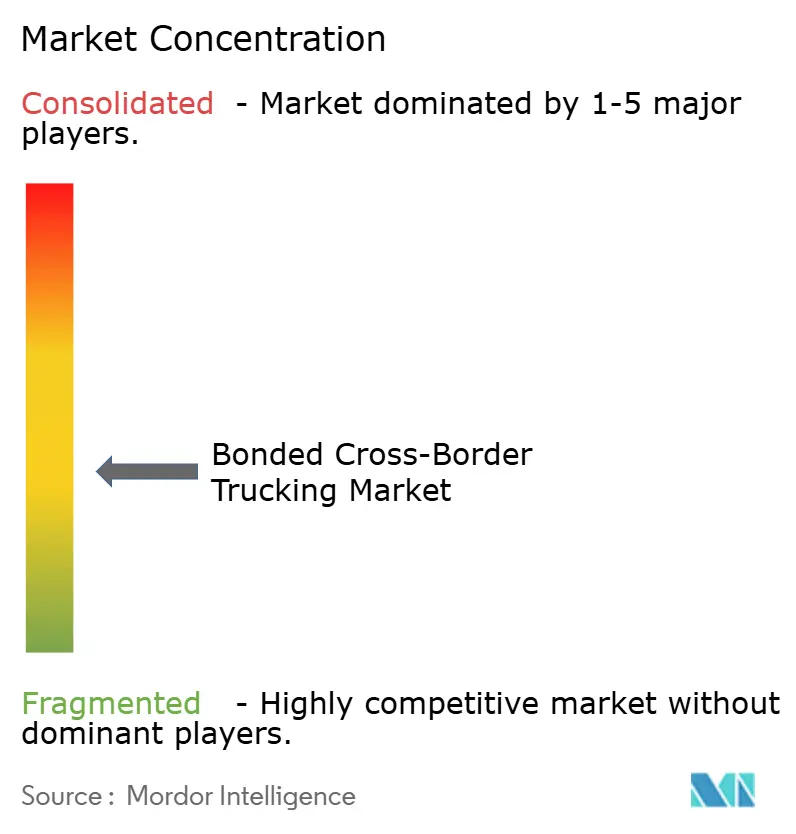
The bonded cross-border trucking market is moderately fragmented because local compliance expertise and border infrastructure remain important. The leading 10 operators hold meaningful but non-controlling market share. DSV completed its acquisition of DB Schenker in April 2025 for USD 15.9 billion. The combined business operates in more than 90 countries and has created a higher benchmark for network coverage. Larger networks can combine cross-border trucking with bonded warehousing, freight forwarding, and customs support.
CEVA Logistics gained a path to a larger North American contract logistics presence through CMA CGM's July 2026 agreement to acquire FedEx Supply Chain for USD 1.4 billion. The transaction supports a broader package of warehousing, trucking, and final-mile services. Schneider National also worked with CPKC on the Mexico-Chicago corridor in 2025. Schneider reported a 99.98% cross-border security rate and transit times up to 3 days faster than the 7-day industry average. These moves show how scale and corridor-specific specialization can coexist.
Digital operations increasingly influence pricing, service reliability, and carrier margins. United States Customs and Border Protection's electronic export manifest test rewards providers that can submit accurate information before departure. XPO reported that its automated platform matched 99.7% of loads in July 2025, while Werner reported a 20% brokerage productivity improvement per employee from its EDGE transportation management system. Regional opportunities remain in bonded LTL consolidation on South American Pacific Alliance lanes and within ASEAN.
Bonded Cross-Border Trucking Industry Leaders
-
DHL Group
-
United Parcel Service of America, Inc. (UPS)
-
C.H. Robinson Worldwide, Inc.
-
Landstar System, Inc.
-
Schneider National, Inc.
- *Disclaimer: Major Players sorted in no particular order
Recent Industry Developments
- September 2026: BNSF Railway and Spearpoint Logistics announced a strategic partnership at the Barstow International Gateway in Southern California, where Spearpoint will establish warehousing and transportation operations to provide customers with additional options for moving international freight across North America, building on BNSF's master-planned intermodal facility and co-location partner program.
- April 2026: Nippon Express Holdings agreed to acquire Metro Supply Chain Group, a Canadian third-party logistics provider operating across Canada, the United States, and the United Kingdom, in a transaction valued at approximately JPY 200 billion (USD 1.25 billion), expected to close by December 2026; the deal gives Nippon Express a stronger foothold in North American cross-border logistics and contract logistics capabilities.
- April 2026: Werner Enterprises expanded its asset-based intermodal service into Mexico, deploying Werner-owned containers across 12 border crossing ports with approximately 400 containers in operation and planned to double the fleet to around 800 by year-end 2026, responding to nearshoring-driven freight demand from manufacturers in central Mexico.
- March 2026: CTT and DHL eCommerce sealed a strategic partnership to establish a joint parcel distribution network in Spain and Portugal, targeting over 1 million shipments daily after the transaction closes. DHL eCommerce acquired a 25% stake in CTT Expresso, and CTT Expresso acquired a 25% stake in DHL eCommerce Spain.
Global Bonded Cross-Border Trucking Market Report Scope
| Agriculture, Fishing, and Forestry |
| Construction |
| Manufacturing |
| Oil and Gas, Mining and Quarrying |
| Wholesale and Retail Trade |
| Others |
| Full-Truck-Load (FTL) |
| Less than-Truck-Load (LTL) |
| Containerized |
| Non-Containerized |
| Long Haul |
| Short Haul |
| Fluid Goods |
| Solid Goods |
| Non-Temperature Controlled |
| Temperature Controlled |
| North America | United States |
| Canada | |
| Mexico | |
| South America | Brazil |
| Argentina | |
| Peru | |
| Chile | |
| Rest of South America | |
| Europe | Germany |
| United Kingdom | |
| France | |
| Italy | |
| Spain | |
| Russia | |
| Nordics (Denmark, Finland, Iceland, Norway, and Sweden) | |
| Rest of Europe | |
| Asia-Pacific | China |
| India | |
| Japan | |
| South Korea | |
| Australia | |
| Southeast Asia (ASEAN) | |
| Rest of Asia-Pacific | |
| Middle East and Africa | Saudi Arabia |
| United Arab Emirates | |
| Qatar | |
| South Africa | |
| Nigeria | |
| Egypt | |
| Rest of Middle East and Africa |
| By End User Industry | Agriculture, Fishing, and Forestry | |
| Construction | ||
| Manufacturing | ||
| Oil and Gas, Mining and Quarrying | ||
| Wholesale and Retail Trade | ||
| Others | ||
| By Truckload Specification | Full-Truck-Load (FTL) | |
| Less than-Truck-Load (LTL) | ||
| By Containerization | Containerized | |
| Non-Containerized | ||
| By Distance | Long Haul | |
| Short Haul | ||
| By Goods Configuration | Fluid Goods | |
| Solid Goods | ||
| By Temperature Control | Non-Temperature Controlled | |
| Temperature Controlled | ||
| By Geography | North America | United States |
| Canada | ||
| Mexico | ||
| South America | Brazil | |
| Argentina | ||
| Peru | ||
| Chile | ||
| Rest of South America | ||
| Europe | Germany | |
| United Kingdom | ||
| France | ||
| Italy | ||
| Spain | ||
| Russia | ||
| Nordics (Denmark, Finland, Iceland, Norway, and Sweden) | ||
| Rest of Europe | ||
| Asia-Pacific | China | |
| India | ||
| Japan | ||
| South Korea | ||
| Australia | ||
| Southeast Asia (ASEAN) | ||
| Rest of Asia-Pacific | ||
| Middle East and Africa | Saudi Arabia | |
| United Arab Emirates | ||
| Qatar | ||
| South Africa | ||
| Nigeria | ||
| Egypt | ||
| Rest of Middle East and Africa | ||
Key Questions Answered in the Report
What is the value of bonded cross-border trucking in 2026?
The sector is estimated at USD 85.48 billion in 2026 and is projected to reach USD 111.21 billion by 2031. The forecast period CAGR is 5.41%.
What is driving demand for bonded transportation services?
Nearshoring, duty deferral, e-commerce consolidation, regulated cargo, and digital customs processes are supporting demand. These factors increase the value of integrated customs and transport services.
Which end-user sector held the largest share in 2025?
Manufacturing held 34.50% in 2025, supported by integrated automotive, electronics, and industrial supply networks. Wholesale and retail trade is the fastest-growing end-user segment at 7.28% CAGR through 2031.
Which service format is growing fastest?
Containerized freight is projected to grow at 7.15% CAGR through 2031, ahead of other containerization formats. Intermodal rail-truck services are expanding the role of containers on cross-border corridors.
Which region is growing fastest through 2031?
Asia-Pacific is forecast to expand at a 6.93% CAGR, supported by the China-ASEAN corridor and border digitization. North America held the largest regional share at 31.50% in 2025.
What risks affect cross-border bonded carriers?
Documentation differences, border congestion, cargo-security exposure, limited cross-dock capacity, and differing zero-emission rules can disrupt operations. These issues can affect transit time, equipment use, and insurance requirements.