

Market Overview
| Study Period | 2021 - 2031 |
|---|---|
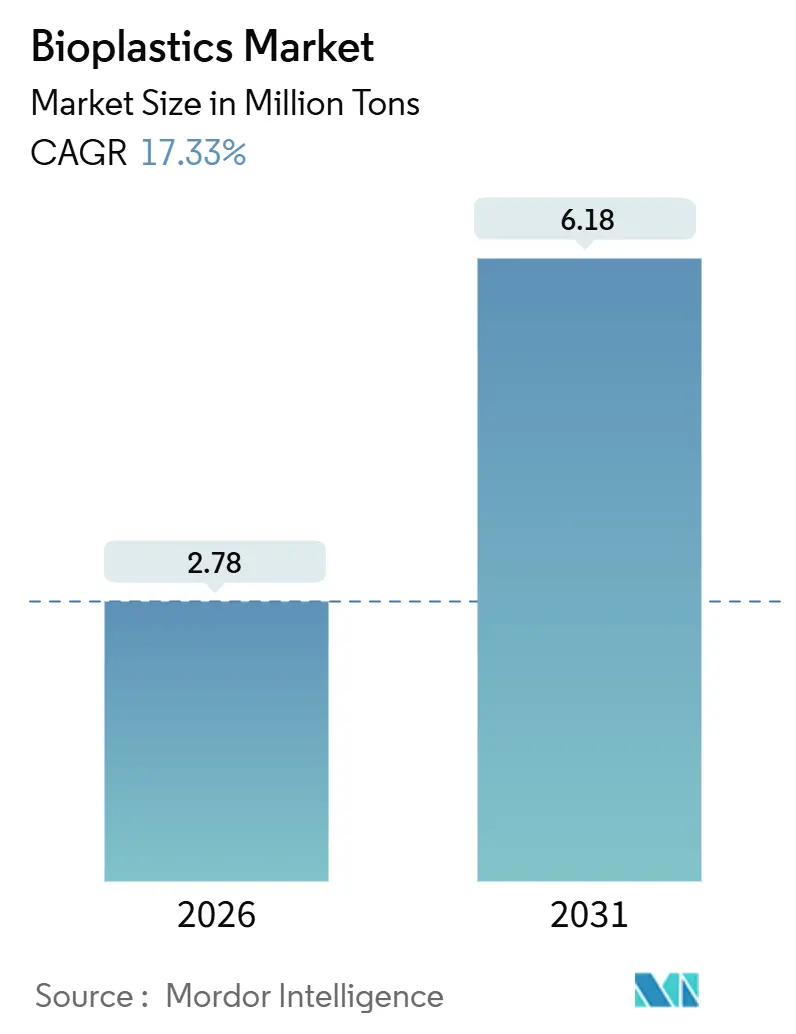
| Market Volume (2026) | 2.78 Million tons |
| Market Volume (2031) | 6.18 Million tons |
| Growth Rate (2026 - 2031) | 17.33% CAGR |
| Fastest Growing Market | Asia Pacific |
| Largest Market | Asia Pacific |
| Market Concentration | Medium |
Major Players *Disclaimer: Major Players sorted in no particular order Image © Mordor Intelligence. Reuse requires attribution under CC BY 4.0. | |
Bioplastics Market Analysis by Mordor Intelligence
The Bioplastics Market size is estimated at 2.78 million tons in 2026, and is expected to reach 6.18 million tons by 2031, at a CAGR of 17.33% during the forecast period (2026-2031). This growth stems from single-use-plastic bans in Europe and Asia, corporate net-zero targets that filter through supplier scorecards, and the rapid alignment of renewable-feedstock supply chains in Brazil, India, and Thailand. Capital spending is migrating toward Asia-Pacific, where tax holidays and land-lease incentives compress payback periods for new PLA and PHA lines. At the same time, North American and European innovators continue to file patents around heat-resistant PLA alloys and enzymatic recycling catalysts that promise to lower total lifecycle emissions versus drop-in bio-PET. Price volatility remains the central risk because bioplastic resins command a 20%–40% premium over fossil LDPE when Brent crude trades below USD 80 per barrel, a level seen intermittently in 2024 and early 2025. These structural forces combine to accelerate capacity additions while exposing margin to crude oil downside.
Key Report Takeaways
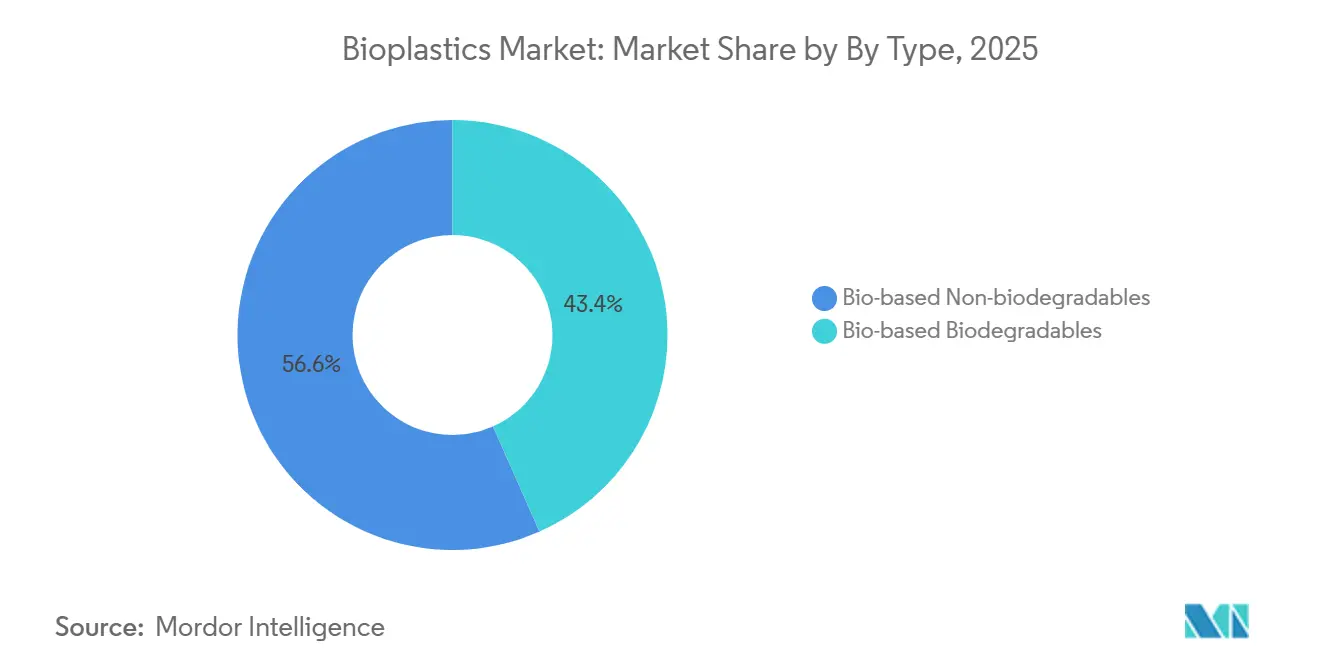
- By polymer class, bio-based non-biodegradables captured 56.64% of the bioplastics market share in 2025, whereas bio-based biodegradables led growth at a 23.46% CAGR.
- By feedstock, sugarcane and sugar-beet inputs supplied 42.28% of global resin volumes in 2025; cellulosic and wood-waste streams are expanding at a 24.59% CAGR.
- By processing technology, extrusion held 46.94% of 2025 volumes, while 3D printing represents the fastest-growing route with a 22.88% CAGR to 2031.
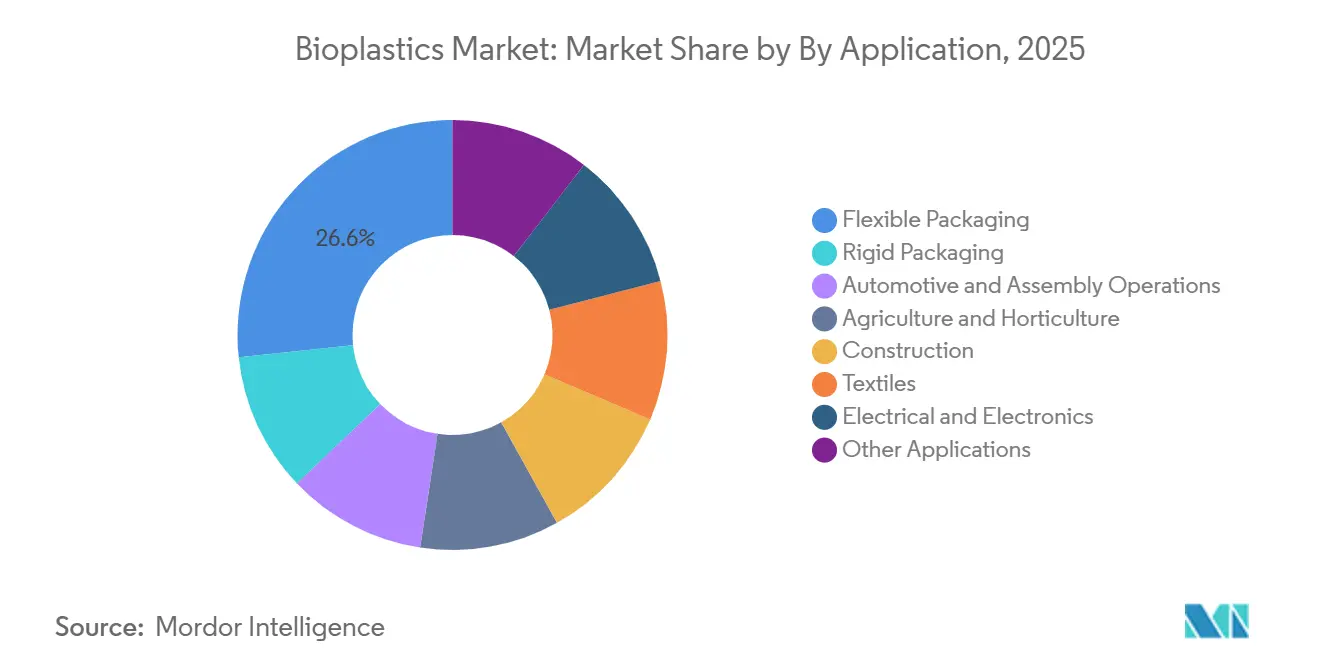
- By application, flexible packaging commanded 26.65% of 2025 demand and is scaling at a 24.69% CAGR through 2031.
- By region, Asia-Pacific accounted for 47.75% of 2025 volumes and is projected to grow at a 22.51% CAGR, outpacing all other geographies.
Note: Market size and forecast figures in this report are generated using Mordor Intelligence’s proprietary estimation framework, updated with the latest available data and insights as of January 2026.
Global Bioplastics Market Trends and Insights
Driver Impact Analysis
| Drivers | (~) % Impact on CAGR Forecast | Geographic Relevance | Impact Timeline |
|---|---|---|---|
| Single-use-plastic bans in Europe and Asia | +3.8% | Europe, India, Southeast Asia | Short term (≤ 2 years) |
| Demand for sustainable packaging | +4.2% | Global, concentrated in North America and EU | Medium term (2-4 years) |
| Corporate net-zero polymer procurement | +3.5% | Global, led by multinational CPG brands | Medium term (2-4 years) |
| Recycling-compatibility incentives | +2.1% | Europe, Japan, South Korea | Long term (≥ 4 years) |
| Availability of renewable feedstock | +2.9% | Brazil, India, Thailand, United States | Medium term (2-4 years) |
| Source: Mordor Intelligence | |||
Mandate for Single-Use-Plastic Bans in Europe and Asia
Regulatory prohibitions on polystyrene foam, Oxo-degradable bags, and polyethylene straws have removed roughly 1.2 million tons of petro-plastic demand since 2021, creating an immediate pull for certified-compostable alternatives. European Commission guidance issued in July 2024 further tightened definitions by linking exemptions to EN 13432, which sidelined oxo-additive packaging and accelerated PLA penetration into food-service ware. In India, the Central Pollution Control Board used spot audits throughout 2024 to seize non-compliant inventory valued at INR 500 million, prompting converters to lock in multi-year PLA and starch-blend contracts[1]Central Pollution Control Board, “Annual Compliance Report 2024,” cpcb.nic.in. Thailand’s January 2025 roadmap extended the mandate to hotels and quick-service restaurants, requiring 40% compostable share by 2027 and thus derisking new domestic capacity. Because enforcement carries financial penalties and brand-owner liability, offtake contracts now underpin capital spending decisions for greenfield plants from Hainan to Gujarat.
Surging Demand for Sustainable Packaging and Eco-Friendly Plastics
Consumer-packaged-goods leaders collectively pledged to displace 8.5 million tons of virgin plastic by 2030, yet 82% of that requirement remained uncontracted as of mid-2025. This procurement gap has fueled RFPs for both drop-in bio-PE and next-generation PLA alloys. Unilever lifted its bio-PE intake to 47,000 tons in 2024—up 22% year over year—and targets a three-fold increase by 2027. Nestlé Waters piloted full-PLA bottles in France that cut cradle-to-gate emissions by 35% versus rPET, though heat-distortion above 55 °C restricted sales to refrigerated channels. Danone’s March 2025 collaboration with NatureWorks aims to push PLA’s heat-deflection ceiling to 70 °C, unlocking ambient yogurt cups in Southern Europe. The takeaway is clear: brands are segmenting procurement between drop-ins for rigid formats and biodegradable alloys for flexible films, each pathway minimizing disruption to existing lines while meeting diverging regulatory tests.
Corporate Net-Zero Procurement of Low-Carbon Polymers
Scope 3 accounting now makes resin selection a direct lever in hitting Science Based Targets, forcing suppliers to disclose cradle-to-gate emissions through ISO 14044-verified LCAs. BASF allocated 320,000 tons of biomass-balance credits across its polymer slate in 2024, up 78% in two years[2]BASF, “Sustainability Report 2024,” basf.com . TotalEnergies Corbion posts a 0.5 kg CO₂-equivalent footprint for its PLA, roughly 75% below fossil PET, positioning it for premium tenders in food and medical packaging. Braskem’s sugar-based bio-PE achieves a –3.09 kg CO₂ balance per kg of polymer, a claim that Procter & Gamble cites in climate disclosures. Chain-of-custody certification has therefore become a ticket-to-trade: producers lacking ISCC PLUS or RSB audits rarely advance beyond pre-qualification.
Advanced Mechanical-Recycling Compatibility Incentives
Eco-modulated fees under France’s CITEO reduce levies by EUR 100 per ton for bio-PE bottles that behave like fossil analogs in optical sorters, whereas PLA still faces a EUR 50 surcharge. Germany’s ZSVR guidance from September 2024 offers minimum-recycled-content credits exclusively for bio-PE, bio-PET, and bio-PA, sidelining many biodegradable grades. Japan’s April 2025 subsidy funds enzymatic depolymerization retrofits so PLA can join PET loops, signaling a shift toward chemical recycling that could eventually close the infrastructure gap. In the interim, bio-based drop-ins enjoy a compliance tailwind wherever mature recycling streams exist.
Restraint Impact Analysis
| Restraints | (~) % Impact on CAGR Forecast | Geographic Relevance | Impact Timeline |
|---|---|---|---|
| Price premium vs. petro-plastics with low oil prices | –2.7% | Global, acute in price-sensitive segments | Short term (≤ 2 years) |
| Heat-resistance and barrier gaps in PLA grades | –1.4% | North America, Europe | Medium term (2-4 years) |
| Limited industrial-composting infrastructure penalties | –1.6% | Asia-Pacific, Latin America | Long term (≥ 4 years) |
| Source: Mordor Intelligence | |||
Price Premium vs. Petro-Plastics Amid Low Oil Prices
PLA traded between USD 2,200 and USD 3,800 per ton in 2024-2025, roughly double virgin LDPE when Brent averaged USD 75 per barrel. Without carbon levies or mandated compostability, converters in India and Southeast Asia confront up to a 60% cost penalty for switching from PP to PLA in takeaway containers. Braskem’s bio-PE premium widened from USD 300 to USD 450 per ton in early 2025 as ethanol prices spiked 12% on Brazilian drought. Sustained crude weakness therefore threatens all but policy-driven demand, forcing most producers to hedge margins through long-term offtake deals indexed to sugar rather than oil.
Heat-Resistance and Barrier-Property Gaps in PLA Grades
Standard PLA softens at 55 °C–60 °C, barring use in hot-fill drinks or microwaveable trays. NatureWorks’ Ingeo 3D870 boosts heat-deflection to 100 °C but adds a 25% resin premium and lengthens cycle times by 15 seconds. Danimer’s Nodax PHA maintains flexibility across –40 °C to +60 °C yet displays oxygen-transmission rates three to five times higher than oriented PP, requiring multilayer laminates that complicate composting. BASF’s Ecovio blends close water-vapor gaps but dilutes renewable content because PBAT remains fossil-derived. Qualification, therefore, proceeds slowly, especially in applications that integrate mechanical and barrier demands into a single wall.
Segment Analysis
By Type: Bio-based non-biodegradable Polymers Dominate, Biodegradables Accelerate
The bio-based non-biodegradable class held a 56.64% bioplastics market share in 2025 because bio-PET and bio-PE run on legacy facilities, preserve bottle-grade clarity, and fit established recycling loops. Coca-Cola shipped its 90 billionth PlantBottle in 2024, validating the scale advantage of partial bio-content that keeps PET bale purity intact. The biodegradables family, led by PLA and starch blends, is growing at 23.46% and will erode share as landfill-diversion mandates spread from Europe to South America. PLA already dominates transparent clamshells for North American produce, while starch-PBAT combinations own grocery bags across Southeast Asia, aided by cassava-based masterbatches priced 15% below corn counterparts. PHA’s marine-biodegradable profile tackles use-cases where litter risk is acute, such as fishing gear; Bacardi’s adoption for bottle caps demonstrates how niche applications can scale once performance meets brand aesthetics. Bio-PA remains a performance polymer for fuel-lines and textile fibers, its high margin insulating producers from crude swings. Overall, the segment profile signals that drop-ins will retain large-volume packaging accounts while biodegradables penetrate regulated niches, driving differentiated capacity deployment through 2031.
Get Detailed Market Forecasts at the Most Granular Levels
Download PDF
By Feedstock: Sugarcane Leads, Cellulosics Surge
Sugarcane and sugar-beet streams supplied 42.28% of total volume in 2025, anchoring cost curves because Brazilian mills bundle bagasse cogeneration credits and ethanol hedges to stabilize input margins. Corn-based dextrose feeds NatureWorks’ 150 ktpa Blair, Nebraska, PLA unit, yet price volatility and land-use scrutiny are pushing producers toward residue-based sugars. Cellulosic pathways will expand at a 24.59% CAGR, spearheaded by pulp mills that sell lignocellulosic syrup into Avantium’s polyethylene furanoate pilot line, which touts a 50% oxygen-barrier gain over PET. Cassava starch underwrites Thailand’s thermoplastic bag grades, exploiting local agronomy and BOI tax holidays that cut break-even time to six years. Algae and microbial oils attracted USD 180 million in venture funding during 2024-2025 and now supply RWDC’s Solon PHA at 20% below prevailing PHA index prices. Feedstock diversification, therefore, limits commodity risk and aligns with deforestation-free procurement pledges issued by major FMCG companies.
By Processing Technology: Extrusion Anchors Volume, 3D Printing Scales
Extrusion accounted for 46.94% of throughput in 2025 because film and sheet lines serve both flexible packaging and agricultural mulch. Screw-temperature profiles for PLA require colder zones and faster chill-roll speeds, yet upgrade costs remain modest relative to barrier-coextrusion investments. Injection molding ranks second as mobile-phone cases, consumer electronics, and rigid foodware adopt bio-PA and high-heat PLA, though mold-cool delays can extend cycle times by one-quarter. Blow-molding embraces bio-PET and bio-PE since they stretch-blow like fossil analogs; line-rate parity minimizes the capex required to meet recycled-content taxes in the United Kingdom. 3D printing is the standout, rising at 22.88% CAGR on the back of Stratasys’s carbon-fiber PLA filaments that print automotive jigs twice as fast as ABS. Binder-jetted wood-fiber composites from Desktop Metal promise furniture prototypes that biodegrade in garden compost piles. Over the forecast horizon, extrusion and injection will absorb most tonnage growth, but additive manufacturing offers the highest EBITDA margins at low volumes.
By Application: Flexible Packaging Leads, Automotive Gains
Flexible packaging captured 26.65% usage in 2025 and should rise at a 24.69% CAGR as France’s AGEC law and Germany’s VerpackG enforce compostability for coffee pods, e-commerce mailers, and fresh-produce films. Mondi’s March 2025 launch of a PLA-coated paper pouch shows the pathway to high-barrier formats that still compost in municipal plants, extending dry-good shelf life to 12 months. Rigid packaging leverages bio-PET’s compatibility with existing bottle loops but remains price-sensitive. Automotive interiors increasingly specify bio-PA and bio-PET composites; BMW’s i Vision Dee concept incorporated 40% bio-based plastics by weight and cut lifecycle emissions 25% versus the company’s 2021 baseline. Agriculture adopts starch-PBAT mulch films that eliminate retrieval labor, with Italy subsidizing the transition under its National Recovery and Resilience Plan. Construction and textiles remain nascent but show promise where green-building certifications or performance stretch fibers demand renewable content. Electrical uses grow more slowly due to the UL 94 V-0 hurdle, yet BASF met that requirement with a halogen-free bio-PA in 2024.
Note: Segment shares of all individual segments available upon report purchase
Get Detailed Market Forecasts at the Most Granular Levels
Download PDF
Geography Analysis
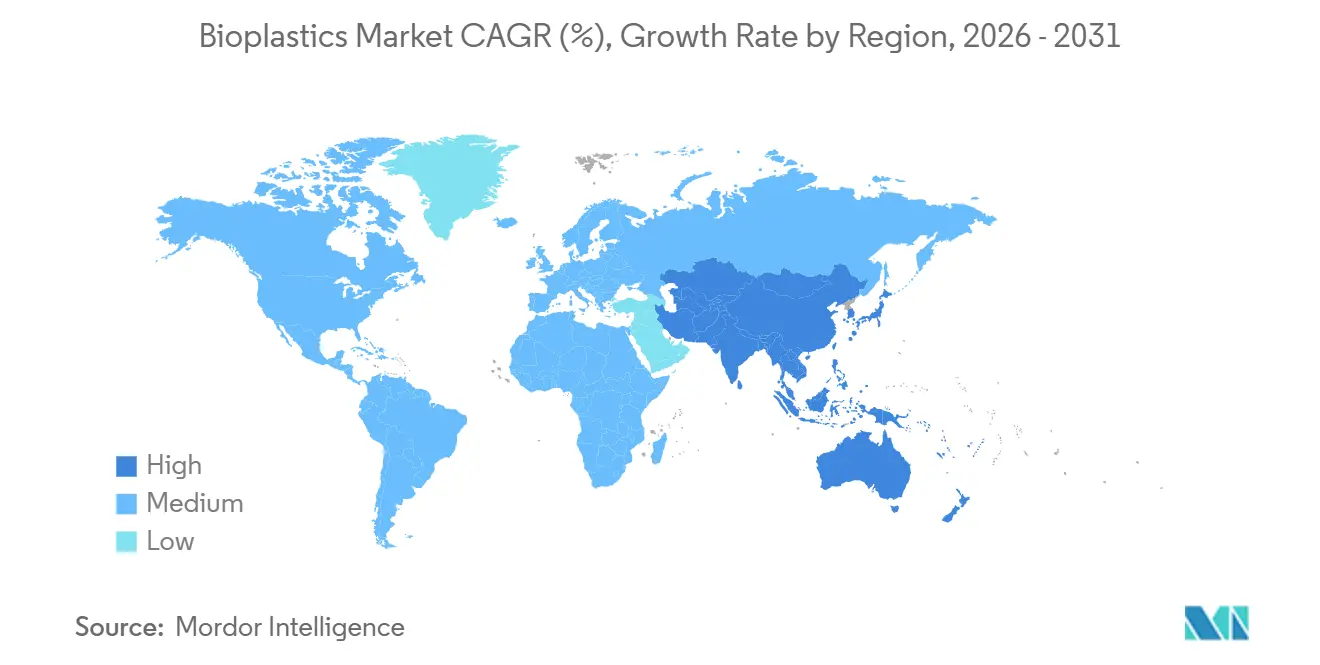
Asia-Pacific held 47.75% of global volume in 2025 and will grow at a 22.51% CAGR through 2031, driven by China’s 30% biodegradable-packaging mandate for express deliveries, Thailand’s tax holidays for PLA plants, and India’s single-use-plastic enforcement that re-tooled 12,000 converters toward compostable resins. Sinopec opened a 60 ktpa PBAT facility in Hainan in September 2024, integrated with sugarcane ethanol to shave 15% off feedstock costs while qualifying for Free Trade Port incentives. Reliance Industries and Danimer plan a 30 ktpa PHA plant in Gujarat by 2026 to serve both domestic mulch film and European marine-biodegradable demand. Japan’s April 2025 subsidy offset 50% of capex for SME molders converting to bio-resins, signaling policy recognition that supply-chain localization is a climate and security objective.
North America and Europe remain innovation hubs that write global specifications. The U.S. Inflation Reduction Act extends 45Q credits to carbon-negative polymers, making Nebraska’s PLA output competitive even when Brent flirts with USD 70. Germany funds enzymatic recycling pilots to handle PLA-PET contamination, hinting that chemical recycling could coexist with composting in the EU Circular Economy Action Plan. France’s AGEC law, fully in force since January 2024, pushes restaurants and canteens into compostable cutlery supplied by TotalEnergies Corbion’s Thai plant, illustrating how cross-border supply networks meet domestic mandates. The United Kingdom’s plastic-packaging tax indirectly favors bio-PE that qualifies for renewable-carbon credits once it reaches the 30% threshold.
South America leverages Brazil’s sugar platform; Braskem exports 60% of its bio-PE to Europe and North America, but domestic uptake lags due to absent bans and low willingness to pay. Argentina pilots source-separated compost collection in Buenos Aires and may scale nationally if contamination rates stay below 10%. The Middle East explores bio-naphtha; SABIC studies feedstock switching at Jubail to supply EU customers exposed to carbon-border adjustments. South Africa drafted producer-responsibility fees on non-compostables in late 2024 but faces implementation delays as small converters lobby for exemptions.
Get Analysis on Important Geographic Markets
Download PDF
Competitive Landscape
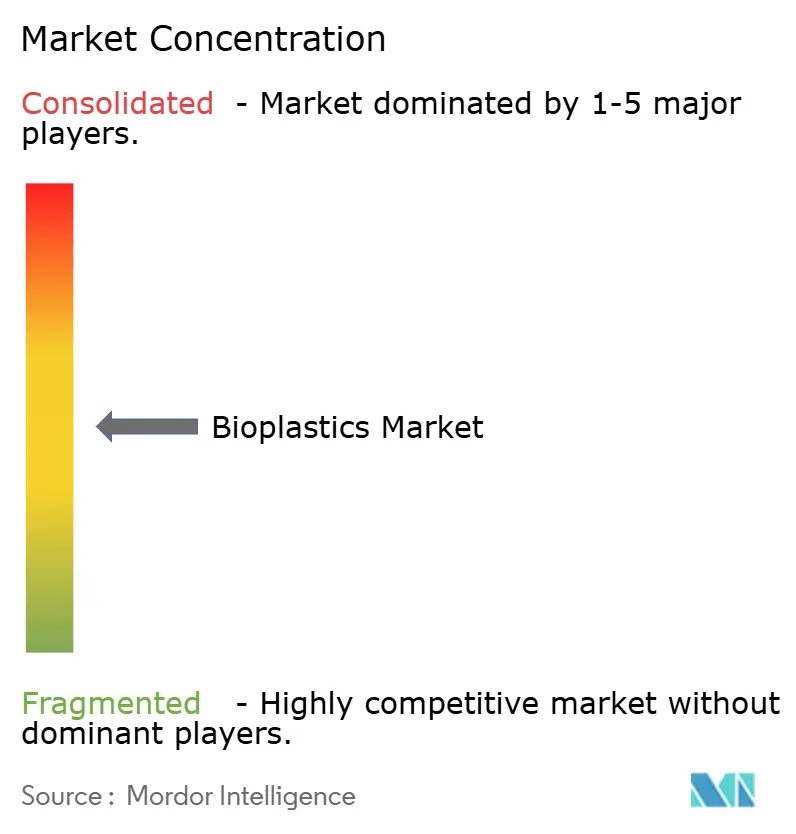
The bioplastics market is moderately consolidated, with leading players accounting for significant market share. However, no player exceeds a 10% individual share, leaving regional specialists ample room to penetrate niches. Integration is a strategic hedge: Braskem owns ethanol supply, while BASF’s biomass-balance credits allow renewable offerings without dedicated assets. Capacity is racing eastward; TotalEnergies Corbion will double its Thai PLA line to 150 ktpa by 2028. Patent activity centers on high-heat PLA crystallization. ISO 17088, EN 13432, ISCC PLUS, and RSB certifications now function as go-to-market prerequisites; smaller fermentation startups struggle to fund compliance audits, meaning that technological prowess alone is insufficient without credible chain-of-custody documentation.
Bioplastics Industry Leaders
NatureWorks LLC
TotalEnergies (Total Corbion)
BASF
Braskem
Eni S.p.A. (Novamont)
- *Disclaimer: Major Players sorted in no particular order
Need More Details on Market Players and Competitors?
Download PDF
Recent Industry Developments
- January 2025: TotalEnergies Corbion unveiled a USD 1 billion plan to expand its Rayong PLA plant to 150,000 tpy by 2028, adding a lactide-purification loop that lifts optical purity to 99.8%, thereby unlocking medical-grade demand.
- November 2024: Sinopec commissioned a 60,000 tpy PBAT complex in Hainan integrated with sugarcane-ethanol-based BDO, enabling 15% feedstock savings and targeting domestic mulch film as well as ASEAN exports.
- October 2024: Danimer Scientific and Reliance Industries formed a joint venture to build a 30,000 tpy PHA plant in Gujarat slated for Q4 2026 start-up, fed by contract canola acreage in Rajasthan.
Research Methodology Framework and Report Scope
Market Definitions and Key Coverage
Our study defines the global bioplastics market as the annual sales volume of polymer resins that are at least partly derived from renewable biomass and are marketed either as drop-in bio-based grades (for example, bio-PE, bio-PET) or as certified biodegradable grades (such as PLA, PHA, PBS, starch blends). Figures are quoted in kilotons at the resin stage before compounding or conversion.
Scope exclusion: recycling streams for fossil-based plastics and bio-additive blends below a 20% bio-content threshold are kept outside the sizing.
Segmentation Overview
- By Type
- Bio-based Biodegradables
- Starch-based
- Polylactic Acid (PLA)
- Polyhydroxyalkanoates (PHA)
- Polyesters (PBS, PBAT, PCL)
- Other Bio-based Biodegradables
- Bio-based Non-biodegradables
- Bio Polyethylene Terephthalate (PET)
- Bio Polyethylene
- Bio Polyamides
- Bio Polytrimethylene Terephthalate
- Other Bio-based Non-biodegradables
- Bio-based Biodegradables
- By Feedstock
- Sugarcane / Sugar Beet
- Corn
- Cassava and Potato
- Cellulosic and Wood Waste
- Others (Algae and Microbial Oil)
- By Processing Technology
- Extrusion
- Injection Molding
- Blow Molding
- 3D Printing
- Others (Thermoforming, etc.)
- By Application
- Flexible Packaging
- Rigid Packaging
- Automotive and Assembly Operations
- Agriculture and Horticulture
- Construction
- Textiles
- Electrical and Electronics
- Other Applications
- By Geography
- Asia-Pacific
- China
- India
- Japan
- South Korea
- Indonesia
- Thailand
- Rest of Asia-Pacific
- North America
- United States
- Canada
- Mexico
- Europe
- Germany
- United Kingdom
- Italy
- France
- Netherlands
- Spain
- Rest of Europe
- South America
- Brazil
- Argentina
- Rest of South America
- Middle-East and Africa
- Saudi Arabia
- United Arab Emirates
- South Africa
- Egypt
- Rest of Middle-East and Africa
- Asia-Pacific
Detailed Research Methodology and Data Validation
Primary Research
Mordor analysts conduct structured interviews with resin producers, packaging converters, agricultural feedstock growers, brand-owner procurement managers, and regulators across Asia-Pacific, Europe, and the Americas. These discussions validate capacity utilization, price corridors, policy timelines, and likely substitution rates that secondary sources alone cannot pin down.
Desk Research
We, the analyst team, first consolidate supply-side facts drawn from open sources such as European Bioplastics, the nova-Institute capacity database, UN Comtrade trade codes, Eurostat PRODCOM polymer output, and the US Energy Information Administration's bio-ethanol series. Company 10-Ks, sustainability reports, and reputable news feeds on Dow Jones Factiva and D&B Hoovers provide plant start-ups, shutdowns, and average selling prices that anchor baseline assumptions. This list is illustrative, not exhaustive; numerous additional public documents are reviewed to validate every data point.
Market-Sizing & Forecasting
A single top-down and bottom-up model is employed. Capacity and utilization roll-ups by polymer and country generate a global production pool, which is then balanced against demand indicators such as packaging substrate shifts, single-use plastic ban coverage, sugarcane ethanol cost indices, composting facility penetration, and average resin yields. Supplier roll-ups and sampled ASP × volume benchmarks provide a bottom-up reasonableness check. Multivariate regression, with installed capacity, regulatory score, GDP per capita, and crude oil price as key predictors, produces the 2025-2030 outlook. Data gaps in smaller countries are bridged by regional proxies and peer-reviewed elasticity factors.
Data Validation & Update Cycle
Layered triangulation, anomaly checks, and peer review precede every release. Outputs are compared with trade volumes and patent-filing momentum; variances beyond set thresholds trigger re-checks. Reports refresh annually, while material events, large plant start-ups, new bans, or price shocks prompt interim updates, and an analyst re-audits numbers before delivery so clients receive the most current view.
Why Mordor's Bioplastics Baseline Commands Reliability
Published estimates often diverge because firms mix value and volume units, choose different polymer lists, or lock in outdated prices.
Our disciplined scope definition and yearly refresh keep the baseline anchored to verifiable production facts.
Benchmark comparison
| Market Size | Anonymized source | Primary gap driver |
|---|---|---|
| 2.37 million tons (2025) | Mordor Intelligence | - |
| USD 18.40 billion (2025) | Global Consultancy A | Revenue model, includes bio-coatings and additives, static ASP grid |
| USD 17.58 billion (2025) | Global Consultancy B | Top-down revenue split, limited primary validation, narrower biodegradables list |
The comparison shows how unit choices, scope breadth, and refresh cadence explain headline gaps.
By grounding numbers in plant-level volumes and live capacity checks, Mordor Intelligence delivers a balanced, transparent baseline that decision-makers can replicate and trust.
Need A Different Region or Segment?
Customize Now
Key Questions Answered in the Report
How large is the bioplastics market in 2026?
The bioplastics volume is estimated to reach 2.78 million tons in 2026 and is forecasted to climb to 6.18 million tons by 2031 at a 17.33% CAGR.
Which polymer class currently leads global demand?
Bio-based non-biodegradables such as bio-PET and bio-PE held 56.64% bioplastics market share in 2025 thanks to seamless compatibility with legacy processing and recycling loops.
What feedstock shows the fastest growth outlook?
Cellulosic and wood-waste streams are expanding at a 24.59% CAGR as pulp mills commercialize lignocellulosic sugar platforms that reduce land-use-change concerns.
Which region will add the most new capacity through 2031?
Asia-Pacific, led by China, Thailand, and India, will grow the bioplastics market at 22.51% CAGR and attract the majority of announced PLA and PHA projects.
What remains the biggest barrier to wider adoption?
Price premiums of 20%–40% over fossil polymers persist when crude prices sit below USD 80 per barrel, limiting uptake in price-sensitive segments absent policy support.
Are composting facilities keeping pace with material rollout?
No, fewer than 500 EU plants accept certified plastics and collection covers only 38% of residents, creating an infrastructure bottleneck that undermines disposal claims.


