
Bio-Based Rubber Processing Aids Market Size and Share
Market Overview
| Study Period | 2022 - 2032 |
|---|---|
| Market Size (2027) | USD 76.57 Million |
| Market Size (2032) | USD 108.29 Million |
| Growth Rate (2027 - 2032) | 7.18 % |
| Fastest Growing Market | Asia-Pacific |
| Largest Market | Asia-Pacific |
| Market Concentration | Low |
Major Players *Disclaimer: Major Players sorted in no particular order Image © Mordor Intelligence. Reuse requires attribution under CC BY 4.0. | |
Bio-Based Rubber Processing Aids Market Analysis by Mordor Intelligence
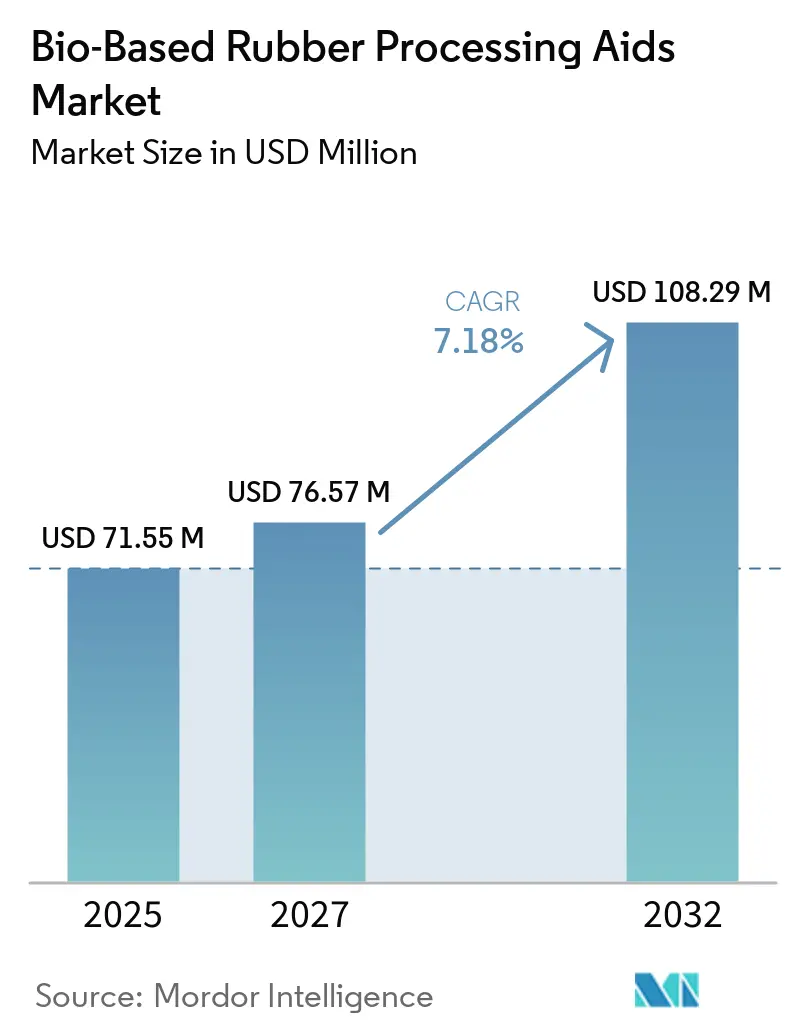
The Bio-Based Rubber Processing Aids Market size was valued at USD 71.55 billion in 2026 and is estimated to grow from USD 76.57 billion in 2027 to USD 108.29 billion by 2032, at a CAGR of 7.18% during the forecast period (2027-2032). The bio-based rubber processing aids market is being shaped by tighter controls on high-polycyclic aromatic hydrocarbon (PAH) oils and by tire manufacturers' efforts to reduce material-related emissions. EU REACH restrictions limit benzo[a]pyrene in tire extender oils to 1 mg/kg and total listed PAHs to 10 mg/kg, supporting the replacement of high-aromatic process oils in tire supply chains. Higher silica content in electric vehicle (EV) tires is also increasing demand for aids that disperse filler evenly while reducing rolling resistance. Producers are responding by using renewable feedstocks, pursuing mass-balance certification, and offering products that maintain established processing performance. The bio-based rubber processing aids market thus presents opportunities to address material qualification, silica compatibility, and renewable-content claims simultaneously.
Key Report Takeaways
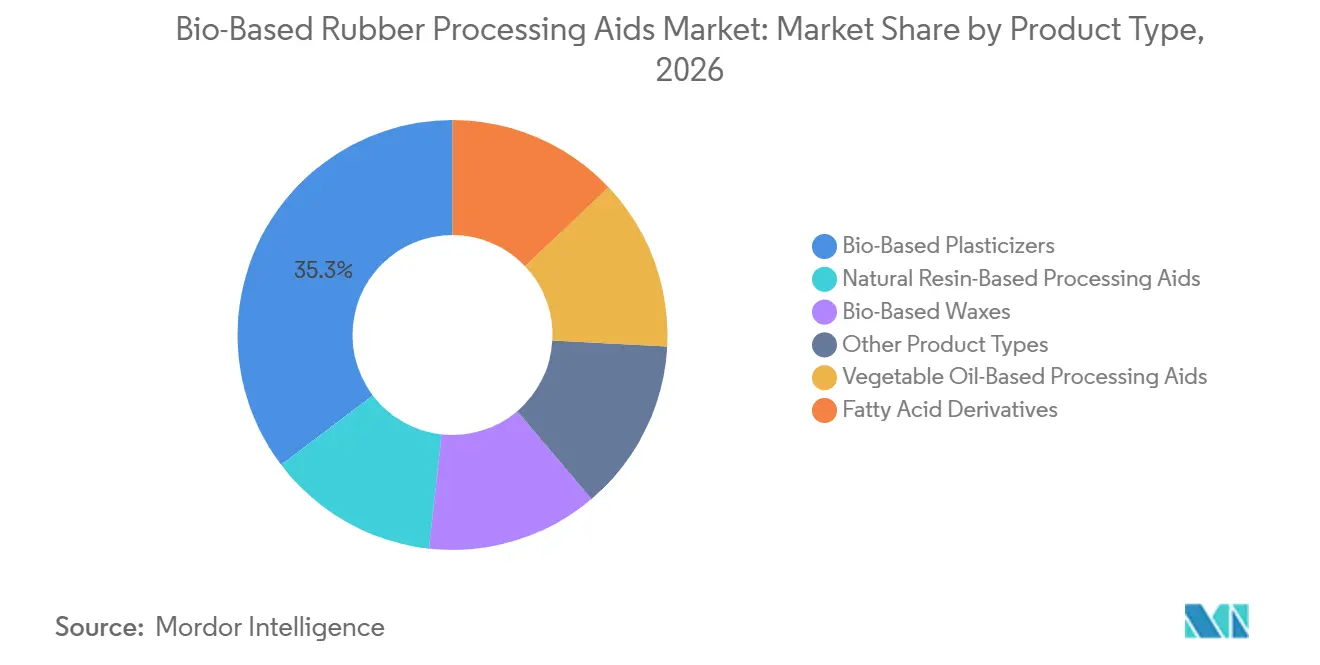
- By product type, bio-based plasticizers held 35.32% of the global market share in 2026 and are forecast to grow at a CAGR of 8.34% through 2032.
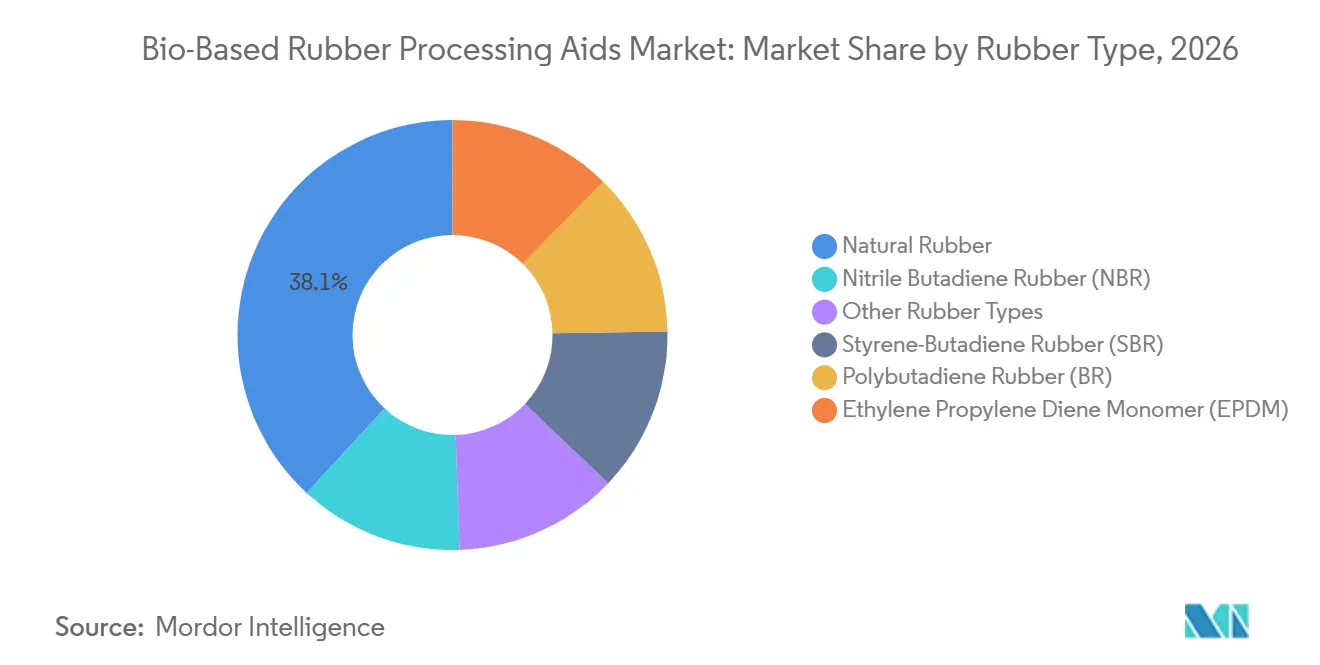
- By rubber type, natural rubber held 38.13% market share in 2026, while nitrile-butadiene rubber is forecast to record the highest CAGR of 7.92% through 2032.
- By geography, Asia-Pacific accounted for 44.56% of the global market share in 2026 and is projected to grow at a CAGR of 8.05% through 2032.
Note: Market numbers in this report are based on Mordor Intelligence's proprietary estimation framework, which combines nine months of actuals with Q4 projections for base year 2026.
Global Bio-Based Rubber Processing Aids Market Trends and Insights
Drivers Impact Analysis*
| Drivers | (~) % Impact on CAGR Forecast | Geographic Relevance | Impact Timeline |
|---|---|---|---|
| Tire and EV Compounders Seeking Lower-Carbon Drop-In Aids | +2.1% | Global, concentrated in Asia-Pacific, Europe, and North America | Short term (≤ 2 years) |
| Restrictions on High-Polycyclic Aromatic Hydrocarbons (PAH) Aromatic Oils | +1.5% | EU core, spillover to Asia-Pacific export markets | Medium term (2-4 years) |
| Renewable Feedstock Integration by Specialty Chemical Suppliers | +0.9% | Global, led by Europe and Asia-Pacific | Medium term (2-4 years) |
| Silica Dispersion and Low-Rolling-Resistance Formulation Demand | +1.2% | Asia-Pacific, North America, and the EU | Short term (≤ 2 years) |
| Multi-Function Vegetable-Oil Chemistry Reducing Mixing Energy | +0.8% | Asia-Pacific core, spillover to South America | Long term (≥ 4 years) |
| Source: Mordor Intelligence | |||
Tire and EV Compounders Seeking Lower-Carbon Drop-In Aids
EV tires need to manage higher initial torque while maintaining low rolling resistance, which increases the importance of compound design. Higher silica loadings can reduce rolling resistance, but they require effective dispersion without compromising tensile integrity. This creates demand in the bio-based rubber processing aids market for polar materials that support more even filler distribution. In July 2025, Pirelli introduced the P Zero, a standard-production tire with more than 70% bio-based and recycled content, including plant-based plasticizers, rice husk-derived silica, and Forest Stewardship Council (FSC)-certified natural rubber. The tire was developed for Jaguar Land Rover (JLR) Range Rover models and certified by Bureau Veritas, demonstrating that high bio-content can be used in a production tire with demanding specifications. Continental's plan to source more than 40% of tire materials from renewable and recycled origins by 2030 also supports longer-term demand for qualified renewable additives.
Restrictions on High-Polycyclic Aromatic Hydrocarbons (PAH) Aromatic Oils
Restrictions on aromatic oils support substitution in tire compounds and strengthen the regulatory case for renewable alternatives. REACH limits certain PAHs in tire extender oils, making compliance a material-selection issue for suppliers serving Europe. A 2025 study found that a 50/50 blend of bio-based di-ester oil and hydrocarbon resin matched the glass-transition-temperature profile of Treated Distillate Aromatic Extract (TDAE) in silica-filled Styrene-Butadiene Rubber (SBR)/Butadiene Rubber (BR) compounds. The same study reported a 60% reduction in carbon footprint, while certain formulations showed lower abrasion resistance than the TDAE reference. Asian manufacturers exporting tires for European vehicle platforms must meet these requirements in finished products, even when their own plants are outside the EU. This makes the bio-based rubber processing aids market relevant to upstream suppliers in China, Korea, and Thailand.
Renewable Feedstock Integration by Specialty Chemical Suppliers
Specialty chemical producers are changing feedstocks within existing product families instead of introducing separate bio-based lines. This approach can reduce the qualification work required from customers because the performance target remains unchanged. In April 2025, Arkema converted its European acrylic-thickener production to bio-sourced ethyl acrylate derived from beetroot and sugarcane, achieving up to 30% bio-based content and a 25% reduction in the product's carbon footprint[1]. In June 2025, BASF transitioned its Rheovis range at Ludwigshafen and Bradford to bio-based ethyl acrylate, with up to 35% biogenic carbon content and up to 30% lower carbon footprint. These examples show how renewable integration can move into established supply channels without changing the customer's intended use. In the bio-based rubber processing aids market, International Sustainability and Carbon Certification (ISCC) PLUS mass-balance certification is an important qualification feature for suppliers serving European Original Equipment Manufacturer (OEM)-aligned tire makers.
Silica Dispersion and Low-Rolling-Resistance Formulation Demand
In the bio-based rubber processing aids market, silica is used in premium tire treads to reduce rolling resistance while maintaining wet grip. Its hydrophilic surface can aggregate in hydrophobic rubber compounds, making uniform dispersion a key formulation requirement. LANXESS launched Aflux SD in 2025 for highly silica-filled compounds, featuring functionalized polymers, with stated benefits in rolling resistance, wear resistance, and wet grip. A 2025 study found that engineered silica networks reduced tan delta at 60°C by 30%, a commonly used indicator of rolling-resistance behavior in rubber compounds. Bio-based aids that combine plasticizing and coupling functions can address dispersion issues and reduce the formulation's carbon footprint. Vegetable-oil chemistry that also reduces mixing energy provides the bio-based rubber processing aids market an additional path to value in large-scale compounding.
Restraints Impact Analysis*
| Restraints | (~) % Impact on CAGR Forecast | Geographic Relevance | Impact Timeline |
|---|---|---|---|
| Feedstock Cost and Crop-Linked Supply Volatility | -0.7% | Global, acute in Asia-Pacific and South America | Short term (≤ 2 years) |
| Formulation Requalification for Variable Bio-Based Chemistry | -0.5% | Global | Medium term (2-4 years) |
| Performance Trade-Offs in Extreme Heat and High-Shear Applications | -0.4% | Global, highest relevance in industrial rubber goods | Long term (≥ 4 years) |
| Source: Mordor Intelligence | |||
Feedstock Cost and Crop-Linked Supply Volatility
Bio-based chemical producers rely on soy, palm, and castor oils, but these feedstocks also face demand from renewable diesel and sustainable aviation fuel supply chains. This competition can increase pressure on input costs in the bio-based rubber processing aids market. Research from the University of Illinois, published in October 2025, found that rising U.S. biofuel demand altered soybean price relationships and increased price uncertainty for downstream buyers[2]. A 2025 American Chemical Society (ACS) study also found that trade disputes and geopolitical shocks can transmit volatility from energy markets into biofuel feedstocks, with stronger price responses to negative shocks. Formulators have limited ability to fully hedge crop-linked costs, particularly when product contracts have fixed qualification periods. For the bio-based rubber processing aids market, the result is margin pressure that can delay conversions even where technical demand remains strong.
Formulation Requalification for Variable Bio-Based Chemistry
Bio-based inputs can vary by season and feedstock source, including fatty acid profiles in vegetable oils and resin acid distributions in tall oil. These variations can affect compound behavior and require repeated checks of Mooney viscosity and dynamic mechanical performance. A 2025 study of glycerol trilevulinate reported an onset degradation temperature of 226°C in natural-rubber compounds, compared with 262°C for a petroleum-based reference. This difference illustrates why thermal behavior must be screened before production-scale approval. Extreme-heat and high-shear conditions can also expose abrasion trade-offs in some bio-based di-ester and resin formulations. Until acceptance specifications are more widely standardized, requalification costs will continue to favor incumbent materials with long production records.
*Our forecasts treat driver/restraint impacts as directional, not additive. The impact forecasts reflect baseline growth, mix effects, and variable interactions.
Segment Analysis
By Product Type: Bio-Based Plasticizers Set the Formulation Agenda
Bio-based plasticizers held 35.32% of the global category share in 2026 and are projected to grow at a CAGR of 8.34% through 2032. This position reflects demand for materials that support processing performance and lower-carbon sourcing. Ester-based plasticizers made from castor oil, soybean oil, and glycerol platform chemicals offer low migration in automotive applications. Their polar groups improve compatibility with silica fillers and support low-temperature flexibility. A 2025 study found that glycerol trilevulinate maintained a breaking strength nearly equivalent to that of unplasticized natural rubber, attributed to enhanced chain mobility and strain-induced crystallization. The study also found a 5-percentage-point reduction in compound reversion compared with petroleum-based trioctyl trimellitate (TOTM).
Vegetable oil-based processing aids are the second-largest category in the bio-based rubber processing aids market. A 2025 study of functionalized soybean oil in silica-reinforced natural rubber (NR)/ethylene-propylene-diene monomer (EPDM) blends reported a 17% higher tensile strength than the naphthenic oil reference. Fatty-acid derivatives are used for lubrication and mold release in technical rubber goods. Natural resin-based aids provide tack and green strength in natural-rubber-heavy compounds. Bio-based waxes are used for surface protection in EPDM and styrene-butadiene rubber (SBR) compounds, where paraffin waxes face reformulation pressure. Suppliers with integrated oleochemical platforms can package bio-lubricants, polyols, and polymer additives together, broadening their offering beyond a single process oil replacement.

By Rubber Type: Natural Rubber Leads Consumption While NBR Records the Fastest Growth
Within the bio-based rubber processing aids market, natural rubber accounted for 38.13% of bio-based processing-aid consumption in 2026. Its scale and compatibility with vegetable-oil-based materials make it an important base for the market. Polar groups in these materials interact effectively with the amorphous and crystalline structure of natural rubber. Styrene-butadiene rubber (SBR) is the second-largest rubber substrate by aid consumption. In 2025 research, soybean oil-based coupling agents used in green tire treads improved wear resistance by 30% and skid resistance by 29% compared with conventional silane coupling agents. Ethylene propylene diene monomer (EPDM) and butadiene rubber (BR) remain mid-consumption materials, with interest in bio-based waxes, functionalized oils, and renewable upstream feedstocks.
Nitrile butadiene rubber (NBR) is projected to grow at a CAGR of 7.92% through 2032, making it the fastest-growing rubber type. Growth is linked to EV battery seals, oil-resistant hoses, and medical components that face sustainability review within OEM supply chains. NBR requires high-polarity plasticizers, which aligns it with bio-based ester chemistry. Michelin, IFPEN, and Axens reported progress in the BioButterfly project in December 2025, including polymer-grade BR and SBR made from bio-based butadiene, with homologation targeted for mid-2026. This work supports a broader shift in rubber-material supply toward renewable feedstocks. The bio-based rubber processing aids market can benefit when processing aids and base elastomers advance along the same qualification pathway.
Geography Analysis
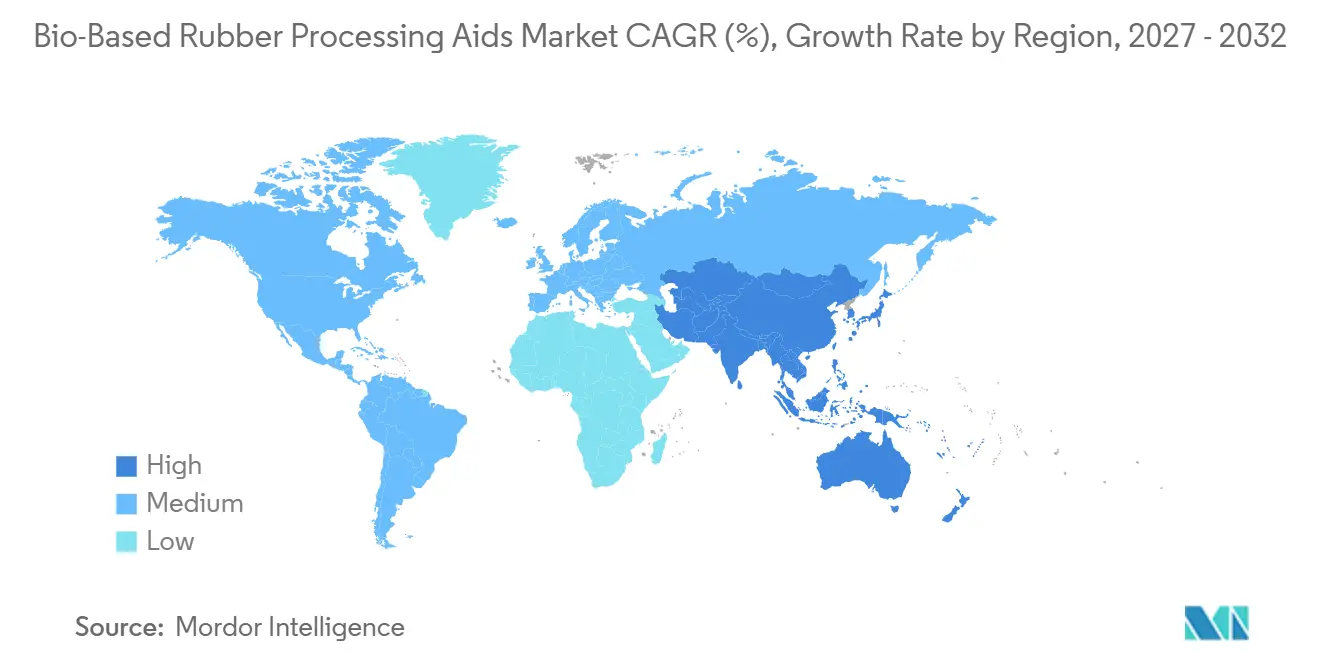
Asia-Pacific held 44.56% of the global market share in 2026 and is forecast to expand at a CAGR of 8.05% through 2032. China is the regional production anchor as the world's largest tire-manufacturing base. The China Rubber Industry Association has identified green additives as a priority, aiming to account for more than 70% of the total rubber-additive output value under the 15th Five-Year Plan. In March 2025, Yanggu Huatai Chemical began construction of a 30,000-ton-per-year rubber-additive complex in Thailand, incorporating biomass-based raw-material substitution for processing aids and protective waxes. Japan is pursuing a differentiated technical path, developing pine-resin-derived tire softeners tailored to EV tire specifications.
India, ASEAN, and South Korea contribute to regional demand by expanding tire capacity and by exporting natural rubber products. Thailand, Indonesia, and Vietnam combine a natural rubber supply with growing tire manufacturing activity, creating a practical basis for adoption as producers seek processing aids suited to natural rubber compounding. Europe has a significant effect on the bio-based rubber processing aids market by setting polycyclic aromatic hydrocarbon (PAH) restrictions and certification expectations that influence global supplier qualification. In September 2025, Continental became the first tire manufacturer to use LANXESS Vulkanox HS Scopeblue in series production. The additive is ISCC PLUS-certified, uses bio-circular acetone, and has a carbon footprint more than 30% lower than that of the conventional 2,2,4-trimethyl-1,2-dihydroquinoline (TMQ) equivalent.
In North America, the bio-based rubber processing aids market is supported by OEM sustainability commitments and the potential cost benefits of domestic renewable inputs. Suppliers can use these commitments to justify specification-led material development rather than competing solely on process oil cost. South America, led by Brazil, holds a supply-side advantage from its sugarcane and oleochemical base. Bioethanol feedstocks in the BioButterfly commercialization pathway could support Brazilian industrial partners. The Middle East and Africa represent smaller near-term output in the bio-based rubber processing aids market, though specialty and bio-based chemical investment in the region could change local supply conditions during the forecast period.
Competitive Landscape
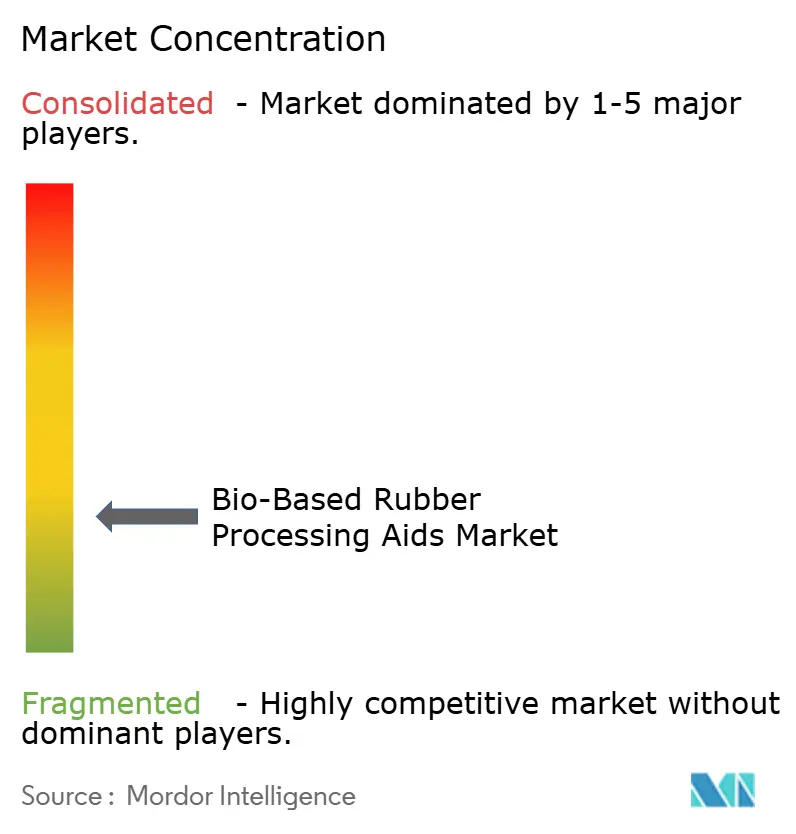
The bio-based rubber processing aids market is fragmented. LANXESS, BASF, Arkema, Emery Oleochemicals, Schill+Seilacher, and SI Group have established qualification experience with tire and rubber customers. Their competitive strength lies in the breadth of formulations, customer approval records, and mass-balance certification infrastructure. Incumbents are converting existing product families to bio-circular feedstocks while seeking to retain molecular architecture and processing performance. This reduces customer switching friction and turns certification into a more durable competitive advantage. Goodyear's 2025 patent US 12,397,585 identifies bio-derived processing aids and vegetable triglyceride oils as components of tire rubber compositions with a majority renewable content.
LANXESS and Continental provided a direct production-scale example in September 2025, when Vulkanox HS Scopeblue entered Continental's series tire production. Arkema's April 2025 conversion to bio-sourced ethyl acrylate demonstrated the value of adapting an established production line rather than requiring customers to qualify an entirely new product family. BASF applied the same approach to the Rheovis range in June 2025. Pirelli's P Zero program provides a downstream example of how plant-based plasticizers and other renewable materials are being used in a commercial high-performance tire. These developments increased the value of supplier relationships that can support both material data and OEM qualification work.
Chinese suppliers are closing technical gaps through state-supported development under the country's dual-carbon policy framework. The bio-based rubber processing aids market has room for scalable products that combine bio-based silane coupling and dispersing functions. Research on soybean oil-based coupling agents supports the performance case, but commercial availability remains limited. Another opportunity is the validation of bio-based aids for NBR in sustained high-temperature service. Suppliers that improve ester durability under these conditions could gain access to the fastest-growing rubber-type application.
Bio-Based Rubber Processing Aids Industry Leaders
-
LANXESS
-
NYNAS AB
-
Emery Oleochemicals
-
Arkema
-
TotalEnergies
- *Disclaimer: Major Players sorted in no particular order
Recent Industry Developments
- November 2025: Struktol Company of America (part of the Schill+Seilacher group) launched RP 17 and RP 53, combination additives designed for odor control and processing efficiency in natural and synthetic rubber compounds formulated with high recycled content. This extended sustainable processing aids applications into circular-materials compounding.
- July 2025: Pirelli launched the P Zero as the first standard-production tire globally with more than 70% bio-based and recycled content. The tire incorporates plant-based plasticizers, rice husk-derived silica, bio-circular polymers, and FSC-certified natural rubber. Developed for Jaguar Land Rover (JLR)'s Range Rover and certified by Bureau Veritas, the tire demonstrates that Ultra High Performance (UHP) standards and high bio-based content can be achieved simultaneously.
Global Bio-Based Rubber Processing Aids Market Report Scope
Bio-based rubber processing aids are renewable chemical additives derived from plant or animal sources. They are mixed into natural or synthetic rubber during manufacturing to improve material flow, mixing, and molding, and serve as direct replacements for traditional petroleum-based mineral oils and synthetic lubricants.
The bio-based rubber processing aids market is segmented by product type, rubber type, and geography. By product type, the market is segmented into vegetable oil-based processing aids, bio-based plasticizers, fatty acid derivatives, natural resin-based processing aids, bio-based waxes, and other product types. By rubber type, the market is segmented into natural rubber, styrene-butadiene rubber (SBR), polybutadiene rubber (BR), ethylene-propylene-diene monomer (EPDM), nitrile-butadiene rubber (NBR), and other rubber types. The report also covers market sizes and forecasts for the global bio-based rubber processing aids across 15 countries in major regions. The market sizes and forecasts are provided in terms of value (USD).
| Vegetable Oil-Based Processing Aids |
| Bio-Based Plasticizers |
| Fatty Acid Derivatives |
| Natural Resin-Based Processing Aids |
| Bio-Based Waxes |
| Other Product Types |
| Natural Rubber |
| Styrene-Butadiene Rubber (SBR) |
| Polybutadiene Rubber (BR) |
| Ethylene Propylene Diene Monomer (EPDM) |
| Nitrile Butadiene Rubber (NBR) |
| Other Rubber Types |
| Asia-Pacific | China |
| India | |
| Japan | |
| South Korea | |
| ASEAN Countries | |
| Rest of Asia-Pacific | |
| North America | United States |
| Canada | |
| Mexico | |
| Europe | Germany |
| United Kingdom | |
| France | |
| Italy | |
| NORDIC Countries | |
| Rest of Europe | |
| South America | Brazil |
| Argentina | |
| Rest of South America | |
| Middle East and Africa | Saudi Arabia |
| South Africa | |
| Rest of Middle East and Africa |
| By Product Type | Vegetable Oil-Based Processing Aids | |
| Bio-Based Plasticizers | ||
| Fatty Acid Derivatives | ||
| Natural Resin-Based Processing Aids | ||
| Bio-Based Waxes | ||
| Other Product Types | ||
| By Rubber Type | Natural Rubber | |
| Styrene-Butadiene Rubber (SBR) | ||
| Polybutadiene Rubber (BR) | ||
| Ethylene Propylene Diene Monomer (EPDM) | ||
| Nitrile Butadiene Rubber (NBR) | ||
| Other Rubber Types | ||
| By Geography | Asia-Pacific | China |
| India | ||
| Japan | ||
| South Korea | ||
| ASEAN Countries | ||
| Rest of Asia-Pacific | ||
| North America | United States | |
| Canada | ||
| Mexico | ||
| Europe | Germany | |
| United Kingdom | ||
| France | ||
| Italy | ||
| NORDIC Countries | ||
| Rest of Europe | ||
| South America | Brazil | |
| Argentina | ||
| Rest of South America | ||
| Middle East and Africa | Saudi Arabia | |
| South Africa | ||
| Rest of Middle East and Africa | ||
Key Questions Answered in the Report
What is current market size of Bio-Based Rubber Processing Aids Market?
The Bio-Based Rubber Processing Aids Market size was valued at USD 71.55 billion in 2026 and is estimated to grow from USD 76.57 billion in 2027 to USD 108.29 billion by 2032, at a CAGR of 7.18% during the forecast period (2027-2032).
Which product category is growing fastest?
Bio-based plasticizers are projected to grow at a CAGR of 8.34% through 2032 and held a 35.32% share in 2026.
Which rubber type has the strongest growth outlook?
Nitrile butadiene rubber is forecast to expand at a CAGR of 7.92% through 2032, supported by EV seals, oil-resistant hoses, and medical components.
Which region leads demand?
Asia-Pacific held a 44.56% share in 2026 and is forecast to grow at a CAGR of 8.05% through 2032.