
Bio-Based Propylene Glycol Market Size and Share
Market Overview
| Study Period | 2021 - 2031 |
|---|---|
| Market Size (2026) | USD 4.91 Billion |
| Market Size (2031) | USD 6.04 Billion |
| Growth Rate (2026 - 2031) | 4.24 % |
| Fastest Growing Market | Asia-Pacific |
| Largest Market | Asia-Pacific |
| Market Concentration | Low |
Major Players *Disclaimer: Major Players sorted in no particular order Image © Mordor Intelligence. Reuse requires attribution under CC BY 4.0. | |
Bio-Based Propylene Glycol Market Analysis by Mordor Intelligence
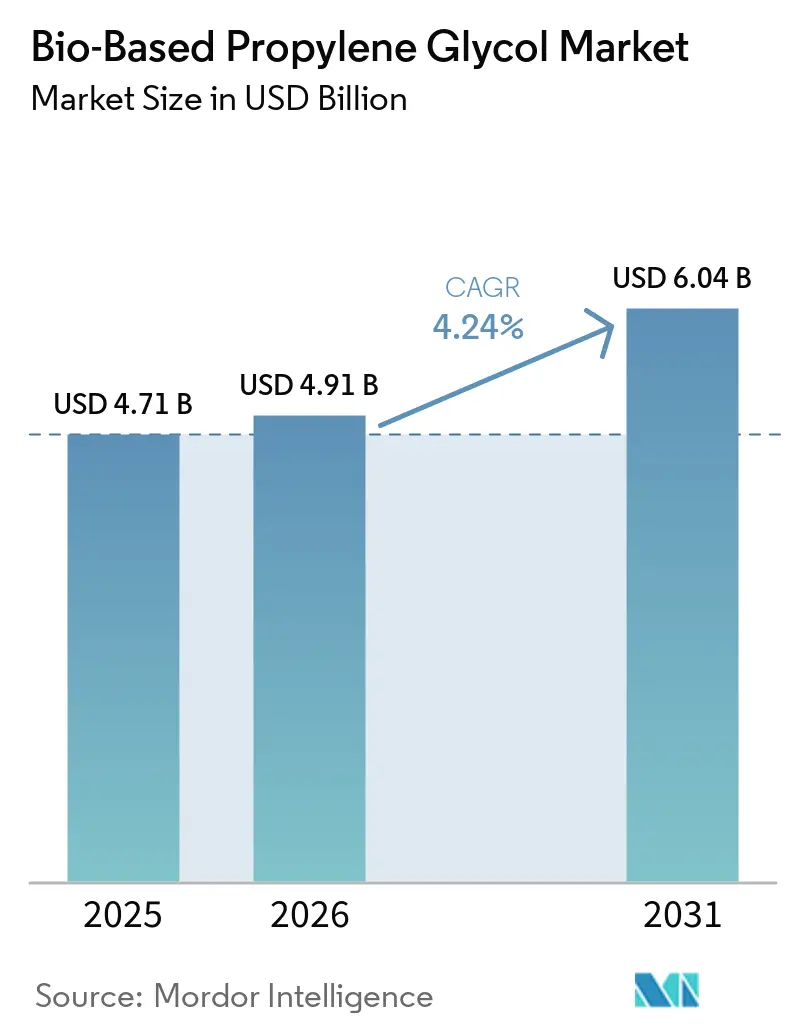
The Bio-Based Propylene Glycol Market size was valued at USD 4.71 billion in 2025 and is estimated to grow from USD 4.91 billion in 2026 to reach USD 6.04 billion by 2031, at a CAGR of 4.24% during the forecast period (2026-2031). The bio-based propylene glycol market benefits from glycerin availability as biodiesel production expands, which gives producers a renewable feedstock route for glycol production. Procurement requirements for renewable content and supply-chain traceability are widening the addressable customer base in consumer, industrial, and pharmaceutical formulations. Producers with captive glycerin and certified processes can reduce feedstock exposure while meeting more demanding buyer qualification requirements. The bio-based propylene glycol market is also supported by demand for lower-toxicity coolant solutions and certified ingredients in regulated applications. Premium demand depends on reliable certification, purity control, and delivery capability rather than capacity alone.
Key Report Takeaways
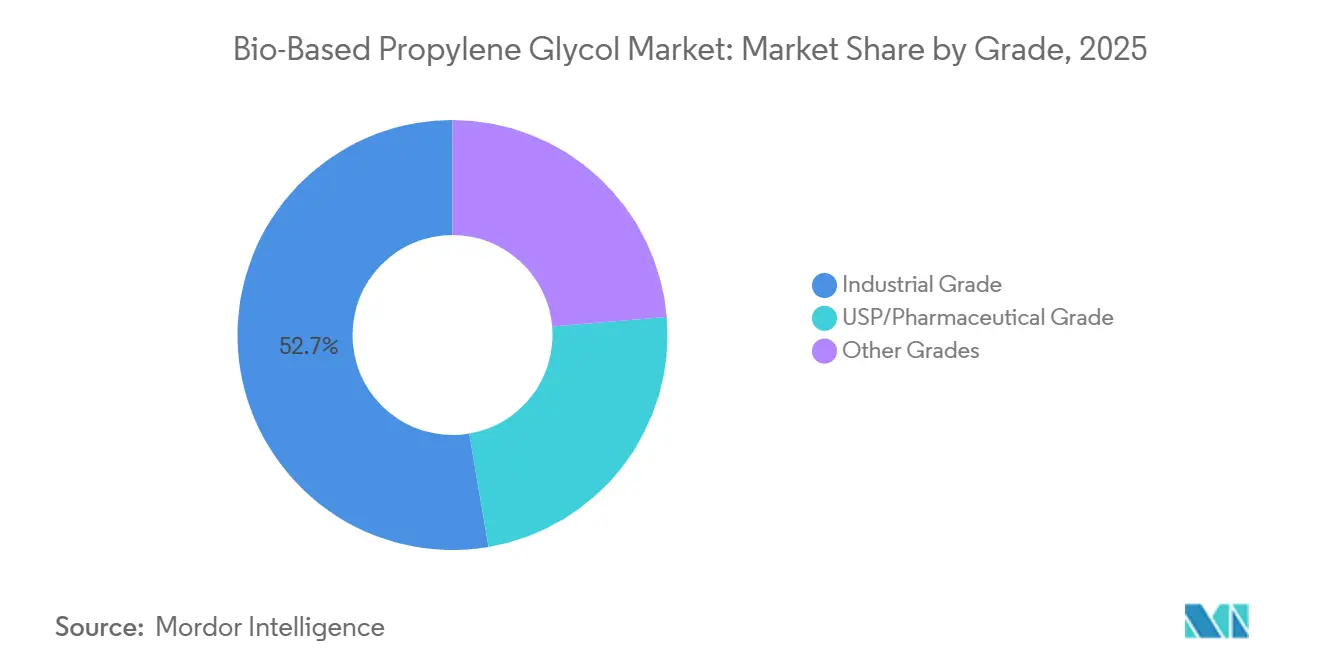
- By grade, industrial grade held 52.67% of the bio-based propylene glycol market share in 2025, while USP/pharmaceutical grade is projected to advance at a 5.04% CAGR through 2031.
- By application, antifreeze and coolant held 30.45% of the bio-based propylene glycol market share in 2025 and is projected to advance at a 5.25% CAGR through 2031.
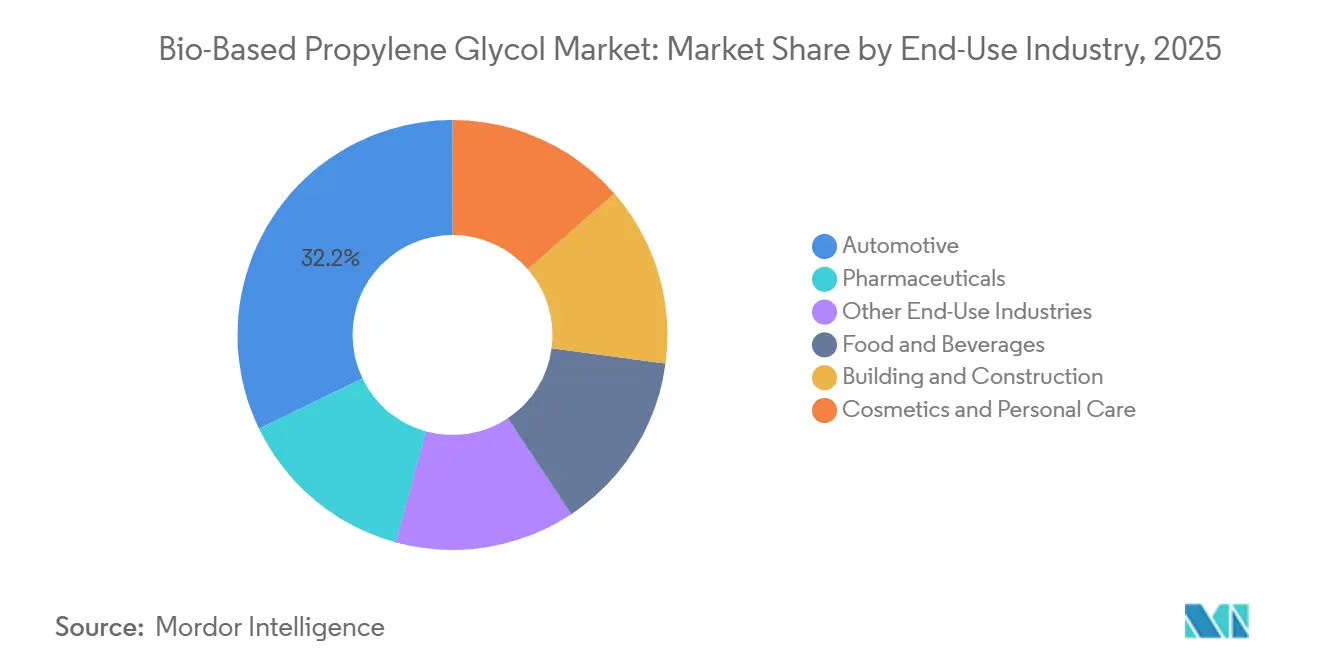
- By end-use industry, automotive held 32.18% of the bio-based propylene glycol market share in 2025, while pharmaceuticals is projected to advance at a 5.42% CAGR through 2031.
- By geography, Asia-Pacific held 34.23% of the bio-based propylene glycol market share in 2025 and is projected to advance at a 5.11% CAGR through 2031.
Note: Market size and forecast figures in this report are generated using Mordor Intelligence’s proprietary estimation framework, updated with the latest available data and insights as of January 2026.
Global Bio-Based Propylene Glycol Market Trends and Insights
Drivers Impact Analysis*
| Driver | (~) % Impact on CAGR Forecast | Geographic Relevance | Impact Timeline |
|---|---|---|---|
| Renewable Glycerin Valorization from Biodiesel Streams | +1.2% | Global, concentrated in North America, EU, and ASEAN | Short term (≤ 2 years) |
| Sustainability Specifications in Regulated Formulations | +1.0% | North America & Europe, spillover to Asia-Pacific | Medium term (2–4 years) |
| EV Thermal-Management and Low-Toxicity Coolant Adoption | +0.8% | Asia-Pacific, North America, Europe | Medium term (2–4 years) |
| Bio-Based Content Requirements in Construction Composites | +0.5% | Europe (core), spillover to North America | Long term (≥ 4 years) |
| Drop-In Qualification of Renewable Propylene Glycol | +0.3% | Global | Medium term (2–4 years) |
| Source: Mordor Intelligence | |||
Renewable Glycerin Valorization from Biodiesel Streams
Biodiesel capacity additions continued through 2024 and sustained glycerin output beyond traditional soap and oleochemical demand channels[1]International Energy Agency, “Biofuels,” International Energy Agency, iea.org. Every 100 pounds of biodiesel generates 10 pounds of crude glycerin, directly linking biofuel expansion to renewable glycol feedstock availability. This feedstock stream gives the bio-based propylene glycol market a direct link to biofuel production and renewable feedstock availability. Crude glycerin from mixed-feedstock operations can contain methanol residues, catalyst salts, and color bodies. Those impurities require further refining before the material can enter food grade or pharmaceutical grade hydrogenolysis. ADM refines glycerol before catalytic conversion at its Decatur, Illinois, operation, giving integrated producers greater control over feedstock quality. Air Liquide states that its BioPG process uses liquid-phase hydrogenolysis at 175 °C to 195 °C and 75 to 200 bar over a copper catalyst, producing pharmaceutical grade and technical grade material from renewable glycerin. Air Liquide also reports that the process can reduce greenhouse gas emissions by up to 70% compared with petrochemical routes. This supports demand from buyers that assesses renewable content and environmental performance together. The bio-based propylene glycol market can benefit when conversion performance supports both requirements.
Sustainability Specifications in Regulated Formulations
Consumer goods, pharmaceutical, and food companies are applying renewable sourcing requirements through supplier qualification processes and sustainability reporting. These requirements connect corporate Scope 3 reporting with customer expectations for renewable content in finished formulations. Dow offers Propylene Glycol REN from an International Sustainability and Carbon Certification PLUS certified process and states that the product contains at least 50% bio-based content. The U.S. Food and Drug Administration guidance requires testing of high-risk drug components, including propylene glycol, for diethylene glycol and ethylene glycol contamination. This requirement raises the importance of traceable sourcing for liquid pharmaceutical formulations and puts greater weight on validated quality systems. ADM states that its EVO-100 product meets United States Pharmacopeia, National Formulary, Food Chemicals Codex, and European Pharmacopoeia requirements. The bio-based propylene glycol market, therefore, rewards suppliers that can combine renewable-content claims with quality documentation and a validated supply chain. This combination can reduce buyer concern over contamination, certification status, and supplier traceability. It is particularly relevant where a formulation must meet both product quality and sourcing expectations.
EV Thermal-Management and Low-Toxicity Coolant Adoption
Electric vehicle battery systems are increasing the demand for water-glycol fluids with controlled electrical conductivity. China implemented GB29743.2 in October 2025, limiting the conductivity of water-glycol coolants in newly developed electric vehicle platforms to 100 µS/cm. Arteco presented testing that compared high-conductivity and low-conductivity coolants in a 57 Ah nickel manganese cobalt prismatic cell at 400 volts. The work reported immediate short-circuit behavior with conventional coolant at 5,000 µS/cm and lower escalation risk at 100 µS/cm under the same test conditions. This performance requirement favors carefully purified glycol formulations in battery-adjacent cooling circuits, where electrical safety and fluid quality are closely linked. Arteco offers a Freecor EV ECO range using International Sustainability and Carbon Certification PLUS certified mass-balance monopropylene glycol. As vehicle makers refine coolant specifications, the bio-based propylene glycol market can serve both safety and renewable-content requirements. Propylene glycol also has a safety profile that supports use in battery-adjacent applications where accidental leakage is a consideration. Renewable variants extend that technical value proposition for manufacturers with supply-chain reporting requirements.
Drop-In Qualification of Renewable Propylene Glycol
Renewable propylene glycol can be qualified in applications that already use conventional propylene glycol when it meets the required purity, performance, and documentation standards. This allows formulators to adopt renewable inputs without changing the core role of glycol in their products. ADM supplies plant-based propylene glycol grades for industrial, food, pharmaceutical, and personal care uses, supporting qualification across established application areas. Dow also offers certified bio-circular propylene glycol for food, pharmaceutical, and personal care customers through its Propylene Glycol REN portfolio. The main requirement is that suppliers provide consistent quality, traceability, and certification that fit existing customer specifications.
Restraints Impact Analysis*
| Restraint | (~) % Impact on CAGR Forecast | Geographic Relevance | Impact Timeline |
|---|---|---|---|
| Cost Premium Versus Petrochemical Propylene Glycol | -1.2% | Global, particularly commodity-grade industrial markets in Asia-Pacific | Medium term (2–4 years) |
| Feedstock Price and Purity Volatility | -1.0% | Global, concentrated in Asia-Pacific and North America | Short term (≤ 2 years) |
| Limited Certified Supply for Pharma and Food Grades | -0.8% | North America & Europe, with spillover to South and Southeast Asia | Long term (≥ 4 years) |
| Source: Mordor Intelligence | |||
Cost Premium Versus Petrochemical Propylene Glycol
Bio-based propylene glycol carried a 20% to 30% price premium over fossil-derived grades in Europe, depending on grade and certification level. The premium ranged from 20% to 50% in North America, where dedicated renewable refining infrastructure and documentation requirements could add cost. Certification, chain-of-custody audits, and specialized processing affect the delivered cost of certified grades. The premium had narrowed from 45% in 2015 to 18% to 20% by 2025 as capacity and conversion efficiency improved. Industrial buyers using glycol as a solvent, antifreeze base, or resin diol remain sensitive to the price gap. The bio-based propylene glycol market will depend on procurement rules and customer willingness to value verified lower-carbon content in these cost-sensitive applications.
Feedstock Price and Purity Volatility
Crude glycerin pricing is tied to biodiesel production economics and the execution of biofuel mandates. Producers without captive glycerin refining assets can face higher spot prices and quality risks from mixed-feedstock biodiesel streams. A batch-level purity failure can lead to rejection in food grade and pharmaceutical grade applications, where a single event can affect supplier qualification. The United States Department of Agriculture BioPreferred Program identifies certified products that meet the program’s bio-based requirements, but certification does not eliminate raw-material price volatility[2]U.S. Department of Agriculture, “About the BioPreferred Program,” United States Department of Agriculture, biopreferred.gov. Leading facilities have improved glycerol-to-propylene glycol conversion efficiency to more than 95%, reducing yield losses but not exposure to changing feedstock prices. Integrated producers can strengthen their margin position during volatile periods, while smaller independent converters have less capacity to fund certification upgrades or expansion. These conditions favor integrated suppliers and can limit investment capacity among smaller independent converters.
*Our forecasts treat driver/restraint impacts as directional, not additive. The impact forecasts reflect baseline growth, mix effects, and variable interactions.
Segment Analysis
By Grade: Industrial Grade Anchors Revenue, USP/Pharmaceutical Grade Accelerates Fastest
Industrial grade held 52.67% of the bio-based propylene glycol market share in 2025. It serves antifreeze formulations, industrial solvents, unsaturated polyester resin production, and functional fluids. Industrial grade output generally needs less distillation and purification than pharmacopeial grade material. This processing profile makes it a practical first product for new renewable glycol capacity. The grade’s broad application base keeps it important to the bio-based propylene glycol industry across industrial value chains.
USP/pharmaceutical grade is projected to advance at a 5.04% CAGR through 2031. Pharmaceutical companies are seeking traceable inputs for liquid dosage forms and excipient systems. ADM states that EVO-100 meets several pharmacopeial standards and has 100% bio-based carbon content certified under ASTM D6866. Producers that upgrade industrial capacity to pharmaceutical grade output must make material investments in purification, validation, and quality control. Those investments can give certified suppliers access to higher-value customer requirements.



By Application: Antifreeze and Coolant Command Both Leadership and Growth Momentum
Antifreeze and coolant accounted for 30.45% of the bio-based propylene glycol market size in 2025. The segment is projected to advance at a 5.25% CAGR through 2031. Automotive electrification is increasing the importance of controlled thermal-management fluids. China’s conductivity requirement for new electric vehicle coolant applications adds a quality specification to this demand. The bio-based propylene glycol market can support this application, where formulators need low impurity levels and renewable-content documentation.
Solvent applications serve pharmaceutical, personal care, and industrial process uses. Renewable-content certification can help formulators support sourcing claims for finished products. Chemical intermediates and unsaturated polyester resin applications benefit from the demand for documented material inputs in composite production. Other uses include de-icing, paints, and tobacco humectants. These applications provide baseline demand even where sustainability specifications are less important. Together, their diverse requirements reduce dependence on any single application within the bio-based propylene glycol market.
By End-Use Industry: Pharmaceuticals Leads Growth While Automotive Defines Scale
Automotive held 32.18% of the bio-based propylene glycol market size in 2025. Vehicle thermal-management systems now require fluids that meet requirements for conductivity, purity, and sustainability documentation. This has changed the quality needs for automotive glycol rather than reducing automotive demand. Food and beverages remain a stable source of demand because propylene glycol is used as a humectant, flavoring carrier, and anti-caking agent. Food-safe sourcing can also support branded product positioning.
Pharmaceuticals are projected to advance at a 5.42% CAGR through 2031. Growth is linked to pharmaceutical manufacturing capacity in India and the use of certified bio-based excipients under pharmacopeial standards. Building and construction demand is supported by composite producers that seek verified renewable propylene glycol content. Cosmetics and personal care manufacturers are applying renewable-input requirements to products such as skincare, shampoo, and toothpaste. Dow positions its certified bio-circular propylene glycol for personal care, pharmaceutical, and food applications. Detergents, marine uses, and specialty electronic applications add smaller demand streams to the bio-based propylene glycol market.
Geography Analysis
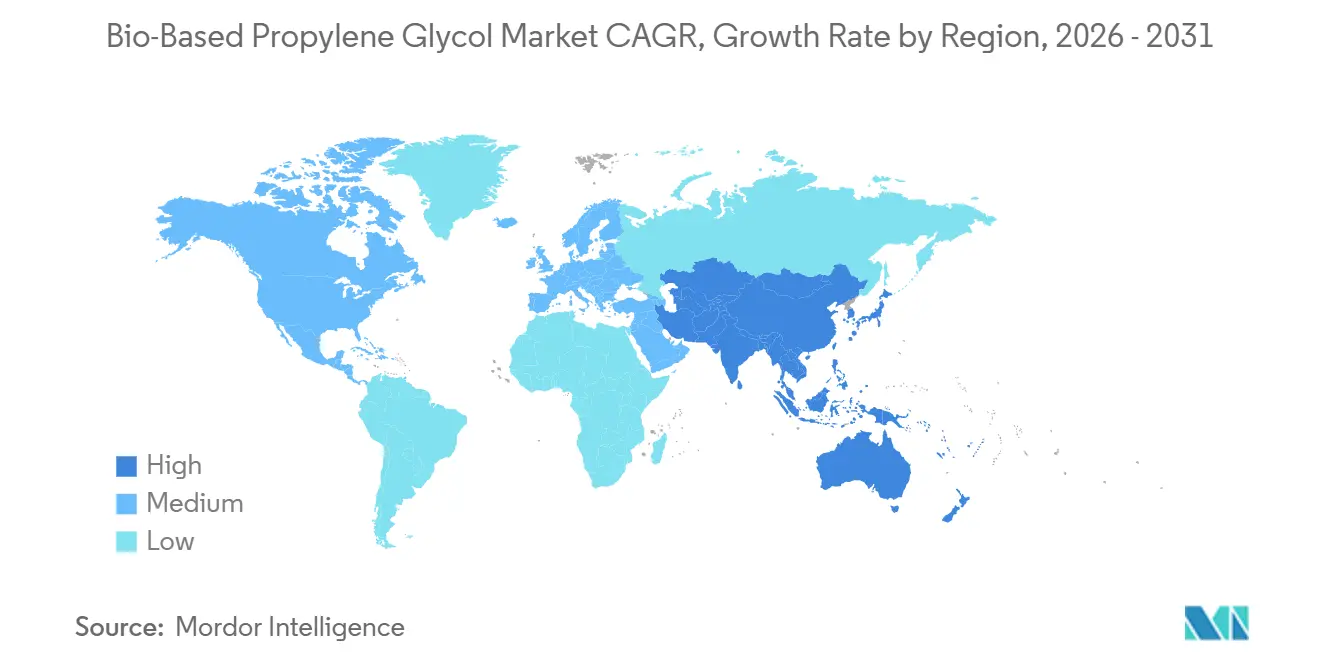
Asia-Pacific held 34.23% in 2025 and is projected to advance at a 5.11% CAGR through 2031. China supports the regional supply base through facilities in Henan, Shandong, and Jiangsu provinces. Dow’s Thailand site reached 250,000 metric tons per year after its 2024 expansion. The site earned International Sustainability and Carbon Certification PLUS certification in March 2025. India’s bio-based propylene glycol imports grew at a 13.43% CAGR from 2020 to 2024, supported by pharmaceutical manufacturing capacity. Japan and South Korea create demand for higher-value pharmaceutical, personal care, and automotive applications. Thailand’s palm-oil biodiesel glycerin infrastructure also gives ASEAN producers a cost-advantaged renewable feedstock base. These producers can serve both regional buyers and export markets.
North America is an important production and consumption center for the bio-based propylene glycol market. ADM and Cargill, Incorporated have soybean and canola processing networks that provide access to glycerin feedstock. ADM’s Decatur, Illinois, plant has produced bio-based propylene glycol commercially at 100,000 metric tons per year and serves industrial, food, pharmaceutical, and personal care customers. The plant uses soybean and canola-derived glycerin that ADM identifies as 100% bio-based under the United States Department of Agriculture BioPreferred Program. The BioPreferred Program provides federal purchasing preference for qualified products. ADM expanded North American capacity in December 2025 to meet demand from pharmaceutical and personal care customers. Food-facility cooling applications also value bio-based propylene glycol, where safety and product-contact requirements guide fluid selection. These factors support demand beyond environmental claims alone. They can give suppliers a role in regulated cooling and processing applications where technical suitability is required. Such use cases can support recurring consumption by qualified facilities. This positioning links feedstock management, certification, and application support in a way that shapes competitive performance over time.
Europe is shaped by buyer demand for mass-balance documentation and certified renewable inputs. LyondellBasell Industries N.V. offers International Sustainability and Carbon Certification PLUS certified low-carbon solutions using a mass-balance approach. BASF’s glycerin-to-propylene glycol catalyst technology supports renewable glycol production for plants using biodiesel-derived glycerin. South America has an opportunity in Brazil, where sugarcane-derived glycerin and industrial biotechnology infrastructure can support production. The Middle East and Africa remain at an earlier stage of development. Pharmaceutical manufacturing expansion in Egypt, Morocco, and South Africa can increase demand for United States Pharmacopeia grade material as facilities target export-quality standards. These regional needs broaden the geographic opportunity for the bio-based propylene glycol market. They also create demand for producers that can supply pharmacopeial quality with consistent certification documentation. Regional expansion is therefore tied to both capacity availability and qualification capability. Producers need to align local feedstock conditions with the purity requirements of target customers. This balance is particularly relevant where pharmaceutical manufacturing capacity is expanding.

Competitive Landscape
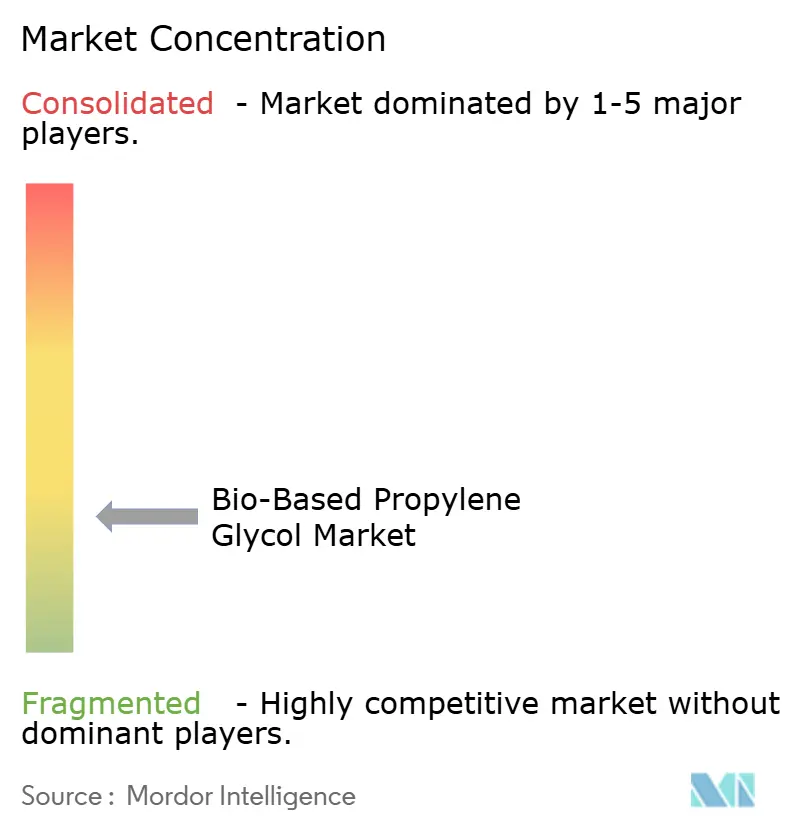
The bio-based propylene glycol market is highly fragmented, with the top five players including ADM, Dow, BASF, Cargill, Incorporated, and Oleon NV. ADM and Cargill, Incorporated benefit from soybean and canola processing networks that generate captive glycerin. ADM uses plant-based glycerin to produce industrial and United States Pharmacopeia grade offerings. This integration can provide more stable input economics than independent sourcing. Dow competes through certified bio-circular and circular product offerings for personal care, pharmaceutical, and food customers. The competitive position of these suppliers depends on their ability to meet quality and traceability requirements at a commercial scale. Suppliers without captive feedstock can still compete where they offer validated processing or specialized application support. However, feedstock integration remains important when crude glycerin prices move sharply. Across the bio-based propylene glycol market, this cost control supports consistent supply planning for qualified customers. It also allows producers to direct suitable glycerin streams toward the grade that offers the best fit.
Dow expanded propylene glycol capacity at Map Ta Phut, Thailand, by 80,000 metric tons per year in May 2024, taking the site’s total output to 250,000 metric tons per year. The facility then received International Sustainability and Carbon Certification PLUS certification in March 2025. ADM expanded bio-based propylene glycol capacity in North America in December 2025 for pharmaceutical, food, and personal care demand. UPM acquired Avantium’s Ray Technology intellectual property in May 2026 for the conversion of plant-based sugars into bio-based mono-propylene glycol and mono-ethylene glycol. This transaction adds a potential feedstock route outside biodiesel-derived glycerin. A lignocellulosic route could reduce exposure to biodiesel co-product cycles if it reaches commercial scale. It also enlarges the technology options available to producers seeking renewable glycol inputs. Within the bio-based propylene glycol market, alternative feedstocks can matter where biodiesel-linked glycerin is limited or volatile. The technology could eventually complement rather than replace established glycerin conversion routes.
BASF participates through glycerin-to-propylene glycol catalyst technology that can support third-party production. LyondellBasell Industries N.V. offers a low-carbon mass-balance range across Europe and the Americas. Air Liquide provides a BioPG process for converting renewable glycerin to propylene glycol. Oleon NV, Ashland, Huntsman International LLC, Shell plc, SKC, and Global Bio-Chem Technology Group Company Limited serve specialty or regional requirements. Competition is increasingly shaped by process validation, certification, and feedstock access. Companies that meet these requirements can address premium customer groups that are not served by commodity grade material alone. Oleon NV and Ashland serve European specialty customers, while Huntsman International LLC and Shell plc maintain selective positions through application formulations and integrated feedstock access. The bio-based propylene glycol market also favors companies that can show material traceability from feedstock through final delivery. Customer qualification can make this capability as important as the listed production capacity.
Bio-Based Propylene Glycol Industry Leaders
ADM
Dow
BASF
Cargill, Incorporated
Oleon NV
- *Disclaimer: Major Players sorted in no particular order

Recent Industry Developments
- July 2026: Safic-Alcan and Primient expanded the distribution of Primient’s 100% bio-based ZEMEA propanediol across Central, Eastern, and DACH Europe. The agreement expands access to plant-derived glycol alternatives for cosmetics and personal care formulations, supporting broader adoption of bio-based glycol solutions.
- May 2026: UPM acquired Avantium’s Ray Technology intellectual property for producing bio-based mono-propylene glycol from plant-based sugars. The acquisition expands UPM’s bio-based glycols technology portfolio and supports the development of renewable feedstock routes for propylene glycol production.


Global Bio-Based Propylene Glycol Market Report Scope
Bio-based propylene glycol is a renewable-source chemical produced from biomass-derived feedstocks rather than conventional fossil-based raw materials. It provides functional properties such as solvent performance, moisture retention, and freeze protection for a range of formulated products.
The Bio-Based Propylene Glycol Market is segmented by grade, application, end-use industry, and geography. By grade, the market is segmented into industrial grade, USP/pharmaceutical grade, and other grades. By application, the market is segmented into antifreeze and coolant, solvent, chemical intermediates, unsaturated polyester resin, and other applications. By end-use industry, the market is segmented into automotive, food and beverages, building and construction, pharmaceuticals, cosmetics and personal care, and other end-use industries. The report also covers the market size and forecasts for bio-based propylene glycol in 15 countries across major regions. For each segment, the market sizing and forecasts have been done on the basis of value (USD).
| Industrial Grade |
| USP/Pharmaceutical Grade |
| Other Grades |
| Antifreeze and Coolant |
| Solvent |
| Chemical Intermediates |
| Unsaturated Polyester Resin |
| Other Applications |
| Automotive |
| Food and Beverages |
| Building and Construction |
| Pharmaceuticals |
| Cosmetics and Personal Care |
| Other End-Use Industries |
| Asia-Pacific | China |
| India | |
| Japan | |
| South Korea | |
| ASEAN Countries | |
| Rest of Asia-Pacific | |
| North America | United States |
| Canada | |
| Mexico | |
| Europe | Germany |
| United Kingdom | |
| France | |
| Italy | |
| NORDIC Countries | |
| Rest of Europe | |
| South America | Brazil |
| Argentina | |
| Rest of South America | |
| Middle East and Africa | Saudi Arabia |
| South Africa | |
| Rest of Middle East and Africa |
| By Grade | Industrial Grade | |
| USP/Pharmaceutical Grade | ||
| Other Grades | ||
| By Application | Antifreeze and Coolant | |
| Solvent | ||
| Chemical Intermediates | ||
| Unsaturated Polyester Resin | ||
| Other Applications | ||
| By End-Use Industry | Automotive | |
| Food and Beverages | ||
| Building and Construction | ||
| Pharmaceuticals | ||
| Cosmetics and Personal Care | ||
| Other End-Use Industries | ||
| By Geography | Asia-Pacific | China |
| India | ||
| Japan | ||
| South Korea | ||
| ASEAN Countries | ||
| Rest of Asia-Pacific | ||
| North America | United States | |
| Canada | ||
| Mexico | ||
| Europe | Germany | |
| United Kingdom | ||
| France | ||
| Italy | ||
| NORDIC Countries | ||
| Rest of Europe | ||
| South America | Brazil | |
| Argentina | ||
| Rest of South America | ||
| Middle East and Africa | Saudi Arabia | |
| South Africa | ||
| Rest of Middle East and Africa | ||


Key Questions Answered in the Report
What is the size of the bio-based propylene glycol market?
The bio-based propylene glycol market stands at USD 4.91 billion in 2026 and is projected to reach USD 6.04 billion by 2031.
What is driving demand for bio-based propylene glycol?
Biodiesel-derived glycerin availability, renewable-content requirements, and demand for traceable inputs in regulated formulations support demand.
Which grade held the largest share in 2025?
Industrial grade held 52.67% of the market share in 2025 because it served broad uses in antifreeze, solvents, resins, and functional fluids.
Which application is projected to advance fastest through 2031?
Antifreeze and coolant are projected to advance at a 5.25% CAGR through 2031, supported by battery thermal-management requirements.
Page last updated on:


 Your data is secure and never sold or shared.


