
Benelux ITSM Market Size and Share
Market Overview
| Study Period | 2021 - 2031 |
|---|---|
| Forecast Data Period | 2026 - 2031 |
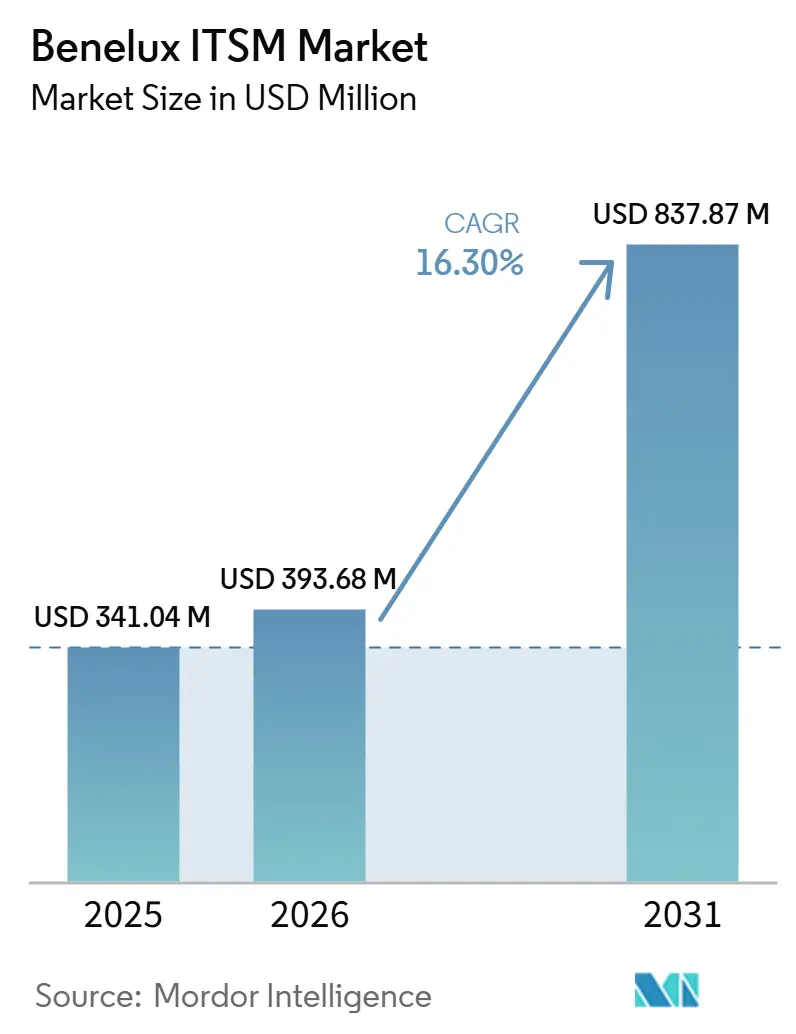
| Base Year Market Size (2025) | USD 341.04 Million |
| Market Size (2026) | USD 393.68 Million |
| Market Size (2031) | USD 837.87 Million |
| Growth Rate (2026 - 2031) | 16.30 % |
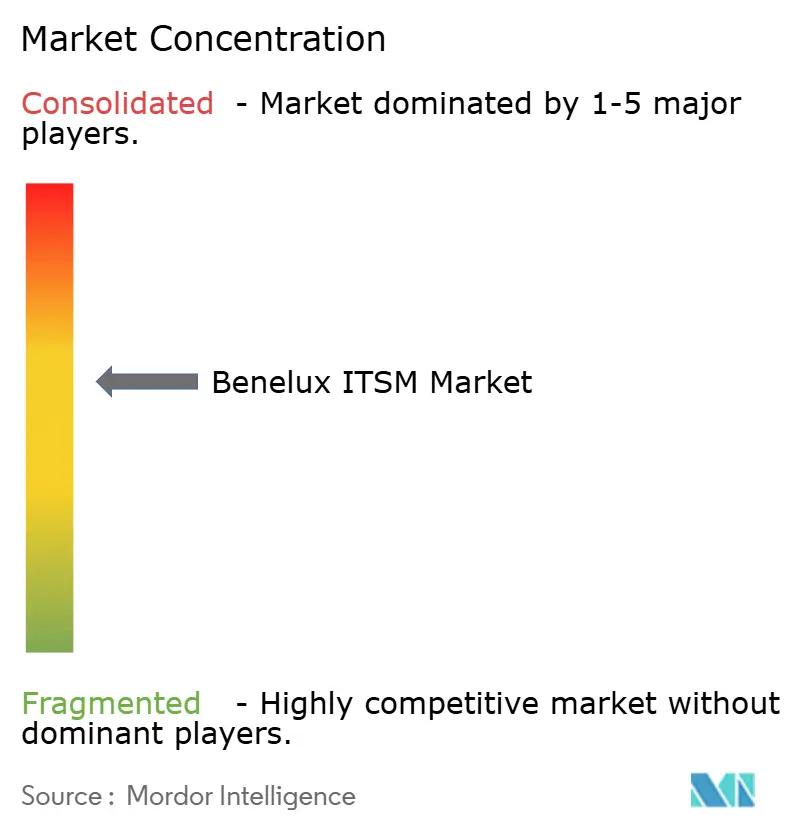
| Market Concentration | Medium |
Major Players *Disclaimer: Major Players sorted in no particular order Image © Mordor Intelligence. Reuse requires attribution under CC BY 4.0. | |
Benelux ITSM Market Analysis by Mordor Intelligence
The Benelux ITSM Market size is expected to grow from USD 341.04 million in 2025 to USD 393.68 million in 2026 and is forecast to reach USD 837.87 million by 2031 at 16.30% CAGR over 2026-2031.
Growth is being supported by a shift in buyer priorities from basic digital migration to measurable service outcomes, which is making automation depth, workflow control, and integration quality more important in purchase decisions. AI-enabled service management is moving closer to everyday operations, which is raising demand for stronger knowledge management, ticket deflection, and governed orchestration across multiple business systems. Compliance requirements in finance, government, healthcare, and essential services are also making structured service workflows harder to postpone, especially where incident traceability and asset visibility matter. Managed service providers are widening access for organizations that lack internal platform expertise, which is helping adoption move beyond the largest enterprises. Competition remains active because large vendors are defending installed enterprise accounts while lower-cost SaaS platforms and deployment-flexible vendors are competing on ease of use, hosting choice, and implementation support across the Benelux ITSM market.
Key Report Takeaways
- By component, solutions led with 67% revenue share in 2025, while services are projected to expand at 18.00% CAGR through 2031.
- By deployment, cloud held 73% of the Benelux ITSM market share in 2025 and is projected to advance at 17.50% CAGR through 2031.
- By application, service desk and incident management accounted for 29% of the Benelux ITSM market size in 2025, while knowledge management is projected to expand at 19.00% CAGR through 2031.
- By end-user industry, BFSI held 20% share in 2025, while healthcare is projected to expand at 16.50% CAGR through 2031.
- By enterprise size, large enterprises held 64.00% share in 2025, while SMEs are projected to expand at 17.20% CAGR through 2031.
- By geography, the Netherlands held 54% share of the Benelux ITSM market in 2025, while Luxembourg is projected to record the highest CAGR at 15.80% through 2031.
Note: Market size and forecast figures in this report are generated using Mordor Intelligence’s proprietary estimation framework, updated with the latest available data and insights as of January 2026.
Benelux ITSM Market Trends and Insights
Drivers Impact Analysis*
| Driver | (~) % Impact on CAGR Forecast | Geographic Relevance | Impact Timeline |
|---|---|---|---|
| Rising Cloud-First IT Operating Models | +4.2% | Belgium and Netherlands, strong, Luxembourg, emerging | Medium term (2-4 years) |
| Accelerating ITSM Automation Demand | +3.5% | Benelux-wide, concentrated in Netherlands and Belgium enterprise clusters | Short term (≤ 2 years) |
| Increasing Enterprise Focus on Employee Experience | +2.6% | Netherlands and Belgium | Short term (≤ 2 years) |
| Expansion of Managed Service Provider Led Delivery Models | +2.0% | Benelux-wide, with highest density in Netherlands and Belgium | Medium term (2-4 years) |
| Demand for Integrated ITSM and ESM Platforms | +1.6% | Global, with early gains in Netherlands enterprise and Luxembourg public sector | Long term (≥ 4 years) |
| Compliance Pressure Across Regulated Industries | +1.3% | Belgium, Netherlands, and Luxembourg financial services | Short term (≤ 2 years) |
| Source: Mordor Intelligence | |||
Rising Cloud-First IT Operating Models
Cloud-led operating design is becoming increasingly embedded across the Benelux ITSM market as organizations build service processes around hybrid and governed digital environments rather than treating cloud adoption as a one-time migration. Belgium’s active NIS2 obligations, effective October 18, 2024, heightened the need for documented incident handling, change control, and asset visibility across critical digital systems. Luxembourg reinforced this trajectory by adopting its Digital Government Strategy 2026–2030 in December 2025, allocating EUR 558 million (USD 597 million) to modernization initiatives, while also advancing a sovereign disconnected cloud partnership in January 2025, underscoring rising demand for cloud solutions that integrate localization requirements.[1]Ministry for Digitalisation Luxembourg, “The Luxembourg Government and Clarence Sign a Partnership on a Sovereign Disconnected Cloud,” Luxembourg Government, mindigital.gouvernement.luThis environment favors ITSM platforms capable of managing discovery, approvals, audit trails, and workflow consistency across multiple hosting models, while vendors that emphasize only cloud speed without governance depth remain less aligned with the evolving Benelux ITSM market.
Accelerating ITSM Automation Demand
Automation is moving closer to the core of the Benelux ITSM market as vendors advance beyond rule-based workflows into more autonomous service execution. ServiceNow launched Autonomous Workforce in February 2026 and expanded it in May 2026 with new AI specialists across IT, employee service, CRM, and security workflows[2]ServiceNow, “ServiceNow Launches Autonomous Workforce That Thinks and Acts, Adds Moveworks to the ServiceNow AI Platform,” ServiceNow Investor Relations, investor.servicenow.com. Freshworks introduced AI Agent Studio in May 2026, enabling organizations to build or deploy Freddy AI agents inside Freshservice without extensive coding requirements. These developments demonstrate that automation is no longer confined to routing, simple self-service, or narrow chatbot tasks, while also elevating the importance of strong knowledge bases, clean workflow logic, and governed integrations, since autonomous resolution depends on accurate context and system access. Within the Benelux ITSM market, vendor selection is shifting toward platforms that can reduce repetitive work without creating new control gaps.
Increasing Enterprise Focus On Employee Experience
Employee-facing service delivery has become increasingly important in the Benelux ITSM market as service friction now affects retention, digital adoption, and daily productivity. A 2025 study conducted with Vlerick Business School showed that only 54% of Belgian employees rated their organization as a great place to work, below the European average of 59%. ServiceNow completed the Moveworks acquisition in December 2025 and launched EmployeeWorks in February 2026, combining conversational AI, enterprise search, and workflow automation into a unified employee support layer. Atlassian broadened Service Collection in the same period to support more non-IT service use cases, reflecting the broader move toward shared internal service delivery across functions. This demand supports platforms that connect portals, knowledge, approvals, and conversational interfaces in ways employees can use without added friction, while also expanding buying criteria beyond classic ticketing as organizations increasingly seek one internal service layer that operates across multiple support functions.
Expansion Of Managed Service Provider Led Delivery Models
Partner-led delivery is gaining prominence in the Benelux ITSM market as smaller organizations seek structured service management solutions without the need to establish large internal administration teams. ManpowerGroup Belgium reported in January 2025 that 72% of Belgian employers faced difficulties filling vacant positions, with IT and data roles being among the most challenging to recruit. In February 2026, onITnow announced a reseller partnership with Halo to distribute HaloITSM across the Benelux region, reflecting vendor interest in channel-driven regional expansion. Service platforms offered through managed partners are more accessible for smaller buyers, as implementation, configuration, and support can be integrated into a single operational relationship. This approach also enables vendors to cater to organizations requiring enterprise-level functionalities without the need for a substantial in-house ITSM team. Consequently, factors such as channel quality, white-label options, and partner economics are becoming increasingly significant in shaping competitive positioning within the Benelux ITSM market.
Restraints Impact Analysis*
| Restraint | (~) % Impact on CAGR Forecast | Geographic Relevance | Impact Timeline |
|---|---|---|---|
| Integration Complexity With Legacy Tooling | -2.7% | Netherlands, legacy banking and insurance infrastructure, Belgium, government IT estates | Long term (≥ 4 years) |
| Persistent Skills Gaps In ITSM Administration | -2.1% | Benelux-wide, most acute in Netherlands and Belgium | Medium term (2-4 years) |
| Budget Scrutiny In Mid-Market Organizations | -1.6% | Benelux-wide, strongest in Luxembourg SME segment | Short term (≤ 2 years) |
| Data Residency And Sovereignty Constraints | -1.2% | Luxembourg financial sector, Belgium public sector, Netherlands sovereign cloud settings | Medium term (2-4 years) |
| Source: Mordor Intelligence | |||
Integration Complexity With Legacy Tooling
Integration challenges continue to hinder the growth of the Benelux ITSM market, where banks, insurers, and public institutions operate older platforms alongside newer cloud-based services. De Nederlandsche Bank's 2025 DORA implementation survey indicates that gaps in ICT risk management persist, highlighting the broader remediation challenges faced by regulated entities. In such environments, ITSM rollouts often require connectors for monitoring tools, CMDB data, asset repositories, identity systems, and legacy ticketing applications. The challenge extends beyond technical aspects, as change approvals, documentation requirements, and audit demands increase when multiple systems remain operational simultaneously. This results in longer deployment cycles and higher modernization costs for organizations with fragmented IT infrastructures. While vendors offering simplified integration can help alleviate these challenges, legacy system complexity continues to slow the pace of transformation in the Benelux ITSM market.
Persistent Skills Gaps In ITSM Administration
Skill shortages continue to pose a significant challenge to the Benelux ITSM market, as deployments grow increasingly complex while service teams are tasked with automating more processes. In 2025, 72% of employers faced difficulties filling positions, with IT and data roles among the most challenging to recruit. While low-code tools and guided setup can simplify initial deployments, tasks such as multi-module governance, AI configuration, and cross-system administration still require skilled professionals. Smaller organizations are particularly impacted, as their lean IT teams often lack the capacity to assign specialists to workflow design and ongoing platform optimization. This shortage also heightens reliance on external implementation partners and managed service providers, leading to higher long-term costs for self-managed adoption. Until internal expertise improves, the Benelux ITSM market will likely continue to experience a gap between purchase intentions and implementation timelines.
*Our forecasts treat driver/restraint impacts as directional, not additive. The impact forecasts reflect baseline growth, mix effects, and variable interactions.
Segment Analysis
By Component: Services Revenue Accelerating As AI-Era Implementations Deepen
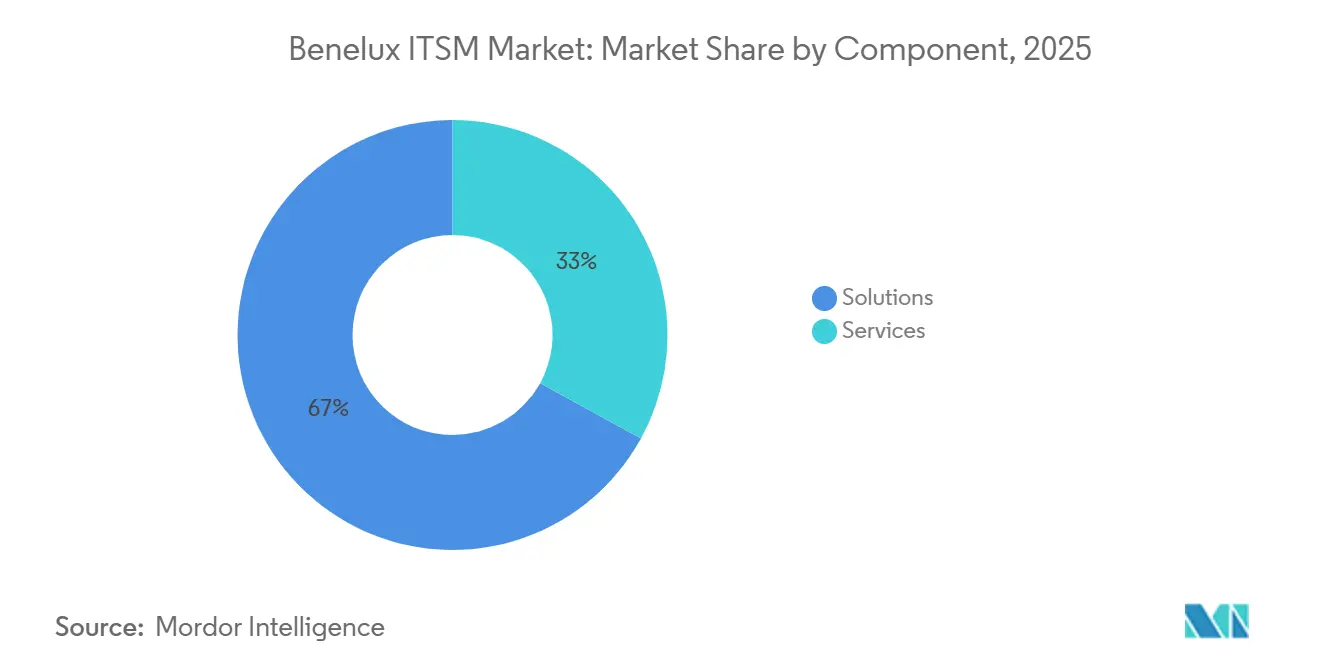
Solutions accounted for 67% of the market share in 2025, while services are projected to grow at a compound annual growth rate (CAGR) of 18.00% through 2031. The installed base of software agreements continues to drive spending, particularly in organizations standardizing ticketing, change control, asset visibility, and service catalogs on a unified platform. This installed base remains significant as many enterprises initially adopted ITSM as a core platform and subsequently expanded its modules over time. In the Benelux ITSM market, this trend sustains software revenue even as procurement priorities shift toward deeper automation and workflow orchestration. However, standalone license value is no longer the sole consideration, as buyers increasingly evaluate whether the platform can be continuously configured and governed post-implementation.
Services are experiencing faster growth due to the increasing demand for AI-enabled deployments, which require implementation, integration, knowledge structuring, model tuning, and ongoing governance, tasks that many organizations lack the internal resources to manage. Atlassian has expanded Jira Service Management to include more cross-functional workflows through its Service Collection, naturally increasing the need for process design and implementation services beyond the initial software purchase. This trend supports extended service engagements across advisory, migration, managed administration, and workflow redesign activities. Additionally, it benefits partners capable of integrating ITSM with employee services, facilities requests, and internal support operations within a unified delivery model. As the Benelux ITSM market evolves, services are expected to capture a larger share of value within contract structures, even as solutions continue to represent the primary revenue source.


By Deployment: Cloud Anchors Demand While Sovereign Requirements Keep Hybrid Relevant
Cloud accounted for 73% of the Benelux ITSM market size in 2025 and is projected to grow at a CAGR of 17.50% through 2031. SaaS delivery has become the standard for new implementations due to its ability to reduce deployment time and simplify feature updates. This aligns with the regional preference for scalability, subscription-based pricing, and easier access to AI-enabled service functionalities. Additionally, cloud solutions better support distributed workforces, external service providers, and multi-site enterprises compared to isolated local environments. These factors ensure that the Benelux ITSM market remains focused on hosted delivery, even as buyer expectations grow more stringent.
On-premise and hybrid models continue to play a significant role due to the importance of sovereignty, data residency, and regulated workflow controls in sectors such as finance, government, and other sensitive industries. For instance, Luxembourg's sovereign cloud partnership with Clarence in January 2025 highlighted the ongoing emphasis on localization and resilience in digital infrastructure planning. Similarly, EasyVista's 2026.1 release included enhanced on-premise deployment options alongside new AI service features, indicating that vendors recognize sustained demand for mixed deployment approaches. Hybrid models often serve as a practical solution for organizations seeking cloud agility while managing workloads or datasets that cannot be migrated at the same pace. This balance ensures that deployment choice will remain a competitive factor in the Benelux ITSM market, rather than a definitive shift toward a single architecture.
By Application: Service Desk Stays Foundational While Knowledge Management Leads Growth
Service desk and incident management are projected to account for 29% of the Benelux ITSM market size in 2025, while knowledge management is expected to grow at a compound annual growth rate (CAGR) of 19% through 2031. The service desk remains a foundational component, as most organizations initiate their ITSM processes with incident intake, routing, escalation, and resolution tracking. It also serves as the most visible service layer for employees and internal users, ensuring its importance even during periods of budget constraints. Asset and configuration management maintain consistent demand due to their role in ensuring compliance and uptime through audit trails, dependency mapping, and ICT inventory controls. Similarly, change and release management remain relevant as hybrid IT environments necessitate more approval points and greater coordination across teams.
Knowledge management is experiencing faster growth due to the increasing reliance on autonomous support tools, which require accurate, structured, and reusable content to resolve issues without manual intervention. For instance, Freshworks introduced AI Agent Studio in May 2026, enabling organizations to deploy Freddy AI agents within service workflows, thereby enhancing the value of well-maintained knowledge libraries. Similarly, ServiceNow expanded its autonomous service capabilities in 2026, emphasizing the need for robust knowledge architecture and governed workflows. Additionally, BMC's 2026 knowledge management release demonstrated that vendors are now automating both knowledge curation and service execution. In the Benelux ITSM market, the highest application growth is shifting toward the content and context layers that underpin reliable AI-driven service management.
By End-User Industry: BFSI Anchors Current Revenue While Healthcare Expands Faster
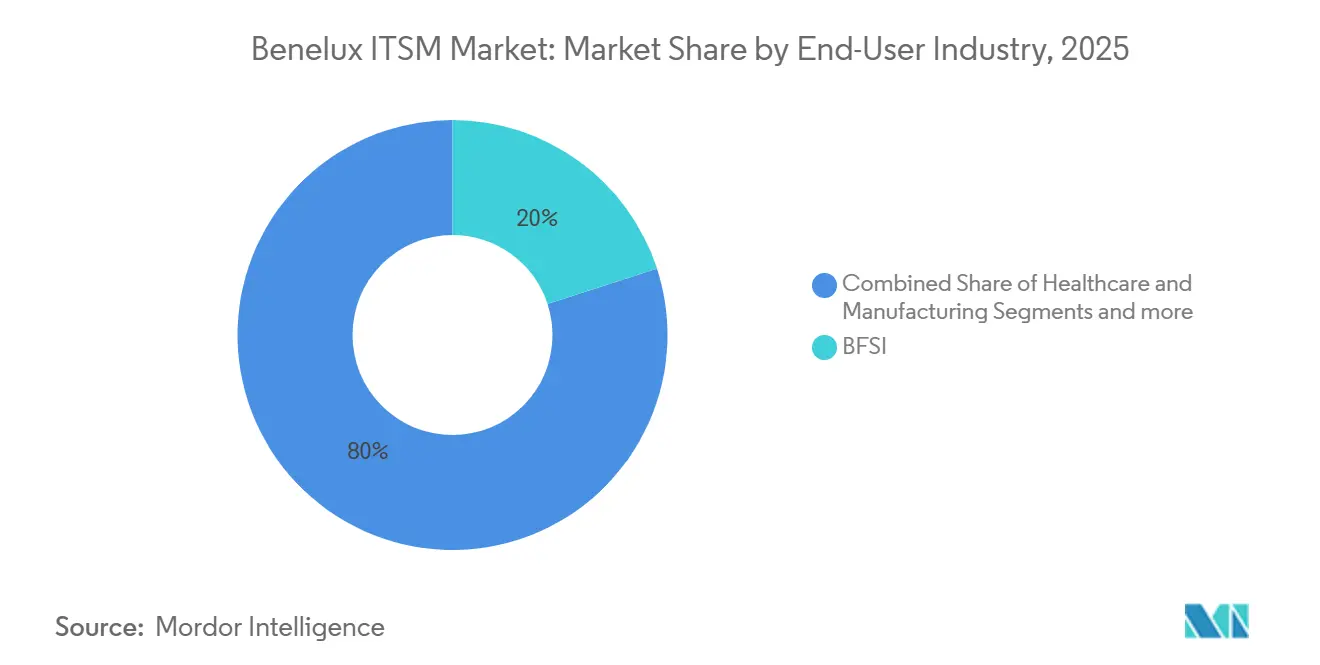
The BFSI sector accounted for a 20% market share in 2025, while the healthcare sector is projected to grow at a compound annual growth rate (CAGR) of 16.50% through 2031. Financial institutions remain key buyers due to the critical importance of incident control, change governance, asset tracking, and third-party oversight in their daily operations. The Digital Operational Resilience Act (DORA) has further emphasized the need for firms to enhance ICT resilience processes and documentation across critical service environments. The concentration of banks, insurers, and payment activities in cities like Amsterdam and Brussels supports above-average enterprise platform adoption in this region of the Benelux ITSM market. Additionally, sectors such as manufacturing, government, IT and telecommunications, retail, and hospitality contribute to demand by requiring configurable platforms to address their diverse workflow needs.
The healthcare sector is expanding rapidly as hospitals and care systems increasingly digitize clinical and administrative processes, driving the need for robust service governance over infrastructure and applications. Public sector modernization is also boosting demand, as governments require improved incident workflows, asset visibility, and service continuity controls for citizen-facing systems. This creates opportunities for vendors capable of mapping regulated workflows without imposing uniform operating templates across all verticals. Additionally, partners with strong integration capabilities are well-positioned to meet the demand for connecting sector-specific applications with core service platforms. Across the Benelux ITSM market, end-user demand is broadening beyond traditional enterprise IT teams to include organizations where service reliability is critical to regulated operations and maintaining user trust.

By Enterprise Size: Large Organizations Lead Revenue While SME Access Broadens
In 2025, large enterprises accounted for 64.00% of the market share, while SMEs are projected to grow at a compound annual growth rate (CAGR) of 17.20% through 2031. Large organizations continue to generate the highest revenue due to their ability to manage a greater number of users, applications, and formalized service processes. These enterprises are more likely to implement multi-module platforms that go beyond basic ticketing systems, incorporating features such as asset control, workflow automation, and enterprise service use cases. This has allowed the large-enterprise segment to maintain its leading position in the Benelux ITSM market in 2025. Additionally, compliance-related spending further supports this segment, as larger institutions often face stricter and more formal governance requirements.
SMEs, however, are experiencing faster growth due to factors such as SaaS delivery models, partner-led deployment strategies, and low-code administrative tools, which have lowered the barriers to adopting structured service management solutions. For instance, onITnow's reseller agreement with Halo in February 2026 demonstrated how vendors are creating tailored access routes for organizations seeking quicker adoption and simplified commercial models in the Benelux region. For smaller companies, managed service packages are often as critical as the software itself, as internal teams may lack the capacity to handle extensive setup and ongoing configuration tasks. This trend is gradually expanding the buyer base beyond traditional large enterprises and challenging the perception that advanced ITSM solutions are only viable for larger organizations. As accessibility improves, SMEs are expected to contribute a growing share of new demand within the Benelux ITSM market.
Geography Analysis
The Netherlands accounted for 54% of the Benelux ITSM market share in 2025, securing the largest position in the region. Its role as a regional headquarters base and a hub for digital infrastructure drives strong enterprise demand for scalable service platforms. Dutch financial institutions continued to address ICT resilience requirements under DORA, with De Nederlandsche Bank highlighting ongoing gaps in risk management and implementation readiness during 2025. This compliance burden has sustained spending on incident processes, change governance, asset visibility, and third-party service oversight. The Netherlands' dominance in the Benelux ITSM market is thus supported by both its commercial scale and structured regulatory requirements.
Belgium represented a significant portion of the Benelux ITSM market in 2025, driven by early compliance-led adoption. NIS2 obligations became active in Belgium on October 18, 2024, and the national framework had already brought thousands of organizations into registration and compliance activities by 2025. By March 2025, over 7,380 organizations had registered with the Centre for Cybersecurity Belgium, including more than 1,574 essential entities subject to the most stringent ICT requirements. This created immediate demand for platforms supporting incident notification, change tracking, asset records, and auditable workflow governance. Belgium's importance is further underscored by its concentration of EU-facing institutions, regulated enterprises, and digital public programs, which closely tie service management to operational control.
Although Luxembourg generated the smallest revenue among the Benelux countries, it is projected to grow at a 15.8% CAGR through 2031, making it the fastest-growing market in the region. In December 2025, the government adopted the Digital Government Strategy 2026-2030, allocating EUR 558 million (USD 597 million) for modernization, which supports upgrades in public administration service workflows. The European Commission reported that Luxembourg's business digital transformation reached 76.7% in 2025, with AI adoption at 33.6%, both exceeding EU averages. Sovereign cloud and AI partnerships signed in 2025 indicate Luxembourg's focus on modernization with localization, providing opportunities for vendors offering private, localized, or European-hosted solutions[3]Ministry for Digitalisation Luxembourg, “The Luxembourg Government and Clarence Sign a Partnership on a Sovereign Disconnected Cloud,” Luxembourg Government, mindigital.gouvernement.lu.
Competitive Landscape
The Benelux ITSM market in 2026 was moderately consolidated among large enterprise accounts, while the mid-market remained more fragmented. Large platforms continued to benefit from established relationships, extensive module offerings, and robust implementation ecosystems. ServiceNow solidified its position by acquiring Moveworks in December 2025 and subsequently launching Autonomous Workforce and EmployeeWorks in early 2026[4]ServiceNow, “ServiceNow Completes Acquisition of Moveworks,” ServiceNow Newsroom, newsroom.servicenow.com. These initiatives integrated conversational AI, enterprise search, and workflow automation more closely with the core platform. This alignment is significant in the Benelux ITSM market, where buyers increasingly seek automation benefits without introducing disconnected tools.
Atlassian maintained its position as a strong competitor by bundling Jira Service Management, assets, customer service functions, and Rovo AI within its Service Collection offering. This strategy appeals to organizations seeking a unified operating layer for both IT and non-IT workflows. Freshworks also advanced its presence in AI-enabled service operations with the launch of AI Agent Studio in May 2026 and the acquisition of FireHydrant in March 2026. These developments provided smaller and mid-sized buyers with alternatives that emphasize quicker deployment and simplified commercial models. Consequently, competition in the market has shifted focus from core ticketing features to AI capabilities, pricing flexibility, and ease of implementation.
Vendors offering European-hosted solutions and flexible deployment options continued to hold relevance, as sovereignty and hybrid architecture remained key considerations for buyers in the Benelux ITSM market. EasyVista invested further in AI service features while supporting on-premise deployment options, catering to buyers hesitant to fully adopt public cloud solutions. Similarly, Halo expanded its regional presence through partnerships, such as its collaboration with onITnow, to enhance channel reach and attract attention beyond large enterprise accounts. As a result, while enterprise incumbency remains significant, growth opportunities persist for vendors that align closely with local deployment preferences, partner networks, and automation needs.
Benelux ITSM Industry Leaders
ServiceNow
BMC Software
Atlassian
IBM
Microsoft Corporation
- *Disclaimer: Major Players sorted in no particular order

Recent Industry Developments
- June 2026: EasyVista introduced EV Pulse AI Conversations as part of the EasyVista Platform 2026.1 update. This update integrated a conversational AI module powered by a proprietary large language model into structured service management workflows, aiming to enhance self-service ticket deflection.
- May 2026: ServiceNow announced significant developments at its annual Knowledge 2026 conference in Las Vegas. These included the launch of an Autonomous Workforce with new AI specialists for IT, CRM, employee service, and security; ServiceNow Otto, a unified AI experience combining Now Assist, Moveworks, and AI Experience; and Action Fabric, an open framework allowing third-party AI agents to interact with ServiceNow via a Model Context Protocol server, now generally available.
- May 2026: Freshworks introduced AI Agent Studio within Freshservice during its annual Refresh conference. This feature enables enterprises to build, customize, or deploy pre-built Freddy AI agents across service workflows using a no-code interface. Additional announcements included a Model Context Protocol Gateway for connecting Freddy AI to third-party tools and a new AI Insights analytics layer with Experience Level Agreement tracking.
- April 2026: Ivanti announced a controlled release of Ivanti Neurons AI Self-Service Agent, its first autonomous AI solution for ITSM. This solution facilitates incident creation, service requests, knowledge searches, and ticket updates through a natural language interface built on the Ivanti Neurons Platform system of record.
- April 2026: Freshworks expanded Freshservice's IT asset management capabilities by integrating Device42's continuous infrastructure discovery and dependency mapping. This integration created a unified service operations platform encompassing ITSM, IT asset management, and IT operations management, all based on a single data foundation.
- March 2026: Freshworks completed the acquisition of FireHydrant, an AI-native incident management and reliability platform. This acquisition integrated FireHydrant's IT operations management capabilities with Freshservice's ITSM foundation, resulting in a unified ServiceOps solution for managing complex, distributed infrastructure.
- February 2026: ServiceNow launched Autonomous Workforce and ServiceNow EmployeeWorks shortly after acquiring Moveworks. These offerings combined Moveworks' conversational AI and enterprise search capabilities with ServiceNow's portal and autonomous workflows, addressing natural-language service requests for an employee base of nearly 200 million.


Benelux ITSM Market Report Scope
The Benelux IT Service Management (ITSM) Market Report is Segmented by Component (Solutions, Services), Deployment (Cloud, On-Premises, Hybrid), Application (Service Desk and Incident Management, Asset and Configuration Management, and More), End-User Industry (BFSI, Manufacturing, and More), and Enterprise Size (Large Enterprises, Small and Medium Enterprises). The Market Forecasts are Provided in Terms of Value (USD).
| Solutions |
| Services |
| Cloud |
| On-Premise |
| Hybrid |
| Service Desk and Incident Management |
| Asset and Configuration Management |
| Change and Release Management |
| Service Request Management |
| Knowledge Management |
| Other Applications |
| BFSI |
| Manufacturing |
| Government and Public Sector |
| IT and Telecommunications |
| Retail and E-commerce |
| Healthcare |
| Travel and Hospitality |
| Other End-User Industries |
| Large Enterprises |
| Small and Mid-size Enterprises (SMEs) |
| Belgium |
| Netherlands |
| Luxembourg |
| By Component | Solutions |
| Services | |
| By Deployment | Cloud |
| On-Premise | |
| Hybrid | |
| By Application | Service Desk and Incident Management |
| Asset and Configuration Management | |
| Change and Release Management | |
| Service Request Management | |
| Knowledge Management | |
| Other Applications | |
| By End-User Industry | BFSI |
| Manufacturing | |
| Government and Public Sector | |
| IT and Telecommunications | |
| Retail and E-commerce | |
| Healthcare | |
| Travel and Hospitality | |
| Other End-User Industries | |
| By Enterprise Size | Large Enterprises |
| Small and Mid-size Enterprises (SMEs) | |
| By Geography | Belgium |
| Netherlands | |
| Luxembourg |


Key Questions Answered in the Report
What is the Benelux ITSM market size in 2026 and how large will it be by 2031?
The Benelux ITSM market was valued at USD 393.68 million in 2026 and is forecast to reach USD 837.87 million by 2031, growing at a CAGR of 16.3% over 2026-2031.
Which deployment model leads IT service management demand in Benelux?
Cloud led demand with a 73% share in 2025 and is projected to grow at 17.50% CAGR through 2031, supported by faster rollout, subscription pricing, and easier access to AI-enabled functions.
Which application area is growing fastest across Benelux ITSM platforms?
Knowledge management is the fastest-growing application at 19.00% CAGR through 2031, because AI agents and autonomous support tools depend on structured and reusable knowledge content.
Which end-user segment contributes the most revenue in this region?
BFSI held the largest end-user share at 20% in 2025, supported by high needs in incident control, change governance, asset tracking, and third-party oversight.
Which country is expanding fastest in Benelux for ITSM adoption?
Luxembourg is projected to grow the fastest at 15.80% CAGR through 2031, supported by public digital modernization, sovereign cloud activity, and above-EU-average business AI adoption.
Why are SMEs becoming a larger buyer group for ITSM solutions in Benelux?
SMEs are projected to grow at 17.20% CAGR through 2031 because SaaS delivery, reseller-led adoption, and managed service models are reducing the staffing and setup burden that once limited adoption.
Page last updated on:


 Your data is secure and never sold or shared.


