
Battery Monitoring System Market Size and Share
Market Overview
| Study Period | 2022 - 2032 |
|---|---|
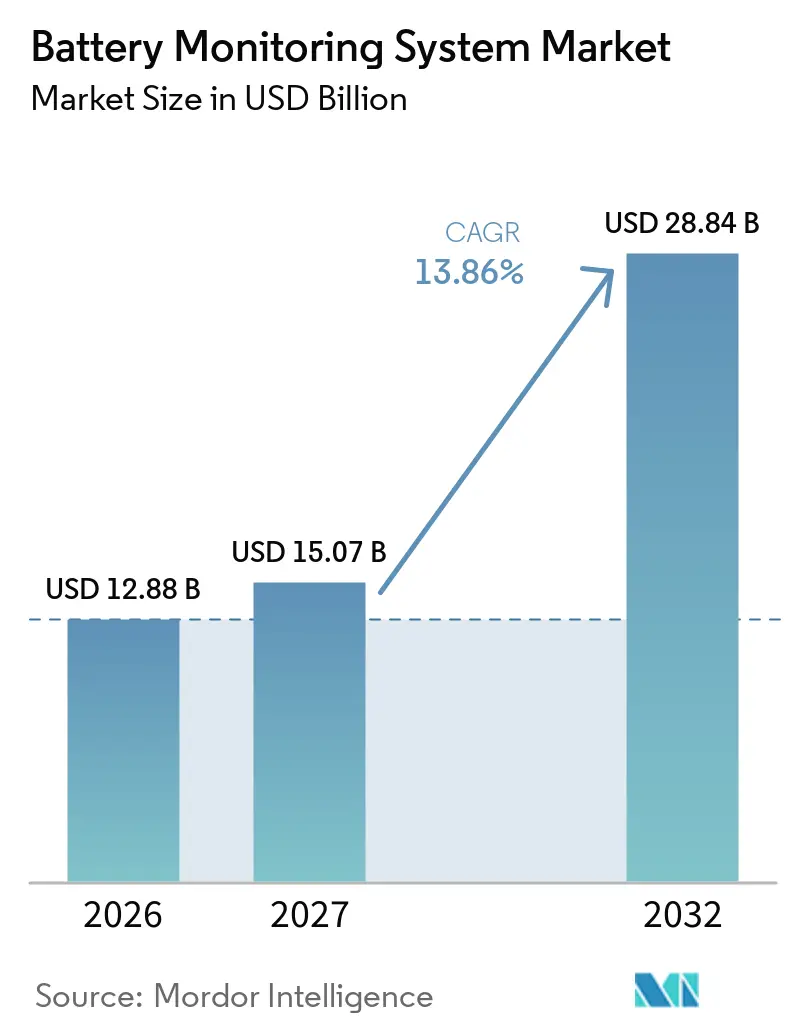
| Market Size (2027) | USD 15.07 Billion |
| Market Size (2032) | USD 28.84 Billion |
| Growth Rate (2027 - 2032) | 13.86 % |
| Fastest Growing Market | Asia-Pacific |
| Largest Market | North America |
| Market Concentration | Medium |
Major Players *Disclaimer: Major Players sorted in no particular order Image © Mordor Intelligence. Reuse requires attribution under CC BY 4.0. | |
Battery Monitoring System Market Analysis by Mordor Intelligence
The Battery Monitoring System Market size was valued at USD 12.88 billion in 2026 and is estimated to grow from USD 15.07 billion in 2027 to reach USD 28.84 billion by 2032, at a CAGR of 13.86% during the forecast period (2027-2032). Electrification, stationary energy storage, and tighter lifecycle data requirements are raising the value of continuous battery measurement. Battery passport requirements in the European Union are making traceability a procurement priority for electric vehicle (EV) and industrial batteries above 2 kWh from February 2027.[1] The battery monitoring system market is also moving from pack-level checks toward cell-level hardware and software that can identify faults earlier. This change expands the value of each installed monitoring system because operators need data on health, thermal behavior, and service life. Competition is increasingly shaped by the ability to combine accurate sensing with practical analytics, safety functions, and cybersecurity controls.
Key Report Takeaways
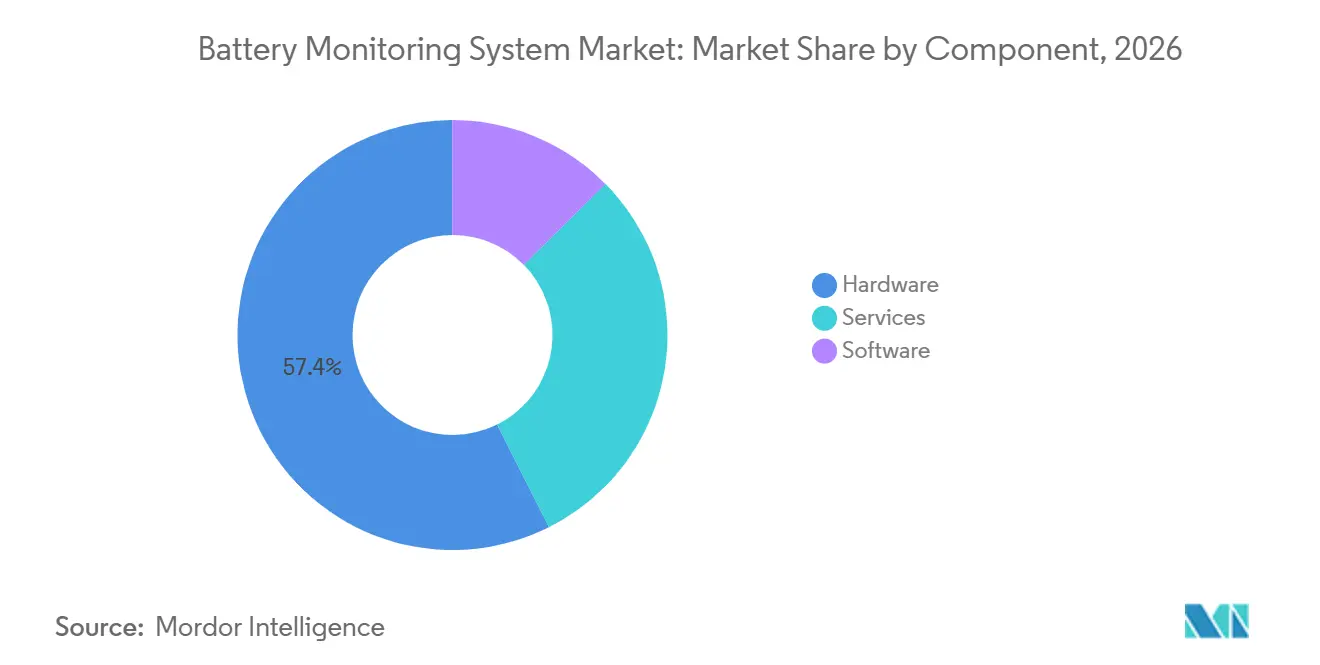
- By component, hardware held 57.4% of the market share in 2026, while software is forecast to grow at a 14.5% CAGR through 2032.
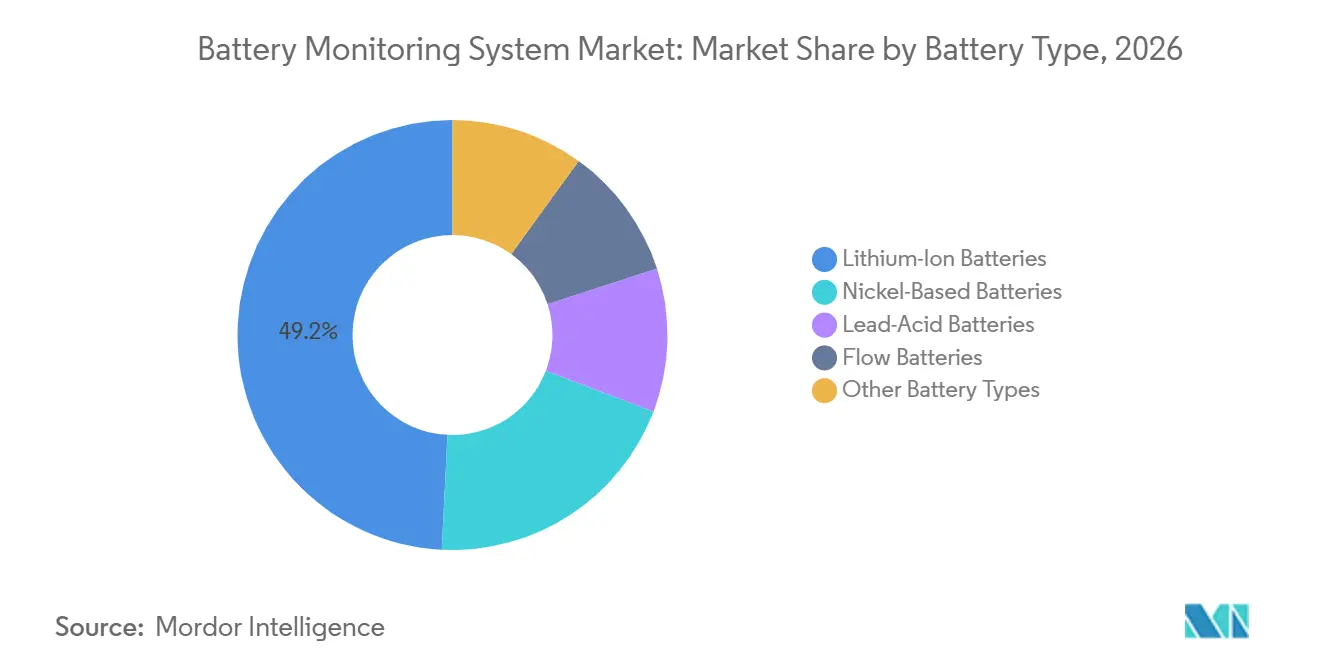
- By battery type, lithium-ion held 49.2% of the market share in 2026, while flow batteries are forecast to grow at a 15.7% CAGR through 2032.
- By system type, wired systems held 55.3% of the market share in 2026, while wireless systems are forecast to grow at a 14.8% CAGR through 2032.
- By topology, distributed systems held 39.6% of the market share in 2026, while modular systems are forecast to grow at a 14.2% CAGR through 2032.
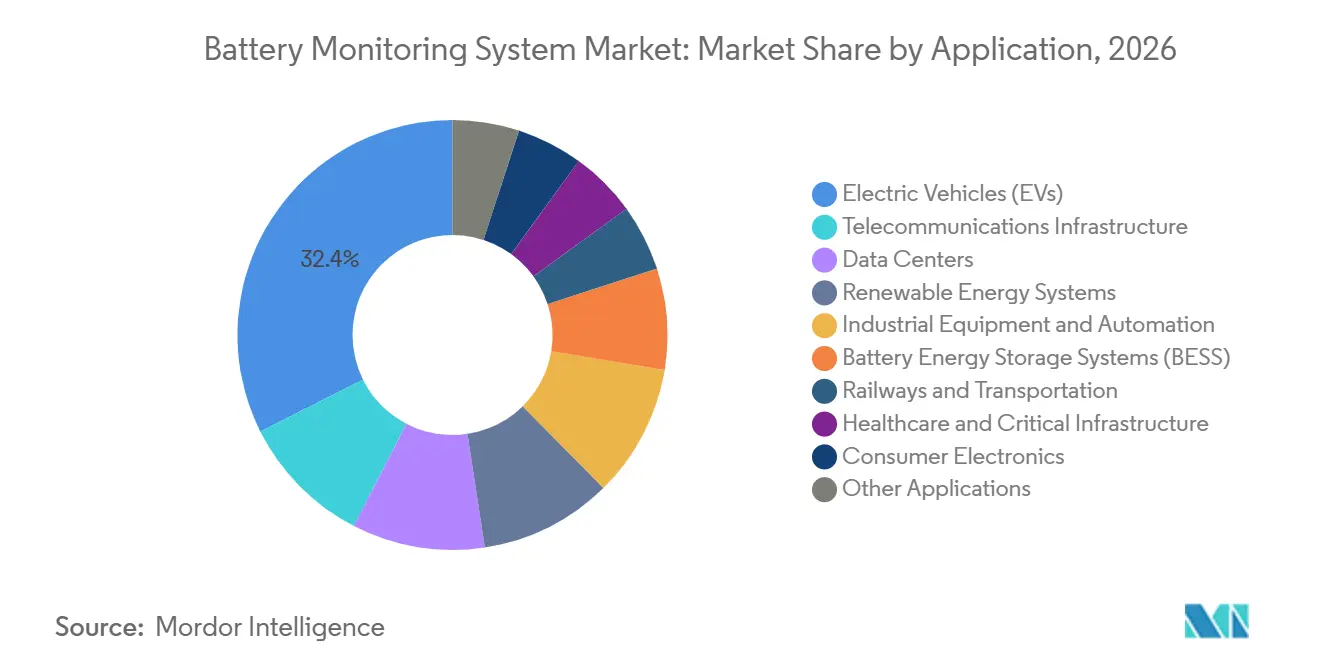
- By application, electric vehicles held 32.4% of the market share in 2026, while battery energy storage systems are forecast to grow at a 15.9% CAGR through 2032.
- By geography, North America held 33.8% of the market share in 2026, while Asia-Pacific is forecast to grow at 14.7% CAGR through 2032.
Note: Market numbers in this report are based on Mordor Intelligence's proprietary estimation framework, which combines nine months of actuals with Q4 projections for base year 2026.
Market Trends and Insights
Drivers Impact Analysis of Battery Monitoring System Market*
| Driver | (~) % Impact on CAGR Forecast | Geographic Relevance | Impact Timeline |
|---|---|---|---|
| Electrification of Vehicles and Battery Packs | +3.5% | Global, concentrated in North America, Europe, and China | Medium term (2-4 years) |
| Expansion of Grid-Scale and Behind-the-Meter Energy Storage | +3.0% | APAC core, with spillover to North America and Europe | Medium term (2-4 years) |
| Rising Reliability Requirements in Data Centers and Telecom Networks | +2.0% | North America and Europe, with rapid APAC expansion | Short term (≤ 2 years) |
| Predictive Maintenance and Battery Health Analytics | +1.8% | Global, with early intensity in North America and Europe | Medium term (2-4 years) |
| Wireless Monitoring for Distributed and Retrofit Battery Assets | +1.5% | Global, with fastest uptake in APAC and MEA | Long term (≥ 4 years) |
| Battery Passport and Lifecycle-Traceability Requirements | +1.2% | EU-led, with effects in the United Kingdom, APAC, and North America | Medium term (2-4 years) |
| Source: Mordor Intelligence | |||
Electrification of Vehicles and Battery Packs
Electric vehicle adoption is increasing the need for detailed battery data across the battery monitoring system market. Research published in 2026 by Coventry University found that a 3°C thermal gradient within a pack can create degradation feedback cycles that accelerate cell aging by 300%. This evidence supports a shift from module-level monitoring to cell-level measurement in vehicle designs. Texas Instruments introduced the BQ79826Z-Q1 in June 2026 with monitoring for 26 cells, voltage accuracy below 2 mV, and electrochemical impedance spectroscopy measurement that is 5 times faster than earlier solutions.[2] The device also targets ISO 26262 Automotive Safety Integrity Level D (ASIL-D) automotive safety applications. European battery passport rules reinforce this move because EV and industrial batteries above 2 kWh must carry traceable information from February 2027.
Expansion of Grid-Scale and Behind-the-Meter Energy Storage
Grid storage is creating a direct financial case for more precise monitoring in the battery monitoring system market. Wärtsilä stated that a 5% state-of-charge error can cause USD 10,000 per MW in annual revenue loss and create a potential USD 20 million lifetime shortfall for a 100 MW, 2-hour storage project.[3] The company also reported that operators can retain up to 20% of installed capacity as a buffer when state-of-charge data is uncertain. Accure Battery Intelligence extended its analytics to cooling fans, inverters, capacitors, and other power-conversion equipment in May 2025.[4] Its launch material cited 5%-15% gains in availability, maintenance-cost reductions of up to 25%, and mean-time-to-repair reductions of up to 30% from its workflow tools. Schneider Electric also introduced a battery-agnostic integrated cell-to-grid storage system in India during May 2026.
Rising Reliability Requirements in Data Centers and Telecom Networks
Data centers and telecom networks require dependable backup power, which strengthens demand in the battery monitoring system market. Schneider Electric states that Uninterruptible Power Supply (UPS) failures are the leading cause of impactful data center outages and put downtime costs between USD 10,000 and USD 10 million per hour. EnerSys integrated embedded monitoring into DataSafe thin plate pure lead batteries, and a European data center deployed 260 of these batteries before a major event in 2025. The deployment provided more frequent status updates and reduced dependence on emergency maintenance. Nuvoton announced mass production of 16-cell monitoring integrated circuits (ICs) for 400 V and 800 V AI-server backup units in July 2026, with up to 55 devices connected in series. Wireless systems also give fleet operators a practical retrofit path where installing new cabling would be expensive.
Predictive Maintenance and Battery Health Analytics
Predictive maintenance is changing battery monitoring from periodic checks to continuous health assessment. Fraunhofer IFAM developed dynamic impedance spectroscopy that can measure during charging or discharging at up to 1 million samples per second. The approach provides real-time results, unlike static methods that require batteries to rest and can take up to 20 minutes. This supports earlier fault detection and charging plans that protect useful cell life. SOCOMEC acquired PowerUp in April 2025 to add a platform that estimates state of charge within ±2% over a battery lifetime and identifies degradation signals months earlier than conventional alarm systems. These capabilities make software valuable not only for alarms but also for maintenance planning, warranty support, and service contracts.
Restraints Impact Analysis of Battery Monitoring System Market*
| Restraint | (~) % Impact on CAGR Forecast | Geographic Relevance | Impact Timeline |
|---|---|---|---|
| High Hardware, Integration, and Software Implementation Costs | -2.00% | Global, with disproportionate impact on SMEs in APAC and MEA | Medium term (2-4 years) |
| Interoperability Gaps Across Battery Chemistries and Control Platforms | -1.50% | Global, particularly in multi-vendor BESS deployments | Long term (≥ 4 years) |
| Cybersecurity and Communications Reliability Risks in Connected Systems | -1.20% | Global, with acute exposure in Europe and North America | Short term (≤ 2 years) |
| Limited Cell-Level Data in Legacy and Second-Life Batteries | -0.80% | Global, with particular severity in emerging markets | Long term (≥ 4 years) |
| Source: Mordor Intelligence | |||
High Hardware, Integration, and Software Implementation Costs
The cost of sensor hardware, gateways, licenses, and engineering can limit adoption in the battery monitoring system market. A 2025 study of 80 organizations linked to battery passport readiness found that 54% saw financial constraints as the main barrier to digital monitoring infrastructure. Retrofit projects can be particularly costly because older installations often lack compatible communication ports and power connections. Operators with mixed fleets must often use tailored integration work for each supplier and site. This limits economies of scale, especially for smaller operators. The challenge is sharper where local specialists have limited experience with chemistry-specific monitoring systems.
Interoperability Gaps Across Battery Chemistries and Control Platforms
Battery chemistries require different impedance profiles, degradation models, and state-estimation methods, which makes interoperability difficult. A 2025 study on digital twin governance for battery storage identified proprietary data formats and limited shared interfaces as major obstacles. The issue is significant for multi-vendor storage facilities that use different chemistries, cell formats, and communication protocols. These gaps add integration work whenever an operator adds assets from a new supplier. Connected systems also require reliable communications and cybersecurity controls, particularly when monitoring platforms transmit operational data to cloud services. Limited cell-level data in legacy and second-life batteries further restricts what software can diagnose with confidence.
*Our forecasts treat driver/restraint impacts as directional, not additive. The impact forecasts reflect baseline growth, mix effects, and variable interactions.
Battery Monitoring System Market Segment Analysis
By Component:
Hardware Infrastructure Anchors Revenue, Software AcceleratesHardware accounted for 57.4% of battery monitoring system market revenue in 2026. This position reflects the large number of voltage, temperature, and current measurements required across modern battery packs. Each sensing point must operate reliably across demanding temperature and voltage conditions. The battery monitoring system industry depends on these physical measurement points because analytics cannot compensate for missing data. Hardware also supports the isolation, communication, and functional-safety requirements that are central to automotive and stationary applications. Eberspächer Vecture launched its GuardIon-IQ™ modular battery management system in September 2026. The product supports systems from 12 V to 1,500 V through 6 variants in an 80 × 55 × 12 mm form factor. This reflects demand for flexible hardware that reduces installation-space and engineering constraints. Services complete the component offering through installation, commissioning, field support, and managed monitoring contracts. They are particularly useful for organizations that operate critical battery assets but have limited internal engineering resources.
Software is the fastest-growing component, with the battery monitoring system market size for software projected to expand at a 14.5% CAGR between 2027 and 2032. Continuous cloud-based analytics can convert measurements into fault warnings, operating recommendations, and evidence of lost revenue. Wärtsilä’s GEMS Pulse uses cell-to-fleet data and frames state-of-charge accuracy as a revenue-protection issue.Services also remain important because operators frequently need help with commissioning, managed monitoring, and field maintenance. Data center and telecom customers are likely to favor service models when they do not have the needed in-house engineering capability. The component mix therefore supports hardware sales today while creating recurring software and service opportunities over time.

By Battery Type:
Lithium-Ion Dominance Masks Chemistry Diversification UnderwayLithium-ion batteries held 49.2% of the battery monitoring system market share in 2026. Their position reflects use in electric vehicles, grid storage, data center UPS systems, and consumer electronics. This broad installed base puts the chemistry across the largest range of monitored applications. Lithium-ion packs need continuous monitoring because even a 3°C thermal difference can worsen cell aging. Cell-to-cell voltage imbalance can also build over time before it appears as capacity loss or a thermal event. Lead-acid batteries continue to support UPS and telecom backup applications, where embedded monitoring is replacing manual testing. EnerSys’s DataSafe deployment shows that existing lead-acid fleets can still create demand for continuous monitoring. Nickel-based systems add demand in industrial and railway settings, where wide operating temperatures and cyclic durability are important. The resulting mix means that a single supplier may need to support very different performance indicators across customer fleets.
Flow batteries are the fastest-growing battery type at 15.7% CAGR through 2032. Their use in long-duration storage requires a different monitoring approach from lithium-ion systems. Operators need data on electrolyte flow, tank level, stack pressure, open-circuit voltage, and electrolyte concentration in addition to temperature and voltage. This wider data requirement favors purpose-built monitoring designs. It also supports a group of specialists that can serve flow-battery projects rather than generic battery fleets. Nickel-based batteries retain a role in industrial and railway systems that need strong cyclic durability and performance across wide temperature ranges. Chemistry diversification is therefore broadening the technical requirements of the battery monitoring system market.
By System Type:
Wired Systems Lead, Wireless Reshapes the Retrofit OpportunityWired systems accounted for 55.3% of the market share in 2026. Automotive production and utility-scale storage installations support this position because these settings favor fixed, high-bandwidth connections. Wired designs also provide predictable latency and galvanic isolation for automotive safety monitoring. They align with CAN bus, RS-485, and daisy-chain communication structures already used in electric vehicle platforms. Data centers, telecom rooms, and substations can also benefit from a defined physical communications boundary. This makes wired systems easier to assess for interference exposure and cybersecurity management.
Wireless systems are forecast to grow at 14.8% CAGR through 2032. In new electric vehicles, wireless architectures can reduce wiring-harness weight and assembly complexity. In existing distributed storage assets, wireless hardware can avoid costly changes to cable infrastructure. NXP introduced an electrochemical impedance spectroscopy-capable battery management chipset with hardware synchronization in October 2025. The chipset combines a cell sensor, a gateway, and a battery junction box controller for synchronized cell measurement. Wireless growth depends on secure, authenticated communication because critical infrastructure buyers increasingly include cybersecurity requirements in their specifications.
By Topology:
Distributed Architecture Leads, Modular Format Gains in Emerging VerticalsDistributed systems held 39.6% of the market share in 2026. Their design places measurement capability close to individual cells or cell groups. This can support fault localization and reduce the effect of a single point of failure. It also provides the detailed data required for lifecycle traceability. Distributed hardware can make it easier to isolate a weak cell before it affects the performance of the wider pack. The EU battery passport framework applies from February 2027 to EV and industrial batteries above 2 kWh. The framework increases the practical value of data that can be associated with individual cells. Centralized systems continue to serve legacy UPS and telecom installations where shorter cable runs and simpler structures remain suitable. They can remain a practical choice where a compact installation does not require extensive redundancy or very granular measurements.
Modular systems are forecast to grow at a 14.2% CAGR through 2032. They are gaining relevance in commercial storage, second-life batteries, and portable industrial power, where operators may expand monitoring in stages. A site can start with a basic arrangement and add measurement nodes as fleet size grows. Eberspächer Vecture ’s GuardIon-IQ™ offers 6 configurable variants that serve smaller integrated packs through systems up to 1,500 V. A common platform can reduce customer development work compared with a different design for each application. This model may reduce demand for topology-specific point solutions as operators seek scalable systems.
By Application:
EVs Command Share, BESS Defines the Expansion FrontierElectric vehicles accounted for 32.4% of the market share in 2026. The segment’s value reflects both vehicle volume and the increasing number of measured parameters per pack. Higher energy density and longer warranties are raising the need for cell-level impedance, state estimation, and thermal data. Texas Instruments’ BQ79826Z-Q1 supports 26 cells and tracks up to 44% more channels than earlier solutions. Telecommunications, data centers, renewable energy systems, industrial equipment, railways, healthcare, and consumer electronics form a broad secondary base of demand. This diversity reduces dependence on a single end-use sector.
Battery energy storage systems are forecast to grow at a 15.9% CAGR through 2032. At a large site, monitoring that detects a serious safety or performance issue can prevent asset losses and support grid-balancing obligations. Wärtsilä estimated a potential USD 20 million lifetime impact from a 5% state-of-charge error at a 100 MW, 2-hour project. This makes monitoring expenditure easier to connect with operational revenue. Renewable and industrial applications add further demand for systems that can support both lead-acid assets and newer lithium-ion deployments. These applications require chemistry-specific data models without forcing operators to maintain parallel monitoring environments.
Geography Analysis
North America Battery Monitoring System Market
North America held 33.8% of the battery monitoring system market share in 2026. A mature data center and critical-infrastructure base support this position, while electric vehicle and grid-storage deployment add demand. In this region, monitoring is often linked to up-time requirements and the need to document maintenance performance. Schneider Electric reported 66% fewer break-fix interventions across a connected 6,000-unit Uninterruptible Power Supply (UPS) installed base compared with traditional service plans. The company also reported 5 critical failures prevented each year at sites with 20 assets. Canada contributes through energy storage deployments, while Mexico adds demand through manufacturing, industrial, telecom, and UPS use cases. These applications create demand for both new systems and upgrades to existing facilities.
Europe Battery Monitoring System Market
Europe’s battery monitoring system market is being reshaped by the approaching battery passport deadline. The European Union requires battery passports for applicable EV and industrial batteries from February 2027 and smart labeling from December 2026. A study of 80 organizations found that 62% lacked systems to track in-use battery events in real time. The same study found that 76% had not considered changes needed for smart labeling and battery passport requirements. Germany’s development of dynamic impedance spectroscopy offers deeper health measurement during live operation. Manufacturing-intensive countries such as the United Kingdom and Poland also add demand from automotive supply chains and industrial energy storage.
South America, APAC and MEA Battery Monitoring System Market
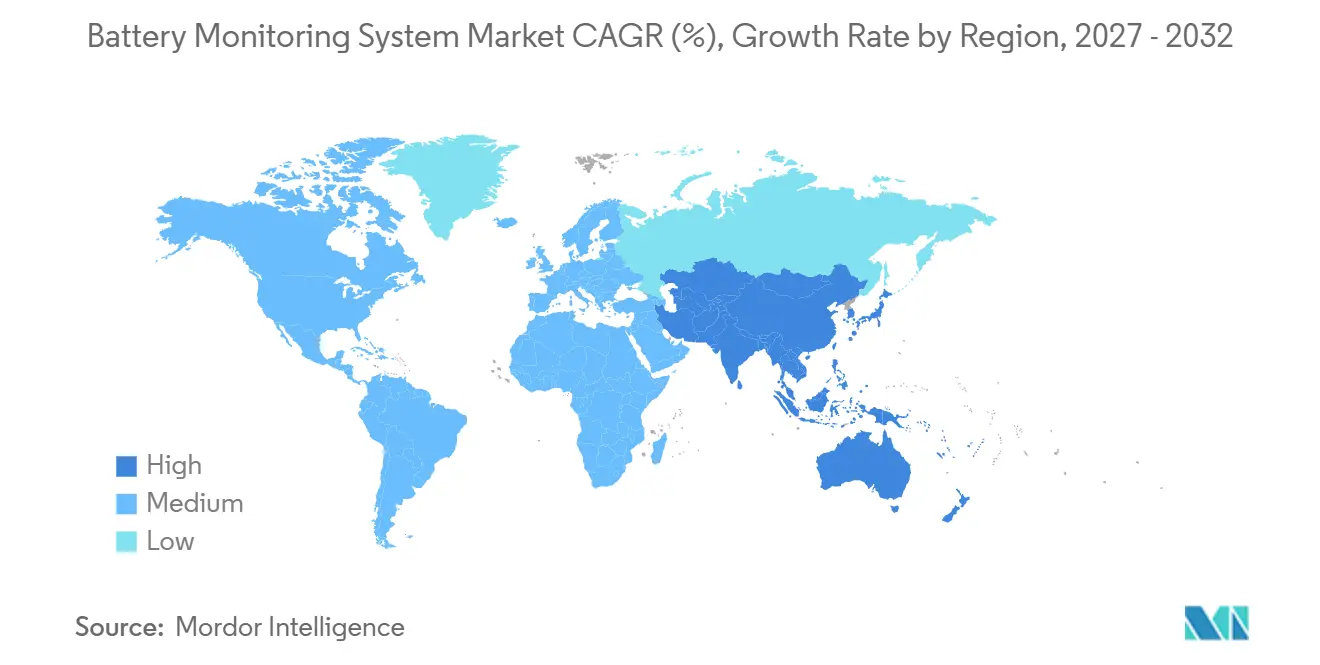
Asia-Pacific is projected to grow at 14.7% CAGR through 2032. China’s storage buildout, India’s electric vehicle and telecom expansion, and Southeast Asia’s growing battery assembly activity support this outlook. India offers a retrofit opportunity across telecom sites that are moving from lead-acid to lithium-ion backup. South Korea and Japan contribute through established battery production ecosystems and greater attention to traceability across the battery lifecycle. South America remains linked to solar and wind development, particularly in Brazil. The Middle East and Africa offer longer-term demand as storage procurement expands, although both regions remain dependent on imported monitoring hardware and need more local application engineering capability.
Competitive Landscape
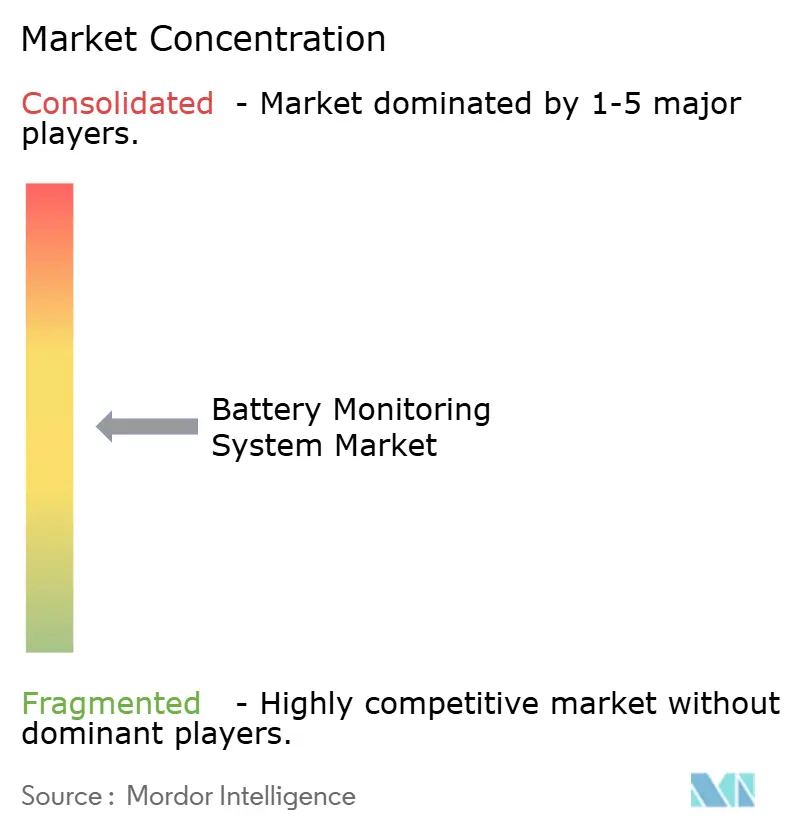
The battery monitoring system market is moderately concentrated. Diversified electronics, power-management, and industrial companies compete alongside specialists that focus on predictive analytics. This structure allows established firms to use their installed base and service footprint, while focused vendors can differentiate through diagnostic depth. Semiconductor suppliers are making electrochemical impedance spectroscopy a more accessible cell-level diagnostic capability. NXP introduced an EIS-enabled battery management chipset in October 2025, while Texas Instruments launched a 26-cell EIS-enabled monitor in June 2026. These developments reduce the gap between laboratory-style diagnostics and embedded monitoring. They also set a higher baseline for suppliers selling cell-level measurement products. Smaller hardware suppliers without comparable measurement roadmaps may face greater pressure on product differentiation.
Large suppliers are also joining monitoring with managed services, which can raise switching costs for customers. Schneider Electric expanded EcoCare to 3-Phase UPS in June 2026 with 24/7 remote monitoring and condition-based maintenance. Its reported results included 66% fewer break-fix interventions in the connected UPS base. Wärtsilä launched GEMS Pulse in October 2025 to use cell-to-fleet data in battery storage operations. These strategies combine installed hardware, operational data, and service delivery into broader customer offerings.
There remains an opening for platforms that work across mixed chemistries and second-life battery fleets. These fleets are difficult to manage because the monitoring layer must interpret data from battery packs with different ages, configurations, and operating histories. Socomec’s acquisition of PowerUp in April 2025 added advanced state-of-charge and degradation analytics to its offering. ACCURE expanded its focus beyond cells to power-conversion components in May 2025. Eberspächer Vecture introduced a configurable battery management platform in September 2026 for applications across mobility, storage, data centers, and industry. Providers that can combine this flexibility with reliable cybersecurity, service support, and earlier fault detection will be better placed to serve complex fleets. The ability to protect data and maintain dependable communications is particularly important when battery systems are linked to cloud platforms. Market-share data for the leading suppliers was not provided, so a concentration score cannot be calculated from the supplied evidence.
Battery Monitoring System Industry Leaders
-
Schneider Electric SE
-
ABB Ltd.
-
Eaton Corporation plc
-
NXP Semiconductors N.V.
-
Vertiv Holdings Co.
- *Disclaimer: Major Players sorted in no particular order
Battery Monitoring System Market Companies Covered in this Report
- ABB Ltd.
- Analog Devices, Inc.
- BatteryDAQ
- BTECH, Inc.
- Canara, Inc.
- Curtis Instruments, Inc.
- Eagle Eye Power Solutions, LLC
- Eaton Corporation plc
- HBL Power Systems Limited
- Honeywell International Inc.
- Infineon Technologies AG
- NDSL Group Limited
- NXP Semiconductors N.V.
- Power Shield Limited
- Renesas Electronics Corporation
- Schneider Electric SE
- Socomec Group
- Storage Battery Systems, LLC
- Texas Instruments Incorporated
- Vertiv Holdings Co.
Recent Industry Developments in Battery Monitoring System Market
- September 2026: Eberspächer Vecture launched GuardIon-IQ™™, a modular Battery Management System (BMS) platform supporting battery systems from 12 V to 1,500 V across 6 configurable hardware variants, targeting mobility, energy storage, data center, and industrial applications. The compact 80 × 55 × 12 mm form factor and scalable architecture reduce development timelines and integration costs for OEM customers across automotive, off-highway, and grid-storage markets.
- July 2026: Nuvoton Technology announced the September 2026 mass production launch of KA49703A and KA49713A battery monitoring Integrated Circuits (ICs) for 400 V and 800 V AI-server battery backup units, each monitoring up to 16 cells with daisy-chain connectivity supporting up to 55 devices in series. The ICs target the power-density and continuous-reliability requirements of hyperscale AI computing infrastructure.
- June 2026: Texas Instruments introduced the BQ79826Z-Q1, a 26-cell Electrochemical Impedance Spectroscopy (EIS)-enabled battery monitor with voltage accuracy under 2 mV and EIS measurement speed 5 times faster than predecessor solutions. The device targets EV and energy-storage applications and complies with ISO 26262 ASIL-D functional safety requirements.
- June 2026: Schneider Electric expanded its EcoCare condition-based maintenance service to 3-phase Uninterruptible Power Supply (UPS), providing 24/7 remote monitoring and condition-based maintenance. Analysis of 6,000 connected UPS systems showed 66% fewer break-fix interventions and 5 critical failures prevented annually per 20-asset site compared with traditional service plans.
Global Battery Monitoring System Market Report Scope
The battery monitoring system (BMS) market encompasses the design, manufacturing, and deployment of specialized hardware and software solutions used to continuously track, evaluate, and manage the health and operational metrics of rechargeable batteries.
The global battery monitoring system market is segmented by component, battery type, system type, topology, application, and geography. By component, the market is segmented into hardware, software, and services. By battery type, the market is segmented into lithium-ion (Li-ion), lead-acid, nickel-based, flow, and other battery types. By system type, the market is segmented into wired and wireless systems. By topology, the market is segmented into centralized, distributed, and modular systems. By application, the market is segmented into electric vehicles (EVs), battery energy storage systems (BESS), telecommunications, data centers, renewable energy, industrial applications, railways, healthcare, electronics, and other applications. The report also covers the market size and forecasts for the global battery monitoring system market across 26 countries in key regions. For each segment, the market sizing and forecasts have been provided on the basis of value (USD).
Segmentation Overview
| Hardware |
| Software |
| Services |
| Lithium-Ion Batteries |
| Lead-Acid Batteries |
| Nickel-Based Batteries |
| Flow Batteries |
| Other Battery Types |
| Wired Battery Monitoring Systems |
| Wireless Battery Monitoring Systems |
| Centralized Battery Monitoring Systems |
| Distributed Battery Monitoring Systems |
| Modular Battery Monitoring Systems |
| Electric Vehicles (EVs) |
| Battery Energy Storage Systems (BESS) |
| Telecommunications Infrastructure |
| Data Centers |
| Renewable Energy Systems |
| Industrial Equipment and Automation |
| Railways and Transportation |
| Healthcare and Critical Infrastructure |
| Consumer Electronics |
| Other Applications |
| North America | United States |
| Canada | |
| Mexico | |
| Europe | Germany |
| France | |
| Italy | |
| Spain | |
| United Kingdom | |
| Poland | |
| Russia | |
| Rest of Europe | |
| Asia-Pacific | China |
| India | |
| Japan | |
| South Korea | |
| Australia | |
| Indonesia | |
| Vietnam | |
| Thailand | |
| Rest of Asia-Pacific | |
| South America | Brazil |
| Argentina | |
| Chile | |
| Rest of South America | |
| Middle East and Africa | Saudi Arabia |
| United Arab Emirates | |
| Egypt | |
| South Africa | |
| Morocco | |
| Rest of Middle East and Africa |
| By Component | Hardware | |
| Software | ||
| Services | ||
| By Battery Type | Lithium-Ion Batteries | |
| Lead-Acid Batteries | ||
| Nickel-Based Batteries | ||
| Flow Batteries | ||
| Other Battery Types | ||
| By System Type | Wired Battery Monitoring Systems | |
| Wireless Battery Monitoring Systems | ||
| By Topology | Centralized Battery Monitoring Systems | |
| Distributed Battery Monitoring Systems | ||
| Modular Battery Monitoring Systems | ||
| By Application | Electric Vehicles (EVs) | |
| Battery Energy Storage Systems (BESS) | ||
| Telecommunications Infrastructure | ||
| Data Centers | ||
| Renewable Energy Systems | ||
| Industrial Equipment and Automation | ||
| Railways and Transportation | ||
| Healthcare and Critical Infrastructure | ||
| Consumer Electronics | ||
| Other Applications | ||
| By Geography | North America | United States |
| Canada | ||
| Mexico | ||
| Europe | Germany | |
| France | ||
| Italy | ||
| Spain | ||
| United Kingdom | ||
| Poland | ||
| Russia | ||
| Rest of Europe | ||
| Asia-Pacific | China | |
| India | ||
| Japan | ||
| South Korea | ||
| Australia | ||
| Indonesia | ||
| Vietnam | ||
| Thailand | ||
| Rest of Asia-Pacific | ||
| South America | Brazil | |
| Argentina | ||
| Chile | ||
| Rest of South America | ||
| Middle East and Africa | Saudi Arabia | |
| United Arab Emirates | ||
| Egypt | ||
| South Africa | ||
| Morocco | ||
| Rest of Middle East and Africa | ||
Key Questions Answered in the Report
What is the battery monitoring system market size?
The battery monitoring system market is projected to grow from USD 12.88 billion in 2026 to USD 28.84 billion by 2032 at a 13.86% CAGR.
Which component leads battery monitoring system demand?
Hardware leads with 57.4% revenue share in 2026, while software is the fastest-growing component at a 14.5% CAGR through 2032.
Which battery chemistry has the largest monitoring demand?
Lithium-ion leads with 49.2% share in 2026 because it is used across EVs, stationary storage, UPS systems, and consumer electronics.
Why are battery energy storage systems important for monitoring suppliers?
Battery energy storage systems are the fastest-growing application at a 15.9% CAGR through 2032, and accurate state-of-charge data can protect project revenue.
Which region leads the battery monitoring system market?
North America leads with 33.8% share in 2026, while Asia-Pacific is expected to grow fastest at a 14.7% CAGR through 2032.
How do battery passport rules affect monitoring demand?
European rules require battery passports for applicable EV and industrial batteries from February 2027, increasing the need for lifecycle and health data.