
Battery Additives Market Size and Share
Market Overview
| Study Period | 2026 - 2031 |
|---|---|
| Market Size (2026) | USD 2.36 Billion |
| Market Size (2031) | USD 3.71 Billion |
| Growth Rate (2026 - 2031) | 9.51 % |
| Fastest Growing Market | Asia-Pacific |
| Largest Market | Asia-Pacific |
| Market Concentration | Low |
Major Players *Disclaimer: Major Players sorted in no particular order Image © Mordor Intelligence. Reuse requires attribution under CC BY 4.0. | |
Battery Additives Market Analysis by Mordor Intelligence
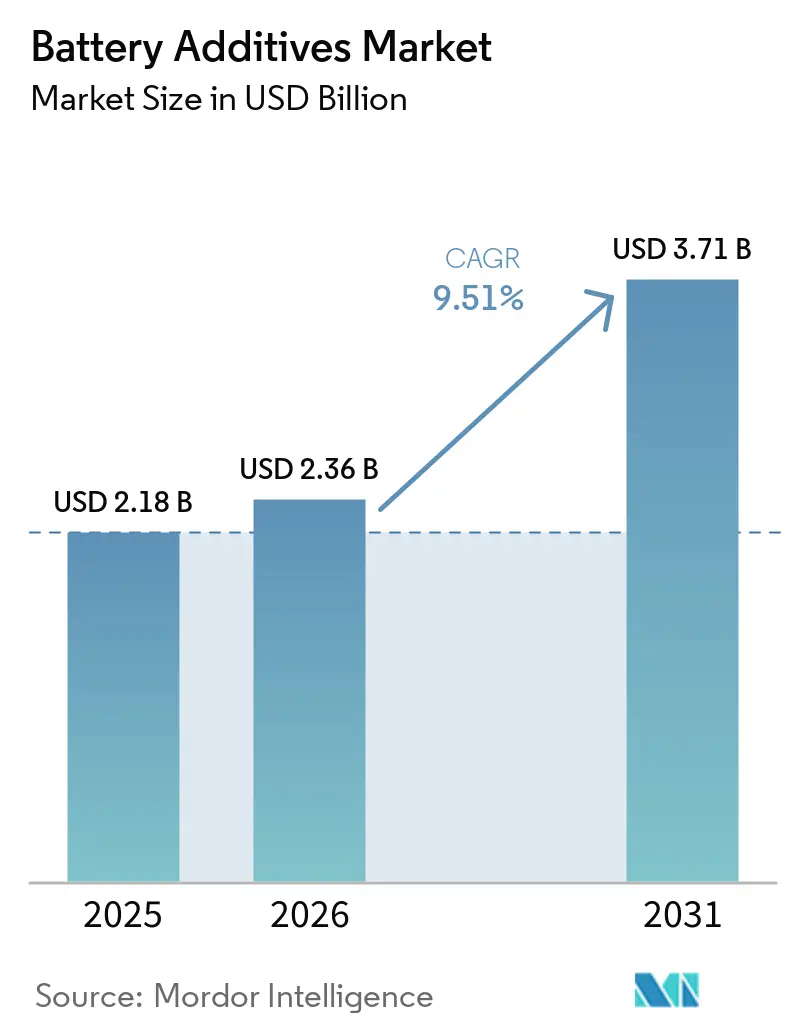
The battery additives market size is projected to expand from USD 2.18 billion in 2025 and USD 2.36 billion in 2026 to USD 3.71 billion by 2031, at a CAGR of 9.51% between 2026 and 2031. Higher-energy lithium-ion cell designs require more specialized conductive, protective, and processing additives. Global electric car output reached nearly 22 million units in 2025, increasing the need for new cell formats and tighter qualification standards across the battery additives market[1]. Stationary storage also expands demand beyond transport as cell production rises for utility applications. Regional manufacturing policies are changing supplier selection because cell makers need traceable and qualified materials near new production sites. These conditions favor suppliers that can support product qualification, local supply, and formulation development across several battery chemistries.
Key Report Takeaways
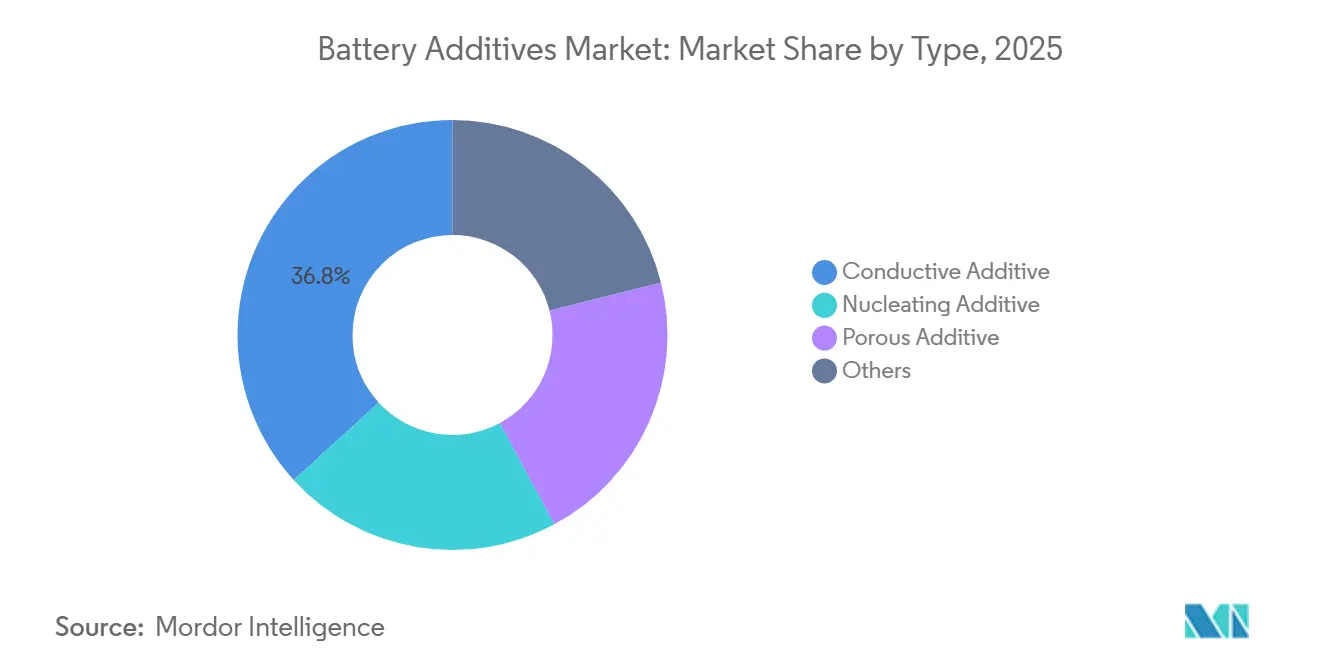
- By type, conductive additives held 36.78% of revenue in 2025 and are forecast to grow at a 10.34% CAGR through 2031.
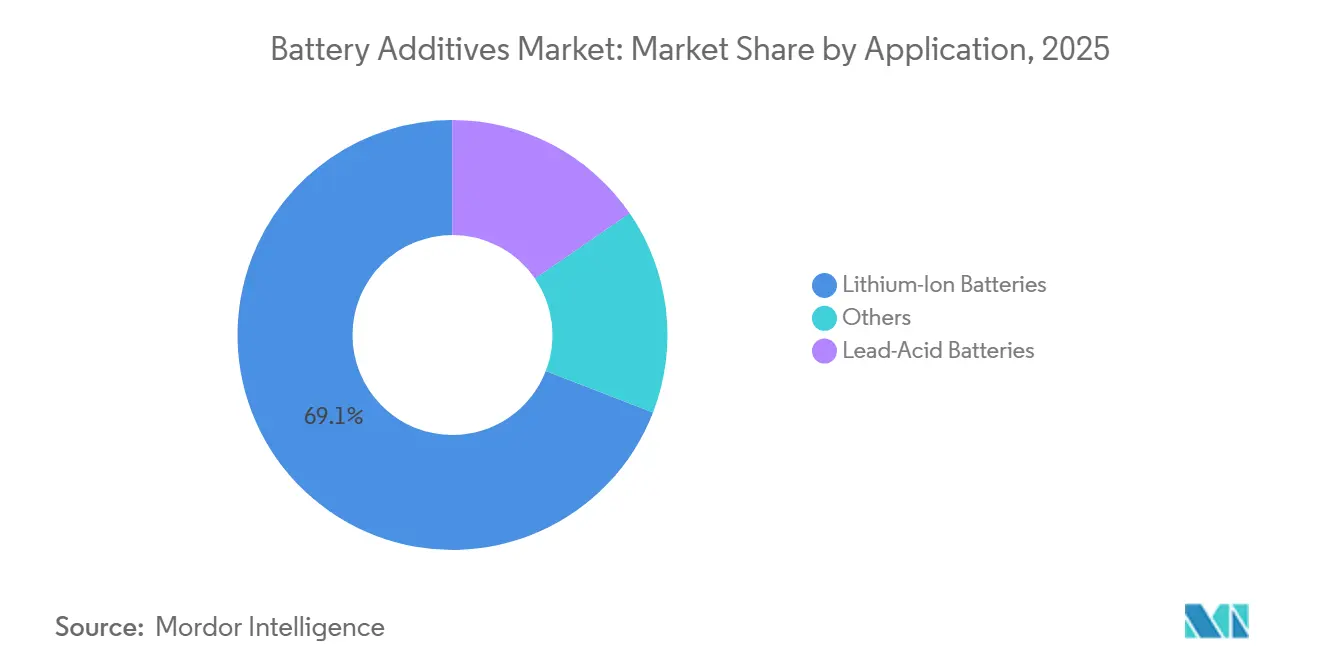
- By application, lithium-ion batteries accounted for 69.13% of revenue in 2025 and are forecast to grow at a 10.56% CAGR through 2031.
- By geography, Asia Pacific accounted for 46.06% of revenue share in 2025, and is forecast to grow at a 10.73% CAGR through 2031.
Note: Market size and forecast figures in this report are generated using Mordor Intelligence’s proprietary estimation framework, updated with the latest available data and insights as of January 2026.
Market Trends and Insights
Drivers Impact Analysis of Battery Additives Market*
| Driver | (~) % Impact on CAGR Forecast | Geographic Relevance | Impact Timeline |
|---|---|---|---|
| Electric Vehicle Battery Production Expansion | +3.0% | Global, with highest density in China, South Korea, Germany, and North America | Short term (≤ 2 years) |
| Grid-Scale Energy Storage Deployment | +2.0% | Global, with primary growth in the United States, China, the European Union, and Australia | Medium term (2-4 years) |
| Higher-Voltage and Longer-Life Cell Formulations | +1.5% | Global, concentrated in research hubs in Japan, Germany, South Korea, and the United States | Medium term (2-4 years) |
| Silicon-Rich Anodes and High-Nickel Cathodes | +1.5% | Global, with highest near-term intensity in China, South Korea, and the European Union | Long term (≥ 4 years) |
| Regional Gigafactory Qualification and Formulation Localization | +1.0% | North America and the European Union, with spillover to India and Southeast Asia | Medium term (2-4 years) |
| Source: Mordor Intelligence | |||
Electric Vehicle Battery Production Expansion
Cell-level volume growth remains a central demand driver for the battery additives market because each production line requires repeatable material inputs. LG Energy Solution began production at its Lansing, Michigan, facility in August 2026. The facility targets more than 35GWh of annual cell capacity for LFP energy-storage and NMC electric-vehicle applications. LG Energy Solution plans more than 50GWh of LFP cell-making capacity across North America by the end of 2026. Each additional gigawatt-hour of capacity requires conductive, porous, and nucleating materials during cell production. Parallel growth in LFP and NMC production broadens formulation needs instead of concentrating demand in one chemistry.
Grid-Scale Energy Storage Deployment
Stationary storage is a major source of additional demand for the battery additives market because it uses large volumes of cells outside vehicle production. The International Energy Agency reported 108GW of battery storage additions in 2025. The U.S. Energy Information Administration tracks 24GW of planned utility-scale battery storage additions in the United States during 2026, compared with 15GW in 2025[2]. Grid-scale systems predominantly use LFP cells with additive requirements that differ from automotive NMC cells. Storage growth, therefore, expands the range of additive packages required by battery manufacturers. This demand supports materials designed for long cycle life, stable electrode processing, and reliable operation at utility scale.
Higher-Voltage and Longer-Life Cell Formulations
Cell developers are raising operating voltages and extending cycle-life targets in the battery additives market. Standard carbonate electrolytes need functional additives to meet these operating conditions without compromising protective interphases. A 2026 study reported that an ether-nitrile molecular additive enabled LMFP cathodes to operate above 4.5V. The cells retained 86.4% capacity after 1,400 cycles. Fluorinated carbonates, sulfonate esters, and boron-containing salts support the protective interphases needed for these designs. The qualification process remains important because high-voltage additives must meet each cell maker’s performance requirements before use in production.
Silicon-Rich Anodes and High-Nickel Cathodes
Silicon-composite anodes are creating demand for additives that form stable solid electrolyte interphases within the battery additives market. Silicon expands substantially during lithiation and requires materials that help manage repeated volume changes during charging and discharge. BASF and Group14 Technologies introduced a silicon battery solution in May 2025 that combined BASF’s Licity 2698 X F binder with Group14’s SCC55 material. Test cells exceeded 1,000 cycles at 25°C with 80% capacity retention and exceeded 500 cycles at 45°C. Research published in 2026 also found that sulfonated carbon nanofiber conductive additives supported 94.2% capacity retention over 300 cycles in silicon anodes. High-nickel NMC cathodes add a separate need for surface-stabilizing materials at higher operating voltages.
Restraints Impact Analysis of Battery Additives Market*
| Restraint | (~) % Impact on CAGR Forecast | Geographic Relevance | Impact Timeline |
|---|---|---|---|
| High Qualification Costs and Long Cell-Validation Cycles | -1.0% | Global battery plants, with greatest pressure in the United States and the European Union | Medium term (2-4 years) |
| Raw-Material Price Volatility and High-Purity Supply Constraints | -0.8% | Global, with high sensitivity in China-dependent feedstock chains and spillover to North America and the European Union | Short term (≤ 2 years) |
| Additive Loading Trade-Offs with Energy Density | -0.7% | Global, with high sensitivity in electric vehicle-grade prismatic and cylindrical formats | Long term (≥ 4 years) |
| Source: Mordor Intelligence | |||
High Qualification Costs and Long Cell-Validation Cycles
Long validation cycles limit the speed at which new materials enter the battery additives market. Suppliers must generate performance, safety, processing, and documentation evidence for each customer relationship. The process is not easily transferable between cell makers because specifications vary by chemistry, cell format, and manufacturing approach. Research presented at the Electrochemical Society’s 2026 meeting described how multiyear qualification programs can exceed the capital available to emerging United States cell manufacturers. UN 38.3 transportation testing and IEC 62133 requirements add further testing steps for suppliers serving more than one region. Established formulations benefit because their validation record reduces the work required for repeat orders and new customer programs.
Raw-Material Price Volatility and High-Purity Supply Constraints
Raw-material volatility can quickly affect costs in the battery additives market because specialty inputs move through short supply chains. Battery-grade precursors require strict controls over purity, moisture content, and consistency from batch to batch. New feedstock capacity must be approved against cell-maker specifications before it can support production. This process can delay supply responses when demand rises suddenly or a customer changes its formulation. Suppliers that rely on a narrow feedstock base face greater exposure to procurement disruption and margin pressure. The pressure is strongest where advanced electrolyte additives depend on specialized lithium salts and fluorinated materials.
*Our forecasts treat driver/restraint impacts as directional, not additive. The impact forecasts reflect baseline growth, mix effects, and variable interactions.
Battery Additives Market Segment Analysis
By Type:
Conductive Additive Formats Define Value CreationConductive additives held 36.78% of the battery additives market share in 2025 and are forecast to grow at a 10.34% CAGR through 2031. Carbon black, carbon nanotubes, graphene, and hybrid dispersions form the main product groups. These materials create conductive pathways that support electrode operation. Electrode engineers are moving toward lower-loading formats that preserve active-material density. The shift is relevant for designs that require faster charging and longer cycle life. The battery additives industry uses conductive materials to maintain electron transport within increasingly demanding electrode designs. Birla Carbon introduced Conductex i10 battery-grade carbon black at Interbattery 2025 for next-generation chemistries, including solid-state and lithium-vanadium-oxide batteries. The launch illustrates the shift from general-purpose carbon materials toward chemistry-specific products.
Porous additives hold the second-largest position in the type segmentation. Their surface area and ion-transport characteristics suit high-energy-density electrode designs. Nucleating additives serve more specialized formulations that need controlled crystallization of electrode active materials. These materials can help limit structural degradation during repeated cycling. Other formats include emerging pre-lithiation additives that support system-level optimization. The battery additives industry is also responding to interest in fluorine-free alternatives to PVDF binders and fluorinated co-solvents. This shift could alter value distribution among type categories as alternative formulations reach larger-scale use. Product suppliers must balance electrochemical performance, processing reliability, and compatibility with the customer’s cell design. The balance differs across lithium-ion, lead-acid, and emerging battery applications.

By Application:
Lithium-Ion Batteries Anchor Demand, Lead-Acid Sustains BaselineLithium-ion batteries accounted for 69.13% of the battery additives market share in 2025 and are forecast to grow at a 10.56% CAGR through 2031. High-nickel NMC and LFP cells use conductive additives in cathodes and binder systems in both electrodes. They also require electrolyte additives for solid electrolyte interphase formation and overcharge protection. Slurry dispersants add another point of additive use during electrode production. Multiple additive functions can therefore be present in the same cell. The battery additives market size for lithium-ion applications rises as cell specifications become more demanding. Long-term supply commitments reflect the value of qualified materials in large-volume cell production. Suppliers that can meet consistent quality and delivery requirements are positioned for repeat procurement.
Lead-acid batteries maintain a secondary role through VRLA and flooded designs. Their use remains important in automotive starting systems, industrial uninterruptible power supplies, and telecommunications backup. AGM batteries use carbon-based additives in micro-hybrid vehicle applications. Borregaard’s lignosulfonate expanders help prevent sulfation in negative lead-acid battery plates. Other applications include sodium-ion cells, which need higher conductive additive loading per kilowatt-hour because of lower cathode conductivity. This requirement can make sodium-ion systems an important source of conductive-material demand as deployment grows. Application diversity reduces dependence on a single end-use area for the battery additives market. It also requires suppliers to adapt products to different operating conditions and cost expectations. This mix maintains demand across established and developing storage technologies.
Geography Analysis
APAC Battery Additives Market
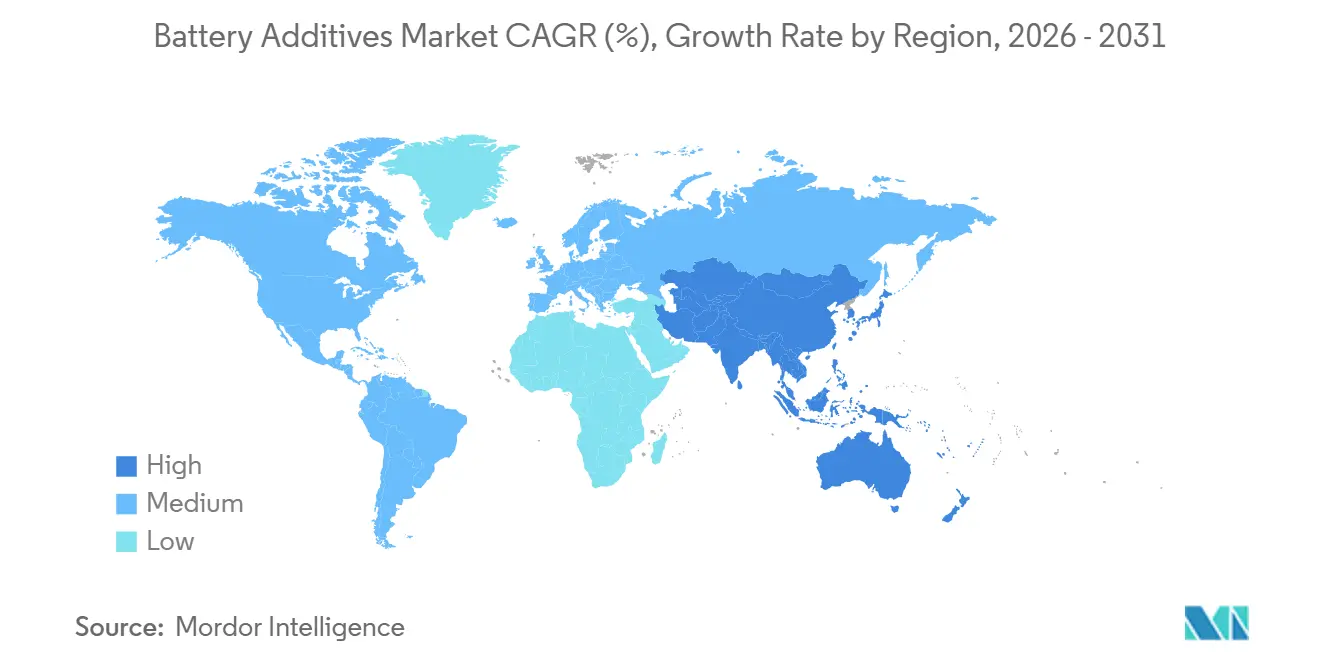
Asia-Pacific accounted for 46.06% of global revenue in 2025 and is forecast to grow at a 10.73% CAGR through 2031. This position reflects established cell manufacturing in China, South Korea, and Japan, alongside a mature battery-material supply base. China’s export controls on battery materials took effect on November 8, 2025. The controls increased the focus on supply diversification among non-Chinese buyers who require dependable access to qualified inputs. They also encouraged domestic suppliers to strengthen integrated material supply chains and secure critical components. The battery additives market remains closely linked to the region’s depth in lithium-ion production, established battery-material ecosystem, and ability to support several cell chemistries.
North America and Europe Battery Additives Market
North America is expanding as domestic cell manufacturing becomes a policy priority. The United States has 24GW of planned utility-scale storage additions in 2026, supporting LFP-related material demand. LG Energy Solution expects its North American LFP cell-making capacity to exceed 50GWh by the end of 2026. The battery additives market size in the region is supported by local qualification needs as storage and electric vehicle cell plants expand. Suppliers must meet customer requirements for material consistency, technical support, and production readiness. Europe is also reshaping sourcing through battery carbon-footprint disclosure requirements that affect supplier documentation. Germany’s announced cell capacity makes the country an important potential center of demand for qualified regional supply.
South America and MEA Battery Additives Market
South America and the Middle East and Africa remain earlier-stage areas for advanced additive demand. Brazil and Argentina support automotive lead-acid production and developing lithium-ion applications. Argentina’s lithium resources continue to attract upstream investment attention, although downstream additive demand remains more limited than in major cell-producing regions. Saudi Arabia’s renewable energy and storage plans can add demand as local cell and module assembly develops. South Africa’s grid instability supports investment in utility and commercial battery storage. Both regions continue to depend largely on imported advanced materials from Asia-Pacific and European suppliers. Local additive production beyond lead-acid formulations depends on broader cell-manufacturing investment, supplier qualification, and demand from domestic battery plants.
Competitive Landscape
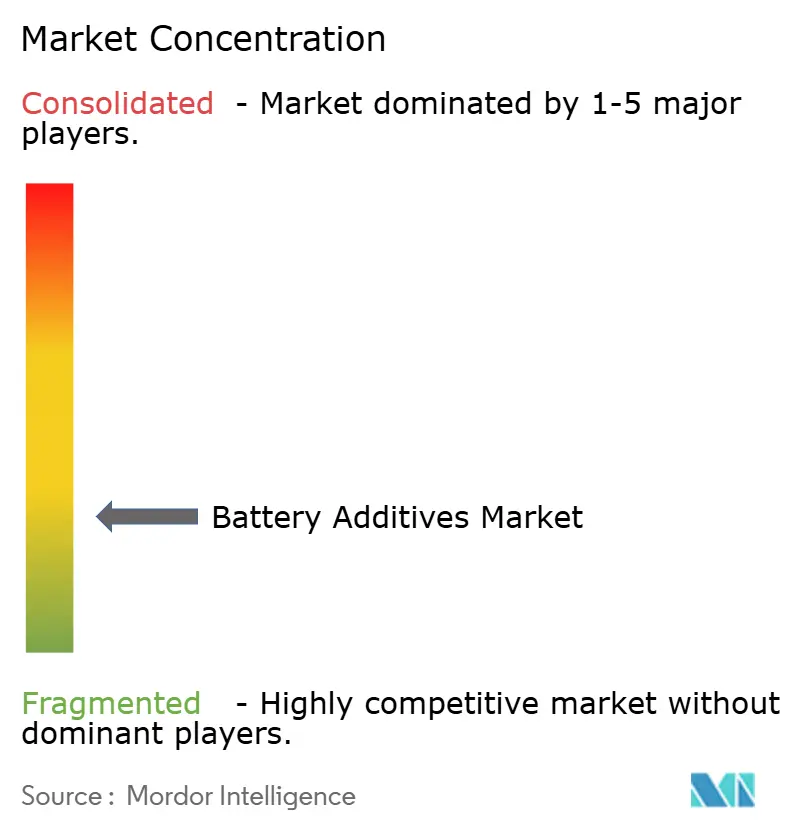
The battery additives market has a fragmented structure. No global supplier holds an outright dominant position because formulations are specific to customers, battery chemistries, and manufacturing processes. BASF, Arkema, and 3M have portfolios across conductive additives, binders, dispersants, and electrolyte materials. Their product breadth supports wider supply relationships with gigafactory customers that need more than one material function. BASF introduced Oppanol N PLUS in June 2026 for next-generation electric vehicle and solid-state battery applications. The product demonstrates the importance of qualifying materials before new cell architectures move into larger-scale production.
Focused specialists compete through supply agreements and closer integration with upstream materials. Cabot’s agreement with PowerCo SE provides an example of early qualification supporting a long-term customer relationship. Suppliers with reliable regional output can be more attractive when customers need documented material traceability and a predictable approval process. Customer switching costs remain high because replacement additives must complete technical validation before they can be used in production. This dynamic protects established suppliers after qualification and reduces the appeal of changing a material without a performance need. It also makes technical service, production consistency, and application support important competitive factors in the battery additives market.
Arkema presented PVDF binder innovations, PAA-based binders for silicon anodes, and dry-electrode coating capabilities in June 2026. Birla Carbon presented Conductex i carbon black and multiwall carbon nanotube products at The Battery Show Europe 2026. These moves show that suppliers are broadening product choices for newer cell designs and specialized electrode requirements. Competitive positioning depends on materials performance, qualification history, regional supply capability, formulation support, and the ability to meet changing customer specifications. The battery additives market does not favor a single universal additive package. Suppliers instead build positions around specific chemistries, cell formats, and customer requirements.
Battery Additives Industry Leaders
-
Cabot Corporation
-
Imerys
-
Orion S.A.
-
SGL Carbon
-
Hammond Group, Inc.
- *Disclaimer: Major Players sorted in no particular order
Battery Additives Market Companies Covered in this Report
- 3M
- ALTANA AG
- Arkema S.A.
- Ascend Performance Materials
- BASF
- Birla Carbon
- Borregaard AS
- Cabot Corporation
- Guangzhou Tinci Materials Technology Co., Ltd.
- Hammond Group, Inc.
- Imerys
- Orion S.A.
- PENOX GmbH
- SGL Carbon
- Shenzhen Capchem Technology Co., Ltd.
- Taiwan Hopax Chemicals Mfg. Co., Ltd.
Recent Industry Developments in Battery Additives Market
- August 2026: LG Energy Solution began commercial production at its new Lansing, Michigan, facility, targeting more than 35GWh of annual cell capacity for LFP ESS and NMC EV applications. With this plant, the company plans more than 50GWh of LFP cell-making capacity across North America by Q4 2026.
- January 2026: Cabot Corporation signed a multiyear supply agreement with PowerCo SE, Volkswagen Group’s battery subsidiary, to supply advanced conductive carbons and dispersions for EV battery electrodes in Europe. The agreement marked a strategic milestone in Cabot’s European battery materials growth.
Global Battery Additives Market Report Scope
Battery additives are chemical formulations designed to enhance performance, prevent corrosion, or rejuvenate lead-acid and lithium-ion batteries.
The battery additives market is segmented by type, application, and geography. By type, the market is segmented into conductive additive, porous additive, nucleating additive, and others. By application, the market is segmented into lithium-ion batteries, lead-acid batteries, and others. By geography, the market is segmented into Asia Pacific, North America, Europe, South America, the Middle East and Africa. The report also covers the battery additives market size and forecasts for the battery additives market in 15 countries across major regions. For each segment, the market sizing and forecasts have been done on the basis of value (USD).
Segmentation Overview
| Conductive Additive |
| Porous Additive |
| Nucleating Additive |
| Others |
| Lithium-Ion Batteries |
| Lead-Acid Batteries |
| Others |
| Asia-Pacific | China |
| India | |
| Japan | |
| South Korea | |
| Rest of Asia-Pacific | |
| North America | United States |
| Canada | |
| Mexico | |
| Europe | Germany |
| United Kingdom | |
| France | |
| Italy | |
| Rest of Europe | |
| South America | Brazil |
| Argentina | |
| Rest of South America | |
| Middle East and Africa | Saudi Arabia |
| South Africa | |
| Rest of Middle East and Africa |
| By Type | Conductive Additive | |
| Porous Additive | ||
| Nucleating Additive | ||
| Others | ||
| By Application | Lithium-Ion Batteries | |
| Lead-Acid Batteries | ||
| Others | ||
| By Geography | Asia-Pacific | China |
| India | ||
| Japan | ||
| South Korea | ||
| Rest of Asia-Pacific | ||
| North America | United States | |
| Canada | ||
| Mexico | ||
| Europe | Germany | |
| United Kingdom | ||
| France | ||
| Italy | ||
| Rest of Europe | ||
| South America | Brazil | |
| Argentina | ||
| Rest of South America | ||
| Middle East and Africa | Saudi Arabia | |
| South Africa | ||
| Rest of Middle East and Africa | ||
Key Questions Answered in the Report
How large is the battery additives market?
It is projected to increase from USD 2.36 billion in 2026 to USD 3.71 billion by 2031, at a 9.51% CAGR. The forecast reflects demand from transport and stationary energy-storage cell production.
Which type of battery additives is growing fastest?
Conductive additives are forecast to grow at a 10.34% CAGR through 2031 after holding 36.78% of revenue in 2025. Carbon black, carbon nanotubes, graphene, and hybrid dispersions are included in this category.
Which region leads global demand?
Asia-Pacific held 46.06% of global revenue in 2025 and is forecast to grow at a 10.73% CAGR through 2031. Its lead reflects deep cell-manufacturing capacity and a developed battery-material supply base.
Why do lithium-ion cells require battery additives?
They use conductive materials, binders, electrolyte additives, and dispersants to support electrode processing, protection, and cycle life. Higher-performance cells can require several additive functions within the same design.