
Bathroom Furniture Market Size and Share
Market Overview
| Study Period | 2021 - 2031 |
|---|---|
| Market Size (2026) | USD 29.60 Billion |
| Market Size (2031) | USD 40.25 Billion |
| Growth Rate (2026 - 2031) | 6.34 % |
| Fastest Growing Market | Asia-Pacific |
| Largest Market | Asia-Pacific |
| Market Concentration | Low |
Major Players *Disclaimer: Major Players sorted in no particular order Image © Mordor Intelligence. Reuse requires attribution under CC BY 4.0. | |
Bathroom Furniture Market Analysis by Mordor Intelligence
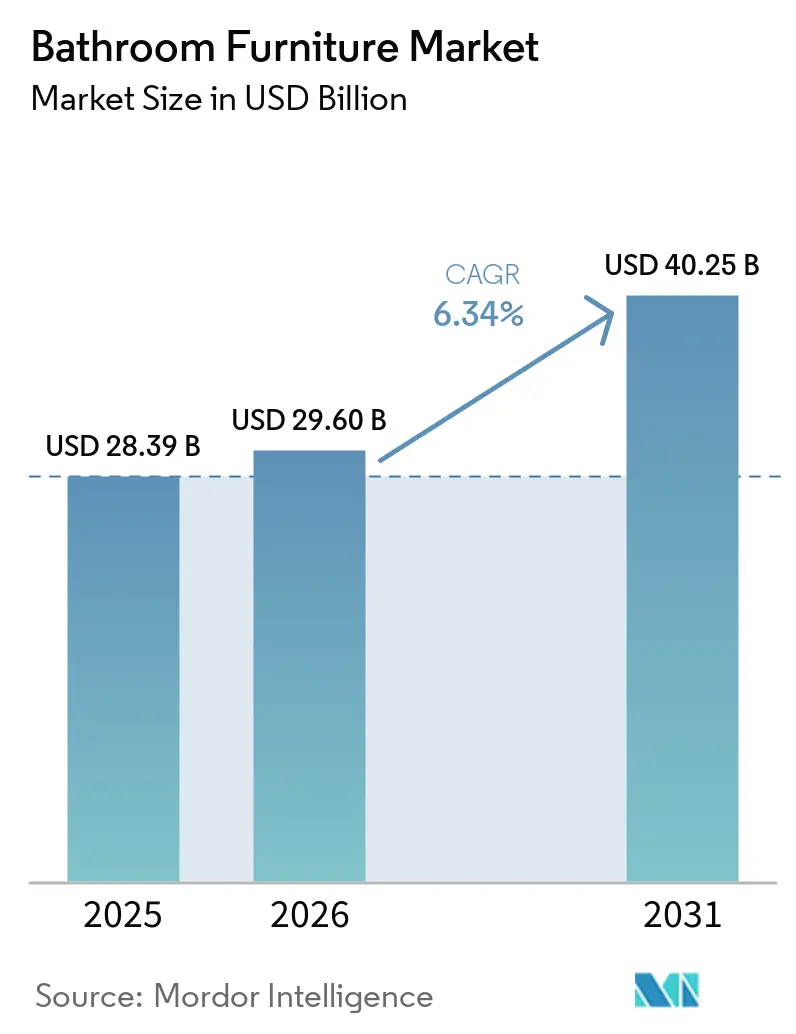
The bathroom furniture market size is expected to grow from USD 28.39 billion in 2025 to USD 29.60 billion in 2026 and is forecast to reach USD 40.25 billion by 2031 at a 6.34% CAGR over 2026-2031. Renovation activity is becoming more important than new construction in mature economies, which gives the bathroom furniture market a steadier replacement base. European consumers increasingly treat bathrooms as part of domestic well-being, supporting spending on coordinated cabinets, vanities, and mirrors[1]. Urban households in Asia-Pacific and the Middle East are shortening renovation cycles, which expands replacement demand beyond new-home completions. Suppliers are responding by integrating modular furniture, moisture-resistant materials, and connected features into broader bathroom systems. The bathroom furniture market also faces material-cost pressure and more low-priced imports, which favor established suppliers with certified processes and broader sourcing options.
Key Report Takeaways
- By product type, bathroom cabinets accounted for 58.5% of the bathroom furniture market in 2025, while bathroom vanities are projected to register a CAGR of 7.16% through 2031.
- By material, wood accounted for 42.6% of 2025 revenue, while plastic and polymer are projected to register a CAGR of 7.02% through 2031.
- By price range, the mid-range segment accounted for 55.3% of 2025 revenue, while premium and luxury products are projected to register a CAGR of 7.28% through 2031.
- By end-user, residential customers accounted for 73.4% of 2025 revenue, while commercial customers are projected to register a CAGR of 7.42% through 2031.
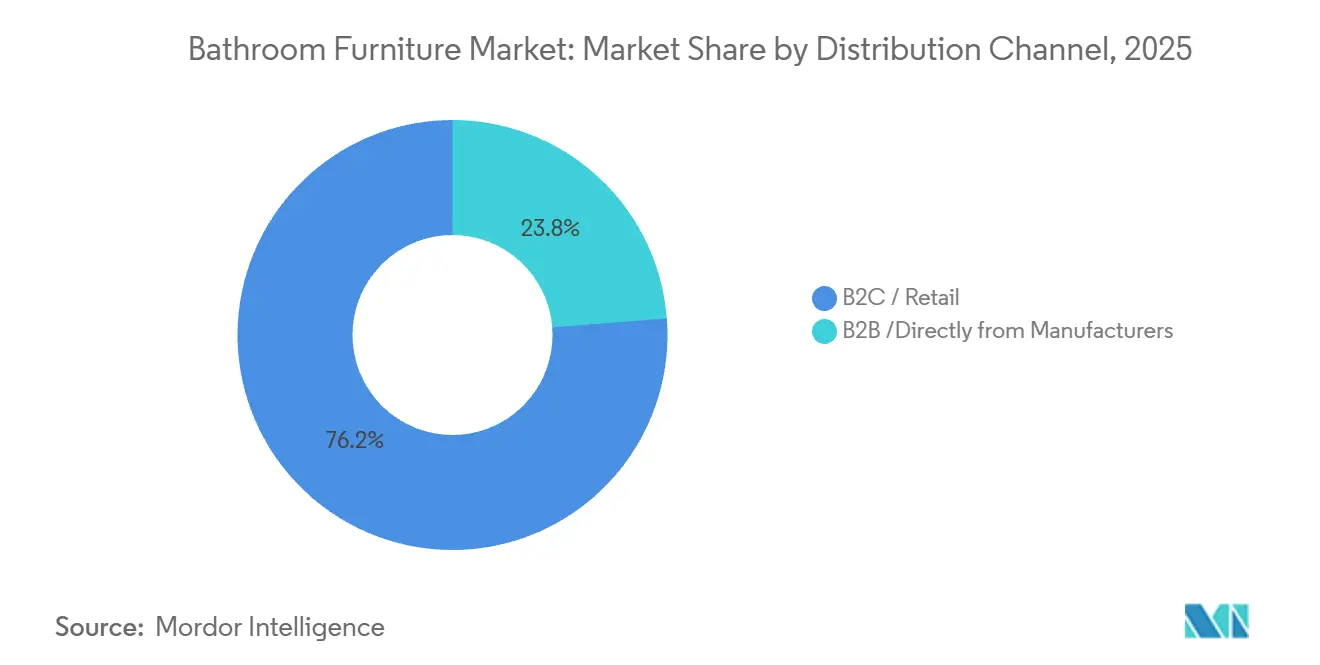
- By distribution channel, B2C and retail accounted for 76.2% of 2025 revenue and are projected to register a CAGR of 7.36% through 2031.
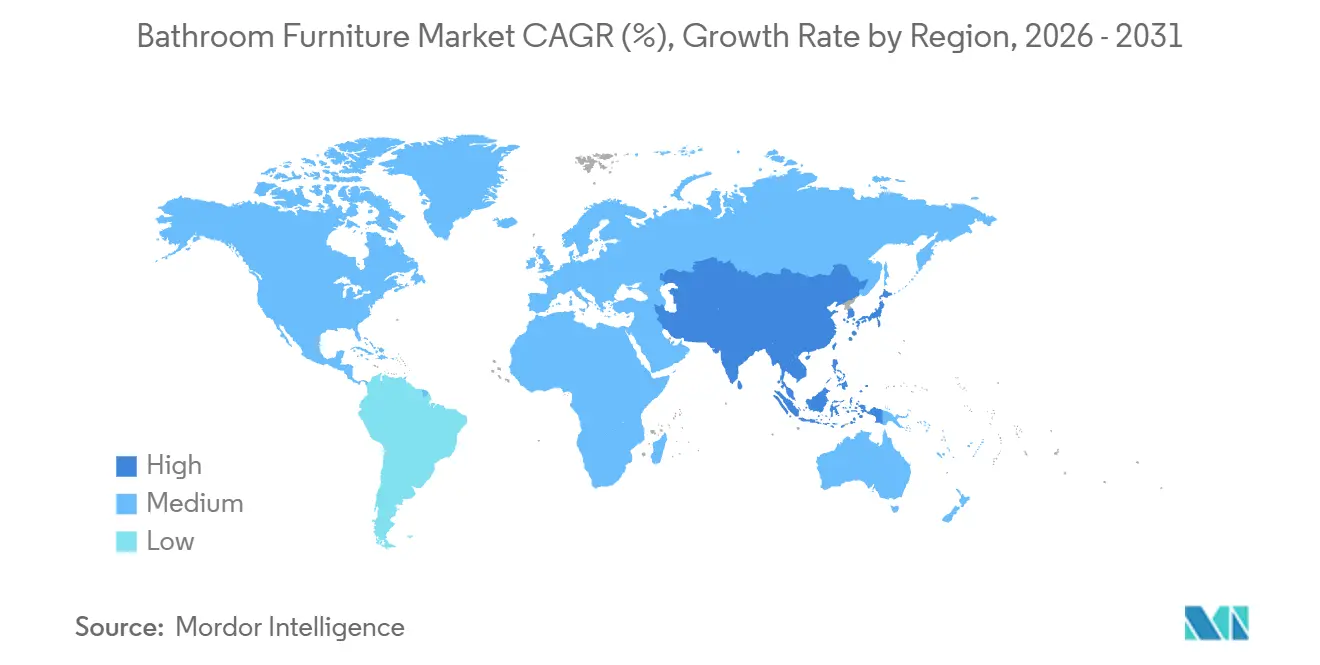
- By geography, Asia-Pacific accounted for 33.2% of 2025 revenue and is projected to register a CAGR of 7.63% through 2031.
Note: Market size and forecast figures in this report are generated using Mordor Intelligence’s proprietary estimation framework, updated with the latest available data and insights as of January 2026.
Market Trends and Insights
Drivers Impact Analysis of Bathroom Furniture Market*
| Driver | (~) % Impact on CAGR Forecast | Geographic Relevance | Impact Timeline |
|---|---|---|---|
| Residential Renovation and Replacement Cycles | +1.6% | Global, with peak activity in Asia-Pacific, North America, and Western Europe | Medium term (2-4 years) |
| Demand for Water-Resistant and Durable Furniture | +0.9% | Global, with strong material switching in humid tropical and coastal markets | Medium term (2-4 years) |
| Premiumization of Bathroom Interiors | +1.2% | North America, Western Europe, GCC, and Asia-Pacific tier-1 cities | Medium term (2-4 years) |
| Modular and Customizable Vanity Systems | +0.8% | Global, led by Europe and Asia-Pacific urban renovation markets | Medium term (2-4 years) |
| Digitally Configured and Smart Furniture | +0.5% | North America, East Asia, Western Europe, and the Middle East luxury segment | Long term (≥ 4 years) |
| Hospitality and Multifamily Construction | +0.9% | Asia-Pacific, GCC, and the wider Middle East and Africa | Medium term (2-4 years) |
| Source: Mordor Intelligence | |||
Residential Bathroom Renovation and Replacement Cycles
Renovation activity is a major source of bathroom-furniture demand in mature housing markets, particularly Japan, the United States, Canada, and Western Europe. It provides suppliers with demand that is less dependent on new-home completions. Fortune Brands Innovations reported FY2025 net sales of USD 4,463.2 million, with builder-led demand representing about one-quarter of its business, implying that roughly three-quarters of demand was repair-and-remodel or replacement-led. Geberit’s FY2025 results show that renovation accounted for around 60% of group sales, while its Bathroom Systems division, including bathroom furniture, grew 6.1% currency-adjusted to CHF 954.0 million (~USD 1,207.6 million)[2]. This result shows the scale of renovation demand even in a mature housing market. Replacement purchases often include storage cabinets, vanities, and mirrors as part of a single room upgrade. The bathroom furniture market benefits when suppliers offer coordinated collections that simplify those purchases.
Rising Demand for Water-Resistant and Durable Bathroom Furniture
Humidity, condensation, and direct water exposure make material performance a central purchase criterion for bathroom furniture. Buyers increasingly prioritise moisture-resistant engineered boards, sealed edges, corrosion-resistant fittings and durable surface finishes that preserve structural stability and appearance under repeated moisture exposure. This requirement is especially strong in tropical and coastal markets, where humidity accelerates swelling, delamination and corrosion in inadequately specified materials. Demand is also rising across hospitality, healthcare and institutional projects, where intensive use, frequent cleaning and long replacement cycles increase the cost of premature failure. Suppliers offering certified moisture-resistant designs, documented product testing and responsibly sourced materials can reduce warranty risk, support premium pricing and meet the procurement requirements of residential, hospitality and institutional buyers.
Premiumization of Bathroom Interiors
Premiumization is expanding demand for furniture that contributes to a coordinated bathroom environment. Kohler launched Kohler Health in October 2025, including Dekoda, a USD 599 toilet-mounted device that monitors hydration and gut-health indicators through optical sensors and a smartphone app[3]. The launch places bathroom products within a wider personal-wellness proposition. Similarly, on 17 March 2025, Duravit launched its Balcoon bathroom range, developed with Patricia Urquiola at ISH 2025. The premium collection combines bathroom furniture, ceramics and refined workmanship, supporting the shift toward coordinated, design-led bathroom environments.
Assobagno reported that 57% of Italian consumers describe the bathroom as the center of domestic well-being. Integrated groups can coordinate vanities, storage, mirrors, ceramics, and fittings more readily than narrow product specialists. This ability supports premium specifications and gives buyers a more consistent design language.
Growth of Modular and Customizable Vanity Systems
Modular and customizable vanity systems are gaining share as buyers seek space-efficient, design-consistent and future-ready bathroom solutions. Modular formats allow manufacturers and retailers to address varied room sizes, plumbing layouts and storage requirements through configurable cabinets, basins, mirrors and accessories, reducing inventory complexity while broadening addressable demand. Customization covering finishes, countertop materials, lighting, hardware and storage configurations supports premiumization and enables differentiation in residential, hospitality and institutional projects. This trend is particularly relevant in urban apartments and renovation projects, where space constraints and coordinated bathroom design increase demand for flexible, made-to-order and scalable vanity solutions.
Restraints Impact Analysis of Bathroom Furniture Market*
| Restraint | (~) % Impact on CAGR Forecast | Geographic Relevance | Impact Timeline |
|---|---|---|---|
| Moisture, Humidity, and Installation-Quality Risks | -0.4% | Global, with elevated failure risks in Southeast Asia and coastal Middle East and Africa markets | Short term (≤ 2 years) |
| Wood, Engineered-Board, Glass, Stone, and Hardware Cost Volatility | -0.6% | Global, with strong effects across Europe and South and East Asia supply chains | Medium term (2-4 years) |
| Fragmented Quality and Durability Standards | -0.3% | Global, especially in cross-border trade among Europe, North America, and Asia-Pacific | Long term (≥ 4 years) |
| Composite and Laminated Furniture Disposal Challenges | -0.2% | Europe and North America, with rising relevance in Asia-Pacific | Long-term (≥ 4 years) |
| Source: Mordor Intelligence | |||
Volatility in Wood, Engineered-Board, Glass, Stone, and Hardware Costs
Material-price changes remain a margin risk for suppliers that rely on MDF and particleboard. The risk is most pronounced in the mid-range tier, where buyers are sensitive to price changes, and manufacturers have limited flexibility to pass on costs. India’s MDF quality control order cut import arrivals by 69% year-on-year in 2025, tightening low-cost panel supply and raising costs for vanity manufacturers.[4]. Similarly, on 5 September 2025, Vietnam imposed anti-dumping duties of up to 39.88% on certain Chinese MDF imports, increasing input costs for furniture and vanity producers. The change tightened supply for cabinet assemblers using low-cost imported panels. Suppliers with regional sourcing, diverse substrate portfolios, and recognized certifications are better prepared for procurement disruptions. Cost volatility can also favor larger groups that purchase materials across several product categories.
Moisture, Humidity, and Installation-Quality Risks
Moisture-related failure remains a practical constraint for bathroom furniture. Swelling, delamination, and concealed-hardware corrosion can result from poor material selection or inadequate installation. EN 14749 covers safety requirements and test methods for domestic storage units, but it does not create a single global moisture-performance standard for every product category. Inconsistent compliance makes quality harder to assess in cross-border supply chains. Early product failures can reduce confidence in lower-priced products during the next renovation cycle. Established brands are better positioned when they provide clear performance specifications and certified processes.
*Our forecasts treat driver/restraint impacts as directional, not additive. The impact forecasts reflect baseline growth, mix effects, and variable interactions.
Bathroom Furniture Market Segment Analysis
By Product Type:
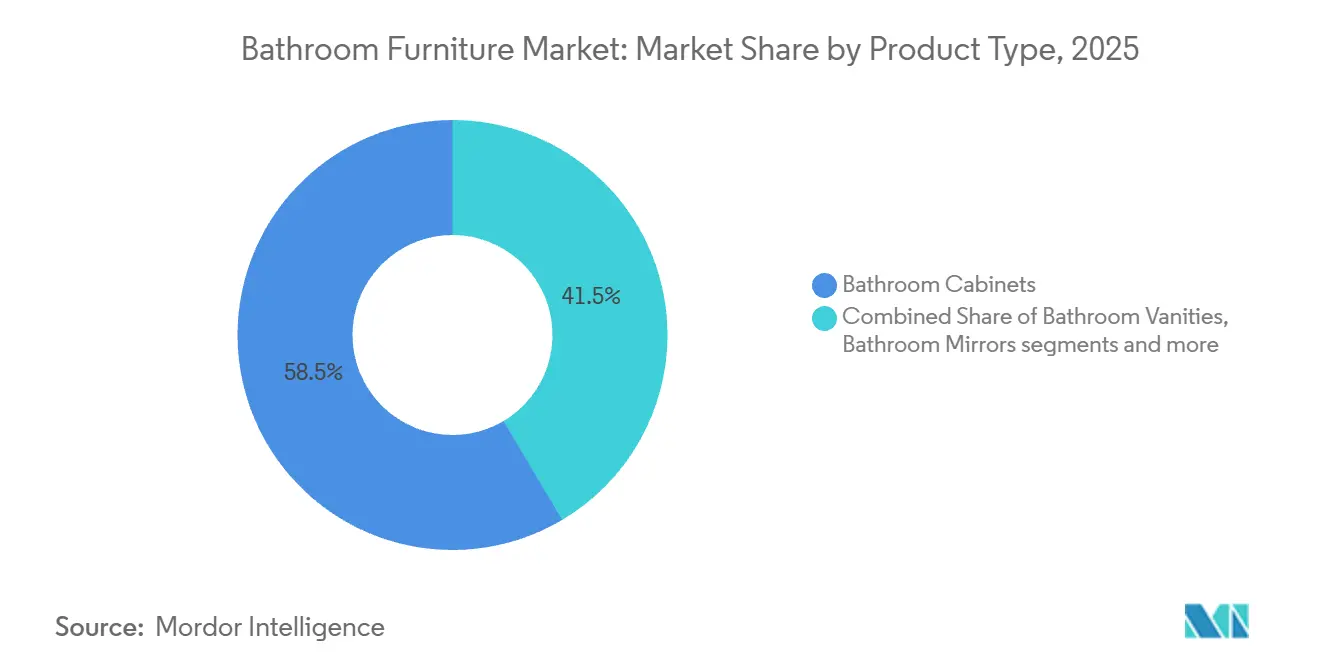
Cabinets Anchor Revenues and Vanities Support Design-Led DemandBathroom cabinets held 58.5% of the bathroom furniture market share in 2025, making them the largest product category. Cabinets remain central because they provide the storage structure required in most bathroom layouts. Their demand is supported by renovation projects that replace several items at once. Bathroom vanities are forecast to grow at 7.16% through 2031. Buyers increasingly use the vanity as the visual focal point of a renovated bathroom. This favors coordinated countertop, basin, storage, and hardware designs. Integrated collections can strengthen premium positioning by bringing these elements together. Mirrors and storage accessories can raise order values when they are sold as part of the same collection.
Bathroom mirrors are becoming more closely connected to the furniture purchase rather than being treated as a separate accessory. Anti-fog capability and integrated lighting make mirror cabinets relevant to both storage and bathroom lighting plans. Suppliers can use these features to differentiate collections without changing the basic renovation workflow. Storage furniture and accessories serve a similar role by completing the design around a vanity or cabinet. The bathroom furniture market benefits when retailers present these items as coordinated room sets. This approach can make it easier for buyers to compare finish, size, and storage choices. It also supports sales through specialist showrooms, home-improvement stores, and design professionals. Product suppliers that align dimensions and finishes across ranges can serve both replacement and new-construction demand. The result is a broader product offer built around a single renovation decision.

By Material:
Wood Maintains Its Position While Polymer Meets Functional RequirementsWood accounted for 42.6% of the bathroom furniture market size in 2025. The material continues to appeal to buyers seeking natural finishes in premium renovations. Its visual warmth supports coordinated interiors that include wood-look surfaces and fittings. Wood-based products also fit established cabinet manufacturing processes in Europe and North America. Plastic and polymer products are projected to grow at a 7.02% CAGR through 2031. Their moisture resistance is particularly relevant in humid settings and in value-oriented applications. Material selection increasingly depends on expected exposure to water, installation quality, and desired price point. PEFC certification is relevant for responsibly sourced timber used in bathroom furniture. RoHS and REACH conformance can also matter for PVC products sold in European markets.
Polymer materials give suppliers another route to durable and accessible bathroom products. They can support affordable housing projects where moisture resilience and ease of cleaning matter more than premium finishes. The bathroom furniture market can therefore serve different buyer needs through both wood and polymer ranges. Metal continues to occupy a design-led niche, particularly in matte-black and brushed-steel finishes. Sintered stone and composite resins are used as premium countertop surfaces. These materials can support a more differentiated vanity offer when paired with purpose-designed storage. Material choices also affect delivery, assembly, and warranty policies. Suppliers that explain material performance clearly can reduce buyer uncertainty. This is especially important when products are ordered online without an in-store inspection.
By Price Range:
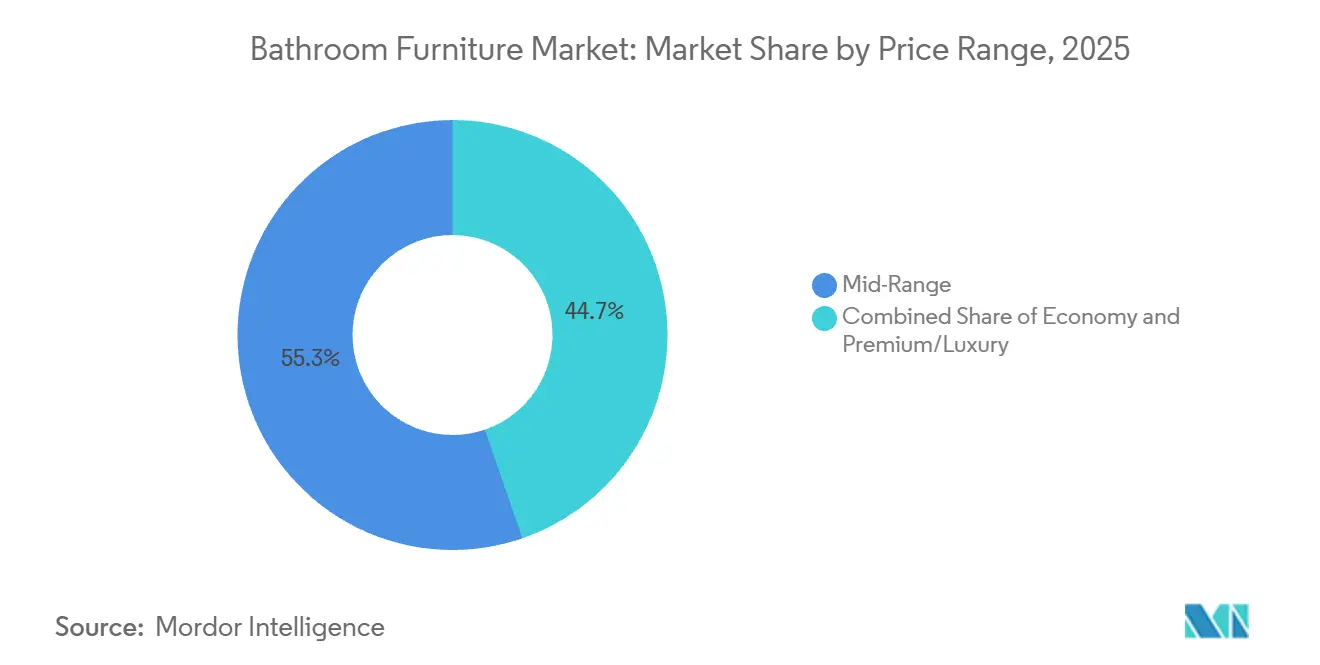
Mid-Range Demand Supports Volume While Premium Products ExpandThe mid-range tier held 55.3% of 2025 revenue. It reflects renovation budgets that seek functional storage and better finishes without full luxury specifications. This tier gives suppliers substantial volume across developed and emerging markets. It is also exposed to cost pressure because engineered boards, hardware, and freight represent meaningful parts of the finished product cost. Premium and luxury products are forecast to grow at a 7.28% CAGR through 2031. Premium demand is extending beyond mature Western markets into high-growth cities in Asia and the Middle East. Kohler identified India as a favorable setting for premium bathware investment in 2026. High-rise residential development, hospitality, and redevelopment support this demand.
Premium products depend on design, finishes, and a coordinated collection rather than storage capacity alone. They also depend on the ability to deliver consistent installation and after-sales service. The economy tier continues to serve affordable housing and large replacement markets in emerging economies. PVC and polymer substrates can make functional furniture accessible in these projects. The bathroom furniture industry uses a broad price architecture because renovation budgets differ by geography and building type. Suppliers that operate across several tiers can preserve customer relationships as buyers trade up over time. The mid-range tier remains important because it combines practical performance with accessible design. Premium growth does not replace this tier, but it changes how suppliers define value across the full product portfolio.
By End-User:
Residential Demand Leads While Commercial Projects Grow FasterResidential customers accounted for 73.4% of 2025 revenue. Aging housing stock in North America and Europe supports replacement demand, while urban development supports demand in high-growth economies. Homeowners often purchase cabinets, vanities, mirrors, and accessories together during renovation. This creates a larger opportunity for suppliers with compatible collections. Commercial customers are forecast to grow at a 7.42% CAGR through 2031. Hospitality projects are a major contributor because each guest room requires a repeatable bathroom specification. The GCC hotel pipeline creates demand for products that combine appearance, reliable installation, and consistent supply. Commercial buyers also place greater weight on compliance, maintenance, and long-term product availability.
Healthcare and education buildings are smaller commercial opportunities but can support technology-enabled replacement cycles. TOTO has highlighted connected bathroom systems for commercial washrooms, showing how monitoring could affect future facilities management. These applications require suppliers to consider durability, accessibility, and maintenance alongside visual design. Commercial procurement often involves longer specification periods than retail purchases. This can favor suppliers that maintain technical documentation and stable product ranges. Residential demand remains the primary revenue base, but commercial projects can lift average project values. Two different buying patterns therefore support the bathroom furniture market. One is the homeowner upgrade, and the other is a structured procurement process for repeated installations.
By Distribution Channel:
Retail Leads While Digital Research Shapes PurchasesB2C and retail held 76.2% of 2025 revenue and are forecast to grow at a 7.36% CAGR through 2031. Retail remains central because bathroom furniture often requires buyers to compare finish, dimensions, and quality before purchase. Physical stores also support design advice and installation planning. At the same time, online research is now a major part of the purchase journey. Assobagno found that 97% of European bathroom-renovation consumers begin online, while 90% still complete purchases in physical stores. This pattern requires suppliers to provide accurate digital product information. It also supports retailers that connect online selection with in-store confirmation.
The online channel can improve reach for standard modular products. It can also make dimensions, finishes, and delivery promises easier to compare. However, furniture buyers may still need support on fit, plumbing positions, and installation. B2B sales directly from manufacturers remain important for hotels and large residential developments. These projects justify direct relationships because of their volume commitments and long specification periods. German manufacturers reported modest improvements in e-commerce and specialist sanitary trade during 2025, while broader retail orders remained subdued. The channel mix is therefore evolving rather than moving fully online. Suppliers that support both digital discovery and specialist sales advice can serve more of the bathroom furniture market.
Geography Analysis
APAC Bathroom Furniture Market
Asia-Pacific accounted for 33.2% of 2025 revenue and is forecast to grow at a 7.63% CAGR through 2031. The region combines urbanization, rising incomes, hotel development, and replacement demand from older urban housing. Hansgrohe announced plans in September 2025 to quadruple India manufacturing capacity and target 10% of global sales from India by 2030. The investment reflects supplier confidence in Indian demand for better bathroom products. LIXIL also reported growth in India and the Middle East, while China remained softer in its first-half fiscal 2026 results. Japan and South Korea support demand for space-efficient and technology-integrated solutions. Southeast Asia adds commercial demand through hospitality and urban residential construction.
The Americas and Europe Bathroom Furniture Market
North America and Europe are primarily renovation-driven markets with high expectations for product design and distribution support. Kohler expanded its United States retail network to 53 locations in 2025, adding 10 stores in Sun Belt and gateway markets. This investment supports showroom-led engagement in a market where buyers often seek advice before a renovation purchase. Geberit reported 4.8% currency-adjusted net-sales growth in 2025, while Bathroom Systems grew 6.1%. Italy’s exports showed varied conditions across European destinations, illustrating uneven regional demand. Brazil and Mexico are the principal contributors in South America. Their demand remains more concentrated in affordable and residential formats.
MEA and Kazakhstan Bathroom Furniture Market
The Middle East and Africa benefit from commercial activity centered on the GCC. More than 400,000 planned or active hotel rooms through 2030 support higher-value bathroom specifications. Roca Group announced a EUR 70 million (~USD 82.3 million) investment in a multi-factory complex in Kyzylorda, Kazakhstan, including bathroom furniture and related products. RAK Ceramics upgraded its United Arab Emirates sanitaryware facility and advanced plans for Saudi Arabian capacity during 2025. These investments deepen the regional supply base for bathroom projects. Outside the Gulf, African demand is concentrated in affordable housing and commercial segments in Nigeria, South Africa, and selected East African cities. The bathroom furniture market has different regional drivers, but renovation, urban development, and hospitality remain the common themes.
Competitive Landscape
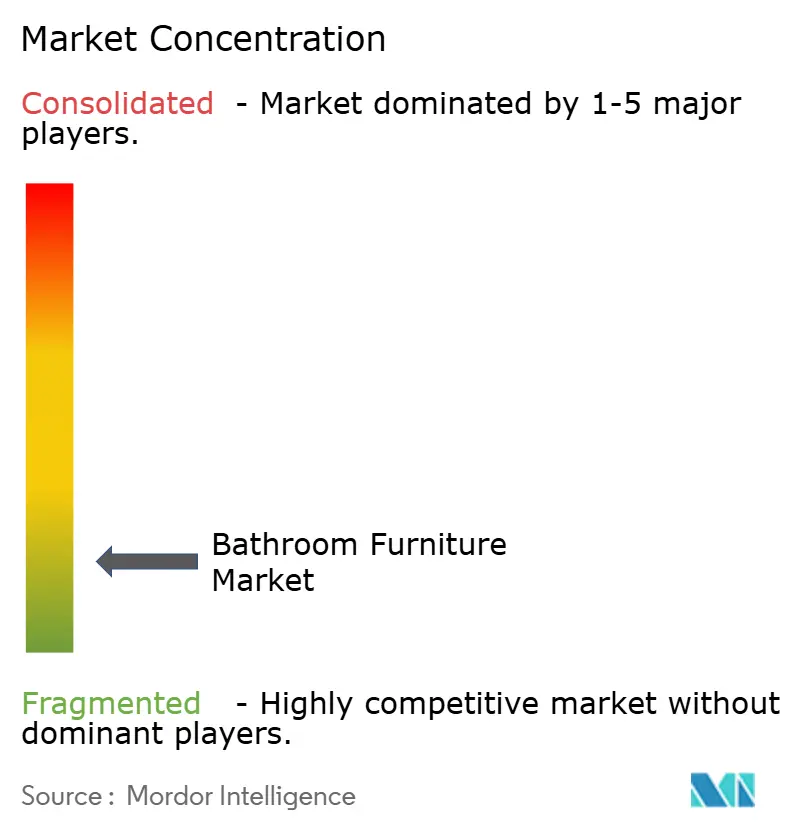
The bathroom furniture market is fragmented. Villeroy & Boch, LIXIL, TOTO, Geberit, Roca, and Kohler compete across wider bathroom-system portfolios. Burgbad, ROYO, KEUCO, and LAUFEN retain positions in architect and designer channels through customization. Villeroy & Boch reported 13.4% growth in Europe and Middle East and Africa Bathroom and Wellness sales in the third quarter of 2025 following the Ideal Standard integration. The result illustrates how scale can strengthen geographic reach and portfolio breadth. Geberit reported 144 patents filed over the preceding 5 years and annual research and development spending of CHF 86 million (~USD 108.9 million). These capabilities matter in specification-led markets where technical design and system compatibility affect supplier choice.
Companies are using portfolio moves, capacity investment, and product development to defend their positions. In April 2025, LIXIL and American Bath Group entered a partnership that gave American Bath Group exclusive production and distribution rights for selected LIXIL bathing brands in North America. In October 2026, LIXIL opened a Hyderabad manufacturing facility to support its housing technology business in South and Southeast Asia. Roca Group acquired Antonio Lupi Design and Phoenix Industries in 2025 while investing in plant digitalization, automation, and sustainability. These actions show how suppliers are building reach in premium design, regional manufacturing, and operational capability. Competition is not limited to cabinets and vanities. It increasingly includes the ability to offer a complete and reliable bathroom proposition.
Opportunities remain in connected furniture for healthcare and education settings, circular material products, and aging-in-place solutions. Duravit commissioned a North American ceramics plant in Matane, Quebec, in 2025 with an electric roller kiln powered by renewable electricity. The investment reflects a broader need to address production efficiency and lower-carbon manufacturing. Product quality certification remains important in hospitality and institutional procurement. ISO 9001 and EN 14749 can help buyers assess suppliers beyond price alone. Fragmented standards create added work for smaller importers, while established brands can use certified processes as a competitive advantage. The competitive environment therefore remains open to specialized players, but scale and integrated portfolios offer clear benefits. The bathroom furniture market continues to reward suppliers that combine design credibility, durable materials, and dependable delivery.
Bathroom Furniture Industry Leaders
-
Kohler Co.
-
American Woodmark Corporation
-
Jaquar & Company Private Limited
-
LIXIL Corporation
-
Masco Corporation
- *Disclaimer: Major Players sorted in no particular order
Bathroom Furniture Market Companies Covered in this Report
- Kohler Co.
- American Woodmark Corporation
- Duravit AG
- Geberit AG
- LIXIL Corporation
- TOTO Ltd.
- Villeroy & Boch AG
- Nilkamal Limited
- LAUFEN Bathrooms AG
- Roper Rhodes Ltd.
- ROYO Group
- burgbad AG
- Svedbergs i Dalstorp AB
- Ideal Standard International NV
- PORCELANOSA Grupo A.I.E.
- RAK Ceramics PJSC
- VitrA
- KEUCO GmbH & Co. KG
- Roca Sanitario, S.A.
- Jaquar & Company Private Limited
- Comercial Salgar, S.L.
- Scavolini S.p.A.
Recent Industry Developments in Bathroom Furniture Market
- October 2026: LIXIL opened a new manufacturing facility in Hyderabad, India, expanding its housing technology business to serve rising residential and commercial bathroom demand across South and Southeast Asia.
- August 2026: Kohler extended Heated BubbleMassage™ technology to its Ceric® and Evok® freestanding bath collections, completing hydrotherapy coverage across the full freestanding portfolio.
- May 2026: Kohler and Studio McGee unveiled the Claude bathroom collection, featuring the Claude smart toilet, and opened a 9,584-square-foot Utah retail store with 10 immersive bathroom suites.
- February 2026: Kohler launched Reveal by KOHLER, a premium bath and shower remodeling service available through authorized dealers across the United States.
Global Bathroom Furniture Market Report Scope
Segmentation Overview
| Bathroom Vanities |
| Bathroom Cabinets |
| Bathroom Mirrors |
| Storage Furniture & Accessories |
| Wood |
| Metal |
| Plastic and Polymer |
| Others |
| Economy |
| Mid-Range |
| Premium/Luxury |
| Residential | |
| Commercial | Hospitality |
| Retail and Office | |
| Healthcare and Education | |
| Others Commercial End User |
| B2C / Retail | Home Centers |
| Specialty Furniture Stores | |
| Online | |
| Other Distribution Channels | |
| B2B /Directly from Manufacturers |
| North America | Canada |
| United States | |
| Mexico | |
| South America | Brazil |
| Peru | |
| Chile | |
| Argentina | |
| Rest of South America | |
| Europe | United Kingdom |
| Germany | |
| France | |
| Spain | |
| Italy | |
| BENELUX (Belgium, Netherlands, Luxembourg) | |
| NORDICS (Denmark, Finland, Iceland, Norway, Sweden) | |
| Rest of Europe | |
| Asia-Pacific | India |
| China | |
| Japan | |
| Australia | |
| South Korea | |
| South-East Asia | |
| Rest of Asia-Pacific | |
| Middle East & Africa | United Arab Emirates |
| Saudi Arabia | |
| South Africa | |
| Nigeria | |
| Rest of Middle East & Africa |
| By Product Type | Bathroom Vanities | |
| Bathroom Cabinets | ||
| Bathroom Mirrors | ||
| Storage Furniture & Accessories | ||
| By Material | Wood | |
| Metal | ||
| Plastic and Polymer | ||
| Others | ||
| By Price Range | Economy | |
| Mid-Range | ||
| Premium/Luxury | ||
| By End User | Residential | |
| Commercial | Hospitality | |
| Retail and Office | ||
| Healthcare and Education | ||
| Others Commercial End User | ||
| By Distribution Channel | B2C / Retail | Home Centers |
| Specialty Furniture Stores | ||
| Online | ||
| Other Distribution Channels | ||
| B2B /Directly from Manufacturers | ||
| By Geography | North America | Canada |
| United States | ||
| Mexico | ||
| South America | Brazil | |
| Peru | ||
| Chile | ||
| Argentina | ||
| Rest of South America | ||
| Europe | United Kingdom | |
| Germany | ||
| France | ||
| Spain | ||
| Italy | ||
| BENELUX (Belgium, Netherlands, Luxembourg) | ||
| NORDICS (Denmark, Finland, Iceland, Norway, Sweden) | ||
| Rest of Europe | ||
| Asia-Pacific | India | |
| China | ||
| Japan | ||
| Australia | ||
| South Korea | ||
| South-East Asia | ||
| Rest of Asia-Pacific | ||
| Middle East & Africa | United Arab Emirates | |
| Saudi Arabia | ||
| South Africa | ||
| Nigeria | ||
| Rest of Middle East & Africa | ||
Key Questions Answered in the Report
What is the projected growth rate for bathroom furniture through 2031?
The sector is projected to grow at a 6.34% CAGR from 2026 to 2031 and reach USD 40.3 billion in 2031.
Which product category generates the most revenue?
Bathroom cabinets lead product revenue with 58.5% of 2025 sales.
Which material is growing fastest in bathroom furniture?
Plastic and polymer are forecast to grow at a 7.02% CAGR through 2031, supported by moisture-resistance needs.
Why are renovations important for suppliers?
Renovations drive replacement demand for cabinets, vanities, mirrors, and related storage, particularly in mature housing markets.
Which region offers the fastest growth prospects?
Asia-Pacific is forecast to grow at a 7.63% CAGR through 2031 and accounted for 33.2% of 2025 revenue.