
Barium Nitrate Market Size and Share
Market Overview
| Study Period | 2021 - 2031 |
|---|---|
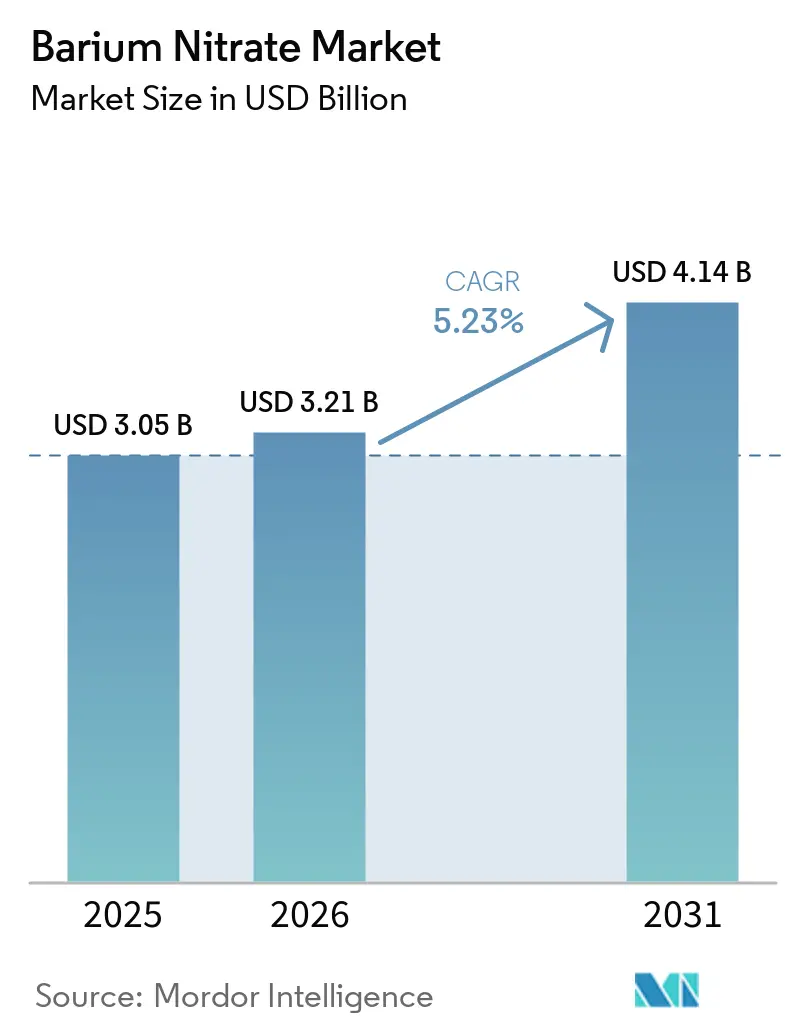
| Market Size (2026) | USD 3.21 Billion |
| Market Size (2031) | USD 4.14 Billion |
| Growth Rate (2026 - 2031) | 5.23 % |
| Fastest Growing Market | Asia-Pacific |
| Largest Market | Asia-Pacific |
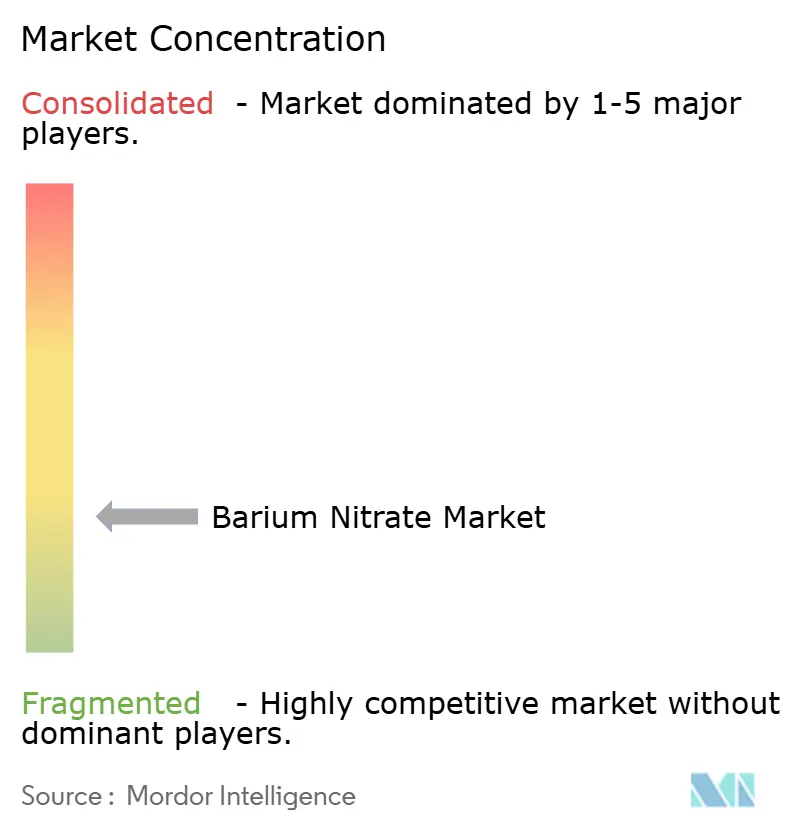
| Market Concentration | Low |
Major Players *Disclaimer: Major Players sorted in no particular order Image © Mordor Intelligence. Reuse requires attribution under CC BY 4.0. | |
Barium Nitrate Market Analysis by Mordor Intelligence
The Barium Nitrate Market size was valued at USD 3.05 billion in 2025 and is estimated to grow from USD 3.21 billion in 2026 to reach USD 4.14 billion by 2031, at a CAGR of 5.23% during the forecast period (2026-2031). Defense procurement, commercial pyrotechnics, specialty glass, ceramics, and electronics create separate demand channels for the barium nitrate market, which reduces its dependence on a single downstream activity. Procurement timing and technical requirements differ across these uses, limiting the likelihood that all demand channels weaken at the same time. Higher purity requirements are separating premium suppliers from producers focused on standard industrial grades. This is making quality control, raw material access, and qualified logistics more important competitive factors in the barium nitrate market. The expanding use of barium titanate in multilayer ceramic capacitors also supports a more stable source of demand for high-purity material, alongside established defense and fireworks applications, and improves planning certainty across the barium nitrate market for all producers and customers.
Key Report Takeaways
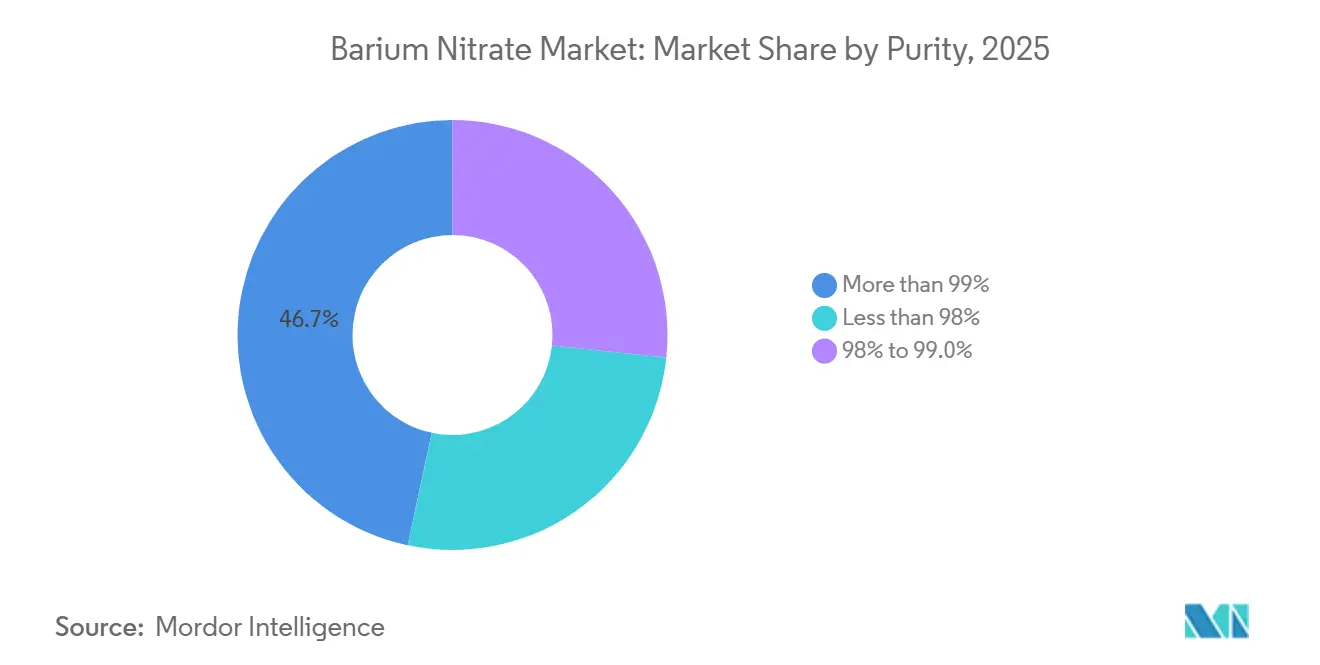
- By purity, more than 99% held 46.67% of the barium nitrate market share in 2025 and is projected to advance at a 5.67% CAGR through 2031.
- By application, fireworks and pyrotechnics held 42.34% of the barium nitrate market share in 2025, while explosives and detonators are projected to advance at a 6.05% CAGR through 2031.
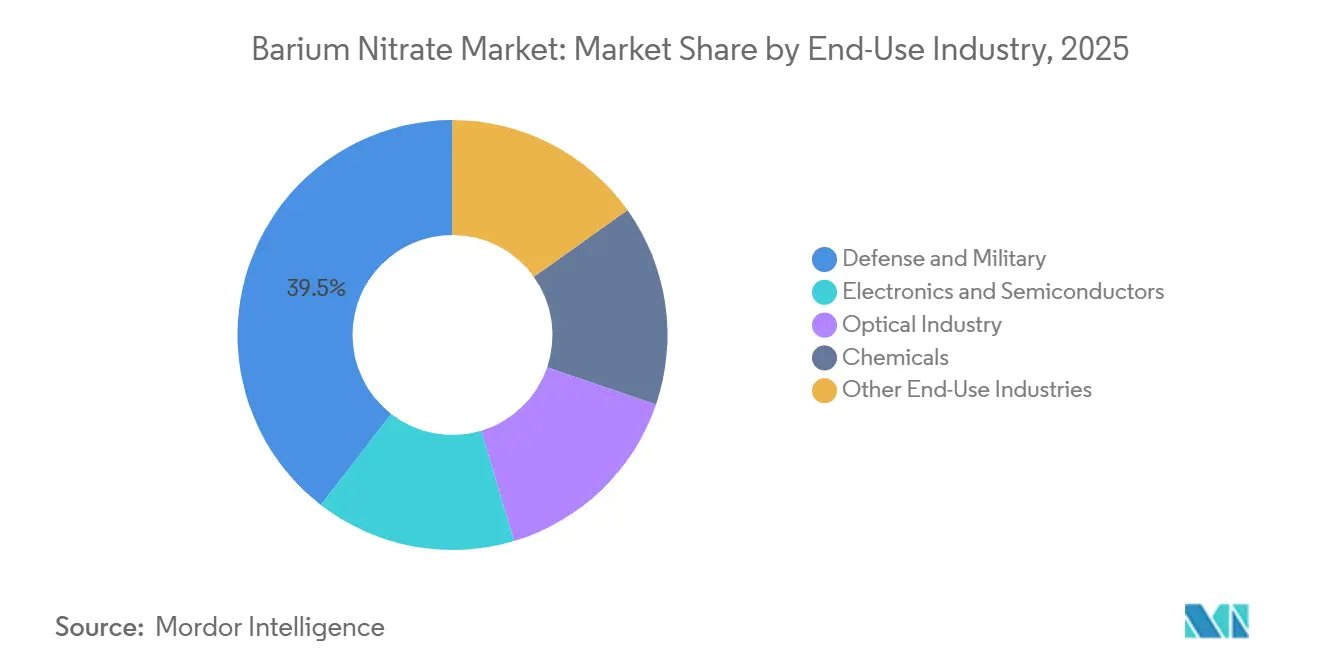
- By end-use industry, defense and military held 39.51% of the barium nitrate market share in 2025 and are projected to advance at a 6.24% CAGR through 2031.
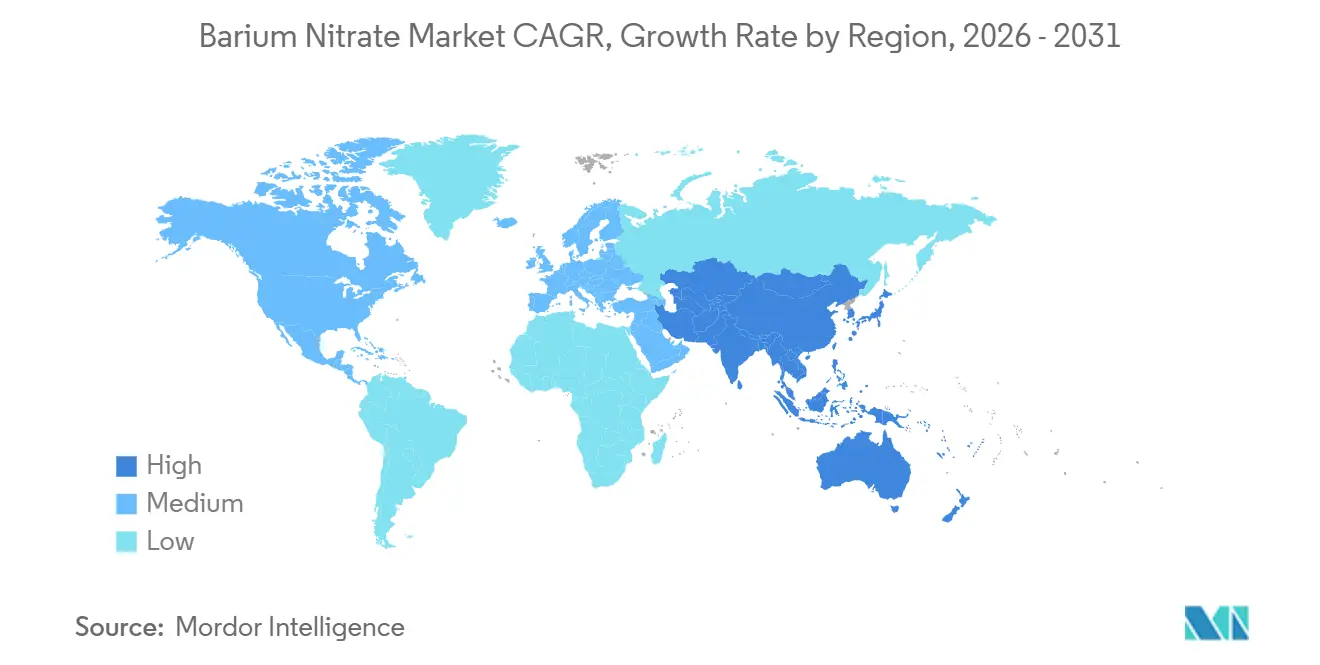
- By geography, Asia-Pacific held 35.18% of the barium nitrate market share in 2025 and is projected to advance at a 5.88% CAGR through 2031.
Note: Market size and forecast figures in this report are generated using Mordor Intelligence’s proprietary estimation framework, updated with the latest available data and insights as of January 2026.
Market Trends and Insights
Drivers Impact Analysis of Barium Nitrate Market*
| Driver | (~) % Impact on CAGR Forecast | Geographic Relevance | Impact Timeline |
|---|---|---|---|
| Defense Modernization and Military Pyrotechnics Demand | +1.3% | Global, with peak concentration in Asia-Pacific, Europe, and North America | Short term (≤ 2 years) |
| Growth in Fireworks, Flares, and Signal Devices | +1.1% | Asia-Pacific (China, India, ASEAN), Middle East | Short term (≤ 2 years) |
| Optical Glass, Specialty Glass, and Ceramic Production | +0.9% | Asia-Pacific, Europe (Germany, Nordic Countries) | Medium term (2–4 years) |
| Expansion of Electronics and High-Purity Barium-Salt Applications | +0.8% | Asia-Pacific core (Japan, South Korea, China), spillover to North America | Medium term (2–4 years) |
| Supply Localization for Hazardous Oxidizers | +0.6% | North America and Europe | Medium term (2–4 years) |
| Source: Mordor Intelligence | |||
Defense Modernization and Military Pyrotechnics Demand
Global military expenditure reached USD 2,887 billion in 2025, rising 2.9% in real terms and extending an 11-year sequence of annual increases. Spending outside the United States increased 9.2%, while Asia and Oceania spent USD 681 billion and Europe spent USD 864 billion in 2025. China spent USD 336 billion, India spent USD 92.1 billion, and Japan spent USD 62.2 billion during 2025. These countries are important consuming locations for the barium nitrate market because military pyrotechnics, flares, tracer ammunition, and energetic materials require a dependable oxidizer supply. The increase in military budgets supports continuing procurement programs rather than one-time purchases, particularly where inventories and munitions stocks are being replenished. Defense specifications also favor consistent, high-purity material, which supports qualified producers with reliable quality-control systems.
Growth in Fireworks, Flares, and Signal Devices
Barium nitrate serves as an oxidizer and green-flame colorant in fireworks, flares, and signal devices. Its green emission is associated with BaCl molecular bands between 511–515 nm and 524–528 nm, which supports its use in green pyrotechnic formulations. China’s manufacturing clusters in Liuyang and Jiangxi remained major consumers of technical-grade material because of their large fireworks production base. South and Southeast Asian festive demand reinforced this commercial demand pattern during seasonal periods. Defense flares follow procurement schedules that differ from the commercial fireworks calendar, providing year-round demand for the barium nitrate market. Saudi Arabia spent USD 83.2 billion on defense in 2025, and its regional security requirements supported the procurement of military signal devices and related materials[1]Nan Tian, Diego Lopes da Silva, Xiao Liang, Lorenzo Scarazzato, and Lucie Béraud-Sudreau, “Global Military Spending Rise Continues as European and Asian Expenditures Surge,” Stockholm International Peace Research Institute, sipri.org.
Optical Glass, Specialty Glass, and Ceramic Production
Barium oxide in glass can improve ultraviolet resistance, raise the refractive index, and reduce bubble formation and internal impurities. A 2025 study found that BaO-B2O3-TiO2 glass systems combined optical clarity, a high refractive index, and radiation-shielding performance. This makes barium-containing glass relevant for medical and industrial radiation-shielding windows, as well as specialty optical products. A separate 2025 study described barium crystal glass applications in container glass, safety glass, decorative glass, optical fibers, and precision optical components. These uses broaden the barium nitrate market beyond its conventional pyrotechnic base because high-specification glass production requires controlled material inputs. Demand from nuclear medicine and industrial radiography can further support specialty barium compounds without following the fireworks seasonality.
Expansion of Electronics and High-Purity Barium-Salt Applications
High-purity barium nitrate is used as a precursor for barium titanate, the ceramic dielectric material used in multilayer ceramic capacitors. Multilayer ceramic capacitor requirements from artificial intelligence server infrastructure have increased demand for high-end electronic components and their material inputs. This relationship links the barium nitrate market to production schedules for electronic infrastructure rather than only to consumer electronics cycles. Nippon Chemical Industrial CO., LTD. produces ultra-pure barium nitrate for cathode ray tube glass, dielectric ceramics, and specialty optical materials. Its production approach reflects the importance of controlled purity for electronic and optical applications. Electronics demand, therefore, provides a non-seasonal demand base for premium material, while the need for advanced purification limits the number of suppliers that can serve this application.
Restraints Impact Analysis of Barium Nitrate Market*
| Restraint | (~) % Impact on CAGR Forecast | Geographic Relevance | Impact Timeline |
|---|---|---|---|
| Toxicity, Occupational Exposure, and Environmental Compliance Costs | -0.8% | Global, with heightened pressure in China and the European Union | Short term (≤ 2 years) |
| Stringent Hazardous-Material Transport and Storage Requirements | -0.6% | Global, with critical impact on Asia-Pacific export routes and intra-European logistics | Short term (≤ 2 years) |
| Substitution by Lower-Toxicity Oxidizers and Alternative Glass Inputs | -0.5% | Europe and North America | Long term (≥ 4 years) |
| Source: Mordor Intelligence | |||
Toxicity, Occupational Exposure, and Environmental Compliance Costs
Barium nitrate requires strict handling because soluble barium compounds can be harmful through ingestion or inhalation. Producers must manage worker protection, emissions, wastewater, and safe material handling throughout manufacturing operations. Environmental upgrades can include closed-loop crystallization and advanced wastewater-treatment systems, which increase capital requirements for smaller producers. Larger integrated businesses can absorb these investments more easily when they have access to barite feedstock and in-house acid production. This difference can accelerate consolidation among smaller Chinese producers and improve the relative position of larger integrated suppliers. European buyers also place greater value on suppliers that can demonstrate certified and controlled production processes under evolving chemical management requirements.
Stringent Hazardous-Material Transport and Storage Requirements
Barium nitrate is regulated as an oxidizer, requiring defined packaging, labeling, segregation, and documentation across transport modes. The Agreement concerning the International Carriage of Dangerous Goods by Road, known as ADR, applied its 2025 requirements from January 1, 2025. The updates required producers and logistics providers to review packaging specifications, vehicle markings, and shipment documentation for cross-border operations. Maritime rules under the International Maritime Dangerous Goods Code Amendment 41-22 became mandatory from January 2024 and required updated certification for hazardous materials shipments[2]“MSN 1914, The Carriage of Dangerous Goods and Marine Pollutants,” Government of the United Kingdom, gov.uk. These concurrent requirements increased transition work for intermediaries and favored suppliers with certified logistics processes. Such capabilities can improve delivery reliability for high-purity material shipped through Asia-Pacific export corridors and European distribution networks.
*Our forecasts treat driver/restraint impacts as directional, not additive. The impact forecasts reflect baseline growth, mix effects, and variable interactions.
Barium Nitrate Market Segment Analysis
By Purity:
High Specification Drives Premium Grade ConsolidationMore than 99% purity held 46.67% of the barium nitrate market size in 2025, reflecting strong demand at the upper end of the purity range. Defense agencies require controlled impurity levels for signal flares and tracer ammunition, while electronics manufacturers need tightly controlled inputs for fine barium titanate precursors used in dielectric materials. These two buyer groups provide a more stable demand base than a single-use application could provide, because their purchasing cycles and technical requirements are different. The 98%-99% range remained the main grade for industrial fireworks and standard ceramic applications, where cost and dependable supply remain central purchasing factors. Less than 98% material served bulk chemical synthesis and lower-specification industrial processes where trace impurities are acceptable, and product performance is less dependent on ultra-high purity. The barium nitrate market, therefore, has separate purchasing requirements across purity grades, rather than a single standard material requirement that would allow suppliers to compete only on volume. Customers selecting premium material are also more likely to assess technical support, consistency between shipments, and formal documentation alongside the price offered.
More than 99% purity is projected to advance at a 5.67% CAGR through 2031. Defense modernization and demand for electronic components support this growth path, as both place greater importance on repeatable material performance than on low purchase cost alone. Nippon Chemical Industrial CO., LTD. maintains advanced purification capabilities for nanoscale electronic applications, illustrating the process-control requirements that separate premium supply from standard industrial output. These capabilities are difficult for mid-grade producers to replicate because they require consistent process control, specialized quality systems, and the ability to meet tightly defined customer specifications. Research on barium crystal glass also supports the use of high-purity barium compounds in specialty glass applications. Capacity additions for premium material may remain more limited than mid-grade additions, because new production must meet higher quality and qualification requirements before it can serve these customers. This supports the continued separation of premium and commodity supply in the barium nitrate industry. It also supports a quality-driven competitive structure among suppliers serving electronic, optical, and defense customers, whose approval processes can make supply relationships longer lasting.



By Application:
Explosives and Detonators Segment Outpaces Fireworks and Pyrotechnics DominanceFireworks and pyrotechnics accounted for 42.34% of the barium nitrate market size in 2025, supported by China’s large-scale pyrotechnic production and established export-oriented manufacturing networks. Liuyang and Jiangxi were key destinations for technical-grade material used in commercial fireworks, where producers require substantial and dependable supplies during production periods. The segment uses considerable volumes of mid-purity material because product performance must be consistent at an industrial scale, even where the specification is less demanding than in electronics or defense applications. Commercial demand is seasonal in some markets, although Asian festival activity provides recurrent purchasing periods and broadens the geographic base for consumption. Defense signal flares add a separate source of demand that does not follow the consumer fireworks calendar and can remain active through formal procurement schedules. This combination keeps pyrotechnics important to the barium nitrate market while reducing sole reliance on individual celebration periods or a limited group of end customers. The use of barium nitrate as an oxidizer and colorant remains central to formulations that require green flame effects. This position provides a durable application base despite localized restrictions on commercial fireworks, because other regional festivals and military uses sustain demand.
Explosives and detonators are projected to advance at a 6.05% CAGR through 2031. The segment is supported by military modernization and guided-munition inventory expansion, which require reliable access to energetic materials and their supporting chemical inputs. High-purity oxidizer inputs are important where consistent performance and defense qualification are required, particularly when the final application is subject to formal procurement specifications. Glass and ceramics use barium nitrate for its role in optical and structural material properties, including applications where barium-containing systems improve the functional characteristics of the final product. BaO-containing glass systems showed radiation-shielding potential for medical and industrial applications in 2025 research. Ammunition, primers, and tracer bullets provide recurring defense-related demand that is independent of commercial calendars and tied more closely to replenishment schedules. Other applications include vacuum tube production, specialty coatings, and chemical synthesis. Together, these applications are increasing the weight of defense and specialty uses relative to purely commercial pyrotechnics, which also increases the importance of material consistency across the barium nitrate market.
By End-Use Industry:
Defense and Military Shapes Demand GrowthDefense and military held 39.51% of the market value in 2025 and are projected to advance at a 6.24% CAGR through 2031. This combination made defense and military both the largest and fastest-growing listed end-use category, which is unusual for a specialty chemical demand base with several established commercial uses. Expanding budgets, procurement activity across several regions, and tighter material specifications supported this position by increasing both the volume and quality requirements of defense customers. Global military expenditure rose to USD 2,887 billion in 2025, including USD 681 billion in Asia and Oceania. These spending patterns support purchases of pyrotechnics, signal devices, ammunition, and related energetic materials across a wider group of consuming countries. Defense procurement can also increase the value of material purchased because qualified grades require more stringent purity, documentation, traceability, and delivery controls. The barium nitrate market benefits when military customers prioritize delivery reliability and approved supply chains. This supports suppliers that can meet formal specifications consistently and maintain dependable supply across the full duration of procurement contracts.
Electronics and semiconductors are an emerging end-use base because barium titanate production depends on barium compounds that can meet controlled purity requirements. Artificial intelligence server infrastructure has increased demand for high-end multilayer ceramic capacitors and related precursor materials, creating a new link between electronic infrastructure investment and premium barium-compound consumption. The optical industry also uses barium-related inputs in radiation shielding, scientific instruments, and defense optics, where optical performance and material reliability are important. Barium’s refractive index and radiation attenuation properties support these specialized uses and distinguish them from commodity chemical applications. Chemicals provide a base-load demand source through barium compound synthesis and industrial processing, helping sustain demand across routine production cycles. Other end-use industries include agriculture, drilling fluids, and specialty coatings. These uses add incremental demand across the barium nitrate market and diversify consumption beyond major defense and electronics buyers. The variety of end-use industries also limits exposure to changes in a single commercial application and gives suppliers several routes to serve both high-volume and high-specification customers.
Geography Analysis
APAC Barium Nitrate Market
Asia-Pacific held 35.18% of the barium nitrate market size in 2025 and is projected to advance at a 5.88% CAGR through 2031. China is the regional production anchor, with capacity concentrated in Shanxi, Hebei, Shandong, Hubei, and Guizhou provinces, while its fireworks export industry supports recurring demand for technical-grade material that serves large commercial pyrotechnic programs. Japan and South Korea serve the high-purity end of regional consumption through vertically integrated multilayer ceramic capacitor supply chains, where Nippon Chemical Industrial CO., LTD. and SAKAI CHEMICAL INDUSTRY CO., LTD. supply ultra-fine material for capacitor applications with stringent quality needs. India’s defense expenditure increased 8.9% to USD 92.1 billion in 2025, and the wider regional rise in defense spending supported procurement of pyrotechnic, tracer-ammunition, and related oxidizer materials.
North America and Europe Barium Nitrate Market
North America has a strategically distinct position because its demand is led primarily by the United States defense and defense-industrial activity, rather than commercial fireworks, and domestic sourcing is becoming more relevant for customers seeking dependable supplies of qualified oxidizers. The United States Army Acquisition Support Center completed a feasibility demonstration on recovering potassium nitrate from waste ammonium nitrate and began analysis of the process for barium nitrate and strontium nitrate, reflecting the objective of improving domestic supply resilience for energetic materials. Europe is shaped by the combined effects of defense rearmament, hazardous-material logistics requirements, and chemical compliance measures that raise the importance of established suppliers with reliable documentation and controlled production processes. European military expenditure increased 14% to USD 864 billion in 2025, with Germany and Spain reporting major increases that support defense-related demand for pyrotechnics and energetic materials. European Agreement concerning the International Carriage of Dangerous Goods by Road (ADR) 2025 requirements add work and cost to intra-European logistics, which can reduce the margin advantage of lower-cost imports and influence buyers toward certified suppliers with dependable regional delivery.
MEA and South America Barium Nitrate Market
South America and Middle East and Africa are smaller demand centers in the barium nitrate market, although Brazil uses material in mining-related industrial explosives and cultural fireworks, while Argentina adds demand through agri-industrial activity and defense procurement. Saudi Arabia’s defense expenditure reached USD 83.2 billion in 2025, supporting purchases of military pyrotechnics, signal devices, and tracer ammunition that incorporate barium nitrate. South Africa and other markets across the Middle East and Africa use industrial-grade material in blasting agents and detonators, with mining and construction activity providing the main application base. These regions are predominantly supplied through Asian and European export channels because domestic production remains limited, and their longer-term opportunity centers on distribution capacity as infrastructure, resource extraction, and defense activity expand.

Competitive Landscape
The barium nitrate market is highly fragmented, with the top five players including Guizhou Redstar Co., Ltd., Hebei Xinji Chemical Group Co., Ltd., SAKAI CHEMICAL INDUSTRY CO., LTD., Nippon Chemical Industrial CO., LTD., and Barium & Chemicals, Inc. Guizhou Redstar Co., Ltd., Hubei JingshanChutian Barium Salt Corp. Ltd., Shanxi Jiaocheng Tianlong Chemical Industry Co., Ltd., and Shanxi Wencheng Chemical Co., Ltd. compete through production scale, price, delivery capability, and access to barite resources, particularly for technical-grade pyrotechnic and chemical applications. Nippon Chemical Industrial CO., LTD. and SAKAI CHEMICAL INDUSTRY CO., LTD. focus on electronics and optical uses that need more rigorous purification, stable particle characteristics, and consistent documentation across specialized customer qualification processes. Hummel Croton Inc. and Barium & Chemicals, Inc. focus on defense-qualified supply for military-specification requirements, where domestic origin preferences and reliable delivery are increasingly important to procurement customers. This split means that competitive intensity is high in mid-grade material, while premium grades have a more specialized supplier field because they require advanced purification capabilities and a proven quality record.
Guizhou Redstar Co., Ltd. reported CNY 2.135 billion in 2025 revenue (approximately USD 294.5 million) and identified high-end customized barium products for optical glass, liquid crystal display substrates, and electronics as strategic areas in its 2025 annual report. The company also identified investments in barite feedstock integration, which are intended to strengthen raw-material access, lower input-cost exposure, and support the shift toward applications that place greater value on product quality and customized specifications. The United States Army’s domestic-production analysis signals another strategic direction, as it examines a pathway that could improve Western independence for energetic-material inputs, including barium nitrate. Producers that invest in advanced crystallization, controlled purification, rigorous quality management, and qualified logistics are better placed to pursue public tenders and longer-term supply agreements with defense customers. Mid-scale producers face greater pressure when export markets require consistent quality, controlled transport, environmental compliance, and dependable delivery alongside competitive prices.
Competitive strategies also differ by the customer served, because defense, electronics, optical, and commercial pyrotechnic buyers do not apply the same specifications or purchasing criteria to barium nitrate. Premium suppliers can protect their position when applications require demonstrated purity, particle control, stable performance, and documented quality assurance, while volume suppliers retain an advantage where customers prioritize scale, cost, and recurring availability of standard-grade material. Environmental investment can create another gap because larger integrated companies are more able to fund wastewater treatment, closed-loop systems, and other compliance upgrades than smaller operators that serve commodity-grade demand. Transport certification is also becoming a practical source of differentiation in the barium nitrate market because oxidizer shipments require controlled packaging, labeling, segregation, and documentation across international supply chains. The competitive landscape remains geographically fragmented, although qualified high-purity supply is more limited because electronics, optical, and defense customers require advanced process control, documented product consistency, and reliable delivery over time.
Barium Nitrate Industry Leaders
Guizhou Redstar Co., Ltd
Hebei Xinji Chemical Group Co., Ltd.
SAKAI CHEMICAL INDUSTRY CO.,LTD.
Nippon Chemical Industrial CO., LTD.
Barium & Chemicals, Inc.
- *Disclaimer: Major Players sorted in no particular order
Barium Nitrate Market Companies Covered in this Report
- Barium & Chemicals, Inc.
- Guizhou Redstar Co., Ltd
- Hebei Xinji Chemical Group Co., Ltd.
- Hubei JingshanChutian Barium Salt Corp.Ltd
- Hubei Yichang Jinxin Chemical Co., Ltd.
- Hummel Croton Inc.
- Jiaocheng Sanxi Chemical Co., Ltd.
- Nippon Chemical Industrial CO., LTD.
- SAKAI CHEMICAL INDUSTRY CO.,LTD.
- Shandong Xinke Environmental Chemistry Co., Ltd.
- Shanxi Jiaocheng Tianlong Chemical Industry Co., Ltd.
- Shanxi Wencheng Chemical Co., Ltd.
- Weifang Qihui Chemical Co., Ltd.
- Xilan Chemicals Co., Ltd.
- Yingfengyuan Industrial Group

Recent Industry Developments in Barium Nitrate Market
- July 2026: The Central Pollution Control Board (CPCB) red-flagged proposed green-cracker formulations containing barium compounds, reinforcing restrictions on barium-based compositions for fireworks in India. The regulatory action could constrain domestic demand for barium nitrate, particularly in pyrotechnic applications.
- July 2025: European Agreement concerning the International Carriage of Dangerous Goods by Road (ADR) 2025 became fully mandatory, introducing stricter technical requirements for the cross-border transport of hazardous materials, including barium nitrate classified as a Class 5.1 oxidizing substance. The updated requirements increase compliance and handling obligations for international suppliers and users of barium nitrate.


Global Barium Nitrate Market Report Scope
Barium nitrate is an inorganic compound valued for its oxidizing properties and ability to impart a characteristic green color in high-temperature applications. It is used as a specialty chemical in applications requiring controlled thermal reactions, optical properties, and specific material performance.
The Barium Nitrate Market is segmented by purity, application, end-use industry, and geography. By purity, the market is segmented into less than 98%, 98% to 99%, and more than 99%. By application, the market is segmented into fireworks and pyrotechnics, glass and ceramics, explosives and detonators, ammunition, primers and tracer bullets, and other applications. By end-use industry, the market is segmented into defense and military, optical industry, chemicals, electronics and semiconductors, and other end-use industries. The report also covers the market size and forecasts for barium nitrate in 15 countries across major regions. For each segment, the market sizing and forecasts have been done on the basis of value (USD).
| Less than 98% |
| 98% to 99% |
| More than 99% |
| Fireworks and Pyrotechnics |
| Glass and Ceramics |
| Explosives and Detonators |
| Ammunition, Primers and Tracer Bullets |
| Other Applications |
| Defense and Military |
| Optical Industry |
| Chemicals |
| Electronics and Semiconductors |
| Other End-Use Industries |
| Asia-Pacific | China |
| India | |
| Japan | |
| South Korea | |
| ASEAN Countries | |
| Rest of Asia-Pacific | |
| North America | United States |
| Canada | |
| Mexico | |
| Europe | Germany |
| United Kingdom | |
| France | |
| Italy | |
| NORDIC Countries | |
| Rest of Europe | |
| South America | Brazil |
| Argentina | |
| Rest of South America | |
| Middle East and Africa | Saudi Arabia |
| South Africa | |
| Rest of Middle East and Africa |
| By Purity | Less than 98% | |
| 98% to 99% | ||
| More than 99% | ||
| By Application | Fireworks and Pyrotechnics | |
| Glass and Ceramics | ||
| Explosives and Detonators | ||
| Ammunition, Primers and Tracer Bullets | ||
| Other Applications | ||
| By End-Use Industry | Defense and Military | |
| Optical Industry | ||
| Chemicals | ||
| Electronics and Semiconductors | ||
| Other End-Use Industries | ||
| By Geography | Asia-Pacific | China |
| India | ||
| Japan | ||
| South Korea | ||
| ASEAN Countries | ||
| Rest of Asia-Pacific | ||
| North America | United States | |
| Canada | ||
| Mexico | ||
| Europe | Germany | |
| United Kingdom | ||
| France | ||
| Italy | ||
| NORDIC Countries | ||
| Rest of Europe | ||
| South America | Brazil | |
| Argentina | ||
| Rest of South America | ||
| Middle East and Africa | Saudi Arabia | |
| South Africa | ||
| Rest of Middle East and Africa | ||


Key Questions Answered in the Report
What is the size of the barium nitrate market?
The barium nitrate market stands at USD 3.21 billion in 2026 and is projected to reach USD 4.14 billion by 2031.
What is driving demand for barium nitrate?
Defense modernization, fireworks and signal devices, specialty glass, ceramics, and high-purity electronics applications support demand.
Which purity led the market demand in 2025?
More than 99% purity held a 46.67% share in 2025.
Which application is expected to grow fastest through 2031?
Explosives and detonators are projected to advance at a 6.05% CAGR through 2031.
Page last updated on:





