
Ball Bearing Market Size and Share
Market Overview
| Study Period | 2021 - 2031 |
|---|---|
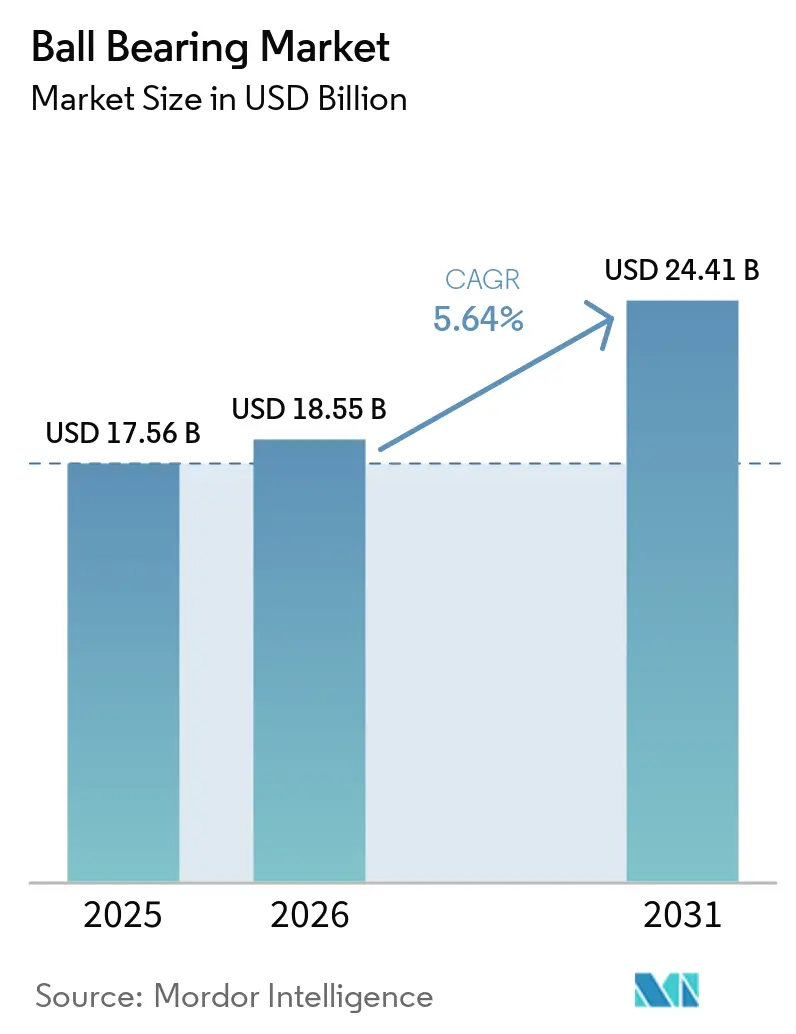
| Market Size (2026) | USD 18.55 Billion |
| Market Size (2031) | USD 24.41 Billion |
| Growth Rate (2026 - 2031) | 5.64 % |
| Fastest Growing Market | Asia-Pacific |
| Largest Market | Asia-Pacific |
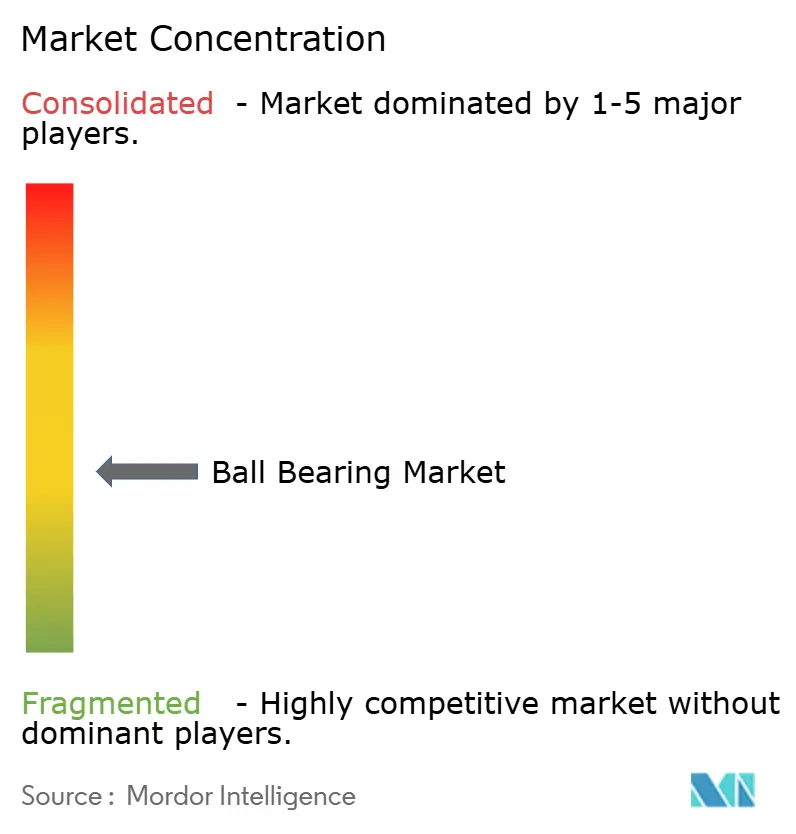
| Market Concentration | Medium |
Major Players *Disclaimer: Major Players sorted in no particular order Image © Mordor Intelligence. Reuse requires attribution under CC BY 4.0. | |
Ball Bearing Market Analysis by Mordor Intelligence
The Ball Bearing Market size was valued at USD 17.56 billion in 2025 and is estimated to grow from USD 18.55 billion in 2026 to reach USD 24.41 billion by 2031, at a CAGR of 5.64% during the forecast period (2026-2031). Electric vehicle powertrains, factory automation, robotics, and renewable-energy projects are increasing demand for bearings that can operate reliably at higher speeds and under more demanding loads. These applications are moving competition toward engineered products, including insulated, sensor-integrated, ceramic, and hybrid designs. Established suppliers are responding through product development, capacity investment, and changes to their manufacturing networks, while Chinese producers are moving into more precise bearing categories. Input cost volatility and counterfeit products remain material constraints because they can affect margins, product quality, and confidence in distribution channels. The ball bearing market also benefits from replacement demand, particularly where predictive maintenance programs identify bearing wear before equipment fails.
Key Report Takeaways
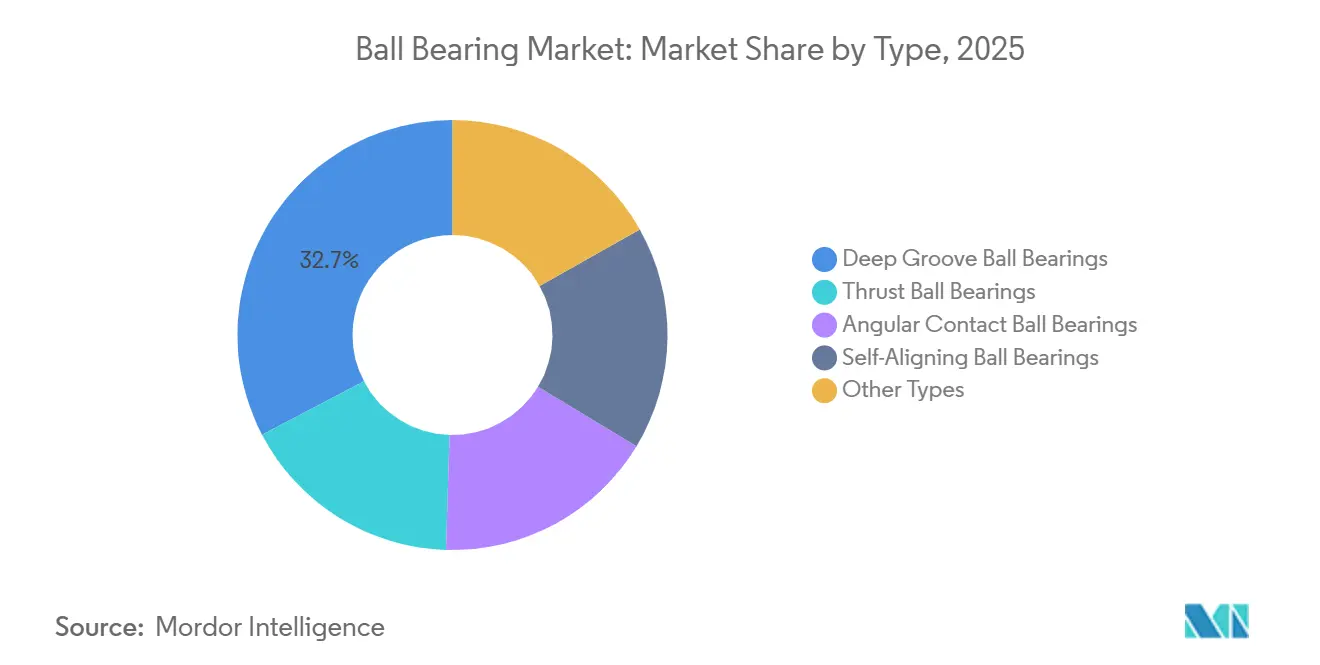
- By type, deep groove ball bearings held 32.67% of the ball bearing market share in 2025, while self-aligning ball bearings are projected to advance at a 6.12% CAGR through 2031.
- By material, chrome steel held 73.56% of the ball bearing market share in 2025, while ceramic ball bearings are projected to advance at a 6.89% CAGR through 2031.
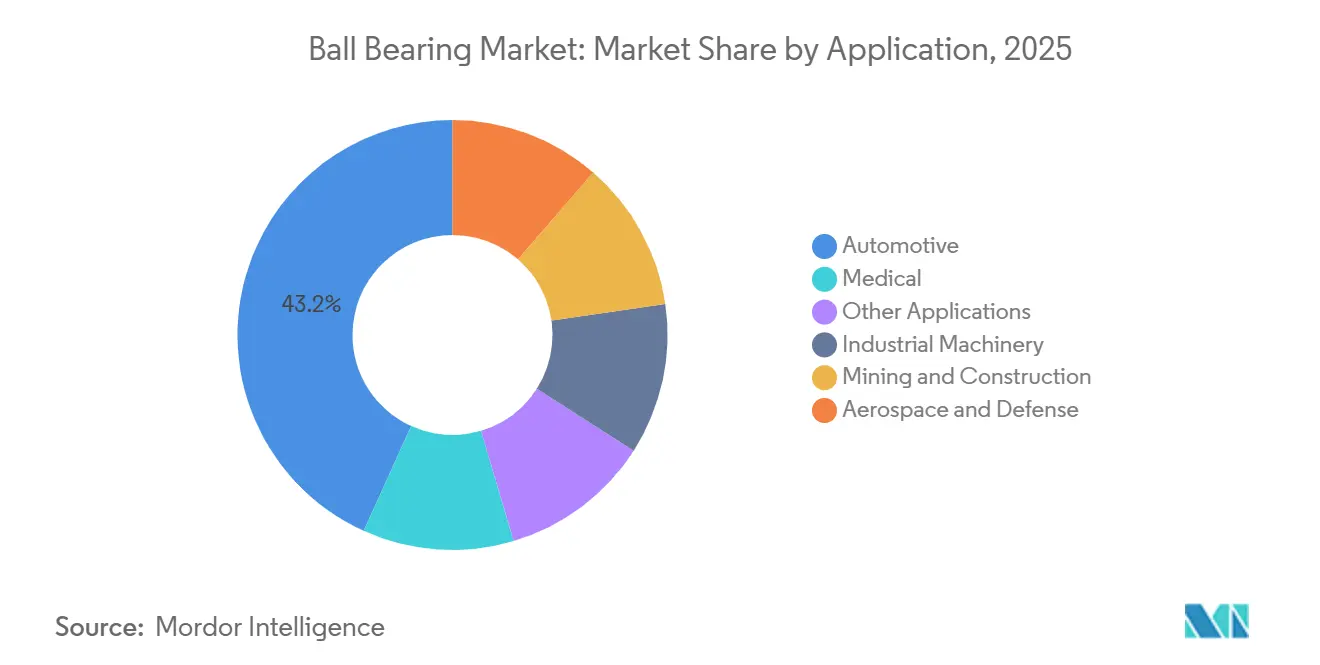
- By application, automotive held 43.23% of the ball bearing market share in 2025, while aerospace and defense is projected to advance at a 7.13% CAGR through 2031.
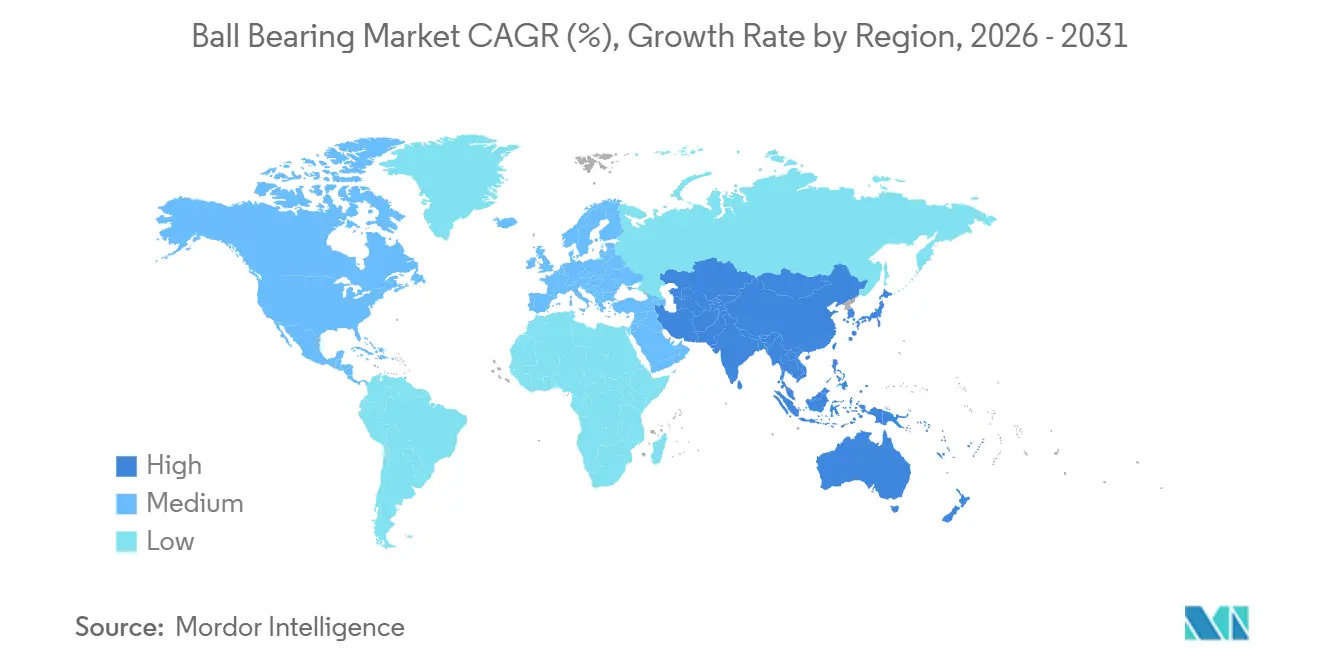
- By geography, Asia-Pacific held 41.78% of the ball bearing market share in 2025 and is projected to advance at a 6.45% CAGR through 2031.
Note: Market size and forecast figures in this report are generated using Mordor Intelligence’s proprietary estimation framework, updated with the latest available data and insights as of January 2026.
Market Trends and Insights
Drivers Impact Analysis of Ball Bearing Market*
| Driver | (~) % Impact on CAGR Forecast | Geographic Relevance | Impact Timeline |
|---|---|---|---|
| Automotive Electrification and High-Speed E-Axle Deployment | +1.5% | Global, concentrated in China, Germany, South Korea, and United States | Medium term (2–4 years) |
| Industrial Automation, Robotics, and Smart Factory Expansion | +1.3% | Global, led by Asia-Pacific electronics plants and European precision machinery hubs | Short term (≤ 2 years) |
| Renewable Energy and Wind-Turbine Capacity Additions | +0.9% | APAC core (China, India); Europe (Germany, NORDIC Countries); spillover to MEA | Medium term (2–4 years) |
| Aerospace, Defense, and Precision-Equipment Demand | +0.7% | North America and Europe, with early gains in India and Middle East | Long term (≥ 4 years) |
| Installed-Base Replacement and Predictive-Maintenance Demand | +0.6% | Global, with concentration in North America and Western Europe | Short term (≤ 2 years) |
| Source: Mordor Intelligence | |||
Automotive Electrification and High-Speed E-Axle Deployment
Electric drive architectures are changing bearing specifications rather than simply raising existing performance requirements. E-axle traction motors operate at 15,000-20,000 r/min, while next-generation designs are moving beyond 40,000 r/min. These speeds require different cage geometry, lubricant retention, and fatigue performance from designs used in internal combustion powertrains. JTEKT Corporation commenced mass production in June 2026 of a deep-groove ball bearing for electric vehicle e-axles rated at 40,000 r/min, using a resin cage designed to reduce centrifugal deformation by 70% against conventional designs. NTN Corporation began supplying prototype Resin Mold Insulated Bearings for e-axle applications from its China manufacturing operation in May 2026, addressing electrical pitting and the needs of local electric vehicle and hybrid electric vehicle producers. The ball bearing market is therefore gaining specialized positions where high-speed operation, electrical insulation, and local supply capability are important purchasing requirements.
Industrial Automation, Robotics, and Smart Factory Expansion
The International Federation of Robotics reported that 542,000 industrial robots were installed globally in 2024, and 4,664,000 units were in operation[1]International Federation of Robotics, “World Robotics 2025 Report,” International Federation of Robotics, ifr.org. This installed base supports demand for replacement bearings and upgrades alongside demand from new robot installations. Collaborative robot joints and high-speed Selective Compliance Assembly Robot Arm systems require miniature or thin-section bearings with sub-10-micron tolerances. Server cooling fan motors and storage-device spindle motors also use miniature bearings, extending demand into artificial intelligence data center infrastructure. MinebeaMitsumi Inc. announced in July 2026 that it would invest JPY 58 billion (approximately USD 360 million) in a Southeast Asian precision-bearing facility intended to increase capacity by 30% in response to artificial intelligence data center demand. The ball bearing market is consequently serving a broader set of precision-motion and infrastructure applications than its traditional industrial equipment base.
Renewable Energy and Wind-Turbine Capacity Additions
Bearing requirements rise sharply with wind-turbine size because large turbines require purpose-built main-shaft assemblies. A 15-megawatt offshore platform requires main-shaft bearings with outer diameters above 3 meters. The Global Wind Energy Council stated that wind power supplied 10%-15% of global electricity demand in 2024 and projected that its share would exceed 20% by 2030. In July 2025, SINOMACH subsidiary Luoyang Bearing Research Institute Co., Ltd. delivered main-shaft bearings with a maximum outer diameter of 3,425 mm for a 17-megawatt direct-drive floating offshore wind turbine in Fujian. Schaeffler AG and Lindø Offshore Renewables Center commissioned a Danish test facility in October 2025 that can validate rotor-bearing systems for turbines rated up to 25 megawatts. This work makes engineering validation and the availability of large, reliable bearing assemblies central to renewable-energy opportunities within the ball bearing market.
Aerospace, Defense, and Precision-Equipment Demand
Rising defense procurement and commercial aircraft replacement needs are increasing the demand for high-precision bearing assemblies. Boeing projected 43,975 new aircraft deliveries through 2043, supporting a long demand horizon for suppliers that meet aerospace quality requirements. An approved bearing design for an airframe or engine position requires testing over several years, which can secure supplier relationships for extended production and service periods. Silicon nitride rolling elements support lower weight, corrosion resistance, and longer maintenance intervals in turbofan accessory gearboxes and electric actuation systems. RBC Bearings Incorporated reported Aerospace and Defense segment net sales of USD 788.0 million in fiscal year 2026, up 32.9%, and a backlog of USD 2.3 billion as of March 28, 2026. The ball bearing market gains higher-value opportunities when suppliers can meet the lengthy qualification and reliability requirements of aerospace and defense customers.
Restraints Impact Analysis of Ball Bearing Market*
| Restraint | (~) % Impact on CAGR Forecast | Geographic Relevance | Impact Timeline |
|---|---|---|---|
| Volatility in Bearing-Grade Steel and Alloying-Element Costs | -1.2% | Global, most acute in Europe and emerging-market exporters dependent on GCr15 steel | Medium term (2–4 years) |
| Counterfeit Bearings and Uneven Quality Assurance Across Distribution Channels | -0.8% | Global, concentrated in South and Southeast Asia and informal distribution networks | Short term (≤ 2 years) |
| Qualification Bottlenecks for New EV and Aerospace Bearing Designs | -0.5% | North America, Europe, and Japan (OEM certification-intensive markets) | Long term (≥ 4 years) |
| Source: Mordor Intelligence | |||
Volatility in Bearing-Grade Steel and Alloying-Element Costs
Bearing manufacturers are exposed to the cost of GCr15 high-carbon chromium steel and related alloying materials. The U.S. Geological Survey reported that ferrochromium prices declined from USD 3.19 per pound in 2022 to USD 1.60 per pound in 2025[2]U.S. Geological Survey, “Mineral Commodity Summaries 2026, Chromium,” U.S. Geological Survey, usgs.gov. The decline gave temporary relief to producers with spot-price exposure, but the movement also shows how sharply input costs can change over a product development cycle. Energy costs in ferrochromium-producing regions and trade-policy changes affecting chromite flows can reverse a favorable cost position. Smaller producers without long-term procurement contracts or integrated steel supply are more exposed to these changes. This restraint can widen the cost advantage of scale manufacturers in the ball bearing market and create pressure on quality controls for lower-priority grades.
Counterfeit Bearings and Uneven Quality Assurance Across Distribution Channels
Counterfeit products reduce revenue for legitimate suppliers and create safety and reliability risks in end-use equipment. The World Bearing Association offers a Bearing Authenticator application that helps users verify product authenticity at the point of purchase. This measure addresses downstream verification, while informal production and distribution networks can continue to introduce unverified products into the supply chain. SAE International Standard AS6834 sets requirements intended to prevent the acquisition and use of suspect or counterfeit bearings in aerospace supply chains. Industrial and aftermarket intermediaries can lack the laboratory capability to confirm product quality when they buy through unauthorized channels. Price discounts in unofficial channels may resemble authorized promotional offers, making direct manufacturer verification important for buyers in the ball bearing market.
*Our forecasts treat driver/restraint impacts as directional, not additive. The impact forecasts reflect baseline growth, mix effects, and variable interactions.
Ball Bearing Market Segment Analysis
By Type:
Deep Groove Ball Bearings Anchor Revenue, Self-Aligning Ball Bearings Leads GrowthDeep groove ball bearings held 32.67% of the ball bearing market value in 2025. Their radial and axial load capability supports use in vehicles, electric motors, appliances, pumps, and industrial equipment. They operate across a wide range of speeds, temperatures, and mounting configurations. JTEKT Corporation’s 40,000 r/min e-axle product shows that development is raising performance limits for this type. Angular contact, thrust, miniature, and instrument ball bearings serve precision spindles, transmissions, gearboxes, data center fans, and medical imaging systems.
Self-aligning ball bearings are projected to advance at a 6.12% CAGR through 2031. They are used in agricultural machinery, paper and textile equipment, and mining conveyors where shaft deflection is common. Their spherical outer raceway permits misalignment that fixed-alignment designs cannot manage. This reduces alignment work and can lower ownership costs for machinery with limited maintenance support. Smart-factory investment in Southeast Asia and South Asia is expanding the machinery base that needs this capability.



By Material:
Chrome Steel Dominates, Ceramic Redefines High-Performance SpecificationsChrome steel accounted for 73.56% of the ball bearing market value in 2025. Production experience has supported consistent fatigue life, surface finish quality, and dimensional accuracy at an industrial scale. GCr15 steel meets the needs of most automotive and industrial uses. Its unit cost remains below that of stainless steel and ceramic alternatives, limiting broad material substitution. Stainless steel serves food processing, pharmaceutical, and marine uses where corrosion resistance is a requirement.
Ceramic is projected to advance at a 6.89% CAGR through 2031. Silicon nitride hybrid bearings reduce weight and extend maintenance intervals in aerospace turbine and actuation systems. Their insulating properties reduce electrical pitting in electric vehicle drivetrains. Medical and semiconductor equipment use them where non-magnetic and non-conductive performance is necessary. The ball bearing market size for ceramic material is expanding as performance-led applications value their 60% lower weight than equivalent steel components.
By Application:
Automotive Leads Demand, While Aerospace and Defense ExpandsAutomotive held 43.23% of the ball bearing market value in 2025. An electric vehicle platform uses 30-50 bearing units, depending on drivetrain architecture. Electrification raises unit value where high-speed, low-friction, and electrically insulated positions replace standardized internal combustion engine equivalents. Electric vehicle mandates and International Automotive Task Force 16949 requirements raise the threshold for qualified automotive supply. Industrial machinery, mining and construction, medical, and other applications add demand from machine tools, conveyors, pumps, compressors, and specialized equipment.
Aerospace and defense is projected to advance at a 7.13% CAGR through 2031. Commercial fleet growth and defense modernization support demand for propulsion, avionics, and actuation systems. Aircraft service lives of 20-30 years create recurring replacement cycles beyond new-platform production. RBC Bearings Incorporated reported a USD 2.3 billion aerospace and defense backlog in fiscal year 2026. The ball bearing market size for this application is supported by long qualification periods and higher-value hybrid ceramic bearing assemblies.
Geography Analysis
APAC Ball Bearing Market
Asia-Pacific held 41.78% of the ball bearing market share in 2025 and is projected to advance at a 6.45% CAGR through 2031. China’s integrated e-axle platforms are increasing demand for electrical-pitting-resistant and high-speed deep-groove assemblies. NTN Corporation established a Chinese manufacturing capability for insulated e-axle bearings in May 2026, while JTEKT Corporation commenced 40,000 r/min e-axle bearing production in June 2026. Japan is a manufacturing and original equipment manufacturer demand center for electric vehicles, robotics, and artificial intelligence infrastructure, with MinebeaMitsumi Inc. recording a monthly output of 350 million bearing units in December 2025. India added 3.4 GW of wind capacity in 2024, a 21% increase, while South Korea and ASEAN countries support electronics and automotive bearing demand.
North America Ball Bearing Market
North America’s ball bearing market demand is led by aerospace and defense procurement, electric vehicle manufacturing, and industrial automation. The United States has high-precision suppliers serving aerospace, medical, and defense applications with demanding approval requirements. RBC Bearings Incorporated recorded USD 1.87 billion in fiscal year 2026 net sales, including 32.9% growth in Aerospace and Defense revenue. Canada and Mexico add manufacturing demand, while predictive maintenance supports a replacement aftermarket.
EMEA and South America Ball Bearing Market
Europe drives ball bearing market demand through automotive electrification, precision machinery, and renewable-energy equipment. Germany anchors demand through premium automotive manufacturing and machine-tool production. Euro 7 standards are supporting ultra-low-friction bearing demand, while Schaeffler AG will integrate Steinhagen production into Schweinfurt by the end of 2026. Nordic offshore wind projects provide further demand, while South America and Middle East and Africa depend on vehicle assembly, agricultural equipment, mining, oil and gas processing, and emerging wind projects. Local industrial investment, precision-bearing imports, and logistics conditions influence the ball bearing market across these regions.

Competitive Landscape
The ball bearing market is moderately concentrated, with the top five players including SKF, Schaeffler AG, NSK Ltd., NTN Corporation, and JTEKT Corporation. C&U Group, Wafangdian Bearing Group Corporation Limited, Harbin Bearing Manufacturing Co., Ltd., and ZWZ Bearings compete in standard-grade segments through price and local supply. Chinese manufacturers are moving into higher-precision categories. NSK Ltd. and NTN Corporation signed a May 2026 Memorandum of Understanding for a joint holding company, targeted for a Tokyo Stock Exchange Prime Market listing in October 2027.
Competition in the ball bearing market centers on sensor integration, electrical insulation, ceramic and hybrid materials, and localized supply. SKF opened a Tangier magnetic-bearing factory in May 2025 for high-speed electric motor applications. MinebeaMitsumi Inc. is expanding precision-bearing capacity for artificial intelligence data center equipment. The Timken Company and RBC Bearings Incorporated benefit from aerospace and defense qualification barriers, and RBC Bearings Incorporated reported a 45.2% adjusted gross margin in fiscal year 2026. Suppliers can gain durable positions through proprietary coatings, sensor modules, and lifecycle service arrangements.
International Organization for Standardization (ISO) 492 and ISO 15243 provide basic dimensional and damage-classification references. SKF announced in April 2026 that it would close Monterrey and shift output to Puebla and La Silla. SKF also planned a fourth-quarter 2026 Nasdaq Stockholm listing for its automotive business. The ball bearing industry will retain global engineering leaders and regional producers because requirements range from standardized aftermarket components to highly qualified motion systems.
Ball Bearing Industry Leaders
SKF
Schaeffler AG
NSK Ltd.
NTN Corporation
JTEKT Corporation
- *Disclaimer: Major Players sorted in no particular order
Ball Bearing Market Companies Covered in this Report
- C&U Group
- Harbin Bearing Manufacturing Co., Ltd.
- JTEKT Corporation
- MinebeaMitsumi Inc.
- Nachi America Inc.
- NACHI-FUJIKOSHI Corp.
- NSK Ltd.
- NTN Corporation
- RBC Bearings Incorporated
- Regal Rexnord Corporation
- Schaeffler AG
- SKF
- The Timken Company
- Wafangdian Bearing Group Corporation Limited
- ZWZ Bearings

Recent Industry Developments in Ball Bearing Market
- August 2026: RBC Bearings Incorporated’s Dodge Industrial subsidiary acquired the business assets of PSC Couplings, LLC for USD 24.2 million, expanding its industrial power-transmission portfolio with disc coupling solutions. The acquisition complements RBC Bearings Incorporated’s existing bearing and engineered-component portfolio, strengthening its broader presence in industrial motion and power-transmission applications.
- July 2026: SKF and Leaderdrive signed an agreement to establish a China-based joint venture focused on high-precision transmission components for humanoid robot joints, combining SKF’s bearing technology with Leaderdrive’s robotics expertise. The venture expands SKF’s bearing technology into emerging humanoid robotics applications, creating additional opportunities for precision bearings and related components.


Global Ball Bearing Market Report Scope
Ball bearings are rolling-element components that reduce friction between moving parts while supporting radial and axial loads in rotating equipment. They enable smooth and efficient motion by minimizing contact resistance and are used in machinery where controlled rotation, durability, and operational reliability are required.
The Ball Bearing Market is segmented by type, material, application, and geography. By type, the market is segmented into deep groove ball bearings, angular contact ball bearings, self-aligning ball bearings, thrust ball bearings, and other types. By material, the market is segmented into chrome steel, stainless steel, ceramic, and other materials. By application, the market is segmented into automotive, industrial machinery, mining and construction, aerospace and defense, medical, and other applications. The report also covers the market size and forecasts for ball bearings in 15 countries across major regions. For each segment, the market sizing and forecasts have been done on the basis of value (USD).
| Deep Groove Ball Bearings |
| Angular Contact Ball Bearings |
| Self-Aligning Ball Bearings |
| Thrust Ball Bearings |
| Other Types |
| Chrome Steel |
| Stainless Steel |
| Ceramic |
| Other Materials |
| Automotive |
| Industrial Machinery |
| Mining and Construction |
| Aerospace and Defense |
| Medical |
| Other Applications |
| Asia-Pacific | China |
| India | |
| Japan | |
| South Korea | |
| ASEAN Countries | |
| Rest of Asia-Pacific | |
| North America | United States |
| Canada | |
| Mexico | |
| Europe | Germany |
| United Kingdom | |
| France | |
| Italy | |
| NORDIC Countries | |
| Rest of Europe | |
| South America | Brazil |
| Argentina | |
| Rest of South America | |
| Middle East and Africa | Saudi Arabia |
| South Africa | |
| Rest of Middle East and Africa |
| By Type | Deep Groove Ball Bearings | |
| Angular Contact Ball Bearings | ||
| Self-Aligning Ball Bearings | ||
| Thrust Ball Bearings | ||
| Other Types | ||
| By Material | Chrome Steel | |
| Stainless Steel | ||
| Ceramic | ||
| Other Materials | ||
| By Application | Automotive | |
| Industrial Machinery | ||
| Mining and Construction | ||
| Aerospace and Defense | ||
| Medical | ||
| Other Applications | ||
| By Geography | Asia-Pacific | China |
| India | ||
| Japan | ||
| South Korea | ||
| ASEAN Countries | ||
| Rest of Asia-Pacific | ||
| North America | United States | |
| Canada | ||
| Mexico | ||
| Europe | Germany | |
| United Kingdom | ||
| France | ||
| Italy | ||
| NORDIC Countries | ||
| Rest of Europe | ||
| South America | Brazil | |
| Argentina | ||
| Rest of South America | ||
| Middle East and Africa | Saudi Arabia | |
| South Africa | ||
| Rest of Middle East and Africa | ||


Key Questions Answered in the Report
What is the size of the ball bearing market?
The ball bearing market stands at USD 18.55 billion in 2026 and is projected to reach USD 24.41 billion by 2031.
What is driving demand for ball bearings?
Electric vehicle e-axles, industrial robots, smart factories, wind turbines, and aerospace equipment are supporting demand.
Which type is expected to grow fastest through 2031?
Self-aligning ball bearings are projected to advance at a 6.12% CAGR through 2031.
Which material held the largest share in 2025?
Chrome steel held 73.56% of the revenue in 2025 because it offers established fatigue performance, dimensional accuracy, and broad industrial availability.
Page last updated on:





