
Automotive Paint Surface Inspection Systems Market Size and Share
Market Overview
| Study Period | 2020 - 2031 |
|---|---|
| Market Size (2026) | USD 277.01 Million |
| Market Size (2031) | USD 406.07 Million |
| Growth Rate (2026 - 2031) | 7.95 % |
| Fastest Growing Market | Asia-Pacific |
| Largest Market | Asia-Pacific |
| Market Concentration | Medium |
Major Players *Disclaimer: Major Players sorted in no particular order Image © Mordor Intelligence. Reuse requires attribution under CC BY 4.0. | |
Automotive Paint Surface Inspection Systems Market Analysis by Mordor Intelligence
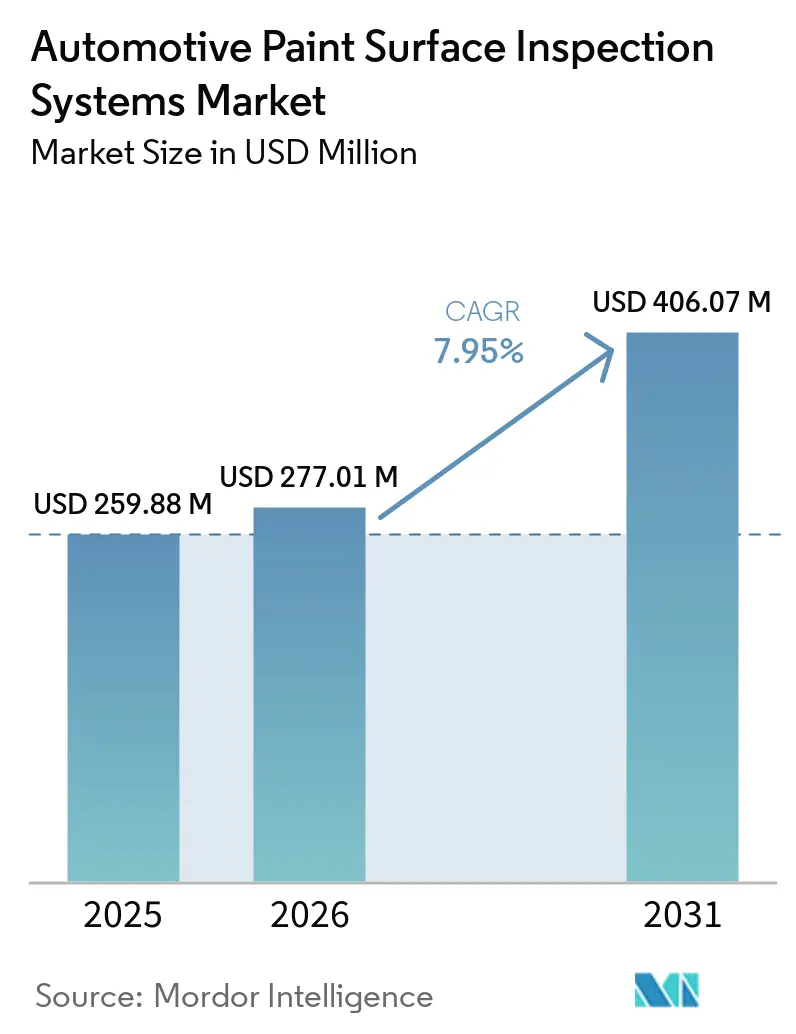
The Automotive Paint Surface Inspection Systems Market size is expected to increase from USD 259.88 million in 2025 to USD 277.01 million in 2026 and reach USD 406.07 million by 2031, growing at a CAGR of 7.95% over 2026-2031.
Demand in the automotive paint surface inspection systems market is shifting from sampled manual checks toward automated verification of every painted surface. Manufacturers need consistent inspection across varied body materials, finishes, and vehicle models. Electric vehicle production adds mixed materials, complex contours, and new clearcoat formulations that are harder to inspect reliably at production speed. Quality documentation and traceability requirements also encourage facilities to connect inspection records with production systems. These conditions support investment in systems that identify defects, route repair work, and help teams prevent repeat issues.
Key Report Takeaways
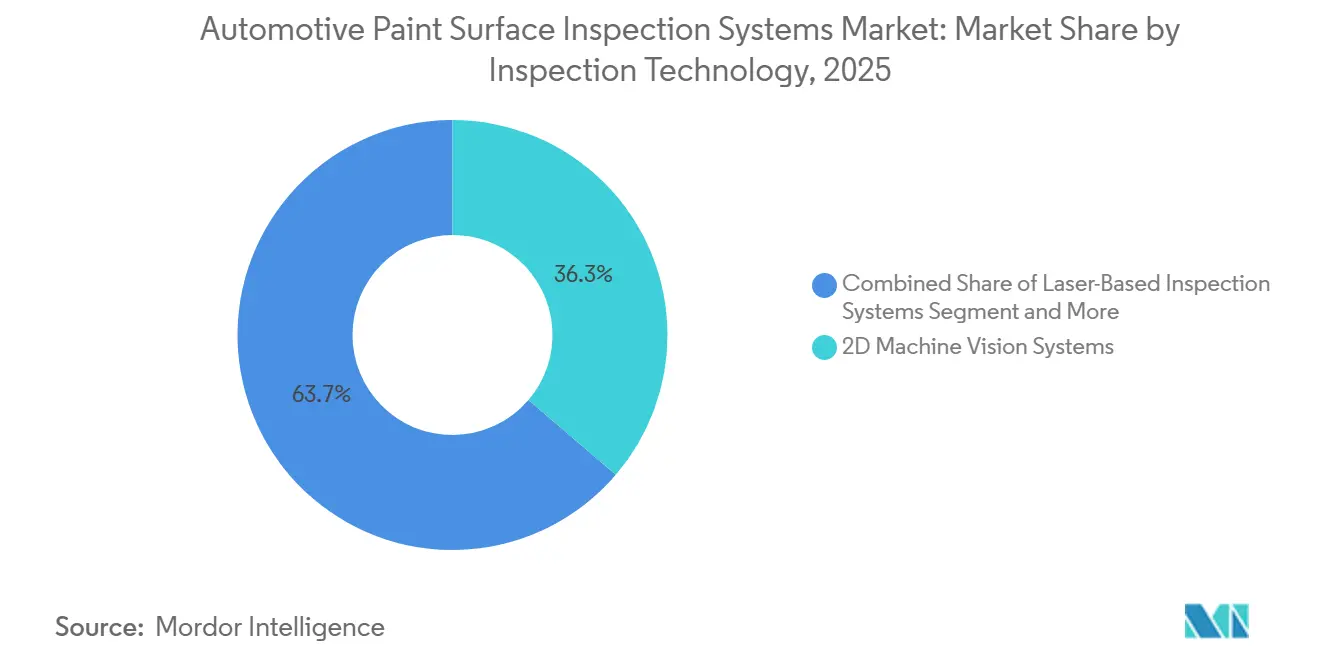
- By inspection technology, 2D machine vision systems held 36.27% of the automotive paint surface inspection systems market share in 2025, while AI-enabled and multi-modal systems are projected to expand at a 10.35% CAGR through 2031.
- By inspection mode, inline moving-line systems held 54.18% market share in 2025, while offline and robotic inspection is projected to expand at a 10.25% CAGR through 2031.
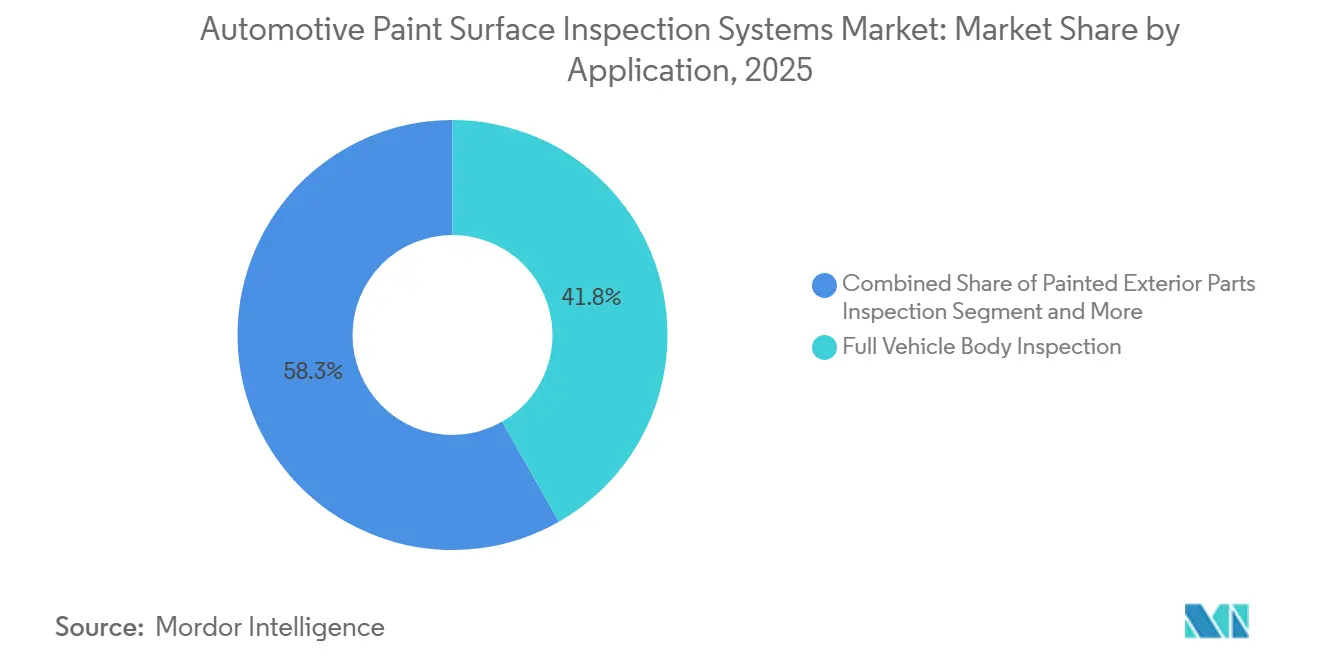
- By application, full vehicle body inspection accounted for 41.75% of the automotive paint surface inspection systems market size in 2025, while paint process and repair verification is projected to expand at a 10.85% CAGR through 2031.
- By end-user, automotive OEMs held 60.15% market share in 2025, while aftermarket and repair facilities are projected to expand at a 9.65% CAGR through 2031.
- By geography, Asia-Pacific held 44.35% of the automotive paint surface inspection systems market share in 2025 and is projected to expand at a 10.95% CAGR through 2031.
Note: Market size and forecast figures in this report are generated using Mordor Intelligence’s proprietary estimation framework, updated with the latest available data and insights as of January 2026.
Global Automotive Paint Surface Inspection Systems Market Trends and Insights
Drivers Impact Analysis*
| Driver | (~) % Impact on CAGR Forecast | Geographic Relevance | Impact Timeline |
|---|---|---|---|
| Rising Demand for Zero-Defect Vehicle Finishes | +2.2% | Global, with highest intensity in Germany, Japan, South Korea, and China | Medium term (2-4 years) |
| Expansion of Automated Paint-Shop Operations | +1.8% | Global, led by European and North American OEM production hubs | Medium term (2-4 years) |
| Increasing Adoption of AI-Based Defect Classification | +1.5% | Global, with fastest uptake in Asia-Pacific and Germany | Short term (≤ 2 years) |
| Growing Electric Vehicle and Model Variant Complexity | +1.1% | Asia-Pacific and Europe, with spillover to North America | Medium term (2-4 years) |
| Paint Defect Data for Closed-Loop Process Optimization | +0.7% | Europe as an early mover, expanding to Asia-Pacific and North America | Long term (≥ 4 years) |
| Need for Human-Independent Inspection on High-Speed Lines | +0.5% | Global, concentrated in high-volume plants in China, India, and ASEAN | Short term (≤ 2 years) |
| Source: Mordor Intelligence | |||
Rising Demand for Zero-Defect Vehicle Finishes
Premium and electric vehicle brands have raised expectations for paint quality on production bodies. A single plant can now apply different defect standards by customer and model during the same production sequence. This requires inspection systems to apply multiple criteria without slowing the line. ISRA VISION stated that its Car Paint Vision system covered at least 99% of vehicle surfaces through AI-based recognition configured to OEM standards.[1]ISRA VISION, “Car Paint Vision, Fully Automated Surface Inspection,” ISRA VISION, isravision.com. Axalta reported that effect or pearl finishes appeared on 19% of black vehicles and 15% of white vehicles in its 2025 color report. Such finishes can create reflections that make conventional 2D inspection less reliable. The automotive paint surface inspection systems market, therefore, favors multi-modal systems that combine controlled illumination, surface measurement, and classification software.
Expansion of Automated Paint-Shop Operations
New paint shops and modernization programs are making automated inspection a standard process step. BMW Group commissioned AI-based automated surface inspection at its Debrecen plant during the 2025 production ramp. The decision placed quality detection in the initial plant design instead of treating it as a later retrofit. BMW had also used AI-controlled robots at Plant Regensburg to assess car bodies against objective and repeatable standards. EINES Vision Systems reported that a two-tunnel ESFI installation reduced inspection and repair operators from 72 to 36. The same case reported EUR 600,000 in annual economic impact, equivalent to USD 649,200 using the stated 2024 average exchange rate, and a 1.5-year return period. These operating benefits support capital commitments as the automotive paint surface inspection systems market adds paint-shop capacity.
Increasing Adoption of AI-Based Defect Classification
AI-based defect classification is moving from pilot programs into routine production use. It depends on large defect libraries that are tailored to each OEM and paint process. A 2026 review identified multimodal fusion, digital twins, and Industrial Internet of Things connectivity as key directions for coating defect detection. These tools move inspection toward real-time feedback rather than isolated defect reporting. Models trained on one vehicle program do not necessarily transfer to another program. Konica Minolta described a 2024 parametric method that creates defect variants from 3 to 4 adjustable parameters, although this earlier research is not used for current operating comparisons. Fraunhofer IPA has also described a self-learning paint process model that links inline sensor data with predicted quality deviations in the automotive paint surface inspection systems market.
Growing Electric Vehicle and Model Variant Complexity
Electric vehicle bodies use material combinations and shapes that present new inspection conditions. Aluminum structures, carbon fiber reinforced panels, and battery-related underbody elements can create varied light reflections. Large castings and new bonding methods can also make fixed inspection thresholds less dependable. J3D Vision offers a stationary, in-motion architecture that inspects vehicles without stopping them or using robotic arms. This approach is designed for complex geometries, including underbody and battery-enclosure coatings, at normal line speed. A 2026 Zhijie Automobile patent filing described an AI visual crawling device for electrocoat and finish-coat inspection. The automotive paint surface inspection systems market must adapt inspection capacity as Chinese electric vehicle programs move quickly between production models.
Restraints Impact Analysis*
| Restraint | (~) % Impact on CAGR Forecast | Geographic Relevance | Impact Timeline |
|---|---|---|---|
| High Capital and Integration Costs | -1.4% | Global, most acute in emerging markets including India, Southeast Asia, and Brazil | Medium term (2-4 years) |
| Shortage of Automotive Vision-System Integration Expertise | -0.9% | Global, most severe in South America and Southeast Asia | Medium term (2-4 years) |
| False Positives on Reflective and Multicolor Surfaces | -0.6% | Global, concentrated at premium and luxury OEM facilities | Short term (≤ 2 years) |
| Limited Transferability of Defect Models Across Vehicle Programs | -0.4% | Global, more acute for high-volume multi-platform OEMs | Long term (≥ 4 years) |
| Source: Mordor Intelligence | |||
High Capital and Integration Costs
Automated robotic inspection cells require sensors, robots, lighting, software, and manufacturing execution system integration. This investment can be difficult for tier-2 suppliers and smaller OEM sites to support. Commissioning also requires work to align defect classification with each OEM's quality standards. That work can extend project schedules by 6 to 12 months after equipment delivery. Lower-throughput plants in India, Mexico, and Brazil carry a higher cost per vehicle for the investment. The IATF framework does not require a specific inspection technology, allowing cost-sensitive suppliers to retain human inspection longer. Retrofit-compatible designs can reduce disruption, but full automotive paint surface inspection systems market deployment economics remain a barrier in smaller installations.
Shortage of Automotive Vision-System Integration Expertise
Automotive paint inspection requires engineers who can program robots, calibrate models, and validate systems against OEM requirements. These capabilities remain scarce in many regions. The gap is especially visible where automotive capacity is expanding quickly, including Southeast Asia and India. Poor calibration can increase false positives, trigger unnecessary rework, and reduce trust in system output. Toyota Kyushu and Takano began a 6-year development program in 2020 to reach human-equivalent or better inspection accuracy for Lexus body and bumper paint lines. Vendor training, digital-twin commissioning, and pre-trained defect libraries can ease deployment. They do not remove the automotive paint surface inspection systems market's need for experienced integration teams.
*Our forecasts treat driver/restraint impacts as directional, not additive. The impact forecasts reflect baseline growth, mix effects, and variable interactions.
Segment Analysis
By Inspection Technology: 2D Systems Retain an Installed-Base Advantage
2D machine vision systems held 36.27% of the automotive paint surface inspection systems market in 2025. Their position reflects long use on standard-volume OEM lines with controlled lighting and predictable surface geometry. System integration paths are established, and service networks are mature. Those advantages continue to support use despite pressure from newer inspection approaches. Structured-light systems and 3D profilometry address curvature that 2D imaging cannot fully resolve. They are relevant for front fascias, door mirrors, and other outer-body parts with changing reflections. Laser-based systems serve a precision role in primer and electrocoat verification. Their purpose is to assess layer consistency that affects later corrosion protection.
AI-enabled and multi-modal inspection systems are projected to expand at a 10.35% CAGR through 2031, the highest rate among inspection technologies. These systems use multiple illumination modes, 3D data, and learning-based classification. They can identify issues on metallic and effect-finish surfaces that single-mode sensors may miss. ISRA VISION reported scan speeds of up to 1,200 mm per second and at least 99% surface coverage for Car Paint Vision. EINES describes its ESFI tunnel as combining cameras, deep learning, and 3D defect mapping for repair routing. BMW Group Plant Leipzig introduced terahertz-based measurement in 2026 for paint-layer measurement on plastic exterior parts. This extends inspection beyond visible-spectrum imaging.



By Inspection Mode: Moving-Line Systems Support High-Volume Production
Inline moving-line inspection held 54.18% of the automotive paint surface inspection systems market size in 2025. High-volume plants depend on it because stopping vehicles for inspection reduces throughput. Tunnel systems scan the exterior at conveyor speed through primer, topcoat, and final-finish stages. This configuration remains the primary choice where volume requirements are high. Inline stop-and-go systems remain relevant on lower-volume and premium production lines. Those facilities can accept a short pause for more detailed inspection. Inovision stated that SMARTInspect processed 80 jobs per hour or more at moving-line speed. The example shows that speed and inspection accuracy need not be opposing choices.
Offline and robotic inspection is projected to expand at a 10.25% CAGR through 2031. These cells can examine vehicles first identified by inline systems for further assessment. Their multi-angle scans are useful for complex defects and difficult surface regions. Porsche installed a 2-robot system at Leipzig in January 2025.[2]Porsche AG, “Perfektion in der Porsche-Lackiererei,” Porsche Newsroom, newsroom.porsche.com. The system generated 100,000 images per vehicle in a 72-second cycle. It also provided 3D visualization and statistical analysis of defects. This helps paint shops use inspection data to adjust process settings. The automotive paint surface inspection systems market benefits when robotic cells support both confirmation and process improvement.
By Application: Full Vehicle Body Inspection Holds the Largest Position
Full vehicle body inspection accounted for 41.75% of the automotive paint surface inspection systems market share in 2025. It covers the complete painted exterior through inspection points from electrocoat to clearcoat. This makes it the largest single installation category for a vehicle program. Its scale reflects the maturity of automated coverage at major OEM paint shops. New spending increasingly upgrades older 2D systems to AI-enabled and multi-modal designs. Painted exterior parts form the next major application area. Bumpers, spoilers, sill covers, and mirror housings require inspection methods suited to their material and shape. ISRA VISION reported at least 98.5% detection and less than 1% pseudo-defect detection for typical plastic exterior parts.
Paint process and repair verification is projected to expand at a 10.85% CAGR through 2031. It links defect detection with repair routing and feedback to paint parameters. Inovision, 3M, and FANUC commercialized a robotic repair solution for a moving automotive line.[3]FANUC America, “First-Ever Robotic Paint Repair Solution on a Moving Automotive Line,” FANUC America, fanucamerica.com. The system uses inspection results to guide polishing and finishing robots. This reduces manual intervention during repair. J3D Vision also described inspection across electrodeposition, primer, and topcoat stages. Earlier detection can prevent more vehicles from reaching the costly finish-coat rework stage. The automotive paint surface inspection systems market size for this application is supported by closed-loop quality workflows.
By End-User: OEMs Remain the Core Buyers
Automotive OEMs held 60.15% of the automotive paint surface inspection systems market share in 2025. OEM sites buy integrated cells, robots, and software platforms for full production-line coverage. Their specifications commonly require complete inspection, documented quality records, and manufacturing execution system links. These conditions support the largest and most complex installations. Suppliers follow OEM requirements as those standards extend through the value chain. General Motors updated its customer-specific IATF requirements in October 2025. The update reinforced traceability and quality-control requirements for suppliers. This creates a practical reason for tier-1 and tier-2 facilities to improve inspection capabilities.
Aftermarket and repair facilities are projected to expand at a 9.65% CAGR through 2031. AI-based photo estimating has increased interest in detailed verification after collision repair. Repair shops can use surface inspection to assess output quality, where light-tunnel checks remain labor-intensive. Certified pre-owned programs also rely on paint condition as an input to vehicle authenticity and valuation. Specialized repair chains can use inspection technology to make service quality more consistent. These factors introduce a different demand base from high-volume assembly plants. The segment remains smaller than OEM demand but adds a distinct channel for equipment providers. Its expansion broadens the automotive paint surface inspection systems industry beyond new-vehicle manufacturing.
Geography Analysis
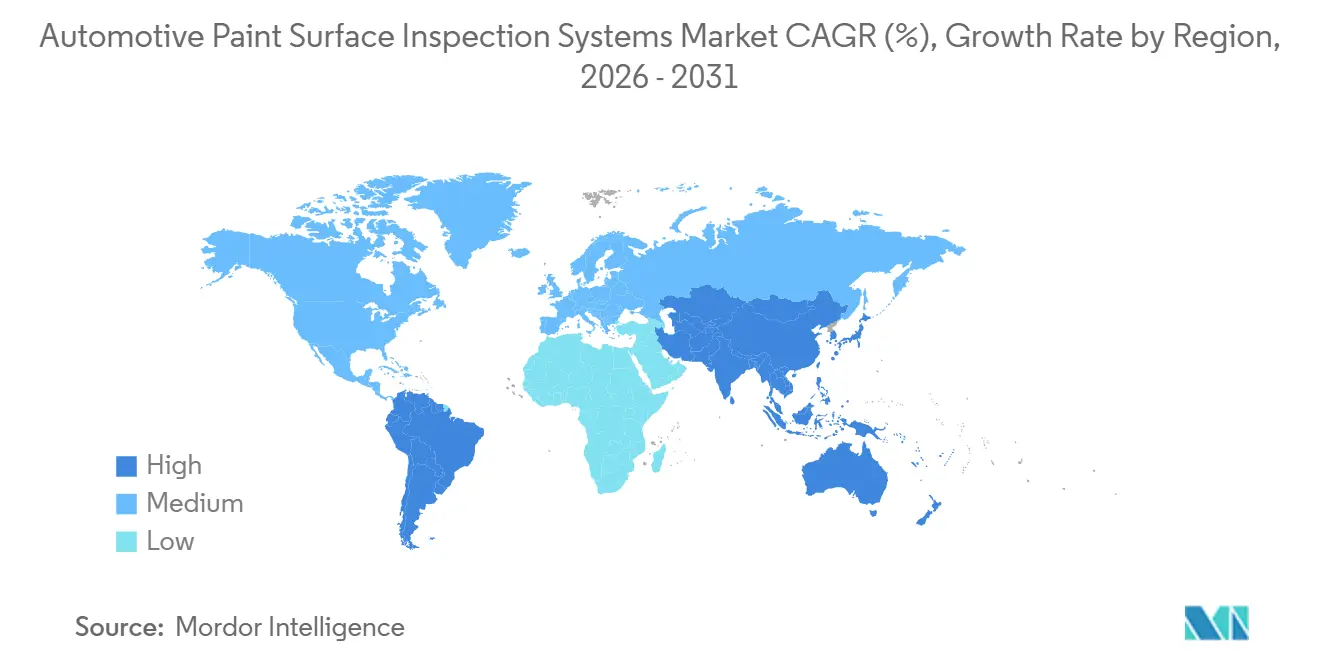
Asia-Pacific held 44.35% of the automotive paint surface inspection systems market size in 2025 and is projected to expand at a 10.95% CAGR through 2031. China drives much of this demand through high electric vehicle output and new paint-shop lines. New factories at Chinese vehicle manufacturers are incorporating AI inspection from the start. This shortens the adoption path compared with retrofitting older plants. A 2026 MAIVS deployment at Changan Ford used AI visual inspection for real-time monitoring without interrupting production. Japan provides a related example through Toyota Kyushu's production use of AI-based inspection for Lexus bodies and bumpers.[4]Coating Media Japan, “自動車でAI活用の外観検査装置導入,” Coating Media Japan, coatingmedia.com. South Korea is tied to Hyundai Motor Group quality standardization, while India and ASEAN are adding automated paint infrastructure in new OEM projects.
Europe remains an important development center for the automotive paint surface inspection systems market. Germany has a high concentration of specialist developers and OEM paint-shop automation projects. ISRA VISION, VITRONIC, and Micro-Epsilon form part of the German supply base. EINES Systems and AUTIS Engineers in Spain have also developed installations for volume OEM programs. European suppliers focus on linking inspection results with broader paint-shop controls. Fraunhofer IPA's self-learning model links inline sensors, predicted deviations, and autonomous correction. North American demand is centered on modernization at OEM plants in the United States, Canada, and Mexico.
South America, the Middle East, and Africa have lower installed system density than the leading regions. Brazil, Saudi Arabia, and Turkey are potential sources of later demand as automotive capacity investment advances. Brazil includes Autaza Tecnologia, a local developer of AI-based surface inspection capability. Saudi Arabia and the United Arab Emirates are focusing industrial programs on advanced automotive manufacturing. Turkey supplies European OEMs and faces comparable supplier quality expectations. South Africa is the main automotive manufacturing location in Africa. Current volumes there do not support dedicated full-body systems at most assembly plants. These regions can favor retrofit and modular installations before large, integrated deployments become more common.

Competitive Landscape
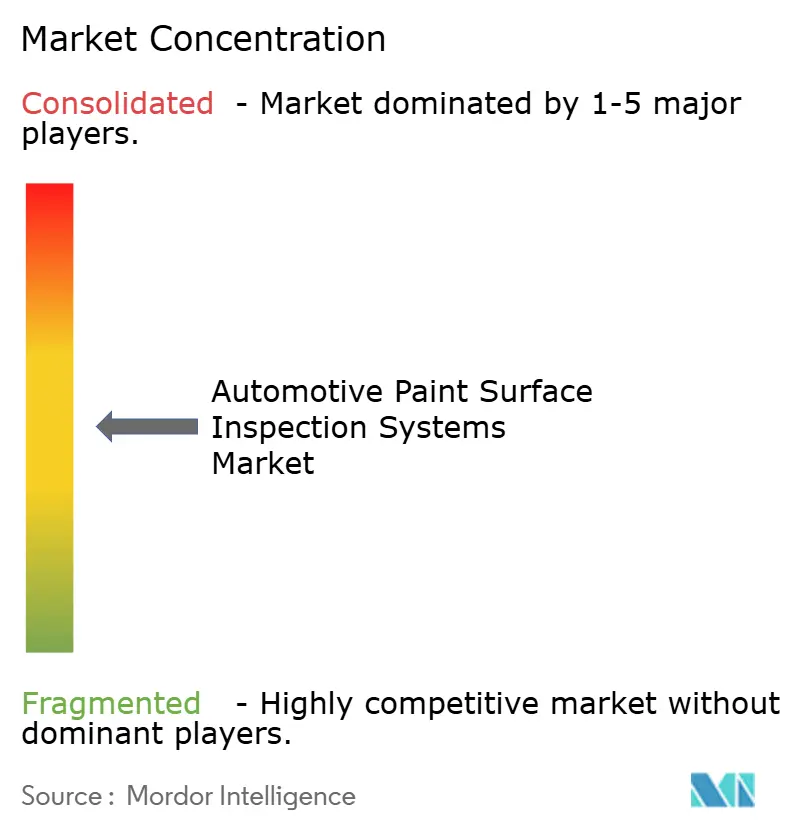
The automotive paint surface inspection systems market has a moderately fragmented structure. ISRA VISION, EINES Systems, VITRONIC, and Micro-Epsilon have strong reference positions with OEM customers. They compete through AI model accuracy, robot integration, and manufacturing execution system connectivity. Their focus is less on sensor resolution alone than in earlier system generations. Cognex and KEYENCE provide broader machine vision portfolios for several paint-shop uses. They often work with application-specific integrators for full vehicle body inspection. Basler supplies high-resolution CoaXPress 2.0 cameras for EINES Vision Systems' ESFI platform. This shows how component suppliers and specialist integrators can hold complementary positions.
Inspection-to-repair integration is an important area of competition. Defect maps must be converted into usable repair paths for automated systems. Inovision and EINES have established capabilities in this area. LMI Technologies presented GoPxL Pro Tools with onboard AI anomaly detection and classification for inline 3D defect detection in 2026. The approach avoids dependence on external cloud infrastructure. Early-stage inspection is another important area, particularly in electrocoat and pre-paint processes. Systems that find defects earlier can reduce the rework burden after clearcoat. These technical choices favor providers that can combine imaging, software, and plant integration.
ISRA VISION launched its Cam-X camera portfolio in August 2026 for vehicle positioning and robot guidance in body-shop settings. The launch extends its scope from paint-shop inspection into body-shop automation. EINES and Konica Minolta announced a 2025 partnership that combined ESFI defect detection with multi-angle color measurement. This created a workflow from defect identification to color consistency verification. Teledyne Technologies announced an agreement to acquire Varex Imaging Corporation for USD 1.1 billion in August 2026. The planned transaction reflects consolidation at the imaging component level. The automotive paint surface inspection systems market remains open to specialists, but entrants need strong integration and production reference capabilities.
Automotive Paint Surface Inspection Systems Industry Leaders
ISRA VISION GmbH
EINES Systems S.L.
AUTIS Engineers S.L.
Micro-Epsilon Messtechnik GmbH & Co. KG
J3D Vision S.L.
- *Disclaimer: Major Players sorted in no particular order

Recent Industry Developments
- August 2026: Teledyne Technologies and Varex Imaging Corporation announced a definitive agreement for Teledyne to acquire all Varex outstanding shares at USD 18.90 per share in cash, representing an aggregate transaction value of USD 1.1 billion. The acquisition adds X-ray source and digital detector capabilities to Teledyne's industrial imaging portfolio, with transaction close expected in early 2027 subject to regulatory and shareholder approvals.
- August 2026: BMW Group Plant Leipzig introduced the terahertz-based Irys measurement system, developed by das-Nano, for non-destructive paint layer thickness measurement on plastic exterior components in series production. The system replaces destructive scalpel-and-microscopy inspection, achieves micrometer-level accuracy, and generates digital data targeted for AI-based trend analysis.
- June 2026: ISRA VISION and LaVision GmbH announced a collaboration to develop a combined optical quality inspection solution for ADAS camera zones in automotive windshields, integrating ISRA VISION's automated inline defect detection with LaVision's SFR/MTF-based optical performance measurement to support functional validation of Level 3 and above driver assistance systems.
- June 2025: Porsche adds an AI-enabled robotic paint Inspection System. The 3D machine vision system projects patterns of light on the surface of the car, and a deep learning module analyzes distortions in the reflections to identify defects.


Global Automotive Paint Surface Inspection Systems Market Report Scope
Automotive paint surface inspection systems are automated quality control solutions that use high-resolution cameras, specialized lighting, and AI software to scan vehicle bodies for defects like scratches, dust, or uneven coating. They replace manual human inspections to ensure flawless paint finishes at high production speeds.
The Automotive Paint Surface Inspection Systems Market Report is Segmented by Inspection Technology (2D Machine Vision Systems, 3D Inspection and Profilometry Systems, Laser-Based Inspection Systems, Structured-Light Inspection Systems, and AI-Enabled and Multi-Modal Inspection Systems), Inspection Mode (Inline Moving-Line Inspection, Inline Stop-and-Go Inspection, and Offline and Robotic Inspection), Application (Full Vehicle Body Inspection, Painted Exterior Parts Inspection, Painted Interior Parts Inspection, and Paint Process and Repair Verification), End-User (Automotive Original Equipment Manufacturers, Automotive Suppliers, and Aftermarket and Repair Facilities), and Geography (North America, Europe, Asia-Pacific, Middle East, and Africa). The Market Forecasts are Provided in Terms of Value (USD).
| 2D Machine Vision Systems |
| 3D Inspection and Profilometry Systems |
| Laser-Based Inspection Systems |
| Structured-Light Inspection Systems |
| AI-Enabled and Multi-Modal Inspection Systems |
| Inline Moving-Line Inspection |
| Inline Stop-and-Go Inspection |
| Offline and Robotic Inspection |
| Full Vehicle Body Inspection |
| Painted Exterior Parts Inspection |
| Painted Interior Parts Inspection |
| Paint Process and Repair Verification |
| Automotive Original Equipment Manufacturers |
| Automotive Suppliers |
| Aftermarket and Repair Facilities |
| North America | United States |
| Canada | |
| Mexico | |
| South America | Brazil |
| Argentina | |
| Rest of South America | |
| Europe | Germany |
| United Kingdom | |
| France | |
| Italy | |
| Spain | |
| Rest of Europe | |
| Asia-Pacific | China |
| Japan | |
| India | |
| South Korea | |
| ASEAN | |
| Rest of Asia-Pacific | |
| Middle East | Saudi Arabia |
| United Arab Emirates | |
| Turkey | |
| Rest of the Middle East | |
| Africa | South Africa |
| Nigeria | |
| Rest of Africa |
| By Inspection Technology | 2D Machine Vision Systems | |
| 3D Inspection and Profilometry Systems | ||
| Laser-Based Inspection Systems | ||
| Structured-Light Inspection Systems | ||
| AI-Enabled and Multi-Modal Inspection Systems | ||
| By Inspection Mode | Inline Moving-Line Inspection | |
| Inline Stop-and-Go Inspection | ||
| Offline and Robotic Inspection | ||
| By Application | Full Vehicle Body Inspection | |
| Painted Exterior Parts Inspection | ||
| Painted Interior Parts Inspection | ||
| Paint Process and Repair Verification | ||
| By End-User | Automotive Original Equipment Manufacturers | |
| Automotive Suppliers | ||
| Aftermarket and Repair Facilities | ||
| By Geography | North America | United States |
| Canada | ||
| Mexico | ||
| South America | Brazil | |
| Argentina | ||
| Rest of South America | ||
| Europe | Germany | |
| United Kingdom | ||
| France | ||
| Italy | ||
| Spain | ||
| Rest of Europe | ||
| Asia-Pacific | China | |
| Japan | ||
| India | ||
| South Korea | ||
| ASEAN | ||
| Rest of Asia-Pacific | ||
| Middle East | Saudi Arabia | |
| United Arab Emirates | ||
| Turkey | ||
| Rest of the Middle East | ||
| Africa | South Africa | |
| Nigeria | ||
| Rest of Africa | ||


Key Questions Answered in the Report
What is the 2026 size of the automotive paint surface inspection systems market?
The automotive paint surface inspection systems market was estimated at USD 277.01 million in 2026 and is forecast to reach USD 406.07 million by 2031.
What is driving demand for automotive paint inspection systems?
Demand is supported by zero-defect finish requirements, automated paint shops, AI-based classification, and more complex electric vehicle body designs.
Which inspection technology is expanding fastest?
AI-enabled and multi-modal inspection systems are projected to expand at a 10.35% CAGR through 2031.
Why do OEMs use inline moving-line inspection?
Inline moving-line systems inspect vehicles at conveyor speed, which helps high-volume plants protect throughput while maintaining finish checks.
Which region leads automotive paint surface inspection system demand?
Asia-Pacific held 44.35% share in 2025 and is projected to expand at a 10.95% CAGR through 2031.
Which end users are expected to add demand beyond OEM plants?
Aftermarket and repair facilities are projected to expand at a 9.65% CAGR through 2031 as repair verification becomes more automated.
Page last updated on:





