
Automotive Driver State Monitoring Systems Market Size and Share
Market Overview
| Study Period | 2020 - 2032 |
|---|---|
| Market Size (2027) | USD 3.11 Billion |
| Market Size (2032) | USD 5.71 Billion |
| Growth Rate (2027 - 2032) | 12.92 % |
| Fastest Growing Market | Middle East and Africa |
| Largest Market | Asia-Pacific |
| Market Concentration | Medium |
Major Players *Disclaimer: Major Players sorted in no particular order Image © Mordor Intelligence. Reuse requires attribution under CC BY 4.0. | |
Automotive Driver State Monitoring Systems Market Analysis by Mordor Intelligence
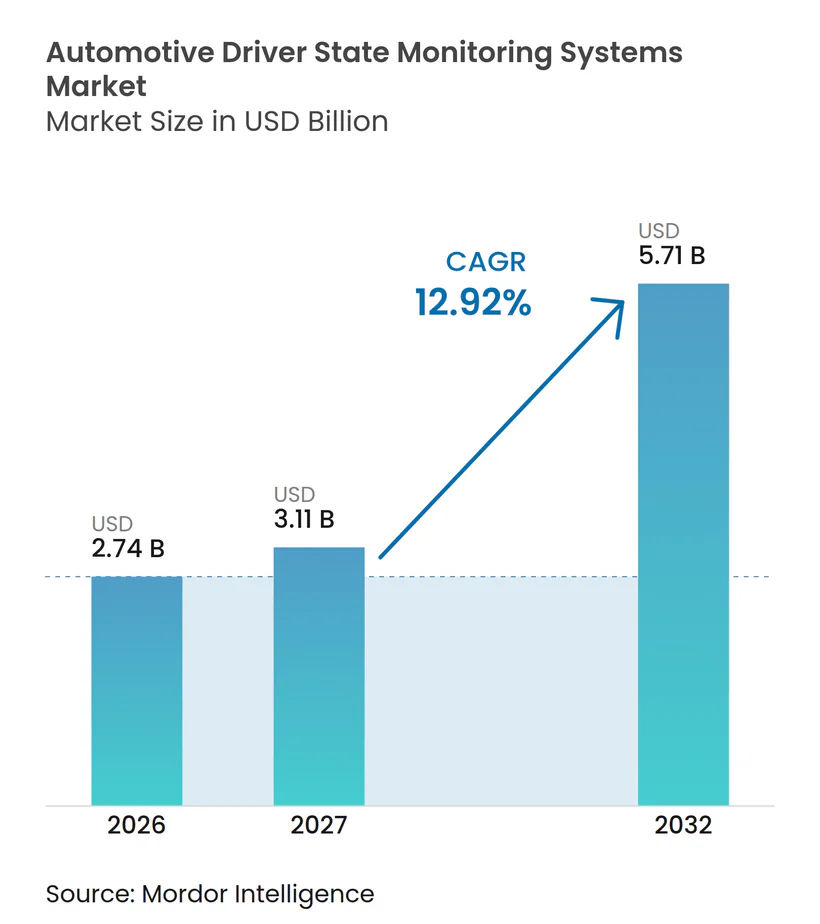
The automotive driver state monitoring systems market size was valued at USD 2.74 billion in 2026 and is expected to grow from USD 3.11 billion in 2027 to USD 5.71 billion by 2032, at a CAGR of 12.92% during 2027-2032. The automotive driver state monitoring systems market is moving from a premium safety feature toward broader vehicle fitment as safety rules and rating protocols place greater emphasis on driver attention. European type-approval rules establish a clear policy basis for systems that warn drivers about distraction and drowsiness. Euro NCAP's 2026 approach also makes driver engagement a material element of vehicle safety assessment, which increases the value of reliable in-cabin sensing[1]. The automotive driver state monitoring systems market therefore favors suppliers that can combine safety performance, practical cockpit integration, and responsible handling of sensitive in-cabin information. Software that can be improved over the life of a vehicle also gives manufacturers a reason to consider driver monitoring as part of a wider in-cabin safety platform.
Key Report Takeaways
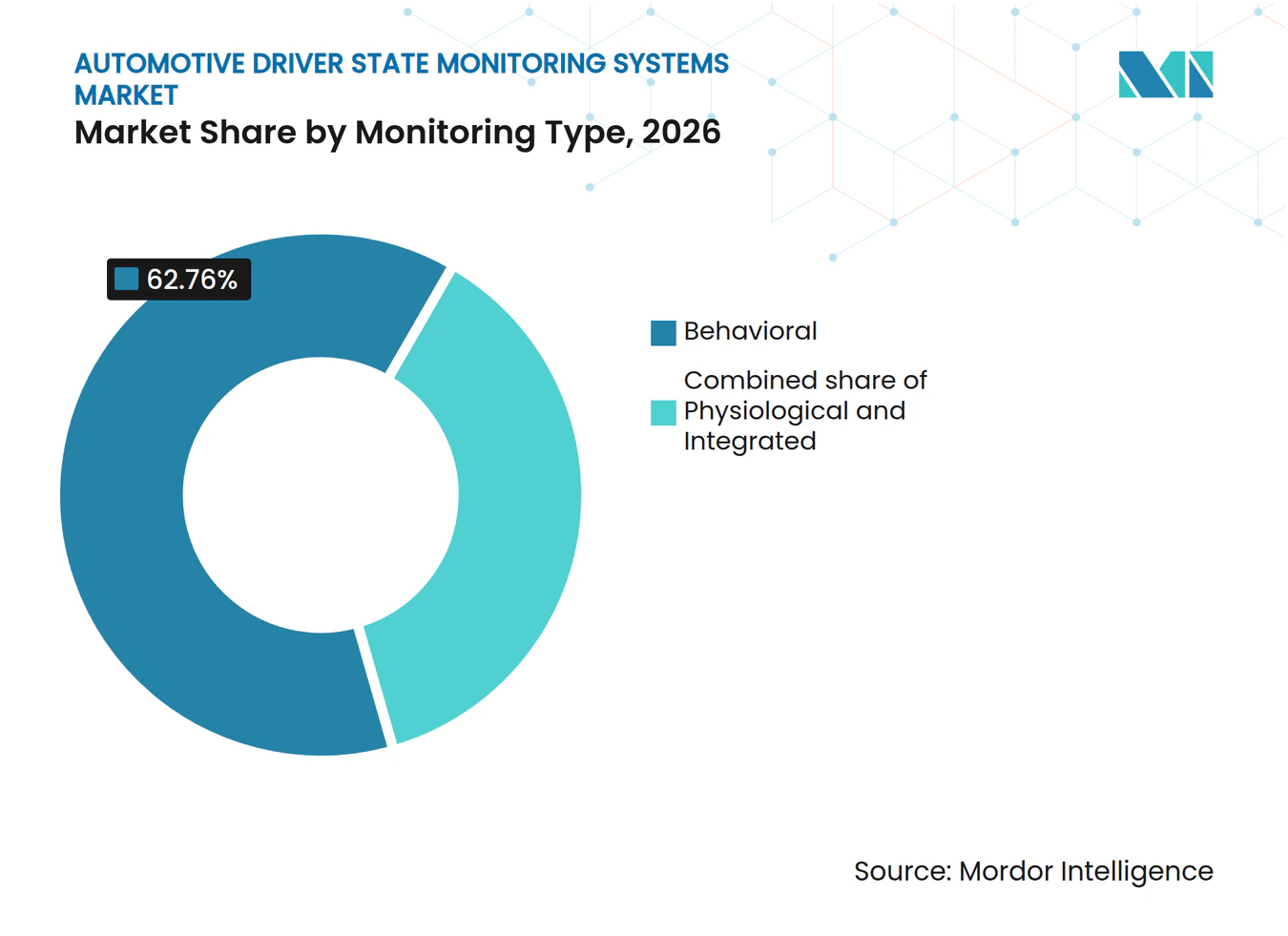
- By monitoring type, behavioral systems held a 62.76% share in 2026, while integrated behavioral and physiological systems are projected to record a 16.17% CAGR through 2032.
- By technology, camera-based infrared systems held a 76.93% share in 2026, while other technologies, including radar and wearables, are projected to record a 15.77% CAGR through 2032.
- By component, hardware held a 58.71% share in 2026, while software is projected to record a 15.07% CAGR through 2032.
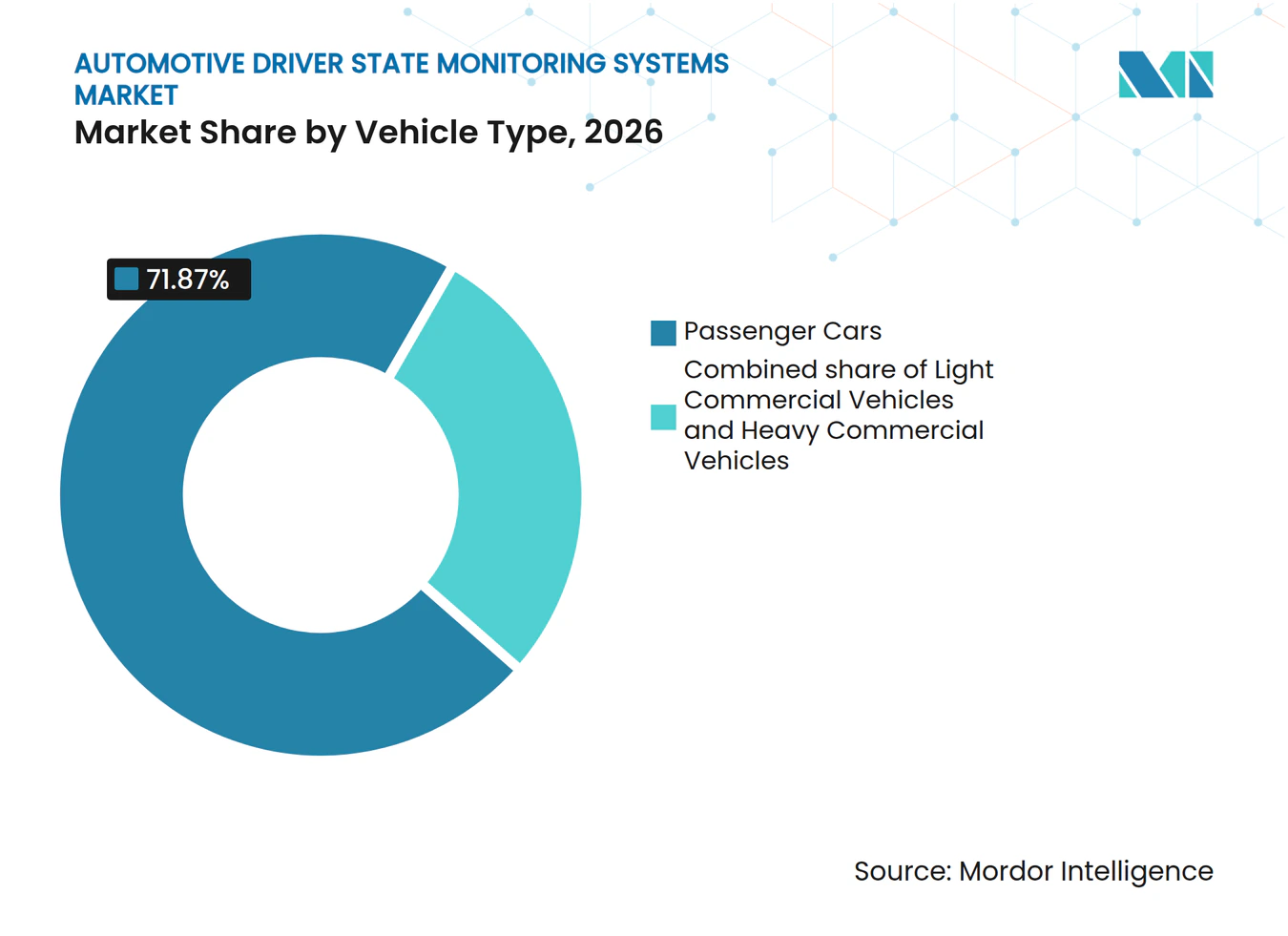
- By vehicle type, passenger cars held a 71.87% share in 2026, while heavy commercial vehicles are projected to record a 14.37% CAGR through 2032.
- By sales channel, OEMs held an 89.08% share in 2026, while the aftermarket is projected to record a 15.97% CAGR through 2032.
- By geography, Asia-Pacific held a 42.52% share in 2026, while the Middle East and Africa is projected to record a 15.67% CAGR through 2032.
Note: Market numbers in this report are based on Mordor Intelligence's proprietary estimation framework, which combines nine months of actuals with Q4 projections for base year 2026.
Market Trends and Insights
Drivers Impact Analysis of Automotive Driver State Monitoring Systems Market*
| Driver | (~) % Impact on CAGR Forecast | Geographic Relevance | Impact Timeline |
|---|---|---|---|
| Regulatory Fitment and Safety-Rating Pressure | +3.5% | Europe (primary), Global spill-over | Short term (≤ 2 years) |
| Growth of L2 and L3 Automated Driving Functions | +2.8% | Global, with Asia-Pacific and Europe as core markets | Medium term (2–4 years) |
| Expansion of Commercial Fleet Safety Programs | +2.2% | North America, Europe, Asia-Pacific | Medium term (2–4 years) |
| Edge AI and Near-Infrared Sensor Cost Improvements | +1.8% | Global, early gains in the Asia-Pacific supply chain | Medium term (2–4 years) |
| Sensor Fusion With Existing Steering and Lane-Position Inputs | +1.2% | North America and Europe | Medium term (2–4 years) |
| Privacy-Preserving In-Vehicle Processing | +0.8% | Europe, North America | Long term (≥ 4 years) |
| Source: Mordor Intelligence | |||
Regulatory Fitment and Safety-Rating Pressure
European rules on type approval make driver attention warnings a direct product requirement rather than a voluntary equipment choice. Euro NCAP's revised safety framework gives vehicle manufacturers a further commercial reason to use continuous driver engagement assessment. The automotive driver state monitoring systems market benefits because a shared regulatory direction reduces uncertainty for vehicle platforms that are sold across several European countries. Manufacturers can increasingly treat the monitoring function as a standard safety capability rather than reserve it for selected premium trims. This change also places greater emphasis on systems that can consistently interpret eye and head movements under routine driving conditions. Suppliers with validated safety functions are better positioned when automakers make production nominations for future vehicle programs.
Growth of L2 and L3 Automated Driving Functions
Higher levels of assisted driving require the vehicle to understand whether a driver can resume control when the system reaches its operating limit. This need makes in-cabin monitoring more important than a simple warning feature because the vehicle must assess driver availability during transitions. The automotive driver state monitoring systems market gains from the closer link between driving automation and direct observation of driver attention. Mobileye has described an approach that combines in-cabin monitoring with the road context captured by the vehicle's exterior perception system[2]. That design supports assessments of whether attention is relevant to the conditions around the vehicle, not only whether a driver is facing forward. As automated functions spread across high-volume vehicle architectures, manufacturers are likely to seek monitoring systems that fit the broader driver-assistance design without creating a separate technology stack.
Expansion of Commercial Fleet Safety Programs
Fleet operators use driver monitoring to support safety management in logistics, public transport, and energy operations. These buyers often value practical alerts, consistent reporting, and equipment that works across mixed vehicle fleets. The automotive driver state monitoring systems market can therefore grow through commercial programs even where passenger-car rules are less prescriptive. Factory fitment is increasingly relevant because it gives operators a more integrated alternative to retrofitting vehicles after purchase. The system must still be useful to the driver, since excessive or poorly timed warnings can reduce acceptance during long shifts. Fleet deployments also create a path for suppliers to demonstrate durability and real-world performance before seeking broader original-equipment contracts.
Edge AI and Near-Infrared Sensor Cost Improvements
In-cabin monitoring is becoming easier to incorporate when processing and sensing functions can be shared with other cockpit features. The automotive driver state monitoring systems market benefits from designs that reduce the need for separate control units and simplify the physical installation. Mobileye's monitoring approach is designed to operate within its EyeQ platform, illustrating the appeal of combining driver and road perception functions[3]. Near-infrared sensing remains useful because it enables observation of the driver's face under varying ambient-light conditions. Suppliers still need to balance sensor placement, optical performance, and cockpit appearance. Better integration can make driver monitoring more accessible on vehicle lines where a dedicated system would otherwise be difficult to justify.
Restraints Impact Analysis of Automotive Driver State Monitoring Systems Market*
| Restraint | (~) % Impact on CAGR Forecast | Geographic Relevance | Impact Timeline |
|---|---|---|---|
| Privacy, Biometric Data, and Cybersecurity Compliance | -2.1% | Europe (primary), North America | Medium term (2–4 years) |
| Hardware Integration and Calibration Costs | -1.7% | Global, particularly emerging markets | Medium term (2–4 years) |
| False Positives Across Driver Diversity and Occlusion Conditions | -1.2% | Global | Medium term (2–4 years) |
| Driver Acceptance and Alert Fatigue | -0.8% | North America and Europe | Long term (≥ 4 years) |
| Source: Mordor Intelligence | |||
Privacy, Biometric Data, and Cybersecurity Compliance
The automotive driver state monitoring systems market must address privacy expectations, as these systems observe behavior inside a personal vehicle. European type-approval rules state that certain driver monitoring systems should not continuously record or retain information beyond what is needed for their purpose. That principle encourages in-vehicle processing and careful limits on the data that leaves the vehicle. It also makes feature design more demanding when manufacturers consider authentication or health-related functions alongside safety monitoring. Cybersecurity needs are equally important when the system connects with vehicle networks or remote services. Suppliers that build privacy and security controls into the product design can reduce delays during vehicle development and approval.
Hardware Integration and Calibration Costs
Camera placement and illumination must work across seating positions, driver characteristics, interior materials, and changing light conditions. This engineering work can make it more difficult for suppliers that rely on a generic module design to compete in the automotive driver state monitoring systems market. A display-based cockpit may require additional optical design work when the camera sits behind a panel. Smart Eye and Visteon presented an integrated instrument-cluster concept that addresses the transmission of near-infrared light through an LCD structure. Existing vehicle platforms can be particularly challenging because the interior was not necessarily designed around a direct view of the driver's face. Costs can remain a barrier when manufacturers cannot spread development work across multiple vehicle lines.
*Our forecasts treat driver/restraint impacts as directional, not additive. The impact forecasts reflect baseline growth, mix effects, and variable interactions.
Automotive Driver State Monitoring Systems Market Segment Analysis
By Monitoring Type:
Behavioral Systems Form the Current Safety Base, While Integrated Systems Extend CapabilityBehavioral monitoring held a 62.76% share in 2026, making it the established core of the automotive driver state monitoring systems market. These systems focus on observable signs such as distraction, drowsiness, gaze direction, and head position. Their broad adoption follows the need for functions that warn drivers when attention has moved away from the task of driving. European requirements provide a practical policy foundation for this use case because they address warnings for distraction and drowsiness. Vehicle manufacturers can use behavioral monitoring as a common safety function across several models while adapting the user interface to each vehicle brand. The segment also benefits from the familiarity of camera-based observation in new vehicle cabins.
Integrated behavioral and physiological monitoring is projected to expand at a 16.17% CAGR through 2032. This approach combines driver behavior data with signals that may help identify broader changes in driver condition. The automotive driver state monitoring systems market has room for these systems, as automakers want a single in-cabin platform to support safety, personalization, and secure access features. The opportunity is balanced by the need to define carefully what information is processed and why it is needed. Processing close to the vehicle can help manufacturers limit data transfer while maintaining safety functions. Product teams must also make the experience clear to drivers, because trust will affect the practical value of additional sensing features.



By Technology:
Infrared Cameras Lead Current Fitment, While Alternative Sensing Broadens OptionsCamera-based infrared systems held a 76.93% share in 2026, reflecting their central role in direct observation of driver behavior. Infrared cameras can monitor eye and head movement when visible-light conditions in the cabin are poor. Their relevance grows as safety assessment increasingly emphasizes driver engagement rather than indirect estimates of attention. The automotive driver state monitoring systems market continues to favor camera-based designs where manufacturers need a mature path to direct sensing. Interior placement, illumination, and privacy messaging remain important factors in how the technology is received. Suppliers also need to ensure that camera performance remains reliable across ordinary use cases involving eyewear, headwear, or shifting daylight.
Other technologies, including radar and wearables, are projected to advance at a 15.77% CAGR through 2032. These approaches can add useful information where a camera view is partially obstructed or where a fleet operator needs a different type of driver signal. Radar-based sensing can support contactless observation, while wearables may provide an additional input for managed commercial fleets. The automotive driver state monitoring systems market can benefit from these methods when they complement, rather than replace, direct attention sensing. Manufacturers must evaluate the safety role of each sensor and the burden it places on drivers or fleet managers. Multi-sensor designs will require clear validation to show that added complexity improves the driver experience and supports safe action by the vehicle.
By Component:
Hardware Supports Deployment, While Software Carries More of the System ValueHardware accounted for 58.71% of the market in 2026, including cameras, illuminators, processing units, and related physical components for in-cabin monitoring. This position reflects the work required to integrate the sensing system into the vehicle cockpit and connect it to the wider electrical architecture. The automotive driver state monitoring systems market still depends on hardware that can withstand automotive operating conditions and meet vehicle safety expectations. Well-designed modules can simplify installation and deliver more consistent results across vehicles by leveraging a shared platform. Hardware suppliers also play an important role in managing supply continuity, manufacturing quality, and the physical integration of the sensor. These responsibilities remain material even as more system differentiation shifts toward software.
Software is projected to grow at a 15.07% CAGR through 2032. It translates raw sensor data into an assessment of the driver's state and determines how the vehicle should present a warning. The automotive driver state monitoring systems market places greater value on software that can be improved after launch as safety protocols and customer expectations evolve. Updates may refine detection logic, adjust alert behavior, or support additional forms of in-cabin sensing without replacing the entire module. This model gives automakers a route to sustain product relevance over a vehicle program's life. It also increases the importance of accountability between software specialists, system integrators, and vehicle manufacturers when a monitored event requires reliable interpretation.
By Vehicle Type:
Passenger Cars Provide Scale, While Heavy Commercial Vehicles Prioritize Operational SafetyPassenger cars held a 71.87% share in 2026, supported by large production volumes and the wider spread of in-cabin safety features. Manufacturers can incorporate monitoring systems across related vehicle lines when a common cockpit architecture is used. The automotive driver state monitoring systems market gains from this scale because suppliers can spread engineering and validation work across a broader set of models. Consumer expectations around driver-assistance features also encourage manufacturers to make cabin safety functions more visible in the vehicle offering. European safety rules create an added reason for fitment on models sold in the region. Passenger-car programs nevertheless require careful user-experience design so the system protects drivers without creating unnecessary concern or annoyance.
Heavy commercial vehicles are projected to grow at a 14.37% CAGR through 2032. Long driving periods, demanding operating conditions, and formal safety procedures make driver attention a practical concern for commercial operators. The automotive driver state monitoring systems market can serve this need with systems that provide useful alerts while fitting the daily realities of professional driving. Fleet managers may value the technology when it supports coaching, incident prevention, and consistent safety practice across drivers. These vehicles can also require close coordination between the monitoring function and broader vehicle controls. Suppliers need to design warnings and interventions with the operating environment in mind, since professional drivers need clear, usable information rather than a system that interrupts routine work.

By Sales Channel:
OEM Programs Dominate Present Delivery, While Fleet Retrofits Create a Faster Growth PathOEMs accounted for 89.08% in 2026 because driver monitoring is commonly fitted during vehicle production. This channel allows the sensor, software, and dashboard interface to be designed together rather than added after the vehicle has entered service. The automotive driver state monitoring systems market is therefore closely tied to vehicle development schedules and type-approval processes. Production contracts may cover several models, which gives suppliers a clearer path to scale but also raises the qualification threshold. Mobileye has announced a production program that integrates its driver-monitoring system into a broader vehicle perception platform for a U.S. automaker. Such programs illustrate why integration with a manufacturer's existing driver-assistance architecture can be commercially important.
The aftermarket is projected to grow at a 15.97% CAGR through 2032. This channel supports vehicles already in use and helps operators address safety priorities without waiting for fleet replacement cycles. The automotive driver state monitoring systems market presents an opportunity for operators seeking practical monitoring capabilities across mixed vehicle fleets from different manufacturers. Suppliers must make installation straightforward and provide fleet managers with controls that respect driver privacy. The offering also needs to show value in daily operations through useful alerts, easy maintenance, and support for existing safety processes. Growth in this channel will depend on whether products can deliver a credible safety benefit without the integration advantages available in original vehicle production.
Geography Analysis
Asia-Pacific
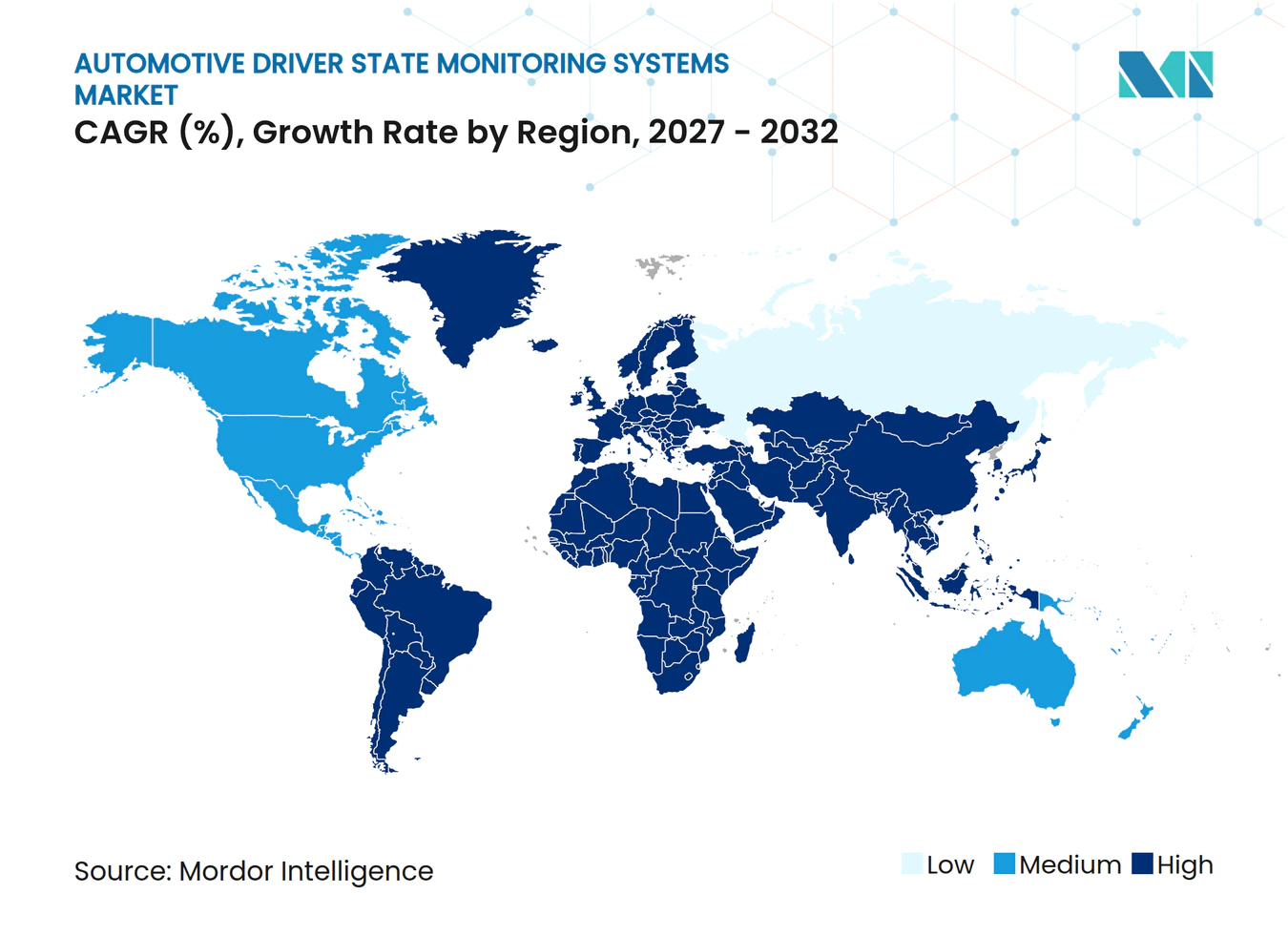
Asia-Pacific accounted for 42.52% of the automotive driver state monitoring systems market share in 2026. China, Japan, and South Korea are major vehicle production bases and have strong electronics supply chains. Chinese manufacturers increasingly treat cabin technology as a core part of connected, software-led vehicle design. Japanese and Korean automakers add regional weight through programs that serve local and export markets. The automotive driver state monitoring systems market rewards systems that adapt across vehicle brands, regulatory settings, interior formats, and cost targets. Local engineering support is important when a common monitoring platform is applied to several vehicle lines. A deeper domestic supply base can shorten development cycles by bringing sensors, processors, and software together. Growth remains supported by scale and technical capability, although requirements differ across countries.
Middle East and Africa
The Middle East and Africa is forecast to grow at a 15.67% CAGR through 2032. Commercial fleets, logistics, public transport, and industrial vehicles provide a practical starting point for adoption. The automotive driver state monitoring systems market can advance when fleet operators make driver attention part of their wider safety process. Insurance, corporate safety policies, and long-distance operating conditions can shape procurement decisions. Providers need reliable systems, practical installation, and clear explanations of the data collected and alerts issued. Retrofit-friendly products are relevant because fleets often operate vehicles from several manufacturers and model years. Growth will vary by country due to differences in fleet ownership, roads, and public safety programs. Local support can influence whether initial deployments become broader fleet programs.
Europe, North America, and Other Markets
Europe is a major reference point because its type-approval framework addresses warnings for distraction and drowsiness. Euro NCAP also encourages automakers to evaluate driver engagement as part of vehicle safety performance. Europe is therefore shaped by compliance, rating performance, and integration with existing safety systems. North America relies more on manufacturer feature strategies and commercial-fleet practices. South American demand can grow through fleets and public transport, while Russia faces constraints in automotive investment and access to electronics. Across these markets, suppliers must match system design with the local vehicle mix, buyer readiness, privacy expectations, and service requirements.
Competitive Landscape
Market Concentration
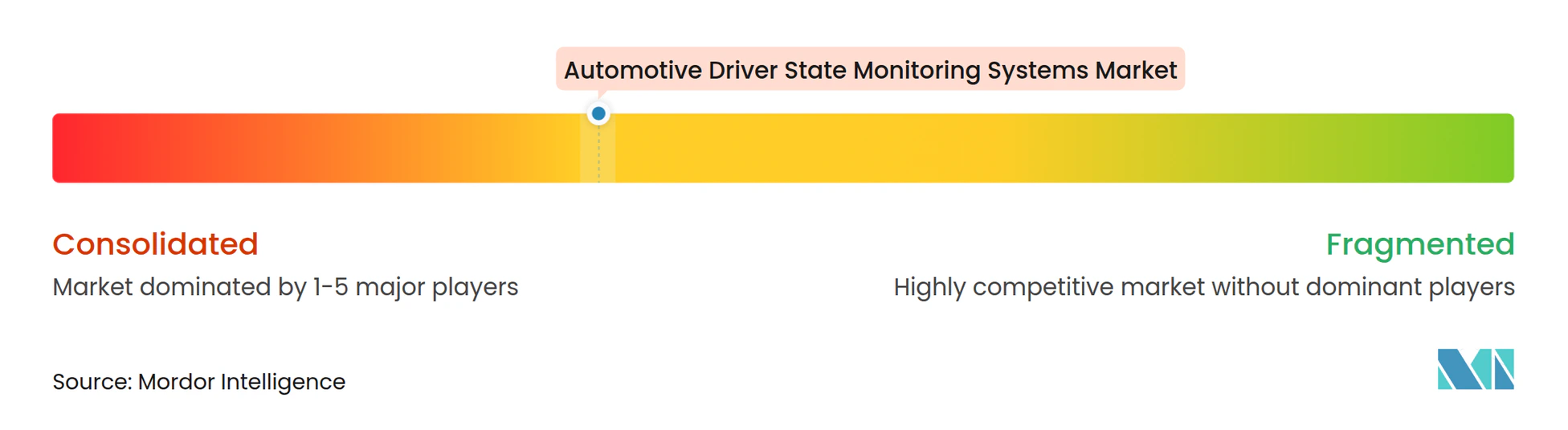
Specialist software providers and major vehicle-system suppliers shape technical direction and access to vehicle production programs. Seeing Machines, Smart Eye, and Cipia are recognized for software that interprets gaze, eye state, and driver behavior. Integrators including Valeo, Bosch, DENSO, Magna, AUMOVIO, Hyundai Mobis, Mitsubishi Electric, FORVIA, and Visteon contribute manufacturing scale and cockpit integration. Specialists often provide the monitoring logic, while larger suppliers manage hardware integration and program delivery. The automotive driver state monitoring systems market depends on partnerships that combine software capability with vehicle-grade engineering. These arrangements give automakers supplier choice, but they also require close coordination across the vehicle program.
Competition is changing as driver monitoring becomes part of a broader driver-assistance computing platform. Mobileye has described a system that combines driver attention with information from the vehicle's exterior perception sensors, allowing attention to be assessed in the context of the road scene. This integrated approach can challenge standalone modules because automakers may prefer fewer controllers and a more unified software environment. It also makes computing architecture a commercial choice. Suppliers that work across several processing platforms may have more opportunities, while specialists must show clear advantages in sensing and interpretation. Reliable performance across ordinary and unpredictable driver behavior remains central to successful adoption.
Cockpit integration remains an important area of competition because modern cabin layouts can complicate camera placement and calibration. Valeo and Seeing Machines presented in-cabin monitoring solutions across several processing platforms at CES 2026, showing a flexible approach for different vehicle programs. The automotive driver state monitoring systems market favors systems that combine direct sensing, dependable software, and a workable interior design. Multi-modal sensing may differentiate suppliers when it improves performance across varied lighting, driver behavior, and cockpit layouts. However, suppliers must show that additional sensors create practical value rather than unnecessary cost.
Automotive Driver State Monitoring Systems Industry Leaders
-
Seeing Machines
-
Smart Eye AB
-
Cipia Vision Ltd.
-
AUMOVIO SE
-
Robert Bosch GmbH
- *Disclaimer: Major Players sorted in no particular order
Automotive Driver State Monitoring Systems Market Companies Covered in this Report
- Seeing Machines
- Smart Eye AB
- Cipia Vision Ltd.
- AUMOVIO SE
- Robert Bosch GmbH
- Valeo SE
- DENSO CORPORATION
- Aptiv PLC
- Magna International Inc.
- Visteon Corporation
- Hyundai Mobis Co., Ltd.
- Samsung Electronics Co., Ltd.
- Mitsubishi Electric Corporation
- FORVIA SE
- Tobii AB
- OMNIVISION Technologies, Inc.
- Xperi Holding Corporation
- Jungo Connectivity Ltd.
- Mobileye Global Inc.
Recent Industry Developments in Automotive Driver State Monitoring Systems Market
- August 2026: Smart Eye won a driver monitoring design win worth about SEK 15 million for a new electric sports car from an existing European premium automaker customer, with production from mid-2027.
- July 2026: Seeing Machines won a new European automaker program through a Tier 1 supplier, with monitoring integrated into the rear-view mirror, worth approximately USD 5 million, with production from 2028.
- June 2026: Smart Eye secured four driver monitoring design wins worth about SEK 50 million from a leading global automaker, for production in 2028 and 2029 in Europe and North America.
- March 2026: Mobileye secured a driver monitoring system production program on its EyeQ6L chip from a leading United States automaker, covering millions of vehicles from 2027.
Global Automotive Driver State Monitoring Systems Market Report Scope
The Automotive Driver State Monitoring Systems Market is segmented by Monitoring Type, Technology, Component, Vehicle Type, Sales Channel, and Geography. By Monitoring Type, the market is segmented into Behavioral (Drowsiness, Distraction), Physiological (Health, Impairment), and Integrated (Behavioral and Physiological). By Technology, the market is segmented into Camera-Based (IR), Steering Wheel and Seat Sensors, and Other Technologies (Radar, Wearables). By Component, the market is segmented into Hardware and Software. By Vehicle Type, the market is segmented into Passenger Cars, Light Commercial Vehicles, and Heavy Commercial Vehicles. By Sales Channel, the market is segmented into OEMs and Aftermarket. By Geography, the market is segmented into North America (United States, Canada, and Mexico), Europe (Germany, United Kingdom, France, Italy, Spain, Sweden, Russia, and Rest of Europe), Asia-Pacific (China, Japan, South Korea, India, Australia, Southeast Asia, and Rest of Asia-Pacific), South America (Brazil, Argentina, Chile, Colombia, and Rest of South America), and Middle East and Africa (Saudi Arabia, United Arab Emirates, Israel, Türkiye, South Africa, Egypt, and Rest of Middle East and Africa). Market forecasts are provided in terms of Value (USD).
Segmentation Overview
| Behavioral (Drowsiness, Distraction) |
| Physiological (Health, Impairment) |
| Integrated (Behavioral and Physiological) |
| Camera-Based (IR) |
| Steering Wheel and Seat Sensors |
| Other Technologies (Radar, Wearables) |
| Hardware |
| Software |
| Passenger Cars |
| Light Commercial Vehicles |
| Heavy Commercial Vehicles |
| OEMs |
| Aftermarket |
| North America | United States |
| Canada | |
| Mexico | |
| Europe | Germany |
| United Kingdom | |
| France | |
| Italy | |
| Spain | |
| Sweden | |
| Russia | |
| Rest of Europe | |
| Asia-Pacific | China |
| Japan | |
| South Korea | |
| India | |
| Australia | |
| Southeast Asia | |
| Rest of Asia-Pacific | |
| South America | Brazil |
| Argentina | |
| Chile | |
| Colombia | |
| Rest of South America | |
| Middle East and Africa | Saudi Arabia |
| United Arab Emirates | |
| Israel | |
| Türkiye | |
| South Africa | |
| Egypt | |
| Rest of Middle East and Africa |
| By Monitoring Type | Behavioral (Drowsiness, Distraction) | |
| Physiological (Health, Impairment) | ||
| Integrated (Behavioral and Physiological) | ||
| By Technology | Camera-Based (IR) | |
| Steering Wheel and Seat Sensors | ||
| Other Technologies (Radar, Wearables) | ||
| By Component | Hardware | |
| Software | ||
| By Vehicle Type | Passenger Cars | |
| Light Commercial Vehicles | ||
| Heavy Commercial Vehicles | ||
| By Sales Channel | OEMs | |
| Aftermarket | ||
| By Geography | North America | United States |
| Canada | ||
| Mexico | ||
| Europe | Germany | |
| United Kingdom | ||
| France | ||
| Italy | ||
| Spain | ||
| Sweden | ||
| Russia | ||
| Rest of Europe | ||
| Asia-Pacific | China | |
| Japan | ||
| South Korea | ||
| India | ||
| Australia | ||
| Southeast Asia | ||
| Rest of Asia-Pacific | ||
| South America | Brazil | |
| Argentina | ||
| Chile | ||
| Colombia | ||
| Rest of South America | ||
| Middle East and Africa | Saudi Arabia | |
| United Arab Emirates | ||
| Israel | ||
| Türkiye | ||
| South Africa | ||
| Egypt | ||
| Rest of Middle East and Africa | ||
Key Questions Answered in the Report
What is driving adoption of automotive driver state monitoring systems?
Safety rules, vehicle safety assessments, and assisted-driving functions increase the need to assess driver attention. These forces encourage manufacturers to treat monitoring as a core safety capability.
How large is the automotive driver state monitoring systems market?
The market size was valued at USD 2.74 billion in 2026 and is forecast to reach USD 5.71 billion by 2032, at a 12.92% CAGR.
Which monitoring approach is growing fastest?
Integrated behavioral and physiological monitoring is the fastest-growing monitoring type, with a projected 16.17% CAGR through 2032. It combines established attention monitoring with additional in-cabin sensing capability.
Why are infrared cameras widely used for driver monitoring?
They support direct observation of eye and head movement in changing cabin-light conditions. This helps align the system with driver-engagement assessment needs.