
Automotive Active Health Monitoring System Market Size and Share
Market Overview
| Study Period | 2020 - 2032 |
|---|---|
| Market Size (2027) | USD 3.19 Billion |
| Market Size (2032) | USD 5.49 Billion |
| Growth Rate (2027 - 2032) | 11.47 % |
| Fastest Growing Market | Asia-Pacific |
| Largest Market | Europe |
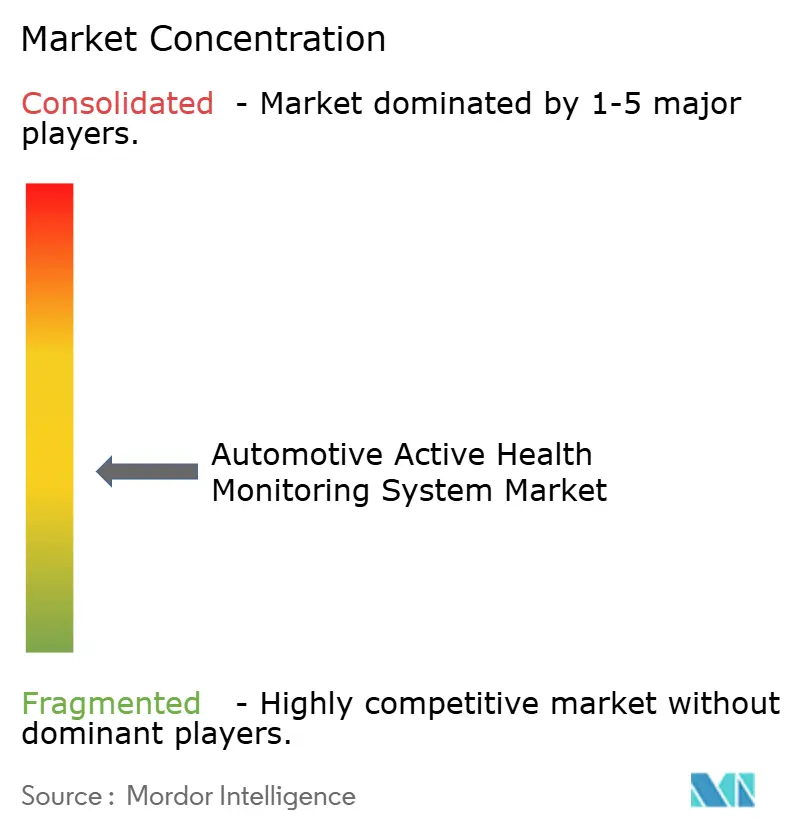
| Market Concentration | Medium |
Major Players *Disclaimer: Major Players sorted in no particular order Image © Mordor Intelligence. Reuse requires attribution under CC BY 4.0. | |
Automotive Active Health Monitoring System Market Analysis by Mordor Intelligence
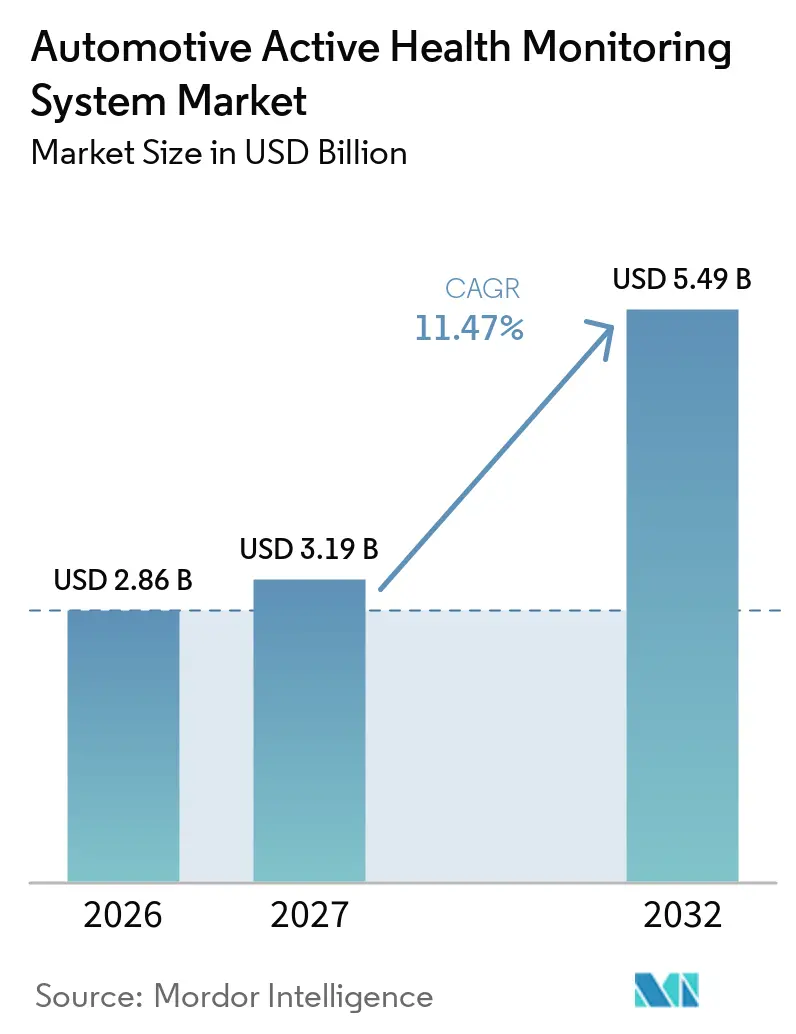
The automotive active health monitoring system market size was valued at USD 2.86 billion in 2026 and is projected to expand from USD 3.19 billion in 2027 to USD 5.49 billion by 2032, registering a CAGR of 11.47% between 2027 and 2032. The automotive active health monitoring system market is moving from a specialized safety feature toward a broader in-cabin sensing capability. European safety rules have made driver monitoring a vehicle-registration requirement for new vehicles, which changes how manufacturers plan cockpit systems[1]. Suppliers are responding by combining cameras, radar, processing hardware, and software in systems that can support several cabin functions. This gives vehicle manufacturers a path to meet safety requirements while preparing for wellness, occupancy, and impairment-related uses. The automotive active health monitoring system market also depends on how well suppliers protect personal data and sustain reliable performance in real driving conditions across global vehicle programs.
Key Report Takeaways
- By monitoring type, behavioral monitoring held 54.18% revenue share in 2026, while physiological and vital-sign monitoring is forecast to expand at a 13.49% CAGR through 2032.
- By sensor technology, camera-based and optical solutions held 52.18% revenue share in 2026, while in-cabin radar is forecast to expand at a 13.84% CAGR through 2032.
- By component, hardware held 68.27% revenue share in 2026, while software and analytics is forecast to expand at a 12.94% CAGR through 2032.
- By vehicle type, passenger cars held 78.18% revenue share in 2026, while commercial vehicles are forecast to expand at a 12.22% CAGR through 2032.
- By sales channel, OEM held 88.63% revenue share in 2026 and is forecast to expand at an 11.81% CAGR through 2032.
- By geography, Europe held 34.18% revenue share in 2026, while Asia-Pacific is forecast to expand at a 12.93% CAGR through 2032.
Note: Market numbers in this report are based on Mordor Intelligence's proprietary estimation framework, which combines nine months of actuals with Q4 projections for base year 2026.
Global Automotive Active Health Monitoring System Market Trends and Insights
Drivers Impact Analysis*
| Driver | (~) % Impact on CAGR Forecast | Geographic Relevance | Impact Timeline |
|---|---|---|---|
| Mandatory Driver Monitoring and Occupant-Sensing Fitment | +3.5% | Global; immediate inflection in EU and China | Short term (≤ 2 years) |
| Rising Demand for Real-Time Vital-Sign and Wellness Feedback | +2.0% | Global; premium segments in North America, Europe, and Asia-Pacific | Medium term (2–4 years) |
| Increasing Integration of Contactless Radar and Camera Sensing | +1.8% | Global; Asia-Pacific manufacturing core, spill-over to EU platforms | Medium term (2–4 years) |
| Fleet Safety Economics and Insurance-Linked Risk Reduction | +1.4% | North America and Europe; spill-over to Asia-Pacific and MEA fleets | Short term (≤ 2 years) |
| Personalization of Cabin Climate, Seating and Human-Machine Interfaces | +1.0% | North America, Europe, and Asia-Pacific premium segments | Medium term (2–4 years) |
| Vehicle-Embedded Detection of Acute Health Events | +0.8% | Global; Europe and Japan leading deployment | Long term (≥ 4 years) |
| Source: Mordor Intelligence | |||
Mandatory Driver Monitoring and Occupant-Sensing Fitment
European rules now require certain driver-assistance equipment in newly registered vehicles, including systems intended to warn drivers when distraction is detected. That requirement makes interior sensing part of vehicle approval rather than an optional equipment decision. Manufacturers therefore need monitoring capability early in vehicle development, not after a model reaches production. The automotive active health monitoring system market benefits because camera placement, processing capacity, and software validation must be planned together. Occupant monitoring assessments also encourage manufacturers to consider more than the driver when defining cabin safety functions. This makes regulatory compliance a continuing design consideration for cockpit platforms.
Rising Demand for Real-Time Vital-Sign and Wellness Feedback
Vehicle manufacturers are exploring ways to identify heart rate and respiratory rate without physical contact. Smart Eye described contactless vital-sign monitoring integrated with its existing driver-monitoring camera platform during 2026[2]. The approach can extend the value of cabin cameras beyond distraction detection when drivers choose to use those functions. It also supports personalized responses such as seating, climate, or alert settings that are linked to occupant condition. The automotive active health monitoring system market may gain from this broader feature set because one installed sensing platform can support several uses. The value of these functions still depends on clear consent, appropriate data handling, and dependable driver communication.
Increasing Integration of Contactless Radar and Camera Sensing
Radar is becoming more relevant where a camera alone cannot provide dependable cabin coverage. Infineon describes its 60 GHz radar technology as capable of supporting occupant detection, localization, security monitoring, and driver vital-sign indication within the cabin. Radar can operate without relying on visible light and can complement cameras where seating position, clothing, or a blocked view reduces optical performance. This supports a sensor-fusion approach that brings several data streams into a single occupant assessment. The automotive active health monitoring system market is therefore shifting toward systems designed as adaptable cabin platforms rather than single-purpose devices. Suppliers must still show that combined systems remain accurate across varied vehicles and user conditions.
Fleet Safety Economics and Insurance-Linked Risk Reduction
Commercial fleets evaluate driver monitoring through the operating consequences of fatigue, impairment, and avoidable incidents. A monitoring system can give fleet managers a clearer basis for coaching, incident review, and preventive action. These uses do not rely on consumer wellness positioning, which can make the value case more direct for fleet customers. The automotive active health monitoring system market can address this need through systems that work across long operating hours and varied cabin environments. Fleet adoption also creates demand for solutions that can be fitted to vehicles already in service. Data handling remains important because fleet safety use must not weaken driver trust or create unclear accountability.
Restraints Impact Analysis*
| Restraint | (~) % Impact on CAGR Forecast | Geographic Relevance | Impact Timeline |
|---|---|---|---|
| Biometric Privacy, Consent and Data-Ownership Concerns | -1.4% | Global; most acute in EU and North America | Short term (≤ 2 years) |
| Sensor Accuracy Degradation from Motion, Occlusion and Individual Variability | -1.0% | Global | Medium term (2–4 years) |
| High Integration Cost and Limited Mid-Market Willingness to Pay | -0.8% | Global, excluding luxury and premium segments | Short term (≤ 2 years) |
| Liability Ambiguity for Health Alerts and Medical-Adjacent Decisions | -0.5% | Global; most acute in jurisdictions with healthcare data law | Medium term (2–4 years) |
| Source: Mordor Intelligence | |||
Biometric Privacy, Consent and Data-Ownership Concerns
In-cabin monitoring can generate data that users view as personal, especially when it includes facial images or health-related signals. Safety functions are easier to explain when processing stays within the vehicle and serves an immediate warning purpose. Broader wellness functions raise more questions about consent, retention, sharing, and the user’s ability to control data. The automotive active health monitoring system market must therefore distinguish clearly between required safety processing and optional services. A system that does not provide understandable choices may face lower acceptance even when its technical capability is strong. Suppliers and vehicle manufacturers need privacy practices that match the sensitivity of the information collected.
Sensor Accuracy Degradation from Motion, Occlusion and Individual Variability
Cabin sensing must work when a vehicle is moving, occupants change position, or faces and bodies are partly obscured. These conditions can affect signal quality for both cameras and radar. Behavioral monitoring is relatively established because driver attention cues have been developed for vehicle use. Vital-sign monitoring faces a higher burden because normal readings differ across people and can change with activity. The automotive active health monitoring system market needs systems that identify uncertainty instead of presenting weak signals as firm assessments. Reliable performance will depend on diverse validation, careful system design, and alert strategies that avoid distracting the driver.
*Our forecasts treat driver/restraint impacts as directional, not additive. The impact forecasts reflect baseline growth, mix effects, and variable interactions.
Segment Analysis
By Monitoring Type: Behavioral Monitoring Supports Present Deployment, While Physiological Monitoring Expands Use Cases
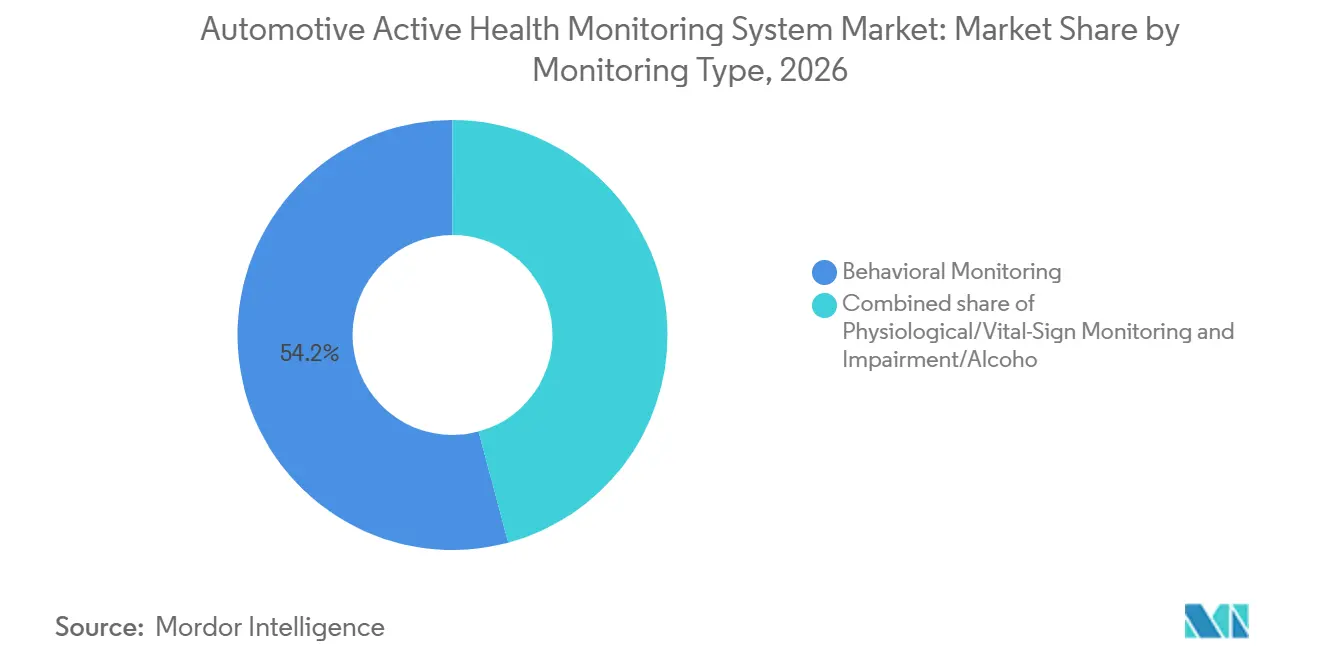
Behavioral monitoring held 54.18% of the automotive active health monitoring system market share in 2026. Eye tracking, head-pose analysis, drowsiness alerts, and distraction warnings fit the safety functions now expected in new vehicles. These features can use camera hardware already installed for driver monitoring. This makes behavioral monitoring a practical starting point for both premium and volume vehicle programs. The automotive active health monitoring system market benefits when suppliers can add functions without redesigning the entire cockpit.
Physiological and vital-sign monitoring is forecast to grow at a 13.49% CAGR through 2032. Contactless systems seek to recognize signals such as heart rate and respiration without requiring a wearable device. Vehicle manufacturers see an opportunity to connect this capability with comfort settings and occupant well-being functions. Reliable performance across different occupants and driving conditions will determine its wider use. The automotive active health monitoring system market will also require clear boundaries between well-being features and medical claims.

By Sensor Technology: Camera-Based Systems Provide a Base, While Radar Broadens Cabin Coverage
Camera-based and optical solutions held 52.18% of the sensor technology segment in 2026. Near-infrared cameras support gaze tracking, eye closure detection, face orientation, and other driver-attention cues. They give manufacturers an established route for implementing driver-monitoring functions. Existing camera locations can also support authentication and selected occupant-monitoring features. The automotive active health monitoring system market gains when one camera supports several cabin functions through software.
In-cabin radar is forecast to grow at a 13.84% CAGR through 2032. It can supplement cameras when low light, clothing, or an obstructed view limits optical sensing. Radar is relevant to rear-seat monitoring, occupant presence detection, and selected vital-sign applications. Infineon presents 60 GHz radar as a platform for several cabin-sensing functions. The automotive active health monitoring system market is likely to favor well-integrated sensor fusion, rather than a single sensing method.
By Component: Hardware Remains Foundational, While Software and Analytics Shape Differentiation
Hardware held 68.27% of the component segment in 2026. Sensors, processors, control units, and modules provide the basic data collection and processing foundation for in-cabin monitoring. Component choices influence sensor placement, thermal performance, reliability, and compatibility with the wider vehicle architecture. Manufacturers are also fitting sensing hardware into mirrors, displays, roof modules, seats, and cockpit processors. The automotive active health monitoring system market continues to depend on dependable hardware that meets automotive requirements.
Software and analytics is forecast to grow at a 12.94% CAGR through 2032. Software converts sensor output into assessments of attention, position, or possible impairment. It also enables camera, radar, and embedded sensors to work together in a common model. When vehicle architecture supports updates, suppliers can improve functions after installation. The automotive active health monitoring system market will reward algorithms that work across different vehicles and occupant conditions.
By Vehicle Type: Passenger Cars Form the Core, While Commercial Vehicles Have a Distinct Need
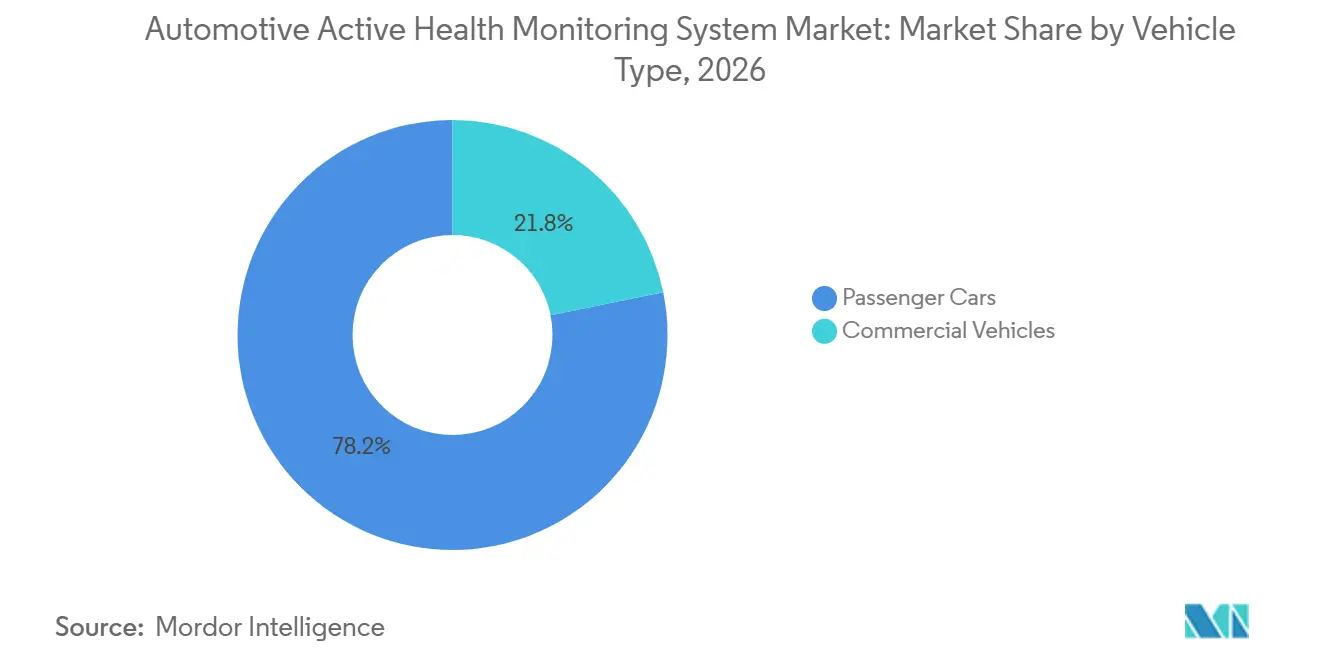
Passenger cars held 78.18% of the vehicle-type segment in 2026. New passenger vehicles provide the main route for factory-installed monitoring because safety functions are designed into the vehicle from the outset. Premium models have often introduced cabin features before they move into broader vehicle programs. Personalized seating, cabin comfort responses, and biometric access can sit alongside core safety features. The automotive active health monitoring system market can expand as these capabilities become more common in mainstream platforms.
Commercial vehicles are forecast to grow at a 12.22% CAGR through 2032. Long operating hours, driver fatigue, fleet safety, and vehicle downtime give these systems a clear operational use case. Fleet managers can use monitoring as part of wider safety programs that include training and incident review. Systems must perform in demanding environments with vibration, changing light, and regular driver movement. The automotive active health monitoring system market also has an aftermarket opportunity because fleets often retain vehicles for long service periods.
By Sales Channel: OEM Integration Dominates, While the Aftermarket Extends Access
The OEM channel held 88.63% of the sales-channel segment in 2026. Factory installation enables monitoring systems to work with vehicle cameras, processing units, displays, and safety functions. It is also the clearest route for equipment that must be considered during vehicle approval. Manufacturers can coordinate sensor, software, and cockpit suppliers within a single vehicle program. The automotive active health monitoring system market is therefore closely tied to OEM development and sourcing cycles.
The OEM channel is forecast to grow at an 11.81% CAGR through 2032. Its position reflects the importance of embedded systems in newly produced vehicles. The aftermarket remains relevant for fleets and consumers that want monitoring capability in vehicles already on the road. Retrofit products can help suppliers test practical functions before larger OEM programs adopt them. The automotive active health monitoring system market can serve both channels, although OEM systems prioritize integration while aftermarket products prioritize installation and support.
Geography Analysis
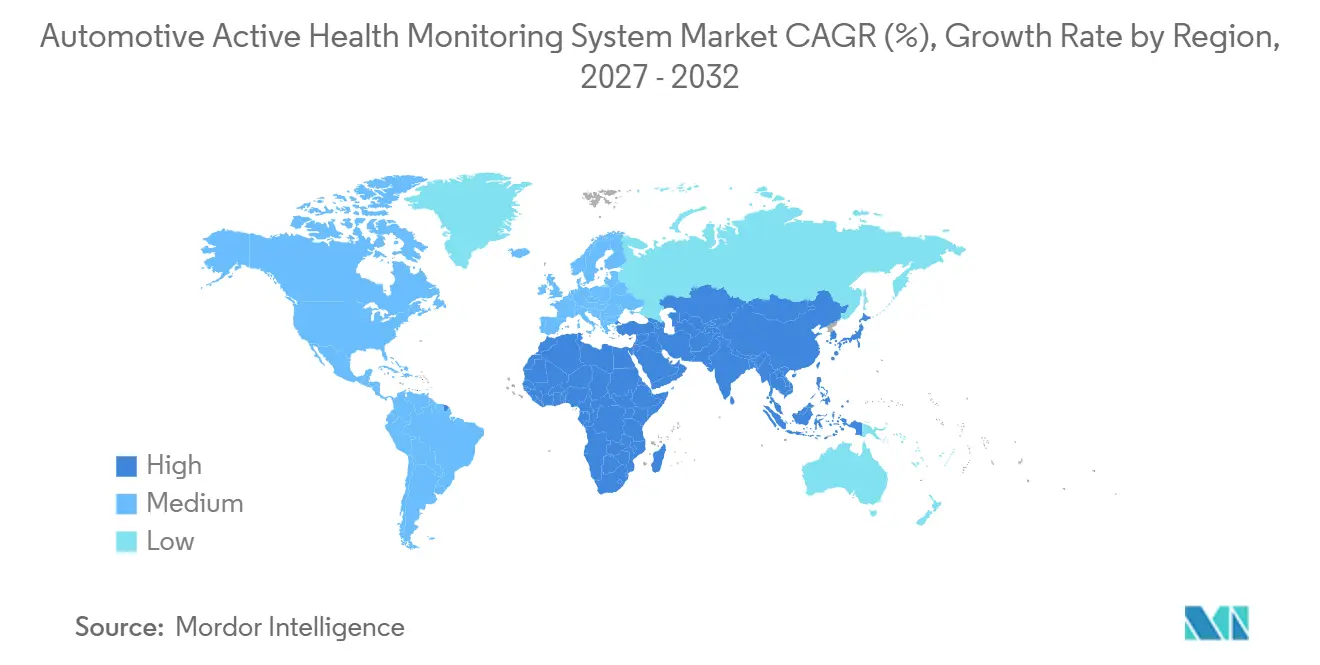
Europe held 34.18% of the automotive active health monitoring system market share in 2026. The region benefits from safety rules that require specified driver-assistance equipment in newly registered vehicles. These requirements make cabin sensing a vehicle-development priority for manufacturers that sell into the region. Germany, France, the United Kingdom, Italy, and Spain provide important vehicle production and sales bases. The automotive active health monitoring system market will remain supported by Europe’s established ecosystem of vehicle, sensor, software, and cockpit suppliers.
Asia-Pacific is forecast to grow at a 12.93% CAGR through 2032. China’s vehicle-safety direction, new-energy vehicle ecosystem, and software-centered development model support in-cabin system adoption. Japan and South Korea contribute sensor engineering, vehicle integration, and supplier capabilities. India and other regional markets offer a more fleet-led path, where operational safety is a central use case. The automotive active health monitoring system market will need regional products that reflect varied vehicle price points, driving patterns, and data expectations.
North America has an opportunity shaped by fleet safety, connected-vehicle services, and manufacturer interest in cabin technology. South America can develop through commercial-vehicle modernization where fleet operators seek practical safety tools. The Middle East has favorable conditions in premium vehicles, fleet renewal, and vehicle-technology investment. Africa begins from a smaller base, and adoption will depend on vehicle availability and service support. The automotive active health monitoring system market requires flexible product and channel strategies because regulation, fleet economics, and affordability vary across these regions.
Competitive Landscape
The automotive active health monitoring system market is moderately concentrated because no supplier leads every layer of sensing hardware, perception software, and vehicle-system integration. Competitors include semiconductor suppliers, camera and radar specialists, perception-software providers, and Tier 1 integrators. Vehicle manufacturers can select different partners for sensors, algorithms, and cockpit implementation. Suppliers compete on performance, integration experience, software capability, and global program support. This structure leaves room for specialized companies with distinct technical strengths.
Valeo and Seeing Machines demonstrated in-cabin monitoring applications at CES 2026, combining vehicle-system integration with perception software for OEM programs. Smart Eye added contactless vital-sign monitoring to its driver-monitoring platform during 2026. Infineon continues to position 60 GHz radar for integrated cabin-sensing functions. These moves show that sensor choice alone does not determine a supplier’s position. The automotive active health monitoring system market favors solutions that meet safety, cost, integration, and update requirements together.
Impairment detection remains an important opening for companies seeking a clearer product position. Camera-based systems can build on existing driver-monitoring locations, while radar can increase coverage where optical sensing is limited. Software that interprets combined data without burdening vehicle processors will be valuable. Large integrators can support broad vehicle programs, while specialists can compete with differentiated algorithms, sensors, or validation capabilities. The automotive active health monitoring system market will continue to favor suppliers that prove production readiness and earn repeat vehicle programs.
Automotive Active Health Monitoring System Industry Leaders
-
Robert Bosch GmbH
-
AUMOVIO SE
-
DENSO Corporation
-
Valeo SE
-
Seeing Machines Limited
- *Disclaimer: Major Players sorted in no particular order
Recent Industry Developments
- October 2026: Smart Eye was selected to supply its cabin monitoring software for a new car model from a major European OEM, adding an estimated SEK 20 million in life-cycle revenue to the driver monitoring software license it had already secured for the same model.
- September 2026: STMicroelectronics (NYSE: STM) introduced the ST SafeSense VD56GA, a 1.1 MP automotive image sensor for infrared in-cabin sensing, helping OEMs and Tier 1 suppliers scale driver and occupant monitoring.
- August 2026: Smart Eye secured an additional driver monitoring system design win for a fully electric sports car from an existing European premium OEM, with production scheduled to begin in mid-2027 and estimated lifetime revenue of SEK 15 million.
- July 2026: Seeing Machines won a driver and occupant monitoring program with a European automaker, with its system integrated into rear-view mirror assemblies for future vehicle platforms, production starting 2028.
Global Automotive Active Health Monitoring System Market Report Scope
The Automotive Active Health Monitoring System Market is Segmented by Monitoring Type, Sensor Technology, Component, Vehicle Type, Sales Channel, and Geography. By Monitoring Type, the market is segmented into Physiological/Vital-Sign Monitoring (Heart Rate Monitoring, Respiration Monitoring, and Blood Pressure Estimation), Behavioral Monitoring (Drowsiness Monitoring, Stress Monitoring, and Emotion and Cognitive-Load Monitoring), and Impairment/Alcohol Detection. By Sensor Technology, the market is segmented into Seat/Steering-Embedded Sensors, In-Cabin Radar, Camera-Based/Optical, and Other Sensor Technologies. By Component, the market is segmented into Hardware (Sensors and Electronic Control Units) and Software and Analytics. By Vehicle Type, the market is segmented into Passenger Cars and Commercial Vehicles. By Sales Channel, the market is segmented into OEM and Aftermarket. By Geography, the market is segmented into North America (United States, Canada, and Mexico), Europe (Germany, United Kingdom, France, Italy, Spain, Russia, and Rest of Europe), Asia-Pacific (China, Japan, India, South Korea, Australia, and Rest of Asia-Pacific), South America (Brazil, Argentina, and Rest of South America), and Middle East and Africa (Saudi Arabia, United Arab Emirates, Israel, South Africa, and Rest of Middle East and Africa).
Market forecasts are provided in terms of value (USD) and volume (Units).
| Physiological/Vital-Sign Monitoring | Heart Rate Monitoring |
| Respiration Monitoring | |
| Blood Pressure Estimation | |
| Behavioral Monitoring | Drowsiness Monitoring |
| Stress Monitoring | |
| Emotion and Cognitive-Load Monitoring | |
| Impairment/Alcohol Detection |
| Seat/Steering-Embedded Sensors |
| In-Cabin Radar |
| Camera-Based/Optical |
| Other Sensor Technologies |
| Hardware | Sensors |
| Electronic Control Units | |
| Software and Analytics |
| Passenger Cars |
| Commercial Vehicles |
| OEM |
| Aftermarket |
| North America | United States |
| Canada | |
| Mexico | |
| Europe | Germany |
| United Kingdom | |
| France | |
| Italy | |
| Spain | |
| Russia | |
| Rest of Europe | |
| Asia-Pacific | China |
| Japan | |
| India | |
| South Korea | |
| Australia | |
| Rest of Asia-Pacific | |
| South America | Brazil |
| Argentina | |
| Rest of South America | |
| Middle East and Africa | Saudi Arabia |
| United Arab Emirates | |
| Israel | |
| South Africa | |
| Rest of Middle East and Africa |
| By Monitoring Type | Physiological/Vital-Sign Monitoring | Heart Rate Monitoring |
| Respiration Monitoring | ||
| Blood Pressure Estimation | ||
| Behavioral Monitoring | Drowsiness Monitoring | |
| Stress Monitoring | ||
| Emotion and Cognitive-Load Monitoring | ||
| Impairment/Alcohol Detection | ||
| By Sensor Technology | Seat/Steering-Embedded Sensors | |
| In-Cabin Radar | ||
| Camera-Based/Optical | ||
| Other Sensor Technologies | ||
| By Component | Hardware | Sensors |
| Electronic Control Units | ||
| Software and Analytics | ||
| By Vehicle Type | Passenger Cars | |
| Commercial Vehicles | ||
| By Sales Channel | OEM | |
| Aftermarket | ||
| By Geography | North America | United States |
| Canada | ||
| Mexico | ||
| Europe | Germany | |
| United Kingdom | ||
| France | ||
| Italy | ||
| Spain | ||
| Russia | ||
| Rest of Europe | ||
| Asia-Pacific | China | |
| Japan | ||
| India | ||
| South Korea | ||
| Australia | ||
| Rest of Asia-Pacific | ||
| South America | Brazil | |
| Argentina | ||
| Rest of South America | ||
| Middle East and Africa | Saudi Arabia | |
| United Arab Emirates | ||
| Israel | ||
| South Africa | ||
| Rest of Middle East and Africa | ||
Key Questions Answered in the Report
What is driving adoption of automotive active health monitoring systems?
New vehicle safety requirements, demand for driver-attention functions, and interest in broader cabin sensing are supporting adoption.
How large is the automotive active health monitoring system market?
It is projected to reach USD 5.49 billion by 2032, growing at an 11.47% CAGR from 2027 to 2032.
Which monitoring approach is most widely used in vehicles?
Behavioral monitoring is the largest monitoring type, supported by established driver-attention and drowsiness functions.
Why are vehicle manufacturers adding in-cabin radar?
Radar can complement cameras where lighting and line-of-sight conditions limit optical sensing, including selected occupant and vital-sign functions.