
Automated Fingerprint Identification System Market Size and Share
Market Overview
| Study Period | 2021 - 2032 |
|---|---|
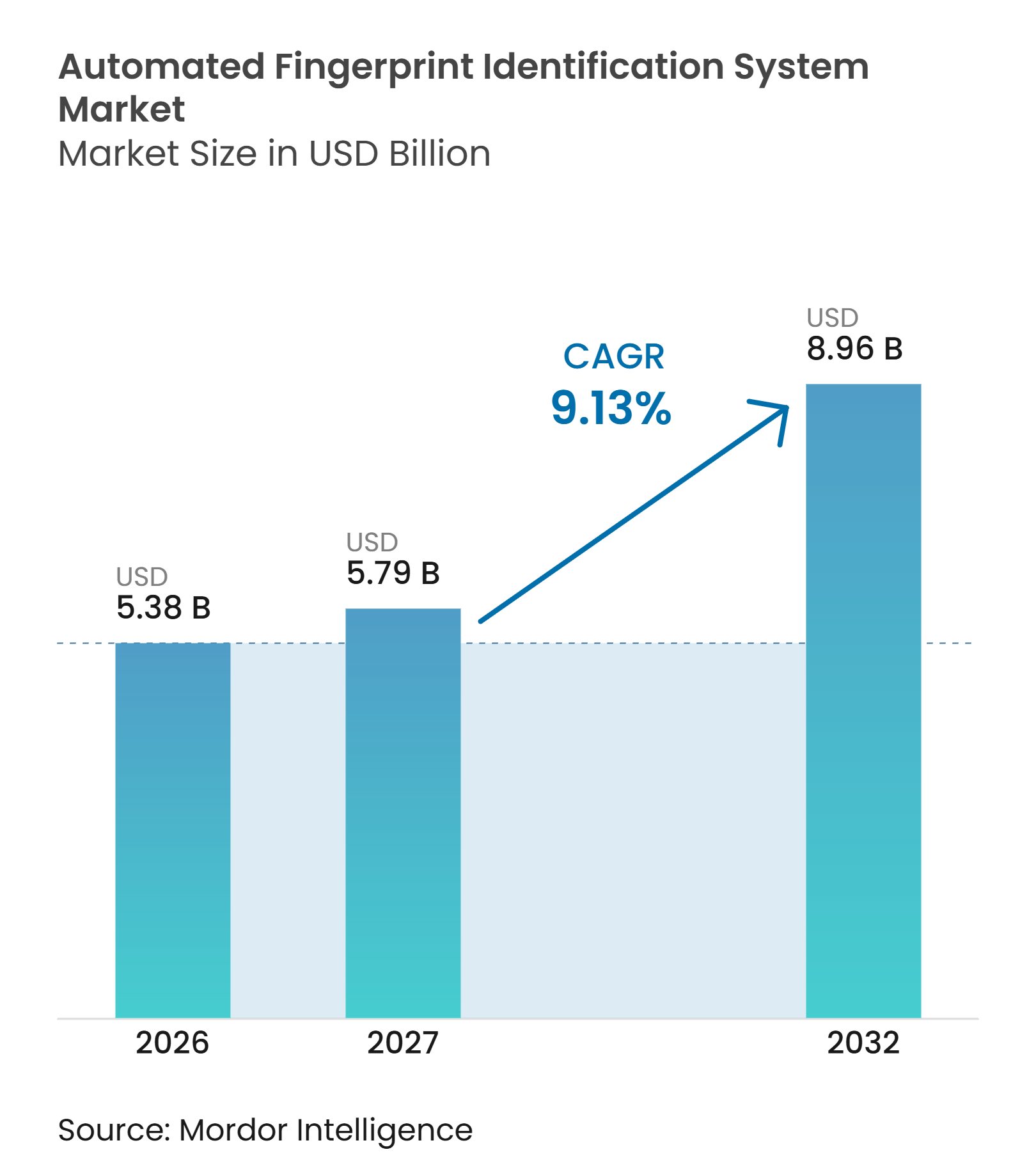
| Market Size (2027) | USD 5.79 Billion |
| Market Size (2032) | USD 8.96 Billion |
| Growth Rate (2027 - 2032) | 9.13 % |
| Fastest Growing Market | Asia-Pacific |
| Largest Market | North America |
| Market Concentration | Medium |
Major Players *Disclaimer: Major Players sorted in no particular order Image © Mordor Intelligence. Reuse requires attribution under CC BY 4.0. | |
Automated Fingerprint Identification System Market Analysis by Mordor Intelligence
The automated fingerprint identification system market size is valued at USD 5.38 billion in 2026 and is projected to reach USD 8.96 billion by 2032, expanding at a CAGR of 9.13% during 2027-2032. Public investment in criminal justice modernization, national identity programs, and border management is supporting demand for modern identification platforms. Agencies are replacing older local systems with connected environments that can synchronize records and support higher search volumes. The transition also increases demand for software, managed services, and upgrades that meet security requirements. Procurement decisions increasingly reflect algorithm performance, interoperability, cloud readiness, and the ability to protect sensitive biometric information. The automated fingerprint identification system market is also shaped by long contract cycles, which favor suppliers with established government delivery capabilities.
Key Report Takeaways
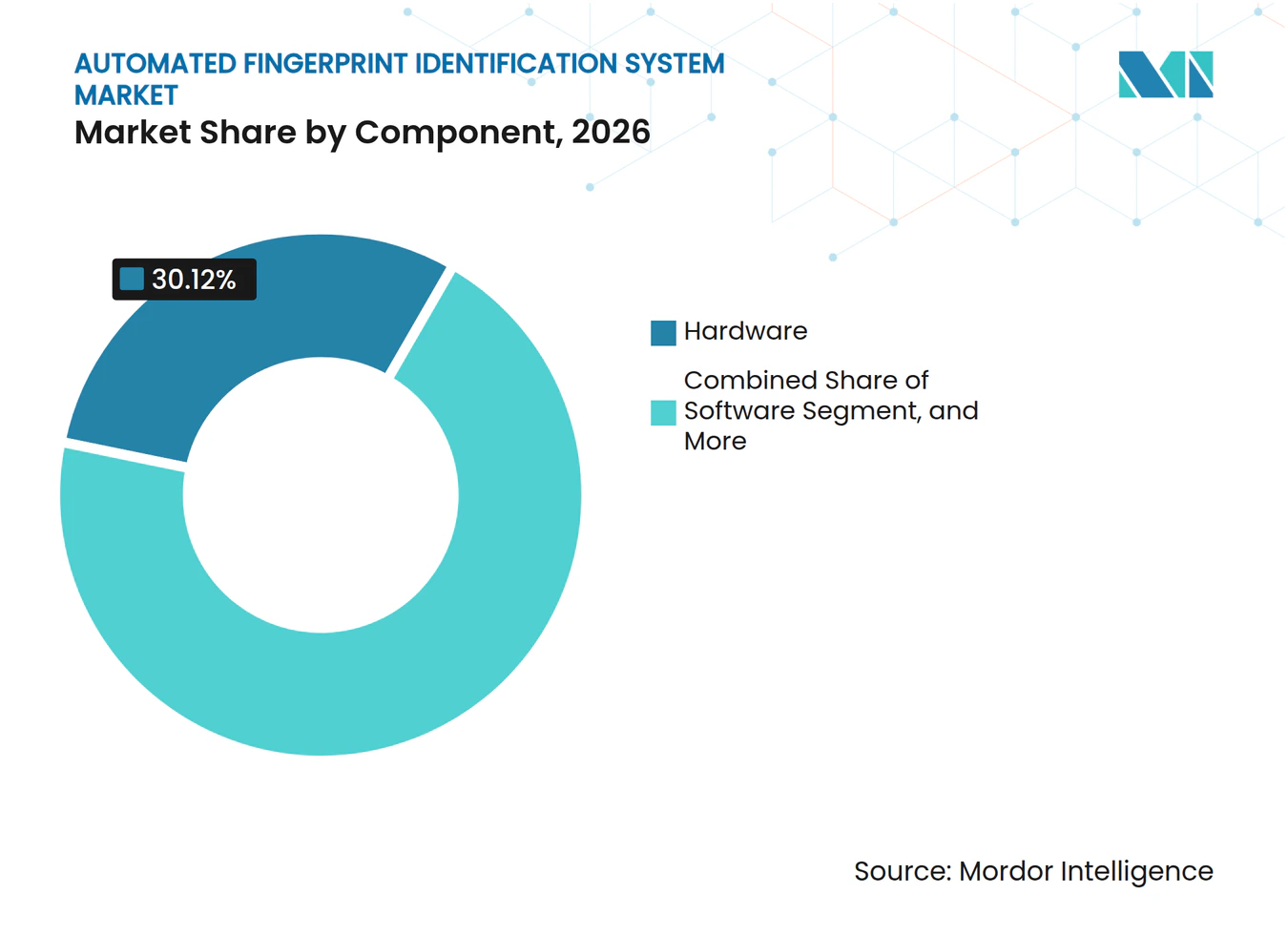
- By component, hardware held 30.12% revenue share in 2026, while software is projected to expand at a 9.88% CAGR through 2032.
- By search type, tenprint-to-tenprint search held 35.66% revenue share in 2026, while latent-to-latent search is expected to expand at a 9.73% CAGR through 2032.
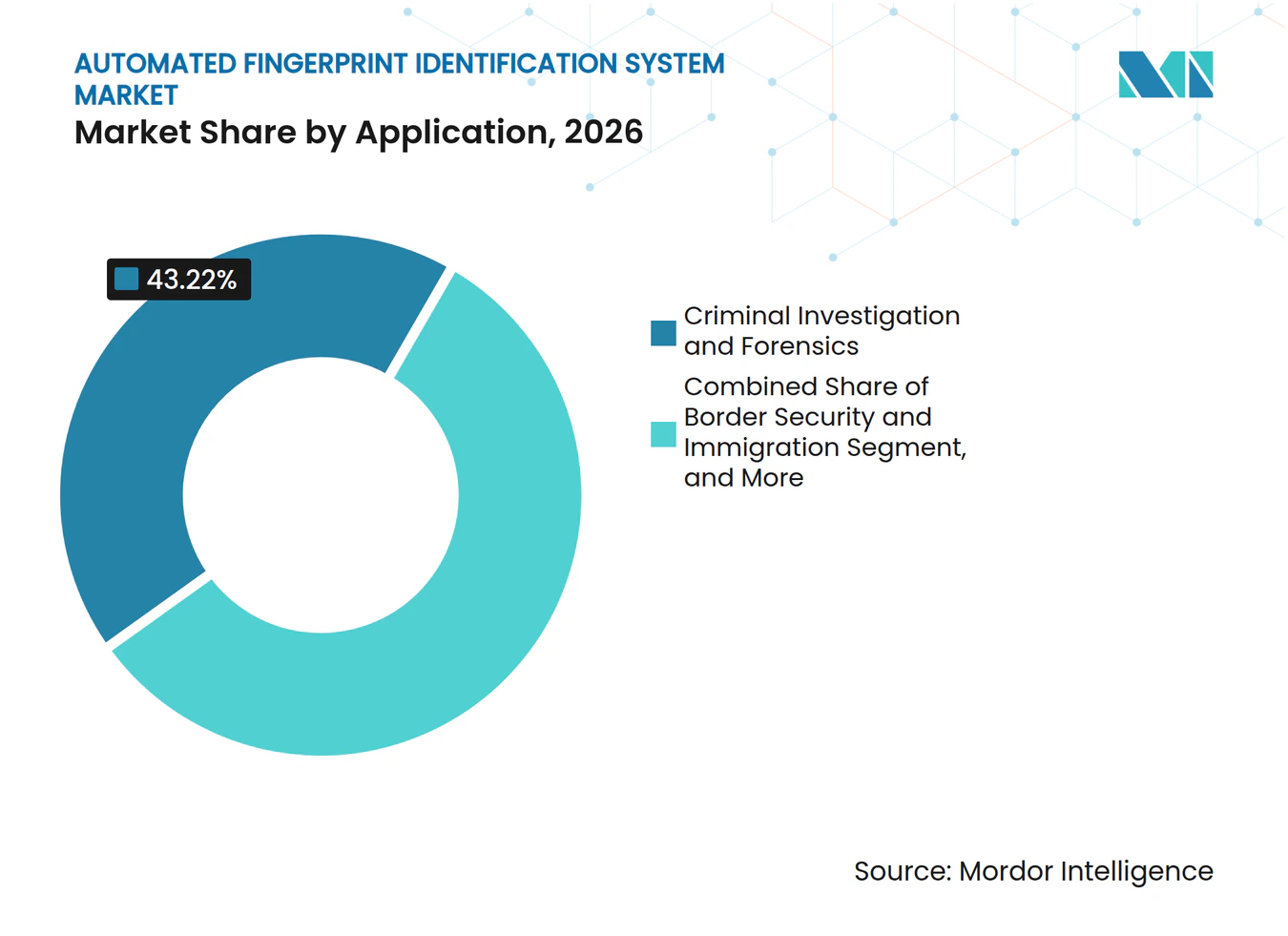
- By application, criminal investigation and forensics accounted for 43.22% revenue share in 2026, while border security and immigration is projected to expand at a 9.92% CAGR through 2032.
- By end user, law enforcement and forensic laboratories held 33.24% share in 2026, while border and immigration authorities are projected to expand at a 9.59% CAGR through 2032.
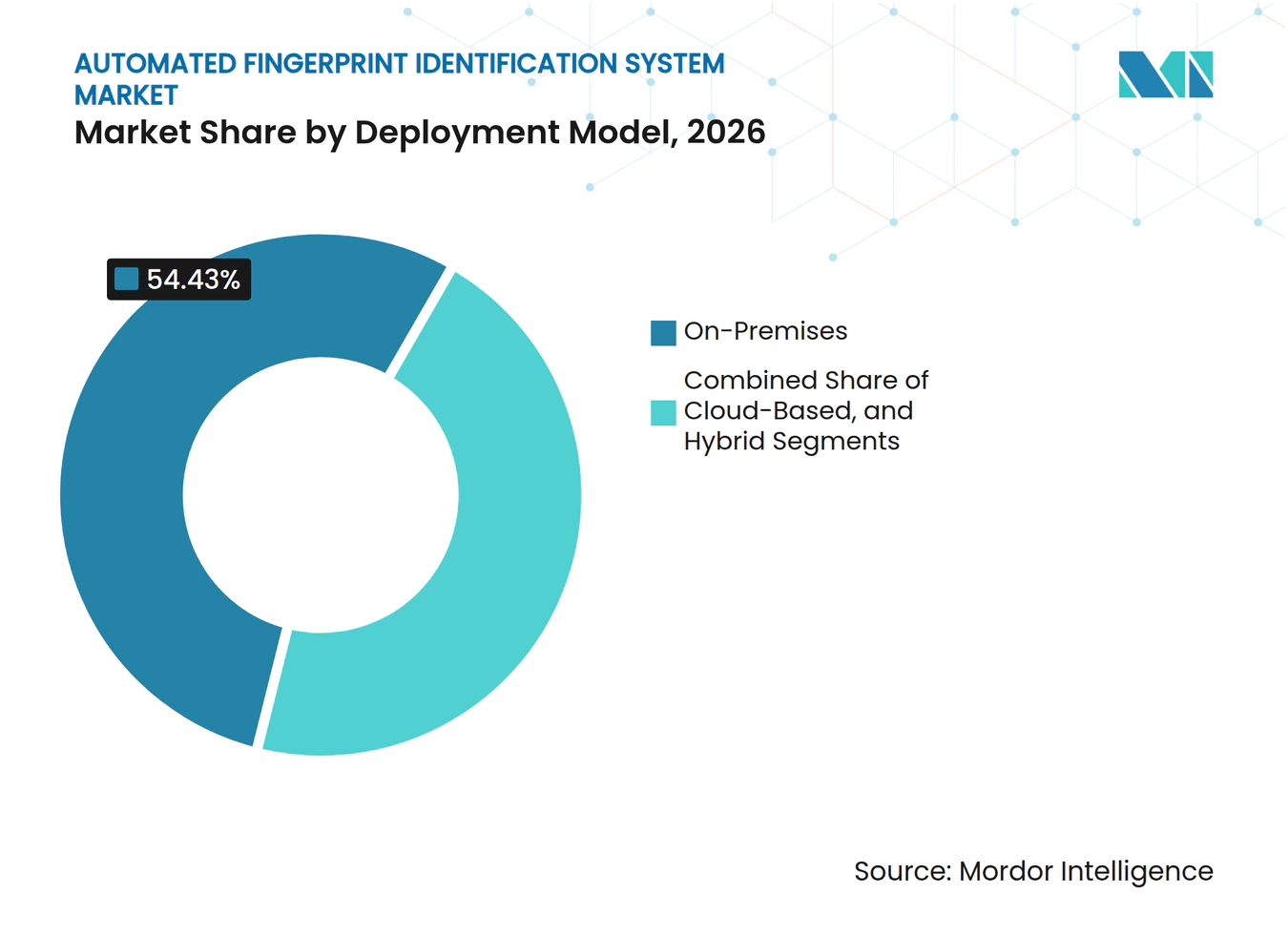
- By deployment model, on-premises systems held 54.43% share in 2026, while cloud-based deployment is expected to expand at a 9.46% CAGR through 2032.
- By technology, 2D fingerprint recognition held 48.62% share in 2026, while 3D and contactless capture is projected to expand at a 9.57% CAGR through 2032.
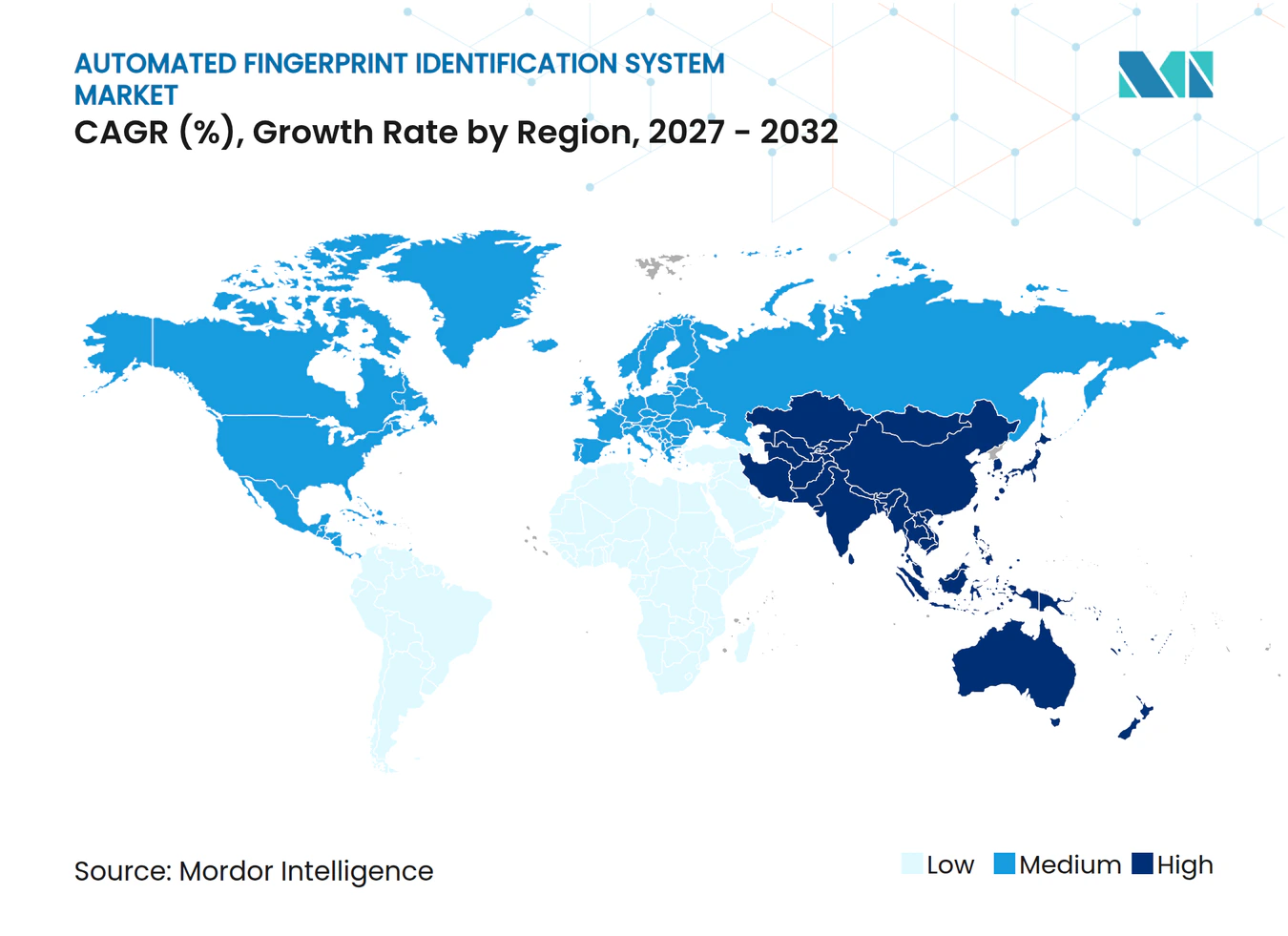
- By geography, North America held 34.21% share in 2026, while Asia-Pacific is expected to expand at a 9.84% CAGR through 2032.
Note: Market numbers in this report are based on Mordor Intelligence's proprietary estimation framework, which combines nine months of actuals with Q4 projections for base year 2026.
Market Trends and Insights
Drivers Impact Analysis of Automated Fingerprint Identification System Market*
| Driver | (~) % Impact on CAGR Forecast | Geographic Relevance | Impact Timeline |
|---|---|---|---|
| Digitization of Criminal Justice and Civil Identity Workflows | +2.4% | Global, with highest intensity in North America and Europe | Medium term (2-4 years) |
| Expansion of National Identity and Border Management Programs | +2.0% | Asia-Pacific, Africa, Middle East, South America | Long term (≥ 4 years) |
| Rising Need for Rapid Latent Print and Tenprint Search | +1.5% | North America and Europe | Short term (≤ 2 years) |
| Government Investment in Public Safety and Identity Infrastructure | +1.2% | North America, Europe, Asia-Pacific | Medium term (2-4 years) |
| Multimodal ABIS Upgrade Pathways from Standalone AFIS | +0.9% | North America and Europe | Medium term (2-4 years) |
| Standards-Based Interoperability and Cross-Jurisdictional Data Exchange | +0.7% | Europe, North America, Asia-Pacific, and Middle East and Africa | Long term (≥ 4 years) |
| Source: Mordor Intelligence | |||
Digitization of Criminal Justice and Civil Identity Workflows
The automated fingerprint identification system market benefits as criminal justice agencies replace older, siloed systems that depend on manual steps and isolated records. Modern platforms support automated case workflows, real-time record synchronization, higher search throughput, and more consistent administration across police organizations. Agencies are also moving toward multimodal environments that can combine fingerprint, facial, iris, and palmprint data when legal authority permits. This change shifts spending away from one-time hardware purchases and toward recurring software, integration, support, and managed-service contracts. Civil identity programs require biometric deduplication to identify duplicate records in national registries and maintain reliable citizen databases.
Expansion of National Identity and Border Management Programs
The automated fingerprint identification system market is supported by new identity and border-management requirements in several regions. India requires biometric information from foreign nationals in specified visa and registration processes under the Immigration and Foreigners Order 2025.[1] Contactless capture at immigration checkpoints can increase demand for compatible devices, secure matching software, and well-maintained connectivity. Border programs also require resilient networks, protected databases, trained operators, and continuous operational support at high-volume locations. The European Entry-Exit System creates a further need for fingerprint-capable border processes across participating countries. These programs broaden procurement beyond traditional law-enforcement systems and extend demand to immigration administration, travel processing, and cross-border identity checks.
Rising Need for Rapid Latent Print and Tenprint Search
Forensic teams need faster searches when they work with partial, distorted, or low-quality latent prints collected from crime scenes. The automated fingerprint identification system market therefore places greater value on demonstrated accuracy, fast search performance, and clear evidence from independent testing. The National Institute of Standards and Technology reported that the best Rank-1 result in the latest latent fingerprint evaluation reached 88%, compared with 65% in the 2012 benchmark.[2] This improvement can reduce manual examiner preparation and help investigators assess potential candidates more efficiently. Suppliers that perform well in independent evaluations can use those results during technical procurement assessments and competitive tenders. Agencies are increasingly likely to ask for evidence from NIST evaluation programs when selecting a matching engine or renewing an existing system.
Government Investment in Public Safety and Identity Infrastructure
Government budgets for border control and public safety create a stable source of project demand for the automated fingerprint identification system market. The U.S. One Big Beautiful Bill Act, passed in July 2025, included funding for advanced border technologies that can support biometric programs. The Department of Homeland Security Office of Biometric Identity Management awarded Thales a USD 11.2 million contract in September 2026 for matching software, hardware, and operational support for IDENT and HART through September 2027.[3] Public projects often involve multiyear implementation, security controls, operating support, and formal acceptance requirements. These characteristics favor vendors that can manage delivery, maintenance, and compliance over a long period. They also create openings for specialist firms that provide certified algorithms, capture technology, integration services, or secure infrastructure to prime contractors.
Restraints Impact Analysis of Automated Fingerprint Identification System Market*
| Restraint | (~) % Impact on CAGR Forecast | Geographic Relevance | Impact Timeline |
|---|---|---|---|
| High Implementation and Lifecycle Costs | -1.2% | Global, most acute in South America and Africa | Medium term (2-4 years) |
| Privacy, Consent, and Biometric Data Governance Requirements | -0.9% | Europe, United Kingdom, North America, Australia, and New Zealand | Long term (≥ 4 years) |
| Proprietary Template Migration and Vendor Lock-In | -0.7% | North America and Europe | Medium term (2-4 years) |
| Latent Print Quality Variability and Examiner Review Burden | -0.5% | Global | Short term (≤ 2 years) |
| Source: Mordor Intelligence | |||
High Implementation and Lifecycle Costs
A full deployment requires capture equipment, matching software, data migration, staff training, systems integration, and security controls. These requirements can exceed the planning capacity of smaller law-enforcement agencies and governments with limited budgets or competing modernization priorities. Costs continue after installation through maintenance, licensing, hardware renewal, cybersecurity updates, and security testing. The DHS procurement record for support to IDENT and HART illustrates the complexity of maintaining a large operating environment. Cloud-managed services can reduce up-front infrastructure costs, but they introduce subscription commitments, variable usage charges, and annual renewal decisions. The automated fingerprint identification system market must therefore address total ownership costs, procurement capacity, and long-term budget predictability as well as initial contract prices.
Privacy, Consent, and Biometric Data Governance Requirements
Biometric data rules affect system design, operational processes, and public procurement schedules. The UK Information Commissioner’s Office states that biometric data used for unique identification is special category data under the UK GDPR. The European Commission identifies many biometric identification systems as high-risk under the EU AI Act. These obligations can require impact assessments, formal documentation, technical safeguards, clear governance, and continued monitoring. They can lengthen contract reviews because buyers must assess legal risk alongside technical performance and security requirements. Suppliers with clear controls for consent, retention, access management, and audit records are better placed in privacy-sensitive jurisdictions.
*Our forecasts treat driver/restraint impacts as directional, not additive. The impact forecasts reflect baseline growth, mix effects, and variable interactions.
Automated Fingerprint Identification System Market Segment Analysis
By Component:
Software Gains Importance as Agencies Separate Algorithms From HardwareHardware held 30.12% of the automated fingerprint identification system market share in 2026. Livescan terminals, fingerprint input modules, microprocessors, servers, and storage remain necessary for operational deployments. These assets are particularly important for large booking, enrollment, and border-control sites. Server and storage refreshes remain a meaningful part of spending as agencies prepare for higher data volumes. Hardware demand is supported by replacement needs in established national and regional systems.
Software is projected to expand at a 9.88% CAGR through 2032. AI-enabled matching engines, cloud-native middleware, and biometric software-as-a-service offerings support this momentum. Agencies can replace a matching layer while retaining existing capture devices, which broadens opportunities for algorithm suppliers. Updated FBI Criminal Justice Information Services security requirements also encourage compliant configuration, authentication, encryption, and audit capabilities. The automated fingerprint identification system market increasingly depends on services for implementation, maintenance, support, and managed biometric operations.



By Search Type:
Latent-to-Latent Search Becomes a Key Forensic Performance TestTenprint-to-tenprint search held 35.66% revenue share in 2026. It remains central to criminal booking and civil enrollment because query and reference images generally come from controlled capture conditions. Latent-to-tenprint search remains a standard forensic workflow for comparing crime-scene evidence against enrolled records. These established search modes depend on reliable record quality, secure data exchange, and large available databases. They form the operational base of many law-enforcement deployments.
Latent-to-latent search is projected to expand at a 9.73% CAGR through 2032. The segment benefits from matching methods designed for partial and lower-quality prints. NIST’s latent fingerprint evaluation reported a best Rank-1 result of 88% for a Department of Defense dataset containing more than 5,000 probes. Better algorithmic results can shorten review work for trained latent-print examiners. The automated fingerprint identification system market will continue to value transparent evaluation results as agencies assess forensic search tools.
By Application:
Border Security and Immigration Adds to Established Forensic DemandCriminal investigation and forensics accounted for 43.22% revenue share in 2026. Law-enforcement organizations have invested in AFIS platforms for decades, which gives this application an established operating base. Agencies use these systems to process bookings, compare evidence, and search criminal records. Civil identification and deduplication also represent a major use case for national registries and citizen-service programs. Large enrollment databases require ongoing record maintenance, duplicate detection, and periodic biometric refreshes.
Border security and immigration are projected to expand at a 9.92% CAGR through 2032. The application is supported by entry-exit systems, visa processing, and immigration-control workflows. India’s immigration rules provide for the collection of identity information in relevant foreign-national processes. European border programs also require compatible fingerprint infrastructure and secure record connections. The automated fingerprint identification system market also serves access control, workforce identity, background screening, licensing, and humanitarian identification.

By End User:
Border and Immigration Authorities Record the Highest Forecast ExpansionLaw enforcement and forensic laboratories held 33.24% share in 2026. These users maintain demand through system upgrades, database expansion, and replacement of aging infrastructure. In mature markets, upgrades increasingly focus on algorithms, interoperability, and security rather than entirely new installations. Government and civil registry agencies form another large user group. They use fingerprint matching for national identity programs, voter registration, welfare administration, and record deduplication.
Border and immigration authorities are projected to expand at a 9.59% CAGR through 2032. Investment is relevant where governments upgrade physical border sites alongside digital identity infrastructure. India’s Bureau of Immigration has set identity-information requirements under the Immigration and Foreigners Order 2025. Banking, healthcare, transportation, and enterprise users apply fingerprint verification to identity checks, patient records, passenger processing, and access control. The automated fingerprint identification system market has room for these emerging deployments alongside its core public-sector base.
By Deployment Model:
Cloud-Based Systems Challenge a Large On-Premises BaseOn-premises systems held 54.43% share in 2026. The position reflects extensive investment in local infrastructure and the lengthy approval process for cloud environments handling criminal justice data. Agencies retain local control over systems that support core booking and forensic workflows. On-premises systems are also useful where connectivity is limited or policy requires sensitive data to stay in dedicated facilities. The installed base provides continuing maintenance and upgrade opportunities for system integrators.
Cloud-based deployment is projected to expand at a 9.46% CAGR through 2032. IDEMIA Public Security completed the NAFIS NextGen go-live in Australia in October 2025 on a protected government cloud environment. The project offers a government-scale reference for cloud operation in biometric identification. Cloud systems can provide flexible capacity, remote updates, and managed security operations. Hybrid deployments support agencies that retain local workloads while using cloud capacity for storage and analytics.
By Technology:
Contactless Capture Moves Toward Operational Use2D fingerprint recognition held 48.62% share in 2026. It remains dominant because contact-based Livescan equipment is widely deployed in law enforcement and civil identity systems. Minutiae-based matching remains the core algorithmic method for many operational platforms. This technology base supports routine enrollment, criminal booking, and controlled identity verification. Its installed base gives buyers established operating procedures and familiar data formats.
3D and contactless capture is projected to expand at a 9.57% CAGR through 2032. The technology can support convenient collection in mobile, border, and field settings. NIST’s Fast Capture program qualified 11 contactless fingerprint providers in Phase One during August 2026. Austria demonstrated a smartphone-based contactless system connected to its national AFIS during United Nations Counter-Terrorism Week in July 2026. Multimodal and pattern-based matching can support agencies upgrading from standalone AFIS to automated biometric identification systems.
Geography Analysis
North America Automated Fingerprint Identification System Market
North America accounted for 34.21% of revenue in 2026. The region has a substantial installed base across federal, state, and local law enforcement systems. Demand is supported by platform replacement, cloud migration, and border-biometric programs. The Indiana Department of Administration published an AFIS modernization opportunity for a system designed to process 15 million biometric items and scale to 35 terabytes within 5 years.
Europe and South America Automated Fingerprint Identification System Market
Europe has a different demand profile because data protection and security needs are closely connected. Privacy requirements increase the importance of impact assessments, access controls, and documented processing practices. The European Data Protection Supervisor has addressed safeguards for automated searches and exchanges of biometric data under the Prüm framework. Switzerland awarded Thales a CHF 18.9 million (USD 21.3 million) AFIS2026 contract in March 2025 for modernization and an optional facial image comparison module. South America remains earlier in its adoption path, where national identity and border programs can support new system deployments.
APAC and MEA Automated Fingerprint Identification System Market
Asia-Pacific is projected to expand at a 9.84% CAGR through 2032. National identity programs, border modernization, and government digitization are creating demand across India, China, Southeast Asia, and Australia. Singapore’s Ministry of Home Affairs awarded NEC Asia Pacific an SGD 35.4 million (USD 26.5 million) contract in August 2025 for biometric identification at land checkpoint lanes and an automated passenger clearance system at motorcycle lanes. Australia’s NAFIS NextGen deployment provides a reference for protected government cloud operation. The automated fingerprint identification system market has emerging opportunities in the Middle East and Africa as governments move from pilots to national identity and airport programs.
Competitive Landscape
Market Concentration
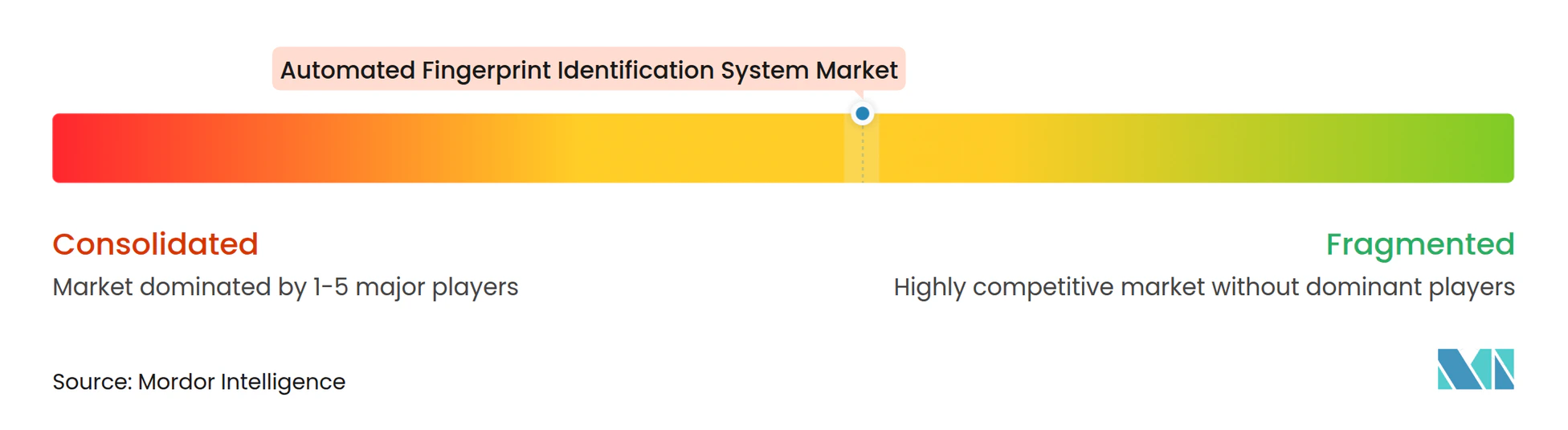
The automated fingerprint identification system market has moderate concentration, with NEC Corporation, IDEMIA Public Security, and Thales holding significant government contract portfolios. Their positions reflect integration capability, long-term delivery experience, and familiarity with public security requirements. Large deployments create switching costs because agencies must protect continuity while moving templates, databases, and operational workflows. Competition depends on technical capability, contract support, and the ability to meet strict security rules. The competitive structure includes a small group of large integrators and a wider group of specialist providers.
Specialist algorithm companies influence procurement even when they do not lead full-system contracts. Neurotechnology, Innovatrics, DERMALOG, and ROC participate in independent fingerprint performance evaluations. NIST maintains a public list of MINEX III-compliant submissions, which gives procuring agencies a way to assess template interoperability. DERMALOG and ROC reported leading results in the NIST evaluation during 2026.
Several strategic moves show how suppliers are responding to government demand. IDEMIA Public Security completed Australia’s NAFIS NextGen cloud deployment in October 2025, which demonstrated cloud operation under protected government controls. IDEMIA.COM Thales received the DHS award for matching software, hardware, and operational support for IDENT and HART in September 2026. Asia Pacific won the Singapore border checkpoint contract in August 2025. The automated fingerprint identification system market also leaves room for contactless capture providers and specialist matching firms that meet public-sector technical requirements.
Automated Fingerprint Identification System Industry Leaders
-
NEC Corporation
-
IDEMIA Public Security SAS
-
Thales S.A.
-
HID Global Corporation
-
DERMALOG Identification Systems GmbH
- *Disclaimer: Major Players sorted in no particular order
Automated Fingerprint Identification System Market Companies Covered in this Report
- NEC Corporation
- IDEMIA Public Security SAS
- Thales S.A.
- HID Global Corporation
- Fujitsu Limited
- DERMALOG Identification Systems GmbH
- Suprema, Inc.
- Aware, Inc.
- Innovatrics, s.r.o.
- SecuGen Corporation
- Synaptics Incorporated
- Precise Biometrics AB
- M2SYS Technology
- Papillon Systems
- Sonda Technologies Ltd.
- BIO-key International, Inc.
- Fingerprint Cards AB
- Neurotechnology, UAB
- DataWorks Plus, Inc.
- Aratek International Limited
Recent Industry Developments in Automated Fingerprint Identification System Market
- October 2026: DHS's Office of Biometric Identity Management awarded Thales a USD 11.2 million sole-source contract for fingerprint-matching software, hardware, and operational support for the IDENT and HART systems through September 2027. The agency's justification, noting only Thales could meet requirements among 14 surveyed companies, also disclosed plans to explore open-standards pathways and additional technical data rights to reduce long-term vendor dependency.
- August 2026: NIST completed Phase One of its Fast Capture program, qualifying 11 contactless fingerprint providers, including Thales and Neurotechnology, under Cooperative Research and Development Agreements, advancing the certification framework for touchless tenprint scanners toward government adoption in Phase Two.
- July 2026: Austria's AIT and the Criminal Intelligence Service Austria demonstrated the BioCapture smartphone-based contactless fingerprint system at the United Nations Counter-Terrorism Week in New York, showcasing operational integration with Austria's national AFIS through encrypted real-time field queries capturing 4 fingers in under 30 seconds.
- March 2026: DERMALOG delivered leading performance in the NIST FRIF TE E1N fingerprint identification benchmark, combining high-precision matching with scalable throughput, consolidating its position among the top European biometric algorithm providers competing in government procurement.
Global Automated Fingerprint Identification System Market Report Scope
The Automated Fingerprint Identification System (AFIS) Market comprises biometric software and hardware solutions that capture, store, and match fingerprint and latent-print data against large databases to verify or identify individuals.
The Automated Fingerprint Identification System Market Report is Segmented by Component (Hardware, Software, and Services), Search Type, Application, End User, Deployment Model (On-Premises, Cloud-Based, and Hybrid), Technology (2D, 3D, and Contactless, Minutiae-Based, Pattern-Based, and Multimodal), and Geography (North America, South America, Europe, Asia-Pacific, and Middle East and Africa). The Market Forecasts Are Provided in Terms of Value (USD).
Segmentation Overview
| Hardware | Fingerprint Input Modules |
| Microprocessors and Microcontrollers | |
| Displays and Operator Terminals | |
| Servers and Storage | |
| Software | Matching Engines |
| Biometric Databases | |
| Middleware and Integration Software | |
| Services | Consulting and Implementation |
| Maintenance and Support | |
| Managed and Biometric-Software-as-a-Service |
| Tenprint-to-Tenprint Search |
| Latent-to-Tenprint Search |
| Latent-to-Latent Search |
| Tenprint-to-Latent Search |
| Criminal Investigation and Forensics |
| Civil Identification and Deduplication |
| Border Security and Immigration |
| Access Control and Workforce Identity |
| Background Screening and Licensing |
| Victim, Missing-Person, and Disaster Identification |
| Government and Civil Registry Agencies |
| Law Enforcement and Forensic Laboratories |
| Border and Immigration Authorities |
| Banking and Financial Institutions |
| Healthcare Providers |
| Transportation and Travel Operators |
| Enterprise and Commercial Security Users |
| On-Premises |
| Cloud-Based |
| Hybrid |
| Two-Dimensional Fingerprint Recognition |
| Three-Dimensional and Contactless Capture |
| Minutiae-Based Matching |
| Pattern-Based Matching |
| Multimodal Biometric Matching |
| North America | United States |
| Canada | |
| Mexico | |
| South America | Brazil |
| Argentina | |
| Rest of South America | |
| Europe | United Kingdom |
| Germany | |
| France | |
| Italy | |
| Spain | |
| Russia | |
| Rest of Europe | |
| Asia-Pacific | China |
| India | |
| Japan | |
| South Korea | |
| Australia | |
| Rest of Asia-Pacific | |
| Middle East and Africa | Saudi Arabia |
| United Arab Emirates | |
| South Africa | |
| Egypt | |
| Rest of Middle East and Africa |
| By Component | Hardware | Fingerprint Input Modules |
| Microprocessors and Microcontrollers | ||
| Displays and Operator Terminals | ||
| Servers and Storage | ||
| Software | Matching Engines | |
| Biometric Databases | ||
| Middleware and Integration Software | ||
| Services | Consulting and Implementation | |
| Maintenance and Support | ||
| Managed and Biometric-Software-as-a-Service | ||
| By Search Type | Tenprint-to-Tenprint Search | |
| Latent-to-Tenprint Search | ||
| Latent-to-Latent Search | ||
| Tenprint-to-Latent Search | ||
| By Application | Criminal Investigation and Forensics | |
| Civil Identification and Deduplication | ||
| Border Security and Immigration | ||
| Access Control and Workforce Identity | ||
| Background Screening and Licensing | ||
| Victim, Missing-Person, and Disaster Identification | ||
| By End User | Government and Civil Registry Agencies | |
| Law Enforcement and Forensic Laboratories | ||
| Border and Immigration Authorities | ||
| Banking and Financial Institutions | ||
| Healthcare Providers | ||
| Transportation and Travel Operators | ||
| Enterprise and Commercial Security Users | ||
| By Deployment Model | On-Premises | |
| Cloud-Based | ||
| Hybrid | ||
| By Technology | Two-Dimensional Fingerprint Recognition | |
| Three-Dimensional and Contactless Capture | ||
| Minutiae-Based Matching | ||
| Pattern-Based Matching | ||
| Multimodal Biometric Matching | ||
| By Geography | North America | United States |
| Canada | ||
| Mexico | ||
| South America | Brazil | |
| Argentina | ||
| Rest of South America | ||
| Europe | United Kingdom | |
| Germany | ||
| France | ||
| Italy | ||
| Spain | ||
| Russia | ||
| Rest of Europe | ||
| Asia-Pacific | China | |
| India | ||
| Japan | ||
| South Korea | ||
| Australia | ||
| Rest of Asia-Pacific | ||
| Middle East and Africa | Saudi Arabia | |
| United Arab Emirates | ||
| South Africa | ||
| Egypt | ||
| Rest of Middle East and Africa | ||
Key Questions Answered in the Report
What is the automated fingerprint identification system market size?
The automated fingerprint identification system market is valued at USD 5.38 billion in 2026 and is projected to reach USD 8.96 billion by 2032 at a 9.13% CAGR.
What is driving demand for automated fingerprint identification systems?
Demand is supported by criminal justice modernization, national identity programs, border management, and the need for faster forensic searches.
Which component is expected to expand fastest through 2032?
Software is projected to expand at a 9.88% CAGR through 2032 as agencies adopt AI-enabled matching engines and cloud-native services.
Which application has the highest projected CAGR?
Border security and immigration is projected to expand at a 9.92% CAGR through 2032, supported by entry-exit systems and immigration workflows.
Why are cloud-based AFIS deployments increasing?
Cloud-based deployment is projected to expand at a 9.46% CAGR because it can provide flexible capacity, remote updates, and managed security operations.
Which region is expected to expand fastest through 2032?
Asia-Pacific is expected to expand at a 9.84% CAGR through 2032, supported by identity, border modernization, and public digitization programs.