
Automated App Testing Platform Market Size and Share
Market Overview
| Study Period | 2020 - 2031 |
|---|---|
| Market Size (2026) | USD 5.92 Billion |
| Market Size (2031) | USD 10.37 Billion |
| Growth Rate (2026 - 2031) | 11.86 % |
| Fastest Growing Market | Asia-Pacific |
| Largest Market | North America |
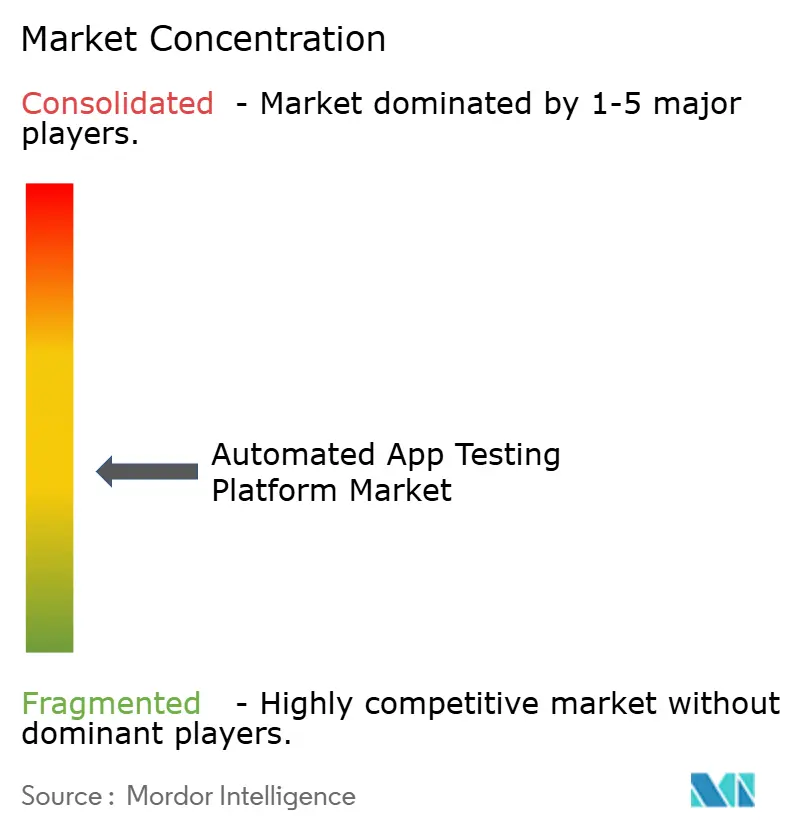
| Market Concentration | Medium |
Major Players *Disclaimer: Major Players sorted in no particular order Image © Mordor Intelligence. Reuse requires attribution under CC BY 4.0. | |
Automated App Testing Platform Market Analysis by Mordor Intelligence
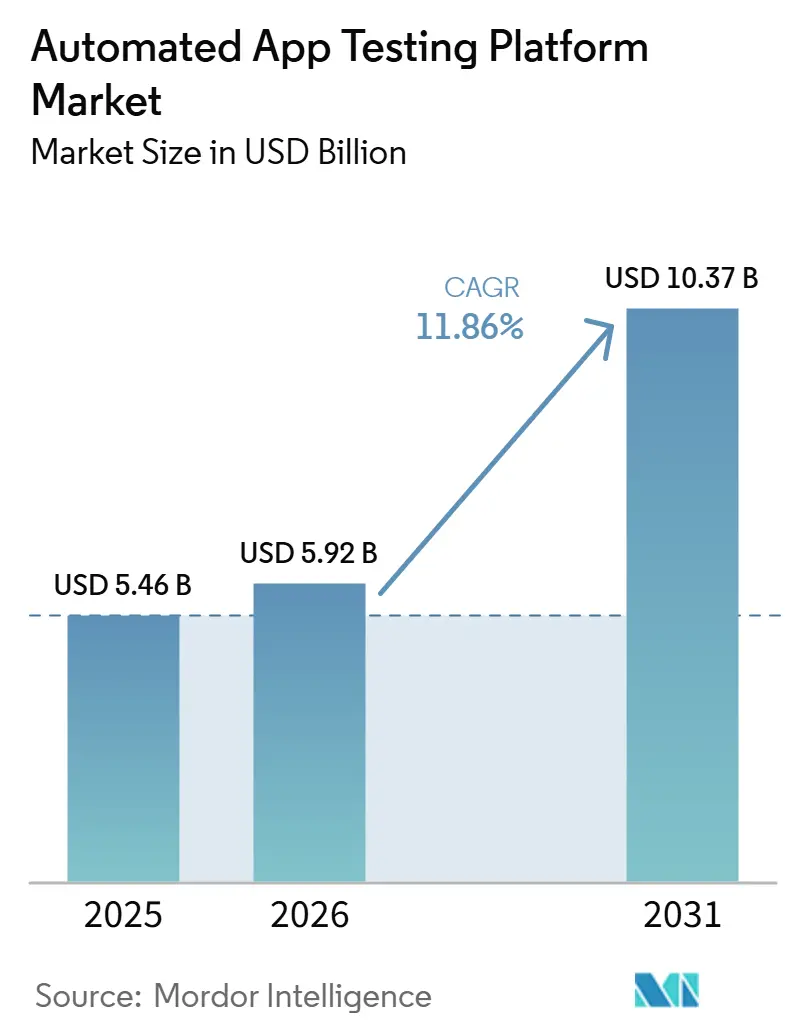
The Automated App Testing Platform Market size was valued at USD 5.46 billion in 2025 and is estimated to grow from USD 5.92 billion in 2026 to reach USD 10.37 billion by 2031, at a CAGR of 11.9% during the forecast period from 2026 to 2031. Demand is moving beyond the narrow goal of reducing manual effort because software teams need dependable testing before frequent releases. In 2025, 62% of organizations increased spending on automation and tools despite tighter IT budgets, showing that testing is receiving a larger share of technology spending. Buyers are increasingly looking for platforms that work within development pipelines and help teams respond to changes in application interfaces. The Automated App Testing Platform Market also benefits from the spread of AI-generated code, which adds to the volume of software that must be checked before release. Competition remains active because established platforms are expanding their product range while newer providers emphasize AI-based test creation, visual checks, and failure analysis.
Key Report Takeaways
- By component, software accounted for 72.41% of revenue share in the Automated App Testing Platform Market 2025, while services are forecast to grow at a 14.82% CAGR through 2031.
- By application under test, web applications accounted for 28.19% of revenue in the Automated App Testing Platform Market 2025, while IoT and embedded applications are forecast to expand at a 15.43% CAGR through 2031.
- By deployment model, cloud accounted for 68.41% of revenue in 2025, while hybrid deployment is forecast to grow at a 13.69% CAGR through 2031.
- By enterprise size, large enterprises accounted for 64.83% of revenue in 2025, while SMEs are forecast to grow at a 16.24% CAGR through 2031.
- By end user, IT and telecommunications accounted for 24.36% of revenue share in the Automated App Testing Platform Market 2025, while healthcare and life sciences are forecast to expand at a 14.91% CAGR through 2031.
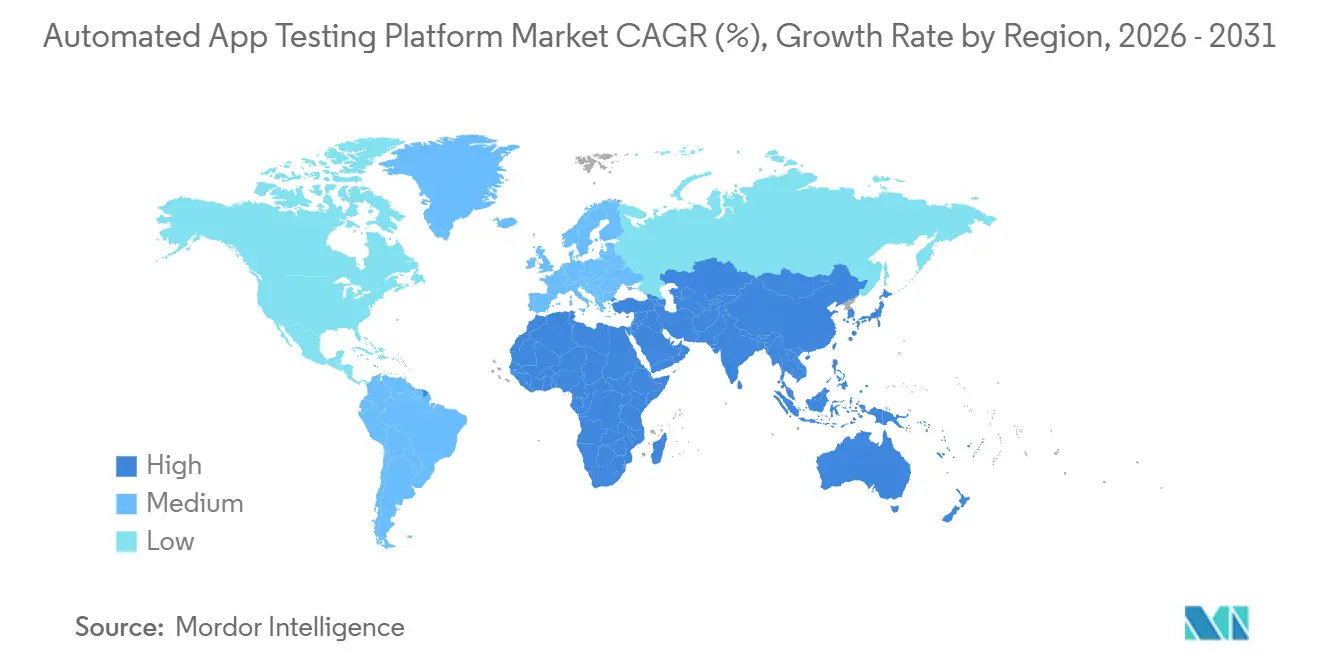
- By geography, North America held 34.62% revenue share in 2025, while Asia-Pacific is forecast to grow at a 15.18% CAGR through 2031.
Note: Market size and forecast figures in this report are generated using Mordor Intelligence’s proprietary estimation framework, updated with the latest available data and insights as of January 2026.
Market Trends and Insights
Drivers Impact Analysis of Automated App Testing Platform Market*
| Driver | (~) % Impact on CAGR Forecast | Geographic Relevance | Impact Timeline |
|---|---|---|---|
| AI-Driven Test Creation and Self-Healing Automation | +3.2% | Global | Short term (≤ 2 years) |
| Accelerating Agile and DevOps Release Cadence | +2.8% | Global, strongest in North America and Europe | Medium term (2-4 years) |
| API and Microservices Expansion Increasing Regression Scope | +2.0% | Global, with North America and Asia-Pacific at the core | Medium term (2-4 years) |
| Cloud Device Labs Lowering the Cost of Real-Device Coverage | +1.4% | Global, with Asia-Pacific and South America accelerating | Short term (≤ 2 years) |
| Rising Mobile Application and Device-OS Fragmentation | +1.0% | Asia-Pacific, with spillover to the Middle East and Africa | Medium term (2-4 years) |
| Accessibility and Privacy Validation Becoming Release Gates | +0.8% | North America and Europe | Long term (≥ 4 years) |
| Source: Mordor Intelligence | |||
AI Driven Test Creation and Self Healing Automation Redefine Platform Value
AI-based testing tools can identify changes to an application interface and update affected test steps with less manual intervention. This matters because maintenance work can consume capacity that teams would otherwise use to improve coverage, investigate defects, and review whether a failure reflects a genuine product issue. Self-healing functions are intended to keep tests aligned with interface changes, thereby making automated testing more reliable for teams that frequently release software. In 2026, AI was the leading investment priority for surveyed QA teams, and 61% of respondents reported a moderate to significant increase in testing demand for AI-generated code.[1]Sembi, “First Edition Sembi Software Quality Pulse Report,” Sembi, sembi.com The Automated App Testing Platform Market is therefore benefiting from both increased code production and a greater need to validate it before release. Tricentis reported record annual recurring revenue of USD 500 million for fiscal 2025 and linked its performance to enterprise demand for agentic quality engineering capabilities.
Accelerating Agile and DevOps Release Cadence Sustains Baseline Demand
Shorter release cycles make manual testing difficult to complete before the software reaches users. Teams using continuous integration and continuous delivery need test execution to begin when code changes are submitted rather than after a separate testing phase. Automated checks can provide developers with earlier information on whether a change affected an existing function or introduced a failure in a connected service. Only 26% of surveyed QA teams were fully or mostly integrated with their DevOps pipelines in 2026, leaving room for more pipeline-connected testing tools. This gap presents the Automated App Testing Platform Market with a clear opportunity for organizations that have adopted delivery tools but still rely on disconnected testing processes. Mabl reported that teams using AI assisted testing increased code deployment speed by 46% compared with 2024 baselines.
API and Microservices Expansion Widening Regression Scope
The move toward smaller, connected software services increases the number of interfaces that need testing with every update. Postman reported that 82% of organizations used an API-first approach in 2026, with 25% describing themselves as fully API-first, compared with 13% in 2024.[2]Postman, “State of the API Report 2026,” Postman, postman.com Each service connection introduces a regression risk when a team changes an interface, a dependency, or the data exchanged between systems. Contract testing gives teams a way to check whether connected services continue to meet the conditions expected by their users and dependent applications. A 2026 study found that contract-driven test frameworks for microservices improved pre-production defect detection by 36.8% and reduced escaped defects per release by 78.6% compared with UI focused approaches. The Automated App Testing Platform Market benefits when platforms can test these connections without forcing users to assemble multiple tools.
Cloud Device Labs Democratizing Real Device Coverage
Physical device labs required a sizable hardware investment and were often limited to large testing organizations. Cloud device labs provide access to devices, operating systems, and browser versions as needed, without requiring every customer to buy and maintain the same equipment. BrowserStack provides access to more than 3,500 real devices, while TestMu AI provides access to more than 10,000 real devices through its Real Device Cloud. This availability supports the cloud segment and lowers a practical barrier for smaller teams that need to check applications across varied user environments. It also shifts the basis of competition in the Automated App Testing Platform Market away from device access alone. Providers need to compete by delivering faster execution, root-cause analysis, early test detection, and useful tool integrations.
Restraints Impact Analysis of Automated App Testing Platform Market*
| Restraint | (~) % Impact on CAGR Forecast | Geographic Relevance | Impact Timeline |
|---|---|---|---|
| High Automation Framework Maintenance Burden | -2.5% | Global | Short term (≤ 2 years) |
| Automation Skills Gaps and Legacy-System Integration | -1.8% | Asia-Pacific, with spillover to the Middle East, Africa, and South America | Medium term (2-4 years) |
| Data Privacy Constraints in Cloud and AI Testing | -1.4% | North America and Europe | Long term (≥ 4 years) |
| Fragmented Device and Operating-System Ecosystems | -1.2% | Asia-Pacific, with spillover to the Middle East and Africa | Medium term (2-4 years) |
| Source: Mordor Intelligence | |||
High Automation Framework Maintenance Burden Erodes Return on Investment
Large test suites built around fragile interface selectors can fail when a screen changes, even if the underlying business function still works. Teams must then spend time fixing tests before they can assess the application change, which can delay feedback for developers and reduce confidence in the testing process. The problem becomes more difficult when the same interface change affects several tests that cover related user journeys. In 2026, 57% of QA tests were automated, while maintenance accounted for around 1/5 of the QA team's capacity. This creates a retention risk for the Automated App Testing Platform Market because dissatisfied users may see automation as another source of work rather than a way to reduce it. A 2025 Tricentis Japan survey of 401 enterprise IT managers found that 64% of major Japanese companies had test automation coverage below 60%, with integration and acceptance testing lagging the most.
Automation Skills Gaps and Legacy System Integration Slow Enterprise Adoption
Introducing testing platforms can be difficult when a business lacks personnel with automation, AI tooling, and security testing skills. In 2026, 44.7% of QA teams were understaffed, according to the Sembi Software Quality Pulse Report. The problem is not limited to hiring because legacy banking, enterprise resource planning, and industrial control systems may expose older interfaces that modern tools cannot easily use. These systems may require custom connections or ongoing manual testing, which reduces the immediate value of a new platform. An OECD analysis published in 2025 identified access to computing resources and skilled configuration as major barriers for SMEs adopting AI. The Automated App Testing Platform Market can reach more users when vendors include low-code features and prebuilt integrations that reduce reliance on specialist internal teams.
*Our forecasts treat driver/restraint impacts as directional, not additive. The impact forecasts reflect baseline growth, mix effects, and variable interactions.
Automated App Testing Platform Market Segment Analysis
By Component:
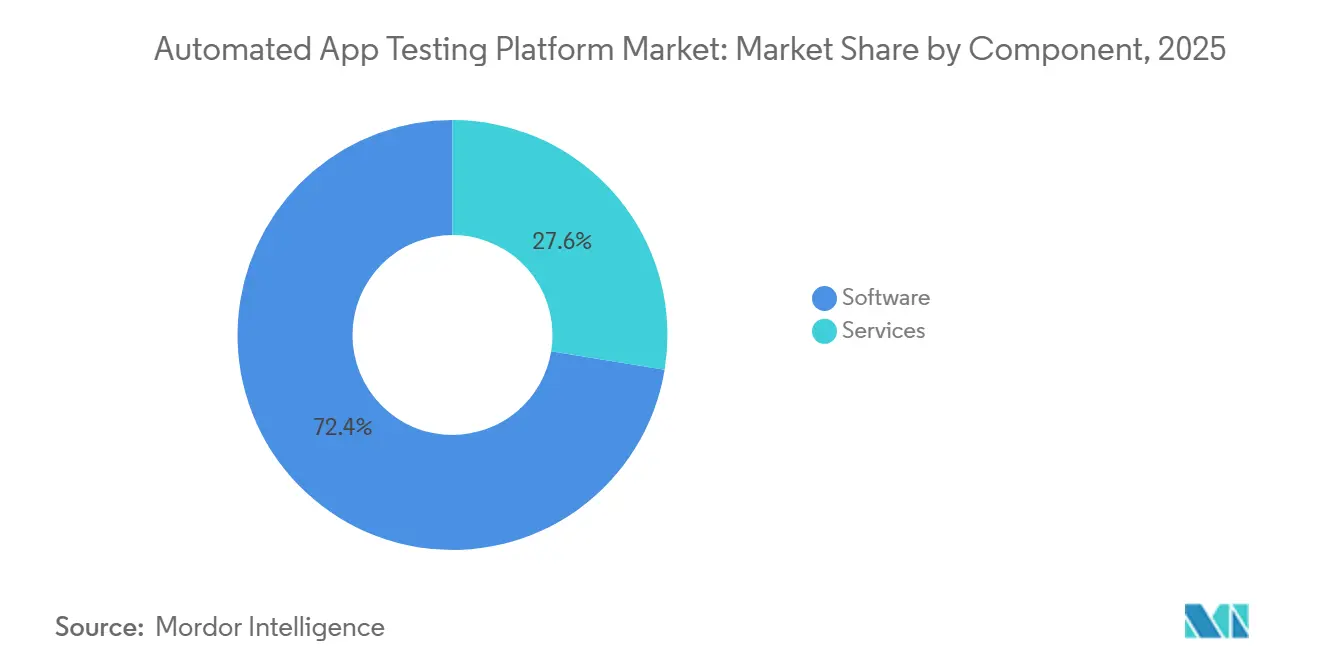
Services Gain Ground as Buyers Seek Managed OutcomesSoftware accounted for 72.41% of revenue in 2025, making it the largest component of the Automated App Testing Platform Market. Enterprises continue to use software platforms for test scripting, development pipeline integration, and reporting. Services are projected to grow at a 14.82% CAGR through 2031, the highest rate among component types. This pattern reflects a preference among some buyers for managed engagements that include platform access and testing expertise. Testlio and Qualitest are examples of providers that combine platform access with managed QA support. Such arrangements can place responsibility for coverage and defect handling with the provider, rather than requiring the customer to build the full capability internally.
The service model also addresses the skills shortage that limits the adoption of self-managed tools. Organizations that cannot hire enough test automation engineers may purchase testing support rather than postpone automation. That makes services both a source of growth and evidence of unmet demand for simpler tools. The boundary between software and services may become less distinct as AI automates more test creation and maintenance work. Platform providers can pursue partnerships or acquisitions to serve a broader set of customers' QA needs. In the Automated App Testing Platform Market, this approach may help vendors retain customer relationships as testing needs change.


By Application Under Test:
IoT and Embedded Applications Set the Fastest PaceWeb applications accounted for 28.19% of 2025 revenue, the largest share across application types. Browser-based applications remain a common way for enterprises to deliver services, and browser testing tools are well established. IoT and embedded applications are forecast to grow at a 15.43% CAGR through 2031, the fastest rate in this segmentation. Connected devices are expanding across manufacturing, healthcare, and logistics. These deployments require testing of device software, firmware, applications, and their connected services. Mobile applications also remain an important source of demand because teams need coverage across devices and operating system versions.
Desktop applications remain relevant in banking and public administration, where browser independence can still be required. APIs and microservices have become more important because software functions are increasingly delivered through connected services. Postman reported that 82% of organizations used an API-first approach in 2026. A single platform that coordinates testing across web, mobile, APIs, and embedded layers can reduce the need to manage separate tools. This capability is relevant to the Automated App Testing Platform Market because enterprise buyers are seeking consistent reporting across different application environments. Vendors that can check business behavior across these layers have an advantage over providers focused on one test category.
By Deployment Model:
Hybrid Use Expands Alongside Cloud DeploymentCloud deployment accounted for 68.41% of 2025 revenue, the largest share. Buyers use cloud delivery to access flexible test capacity without managing their own test infrastructure. Consumption-based pricing can also align testing spending with the pace of software development. Hybrid deployment is forecast to grow at a 13.69% CAGR through 2031, the fastest rate among deployment choices. This growth reflects the need to keep sensitive data and some test assets within a customer's own environment. On-premises deployment remains important for government, defense, and financial organizations with strict network isolation requirements.
Hybrid adoption does not necessarily mean that organizations are moving away from cloud services. It can reflect a decision to use cloud-based management and analytics while running execution agents within company networks. This design can be useful when test cases involve sensitive production data or proprietary device firmware. Data residency requirements in Europe also make hybrid configurations relevant for some deployments. In the Automated App Testing Platform Market, vendors that support cross-private and cloud environment coordination can better address regulated sectors. Compliance features may become especially important in healthcare and financial services buying decisions.
By Enterprise Size:
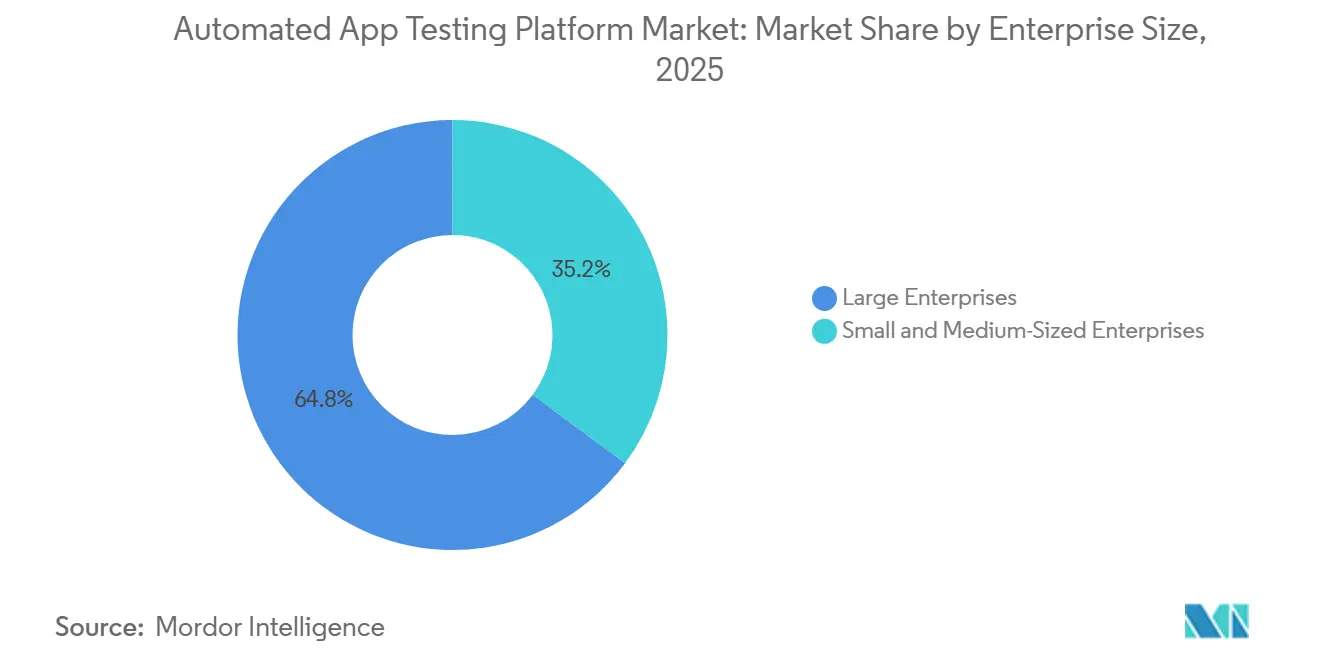
SMEs Expand Faster as Entry Barriers FallLarge enterprises accounted for 64.83% of revenue in 2025, supported by their larger QA budgets and dedicated engineering resources. SMEs are forecast to grow at a 16.24% CAGR through 2031, the fastest rate among enterprise sizes. AI-based and no-code tools can reduce the scripting expertise required to get automated testing started. A 2025 academic study found that AI-driven automation could reduce cost and technical barriers for SMEs compared with conventional tools. This lowers the entry barrier for smaller teams that previously depended on manual processes. Cloud delivery can further reduce the need for internal infrastructure.[3]International Journal of Interdisciplinary Research, “AI-Driven Automation in Software Testing: Enabling SME Adoption,” International Journal of Interdisciplinary Research, doi.org
Smaller teams can also benefit when testing tools help them keep suites current despite limited staffing. Rainforest QA reported in 2025 that small teams using AI testing tools were more likely to maintain up-to-date automated test suites than larger teams using traditional frameworks. Pricing based on use or users may help vendors reach customers who cannot meet the minimums of large enterprise contracts. At the same time, large enterprises are moving toward broader platform suites and reducing the number of separate vendors they manage. This can concentrate spending among vendors that cover several testing needs. The Automated App Testing Platform Market must therefore serve both cost-sensitive smaller buyers and large organizations seeking unified platforms.[4]Rainforest QA, “AI in Software Testing: State of Test Automation Report 2025,” Rainforest QA, rainforestqa.com
By End User:
Healthcare and Life Sciences Accelerate as Software Assurance Requirements RiseIT and telecommunications accounted for 24.36% of revenue in 2025, the largest end-user share. These organizations run large application portfolios, rely on continuous integration, and manage connected service environments. The healthcare and life sciences industry is projected to grow at a 14.91% CAGR through 2031. In September 2025, the FDA issued final guidance on Computer Software Assurance for production and quality system software, setting out a risk-based approach to software assurance in medical device manufacturing. The alignment of 21 CFR Part 820 with ISO 13485:2016 took effect in February 2026. These developments increase the need for documented, risk-based validation processes.
BFSI, automotive and transportation, and retail and e-commerce also create steady demand for automated testing. Financial services require dependable transaction processing, while automotive software requires careful validation in safety-related applications. Retailers use frequent application updates and digital experiments, creating a need for continuous testing. Industrial manufacturing is adopting more software-defined equipment, which brings testing needs similar to those in IoT and automotive use cases. Government organizations are also increasing QA investment as public applications move toward cloud-based designs. In the Automated App Testing Platform Market, energy and utilities are beginning to adopt automated testing to meet cybersecurity requirements for operational technology software.
Geography Analysis
North America Automated App Testing Platform Market
North America held 34.62% of 2025 revenue, the largest regional share. The region has a high concentration of cloud providers, software-as-a-service companies, and enterprise software developers with frequent release schedules. Tricentis reported USD 500 million in annual recurring revenue for fiscal 2025 and stated that more than 60% of Fortune 500 companies were in its customer base. This reflects the depth of enterprise demand for quality engineering in the region. Accessibility and data privacy requirements add another reason for companies to test digital services before release.
Europe and South America Automated App Testing Platform Market
Europe is driven by data protection, accessibility, and sector-specific obligations in financial services and healthcare. These requirements favor platforms that provide compliance-related testing capabilities. Germany and the United Kingdom remain important European countries, with Germany also generating demand for embedded and IoT testing through industrial manufacturing. South America is at an earlier stage of adoption, with Brazil and Argentina identified as leading adopters in the supplied research. OECD analysis found that cost barriers and limited cloud infrastructure can constrain SME AI adoption in the region. Cloud-delivered and use-based offerings can help the Automated App Testing Platform Market reach more organizations in these countries.
APAC and MEA Automated App Testing Platform Market
Asia-Pacific is forecast to grow at a 15.18% CAGR through 2031, the fastest regional rate. Smartphone use, digital-first business activity, and a growing focus on software quality support the region's expansion. In Japan, 97.5% of 401 enterprise IT managers surveyed in late 2025 recognized software quality risk, while 64% reported test automation coverage below 60%. India is becoming an early adopter location through its global capability centers and testing delivery work. The Middle East is seeing demand from government-linked digital programs, particularly in Saudi Arabia and the United Arab Emirates. Africa remains constrained by infrastructure, but can gain access through cloud-delivered platforms.

Competitive Landscape
The Automated App Testing Platform Market includes established providers such as Tricentis, BrowserStack, SmartBear Software, and OpenText, as well as newer AI-focused companies. This creates a moderately fragmented setting rather than one dominated by a single supplier. Tricentis reported USD 500 million in annual recurring revenue for fiscal 2025 and added more than 650 customers, including 80 Global 2000 companies. BrowserStack stated in January 2026 that it expected revenue to exceed USD 300 million during 2026 and announced a USD 125 million employee stock ownership plan and share buyback program. These examples show that the leading providers have financial resources to extend their product lines. Smaller providers compete through AI-based test authoring, visual regression testing, and specialized user experiences.
In March 2026, Tricentis launched its Agentic Quality Engineering Platform through the Tricentis AI Workspace. The release brought test automation, test management, performance testing, and quality intelligence into a unified AI-focused interface. In May 2025, BrowserStack acquired Requestly, adding network request interception and API mocking capabilities to its offering. In October 2025, BrowserStack launched an Accessibility Issue Detection Agent for its accessibility suite. These moves show how vendors are broadening coverage across development, testing, and accessibility work. The Automated App Testing Platform Market also has room for specialized offerings in regulated medical software and embedded automotive systems.
Standards and compliance requirements can favor larger platforms because they can invest in the work needed to incorporate testing standards into their products. ISO/IEC 29119 is becoming more relevant as a software testing reference, while ISO 26262 and IEC 62443 matter in automotive and industrial settings. Prebuilt templates for these requirements can be useful where general-purpose testing is not sufficient. At the same time, vendors focused on monitoring and observability may move closer to testing because production data can inform quality checks before release. The boundary between production monitoring and pre-release validation may become less clear as platforms connect more of the software delivery process.
Automated App Testing Platform Industry Leaders
BrowserStack Limited
Applitools Ltd.
LambdaTest, Inc.
Kobiton, Inc.
Testlio Inc.
- *Disclaimer: Major Players sorted in no particular order
Automated App Testing Platform Market Companies Covered in this Report
- Applause App Quality, Inc.
- Applitools Ltd.
- BrowserStack Limited
- Cigniti Technologies Limited
- Global App Testing Ltd.
- HeadSpin, Inc.
- International Business Machines Corporation
- Katalon, Inc.
- Kobiton, Inc.
- LambdaTest, Inc.
- Leapwork A/S
- mabl Inc.
- OpenText Corporation
- Parasoft Corporation
- Perfecto Mobile Ltd. (Perforce Software)
- Qualitest Group Ltd.
- QA Wolf, LLC
- Rainforest QA, Inc.
- Ranorex GmbH
- Sauce Labs Inc.
- SmartBear Software, Inc.
- Testlio Inc.
- TestMu AI, Inc. (formerly LambdaTest)
- Tricentis GmbH
- Worksoft, Inc.

Recent Industry Developments in Automated App Testing Platform Market
- June 2026: UNGUESS acquired Testbirds, the leading crowdtesting provider in the DACH and Benelux regions, to create the leading European AI-powered platform for digital quality and security. The acquisition combines UNGUESS's AI training and cybersecurity solutions with Testbirds' IoT and connected-device testing services, extending coverage to over 1 million active users across 100+ countries
- May 2026: Tricentis announced a record Annual Recurring Revenue of USD 500 million for fiscal year 2025, adding over 650 new customers including 80 Global 2000 companies and expanding its total customer base beyond 3,000. The company attributed growth to surging enterprise demand for its agentic quality engineering solutions.
- March 2026: Tricentis launched the Agentic Quality Engineering Platform, powered by the new Tricentis AI Workspace. The platform integrates agentic test automation, test management, performance testing, and quality intelligence under a unified AI-first interface.
- January 2026: BrowserStack announced its third and largest ESOP and share buyback program, valued at USD 125 million, funded entirely from operating profits. The company is actively evaluating acquisitions of developer tool startups, and its 2026 revenue is projected to exceed USD 300 million.


Global Automated App Testing Platform Market Report Scope
The automated app testing platform market refers to the ecosystem of software solutions and associated services that automate the validation of the functionality, usability, performance, and security of software applications. This market encompasses platforms capable of testing a diverse array of application types, including web, mobile, desktop, APIs, microservices, and IoT and embedded applications. Deployed via cloud-based, hybrid, or on-premises models, these solutions cater to organizations of varying sizes across multiple industries, such as IT, BFSI, healthcare, and retail. By leveraging advanced technologies like artificial intelligence, machine learning, scriptless automation, and cross-environment execution, automated app testing platforms enable enterprises to seamlessly integrate into continuous integration and continuous deployment (CI/CD) pipelines, accelerate release cycles, significantly reduce the reliance on manual testing efforts, and ensure the delivery of high-quality, bug-free digital experiences.
The Automated App Testing Platform Market Report is Segmented by Component (Software, and Services), Application Under Test (Web Applications, Mobile Applications, Desktop Applications, APIs and Microservices, and IoT and Embedded Applications), Deployment Model (Cloud, Hybrid, and On-Premises), Enterprise Size (Large Enterprises, and Small and Medium-Sized Enterprises), End User (IT and Telecommunication, BFSI, Automotive and Transportation, Healthcare and Life Sciences, Retail and E-Commerce, Industrial Manufacturing, Education and Research Institutions, Government and Administration, Energy and Utilities, and Other End-Users), and Geography (North America, South America, Europe, Asia-Pacific, and Middle East and Africa). The Market Forecasts are Provided in Terms of Value (USD).
| Software |
| Services |
| Web Applications |
| Mobile Applications |
| Desktop Applications |
| APIs and Microservices |
| IoT and Embedded Applications |
| Cloud |
| Hybrid |
| On-Premises |
| Large Enterprises |
| Small and Medium-Sized Enterprises |
| IT and Telecommunication |
| BFSI |
| Automotive and Transportation |
| Healthcare and Life Sciences |
| Retail and E-Commerce |
| Industrial Manufacturing |
| Education and Research Institutions |
| Government and Administration |
| Energy and Utilities |
| Other End Users |
| North America | United States | |
| Canada | ||
| Mexico | ||
| South America | Brazil | |
| Argentina | ||
| Rest of South America | ||
| Europe | Germany | |
| United Kingdom | ||
| France | ||
| Russia | ||
| Spain | ||
| Rest of Europe | ||
| Asia-Pacific | China | |
| Japan | ||
| India | ||
| South Korea | ||
| Southeast Asia | ||
| Rest of Asia-Pacific | ||
| Middle East and Africa | Middle East | Saudi Arabia |
| United Arab Emirates | ||
| Rest of Middle East | ||
| Africa | South Africa | |
| Nigeria | ||
| Rest of Africa | ||
| By Component | Software | ||
| Services | |||
| By Application Under Test | Web Applications | ||
| Mobile Applications | |||
| Desktop Applications | |||
| APIs and Microservices | |||
| IoT and Embedded Applications | |||
| By Deployment Model | Cloud | ||
| Hybrid | |||
| On-Premises | |||
| By Enterprise Size | Large Enterprises | ||
| Small and Medium-Sized Enterprises | |||
| By End User | IT and Telecommunication | ||
| BFSI | |||
| Automotive and Transportation | |||
| Healthcare and Life Sciences | |||
| Retail and E-Commerce | |||
| Industrial Manufacturing | |||
| Education and Research Institutions | |||
| Government and Administration | |||
| Energy and Utilities | |||
| Other End Users | |||
| By Geography | North America | United States | |
| Canada | |||
| Mexico | |||
| South America | Brazil | ||
| Argentina | |||
| Rest of South America | |||
| Europe | Germany | ||
| United Kingdom | |||
| France | |||
| Russia | |||
| Spain | |||
| Rest of Europe | |||
| Asia-Pacific | China | ||
| Japan | |||
| India | |||
| South Korea | |||
| Southeast Asia | |||
| Rest of Asia-Pacific | |||
| Middle East and Africa | Middle East | Saudi Arabia | |
| United Arab Emirates | |||
| Rest of Middle East | |||
| Africa | South Africa | ||
| Nigeria | |||
| Rest of Africa | |||


Key Questions Answered in the Report
How large is the Automated App Testing Platform Market?
It was valued at USD 5.46 billion in 2025, is estimated at USD 5.92 billion in 2026, and is forecast to reach USD 10.37 billion by 2031 at an 11.86% CAGR.
Which deployment model leads adoption?
Cloud held 68.41% of revenue in 2025 because it provides flexible test capacity without customer-managed infrastructure.
Which application category is growing fastest?
IoT and embedded applications is forecast to grow at a 15.43% CAGR through 2031 as connected devices require validation across firmware, apps, and APIs.
Why are SMEs adopting automated testing more quickly?
SMEs are forecast to grow at a 16.24% CAGR through 2031 because AI-based, no-code, and cloud-delivered tools reduce skill and infrastructure barriers.
Which region is growing fastest?
Asia-Pacific is forecast to expand at a 15.18% CAGR through 2031, supported by digital-first businesses, smartphone use, and a growing focus on software quality.
What is driving demand for automated app testing platforms?
Frequent software releases, AI-generated code, API-based architectures, and wider device coverage requirements are increasing the need for automated testing.
Page last updated on:


 Your data is secure and never sold or shared.


