
Australia and New Zealand Quick Commerce Market Size and Share
Market Overview
| Study Period | 2020 - 2031 |
|---|---|
| Forecast Data Period | 2026 - 2031 |
| Base Year Market Size (2025) | USD 4.15 Billion |
| Market Size (2026) | USD 4.54 Billion |
| Market Size (2031) | USD 6.28 Billion |
| Growth Rate (2026 - 2031) | 6.73 % |
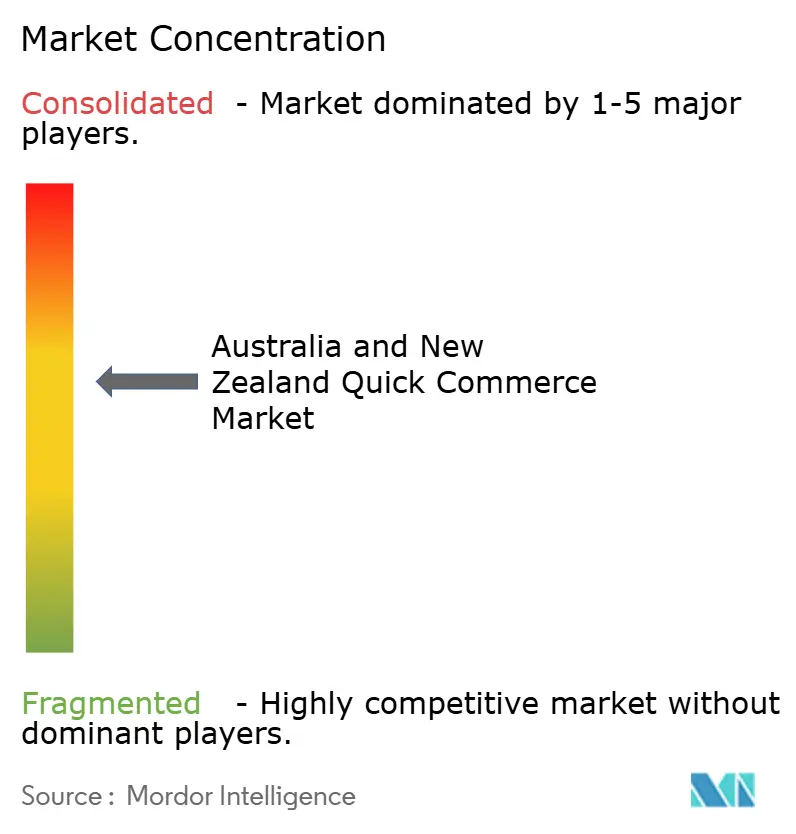
| Market Concentration | Medium |
Major Players *Disclaimer: Major Players sorted in no particular order Image © Mordor Intelligence. Reuse requires attribution under CC BY 4.0. | |
Australia and New Zealand Quick Commerce Market Analysis by Mordor Intelligence
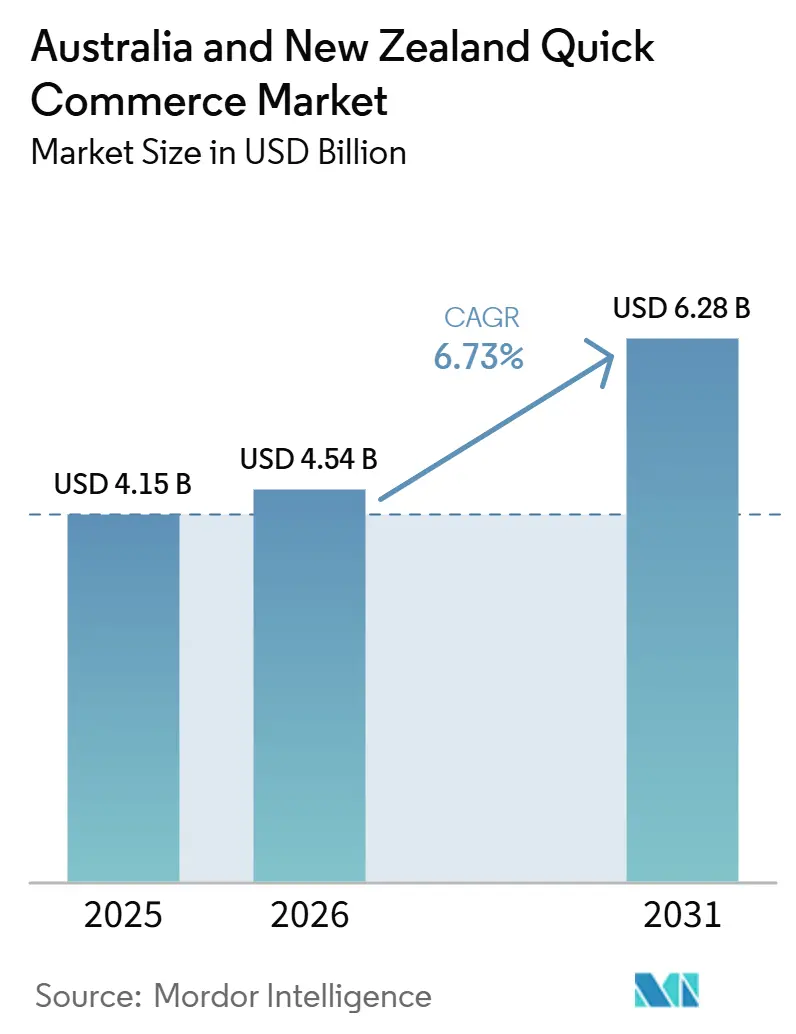
The Australia and New Zealand quick commerce market size was valued at USD 4.15 billion in 2025 and is estimated to expand from USD 4.54 billion in 2026 to reach USD 6.28 billion by 2031, at a CAGR of 6.73% during the forecast period (2026-2031). Retailers are moving rapid delivery from a limited convenience offer into a regular part of grocery operations. This approach uses existing stores, cold-chain capability, and local inventory rather than relying mainly on dedicated dark stores. The largest opportunities remain tied to frequent grocery replenishment, while snacks and other small-basket categories can increase order frequency. Partnerships between major grocers and delivery platforms are also shaping access to large catalogs and delivery capacity. Price premiums, delivery fees, labor costs, and lower density outside major cities continue to limit how widely ultra-fast delivery can be offered.
Key Report Takeaways
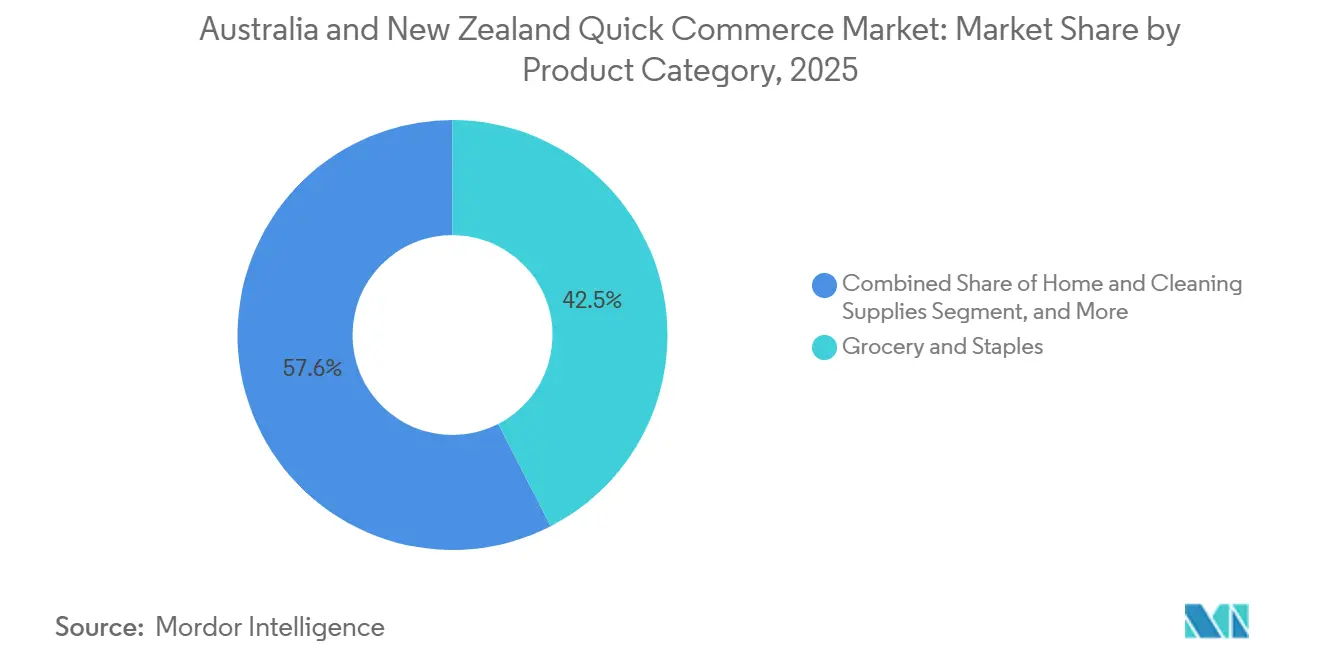
- By product category, grocery and staples held 42.45% of the Australia and New Zealand quick commerce market share in 2025, while snacks and beverages are projected to expand at a 7.82% CAGR through 2031.
- By delivery time promise, the 11-30 minute window accounted for 42% of the Australia and New Zealand quick commerce market size in 2025 and is projected to advance at a 7.54% CAGR through 2031.
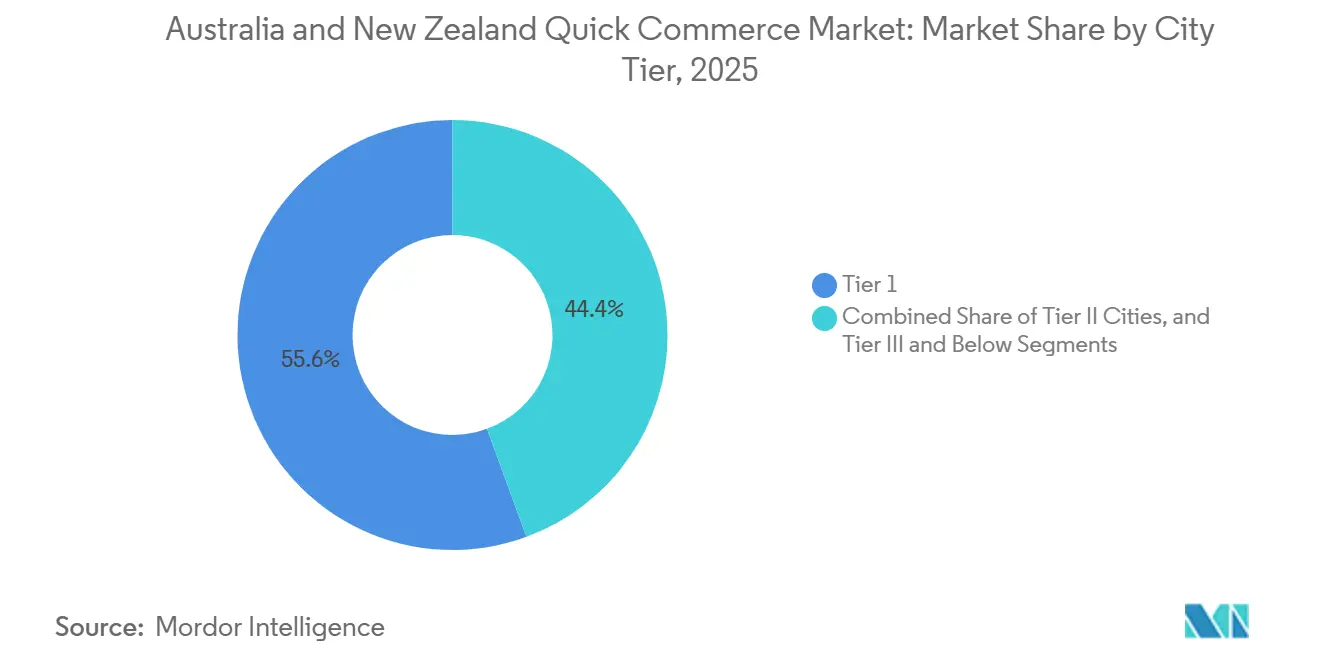
- By city tier, Tier I metros held 55.60% of revenue in 2025, while Tier II cities are expected to expand at a 7.87% CAGR through 2031.
Note: Market size and forecast figures in this report are generated using Mordor Intelligence’s proprietary estimation framework, updated with the latest available data and insights as of January 2026.
Market Trends and Insights
Drivers Impact Analysis of Australia and New Zealand Quick Commerce Market*
| Driver | (~) % Impact on CAGR Forecast | Geographic Relevance | Impact Timeline |
|---|---|---|---|
| Expansion of Retailer-Led Rapid Delivery Networks | +2.0% | Australia and New Zealand | Short term (≤ 2 years) |
| Rising Demand for Convenience and Fill-In Shopping | +1.5% | Australia, Sydney, Melbourne, Brisbane, and Auckland | Short term (≤ 2 years) |
| Higher Smartphone, Digital Wallet, and App Usage | +1.2% | Australia and New Zealand | Short term (≤ 2 years) |
| Expansion of Multi-Category Delivery Platforms | +0.9% | Australia-led, with spillover to New Zealand | Medium term (2-4 years) |
| Growth of Store-Based Picking and Micro-Fulfillment | +0.7% | Sydney, Melbourne, Brisbane, and early gains in Auckland | Medium term (2-4 years) |
| High-Frequency Top-Up Demand in Dense Urban Catchments | +0.6% | Tier I Australian metros and Auckland CBD | Short term (≤ 2 years) |
| Source: Mordor Intelligence | |||
Expansion of Retailer-Led Rapid Delivery Networks
The integration of rapid delivery into major grocery store networks is the largest structural driver of the Australia and New Zealand quick commerce market because it lets established retail assets serve time-sensitive orders without a separate network. Woolworths Group reported that eComX sales rose 23.8% in Q3 2026, while On Demand delivery was available through more than 800 stores. It also stated that 47% of delivery sales were fulfilled within 2 hours in 2026.[1]The retailer-led model draws on existing stores, refrigeration, inventory, and workforce arrangements, reducing the need for a dark-store network and giving retailers closer control over product availability. In New Zealand, Woolworths NZ shortened its express delivery period to 1 hour in 2025, while Foodstuffs South Island added same-day delivery to most New World stores. Exclusive partnerships can make catalog access more difficult for smaller grocers that cannot fund comparable delivery operations or match the purchasing scale of larger chains.
Rising Demand for Convenience and Fill-In Shopping
Convenience-led replenishment is making quick commerce a more regular shopping option for households in the Australia and New Zealand quick commerce market, especially when a planned grocery shop leaves a small but immediate need. Australians spent AUD 14 billion (USD 8.9 billion), on food and grocery purchases online in 2025, an increase of 15% from 2024.[2] The same report found that 23% of food purchases were dispatched through same-day or next-day delivery, and capital-city households accounted for 72% of online food and grocery spending. Millennials and Generation X represented nearly 70% of online food and grocery spending in 2025, while Baby Boomers and Builders recorded year-over-year spending increases of 17.2% and 18.1%. These patterns support repeat fill-in orders, but average basket size declined 1.1% in 2025, making repeat purchasing and dependable app use more important than a larger order value. New Zealand consumers also identify convenience and real-time price visibility as important reasons to use online grocery services.
Higher Smartphone, Digital Wallet, and App Usage
Payment behavior supports app-based ordering across the Australia and New Zealand quick commerce market by removing steps that can interrupt a small, repeat purchase. The Reserve Bank of Australia found that device-based payments made up 40% of card transactions in 2025.[3] During the 2025 Consumer Payments Survey diary week, 43% of consumers used a mobile wallet for a contactless payment, compared with 35% in 2022. Mobile apps represented 46% of online payments in Australia in 2025, up from 37% in 2022. These payment methods reduce checkout steps and can make repeat grocery orders easier to complete when shoppers already have an app account and payment credential. PayID had reached 80% consumer awareness in Australia in 2025, further supporting familiarity with real-time digital payment tools. The effect is strongest where delivery apps already have broad store coverage, reliable fulfillment, and frequently purchased categories.
Expansion of Multi-Category Delivery Platforms
Delivery platforms are extending beyond restaurant food into grocery, pharmacy, alcohol, pet care, and consumer electronics, which gives customers several reasons to return to the same ordering app. DoorDash began an exclusive collaboration with Costco Australia in February 2025 and started an on-demand grocery delivery trial with ALDI in Canberra in July 2025. These partnerships add warehouse and discount grocery ranges to a delivery platform that already handles smaller food orders. Personal care and over-the-counter pharmacy products suit 30-60 minute delivery windows because they can be time-sensitive and carry a higher value per order. Alcohol delivery requires operators to meet liquor licensing, age-verification, and consumer-protection requirements in relevant Australian and New Zealand jurisdictions. The compliance burden favors operators that can maintain dependable controls across a large store and courier network. Adding several repeat-use categories can improve session frequency without requiring every order to be a full grocery basket.
Restraints Impact Analysis of Australia and New Zealand Quick Commerce Market*
| Restraint | (~) % Impact on CAGR Forecast | Geographic Relevance | Impact Timeline |
|---|---|---|---|
| High Delivery Fees and App-Based Product Markups | -1.5% | Australia and New Zealand | Short term (≤ 2 years) |
| Labor, Fuel, and Last-Mile Cost Pressure | -1.2% | Australia and New Zealand | Medium term (2-4 years) |
| Limited Economics of Ultra-Fast Delivery Outside Dense Areas | -0.8% | New Zealand regional areas and Australian outer suburbs | Long term (≥ 4 years) |
| Alcohol, Age-Verification, and Consumer-Protection Compliance | -0.5% | Australia and New Zealand, at state and national level | Medium term (2-4 years) |
| Source: Mordor Intelligence | |||
High Delivery Fees and App-Based Product Markups
High item prices and delivery charges can weaken the value proposition of the Australia and New Zealand quick commerce market for price-sensitive households, especially where an order is planned rather than urgent. Consumer research cited in the supplied material found that some supermarket items sold through on-demand platforms were priced up to 42% above in-store levels, before delivery fees. New Zealand food price inflation reached 4.6% in the year to December 2025, increasing household sensitivity to added delivery costs. The combined effect of per-item markups and service fees is more difficult to justify for planned, non-urgent grocery purchases. The Australian Competition and Consumer Commission and the New Zealand Commerce Commission have increased attention on grocery pricing transparency and market structure. Some consumers may choose scheduled delivery at store pricing instead, which preserves online grocery demand but can reduce orders through rapid third-party channels. The risk is most relevant when delivery does not offer a clear time, availability, or service-quality benefit.
Labor, Fuel, and Last-Mile Cost Pressure
Last-mile economics remain difficult in the Australia and New Zealand quick commerce market because labor, fuel, urban travel time, and variable demand all affect each delivery. Australia’s Closing Loopholes Act introduced a framework for minimum standards and employment protections for gig workers from 2024. This policy environment raises the importance of route density, order consolidation, and predictable courier utilization for platform profitability. Fuel price movement and congestion in Sydney and Melbourne can further pressure margins in the areas that generate the highest order volumes. Woolworths opened a AUD 20 million (USD 12.7 million), automated eStore in St Marys in March 2026, using KNAPP goods-to-person technology to process up to 6,000 online orders each week. Automation can reduce labor per order, although the investment requires sustained volume and dependable utilization to justify fixed costs. The operating challenge is not only delivery speed but also keeping fulfillment and courier resources productive throughout the day.
*Our forecasts treat driver/restraint impacts as directional, not additive. The impact forecasts reflect baseline growth, mix effects, and variable interactions.
Australia and New Zealand Quick Commerce Market Segment Analysis
By Product Category:
Grocery and Staples Sustain the Revenue BaseGrocery and staples retained 42.45% of the Australia and New Zealand quick commerce market share in 2025, making the category the largest source of demand. Frequent replenishment of food and household essentials gives the category demand that is less dependent on a special occasion. Major grocery retailers have built rapid delivery offers around broad catalogs with fresh produce, dairy, cold-chain goods, and promotional items. DoorDash reported that fruit and vegetables, bread, and milk were among the most frequently ordered categories in Australia in 2025. This pattern confirms that quick commerce is often used for smaller fill-in purchases rather than a complete weekly grocery trip.
Snacks and beverages are projected to expand at a 7.82% CAGR from 2026 to 2031, making them the fastest-growing product category. Post-work purchases, social gatherings, and at-home entertainment can create immediate demand that suits a short delivery period. Personal care and over-the-counter pharmacy products add relevance where an item is needed quickly, while home and cleaning supplies can be bundled with a grocery order. Pet care, flowers, gifts, electronics, and accessories are smaller categories that can improve the value of a delivery trip. The 23% share of food purchases dispatched through same-day or next-day delivery in Australia in 2025 shows that faster fulfillment expectations now extend beyond staple groceries.

By Delivery Time Promise:
The 11-30 Minute Window Becomes the Operating StandardThe 11-30 minute delivery window accounted for 42% of the Australia and New Zealand quick commerce market size in 2025, making it the leading service tier. This period gives store teams or automated systems enough time to pick, pack, and transfer an order to a courier. It also avoids much of the capital intensity associated with a dedicated dark-store model. Woolworths stated that MILKRUN averaged 33 minutes per delivery from more than 630 Australian stores in 2025. Store-integrated fulfillment can therefore provide a credible rapid-delivery offer across a broader urban footprint.
The 31-60 minute tier serves metropolitan and near-suburban locations where store density or courier supply is lower. Foodstuffs North Island offers 60-minute delivery for New World stores and 45-minute delivery for Four Square outlets. Woolworths NZ shortened its express delivery period to 1 hour in 2025, pointing to a national standard closer to this tier. The 11-30 minute window is projected to expand at a 7.54% CAGR through 2031. Operators are focusing on consistent performance within this workable period rather than a costly sub-10-minute service over a wider area.
By City Tier:
Tier II Cities Drive the Next Expansion PhaseTier I metros, including Sydney, Melbourne, Brisbane, and Auckland, held 55.60% of revenue in 2025. Dense store networks, higher courier availability, and concentrated populations support faster delivery economics in these locations. Australian capital cities accounted for AUD 10 billion (USD 6.3 billion), of online food and grocery spending in 2025, equal to 72% of the national total. This concentration explains why retailers and platforms prioritize metropolitan coverage when building the Australia and New Zealand quick commerce market. It also means that speed expectations are largely set by the performance of large urban store networks.
Tier II cities are projected to expand at a 7.87% CAGR from 2026 to 2031. DoorDash’s ALDI delivery trial in Canberra, launched in July 2025, showed that large operators view secondary cities as an important step for rapid grocery availability. Inner regional and outer regional areas generated AUD 3.8 billion (USD 2.4 billion), of Australian online food and grocery spending in 2025, but their store density is less favorable for quick delivery. Tier III and lower-density areas face a smaller courier pool, longer store-to-home distances, and scattered demand. Different liquor delivery rules across Australian jurisdictions add another consideration as platforms extend category coverage beyond major metropolitan areas.
Geography Analysis
Eastern Australia Quick Commerce Market
Australia is the larger part of the Australia and New Zealand quick commerce market, supported by its grocery retail duopoly, eastern seaboard urban density, and developed last-mile logistics network. Australia’s food and grocery e-commerce penetration was 9.6% in 2025, leaving room for broader use of digital grocery services. Woolworths reported more than AUD 5 billion (USD 3.2 billion), in online sales during the first half of 2026, a 15.3% year-over-year increase. Amazon announced in March 2026 that it would invest more than USD 750 million in a robotics fulfillment center in Logan, Queensland. The location and scale of that project reinforce the role of eastern Australia in future fulfillment capacit
New Zealand Quick Commerce Market
New Zealand is smaller, but it is developing a more established online grocery base. The Commerce Commission reported that major grocery retailers recorded online sales increases of 16-21% in 2025, and Woolworths NZ achieved the highest online share at 16% of total revenue. Auckland is the main New Zealand center for rapid delivery because it has the densest mix of consumers, stores, and couriers. Foodstuffs North Island supports rapid grocery delivery through New World and Four Square stores, with 60-minute and 45-minute delivery periods. Teddy operates a 30-minute delivery service in Auckland, Christchurch, and Queenstown.
Australia and New Zealand Quick Commerce Market
Australia has greater absolute scale, a deeper infrastructure base, and broader platform activity across the Australia and New Zealand quick commerce market. Click-and-collect represented 53% of New Zealand online grocery fulfillment in 2025, compared with 47% for delivery, which shows that delivery adoption remains at an earlier stage. New Zealand can adopt retailer-led delivery formats established in Australia, but its lower population density creates a different rollout pace. The Commerce Commission’s grocery monitoring includes online pricing, delivery-fee transparency, and market access for smaller retailers.
Competitive Landscape
The Australia and New Zealand quick commerce market has a concentrated structure because Woolworths Group and Coles Group influence grocery catalog breadth, fulfillment expectations, and access to major delivery platforms. In December 2025, Coles announced an exclusive on-demand grocery delivery partnership with Uber Eats that made 17,000 SKUs available to customers. Woolworths separately brought its grocery inventory and MILKRUN service to DoorDash’s national network. These arrangements connect each aggregator’s grocery offer to an anchor retailer’s assortment and promotions. They also make retailer assortment depth a central factor in customers’ choice of delivery app.
Specialist retail categories remain important areas for competition in the Australia and New Zealand quick commerce market. Pharmacy, pet care, electronics, and fresh specialty food can provide product depth that a standard grocery assortment does not fully replicate. Amazon’s planned Logan fulfillment center is expected to cover 150,000 square meters over 4 floors and is scheduled for completion in 2028. Woolworths opened its St Marys eStore in March 2026 to increase online order processing capacity in Western Sydney. Woolworths also integrated Google Gemini into its shopping workflow, becoming the first Australian supermarket to enable AI-agent-assisted purchasing.
In New Zealand, Foodstuffs operates with a cooperative governance model that can make technology and partnership decisions slower than those of corporate grocery groups. This can create openings for independent delivery services and specialty retailers at the city level. Foodstuffs continues to support New World and Four Square rapid-delivery formats through its store base. Teddy’s presence in 3 New Zealand cities illustrates the scope for focused local operators. The Australia and New Zealand quick commerce industry remains shaped by fulfillment reliability, category range, cost control, and compliance capability.
Australia and New Zealand Quick Commerce Industry Leaders
-
Woolworths Group Limited
-
Uber Technologies, Inc.
-
DoorDash, Inc.
-
Coles Group Limited
-
Foodstuffs North Island Limited and Foodstuffs South Island Limited
- *Disclaimer: Major Players sorted in no particular order
Australia and New Zealand Quick Commerce Market Companies Covered in this Report
- Woolworths Group Limited
- Coles Group Limited
- Uber Technologies, Inc.
- DoorDash, Inc.
- Just Eat Takeaway.com N.V.
- Amazon.com, Inc.
- ALDI Stores
- Costco Wholesale Corporation
- Foodstuffs Group
- Harris Farm Markets Pty Ltd
- Chemist Warehouse Group Limited
- Click Spice
- HungryPanda SG Pte. Ltd.
- MILKRUN Delivery Pty Limited
Recent Industry Developments in Australia and New Zealand Quick Commerce Market
- July 2026: ALDI Australia celebrated one year after launching its first-ever on-demand grocery delivery service via DoorDash, initially limited to Canberra, Australian Capital Territory, as a trial before planned national rollout. The partnership marked the first time ALDI made its product range available on a third-party delivery platform in Australia.
- March 2026: Woolworths Group launched a AUD 20 million (USD 12.7 million) automated eStore in St Marys, New South Wales, the largest of its kind in Australia at 2,500 sq m, using KNAPP Evo Shuttle goods-to-person automation technology. The facility processes up to 6,000 online orders per week, with 60% fulfilled same-day, doubling online delivery capacity for Western Sydney households.
- March 2026: Amazon Australia announced an investment of over USD 750 million in a new robotics fulfillment center in Logan, Queensland, its first in the state, covering 150,000 sq m across 4 floors. Targeted for completion in 2028, the facility will create 1,000+ permanent jobs and substantially expands Amazon's rapid delivery capacity in South East Queensland.
- January 2026: Woolworths Group officially activated its DoorDash partnership across Australia, enabling on-demand orders for pantry staples, fresh food, and household essentials from Woolworths stores nationwide via the DoorDash app, extending On Demand delivery availability across 800+ stores.
Australia and New Zealand Quick Commerce Market Report Scope
The Australia and New Zealand (ANZ) Quick Commerce Market comprises the on-demand retail ecosystem focused on the rapid delivery of groceries, convenience products, household essentials, health and personal care items, pet supplies, and select consumer goods, typically within 10 to 60 minutes of order placement through digital platforms such as mobile applications and websites.
The Australia and New Zealand Quick Commerce Market Report is Segmented by Product Category (Grocery and Staples, Fresh Produce and Dairy, Snacks and Beverages, Personal Care and OTC Pharma, Home and Cleaning Supplies, Electronics and Accessories, Pet Care, Flowers and Gifts, and Other Product Categories), Delivery Time Promise (Less than 10 Minutes, 11-30 Minutes, and 31-60 Minutes), and City Tier (Tier I Metros, Tier II Cities, and Tier III and Below). The Market Forecasts are Provided in Terms of Value (USD).
Segmentation Overview
| Grocery and Staples |
| Fresh Produce and Dairy |
| Snacks and Beverages |
| Personal Care and OTC Pharma |
| Home and Cleaning Supplies |
| Electronics and Accessories |
| Pet Care |
| Flowers and Gifts |
| Other Product Categories |
| Less than 10 Minutes |
| 11-30 Minutes |
| 31-60 Minutes |
| Tier I Metros |
| Tier II Cities |
| Tier III and Below |
| By Product Category | Grocery and Staples |
| Fresh Produce and Dairy | |
| Snacks and Beverages | |
| Personal Care and OTC Pharma | |
| Home and Cleaning Supplies | |
| Electronics and Accessories | |
| Pet Care | |
| Flowers and Gifts | |
| Other Product Categories | |
| By Delivery Time Promise | Less than 10 Minutes |
| 11-30 Minutes | |
| 31-60 Minutes | |
| By City Tier | Tier I Metros |
| Tier II Cities | |
| Tier III and Below |
Key Questions Answered in the Report
What is the size of the Australia and New Zealand quick commerce market?
The Australia and New Zealand quick commerce market size is estimated at USD 4.54 billion in 2026 and is forecast to reach USD 6.28 billion by 2031, at a CAGR of 6.73%. The outlook reflects wider retailer-led delivery coverage and continuing demand for rapid replenishment.
Which product category leads rapid delivery demand in Australia and New Zealand?
Grocery and staples led with 42.45% of revenue in 2025 because frequent household replenishment remains the primary use case. Fresh food, dairy, and household essentials keep this category central to platform use.
What delivery time is most common for quick commerce orders in Australia and New Zealand?
The 11-30 minute service window held 42% of revenue in 2025 and is projected to expand at a 7.54% CAGR through 2031. It is supported by store-based picking rather than a broad dark-store rollout.
Why are Tier II cities important for quick commerce expansion?
Tier II cities are expected to advance at a 7.87% CAGR through 2031, as platforms move beyond the largest metropolitan delivery networks. Their expansion depends on adequate store density, courier availability, and demand concentration.
What limits wider adoption of rapid grocery delivery?
Product markups, delivery charges, labor costs, fuel costs, and lower delivery density outside major cities remain key limits. These factors are most difficult where an order has little urgency or a small basket value.
Which companies are shaping on-demand grocery delivery in Australia and New Zealand?
Woolworths, Coles, DoorDash, Uber Eats, Foodstuffs, Amazon, and Teddy influence retailer access, fulfillment, and delivery availability. Their strategies center on catalog availability, store networks, and the speed of reliable delivery.