
Market Overview
| Study Period | 2020 - 2031 |
|---|---|
| Forecast Data Period | 2026 - 2031 |
| Historical Data Period | 2020 - 2024 |
| Growth Rate | 6.84 % |
| Market Concentration | High |
Major Players *Disclaimer: Major Players sorted in no particular order Image © Mordor Intelligence. Reuse requires attribution under CC BY 4.0. | |
Asia-Pacific Waterborne Adhesives Market Analysis by Mordor Intelligence
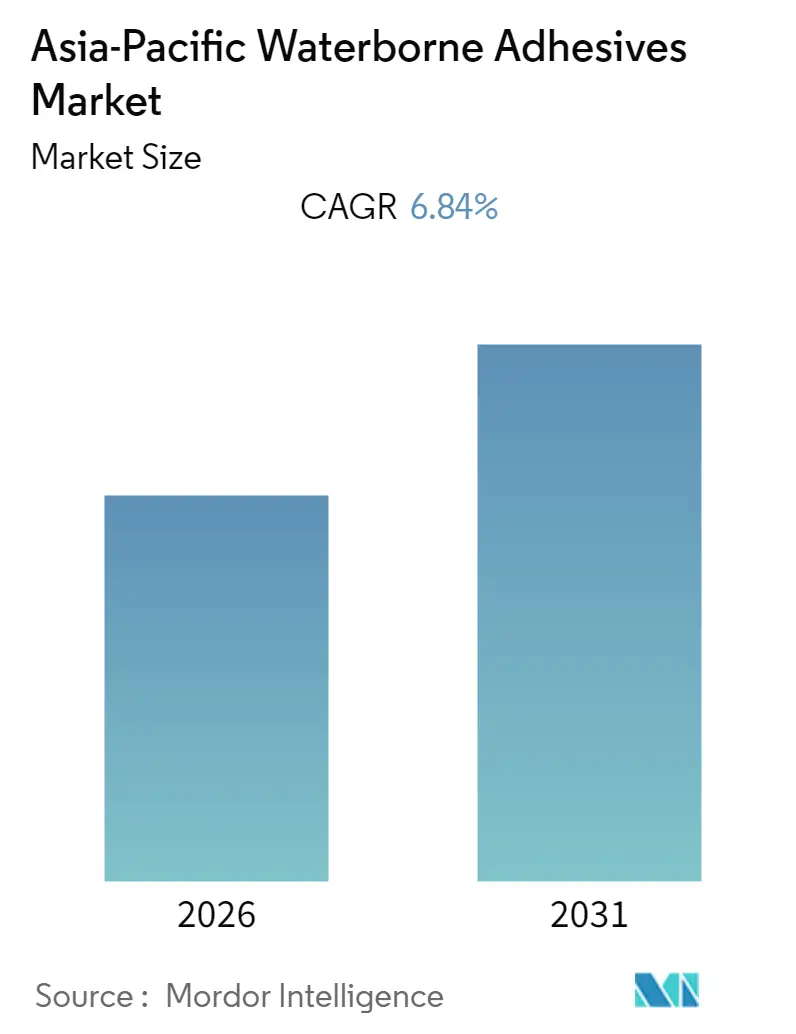
The Asia-Pacific Waterborne Adhesives Market size is expected to register a CAGR of 6.84% during the forecast period (2026-2031).
- Advancements in food packaging and safety industry is expected to provide a major growth opportunity for the market studied.
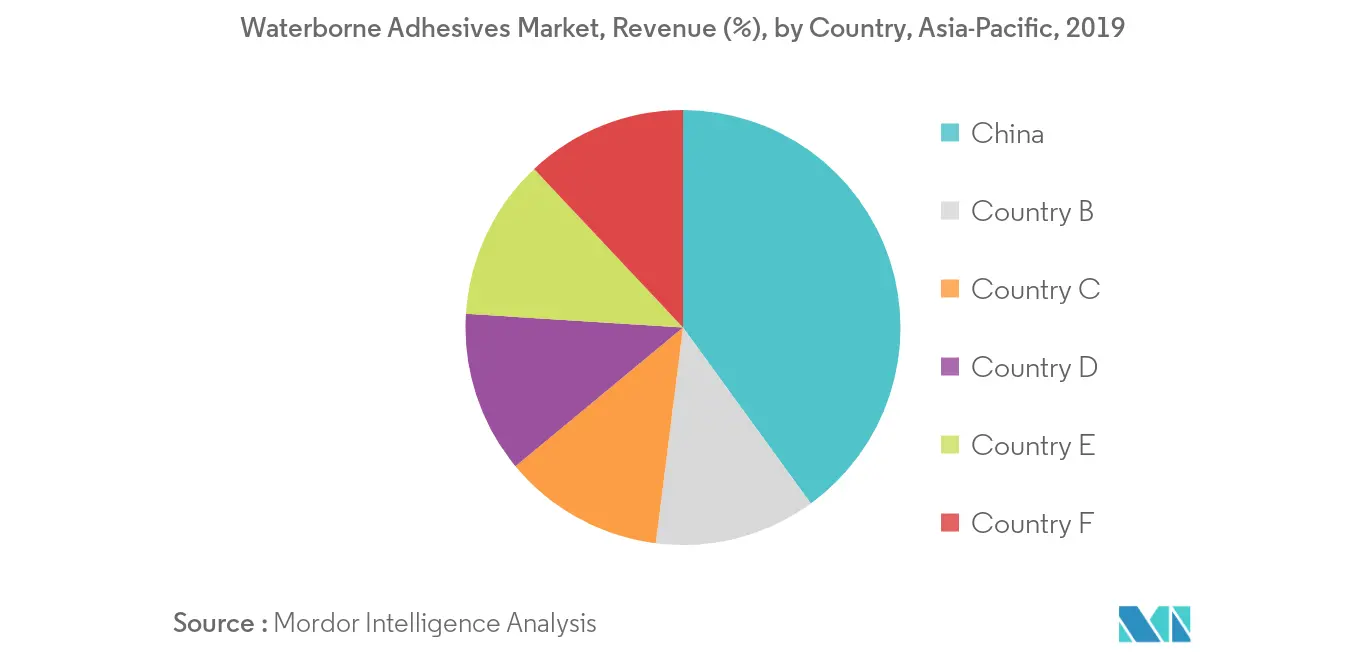
- China accounted for the highest share of the market and is likely to continue dominating the market during the forecast period.
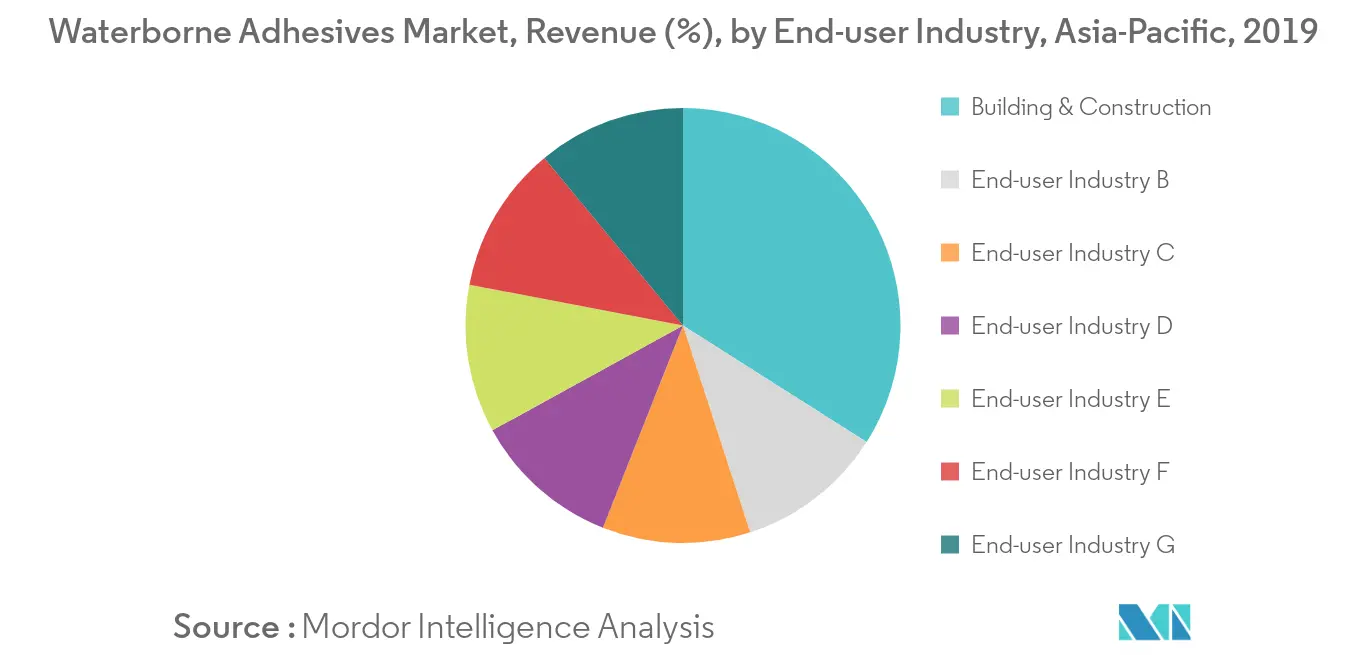
- Among the application areas, packaging industry is expected to witness the highest growth rate during the forecast period.
Note: Market size and forecast figures in this report are generated using Mordor Intelligence’s proprietary estimation framework, updated with the latest available data and insights as of 2026.
Asia-Pacific Waterborne Adhesives Market Trends and Insights
Packaging Industry is likely to Witness the Highest Growth Rate
- Packaging is a rapidly growing industry with respect to waterborne adhesives as they are nonreactive and safer as compared to other types of adhesives.
- Waterborne adhesives are cost-effective, non-reactive, and quick hardening as compared to previous adhesive technology.
- Thus, the use of waterborne adhesives in packaging materials is seen as a technologically upward trend in the Asia-Pacific region.
- Also the use of waterborne adhesives is seen as an eco-friendly step among the manufacturers.
- Hence, owing to the above-mentioned reasons, packaging industry is likely to witness the highest growth rate in the Asia-Pacific Waterborne Adhesives Market during the forecast period.
China to Dominate the Market Studied
- China accounts for the major market share for the Asia-Pacific waterborne adhesives market owing to the high demand from packaging and building & construction industries.
- Rapid urbanisation and population growth of the country has propelled infrastructure and construction activities in this region, which, in turn, has boosted the demand fro waterborne adhesives in the country.
- Additionally, the growing demand from the packaging industry is also driving the demand for waterborne adhesives in the country.
- Hence, owing to the above-mentioned reasons, China is expected to dominate the Asia-Pacific Waterborne Adhesives Market during the forecast period.
Competitive Landscape
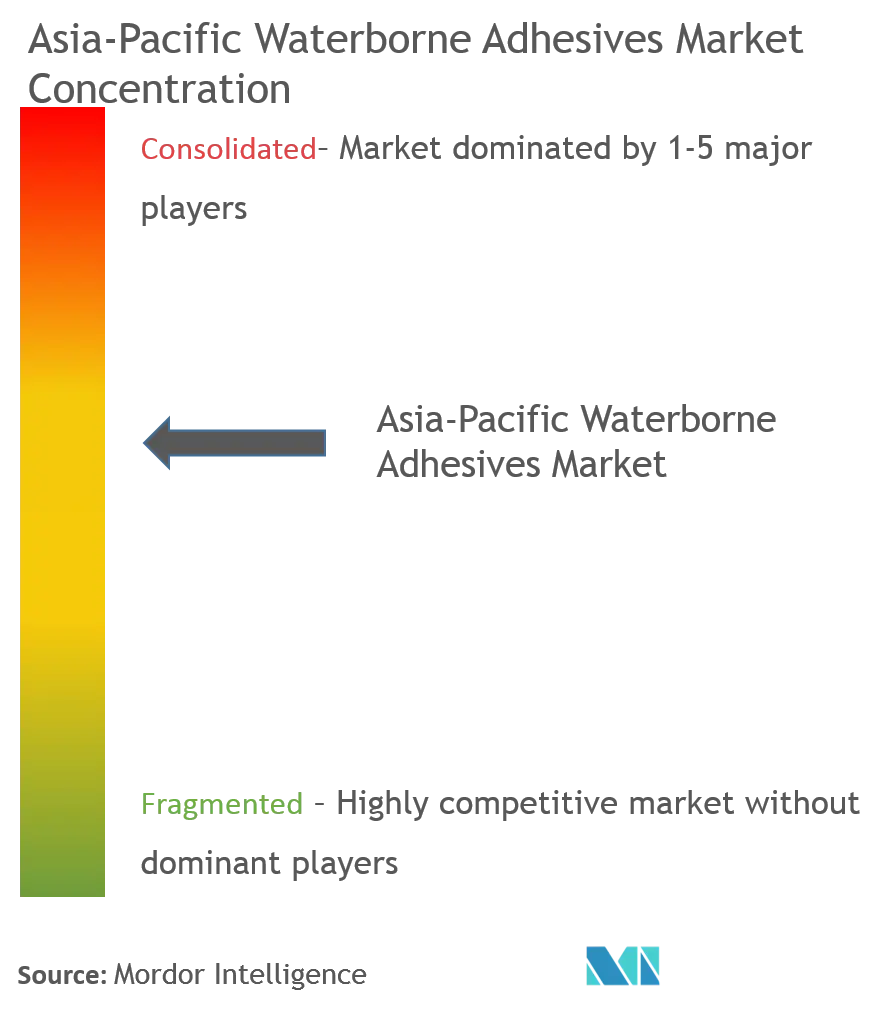
The Asia-Pacific Waterborne Adhesives Market is moderately consolidated as the market of the market share is divided among a few players. Some of the key players in the market include 3M, Arkema Group, Dow, Henkel AG & KGaA, and Sika AG, among others.
Asia-Pacific Waterborne Adhesives Industry Leaders
-
3M
-
Arkema Group
-
Dow
-
Henkel AG & Co. KGaA
-
Sika AG
- *Disclaimer: Major Players sorted in no particular order
Market Opportunities and Future Outlook
Advancements in food packaging and safety requirements across Asia-Pacific create room for waterborne adhesive formulations that align with tighter VOC and food-contact requirements while supporting line speed in converting operations. China has moved VOC control for indoor applications via GB 33372-2020 (50 g/L VOC limit for waterborne adhesives), and India uses Bureau of Indian Standards compliance pathways such as IS 15490 for adhesives used in food-contact packaging, which pushes brand owners and converters toward qualified, documented adhesive systems. Together, these safety and lower-emission targets are increasing the use of waterborne acrylics, PVA emulsions, and selected dispersions in paper, board, and packaging applications.
Regional investments and capability build-outs also indicate ongoing emphasis on local supply and technical service for adhesive materials in Southeast Asia and Northeast Asia. UPM Adhesive Materials initiated production line upgrades at its Johor Bahru, Malaysia site in August 2025, including a new coating line targeted for operation by mid-2026, which should improve in-region availability for label and packaging-related adhesive materials. On the upstream side, Kumho Mitsui Chemicals planned the start of construction for a 100,000 ton/year MDI capacity expansion in Yeosu, South Korea (February 2026 plan), supporting local availability of polyurethane value-chain inputs relevant to waterborne dispersion-based adhesive systems in higher-performance end uses such as electronics and transportation.
Recent Industry Developments
- June 2026: Wevo-Chemie GmbH scheduled the start of production at its new polyurethane potting compounds, adhesives, and sealants production site in the Tuas industrial area, Singapore. The added local manufacturing footprint supports faster supply and application support for electronics-facing adhesive and encapsulation demand in Southeast Asia.
- September 2025: Henkel AG & Co. KGaA inaugurated the Inspiration Center for Adhesive Technologies in Shanghai, China, a EUR 60 million investment focused on sustainable adhesive innovation. The facility strengthens regional R&D and customer collaboration for packaging and industrial adhesive solutions, including waterborne systems.
- July 2024: Henkel AG & Co. KGaA completed Phase III expansion of its Kurkumbh manufacturing facility in India, including an automated storage and retrieval system (ASRS) to increase capacity for high-performance adhesives and sealants. The upgrade improves manufacturing efficiency and responsiveness to growth in India across building and construction and packaging-related applications.
Research Methodology Framework and Report Scope
Market Definition and Coverage
This market covers waterborne adhesive products sold and used across Asia Pacific, where water is the main carrier, and value is counted as sales revenue from manufacturers and importers to end-use customers.
Scope exclusions: Solvent-based, hot-melt, and reactive 100% solids adhesive technologies are excluded, and downstream converting or application service charges are not counted.
Segmentation Overview
- Resin Type
- Acrylics
- Polyvinyl Acetate (PVA) Emulsion
- Ethylene Vinyl Acetate (EVA) Emulsion
- Polyurethane Dispersions and CR (Chloroprene Rubber) Latex
- Other Resin Types
- End-user Industry
- Building & Construction
- Paper, Board, and Packaging
- Woodworking & Joinery
- Transportation
- Healthcare
- Electrical & Electronics
- Other End-user Industries
- Geography
- China
- India
- Japan
- South Korea
- ASEAN Countries
- Rest of Asia-Pacific
Data Sources, Market Sizing, and Validation
Desk Research
For desk research, we start by building a clean view of the demand pool in key Asia Pacific countries, then map where waterborne systems are typically used across packaging, woodworking, construction, and transport.
Public sources such as UN Comtrade trade statistics, national customs and statistical offices in the region, the World Bank macro indicators, and publications from agencies like the International Energy Agency help us anchor activity levels and country growth direction.
After that, we cross-check resin and downstream signals using sources such as environmental regulators that publish VOC and chemical compliance updates, peer-reviewed journals on polymer dispersions and adhesive performance, and company annual reports and investor presentations that describe product mix and end-market exposure. When needed, we also use paid subscriptions focused on company financials and intelligence, patent databases, and shipment-level import and export datasets to validate company footprint and trade flows.
The sources listed here are illustrative, and many other public documents and datasets were also used for collection, cross-checking, and clarification.
Primary Interviews and Surveys
Primary interviews and structured surveys were used to confirm where waterborne adhesives are gaining share, how pricing moves with feedstocks, and what changes customers are actually adopting in packaging, wood, and construction uses. We spoke with a mix of producers, distributors, formulators, and large end users, and inputs were balanced across major Asia Pacific economies so assumptions did not lean too heavily on one country's cycle.
Distribution of primary research fieldwork respondents
| Company type | Respondent position |
|---|---|
| Top tier: 31% | CXOs: 12% |
| Mid tier: 49% | Functional/Unit leaders: 42% |
| Smaller Players: 20% | Managers: 46% |
Market-Sizing & Forecasting
Sizing was built using a top-down approach where production and trade data reconstruct the addressable adhesive demand, which is then filtered to waterborne share by end-use patterns discussed in interviews. Since waterborne uptake is not uniform, country splits were shaped using packaging output, construction activity, furniture and panel production indicators, and the pace of VOC compliance tightening that pushes substitution away from solvent systems.
Once the regional total was formed, it was checked against selective bottom-up approximations, including sampled supplier revenues, channel feedback on shipment volumes, and ASP-by-resin ranges for common dispersions like acrylic and PVA. Where company disclosures were partial, gaps were handled by using peer mix proxies within the same country and applying conservative share bands validated by distributors.
For forecasting, we rely mainly on scenario analysis because demand is sensitive to construction cycles and packaging volume shifts, and experts often disagree on the speed of substitution. The forward view is driven by variables such as packaging conversion growth, housing starts and renovation spend, furniture production trends, import dependence for key resin inputs, and expected VOC policy enforcement intensity, which are then reviewed and adjusted based on consistent interview feedback.
Data Validation & Update Cycle
Validation is done through triangulation across independent signals, and then through structured variance checks at the country and end-use level so unusual jumps are explained before being accepted. We compare model outputs with trade-based movement, resin demand direction, and the implied consumption per unit of downstream output, and any mismatch is flagged for another review.
Before sign-off, assumptions and intermediate calculations go through multi-step analyst checks, and follow-up calls are triggered when a key input moves outside the agreed range. Reports are refreshed annually, and interim updates are made when material events shift demand, pricing, or regulation, after which a final pre-delivery pass is completed so clients receive the latest view.
Mordor Intelligence's Asia Pacific Waterborne Adhesives Market Sizing Compared With Other Published Estimates
Published numbers for Asia Pacific waterborne adhesives do not always match because each study draws the boundary in its own way, and then uses different ways to treat pricing, imports, and end-use coverage. Differences also show up when one estimate uses a later base year or applies an aggressive substitution curve without checking it against practical supply and adoption constraints.
Key gap drivers in this market usually come from whether acrylic, PVA, EVA, and polyurethane dispersions are all included consistently, and whether packaging, woodworking, and construction are sized using local output indicators or broad GDP proxies. By tracking country-level trade and demand indicators, refreshing ASP ranges through interviews, and then applying a scope filter focused on water-as-carrier systems, Mordor Intelligence reduces inflation from adjacent adhesive technologies that can get blended into totals.
Benchmark comparison
| Source | Market Size | Gaps in Research Methodology |
|---|---|---|
| Mordor Intelligence | USD 0.00 B (2024) | |
| Industry Publisher A | USD 3.42 B (2024) | Uses a broader water-based definition and appears to mix multiple application markets without clearly separating waterborne adhesive revenue from adjacent coatings and related polymer dispersions in the same value pool. |
| Research Outlet B | USD 4.80 B (2026) | Starts from a later base year and uses a long-horizon growth curve, and the scope reads closer to a wider adhesive bucket with simplified resin coverage and limited checks against near-term capacity and import reliance. |
The spread in the table mainly comes from boundary choices and the timing of the base year, which change the counted revenue pool before growth is even applied. Using stepwise filters tied to end-use demand signals and interview-backed pricing logic keeps the market value traceable to repeatable inputs, and it avoids counting neighboring chemistries that do not meet the stated waterborne definition.
Key Questions Answered in the Report
What is the current Asia-Pacific Waterborne Adhesives Market size?
The Asia-Pacific Waterborne Adhesives Market is projected to register a CAGR of 6.84% during the forecast period (2026-2031)
Who are the key players in Asia-Pacific Waterborne Adhesives Market?
3M, Arkema Group, Dow, Henkel AG & Co. KGaA and Sika AG are the major companies operating in the Asia-Pacific Waterborne Adhesives Market.
What years does this Asia-Pacific Waterborne Adhesives Market cover?
The report covers the Asia-Pacific Waterborne Adhesives Market historical market size for years: 2019, 2020, 2021, 2022, 2023 and 2024. The report also forecasts the Asia-Pacific Waterborne Adhesives Market size for years: 2026, 2027, 2028, 2029, 2030 and 2031.